Minutes of the April 12, 2016 AAAP Meeting

by James Poinsett, Secretary

  • The meeting was called to order by the Director and the lecture for the evening was by Dr. James Green entitled “New Discoveries in the Outer Solar System: Ceres, Pluto and Planet X.”
  • After the lecture, Rex summarized the history of the Hastings-Byrne refractor pointing out that with the May 9th transit of Mercury will be the third century that a Mercury transit was observed with this scope. We will be at the observatory that day. The transit is from 7:15 AM through 2:00 PM.
  • On Saturday May 14th at 10:30 AM in the NJ State planetarium, Bill Murray will present a sequel the April keyholder training using the Minolta MS-10 Star Projector. Bring your binoculars to observe some of the dimmer objects it projects. Volunteers are needed for solar observing after the planetarium session.
  • Rex brought up the space elevator and also “Skyline”, the space elevator documentary. The club will try to set up a viewing of the film.
  • A group of club members are going to the Cherry Springs Star Party on June 2-5. It is a very basic party with camping on site.  There are nearby lodging facilities. There will be a food vendor on site also. If you are planning on going or would like to go let Bill Murray or Rex Parker know, and they will make sure you are in touch with the group.
  • Our star party, StarQuest, will be on Oct 28-30. Once again at the Hope Center in Hope NJ. More details will follow.
  • The nominating committee announce the slate of officers for the coming year that are up for election. All current officers have offered to return. If you are interested in running for office, let Bill Murray know before the May meeting.
  • There will be 150 Boy Scouts and their leaders in Washington Crossing State Park the weekend of April 29th. Extra help will be needed at the observatory that Friday night. Volunteers are also needed for solar viewing the following day and night time viewing that evening. Let David Letcher know if you are able to help out.
  • There is a new polarizing filter in the eyepiece case at the observatory.
  • We are reviving public nights in conjunction with the NJ State Planetarium. They will be held on May 13th and May 27th. Larger crowds than usual are expected at the observatory those nights. Any extra help is always appreciated.
  • Input from members for a second telescope on the mount with the HB refractor is desired. Please express your opinion even if that opinion is that no additional scope is needed!
  • Meeting adjourned at 9:50, 30 members in attendance.
Posted in Sidereal Times | Leave a comment

Minutes of the March 29, 2016 AAAP Board of Directors Meeting

by James Poinsett, Secretary

  • The meeting was called to order by the Director, Rex Parker at 7:00.
  • The entire five member board was present along with the Observatory Chairs and several members.
  • Bill Murray volunteered to be the Nominating Chair for the upcoming election. The slate will be announced at the April meeting with the election to be held at the May meeting.
  • Some additional publicity will be done for Jim Green’s appearance at the April meeting.
  • The May speaker is set and the Program committee is looking for suggestions for next years speakers. Specific speakers or even topics are wanted.
  • The website was reviewed and overall received very well. A suggestion was made to slow down the picture rotation speed on the home page and to increase the size of the next speaker announcement.
  • The topic of attracting younger members was next. Several ideas were discussed. We will put together a list of area high school science teachers and make sure to email them our meeting announcements and perhaps attract them or some of their students.
  • The keyholder refresher at the planetarium went very well. Another is planned for May 14th using the Minolta star projector.
  • There will be training on the Mallincam video camera on April 1st and 8th at the observatory. If there is bad weather, the training will still be held.
  • The Board expressed it’s thanks to Michael Mitrano and crew for the work on the roof and the south end gable.
  • The next topic for discussion was another telescope for the mount with the HB refractor. Rex has suggested a 10-inch Maksutov-Cassegrain he found on Astromart. It is an exceptional scope with many pros and cons. No decision was made except to ask for more ideas from the membership.
  • The new computers and software for the observatory that was approved last year will be purchased and installed. A new monitor for the Mallincam will be installed also.
  • The topic of the club-owned CCD camera was brought up for discussion. The camera has seen very little use. A suggestion was made to sell the current one and buy an easier one to use. More discussion will be held at the next meeting.
  • Possible field trips to Goddard Space Center and the Cherry Springs star party were discussed.
  • Communiversity was April 17th and was a big success.
  • The Board agreed to make a $100 donation to the Washington Crossing Park Association.
  • The meeting was adjourned at 9:00 PM.
Posted in May 2016 | Tagged , , , | Leave a comment

Reusable Launch Vehicle

CRS-8 first stage landing. Taken by remote camera from "Of Course I Still Love You" droneship

CRS-8 first stage landing. Taken by remote camera from “Of Course I Still Love You” droneship

by Prasad Ganti

SpaceX’s Falcon 9 rocket was recently launched from Cape Canaveral. It was a routine launch on a routine mission except for a couple of differences, which are important steps for a brighter future. SpaceX or Space Exploration Technologies, started by Elon Musk, has been one of the earliest successful private sector ventures to routinely launch rockets  to carry cargo to the International Space Station (ISS).

After initial failures, SpaceX mastered the art and science of rocket launches to hurl payloads into space in a very precise and safe manner proving that a private venture apart from NASA can do this complex maneuvering. Wanting to improve the economics of carrying cargo into space, SpaceX made the first stage of the rocket reusable. The first stage of a rocket gives a heavy boost towards the outer confines of Earth’s atmosphere and falls off after exhausting all its fuel. The second stage then takes over and pushes the rocket and its payload into the space. The detached first stage falls into the ocean as debris.

The one-time use of the multiple-stages rockets cause the economics of launches to skyrocket. If somehow the first stage can be reused, the costs of the launch could be reduced significantly. Towards this end, SpaceX wanted to have the first stage return to Earth and land safely so that it could be recovered, refurbished and reused.

SpaceX has made several attempts to make the first stage return and land safely. After a few failures, it was able to make it touch down on land, but not on a floating platform. The recent attempt is the first time that the first stage returned and successfully landed on a platform in the Atlantic Ocean. Of course, there is still more work to be done to make the first stage truly reusable. A great first step which bodes well for the future.

unnamed-24The second major achievement of the mission was in the payload itself. In addition to the routine supplies to ISS, the payload included an inflatable module called BEAM (Bigelow Expandable Activity Module). It is a precursor to the inflatable habitats and structures to be built in space or on other planets like Mars. An inflatable module is lighter than metal, which was used in the construction of ISS. It takes up less space when sent into space. If this module can withstand the rigors of space like vacuum, radiation and micrometeorites, it will herald a new era of construction in space. This experiment too is the result of a private sector initiative by both Bigelow Aerospace and SpaceX performing under contract to NASA.

Given that space flights are being democratized in today’s globalized world, the superpowers do not have the monopoly on technology anymore. Rocket science is very complex and expensive. Escaping the bonds of Earth’s gravity is not easy. The private sector initiatives towards space economics and NASA’s mantra of faster, better and cheaper will greatly help the cause.

Posted in May 2016 | Tagged , , | Leave a comment

Snippets

Compiled by David Kaplan, Michael Wright and William Gray

Firefighters forced to backtrack on meteorite fire claim

Firefighters in Maryland backtrack after blaming a meteorite for a brush fire.

Extending the New Horizons mission

“We call this mission to explore the Kuiper Belt (KB) “KEM” — for KB Extended Mission. The centerpiece of the KEM is the close flyby of an ancient Kuiper Belt object (KBO) called 2014 MU69 on Jan 1, 2019.”

A hunt for clues to the universe’s birth

PPPL’s new PTOLEMY Laboratory will help scientists hunt for elusive Big Bang neutrinos that could offer clues to the origins of the universe.

Art meets physics at Princeton Art Museum exhibit

PPPL graduate students get out of the laboratory and into the gallery in a collaboration on the connection between art and physics at the Princeton University Art Museum.

Maria Popova reviews Janna Levin’s ‘Black Hole Blues’

In “Black Hole Blues: And Other Songs From Outer Space,” the astrophysicist and novelist Janna Levin chronicles the decades-long development of LIGO — a quest marked by the highest degree of human intelligence, zest and perseverance.

‘The Universe in Your Hand’ and ‘Seven Brief Lessons on Physics’

Jennifer Ouelette reviews Christophe Galfard’s “The Universe in Your Hand,” and Carlo Rovelli’s “Seven Brief Lessons on Physics.”

Albert Einstein’s wonderful letter of support to Marie Curie

Few things are more disheartening to witness than the bile which small-spirited people of inferior talent often direct at those endowed with genius. And few things are more heartening to witness than the solidarity and support which kindred spirits of goodwill extend to those targeted by such loathsome attacks.

How to Talk to Aliens?

In the Victorian era, a small group of scientists worked on proposals for extraterrestrial communication. Many involved giant mirrors.

A visionary project aims for Alpha Centauri

Silicon Valley scientists and billionaires announce an effort to send probes to explore Alpha Centauri, an interstellar mission that could take decades.

Planets stripped bare by host stars

Astronomers have defined a class of planet that have had their atmospheres stripped away by their host stars.

Lessons from the Retrofit Revolution

From the IDA: Policymakers are under ever-increasing pressure to save energy, reduce costs and lower taxes, all while continuing to make their cities safer and more attractive. Although joining the LED streetlight revolution seems like a great solution, this seemingly good short-term answer often comes with misinformation, creating potential long-term negative effects on the environment and human health.

You could snooze your way through an asteroid belt

Misconception: In an asteroid belt, spaceships have to dodge a fusillade of oncoming rocks.

Actually: If you were in the middle of an asteroid belt, you probably wouldn’t see any asteroids at all.

NASA is facing a climate change countdown

Kennedy Space Center and other NASA facilities near coastlines are facing the prospect of continually rising waters.

Japanese satellite Hitomi: Lost in space?

Dozens of Japanese engineers and scientists are scrambling to save an X-ray satellite – and more than a quarter of a billion dollars of investment – tumbling out of control in space.

Comet 67P presented in silhouette

Perfectly backlit by our star, Comet 67P was photographed in dramatic fashion by the Rosetta spacecraft – 260 million km from Earth.

The first inflatable home being launched into space

NASA’s inflatable space home was launched on 8 April. Take a peek at what it looks like and why it’s so important.

Posted in May 2016 | Tagged , , , | Leave a comment

Maine Astronomy Retreat

Dear AAAP,

We are reaching out to inform you and the members of the Amateur Astronomers Association of Princeton about the Maine Astronomy Retreat at Medomak Retreat Center in Washington, Maine – a vacation for you and your telescope!

Washington, Maine has some of the darkest skies in the Northeast, with a limiting visual magnitude of 6.3 (SQM value: 21.3 MPSAS). This summer, July 24-30, we are hosting our third annual Maine Astronomy Retreat. For six nights you will be able to revel under our expansive dark skies – we will have telescopes on hand and encourage you to bring yours, too. During the day, in addition to engaging lectures and programs by our expert facilitators, you can enjoy the use of our facilities, including a waterfront with canoes, kayaks and sailboats, tennis and basketball courts, and an archery range.

The retreat is led by J. Kelly Beatty, Sky & Telescope’s senior editor; Bruce Berger, director of Amateur Telescope Makers of Boston Research and Imaging Observatory; Greg Mort, renowned artist and life-long amateur astronomer, telescope maker, and astrophotographer; Babak A. Tafreshi, founder of The World at Night or TWAN program and a photographer for National Geographic; and Rod Mollise, contributing editor at Sky & Telescope magazine.

For this star party there’s no need to bring a tent, sleep in a sleeping bag, or eat uninspired food. Medomak has comfortable, private cabins with real beds, hot showers, and electricity, as well as delicious, locally sourced meals prepared on the premises. And it’s all included in your tuition. 

Please see our website, http://www.astronomyretreat.com, for more details, and to register.

If you have any questions, please feel free to give us a call at 1-866-MEDOMAK.

Thank you so much for your time and consideration.

Best regards,

Anastasia

Anastasia MacDonald
Outreach Director

Medomak Camp &
Medomak Retreat Center
178 Liberty RD
Washington, Maine 04574

www.medomakcamp.com
www.medomakretreatcenter.com
www.thefirsofmaine.com

Posted in May 2016 | Tagged , , | Leave a comment

Beautiful Nighttime Atlas Launch Rockets Cygnus Supply Ship to ISS

by Dr. Ken Kremer

ULA Atlas V rocket carrying Orbital ATK CRS-6 Cygnus cargo spacecraft lifts from Space Launch Complex 41 at 11:05 p.m. on Mar. 22, 2016 from Cape Canaveral Air Force Station, Fla. Credit: Ken Kremer/kenkremer.com

ULA Atlas V rocket carrying Orbital ATK CRS-6 Cygnus cargo spacecraft lifts off from Space Launch Complex 41 at 11:05 p.m. on Mar. 22, 2016 . Canaveral Air Force Station, FL. Credit: Ken Kremer

KENNEDY SPACE CENTER, FL –  A stunningly beautiful nighttime launch on March 22 mesmerized delighted spectators as the rocket roared off a Florida space coast, launch pad  stocked with over three tons of science and supplies for the multinational crews working aboard the International Space Station (ISS).

A United Launch Alliance (ULA) Atlas V rocketed raced to orbit from Cape Canaveral Air Force Station  carrying an enlarged Cygnus commercial resupply spacecraft on the Orbital ATK CRS-6 mission to the ISS, as I watched from the roof of the world-famous Vehicle Assembly Building (VAB) where Saturn V moon rockets and Space Shuttles were assembled for launch.

The venerable Atlas V lifted off right on target at 11:05 p.m. EDT from Space Launch Complex 41 into a picturesque moonlit sky. The moon magnificently illuminated the scattered, thin clouds hovering over the seaside launch pad for the hordes of excited folks and families lining the beaches. They were lucky to witness what may be the last launch of a Cygnus from Florida.

After a three-day orbital chase, the Cygnus spacecraft arrived as scheduled  at the station on March 26. Expedition 47 Commander Tim Kopra of NASA and Flight Engineer Tim Peake of ESA (European Space Agency) successfully grappled Cygnus with the space station’s robotic arm and berthed it at the Earth-facing port of the Unity module.

Cygnus was named the S.S. Rick Husband in honor of Col. Rick Husband, the late commander of Space Shuttle Columbia, which was tragically lost with its crew of seven NASA astronauts during re-entry on Feb. 1, 2003.  It was built by Orbital ATK based in Dulles, Virginia.

Inside Payload Hazardous Servicing Facility clean room at the Kennedy Space Center in Florida with Orbital ATK Cygnus cargo spacecraft launched to ISS on Mar. 22, 2016. Credit: Ken Kremer

Inside Payload Hazardous Servicing Facility clean room at the Kennedy Space Center in Florida with Orbital ATK Cygnus cargo spacecraft launched to ISS on Mar. 22, 2016. Credit: Ken Kremer

The Orbital ATK CRS-6 mission is the firm’s fifth contracted cargo delivery mission with NASA to the space station.  It was loaded with 3513 kg (7700 pounds) of science experiments and hardware, crew supplies, spare parts, gear and station hardware for the orbital laboratory in support over 250 research experiments being conducted on board by the Expedition 47 and 48 crews.  About a quarter of the cargo is devoted to science and research gear including 1713 pounds of science investigations.

Among the research highlights are experiments like Strata-1, which will evaluate how soil on airless bodies like asteroids moves about in microgravity. Gecko Gripper will test adhesives similar those found on geckos’ feet. Meteor will evaluate the chemical composition of meteors entering the Earth’s atmosphere. Safire will purposely set a large fire inside Cygnus after it unberths from the ISS to examine how fires spread in space, and a nanosat deployer mounted externally will deploy over two dozen nanosats also after unberthing.

Watch my Atlas/Cygnus launch video from a remote video camera set at the launch pad.  Credit: Ken Kremer/kenkremer.com

https://youtu.be/Flf6hNwZ_2I

Here a cool video prelaunch look at Cygnus and me in the NASA Kennedy Space Center clean room discussing the Meteor experiment by Thaddeus Cesari/VideoShampoo.com:

https://youtu.be/3BVjJE799vM

The next cargo launch to the ISS is set for April 8 with a SpaceX Falcon 9/Dragon vehicle.  Learn all about these and more at my outreach lectures on April 9/10 and April 17 listed below.

For complete details about ULA’s Orbital ATK Atlas/Cygnus launch see my recent articles and photos at Universe Today:

http://www.universetoday.com/128020/stunning-nighttime-cygnus-freighter-rockets-to-iss-stocked-with-science-mesmerizing-spectators/

http://www.universetoday.com/127970/full-moon-offers-spectacular-nighttime-launch-outlook-for-orbital-atk-cygnus-resupply-to-iss-on-ula-atlas-v-on-march-22-watch-live/

Astronomy Outreach by Dr. Ken Kremer

Apr 9/10: “NASA and the Road to Mars Human Spaceflight programs”  and “Curiosity explores Mars” at NEAF (NorthEast Astronomy and Space Forum), 9 AM to 5 PM, Suffern, NY, Rockland Community College and Rockland Astronomy Club – http://rocklandastronomy.com/neaf.html

Apr 17: “NASA and the Road to Mars Human Spaceflight programs”- 1:30 PM at Washington Crossing State Park, Nature Center, Titusville, NJ – http://www.state.nj.us/dep/parksandforests/parks/washcros.html

Please contact Ken for more info, science outreach presentations and his space photos. Email: kremerken@yahoo.com   website:  www.kenkremer.com http://www.universetoday.com/author/ken-kremer/ https://www.facebook.com/kremerken1

Posted in April 2016 | Tagged , , | Leave a comment

New Discoveries in the Outer Solar System: Ceres, Pluto and Planet X – April 12, 2016 Lecture

by Ira Polans, Program Chair

Dr. Jim Green

Dr. James Green, Director of Planetary Sciences, NASA

The April meeting of the AAAP will be held on the 12th at 7:30 PM in Peyton Hall on the Princeton University campus. The speaker will be Dr. James Green, NASA’s Director Planetary Science. Dr. Green will talk about “New Discoveries in the Outer Solar System: Ceres, Pluto, and Planet X”. The Program Committee would like to thank AAAP member Ken Kremer for arranging this talk.

Ceres was first discovered in 1801 and thought to be a planet. It was realized 50 years later that Ceres was a member of a huge number of objects in what we now know as the asteroid belt. The Dawn spacecraft was captured into orbit around the dwarf planet Ceres in March 2015. We knew almost nothing about Ceres, and the new images that are being sent back are showing a fascinating world from heavily cratered regions to large smooth plains, and a number of mysterious bright spots. Ceres has started to reveal its secrets.

Pluto was discovered in 1930 by Clyde Tombaugh and was at first thought to be the size of the Earth. Over time, observations of Pluto determined that it is considerably smaller (~2,000 km in diameter). Pluto’s orbit is moderately inclined relative to the ecliptic by over 17° and moderately elliptical with a period of 248 Earth years. Before the flyby, we knew so very little about Pluto and its moons. Beginning in 1992, planetary astronomers began to find Pluto like objects beyond the orbit of Neptune showing us that Pluto was a member of an entirely new family of objects we now call the Kuiper Belt. The Kuiper Belt is believed to have tens of thousands of similar bodies to Pluto that are left over from the formation of the Solar System. On July 14, 2015 the New Horizons spacecraft flew by the Pluto system revealing a fascinating new world and its five moons whose complexity surprised many of our planetary scientists.

Over the last several years, our ground-based telescopes have revealed a handful of Kuiper Belt Objects that have highly unusual orbits perhaps indicating they have been scattered by an unseen large planet that exists at a phenomenal distance from the sun. This is indeed a fascinating time for planetary science.

There will be a meet-the-speaker dinner at 5:45 PM at Winberie’s in Palmer Square. Since we’re hoping for a large turn-out if you’re planning to attend please contact program@princetonastrony.org on Monday, April 11 by 5PM. Please note that the dinner starts 15 minutes earlier than normal.

Members are encouraged to invite their friends and family to what is sure to be an interesting and informative talk! We look forward to seeing you at the April meeting.

Posted in April 2016, Sidereal Times | Tagged , , , | Leave a comment

From the Assistant Director

by Larry Kane, Assistant Director

As a trustee of the Washington Crossing Park Association (WCPA), I want to urge members of the AAAP to consider joining the WCPA.  This organization is strategically placed to intercede with agencies of the State of New Jersey in issues involving the park in which our observatory is located.  In addition to hosting and facilitating the expected history related events and remembrances that make the park both famous and unique, the WCPA assists the AAAP in our outreach efforts at our observatory.   For example, over the weekend of April 29, we will be hosting 115 boy scouts and their adult scout leaders from the Northern New Jersey Scouts.  On both Friday and Saturday nights we can show them some of the wonders that the Spring skies offer for viewing.   We can during the day, set up solar telescopes to view the nearest star to us.   I hope that you will consider joining the WCPA.  Membership is $25.00 a year.  Please go to the website below for the application.

http://www.washingtoncrossingparkassociation.com/join

Another activity I am working on is Communiversity Day in Princeton.  This year it will be held on Sunday, April 17, from 1:00 PM to 6:00 PM.  This will be the fourth time the AAAP has participated.   It is a rare opportunity to set up solar telescopes on Princeton’s campus and talk to literally hundreds of people of all ages.  We have lots of handouts, courtesy of Astronomy Magazine, for the event.  I am hoping that we get a good turnout from the AAAP membership to join us at our table and/or to enjoy the event.  Communiversity Day normally draws over thirty thousand people in one afternoon.  Please contact me if you can lend us a hand.  Hope to see you there.

We are still considering a group trip to view the Total Solar Eclipse in August of 2017.  From what I have been able to gather, the best place to be, and the one having the best chance of clear skies is in Oregon.  While there are closer venues, e.g. Illinois, Tennessee, Kentucky or the Carolinas, these states may not offer the best chances for clear skies.  If you would be interested in joining in on this group “expedition,” or if you have any ideas of where we might be able to go as a group, please let me know.  Send your thoughts to me at this email address: assist.director@princetonastronomy.org

Posted in April 2016, Sidereal Times | Tagged , | Leave a comment

Outreach Report

by David Letcher, Outreach Chair

SSSAAAP participated in a number of star parties held at local elementary schools this past academic year, which a few of our members made possible. Last November we visited the Newell school in Allentown, NJ, and the Stuart Country Day school in Princeton.  We were also invited to visit the Constable Elementary school in Kendall Park last October but that was cancelled on account of the inclement weather. We visited the Princeton Day school earlier this year too.

Communiversity happens on April 17th this year!  AAAP’s volunteers have brought their telescopes to the event the past few years and, hopefully, will do it again this spring.

Our next star party on April 29th is a big one!  A group of about 115 scouts and their adult leaders will visit the observatory on the evening of Friday, April 29th! Obviously the scheduled key holder team will need lots of help that night. We’ll need additional members to bring their telescopes to the observatory to supplement the club’s supply in the observatory.

We will also host a cub scout troop at our observatory on Saturday evening, June 11th of this year.  Volunteers are needed for this event.

We have been invited by the Boy Scouts of America’s Washington Crossing Council to help at ScoutFest 16 at the Hunterdon County Fairgrounds in Ringoes, NJ.  ScoutFest 16 runs from October 7 to October 9 and will offer fun and exciting exhibits and activities to 3000-4000 scouts, family and guests representing Cub Scouting, Boy Scouting, Varsity Scouting, Venturing, Sea Scouts and Exploring.

ScoutFest’s main programs and activities will occur on Saturday from 9:30 am to 3:30 pm on Saturday October 8. Imagine giving a star party to 3000 – 4000 scouts!  Lots of scopes and volunteers needed if we go.

AAAP continues to support local school teachers and PTA/PTO groups by our volunteer members setting up their telescopes out in the school yard so children and their parents and grandparents can view nighttime sky objects.

Our AAAP has a reliable group of six to ten volunteers who consistently attend these star parties year-after-year and for that we are thankful.


Posted in April 2016 | Tagged , | Leave a comment

What’s All The Flap About?

By Michael Mitrano, Treasurer (Photo credits: David Skitt)

unnamed-6On the weekend of March 19, 2016, Gene Allen, John Delaney, Dave Skitt and I rebuilt the south gable end of the Washington Crossing Observatory’s roof.  Where once there was the flap that we needed to haul up before opening the roof, you will now find a section of wall permanently fixed to the block structure of the observatory.  This season, all you need to do to open the roof is unlatch the four corner turnbuckles and turn the crank.
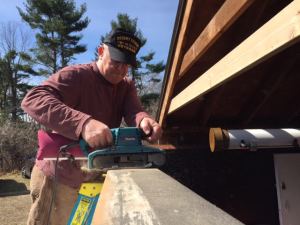
unnamed-16We undertook this project to create higher roof clearance over the south telescope pier, which now holds only our special Hastings refractor.  That south pier now has an excellent Paramount mount that it is capable of supporting two telescopes, just as we have two scopes mounted on the north mount.  However, the south pier is taller, leaving less than an inch of clearance between the top of the mount and the gable end opening when the old flap was raised.  This greatly limited the diameter of the scope
that could be mounted alongside the Hastings on the south mount.

unnamed-17Initially we considered replacing the flap with a larger flap, but realized that tree growth over the years has concealed the south horizon that was made visible by raising the flap.  Replacing the flap with a fixed wall simplified construction and lightens the weight of the movable roof, as well as making it easier for all of our members to operate the observatory.
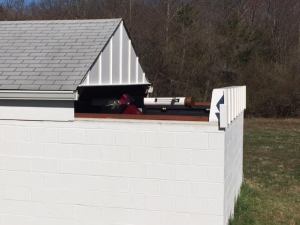
We will be adding ventilation to the gable and installing a brush-style sweep seal to keep light snow from blowing through the horizontal gap between the moving and fixed portions of the gable wall.

unnamed-4Thanks to the Board for supporting this and the construction team for making this happen.  We bid goodbye to the flap and hello to new telescope possibilities on the south mount.

Posted in April 2016, Sidereal Times | Tagged , , | Leave a comment

March 2016 AAAP Meeting Minutes

by James Poinsett, Secretary

  • Larry Kane called the meeting to order and introduced Prasad Ganti
  • Prasad then introduced the speaker for the evening, Dr. Neta Bahcall and her lecture “The Dark Side of the Universe”.
  • After the lecture Larry reminded the group that there will be a board meeting on Tuesday, March 29th at the West Windsor Library at 7:00 PM.
  • The club has reserved a table at Communiversity on April 17th. Volunteers are needed.
  • The last weekend of April, the 29th and 30th, there will be a Boy Scout Jamboree in Washington Crossing State Park. There will be 150+ scouts along with 30-40 adults. The observatory will be open both Friday and Saturday nights. Volunteers are requested for daytime solar observing.
  • A nominating committee is needed to set a slate of officers for election in May.
  • Observatory notes
    • Water has been turned on
    • The main gate to the park is broken. The club discussed the possibility of buying a chain and reflectors to assist the park. Gene will discuss the possibility of opening the gate for the season early giving the park several months to repair it. Another idea was brought up that it is not our problem, it is the park’s problem and we should have nothing to do with fixing or replacing it due to liability concerns.
    • The work on the new gable end should be finished by the time you read this.
  • The speaker next month is Jim Green from NASA.
  • April 1st and 2nd is the Stokes Star party. Be forewarned, it is a bare bones star party, there is not food available on site, you must bring your own.
  • There will not be a Super Science Saturday at the NJ Museum this year.
  • NEAF is the 9th and 10th of April.
  • The meeting was adjourned.
Posted in April 2016, Sidereal Times | Tagged , , | Leave a comment