
by S. Prasad Ganti
I wrote about Neutrino Astronomy in April of this year. And in October, we hear the good news that the Nobel prize in Physics is awarded to the pioneer Fracis Halzen who was instrumental in building the monumental neutrino observatory called the IceCube at the South Pole. Unlike most of the science prizes which are awarded to more than one person, this prize is for a single towering individual. The site nobelprize.org has more information on the prizes and prize winners than what the media reports. Some of the statements in this article are being quoted verbatim.
Neutrinos are elementary particles like electrons and protons. They were predicted by Wolfgang Pauli in the 1930s to explain the case of missing mass in a nuclear reaction called the beta decay. Beta decay is the emission of an electron from the nucleus of some radioactive elements. Their existence was confirmed in 1956 by Clyde Cowan and Frederick Reine using a nuclear reactor as a source. In 1995, Reines was awarded the Nobel Prize in Physics “for the detection of the neutrino” (Cowan had passed away in 1974 and Nobel prizes are not awarded posthumously).
Neutrinos are very difficult to detect. They rarely interact with any matter. They just pass through as if “matter” does not matter ! Particularly the high energy neutrinos coming from distant objects. Neutrinos are emitted by nuclear reactors, Sun and other astronomical objects – both near and distant ones. In 2002, R. Davis Jr. and M. Koshiba were awarded the Nobel Prize in Physics “for the detection of cosmic neutrinos” after the detection of high energy neutrinos (mega electron volt) from the Sun and the distant supernova 1987A which is at 160,000 light years from us.
“Neutrinos are the second most common particle in the Universe, after photons, which carry light. Neutrinos are great cosmic messengers because they can reach us without changing direction or losing energy, meaning they carry information no other messenger can, not even light”. Neutrinos travel from their source without being impacted by any matter. This is why they move without change of direction or without losing any energy. Which means they can indicate the direction of the source.
Halzen is a strong proponent of the IceCube. He was convinced of the neutrino detector and championed it. A couple of prototypes were built to test out the concept. The National Science Foundation funded the observatory which was completed in 2011. The basic concept is a very chancy interaction of neutrinos with matter. When zillions of them pass through, one of them may interact. That interaction is collected and amplified. The detectors are placed in locations which are isolated, like deep under water or ice, or underground in old and abandoned mines.
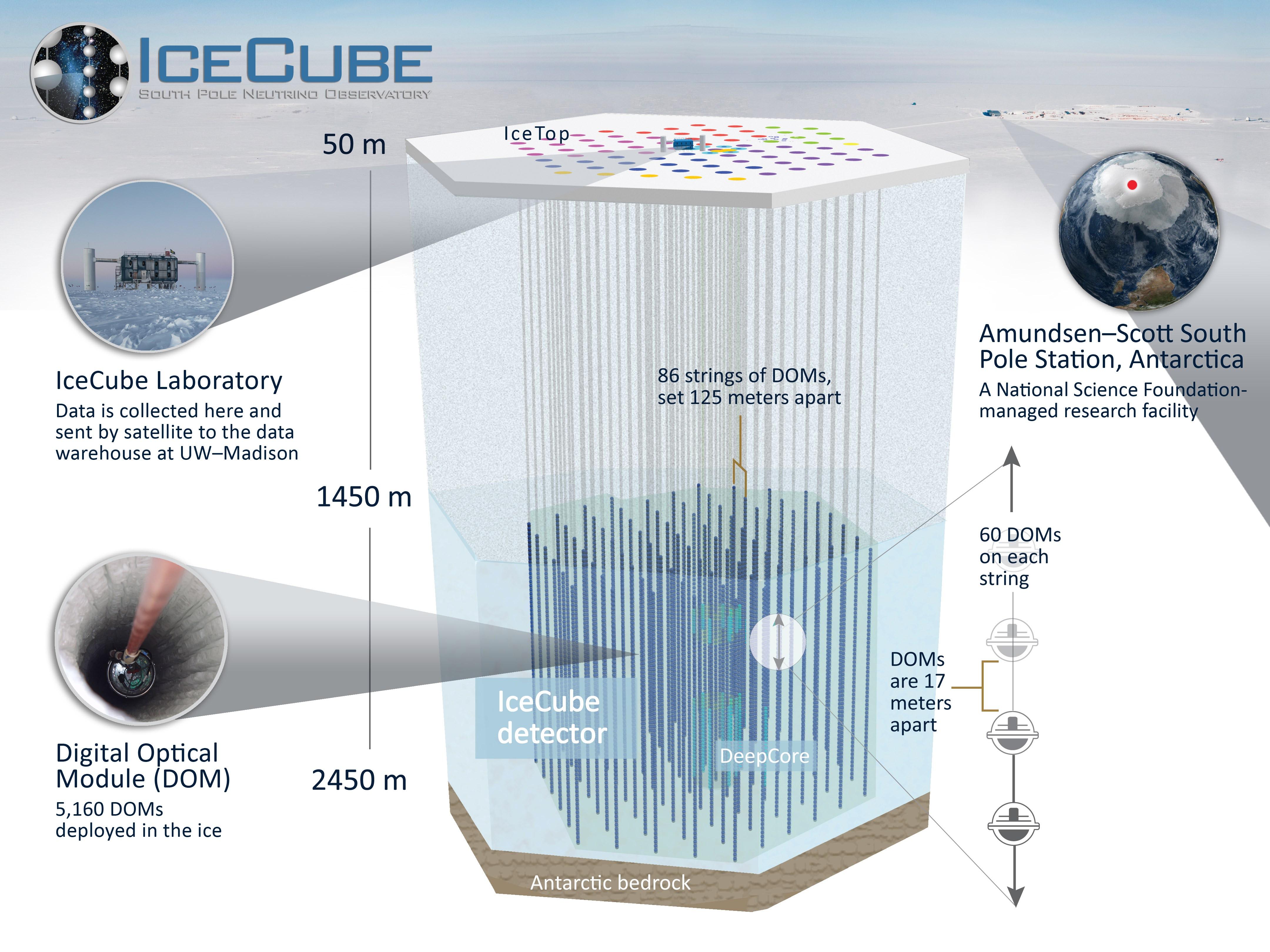
The IceCube consists of an array of about 5000 electronic sensors buried about 1500 feet below the ice core. The whole observatory is about a cubic km in size. This shields the detectors from other radiation. The sensors detect light emitted by charged particles that are produced when a single neutrino collides with a proton or neutron inside an atom. Although a rare event, quadrillion such neutrinos produce a collision every few days. The resulting nuclear reaction produces secondary particles traveling at high speeds that give off a blue light called Cherenkov radiation. Such tiny flashes of light are multiplied in the thousands of the photo multiplier tubes to give a good visual measurement.
Validating Halzen’s bet, who is the principal investigator of the observatory, within two years of its establishment, the detector had observed neutrinos from beyond the galaxy and with extreme energies. Since they provide information about their sources, like optical and other multi-messenger signals from distant astronomical objects, neutrino astronomy as an arm of astronomy has gained ground.
The picture below, courtesy IceCube Neutrino Observatory, shows the sensors buried deep inside the ice at the South Pole.
IceCube Gen2 is in the planning stages. It involves 8 cubic kms of ice. As opposed to 1 cubic km for the current observatory. More ice means more sensors which means more detection capability which means more astronomical discoveries to come. In the meantime, it is a worthy recognition for the pioneer who made this possible.


