From The Director

by Rex Parker, PhD
director@princetonastronomy.org

December 9, 2025 Meeting at Peyton Hall.  December’s winds whirl over the ivy-covered gothic spires and gleaming contemporary towers on the Princeton University campus, where we’ll meet for our final session of the calendar year at Peyton Hall of Astrophysics. I hope you enjoyed the presentation by our young AAAP astronomers on their experiences with the Unistellar telescope at the October meeting. Youth will be in the spotlight again for the Dec 9 meeting.  Our guest speakers are young researchers at Princeton and IAS who are studying the mysterious solar system bodies that orbit in the region beyond Neptune’s orbit at around 30 astronomical units from the sun. Recall our discussion at Peyton last month about the trans-Neptunian region, also known as the Kuiper belt, where shorter period comets such as the famed Hale-Bopp originated.  The talk on Dec 9 will involve discovery of a significant new object from this region and implications for more.  For additional information on the Dec 9 presentation please see Victor’s section below.

Following the first talk, we will have an Unjournal Club presentation by the AAAP Youth Group (Unistellar group), who on Nov 13 represented AAAP with knowledge and enthusiasm at the Stone Bridge Middle School Science Fair in Allentown NJ.  Thanks go to Jason, Hassan, Mia, Rujula, Eklavya and Sarvesh for spearheading that effort.  For the Dec 9 meeting, I hope that you will join in person at Peyton Hall.  If you cannot be there in bodily form (as I, out of state for a couple months this winter), you may participate virtually through Zoom.  See the link details below and on our website. 

Thanks for a Colorful 2025!  Our organization accomplished a lot during the past year, helping keep AAAP strong and vibrant with education, outreach, and science-social events.  A big thanks go to my fellow Board Members, the Observatory keyholders and Outreach Committee, and the Website Design committee for making things click this year.  Here’s a brief summary.  Membership remained strong with over 210 dues-paying members.  The Observatory at Wahington Crossing State Park was repaired back to full capacity electrically and electronically, with completion of the AC power rewiring project and JCP&L reconnection, and with Verizon fiber-optic high speed internet restored.  We had a highly productive and engaging season of public Friday observing nights at Washington Crossing despite the challenges noted above.  It’s difficult to estimate the total number of people who attended but it must be several-hundreds over the season.  In June, we held a long-awaited but well-attended memorial for Gene Ramsey, fittingly at the WC Park Pavillion.  We provided outstanding monthly programs at Peyton Hall (and via Zoom) with great guest speakers.  The AAAP website was redesigned and re-coded and a beta version has launched, with cut-out of the old site expect here at year’s end. The AAAP YouTube channel is growing with a cache of well-edited recordings of our meetings at Peyton plus other activities (https://www.youtube.com/@amateurastronomersassociat1439).  We successfully transitioned the fiscal functions to a new Treasurer.  And following the remarkable donation to AAAP of a Unistellar EV Scope2 and the summer Unistellar student project, we launched a AAAP Youth Group helping drive connections and outreach to schools and others.  It has been a fine year in AAAP, and I thank all of you who helped make it so.

A Winter’s Verse for Cold Nights.  I close here with a brief poem to further set the mood as we approach winter solstice. — Rex

Posted in December 2025, Sidereal Times | Tagged , , | Leave a comment

From The Program Chair

by Victor Davis, Program Chair

The Universe in a Computer
The December, 2025 meeting of the AAAP will take place in Peyton Hall on the campus of Princeton University on Tuesday, December 9th at 7:30 PM. As usual, the meeting is open to AAAP members and the public. Participants can join the meeting in-person at Peyton Hall or log in to the Zoom session as early as 7:00 pm to chat informally before the meeting begins.

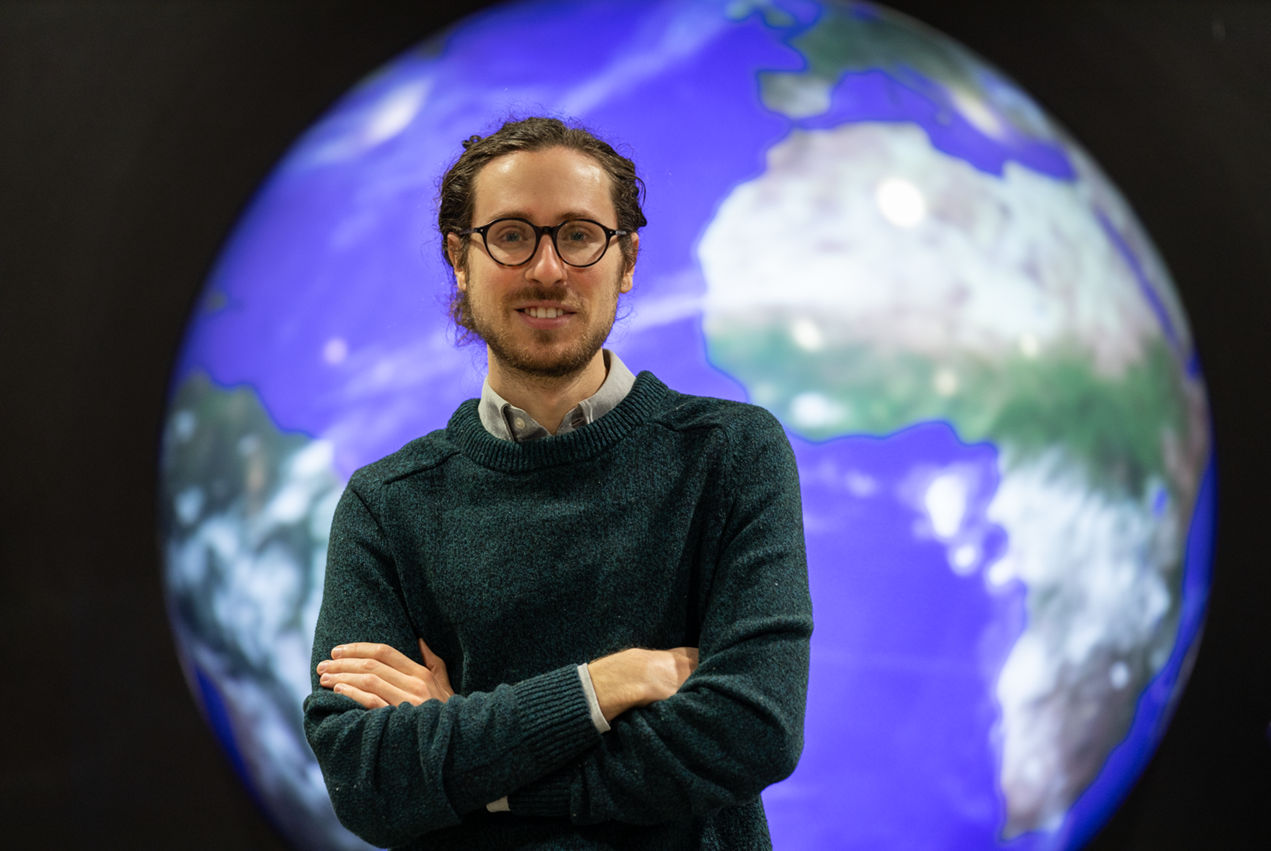
The evening’s guest speaker, Jiaxuan Li, is a fourth-year graduate student pursuing a PhD in astrophysics at Princeton University. Recently, along with Sihao Cheng at the Institute for Advanced Study and fellow Princeton graduate student Eritas Yang, Li and his team discovered a trans-Neptunian object in an unusually wide orbit that challenges the Planet 9 hypothesis.

Options for Attending the Meeting
You may choose to attend the meeting in person or participate via Zoom or YouTube as we’ve been doing for the past few years. (See How to Participate below for details). Due to security concerns, if you log in before the host has set up internet connectivity in Peyton Hall, you may need to wait in the Waiting Room for a few minutes until the host is prepared to admit you into the meeting. You’ll need to unmute yourself to make comments or ask questions. It’s polite, though not required, for you to enable your camera so other participants can see you. The meeting will be recorded and edited for posting to our club’s YouTube channel.

Join us for our “meet the speaker” dinner
Mr. Li will be joining us for our traditional “meet the speaker” dinner at Winberie’s before the meeting. Our reservation is for 5:45 pm Tuesday, December 9th. Please contact the Program Chair if you plan to attend.

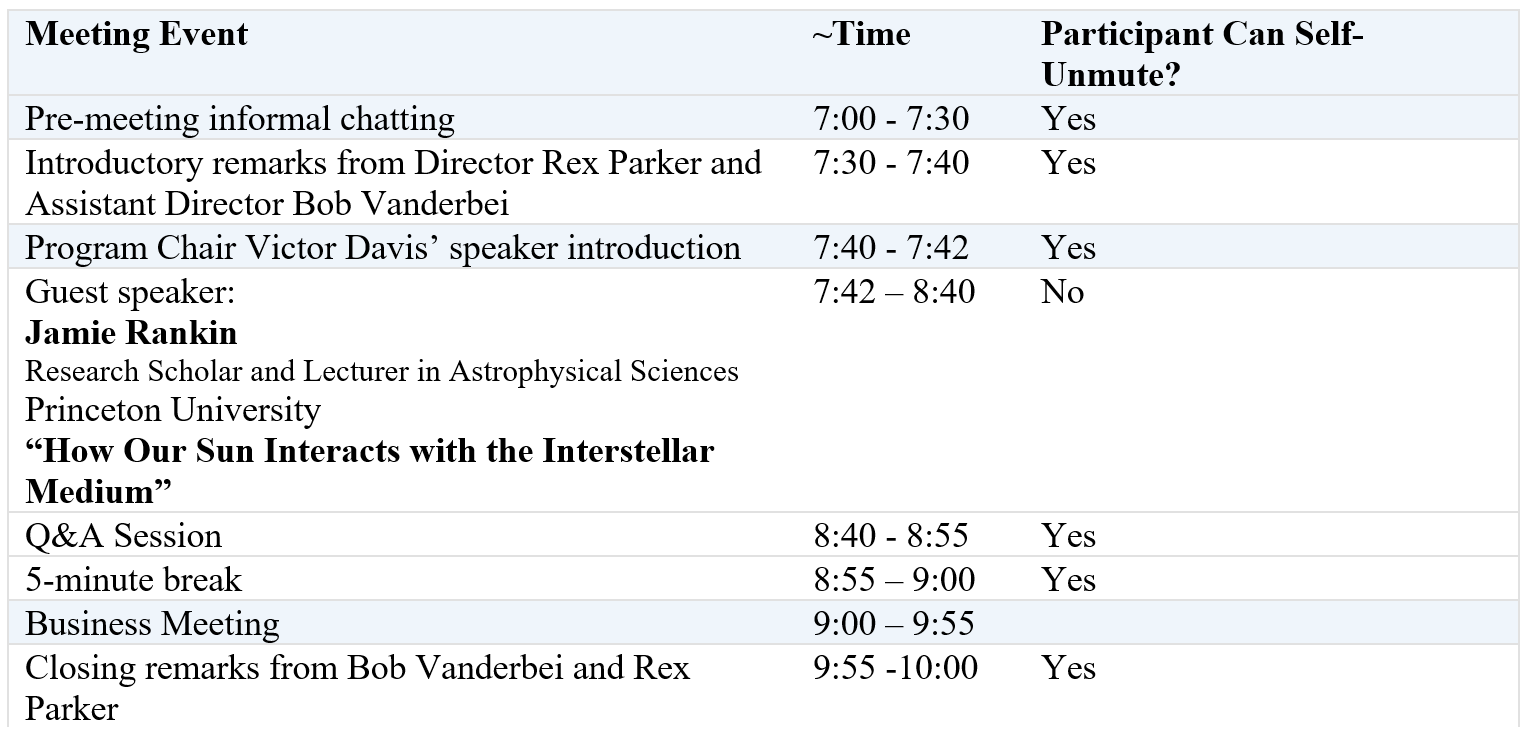
Here’s the anticipated agenda for November 11th, 2025’s monthly meeting of the AAAP:

(Times are approximate)

Getting to Peyton Hall
The parking lots across the street (Ivy Lane) from Peyton Hall are now construction sites, unavailable for parking. We’ve been advised by the administration of the astrophysics department that we should park in the new enclosed parking garage off Fitzrandolph street and walk around the stadium and athletic fields. Here’s a map of the campus and walking routes from the parking garage to Peyton Hall. The map shows the recently completed East Garage. Not shown is an access road Sweet Gum that connects from Faculty Road to an entrance at the lower left corner of the garage. Stadium Road connects from Fitzrandolph Road to another entrance at the opposite corner (and higher level) of the garage. It’s about a 10-15 minute walk from the parking garage to Peyton Hall.


PhD Candidate in Astrophysics
Princeton University

A Newly-discovered Distant World: The Dwarf Planet Candidate 2017 OF201
Astronomers Jiaxuan Li and Eritas Yang (graduate students at Princeton University’s Department of Astrophysics) and Sihao Chang (Institute for Advanced Study) identified a remarkable new world in the far outer Solar System: a dwarf-planet candidate named 2017 OF201, currently more than 90 times farther from the Sun than Earth. By combining observations spanning the past two decades, the team showed that it follows an enormous, elongated orbit that reaches deep into the inner Oort Cloud. With an estimated diameter of roughly 700 km, it ranks among the largest known objects on such distant orbits and is very likely a dwarf planet. Its extreme trajectory hints at a far larger, still-hidden population of similar bodies that may collectively contain about 1% of Earth’s mass. Intriguingly, its orbit does not share the clustering seen in some other remote objects—a pattern often cited as evidence for a possible “Planet Nine.” Continued searches for distant Solar System bodies will help unveil the true structure and diversity of this unexplored frontier.

Jiaxuan Li
Jiaxuan Li grew up in Dingxi, Gansu Province, a small town in northwestern China. An amateur astronomer since elementary school, Li participated in several international competitions, including the Chinese National Astronomy Olympiad. He earned his undergraduate degree in Astrophysics at Peking University, then came to Princeton to pursue his PhD. He’s interested in a variety of topics in astronomy and astrophysics, mainly on galaxy formation and evolution, low surface brightness astrophysics, sky surveys, machine learning, and instrumentation. His current research examines the formation and evolution of dwarf galaxies through both careful observation and numerical simulations.

How to Participate (Links)
Zoom & YouTube Live
Amateur Astronomers Association of Princeton is inviting you to a scheduled Zoom meeting.
Time: December 9, 2025 07:00 PM Eastern Time (US and Canada)

Join Zoom Meeting
Topic: December 9,2025 AAAP Meeting-Prof. Cheng, Jiaxuan Li, Eritas Yang, Dwarf Planet Candidate
Time: December 9, 2025 07:00 PM Eastern Time (US and Canada)
Meeting ID: 824 8572 5475
Passcode: 136481
Join instructions


https://us06web.zoom.us/j/82485725475?pwd=ikn08sd7Gz4rTLA7LFPIYCQVf2YMib.1 ….https://youtube.com/live/2jYvuRj0oMY
Click the above icons for Zoom and YouTube

AAAP’s library of monthly meetings is available on the club’s YouTube channel. November’s edited meeting featuring a presentation “The Universe in a Computer” by Princeton University astrophysicist Dr. Romain Teyssier can be viewed at https://youtu.be/lqs7znI1nEg

A look ahead at future guest speakers:

Date Featured SpeakerTopic
Jan. 13,
202
6
Jamie Rankin
Research Scholar
Princeton University
jsrankin@princeton.edu
Dr. Rankin will talk about her work as Project Manager for the Voyagers’ last gasp; observing the interaction between the solar and interstellar media as these spacecraft (still transmitting data since their launch in 1977!) leave the Sun’s influence. She’ll also speak more broadly about exciting things about how the Sun interacts with the interstellar medium and about the Princeton-led Interstellar Mapping and Acceleration Probe (IMAP) mission launched this past September.
 
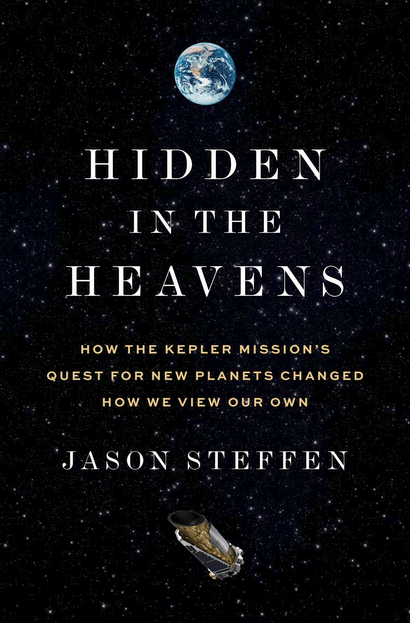
Dr. Rankin’s role is described in a recent book “The Clock in the Sun” by Pierre Sokolsky.
Feb. 12, 2026
John Bochanski
Associate Professor and Chair,
Department of Computer Science and Physics
Rider University
Dr. Bochanski has been connected to the Legacy Survey of Space and Time Discovery Alliance since his graduate studies more than 15 years ago. Rider University is part of the global effort using the Vera C. Rubin Observatory to map the optical sky. The Rubin observatory (formerly the Large Synoptic Survey Telescope, LSST) will capture more information about our Universe than all other optical telescopes throughout history combined. The observatory released its first images this past June. Prof. Bochanski will discuss the project’s history and discoveries.
 
Thanks to Nick Mellis for suggesting this speaker.
Mar. 10, 2026Robert Vanderbei
Emeritus Professor in the Department of Operations Research and Financial Engineering
Princeton University
 
AAAP Assistant Director
rvdb@princeton.edu
Prof.  Bob Vanderbei will talk about stellar dynamics.
Apr. 14, 2026Astronomer
Berkeley SETI Research Center
astrobrianlacki@gmail.com
September’s guest speaker Edwin Turner voiced his less-than-optimistic view of the prospect for discovering extraterrestrial life. Dr. Lacki, affiliated with Breakthrough Listen, a SETI initiative, recently submitted for publication a catalog of objects he and his team consider to be realistic and valuable observation targets. Dr. Lacki will talk about the catalog, “One of Everything: The Breakthrough Listen Exotica Catalog” and opine on the prospects of finding technosignatures and extraterrestrial intelligence.

Thanks to Ira Polans for suggesting this speaker.
May 12, 2026
John Horgan
Science Writer
horganism3@gmail.com
Mr. Horgan will discuss his controversial 1996 book The End of Science, in which he argues that pure science, defined as “the primordial human quest to understand the universe and our place in it,” may be coming to an end. Horgan claims that science will not achieve insights into nature as profound as evolution by natural selection, the double helix, the Big Bangrelativity theory or quantum mechanics. In the future, he suggests, scientists will refine, extend and apply this pre-existing knowledge but will not achieve any more great “revolutions or revelations.” Shades of Auguste Comte, perhaps?
 
We expect to have copies of his book(s) for sale for the author to sign at the conclusion of his presentation.
 
Thanks to Rex Parker for engaging this speaker.
Jun 9, 2026
Jacob Hamer
Assistant Curator
NJ State Museum Planetarium
Jacob.Hamer@sos.nj.gov
As usual, the June meeting will take place in the planetarium at the NJ State Museum in Trenton. There will be no streaming of this live-only sky show and PowerPoint presentation. Topic to be announced.
Sep. 8, 2026Michael DiMario
Chair of AAAP’s Astro-imaging SIG
K2mjd@outlook.com
Dr. DiMario will present a primer on astro-imaging.
Oct. 13, 2026Becka Phillipson
Assistant Professor in Physics
Villanova University
Prof. Phillipson, originally scheduled to be October 2025’s guest speaker, is an unconfirmed prospect to try again in 2026.

As always, members’ comments and suggestions are gratefully accepted and much appreciated. Thanks to Ira Polans and Dave Skitt for setting up the online links and connecting the meeting to the world outside Peyton Hall.

victor.davis@verizon.net
program@princetonastronomers.org
(908) 581-1780 cell

Posted in December 2025, October 2025, Sidereal Times | Tagged , , , , , | Leave a comment

Observatory Report

by Dave and Jennifer Skitt, Observatory Co-Chairs

Solar Observing on November 29, 2025

Upon hearing of the Grand Re-Opening of the Nature Center in Washington Crossing State Park on Thanksgiving weekend, I wondered what AAAP could do to entice park visitors to view nature in ways above and beyond those offered by the Nature Center.  You see, the Nature Center lies just down the road from our observatory, and their daytime activities were all slated to be indoors.  We could open the Observatory roof and do Solar Observing, of course!

Word went out to our Keyholders to solicit volunteers to staff the observatory while the Nature Center did their thing.  Once we had sufficient coverage for our telescopes, I invited AAAP members and Keyholders-in-Training (KIT’s) to join us.  Then, all we had to do, was hope for clear skies.  Nature provided that for us on Saturday November 29.  And, what an incredibly nice sunny day we had!  

I arrived around 0930 and made a brief stop by the renovated Nature Center to introduce myself and our event to the new naturalist, Joe Moore.  We both promised to direct visitors to each others activities.

In total, we had six telescope set-ups in the field along with the observatory scopes.  Our scopes were white light solar only and the field scopes had both white light and hydrogen-alpha capabilities.  Later in the day, we pointed a few scopes toward at Venus and the Moon, for a change of scenery.

Five KIT’s appeared and I went through the set up and safety protocol for solar observing with our telescopes.  The KIT’s were a big help in kicking things off in the morning.  Two of them earned their keys to the observatory as they had completed their training.

While I was too busy to get a final head count (or photos), I estimate we had 35-40 visitors of all ages.  In the crowd were a few Park volunteer employees and the executive director of the Washington Crossing Park Association.  Also present were a local mom and dad and their daughter, who is currently studying Engineering at UC Berkley and working on a NASA planetary mission set to launch in 2030.  They said they have visited our observatory off and on since their daughter was a little girl.  Wow!

It was a busy day for all of us; there was never a dull moment.  My wife, Jennifer, helped us close out the day, directing people to telescopes, answering questions and handing out brochures.  Jennifer’s arrival provided Bill Murray and I a few moments to hang the Gene Ramsey memorial plague.  While completing the task, we spoke well of Gene, remembering his contributions to the club and our personal lives. 

As the Sun cast longer shadows and 1600 drew near, Jennifer and I took a walk up to the Nature Center.  Jennifer spoke of bugs and flying squirrels (ask me about that sometime) and I talked of future club interaction with Joe and the Nature Center staff.  Everyone agreed resumption of Nature Center operations was a good thing.  Needless to say, Jennifer and I were deeply satisfied with the days activities.  

Many, many thanks to all who came out to make it happen and observe the Sun.

Posted in December 2025, Sidereal Times | Tagged , , , , , , | Leave a comment

From The Astrophotography Group

by Michael DiMario, Astrophotography Chair

Bubble Nebula NGC7635 taken by Michael DiMario
Telescope:       Celestron C9.25 Edge HD at FL 1645mm f7.0
Mount:             Losmandy GM811G
Exposures:       229 subframes @ 300 sec each over 5 nights for 19 hours of integration; ASI2600MC-P; Optolong L-Ultimate filter
Processing software: Pixinsight
Location, Bortle, and Date: Doylestown, PA; Bortle 6; August 22-30, 2025
Description and Story: The Bubble Nebula NGC7635 is a rich ionized hydrogen region (HII) in the constellation Cassiopeia. The “bubble” shape was created from the stellar wind created by the intensely hot central star (SAO 20575) and is within a giant, glowing molecular cloud. The Bubble itself is about 10 light-years in diameter.

Great Carina Nebula NGC3372 taken by Michael DiMario
Telescope:       Takahashi FSQ85EDX FL 455mm f5.3
Mount:             Losmandy GM811G
Exposures:       27 subs @ 30 sec each; ASI2600MC-P; Antilla Triband filter
Processing software: Pixinsight
Location, Bortle, and Date: Big Cypress, FL; Bortle 2; March 31, 2024
Description and Story: Great Carina Nebula is located in the southern sky constellation Carina located in the Carina–Sagittarius Arm of the Milky Way galaxy. The nebula is approximately 8,500 light-years from Earth. The nebula is one of the largest diffuse nebulae in Earth’s sky whereby it is four times as large as and brighter than the Orion Nebula.

This image taken in 2024, was reprocessed in Pixinsight. This evening’s session began with a 6-foot alligator very near my observing spot. Fortunately, it moved quickly back to the water. As darkness enveloped, the Everglades continued to be challenging with passing clouds, very large mosquitoes seemingly the size and whirring of humming birds, and python hunters with their large floodlights. The area of sky where the Great Carina Nebula was located was clear and was not my observing plan that night. However, NGC3372 was an opportunity to be taken that night as it was visible given its very low altitude. It was challenging as it was approximately 1-5 deg above the southern horizon, over far off trees and a field of many astronomers’ red lights. Imaging at this low of an altitude is equivalent to looking through approximately 11-26 atmospheres as opposed to 1 atmosphere at zenith.

Fireworks Galaxy NGC6946 taken by Michael DiMario
Telescope:       Celestron C9.25 Edge HD at FL 2350mm f10.0
Mount:             Losmandy GM811G
Exposures:       86 subframes @ 200 sec each over 2 nights with Antilla Triband filter; 90 subframes @ 200 sec each broadband over 3 nights for 9.8 hours of integration; ASI2600MC-P
Processing software: Pixinsight
Location, Bortle, and Date: Doylestown, PA; Bortle 6; October 3-18, 2025
Description and Story: The Fireworks Galaxy is located between the constellations of Cepheus and Cygnus. Its distance from Earth is about 25.2 million light-years. It is heavily obscured by interstellar matter due to its location close to the galactic plane of the Milky Way. NGC 6946 has also been classified as a double-barred spiral galaxy, with the inner, smaller bar presumably responsible for funneling gas into its center. Due to its large number of star formation, it has been classified as an active starburst galaxy. However, this galaxy derives its name not from its star nursery capability but from the ten supernovae observed since 1917. The number of observed supernovae in this galaxy is ten times the number observed in our Milky Way galaxy, even though the Milky Way has twice as many stars.

Fireworks Galaxy was a challenging project given its small field of view (FOV) and thus imaging at native FL of 2350mm. The tracking of the Losmandy GM811G mount was outstanding. A bright Moon in early October forced the use of the Antilla Triband filter with remaining subframes taken in broadband (no filters) when Moon was absent.

3i/Atlas the Interstellar Comet taken by Daniel Mints
Telescope:       Meade LX200 EMC reduced to 1650mm
Mount:            ZWO AM5N
Exposures:     ZWO533MCPro – 35 subframes @ 60 sec each with Antilla Triband filter
Processing software: Pixinsight/Lightroom
Location, Bortle, and Date: Hillsborough, NJ; Bortle 6; Early Morning, November 18, 2025
Description and Story: Interstellar Comet 2I/Borisov—sometimes called “Atlas of the stars” for the vast journey it represents—made history in 2019 as only the second known visitor from beyond our solar system. Discovered by amateur astronomer Gennadiy Borisov, the comet entered the Sun’s neighborhood at an extraordinary speed and on a sharply hyperbolic path, clear signs that it was not bound to our star. Unlike typical comets shaped by billions of years of orbiting the Sun, 2I/Borisov came from the deep cold between the stars, probably carrying pristine material left over from the formation of a distant, unknown planetary system.

Messier 16 (Eagle Nebula) and Comet C/2025 R2 (SWAN) conjunction taken by Daniel Mints
Telescope:       Samyang 135mm
Mount:            ZWO AM3
Exposures:      ZWO183MMPro – 240 subframes @ 30 sec each (LRGB mono captured)
Processing software: Pixinsight/Lightroom
Location, Bortle, and Date: Rockland, TX; Bortle 1; October 17, 2025
Description and Story: The conjunction of Messier 16 (the Eagle Nebula) and Comet C/2025 R2 (SWAN) creates a stunning celestial scene where two very different cosmic objects briefly share the same patch of sky. The Eagle Nebula, located about 7,000 light-years away in the constellation Serpens, is a vast star-forming region famous for the towering Pillars of Creation. These immense columns of gas and dust are nurseries where new stars ignite, shaping the nebula with intense radiation and sculpting its iconic form. The visual pairing of the fast-moving comet with the distant, majestic Eagle Nebula tells a story of two cosmic journeys: one fleeting and ephemeral, the other spanning millions of years.

Posted in December 2025, Sidereal Times | Tagged , , , , | Leave a comment

The Perfect Machine

by S. Prasad Ganti

“The Perfect Machine” is the name of a book written by Ronald Florence. It covers the design, construction and the installation of the 200 inch Hale telescope at the Mount Palomar observatory, close to San Diego in southern California. Recently I had the opportunity to visit Los Angeles and San Diego to be with family and friends. I spent a few hours at the Palomar observatory. Having read the book a few years back, I was thrilled to see the perfect machine. 

The telescope was conceived by George Hale who was known for his research in solar astronomy, and importantly for constructing the 60 inch Yerkes telescope near Chicago and the 100 inch telescope at Mount Wilson near Los Angeles. He also cofounded Caltech. In 1928 Hale secured Rockefeller foundation sponsorship for the 200 inch telescope. It took a couple of decades before the construction could complete, just after the second world war. By that time Hale had passed away. The New York Times suggested that the new telescope be named in his honor. 

The main part of a reflecting  telescope is its mirror. Palomar’s mirror is 200 inches in diameter and was cast in Corning, New York. It is a very painstaking glass making process taking months to get it right. Heating sand in a rotating furnace followed by a very slow cooling process. Contemporary mirrors are not cast as a single piece. Instead they are composed of multiple segments, with each segment controlled by an actuator/motor. This is a scalable design but requires a lot of computing power to precisely move the actuators in tandem so that all the pieces work as one big mirror. Back in those days, such technology did not exist. Hence the need to cast it as one big piece. The cast was sent by a special freight train from New York to Caltech in California. Caltech has a polishing lab where the mirror was polished to very fine tolerances. The polishing work took longer since the work was interrupted by the second world war as Caltech turned to wartime research. 

The next critical piece in the telescope is the mount. The telescope moves within the mount to point to a specific area in the sky and once locked to an object in the sky, to keep the telescope moving so that the object remains locked even as the earth below is rotating on its axis. It is like chasing a star as it is moving from east to west in the nightly skies. Today’s technology is different from what existed in those days. The current mounts are called alt-azimuth mounts. Such mounts  move in two directions – one up and down vertically, other horizontally firstly to locate a given object and then to move with the object as it moves across the sky. This motion requires a lot of computing power and is the standard mount today on modern telescopes. 

Back in the 1940s, Hale telescope was designed using the equatorial mount. A superstructure called the yoke (a Y or U shaped structure) is permanently aligned parallel to  the axis of earth’s rotation. This fixes one axis of movement. The only manipulation required is to move the mount across the sky as the star moves through the night. This movement is called the right ascension. The telescope itself is mounted between the two arms of the yoke and is free to move in the vertical plane, called the declination. For a long time, I had a tough time imagining what the mount would look like. Pictures did not help me that much. When I saw the real mount, I could realize how it worked. 

The picture given below is courtesy Palomar Observatory/Caltech. The thick tube in the middle of the picture is one arm of the yoke. The angle of this arm with respect to the floor aligns with the earth’s axis of rotation. The black truss structure extending to the top of the observatory is the telescope hung between the two arms of the yoke (the second arm of the yoke is behind the first arm, not visible from this angle). The telescope itself is free to swing up and down between the two arms of the yoke and is controlled by a motor. At the bottom of the truss is the mirror facing the sky. Towards the upper end of the truss are the secondary mirror and the electronics required to capture the images.   

The yoke itself is connected to a horse shoe bearing which is on the right of the yoke. One motor moves the yoke on this bearing to position the telescope to a particular object in the sky. Once set, a second motor moves the yoke to track the object in the sky as the night progresses to dawn. This rotation of the yoke is on the axis which is parallel to earth’s rotation. These three motors are the key controllers of the telescope.        

The following youtube video explains the mount in 2.5 mins while the second video explains the history of Mount Palomar design and construction. Both the videos show the detailed design of the equatorial mount and how it turns. 

The whole structure of the mount and the telescope are housed in an outer cylindrical structure with a dome at the top. The dome has a slit on the top. This slit is open during the night for observations. The whole dome rotates on bearings at the top of the cylindrical structure. This rotation would position the open slit to the part of the sky which needs to be observed. Given below is the picture of the dome which I shot using my iPad pro. The dome is painted white to reflect the sunlight. The temperature inside the observatory needs to be constant so that the telescope remains in alignment all the time. The dark band at the bottom of the dome, but higher than the steps and the front door, indicates the track on which the dome rotates.    

The whole mount, truss and the dome were designed by Russell Porter, who is a polymath considered as one of the founding fathers of amateur astronomy. Porter also contributed to the design of buildings at the Palomar observatory and Caltech campus. He made about 1000 drawings of the telescope and its related instruments and buildings. 

The telescope works in the visible, infrared and ultraviolet ranges. It is a pretty wide range given the technology with which the mirror was built. Fred Zwicky used this telescope to detect supernovae. Maarten Schmidt discovered the first Quasar in 1963. These objects are very bright in the whole universe. But Schmidt’s spectroscopy revealed that the light is so red shifted which indicates that they are billions of light years away, formed during the infant stages of our universe. Now it is postulated that such objects represent supermassive black holes and the accretion disk of gases around them is the bright light we are seeing. Thousands of Quasars have been discovered since. 

The telescope has been fitted with adaptive optics on its secondary mirror  to modernize it. Adaptive optics is used to compensate for the distortions in the atmosphere which make the stars twinkle. The  twinkle looks good in the sky, but makes the observations unsteady. Adaptive optics divides a mirror into smaller segments with each segment controlled separately by an actuator/motor. A reference laser is shot into the skies. The reflected picture of the laser is used to find out how much distortion the atmosphere is causing. Accordingly each actuator is moved differently  to change the shape of the mirror to provide a sharp picture. Adaptive optics is a standard design for all modern telescopes.   

It is a fascinating story of how the telescope was conceived, designed and constructed and the discoveries it made and the efforts to modernize it. My tributes to George Hale and Russell Porter, two of the most important people who built the Mount Palomar observatory. 

Posted in December 2025, Sidereal Times | Tagged , , , | Leave a comment

Snippets

compiled by Arlene & David Kaplan

-NYT

Fighting for ‘The Right to Night’ Under Starry, Rural Skies On a Saturday in September in Michigan’s Upper Peninsula, a dozen people navigated through the woods to the shore of Lake Superior, where the waves licked softly against the land. Above, a wash of stars filled the blue-black sky, cut in half by the haze of the Milky Way…more

-NASA
-NYT

Why the Rings of Saturn Seem as if They’re About to Disappear If you head into your backyard this weekend and set up your telescope, the giant planet Saturn will be there for you to see. “Saturn is a spectacular object to look at,” said Damian Peach, an English astrophotographer who frequently observes the giant planet. “Even with small telescopes, you can see the rings.”….more

-NYT

The Moon Was an Inside Job Not long after Earth formed, it received an almighty sucker punch when an object roughly the size of Mars slammed right into it. The interloper, known as Theia, was destroyed, and parts of it and Earth were sprayed into space. The result was the moon….more

-NASA

Almost Everything About NASA’s Latest Mission to Mars Is Unusual NASA’s latest robotic mission to Mars, ESCAPADE, should perhaps have been named the Great Escape, given how many times it has eluded doom. The data that the mission eventually collects will provide clues about why Mars, which once possessed a thick atmosphere and flowing water on its surface, is today cold, dry and almost airless…..more

-NYT

The ‘Lost Sisters’ of the Pleiades Fill the Entire Night Sky Look to the east after sunset on a clear winter night and you’ll spot a bright, tightly packed collection of stars. That’s the Pleiades, a star cluster 445 light-years from Earth that has inspired both myth and measurement for centuries….more

-NYT

Northern Lights Bring Dazzling Views to Northeast The northern lights could be seen in skies as far south as Texas late Tuesday and early Wednesday after the sun emitted masses of charged particles that disrupted the Earth’s magnetic field — and created a dazzling display. Aurora borealis, or northern lights, are most common over locations closer to the North Pole…more

-Livescience

New ‘nearly interstellar’ comet — wrongly linked to 3I/ATLAS A never-before-seen comet that shares some minor similarities with the infamous interstellar object 3I/ATLAS is about to make its closest approach to our planet just a few days after it was first spotted speeding toward us…more

-NYT

What Can Cosmic Dust Tell Us About the Changing Arctic? Scientists have reconstructed 30,000 years of changes to sea ice in several locations across the Arctic Ocean by looking for traces of cosmic dust embedded in the seafloor, according to a study published Thursday. Scientists analyzed sediment samples from the Arctic Ocean by looking for traces of space particles,..more

-NYT

2 Spooky Flashes Lit Up the Moon. Here’s What Made Them Early November, a handful of watching telescopes captured something crashing into the moon. Then over the weekend, a second object punctured its silvery surface. The two incidents were a reminder that the moon is not so much the serene orb we clearly see in night skies a few nights a month but rather a noisy battleground constantly gaining new craters….more

-NYT

NASA Rover Makes a Shocking Discovery: Lightning on Mars It is shocking but not surprising. Lightning crackles on Mars, scientists reported on Wednesday. What they observed, however, were not jagged, high-voltage bolts like those on Earth, arcing thousands of feet from cloud to ground…more

Posted in December 2025, Sidereal Times | Tagged , | Leave a comment

From The Director

by Rex Parker, PhD director@princetonastronomy.org

November 11, 2025, Meeting on Campus.  With the close of a very successful season of public observing nights at Washington Crossing Observatory, our main venue for several months will be the evening meetings at Peyton Hall on campus the second Tuesday each month (7:30pm).  Our guest speaker Nov 11 will be Romain Teyssier, Professor of Astrophysical Sciences and Applied and Computational Mathematics at Princeton University.  Dr Teyssier studies cosmology and galaxy and star formation. He is the main author of the RAMSES code, a massively parallel open-source code used to model large scale astronomical structures using supercomputers.  This has inspired an international community of researchers to employ RAMSES for cosmology with high spatial resolution.  This presentation will provide AAAP members with insights to how cosmology is being practiced today.  The Nov 11 meeting will also be run via Zoom as usual, but it’s better to attend in person at Peyton Hall if you can.  Please see Victor’s article in this issue for more information.  I hope to see you on Nov 11!

Be Part of the Unjournal Club.  We’ve developed the tradition of the member “10 min talk”, which I like to call the Unjournal Club (a take-off from the journal clubs found in many science grad student programs).  This runs at the top of the 2nd hour of the regular meetings after the main speaker has finished.  The plan is to help break the boundaries between members and share our interests in astronomy.  Here I am asking you to volunteer to give an “unjournal” club session!  For example I gave a talk last month on the Mars Perseverance rover finding a possible biosignature fossil on Mars based on a recent paper in Nature.  But the unjournal club talks don’t need to be scholarly, journal-like topics at all, they only need to engage members with what you care about in astronomy.  If you aren’t there in person you can still do a talk via Zoom which works great with PowerPoint slides or simple text or photos.  To get on the schedule for an upcoming meeting (e.g., Nov 11), please contact me or program chair Victor Davis.

Announcement:  Electronically Assisted Astronomy (EAA) Is Now Part of the AAAP Astroimaging Group.  Members interested in EAA activities (“astrovideo”) are invited to join the AAAP Astroimaging Group.  This includes smart telescopes such as the ZWO SeeStar and Unistellar telescopes.  Meetings going forward will include discussions of equipment and software for EAA as well as astrophotography. Please contact Michael Dimario at astroimagers@princetonastronomy.org and Gene Allen at secretary@princetonastronomy.org to sign up or share ideas for the meetings.  The next session is  planned for Dec 30. 
Brilliant Star Forming Regions in the Autumn Sky.  I’ve been observing some of the deep sky objects well-positioned in the northern sky over the past few weeks of good weather.  Using narrow-band filters in astrophotography allows us to see through some of the light pollution and get images of some remarkable nebulae in the northern region around the constellation Cepheus. The image below of the NGC 7822 (H-II region) in Cepheus was taken with a 12.5-in reflector telescope using a dual H-alpha and Oxygen-3 narrow band filter with color camera, The intense red color in the image comes from hydrogen-alpha emission from interstellar clouds of ionized hydrogen gas.  The pillar-like condensed gas cloud structures in NGC 7822 are formed by stellar winds radiating from massive new stars embedded within the nebula. The radiation ionizes the gas and forms compressed, high density regions of both gas and dust to generate the pillars and darker globules, in turn contributing to more new stars being born.    

Nebula NGC 7822 in the Constellation Perseus.  The pillar like columns are high density regions being compressed by the stellar winds of newly born stars.  Image from NJ by Rex Parker using a 12.5 inch reflector telescope with dual-narrow band filter and ZWO ASI2400MC camera.

Posted in November 2025, Sidereal Times | Tagged , , | Leave a comment