
by Victor Davis, Program Chair
On the Matter of “Dark Matter”
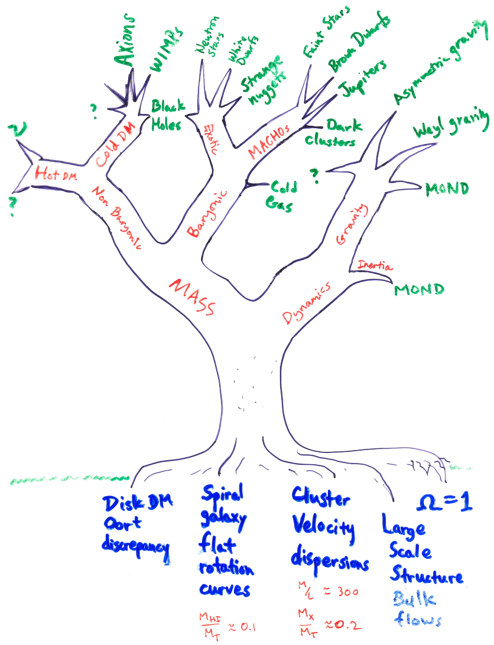
The November 2026 monthly meeting of the Amateur Astronomers Association of Princeton will take place in the lecture room in Sherrerd Hall on the campus of Princeton University on Tuesday, November 10th at 7:30 PM. As usual, the meeting is open to AAAP members and the public. Participants can join the meeting in-person at Sherrerd Hall or log in to the Zoom session as early as 7:00 pm to chat informally before the meeting begins. The evening’s guest speaker will be astrophysicist and MOND proponent Stacy McGaugh at Case Western Reserve University in Cleveland. MOND is an acronym for Modified Newtonian Dynamics, an alternative to the now well-accepted idea that 85% of the matter in the universe is dark matter, invisible material that provides the gravity necessary to explain the rotation rate of spiral galaxies.
Options for Attending the Meeting
You may choose to attend the meeting in person or participate via Zoom or YouTube as we’ve been doing for the past few years. (See How to Participate below for details). Due to security concerns, if you log in before the host has set up internet connectivity on-site, you may need to wait in the Waiting Room for a few minutes until the host is prepared to admit you into the meeting. You’ll need to unmute yourself to make comments or ask questions. It’s polite, though not required, for you to enable your camera so other participants can see you. The meeting will be recorded and edited for posting to our club’s YouTube channel.
Due to the guest speaker’s virtual participation, there will be no “meet the speaker” dinner this month.
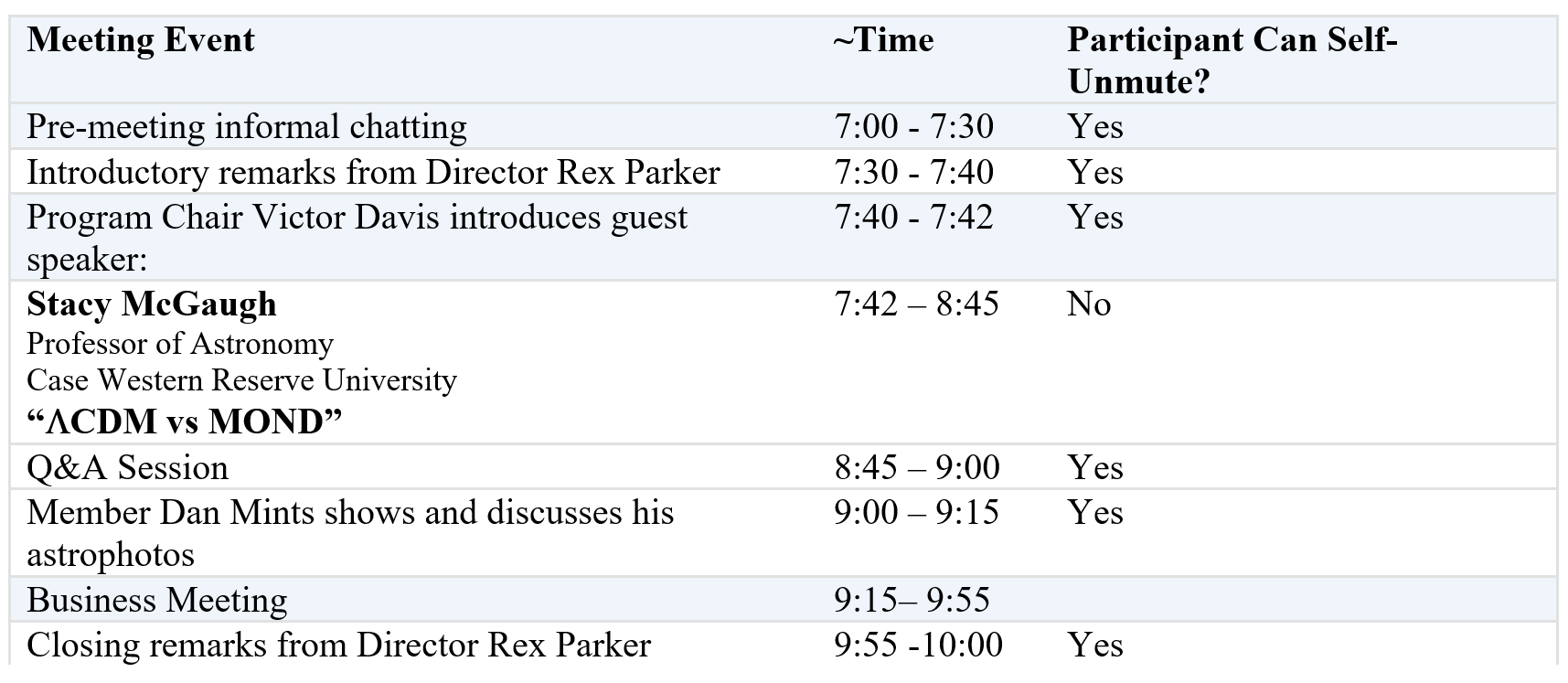
Here’s the anticipated agenda for November 10, 2026’s monthly meeting of the AAAP:
ACDM vs MOND
Featured Speaker:
Stacy McGaugh
Professor of Astronomy
Case Western Reserve University
stacy.mcgaugh@case.edu

Modified Newtonian Dynamics was proposed by astrophysicist Moti Milgrom as a solution to the “missing mass problem;” that when we measure the luminous mass of external galaxies, we find that the measured mass falls well short of what’s required to explain the galaxies’ observed rotational speeds. It seems that there’s either some kind of invisible “dark matter” that makes up approximately 85 percent of the universe, or that Newton’s laws of gravity need to be modified, especially at extremely low accelerations of less than 10-10 meters per second per second. Postulating nonluminous, mysterious mass that makes up so much of the universe to contort theory to match observations is a bargain that some astrophysicists have been unwilling to make. As Rex Parker describes in last month’s ST column, the choice has been to keep the laws of gravity intact by adjusting the universe’s mass or to keep the mass intact by adjusting the laws of gravity. Prof. McGaugh is among those choosing the latter approach. He’ll describe the virtues and faults of dark matter versus MOND in his presentation this month.
Professor Stacy McGaugh is an astronomer who studies galaxies, cosmology, dark matter, and modified gravity. McGaugh was a student at MIT (S.B. Physics 1985), Princeton, and the University of Michigan (Ph.D. Astronomy 1992) and a postdoc at the Institute of Astronomy of the University of Cambridge, the Department of Terrestrial Magnetism of the Carnegie Institution of Washington, and Rutgers. He joined the faculty of the University of Maryland in 1998, commuting for fourteen years from Cleveland where his wife is a member of the faculty of John Carroll University. In 2012, McGaugh moved to Case Western Reserve University where he served as the Chair of the Department of Astronomy and Director of the Warner and Swasey Observatory from 2015 to 2022.
Prof. McGaugh is the author of over 150 refereed publications that have been cited more than 16,000 times. He ranks in the top 2% of the top 2% of impactful authors across all sciences in the Stanford-Elsevier Updated science-wide author databases of standardized citation indicators and in the top 100 of those working in astronomy & astrophysics (of over 49,000 listed in that field in the top 2% database). He is thanked in the acknowledgements of over 200 papers of which he is not an author, and blogs about science at a high but accessible level.
McGaugh has made important contributions to multiple fields, including low surface brightness galaxies, galaxy dynamics, elemental abundances, stellar populations, cosmology, dark matter, and modified gravity. He demonstrated that low surface brightness galaxies are more common than had previously been thought, settling a decades-long debate over Freeman’s Law. He and his collaborators discovered that low surface brightness galaxies are dark matter dominated, the central density relation, and the radial acceleration relation. He showed that baryonic mass (rather than luminosity) was the salient variable in the Tully-Fisher relation, coining the term “Baryonic Tully-Fisher relation.” In addition to his observational work, McGaugh has had success as a theorist, correctly predicting the first-to-second peak amplitude ratio of the acoustic power spectrum of the cosmic microwave background, the rotation speeds and velocity dispersions of numerous dwarf galaxies including the dwarf satellites of Andromeda and the ultradiffuse Local Group object Crater 2, the outer slope of the rotation curve of the Milky Way early reionization, the redshift and amplitude of the 21 cm absorption signal at cosmic dawn, and the formation of massive galaxies at high redshift
How to Participate (Links)
Zoom & YouTube Live
Topic: AAAP November Meeting-Prof Stacy McGaugh, Case Western, Alternatives to Cold Dark Matter
Time: Nov 10, 2026 07:00 PM Eastern Time (US and Canada)
Join Zoom Meeting
Meeting Chat Link
Meeting ID: 818 8542 6117
Passcode: 618643
Join Instructions ....

Click the above icons for Zoom and YouTube
AAAP Video Library
AAAP’s library of monthly meetings is available on the club’s YouTube channel. Last month’s meeting featured Dr. Michael DiMario and Prof. Robert Vanderbei presenting “Fundamentals of Astroimaging.” The edited video (AAAP Sept 8 2026) is at http://youtu.be/UfTktZlx5Ao and runs 1:48:17.
A look ahead at future guest speakers:
| Date | Featured Speaker | Topic | |
| December 8 2026 | Joel Hurowitz Associate Professor Graduate Program Director Acting Principal Investigator, Mars 2020 PIXL Team Department of Geosciences Stony Brook University joel.hurowitz.stonybrook.edu  | Prof. Hurowitz will speak virtually to our club about his research using the Perseverance rover and about astrobiology on Mars. Thanks to Rex Parker for suggesting this speaker. | |
| Sometime in 2027 | Becka Phillipson Assistant Professor in Physics Villanova University rebecca.phillipson@villanova.edu  | Prof. Phillipson, originally scheduled to be October 2025’s guest speaker, is an unconfirmed prospect to try again in 2027 Prof. Phillipson leverages statistics, nonlinear dynamics, and machine learning to study the explosive and highly variable characteristics of exotic astrophysical objects such as black holes and neutron stars. Thanks to Bill Thomas for suggesting this speaker. |
As always, members’ comments and suggestions are gratefully accepted and much appreciated. Thanks to Ira Polans and Dave Skitt for setting up the online links and connecting the meeting to the world outside Peyton Hall.
victor.davis@verizon.net
program@princetonastronomers.org
(908) 581-1780 cell


