Neutrinos: Their discovery, detection, and future prospects – September 13, 2016

By Ira Polans, Program Chair

Dr. Jia Liu

Dr. Jia Liu

The first talk of the 2016-2017 season is on September 13 at 7:30PM in Peyton Hall on the Princeton University campus. The talk is on “Neutrinos: Their discovery, detection, and future prospects” by Princeton University Postdoctoral Fellow Dr. Jia Liu.

Dr. Liu’s work currently focuses on weak lensing non-Gaussian statistics, using N-body ray tracing simulations as a tool to study the large scale structure of our universe. The ultimate goal of this work is to understand the nature of dark energy, the total mass of neutrinos, and other cosmological parameters.

Dr. Liu also spends time observing AGNs at optical telescopes, hoping to find super-massive black-hole binaries!

Prior to the September meeting there will be a meet the speaker dinner held at Winberies, Palmer Square in Princeton at 6PM. If you wish to join please email program@princetonastronomy.org no later than noon on September 13.

Please come and join us for what will be an informative and interesting talk!

Posted in Mid-summer 2016, Sidereal Times | Tagged , , | Leave a comment

From the Assistant Director

by Larry Kane

After a discussion with Director Rex Parker, he and I concluded that we want to invite our membership to a relaxed evening at the Gravity Hill Farm in Titusville. While much has to be planned and confirmed, we are working on putting together an evening of relaxation, pizza, beverages and star gazing with the membership of the Washington Crossing Park Association (WCPA). This will be an event sponsored by the Boards of Directors of both organizations as a thank you to their members. We hope that, we can form a strong union with the WCPA as a way of showing our support for an organization working for the maintenance and betterment of the park that houses our observatory.

Our initial thoughts are to have a “Membership Night Out” in early November.   It is our hope that this pleasant, free of charge, evening of pizza under the stars will become an annual event. It will be a benefit of membership provided to those belonging to each of our organizations. This event will be able to solidify a mutual imperative for all of us, the preservation and improvement of our park.

So start thinking of a weekend evening in the first or second week of November. Think of it as a reward being granted to you as a member of an organization that seeks to be worthy of your support. Stay tuned for more information as things develop.

Posted in September 2016, Sidereal Times | Tagged , | Leave a comment

Conjunction of Venus and Jupiter

By Gene Allen

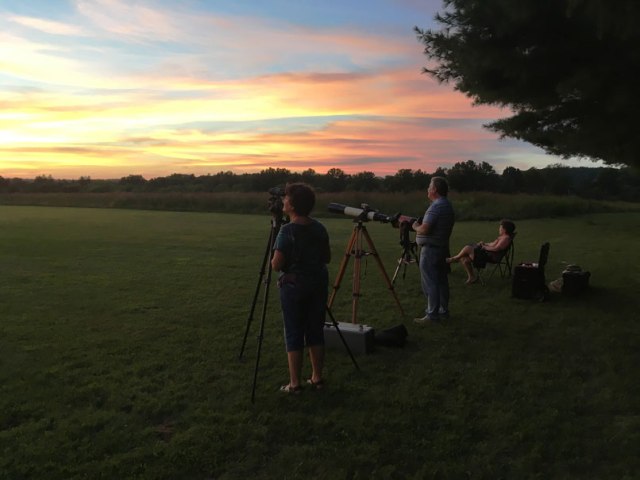
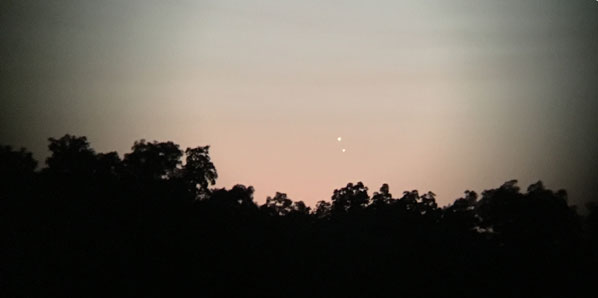
Two couples responded to Bill Murray’s invitation to join him on the soccer fields to try to observe the conjunction of Venus and Jupiter on August 27. When Gene and Seraphine Allen arrived with tripod-mounted binoculars, Bill’s refractor and Dave and Jen Skitt’s SCT were already set up and pointed at Venus. The sun sank below the horizon, and Venus became visible without assistance. As the twilight deepened, we sampled each other’s optics, and both Venus and Jupiter became lovely targets. We even managed an iPhone snapshot through one lens of the little binoculars. It was a simple and fun evening. Thank you, Bill, for inspiring us to try!

Seraphine Allen, Bill Murray and Jen Skitt waiting for a darker sky. Credit: Gene Allen

Seraphine Allen, Bill Murray and Jen Skitt waiting for a darker sky. Credit: Gene Allen


Venus-Jupiter using iPhone SE camera through one eyepiece

Venus-Jupiter using iPhone SE camera through one eyepiece
of Nikon Monarch 7 10×42 binoculars. Credit: Gene Allen

Posted in September 2016, Sidereal Times | Tagged , | Leave a comment

Juno, the wife of Jupiter

By Prasad Ganti

NASA’s Juno spacecraft traveled for five years before reaching Jupiter on July 4, 2016. It will orbit around for 20 months studying Jupiter’s atmosphere before crashing into it. The last spacecraft to visit and study Jupiter was Galileo.

Jupiter, named after the King of Gods in Roman mythology, is the fifth planet from the Sun and the first gas giant. There is supposedly very little core or “land” inside its thick atmosphere. Juno in Roman mythology is Jupiter’s wife. The spacecraft Juno was travelling to meet her husband!

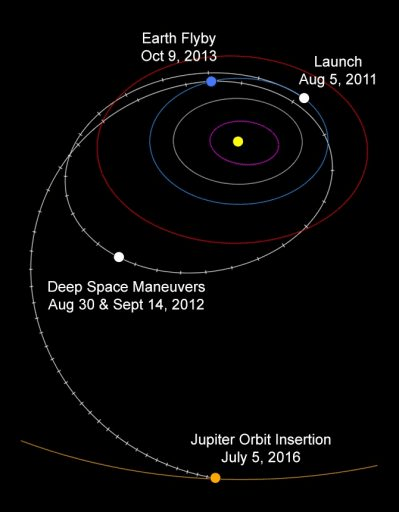
Like any space trajectory, the spacecraft does not travel in straight line from Earth to Jupiter partly because both the planets are moving all the time. The launch platform as well as destination are moving at the same time. A circular trajectory is the most most natural one in space. When launched in 2011, Juno was put into an orbit around the Sun. In 2012, deep space maneuvers, by firing the thrusters, brought it closer to the Earth again. In 2013, it received gravity assist from Earth and was flung towards Jupiter. This maneuver is difficult to imagine but it is like the action of a slingshot. The picture of the trajectory is shown below. Courtesy NASA.

Path of Juno from Earth to Jupiter.

Path of Juno from Earth to Jupiter.

Juno is armed with 3 solar sails on its outward journey. The sails provide power for propulsion as well as the contained electronic instruments. It was also spinning as it sped along. The spinning allows for more stability and orientation. As massive as the planet is, next to the sun, it is the largest body in our solar system. Although it consists mostly of gas, it has an intense gravitational field. Understandably so because huge masses have surrounding gravitational fields of more intensity. The gravitational field is enough to support a structure of about seventy moons, the most significant and largest of which are the Galileans – Ganymede, Europa, Io, and Callisto. Along with its mighty gravity, it also has a very strong magnetic field presumably due to the metallic hydrogen it harbors. Metallic hydrogen is the liquid form of hydrogen which exists under the intense pressure of Jupiter’s atmosphere. It does not exist anywhere on Earth, but has been produced only in laboratories under extreme pressure and temperature for a tiny fraction of a second.

Juno’s mission is to map out Jupiter’s gravitational and magnetic fields. Additionally, it will try to find more about the interior structure of the gas giant. Its findings might reveal if the planet has a rocky core or none at all. There is a great red spot on the planet which is supposed to be a storm raging for more than a thousand years. Juno will try to ascertain its depth.

All the electronic equipment aboard the spacecraft is enclosed in a Titanium vault to shield it from the intense radiation. In addition to the data from the sensors, the JunoCam will also send back close up pictures of the planet.

The famous science fiction writer Arthur C. Clarke has speculated that there is an Earth sized diamond in the middle of Jupiter’s core. Is it really there ? Is it just metallic hydrogen ? Well, hopefully, Juno will provide the answers !

Posted in September 2016, Sidereal Times | Tagged , | Leave a comment

Snippets

compiled by David Kaplan
Unknown galaxies. Photo: NYTimes

Unknown galaxies. Photo: NYTimes

South African Telescope Spots 1,300 Unknown Galaxies.
A patch of sky about as big as the full moon where the MeerKAT telescope discerned the radio glow of about 200 galaxies. Only a few (circled) had been previously observed; Right: A distant galaxy with an explosive core powered by a black hole.

Pluto’s “heart” Photo: NYTimes

What We’ve Learned About Pluto
In the year since NASA’s New Horizons spacecraft flew by Pluto, the dwarf planet has maintained its icy heart. But closer analysis of the trove of data collected by the space probe reveals intriguing clues to other possible features.

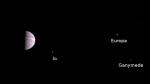
 Juno probe returns photo. Credit: BBC

Juno probe returns photo. Credit: BBC

Juno probe returns first in-orbit Jupiter photo
The American space agency’s new Juno mission to Jupiter has returned its first imagery since going into orbit around the gas giant last week.

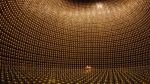
Inside the Super-Kamiokande detector in Japan

Inside the Japanese Super-Kamiokande detector

Flavor changing neutrinos give insight into Big Bang
The question of why are we here perhaps means different things to different people, but in the field of particle physics it is a question that we may be close to finding an answer to.

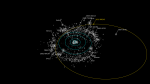
Dwarf Planet, the Latest of Many

Dwarf Planet, the Latest of Many. Photo: NYTimes

Astronomers Discover New Likely Dwarf Planet, the Latest of Many
The neighborhood beyond Neptune is becoming ever more crowded, with astronomers announcing this week the discovery of another likely dwarf planet.

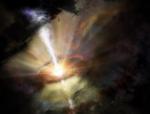
Black hole 'feasting'. Photo: BBC

Black hole ‘feasting’. Photo: BBC

Cardiff University astronomers observe black hole ‘feasting’
Astronomers at Cardiff University have observed a supermassive black hole preparing to “feast” in a galaxy one billion light years from Earth.

Low-cost satellites to Moon's orbit. Photo: BBC

Low-cost satellites to orbit Moon. Photo: BBC

British partnership to send low-cost satellites to Moon’s orbit
A British partnership has announced plans for low-cost lunar missions and space exploration. Goonhilly Earth Station in Cornwall and Surrey Satellite Technology Ltd plan to send a “mother ship” to transport satellites beyond Earth’s orbit.

It is being called a “new model of low-cost, high-value, space exploration”.

Juno mission

Juno mission. Photo: BBC

What would it be like to fall into Jupiter?
What would it be like to fall through Jupiter’s many gaseous layers? And what is at the center of the planet? Is there a solid core?

Osiris-Rex launch

Osiris-Rex launch

NASA Launches Osiris-Rex Spacecraft to Retrieve Asteroid Pieces
The craft is set to return to Earth in seven years with bits of a nearby asteroid that would give scientists a window on some of the material that made up the early solar system.

Posted in September 2016, Sidereal Times | Tagged , | Leave a comment

From the Director

Rex


by Rex Parker, Director

New Telescope for the Observatory. After the vote at the June meeting the new telescope acquisition proposal was approved by the membership (34 “yes” votes). For the record, the previously stated need for a 40% quorum was outdated (my mistake); current by-laws require “majority of the votes cast and not less than 30% of membership”. A big thanks to several members who volunteered to serve on the telescope search and selection committee: Bill Murray, Larry Kane, Jim Poinsett, Arshad Jilani, John Church, Jim McHenry, and Jeff Bernardis; Ira Polans, Dave Skitt, Jennifer Skitt, Gene Ramsey, and Michael Mitrano also weighed in. A telescope interest survey in late June elicited 35 member responses and helped sort out priorities. The selection committee reviewed many options and through four teleconferences the following candidates were considered:

     • 16-22” f/5 Dobsonian Newtonian, tabled the idea for future consideration.
      • Parallax 14” f/7 Newtonian, decided against due to ergonomics of eyepiece position.
      • 6” TMB apochromatic refractor, decided against due to similarity to Hastings 6”.
      • TEC 8” f/20 Maksutov Cassegrain, decided against due to smaller aperture.
      • Luton Optics 10” f/20 Maksutov-Cassegrain.
      • TEC 10” f/20 Maksutov Cassegrain.
      • Takahashi Mewlon 250 10” f/12 Dall-Kirkham Cassegrain.

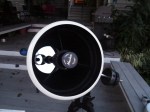
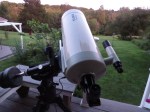
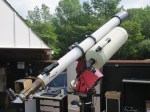
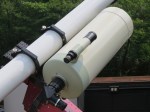
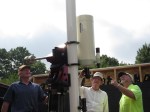
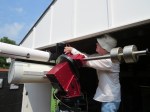
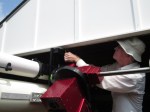
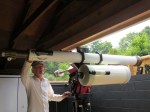
In the end the decision came down to the Cassegrain designs, and the Takahashi Mewlon 250 was selected. This very high quality instrument has a 3-meter focal length and excels with high resolution and very good contrast. The outstanding optical quality of the Mewlon mirrors and the Dall-Kirkham Cassegrain design are especially well suited for planetary/lunar observing, but the scope is also very capable with deep sky celestial objects as well. There are several reviews on the internet available, such as the Cloudy Nights forum, which help to understand just how special this telescope is. The telescope, Feathertouch focuser, and mounting hardware were received in late July. On July 30, Gene Ramsey, Tom Swords, and I mounted the Mewlon onto the Paramount ME alongside the Hastings refractor. Some pictures are below and more are posted on the website. Let’s have some good member turnouts at the Observatory this Aug and Sept to try out the new telescope.


Takahashi Mewlon 250 acquired by AAAP mounted on the Paramount ME alongside the historic Hastings refractor at the Observatory Jul 30. Working on the scope are Gene Ramsey, Tom Swords, and Rex Parker.

Posted in Mid-summer 2016, Sidereal Times | Tagged , , | Leave a comment

Minutes of the June 14, 2016 AAAP Meeting

by James Poinsett, Secretary

  • Rex called the meeting to order.
  • Gene introduced the newest keyholder, Tim Donney.
  • John announced that Sky and Telescope has accepted the story about viewing the Mercury Transit through the Hastings/Byrne refractor, the third century that instrument has viewed such an event.
  • Rex brought up the subject of adding another scope to the mount with the refractor.
  • Treasurer Michael Mitrano reported that club treasury is in excess of $25000. He also stated that some money needs to be spent or dues reduced.
  • It was brought up that the observatory has been modified to allow a larger scope on the south mount with the refractor, there is plenty of space to fit any scope the club could afford.
  • Discussion was held on the proposal to spend up to $10K to purchase an extraordinary to add to the observatory. Points that were brought up include:
    • A scope that would stand out and make the club more attractive to new members.
    • A larger dedicated hydrogen-alpha solar scope.
    • An exceptional planetary scope.
  • A motion was made to spend up to $10K on a scope to be decided upon by a committee. The motion was seconded and a vote was held. The motions passed 35 yes votes to 0 no votes.
  • There were several volunteers for the committee, Rex will host a conference call to get the process started.
  • Gene brought up his concern that the columns supporting the roof of the observatory needed to be inspected for wear and tear, Jim McHenry knows a mason who will inspect them for us and make a recommendation.
  • Gene also expressed concern about the park’s ability to maintain the gates and roads to access the observatory. Larry will speak with the Friends of WC Park to see what may be done.
  • The topic of getting an internet connection at the observatory to update software. Jim McHenry will look into getting a wireless 4G connection.
  • Ira and the program committee were thanked for the excellent lecture series this past season.
  • Larry brought up that it is time for a new batch of AAAP shirts. More discussion will be held in the future.
  • Gene shared a thank you letter for our outreach from Hopewell Elementary School.
  • We have two volunteers to help Surabhi with Sidereal Times.
  • Meeting was adjourned.
Posted in Mid-summer 2016, Sidereal Times | Tagged , | Leave a comment

Because Rust Never Sleeps

by Michael Wright

Corrosion Technology lab

Corrosion Technology lab

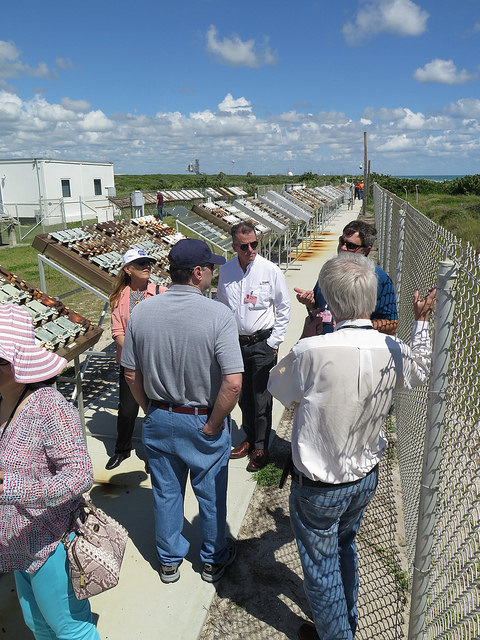
In May, I ran a workshop in Orlando on “Successful Preservation Practices for Steel Bridge Coatings”. Representatives from NASA presented at the workshop and invited the participating experts from various Departments of Transportation to tour their Corrosion Technology Laboratory and Beach Atmospheric Exposure Site at Kennedy Space Center.

Why was NASA invited to a workshop on bridge painting? NASA has been dealing with corrosion since the early years of the space program because Kennedy Space Center and Cape Canaveral Air Force Station are in one of the most naturally corrosive environments in North America. Launch facilities are exposed to salty ocean air, high ambient air temperatures, UV light and 5000°F engine exhaust. When the Space Shuttle began launching with solid rocket boosters, corrosion at the launch pads became even more severe due to the solid rocket exhaust. Every shuttle launch dumped the equivalent of 70 tons of hydrochloric acid on Launch Complex 39, pads A & B.

Team visits lab

The Corrosion Technology Laboratory has developed corrosion protection standards used program-wide and new methods to evaluate and test materials and coatings. They are currently working on more environmentally friendly coatings, and “smart” coatings using micro-capsules and micro-containers that can detect, indicate and heal corrosion. More detailed information is on their website: http://corrosion.ksc.nasa.gov

I was very impressed with the pride that our NASA hosts had in the space program and their dedication to keeping the NASA’s personnel and facilities safe.

In addition to visiting the Beach Atmospheric Exposure Site, we toured the Space Station Processing Facility where the International Space Station’s modules were prepared for launch. This facility now prepares experiment packages going to the ISS. For example, botanists are developing packages that will be used to grow plants to sustain astronauts traveling to Mars. The packages are sent up to the ISS where the astronauts grow the plants in micro-gravity.

Check out pictures of both facilities and a few other cool sites at KSC in my Flickr album.

Posted in Mid-summer 2016, Sidereal Times | Tagged , , , , | 1 Comment

Snippets

compiled by David Kaplan

Proxima b: An artist’s impression Photo: NYTimes

Proxima b: An artist’s impression Photo: NYTimes

One Star Over, a Planet That Might Be Another Earth
Another Earth could be circling the star right next door to us. Astronomers announced on Wednesday that they had detected a planet orbiting Proxima Centauri, the closest neighbor to our solar system. Intriguingly, the planet is in the star’s “Goldilocks zone,” where it may be neither too hot nor too cold. That means liquid water could exist at the surface, raising the possibility for life…more
Atmospheric Dynamics Mission (ADM-Aeolus). Photo: BBC

Atmospheric Dynamics Mission (ADM-Aeolus). Photo: BBC

Aeolus space laser catches a following wind
Europe’s Aeolus space laser mission, which is designed to make unprecedented maps of Earth’s winds, has reached a long-awaited key milestone. Engineers at Airbus in the UK have finally managed to bolt together all the elements of the satellite after overcoming major technical challenges.

Aeolus is now set for several months of testing before being sent into orbit next year…more
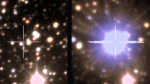
The nova eruption. Photo: BBC

The nova eruption. Photo: BBC

Star snapped before and after nova explosion
Astronomers have captured rare images of a tiny star before, during and after it exploded as a “classical nova”. In this type of binary system, a white dwarf sucks gas from a much bigger partner star until it blows up – about every 10,000 to one million years. Now, a Polish team has caught one in the act using a telescope in Chile…more
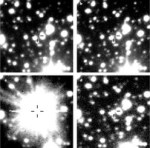
Nova lifecycle. Photo:Nature

Nova lifecycle. Photo:Nature

The awakening of a classical nova from hibernation
Cataclysmic variable stars—novae, dwarf novae, and nova-likes—are close binary systems consisting of a white dwarf star (the primary) that is accreting matter from a low-mass companion star (the secondary).

From time to time such systems undergo large-amplitude brightenings. The most spectacular eruptions, with a ten-thousandfold increase in brightness, occur in classical novae …more
 Photo:ESA/NASA

Photo:ESA/NASA

Don’t Let Them Tell You You’re Not at the Center of the Universe
Misconception: The universe started someplace.
Actually: The Big Bang didn’t happen at a place; it happened at a time, namely 13.8 billion years ago, according to the best cosmological data….more
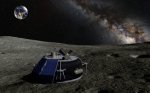
An artist’s conception of Moon Express’s MX-1 lander. Photo: NYTimes

An artist’s view. Photo:NYTimes

Florida Company Gets Approval to Put Robotic Lander on Moon
A small start-up has received the green light from the federal government to do something that NASA has not done for more than four decades: land on the moon. Moon Express, based in Cape Canaveral, Fla., announced Wednesday that it had received approval from the FAA to set a robotic lander on the moon…more
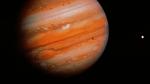
The huge storm, seen here by Voyager 1 in 1979, apparently creates a high-altitude hotspot. Photo: BBC

A high-altitude hotspot. Photo:BBC

Jupiter’s Great Red Spot ‘roars with heat’
Jupiter’s Great Red Spot – a hurricane three times bigger than Earth – is blasting the planet’s upper atmosphere with heat, astronomers have found. Using measurements from an infrared telescope in Hawaii, a UK and US team found evidence for temperatures as high as 1,500C – hundreds of degrees warmer than anywhere else on the planet…more
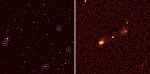
Unknown galaxies. Photo: NYTimes

Unknown galaxies. Photo: NYTimes

South African Telescope Spots 1,300 Unknown Galaxies
Left: A patch of sky about as big as the full moon where the MeerKAT telescope discerned the radio glow of about 200 galaxies. Only a few (circled) had been previously observed; Right: A distant galaxy with an explosive core powered by a black hole…more


Posted in Mid-summer 2016, Sidereal Times | Tagged , , , | Leave a comment

From the Director

Rex


by Rex Parker,  Director

June 14 meeting – quorum needed for proposal below – please participate in the motion. We’ll be meeting at the NJ State Museum Planetarium, our tradition each June. Bill Murray, AAAP member and staff technical guru at the Planetarium, will be running the show. See Ira’s section in this month’s Sidereal Times.

Capital expenditure proposal at June 14 meeting: Authorize expenditure of up to $10,000 to acquire a telescope for the Observatory. Specifically the idea is to purchase a telescope to co-mount with the Hasting 6” refractor on the second Paramount at the club’s Washington Crossing Observatory. The goal is to obtain the new scope in time to support this summer’s observing season. The treasury can readily absorb the expenditure. I will also appoint and chair a committee to decide on the specific telescope.

AAAP by-laws state: “For expenditures or appropriations in excess of $500 per meeting, a quorum of 40% of the membership shall be required; up to 25% of the membership may be represented by written and signed absentee ballot on an expenditure question that has been previously published in the Association’s monthly newsletter.”

Rationale and recommendation for the proposed new telescope. One of our greatest assets is the Observatory at Washington Crossing State Park. It enables the direct experience of astronomy for our members and provides the stage for public outreach where we connect with hundreds of kids and adults every year. As detailed in the plan reviewed by the Board 2 years ago, the goal is to upgrade the telescopes and instruments and computer/software systems to improve the quality of the experience at the Observatory. Some of the equipment has indeed been upgraded. To complete the plan, the current proposal is to acquire an instrument that compliments the existing telescopes. It would be primarily used visually but should be capable of digital imaging as well.

The recommendation, discussed at the March Board meeting, is to identify a telescope designed to excel at planetary/lunar/double star observing as well as the smaller deep sky objects such as planetary nebulae. Candidates (likely “used” scopes) include a 6” apochromatic refractor, 10” Maksutov-Cassegrain reflector, Dall-Kirkham Cass (such as a Takahashi Mewlon), or maybe a dedicated solar scope. At least two used telescopes have been identified to date that fit the requirements. There will be time to discuss which scope and why over the next several weeks, but the time to conduct the procedural requirement is June 14 if we want to acquire it this summer.

Seeking a new Co-Editor of Sidereal Times. We seek a member with the “right stuff” to succeed Michael Wright as co-editor of the ST, along with Surabhi Agarwal who will continue. Sidereal Times is the official voice of AAAP and is updated on-line monthly as a blog on our website. The co-editor manages written contributions from members and has the opportunity to apply creative writing skills and become proficient in WordPress. This is a visible and high status role in the club and brings internet visibility to the editors and contributors and the club as a whole. Please contact me and/or Surabhi if interested.

Plan to attend Jersey StarQuest Oct 28-30. If you’d like to get away from light pollution with your telescope but wonder where to go and safely observe in public places, Starquest is an opportunity to observe under some of the better skies in the NJ area. AAAP will host the annual Jersey StarQuest Oct 28-30, 2016 at the Hope Conference and Renewal Center in Hope, NJ. This family-friendly event is located in northern Jersey (north of Jenny Jump State Forest). If you don’t own a scope, this is an excellent event to observe through many different kinds and learn more about telescopes and mounts. The venue offers a fine observing field with electricity under good skies, modern bunkhouses, showers, and group lobby area with kitchen. Registration will be walk-in with modest pay-on-arrival fee. Mark your calendar!


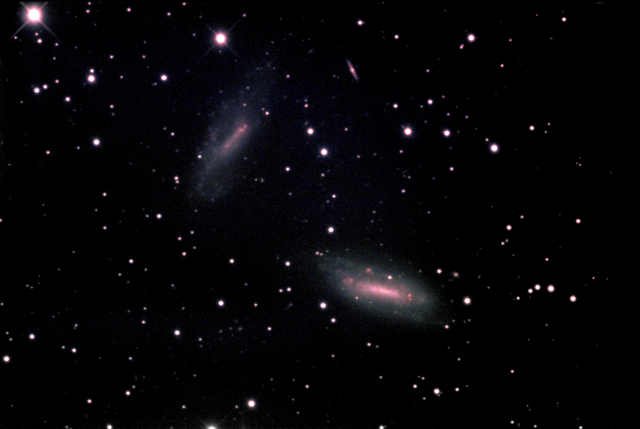
NGC672, interacting galaxies in the constellation Triangulum. Credit: Rex Parker, 2016, www.rexparkerpixels.com

NGC672, interacting galaxies in the constellation Triangulum. Credit: Rex Parker, 2016, http://www.rexparkerpixels.com

Posted in June 2016, Sidereal Times | Tagged , , | Leave a comment

AAAP June 14, 2016 Meeting – NJ State Planetarium

by Ira Polans, Program Chair

New Jersey State Museum

New Jersey State Museum

The June meeting of the AAAP, and our last until next September, will take place on June 14th at the Planetarium of the New Jersey State Museum in Trenton. The meeting will start at 7:30 PM.

In addition to our normal club meeting attendees will view a live star talk as well as our new science show at the Planetarium, “Asteroid: Mission Extreme”.

There is plenty of parking in front of the planetarium entrance behind the museum.

Museum is located at – 205 W. State Street, Trenton, NJ 08625

We look forward to seeing you at the meeting.

The program committee is beginning to look for speakers for September and beyond. If you have any suggestions please email program@princetonastronomy.org.

Posted in June 2016, Sidereal Times | Tagged , , , | Leave a comment

Minutes of the May 10, 2016 AAAP Meeting

by James Poinsett, Secretary

  • Assistant Director Larry Kane called the meeting to order and introduced the chairman of the nominating committee, Bill Murray.
  • Bill read the slate of candidates for officers for the 2016/2017 club year and asked if there were any other members interested in running for office, no one volunteered. The election was held and the slate was elected unanimously, there were 40 members present and voting.
  • Larry continued the meeting after the lecture and thanked everyone who participated in communiversity, we had a very good day.
  • Michael Mitrano, the treasurer, had no news to report.
  • Secretary Jim Poinsett sent an email to all members requesting they respond to confirm their email address. If you didn’t receive that email please email secretary@princetonastronomy.org to confirm your email.
  • Gene Ramsey gave the observatory report.
    • We had a good day for the Mercury transit. There were 10 telescopes at the observatory for viewing. An article is being written for Sky and Telescope about using it being the third century the H/B refractor was used to view a Mercury transit.
    • There was poor weather for the scout jamboree. We still managed to show them the observatory and telescopes. There was a brief window of clear sky for viewing on Saturday night.
  • Two representatives from Jenny Jump were visiting to discuss our rarely used observatory. They suggest sharing/leasing it with a NY club that is interested or possibly giving it up entirely. The discussion on this will continue at future meetings.
  • Michael Wright has stepped down as co-editor of SideReal Times. A new co-editor is needed. Let Surabhi know if you are interested.
  • Two nights of a planetarium/observatory program are planned, they are May 13th and 27th.
  • The Cherry Springs Star Party is June 2-5, a group is planning on meeting there. Speak with Rex Parker or Bill Murray if you are interested.
  • Dave Skitt is setting up tax-exempt status with a computer vendor for the club. Soon we will have the new computers and software that was approved for purchase.
  • There being no further business the meeting was adjourned.
Posted in June 2016, Sidereal Times | Tagged , | Leave a comment