by Rex Parker, PhD director@princetonastronomy.org
Meeting Sept 8 (7:30pm) on Campus. Welcome back to our monthly astronomy club meetings in person (and Zoom) after the summer hiatus. Reacquaint with other members and catch up on ideas and activities for the club this fall. Our long-time venue Peyton Hall is still under reconstruction and Sherrerd Hall, our location in May, is not available on this date. So, on Sept 8 at 7:30pm we have arranged to meet in Louis Simpson Hall room A71, just a stone’s throw from Sherrerd Hall. Parking lots and streetside spots are very close on William Street. Stay tuned to your email the night before for any last-minute announcements. Here’s a map, Simpson Hall is #8 on this chart. Simpson Hall Map
There have been tremendous advances in astrophotography in the past several years, from smart telescopes to harmonic mounts to remote observing. The Sept 8 meeting will delve into the current state of astrophotography as practiced by amateur astronomers. We’ll feature two members who have great experience here, Dr Michael DiMario and Dr Bob Vanderbei. For more on the presentation please see Victor’s article below.
Also at the Sept 8 meeting after the main presentation, we’ll discuss “What you did on your Summer Vacation”. Here is an opportunity to tell others about your great astro escape or other astronomy/science adventures or trips you took this summer. Please send a note to me and Program Chair Victor if you’d like to hold a 5-10 minute slot to relate your escapades.
The Planets Return to our Stage. Solar system watchers have had some sparse evenings this summer, with Jupiter nowhere in sight till the wee hours. But the situation is becoming more enticing. While Venus has been steady in the western sky after sunset at an astonishing brightness (magnitude -4.4) only recently has its phase become a sight worth pulling your telescope out for. Recalling that only planets sun-ward from earth can display a phase in telescopes, the phases of Venus are interesting to study. The illuminated disk of Venus will be ~40%, making a beautiful telescopic crescent as it shines just south of first magnitude Spica in Virgo in early Sept..
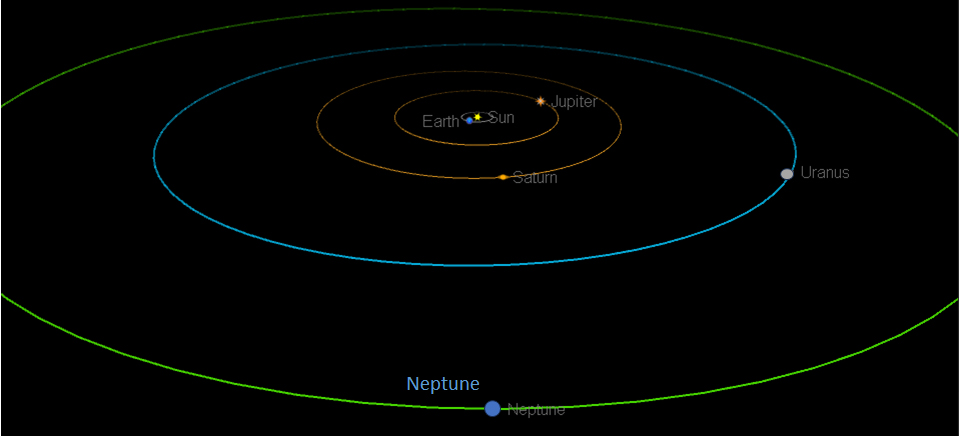
And now the observing windows for the gas giant planets are opening up for evening observing. The opposition of Neptune (when it is closest to earth) occurs during late September. Neptune at opposition is still very far away, about 2.7 billion miles or 240 light minutes from earth. Because it is completely invisible to the naked eye (magnitude ~7.8), Neptune is much less viewed and of course much more difficult to see than the other gas giants. It can be estimated that well under 1 in 1000 people (0.1%) in the US have observed Neptune. Can you hunt down its tiny, bluish-green disk using finder charts near the Great Square of Pegasus? The club’s telescopes at our Washington Crossing Observatory have enough magnification and aperture to make it feasible and worthwhile for you to join that 0.1%.
The planetary positions in September from TheSkyX star chart. Neptune is ~4 light hours away (about 2.7 billion miles, 28 astronomical units).