
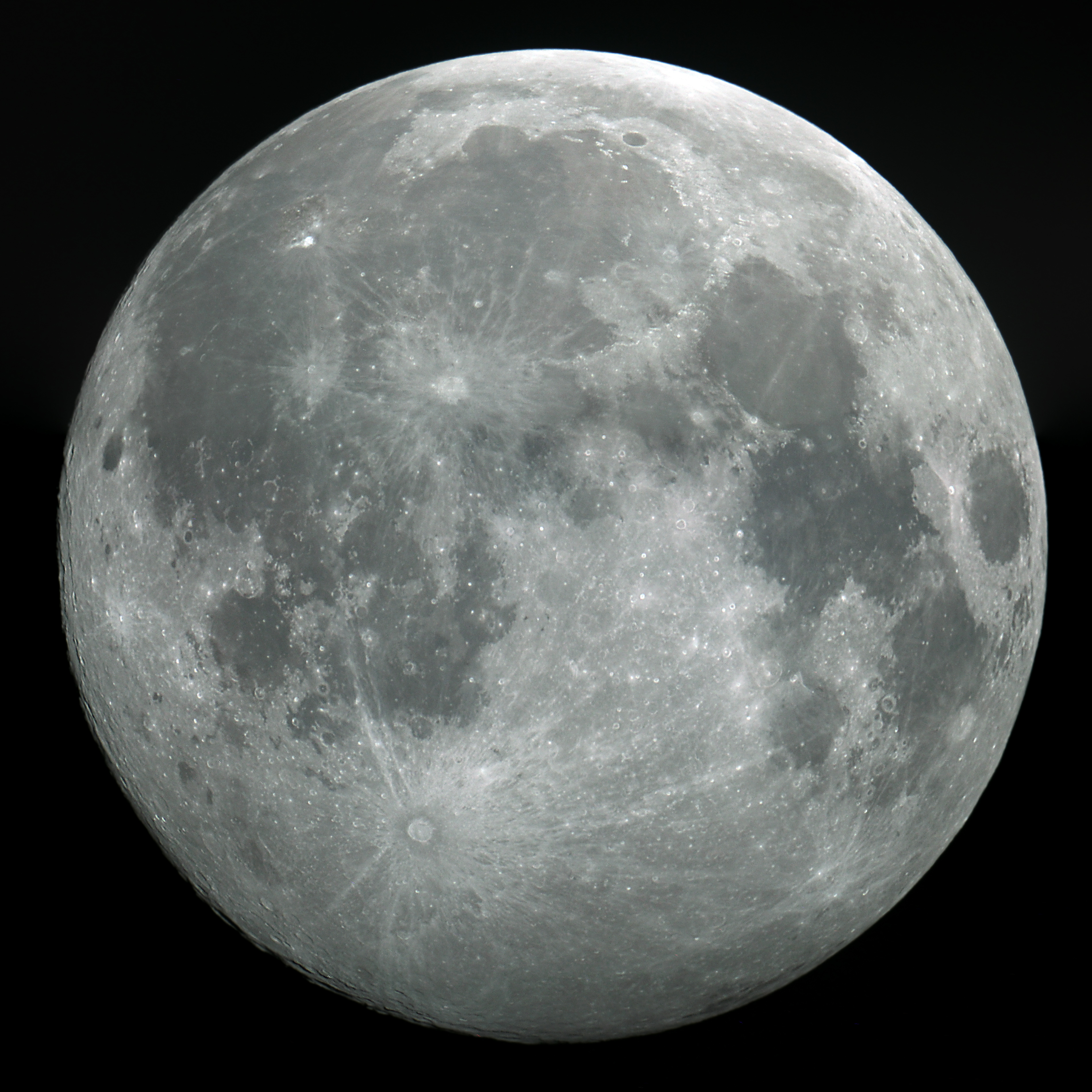
Blue Moon by Member Robert Vanderbei
July 30, 2014, 22:35 EDT (8 hours before actual full fullness)
Canon 450D on 10″ RC
Four-image Mosaic of 8-image stacks.
Exposure: 1/2400 sec at ISO 800.
Blue Moon by Member Robert Vanderbei
July 30, 2014, 22:35 EDT (8 hours before actual full fullness)
Canon 450D on 10″ RC
Four-image Mosaic of 8-image stacks.
Exposure: 1/2400 sec at ISO 800.
Compiled by David Kaplan and Michael Wright
Politician wants to renew legislation to ban green lasers:
Blinded by the light: Who is shining laser pointers into planes over N.J.? NJ.com
12 planes hit by blinding lasers in N.J. among dozens targeted in U.S. in one night: NJ.com
Astronomy meets the blues: When I Look into the Night Sky by Lori Henriques
“I know that I am mortal by nature and ephemeral, but when I trace at my pleasure the windings to and fro of the heavenly bodies … I stand in the presence of Zeus himself and take my fill of ambrosia.” ~Ptolemy
The flyby of Pluto was a triumph of human ingenuity and the capstone of a mission that unfolded nearly flawlessly. It almost did not happen. NYTimes
The NYTimes says the New Horizons flyby ends an era of planetary exploration. I don’t think so. It ended with the Voyager flyby of Neptune. We just did not know it. Maybe this flyby begins an era of Kuiper belt object exploration? ~Mike
Extraordinary lunar astrophotography by Paolo Lazzarotti National Geographic
Don’t miss NYTimes’ Summer of Science
Space video cameras to circle globe: Canadian group Urthecast plans to put a 16-satellite constellation in orbit to image the Earth, including making small movies of what is happening at the surface of the planet. BBC
Volcanic eruptions glimpsed on Venus: Scientists say they have the best evidence yet that there is hot lava spewing from the surface of Venus. BBC
Recently discovered galaxy, CR7, holds the signature of a lost generation of stars that created the elements needed for life. NYTimes
Philae comet lander wakes up: the Philae lander which lost power after historic comet landing has woken up and contacted Earth – European Space Agency BBC
Earth enters new extinction phase: The Earth has entered a “new period of extinction”, a study by three US universities concludes, and humans could be among the first casualties. BBC
Ceres’ spots seen in more detail: NASA releases a new, higher-resolution picture of the brightest spots on the dwarf planet Ceres. BBC
Aiming to make the first portrait of the hungry monster at the center of our galaxy, astronomers built a telescope as big as the world. NYTimes
HST studies Pluto’s wobbly moons: Hubble reveals fascinating new details about Pluto’s four smaller moons – Styx, Nix, Kerberos and Hydra. BBC
Does science always need empirical evidence? NYTimes
Green light for Magellan super-scope: Construction of the Giant Magellan Telescope receives the go-ahead, leading to preliminary operations in 2021 or 2022. BBC
Hadron collider turns on data tap: the Large Hadron Collider has re-started scientific investigations after a two-year pause. BBC
Black hole seen ‘playing billiards’: a series of images captures two vast blobs of plasma, shot out by a black hole, cannoning into each other in a nearly light-speed cosmic collision. BBC
by Rex Parker, PhD, Director
Tuesday June 9 (7:30 pm) at the New Jersey State Museum Planetarium will be the last regular monthly meeting of the season. You are welcome to bring family and friends for our gathering at the Planetarium, at 205 West State Street in the capitol area of Trenton. AAAP member and Planetarium staffer Bill Murray will give us a private show (no charge) using the state-of-the-art “Full DomeVideo” technology which immerses the audience within images covering the entire dome. http://www.nj.gov/state/museum/dos_museum_programs_planetarium.html
The meeting continues the tradition of AAAP sharing the vision of the Planetarium to bring astronomy experiences to the public. After the show, we’ll review club plans for summer observing activities at the Washington Crossing Observatory, and discuss the upcoming Cherry Springs State Park astronomy observing field trip (see below).
Officers and Committees. At the May meeting, a new Board of Trustees was elected to lead the club in the next season. I would like to congratulate and thank my colleagues on the Board: Assistant Director Larry Kane, Program Chair Ira Polans, Secretary Jim Poinsett, and Treasurer Michael Mitrano. Deep appreciation goes to former Program Chair Kate Otto for bringing in so many good speakers the last three years, and thanks to Prasad Ganti and John Miller who form the new Program Committee with Ira. Thanks also to continuing Outreach Chair Dave Letcher, and Observatory Co-chairs Gene Ramsey and Dave Skitt, along with Jennifer Skitt, John Church, and the Keyholders for improving the observatory and running our weekly public observing operations.
Upcoming Events
Astronomy Observing Field Trip to Cherry Springs State Park, Pennsylvania, June 19-20. This will be the dark sky observing event of the year! Plan for both Friday and Saturday nights, June 19 and 20. The trip is contingent on good weather and sky conditions to be decided the week of the event. We don’t have a backup date at this time.
The park is situated at 2300 ft elevation deep in the wild forests of north-central PA. It has some of the darkest and best skies for astronomy in the entire eastern U.S. All interested AAAP members are invited to attend, but please understand that this will be a “roughing it” type trip. We will happily offer telescope viewing access and share knowledge of the celestial sphere to members and family/friends, attendees must provide their own transportation, equipment and supplies including tent, sleeping bag, food and drink. Please read carefully the information on the Cherry Springs State Park website:
Pennsylvania State Parks
Serious Stargazing at Cherry Springs State Park
It’s about a 5 hour drive from Princeton (important – see recommended directions, below). You must arrive well before dark to set up even if you don’t have a telescope (i.e., setting up tents etc). White flashlights or other white lights on or near the observing field are strictly prohibited. Red flashlights are accepted and are a necessary item. It’s important to understand there are essentially no amenities except for 110V AC electrical plug-ins and concrete telescope pads. You must bring all of your own supplies, tents and camping equipment, food and drinks, etc. Water for washing dishes is supplied at several pumps located around the site. There are modern bathroom facilities and sinks, but no showers at Cherry Springs State Park, and the nearest showers are at Lyman Run State Park about 10 miles down the road. Those are good private showers with hot water. There are no motels or restaurants nearby. Some have complained about the taste of the water available at the site; fracking is done in the area. The water is fine for washing but if you care about this point, it is recommended that you bring drinking water with you.
Be ready for dew at Cherry Springs. If the sky is clear there will be dew, probably more dew than you have ever seen. Everyone should have dew heaters and/or “hair dryers” for their scopes. Dew shields are useful but not enough. Bring an extension cord as well.
Directions. The directions given on the Cherry Springs Star Party website are not the best. They will take you through ~50 miles of unpaved logging roads to get to Cherry Springs State Park. It has been suggested by observers from recent years that the best way to get there is the following.
Please respond by e-mail if you plan to make the trip (director@princetonastronomy.org). I look forward to having you join us at Cherry Springs!
by Ira Polans, Program Chair
AAAP member Bill Murray will once again host the AAAP’s last program of the season on June 9th at the New Jersey State Museum Planetarium. Members will gather at 7:30 for a private show. Friends and family are welcome. Free parking and easy access to the Planetarium is available. After the show, there will be a meeting to review the AAAP’s summer activities.
by Larry Kane, Assistant Director
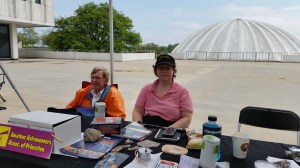
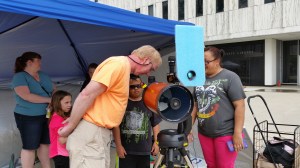
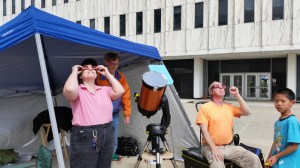
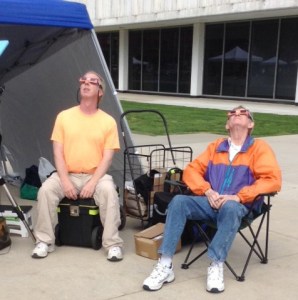
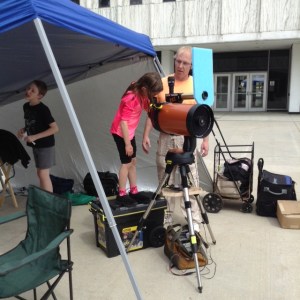
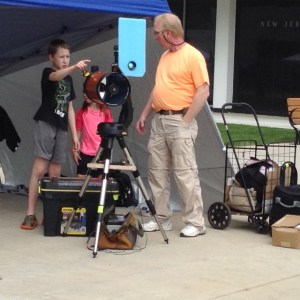
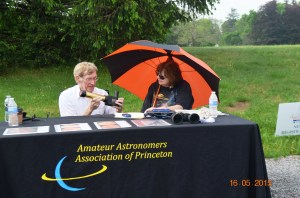
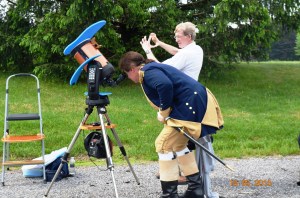
May saw the AAAP table turn up at two events. At the first event, Super Science Saturday in Trenton, our club was represented by Gene Ramsey, Jennifer and Dave Skitt and myself, as custodian of the club’s table banner. Even though the day started with rain, it did stop. Lots of people turned out to talk to us and take free literature offered by Astronomy Magazine and the AAAP. Despite the continuing cloud cover that thwarted our efforts to view the Sun, everyone that came to our table went away pleased and more knowledgeable about the AAAP.

by Michael Mitrano, Treasurer
New memberships and renewals have tapered off, but hopefully the summer public nights will bring us more new members. Our count now stands at 88.
With the purchase of additional equipment to improve the observatory, we are now showing a $1,300 loss for the fiscal year to date. Since we account for the cost of new equipment when it is purchased rather than using accrual accounting to depreciate it over time, we will show a loss in a year when we use some of our reserves to invest in the facility.
On a cumulative basis, the AAAP’s surplus is slightly below $24 thousand.
by Jim Poinsett, Secretary
by David Kaplan
Time is more ancient
Than the stars.
It is a dimension.
A silent perpetual
Motion machine.
Time is unforgiving.
Verdict and sentence
Are handed down to both
The guilty and the innocent.
Time is without obstruction.
In its headlong drive, it births
Evolution, yet limits life.
Time is insurmountable.
A semi-transparent wall of memories,
Distorted under the weight of age.
Time is change.
Time is impermanence.
Time stops not for an unwound clock.
by S. Prasad Ganti
Recently, the committee on a Strategy to Optimize the U.S. Optical and Infrared System (OIR) in the Era of the Large Synoptic Survey Telescope (LSST) came up with set of recommendations. This is a summary of the draft version of the report. I organized the summary in form of notes and conclusions and recommendations. Each paragraph is marked accordingly.
NOTES: The committee’s highest priority is a U.S. OIR System that is well coordinated and facilitates broad access to do the best science. An integrated OIR System can do the best science when it engages a broad population of astronomers to pursue a diversity of science and scientific approaches.
NOTES: But why OIR region? Setting aside the cosmic microwave background radiation, most of the radiation in the universe is starlight, and the infrared background is largely radiation from dust heated by stars. X-ray astronomers and radio astronomers need to know what kind of optical and infrared light is associated with their sources to understand their nature. A growing trend in astronomical research is the synergy between observations with different telescopes and instruments in the study of astrophysical phenomena. This includes coordinated use of multiple ground-based OIR facilities with complementary capabilities, use of OIR facilities in combination with ground based observations at other wavelengths, and use of OIR facilities in combination with space based facilities.
RECOMMENDATION: The National Science Foundation should support the development of a wide-field, highly multiplexed spectroscopic capability on a medium or large aperture telescope in the Southern Hemisphere to enable a variety of science, including follow-up spectroscopy of LSST targets.
RECOMMENDATION: The National Science Foundation (NSF) should continue to invest in the development of critical instrument technologies, including detectors, adaptive/active optics and precision radial velocity measurements. NSF should also use existing instrument and research programs to support small-scale exploratory programs that have the potential to develop transformative technologies.
NOTES: Powerful science comes from combining space-based observations with data from the OIR system. In the 1990s, HST (Hubble Space Telescope) along with Keck, HET (Hobby-Eberly Telescope), Gemini, Magellan, and other large ground-based telescopes worked effectively to exploit these opportunities. In the 2020s, JWST (James Webb Space Telescope) along with LSST and other large telescopes and the GSMTs (Giant Segmented Mirror Telescopes-Giant Magellan Telescope in Hawaii and Thirty Meter Telescope in Chile) will combine to solve a new set of cosmic mysteries. Along with ESO’s (European Southern Observatory) 39-meter European Extremely Large Telescope (E-ELT) in Chile, will revolutionize OIR astronomy by achieving angular resolution and depth far beyond current telescopes.
RECOMMENDATION: The National Science Foundation should plan for an investment in one or both Giant Segmented Mirror Telescopes to capitalize on these observatories’ exceptional scientific capabilities for the broader astronomical community in the Large Synoptic Survey Telescope era, such as through shared operations costs, instrument development, or limited partnerships in telescope or data access or science projects.
NOTES: While the field of astronomy is driven by the existence of state-of-the-art facilities for collecting photons from astronomical sources, the pursuance of research in astronomy, and in particular the physical understanding of astronomical phenomena, requires software, analysis techniques, scientific interpretation, theoretical work, and numerical simulations.
CONCLUSION: Making effective use of petabyte-scale databases (“big data”) requires new skills, and the astronomical community working in this area needs to continue to develop algorithms and procedures for data processing and analysis to take advantage of the next generation of data sets.
RECOMMENDATION: The National Science Foundation should help to support the development of event brokers, which should use standard formats and protocols, to maximize LSST transient survey follow-up work.
RECOMMENDATION: The National Science Foundation (NSF) should support a coordinated suite of schools, workshops, and training networks run by experts to train the future generation of astronomers and maintain instrumentation, software, and data analysis expertise.
RECOMMENDATION: A data archive that is publicly accessible and well curated is a commendable central goal for every major survey from a public or private facility.
RECOMMENDATION: The National Science Foundation should ensure via a robustly organized U.S. OIR System that a fraction of the its observing time be allocated for rapid, faint transient observations prioritized by an Large Synoptic Survey Telescope event broker system so that high-priority events can be efficiently and rapidly targeted.
My two cents is that with the coming of an era of more powerful telescopes, both on ground and in space, strategizing to make the best use of the telescopes and giving a boost to the accompanying technologies augurs well for astronomy in US.
Compiled by David Kaplan and Michael Wright
Galaxies die by slow ‘strangulation’ – A study suggests that when most galaxies stop forming stars, this death is a slow process that gradually chokes them of the necessary cool gases. BBC
The Quiet Zone: Where mobile phones are banned – Two-hundred miles west of Washington DC lies the National Radio Quiet Zone – 13,000 square miles of radio silence. What is it for and how long will it survive? BBC
New Horizons Dust Counter – An instrument built at the University of Colorado is analyzing space dust for the remnants of colliding objects to learn more about our solar system. NYTimes
World Science Festival – Brian Greene, the physicist and a festival founder, and Alan Alda, a board member, hope to awaken a love of science in the non-academic public. NYTimes
Celestial Vault – The astronomical optical illusion/art installation in the Hague known as the Celestial Vault is a curious place that is equal parts Druidic stone altar and stark modern landscaping which allows those willing to interact with it a chance to see the heavens in a new way. Atlas Obscura
Roden Crater – The artist James Turrell is repurposing an extinct volcano crater as an observatory to experience the cosmos. Atlas Obscura
by Dr. Ken Kremer, Universe Today and AAAP
On May 20, the X-37B, a reusable Air Force space plane launched from Cape Canaveral, Florida, on its fourth classified mission. The program is steeped in mystery about its true goals for the U.S. military. It was accompanied to orbit by ten tiny CubeSat experiments for NASA and the National Reconnaissance Office (NRO) including a solar sailing demonstration CubeSat for The Planetary Society called LightSail.
The military space plan successfully blasted off for low Earth orbit atop a 20-story United Launch Alliance Atlas V rocket at 11:05 AM EDT from Space Launch Complex-41 on Cape Canaveral Air Force Station, Florida on the clandestine Air Force Space Command 5 satellite mission for the U.S. Air Force Rapid Capabilities Office. The exact launch time was classified until it was released by the Department of Defense a few hours before liftoff.

US Air Force X-37B mini space shuttle encapsulated in 5-meter payload fairing and bolted atop an Atlas 5 rocket at Pad 41 at Cape Canaveral Air Force Station, Florida before May 20, 2015 launch. Credit: Ken Kremer
Among the experiments were 10 CubeSats housed in the Aft Bulkhead Carrier located below the rocket’s Centaur upper stage. Together they are part of the National Reconnaissance Office’s Ultra Lightweight Technology and Research Auxiliary Satellite (ULTRASat). They were contained in eight P-Pod carriers from which they were deployed in orbit.
Among the few non-classified experiments aboard was a NASA materials science experiment called METIS and an advanced Hall thruster experiment. The Hall thruster is a type of electric propulsion device that produces thrust by ionizing and accelerating a noble gas, usually xenon.
LightSail marks the first controlled, Earth-orbit solar sail flight according to the non-profit Planetary Society. Photons from the sun should push on the solar sails.
“The purpose of this LightSail demonstration test is to verify telemetry, return photos and test the deployment of the solar sails,” said Bill Nye, the Science Guy and President of The Planetary Society. “LightSail is comprised of three CubeSats that measure about 30 cm by 10 cm.”
The Boeing-built X-37B is an unmanned reusable mini shuttle, also known as the Orbital Test Vehicle (OTV), and is flying on the OTV-4 mission. It launches vertically like a satellite but lands horizontally like an airplane and functions as a reliable and reusable space test platform for the U.S. Air Force. It is somewhat like a miniature version of NASA’s space shuttles. Boeing has built two OTV vehicles, but it is not known which of the two vehicles was launched.
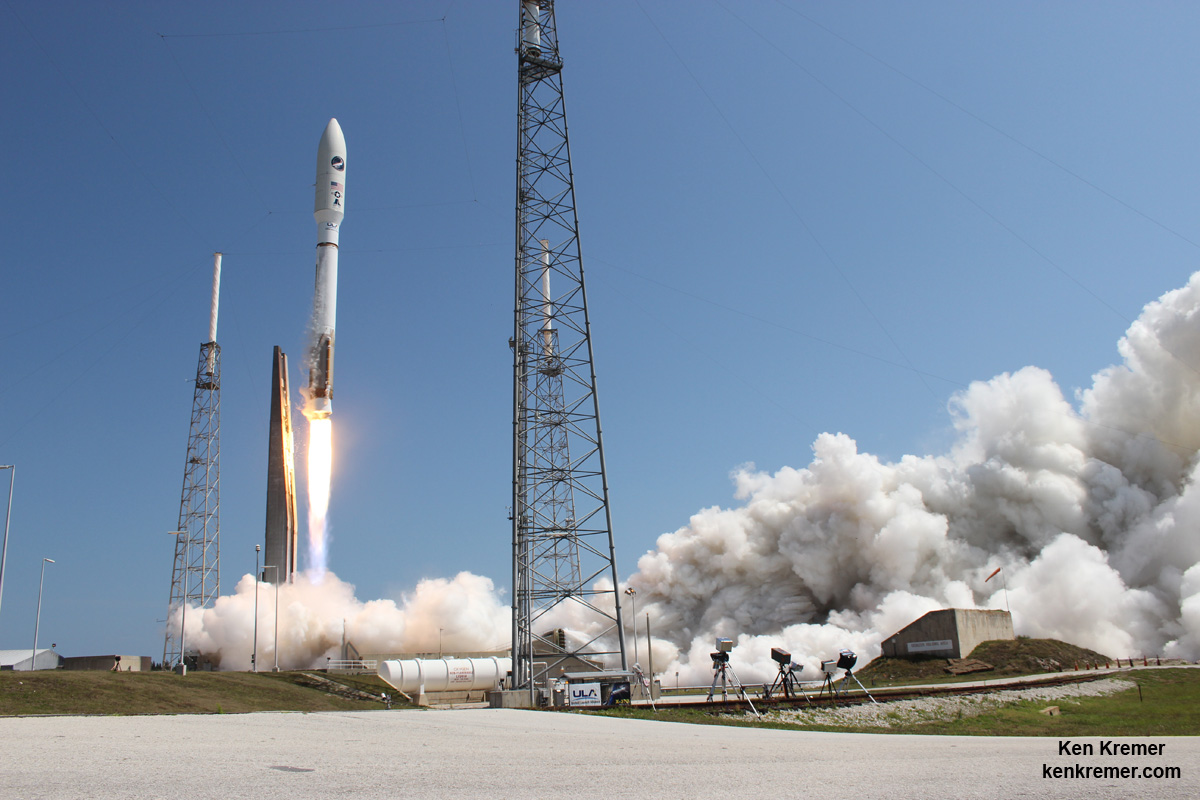
Blastoff of the X-37B spaceplane on United Launch Alliance Atlas V rocket on the OTV-4 for the U.S. Air Force on May 20, 2015 from Cape Canaveral Air Force Station, Florida. Credit: Ken Kremer
Together the two X-37B vehicles have spent a cumulative total of 1367 days in space during the first three OTV missions and successfully checked out the vehicles reusable flight, re-entry and landing technologies.
The 11,000 pound (4990 kg) state-of -the art reusable OTV space plane was built by Boeing and is about a quarter the size of a NASA space shuttle. It was originally developed by NASA but was transferred to the Defense Advanced Research Projects Agency (DARPA) in 2004.
Among the primary mission goals of the first three flights were check outs of the vehicles capabilities and re-entry systems and testing the ability to send experiments to space and return them safely. OTV-4 will shift to conducting research.
The next SpaceX cargo resupply launch to the ISS is now slated for June 26. I’ll be reporting from onsite at the Kennedy Space Center press site for Universe Today.
For complete details about SpaceX and the X-37B check out my recent articles and photos at Universe Today and Facebook: https://www.facebook.com/kremerken1
http://www.universetoday.com/120513/u-s-air-force-certifies-spacex-for-national-security-launches-ending-monopoly/
http://www.universetoday.com/120396/x-37b-air-force-space-plane-launches-on-4th-mystery-military-mission-and-solar-sailing-test/
http://www.universetoday.com/120242/air-force-x-37b-spaceplane-launches-on-may-20-with-military-nasa-and-lightsail-payloads-watch-live/
Astronomy Outreach by Dr. Ken Kremer
SpaceX Launches: Jun 24-27, NASA Kennedy Space Center, FL. Evening outreach at Quality Inn, Titusville, FL
Please contact Ken for more info, science outreach presentations and his space photos. Email: kremerken@yahoo.com website: www.kenkremer.com http://www.universetoday.com/author/ken-kremer/
by Rex Parker, PhD, Director
Your Attendance Essential at May 12 Meeting. (Bowen Hall, Princeton campus) May is the Annual Meeting for election of officers for the coming year. A membership quorum is needed to accomplish this, so please do your part and participate in the vote. The candidate slate is reviewed elsewhere in this issue (Elections 2015-2016). In addition, an important expenditure proposal for observatory instrument upgrades will be discussed and voted upon at the meeting. Details are described below.
For the main presentation, Dr. Timothy Morton of the Dept. of Astrophysics, Princeton University, will speak about his research in extra-solar planetary astronomy: “The Astonishing Diversity of Planetary Systems”. Dr Morton uses cutting edge technology and instrumentation to identify and evaluate planets around other stars, studies we could only imagine a decade ago. In addition Dr Morton is adept with instruments of the musical variety, from flute, piano, and guitar to voice and choral. For more on Dr. Morton’s AAAP talk on May 12, see elsewhere in this issue (May 12 talk).
Join Us for These AAAP Events. Keeping the emphasis on high-tech we are rolling out a few projects and events that we hope will entice you to get involved:
AAAP Washington Crossing Observatory to Reopen May 8. The equipment and computer upgrades at Washington Crossing Observatory are nearing completion, and we we will re-open for member and public events beginning May 8. Special thanks to Dave Skitt, Gene Ramsey, and John Church for installing the new Paramount-ME and mounting the historic Hastings refractor. Also thanks to Brian Van Liew, Michael Mitrano, Larry Kane, and Jim Poinsett for helping with the video/telescope project. If you have further questions about observing or to begin training to become an Observatory Keyholder, please contact co-chairs Dave or Gene observatory@princetonastronomy.org.
Expenditure Proposal for Members Vote on May 12. As discussed at the April meeting, several additional components need to be purchased to complete the hardware and software upgrade project at WC Observatory. The total upper limit for the proposal to complete this project is $5000. This is well within our budget and treasury balance. Completing the upgrade project is critical to the AAAP’s mission of bringing observational astronomy to members and to the public. Detailed items and costs are listed below (thanks to Dave Skitt for providing the estimates). Depending on the options implemented, it is possible that less will be spent. The Observatory Committee and the Officers recommend approval.
SkyX software and Paramount controller upgrades.
For the original AAAP Paramount ME.
— or–
For the donated Paramount ME.
Computer Upgrades.
Total proposed – $5000.
Depending on options it is possible that less will be spent. We are requesting authorization to spend up to $5000 to complete the current project.
by Ira Polans, Acting Program Chair
The next AAAP meeting will be on Tuesday, May 12, 2015 at 7:30 p.m. in Bowen Hall (see Princeton campus maps for building and parking locations). Our guest speaker Tim Morton is an Associate Research Scholar in the Astrophysics Department at Princeton University studying the diversity of exoplanetary systems. He will talk to the club about “The Astonishing Diversity of Planetary Systems”. A meet-the-speaker dinner for AAAP members will begin at Winberries on Palmer Square at 6:00 pm. Please RSVP to S. Prasad Ganti if you will attend the dinner.
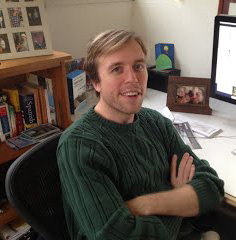
Tim Morton
From the very first detections of planets around other stars (now known as exoplanets) 20 years ago, our solar-centric understanding of planets and planetary systems—stable for hundreds of years of scientific inquiry—has been up-ended. Tim will review the history of what we have learned through the study of exoplanets, focusing especially on some surprising discoveries about the typical nature of planetary systems enabled by NASA’s Kepler mission in just the past few years. Tim will conclude with a look forward to what the future of exoplanet science may hold in the coming decade.
The final meeting of the season is in June and will be held at the NJ State Planetarium in Trenton, NJ. If you have suggestions for speakers for the 2015-2016 season, please contact the program committee: Ira Polans, S. Prasad Ganti and John Miller. You may also email suggestions to program@princetonastronomy.org.


