Short Stories Series from Eklavya Doegar
In ancient times, numbers used to be natural numbers also known as counting numbers which start from ‘1’.
The concept of assigning a value or a number to “nothing” did not exist. There used to be numbers for numerical values, but the question was, what if one had nothing. How could one give nothing a value?
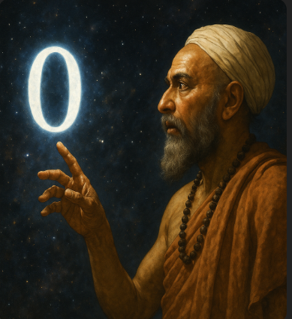
The mathematician Brahmagupta lived in the 600’s in Rajasthan, India. He studied the stars and did math. One day he questioned: What if nothing could be a number?
At that time people believed zero just represented blank space.
Brahmagupta saw it differently. He wrote a book called the Brahmasphutasiddhanta, which means “The Opening of the Universe.” In it, he did something interesting. He used zero like a real number.
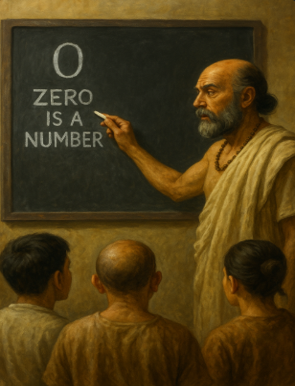
He talked about how to add, subtract and multiply with zero. Additionally, he made rules on how to divide with zero. This helped create the foundation of the number system we still use to this day!
Later, Brahmgupta’s work spread to the Middle East and then to Europe. Binary Systems and the basis of Computers are very much based on the foundational principles laid down by Brahmgupta in the 7th Century!