

by Rex Parker, PhD director@princetonastronomy.org
October 13, 2026 Meeting at Sherrerd Hall. The nor’easter storm here in September and multiple hurricanes in the Pacific remind us of the power of the sun coupling with earth’s atmosphere to create large storms persisting for days and weeks. Now as autumn’s golden glow and earlier sunsets work their wonder on our psyches, and hopefully yield to clearer night skies, it’s time to roll up our sleeves and get back more deeply into astronomy. Let’s aim for a strong turnout in person for the October 13 meeting of our club. We aspire to be more than another virtual presence offering popular astronomy on the internet. Our club has met in person continuously on a monthly basis for over 60 years (except those few times when we winter storms did prevail). It is up to you, our members, to help continue that tradition by participating in person whenever possible. Of course it isn’t always possible, and this meeting will be stream by Zoom and You Tube from the live event. For more on the guest speaker for Oct 13, please see Victor’s section below. After the main talk we will continue our discussions into current topics in astronomy and club and observatory activities.
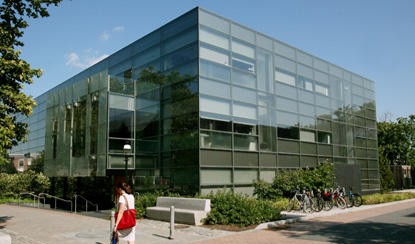
Venue and parking for the Oct 13 meeting. Our long-time venue Peyton Hall (home to the Princeton Astrophysics Dept) remains under reconstruction, and we hope to return soon. Until then, thanks go to Bob Vanderbei and Princeton’s Dept of Operations Research and Financial Engineering for the privilege of holding our meeting at Sherrerd Hall (picture below). Parking lots and streetside spots are very close on William Street, and Sherrerd is less than a block east of the street, #4 on the map here: https://www.princetonianamuseum.org/artifact/7102bbbd-5b04-4138-9c2b-5cd9b425da73. I hope to see you there on Oct 13.
The architecture of Sherrerd Hall is unique, making it easy to find just east of William St.
Hot Topics for Our Meetings. You are probably the go-to person in your family and circle of friends when it comes to emerging astronomy themes. The popular press and media have been providing abundant PR for supermoons, planet alignments, and meteor showers, but they don’t usually go into the physics. We need your participation each month to help identify in advance the upcoming astro topics soon to emerge in the popular press and media. Please send your thoughts and themes for hot topics by email to me at director@princeonastronomy.org.
Dark Matter Illuminated, part 2. As a primer for November’s guest speaker, I would like to go deeper into a different theory addressing the galaxy rotation problem in astrophysics which appears to fit at least some of the data better than the cold dark matter theory (also called lambda CDM). This is called Modified Newtonian Dynamics (MOND). In the Jan 2026 issue of Sidereal Times (link: https://princetonastronomy.com/2026/01/03/from-the-director-156/) I described how the dark matter theory evolved and mentioned MOND as an important alternative theory in cosmology. Recently MOND has been getting more attention in the astrophysics community, perhaps in part because of the challenges of identifying what dark matter could actually be. Most dark matter candidates are a type of particle not yet known to physics. Several experiments are underway searching for the fundamental particle comprising dark matter, such as the LUX–ZEPLIN (LZ) experiment I described at the September AAAP meeting, an ultra‑sensitive dark matter detector searching for weakly interacting massive particles (WIMPs) using 7 tonnes of liquid xenon in a gold mine nearly a mile deep in South Dakota. But so far these amazing physics experiments have not yielded a positive result. Here I’d like to show in a simplified way how MOND could better account for at least some of the key data that led to the dark matter theory in the first place.
The Israeli physicist Mordehai Milgrom, who worked at the Weizmann Institute and also at the Institute for Advanced Study here in Princeton, had a different take on the enigma which arises from galaxy rotation speeds. In spiral galaxies the speed of stars and gases is controlled by gravity, but the velocities out in the perimeter do not drop with radius as expected from Newtonian gravitational physics. Rather than adding an invisible ingredient, dark matter, Milgrom proposed that Newton’s law of gravity itself might behave differently at a galaxy’s edge. The key is that out in these regions, the gravitational acceleration of stars and gas is far lower than in the crowded inner parts of a galaxy, and far lower than anything in our neighborhood of planets. You’d have to travel about 7,000 times Earth’s distance from the Sun, well into the Oort cloud, before the Sun’s gravity fades to the MOND level.
Just how faint is that? Physicists put the threshold at about 1.2 × 10⁻¹⁰ meters per second squared, roughly 80 billion times weaker than the 9.8 we feel on Earth. A ball dropped on Earth falls a meter in under half a second. At the MOND threshold, that same ball would need a day and a half to drop a meter. Since we can’t reproduce these conditions here or reach them with planetary probes, MOND theory is tested on galaxies and on wide binary stars, where the results are still hotly debated.
Put more simply, dark matter keeps the laws of gravity intact and adjusts the mass, while MOND keeps the mass as observed and adjusts the law. Since Newton’s law is a foundation of physics, that makes MOND at least as revolutionary as invisible mass. Its strength is that from visible matter alone, it accurately predicts spiral galaxy rotation speeds with no invisible halo needed for each galaxy. MOND has its own puzzles, though, and they are being studied intensely. Two areas in astrophysics where dark matter seems to fit better than MOND are the gravity-driven movements in very large-scale clusters of galaxies, and in patterns found in the cosmic microwave background (see the January article cited above). On November 10 our guest speaker, Dr Stacy McGaugh of Case Western Reserve University, will show us how the astrophysics world sees MOND and where it stands along with dark matter theory in these profound areas of cosmology.


