Sidereal Times Needs You

Michael Wright and Surabhi Agarwal, Co-editors

To celebrate the kick-off of AAAP’s 50th year, we would like the November issue to be a celebration of the club’s history and accomplishments. We are producing an illiustrated commemorative booklet with specially written articles. We still need members to make this their celebration by contributing personal photographs, artwork or reminiscences about important events or notable members. If you have paper copies, we will scan them for you. Help make this issue really special by submitting your contributions. Email contribution and inquiries to editors@princetonastronomy.org.

Posted in October 2012, Sidereal Times | Tagged , , | Leave a comment

The Observatory Has Been Painted

by John Church

After a complete power washing and also spot bleaching where needed, our Simpson Observatory at Washington Crossing State Park is sporting a brand new double coat of white latex semi-gloss on the exterior of the cinder blocks and a double coat of white latex gloss on the exterior woodwork. The latter was also scraped and wire-brushed to insure that all scaled portions of the old paint were completely removed.

Power washing and wire brushing the steelwork removed all of the peeled portions of the previous red overcoat. The brown primer that was put on some years ago was still in good condition. The steelwork was then given two coats of glossy black oil-based Rustoleum.

This work was done by Bearclaw Exteriors, which is close by in Ewing Township. The owner, Eric dePugh, is interested in astronomy himself and would like to come to the next open house that occurs on a good night. Gene Ramsey and I showed him the instruments in the building.

I was there during the day and a half job, with Gene there a good part of time as well. I hope it meets with everyone’s approval. We still need some work on the masonry of the supporting pillars for the steelwork, and we have some leads for possible contractors.

Posted in October 2012, Sidereal Times | Tagged , , | Leave a comment

2012 AAAP Picnic

This slideshow requires JavaScript.


Pictures by John Miller www.nounpix.com

Posted in October 2012, Sidereal Times | Tagged , | Leave a comment

Transit of Venus June 5, 2012

by Ira Polans

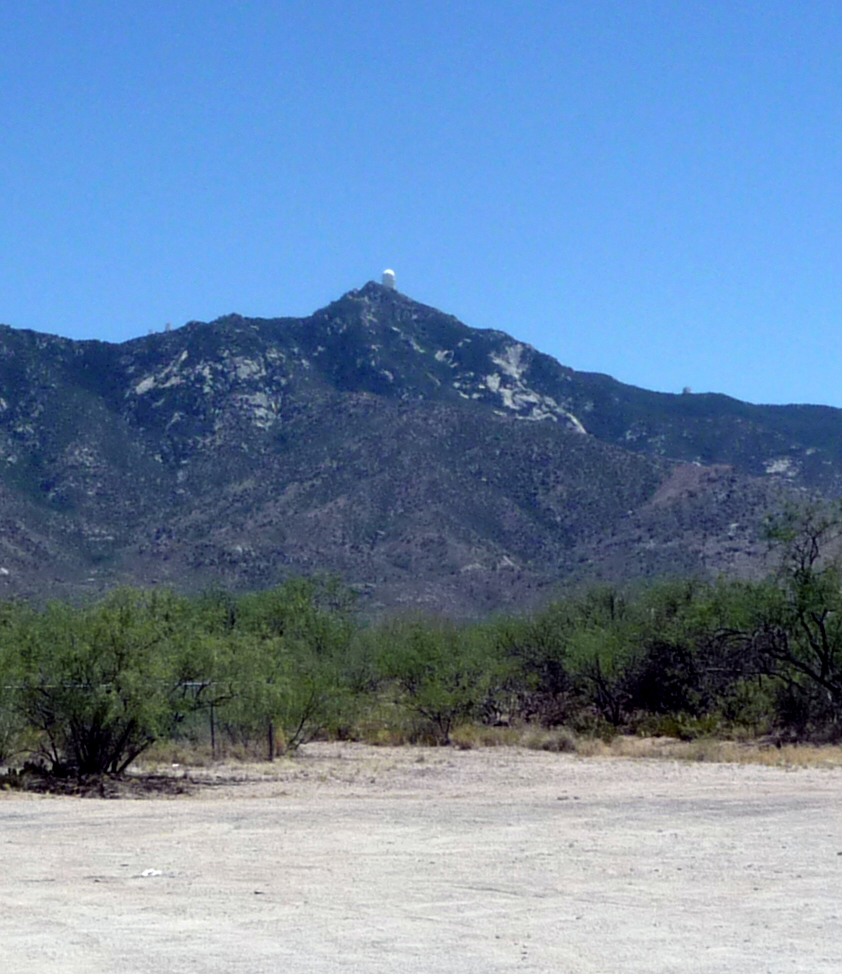
From the base of Kitt Peak, you can see the domes of the various telescopes along the ridgeline.

From the base of Kitt Peak, you can see the domes of the various telescopes along the ridgeline. Photo: Ira Polans

In 2004 when Venus last transited the sun, I was not yet a member of the AAAP. While I had made plans to observe the event, the plans did not work out. Realizing that the 2012 transit would be my last chance to see one, I decided to maximize my chances. After researching the options, my wife and I took a trip to Tucson, AZ to view the event.

Tucson was chosen because it has several advantages over the Northeast. The main one being that there would be a small chance of a cloudy sky on the day of the transit.

The famed McMath-Pierce Solar Telescope

The famed McMath-Pierce Solar Telescope. Photo: Ira Polans

Another attraction was that Kitt Peak National Observatory planned a special program for the transit. Also, my wife’s parents had retired to the Southwest. This trip would give us a chance to spend some time with them.

The trip from Tucson to Kitt Peak is about 60 miles. However since part of the trip is up the mountain, it takes about 90 minutes to get there. Most of the drive is through the Sonoran desert, which is famous for the Saguaro cactus. To me, any part of the Southwestern landscape is beautiful, and this part of the desert I hadn’t seen before. The last part of the trip is the ascent of the mountain on a winding road. The ascent is about 4000 feet. When you arrive at the summit, you drive past a few domes to the Visitor Center which is at 6875 feet.

Ira During the Transit

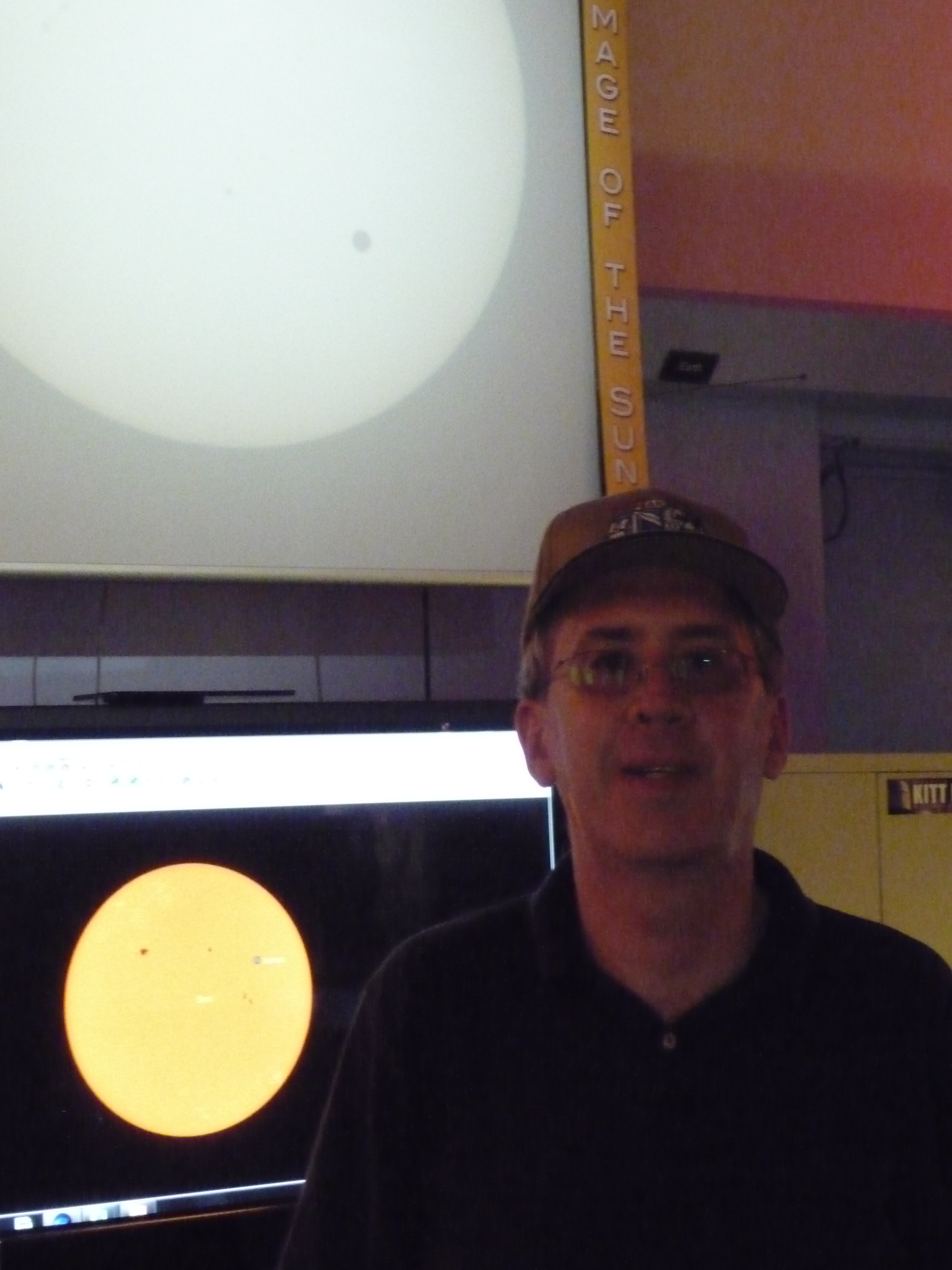
Ira in front of the heliostat mid-transit. The Sun’s image at the bottom is computer plotted. The Sun’s image at the top is the projection from the heliostat.

The Visitor’s Center contains a small museum, a 20” telescope, and a heliostat. For the transit, they also had several amateur telescopes in the courtyard, binoculars, and a sunspotter solar telescope. Of course all the optics had the proper filters. In addition all attendees of the transit program received eclipse shades for safely viewing the sun.

Check-in was at 2:00 pm and the transit began at 3:05 pm. The heliostat projected the image onto a screen about four feet tall. While I knew there would be scopes outside, I thought it would be best to watch second contact here. When the transit began I was surprised by two things. The first was how big Venus appeared against the Sun. The second was how long it took Venus to separate itself from the Sun’s limb. I was aware of the back teardrop affect, but to me and many others in the room, Venus just seemed to stick to the limb.

Looking-Up

View from the bottom of the missile silo looking up showing the partially retracted silo door. It is locked in this position so the Russians know this is not an active missile base. This missile when operational could have delivered the largest warhead in the US arsenal.

Historically a transit of Venus was important because it allowed astronomers to figure out how big the solar system really is. Without an event likes this, the best astronomers could do was measure the relative distances between planets. By using trigonometry, parallax, and accurate timings of second and third contact, along with Kepler’s third law they could finally figure out the actual distance from the Earth to the Sun. And once they knew that they could figure out the distances to the planets.
To give the attendees a better idea of the effort involved in applying this technique, Andrea Wulf lectured us about her book “Chasing Venus: The Race to Measure the Heavens”. In her lecture, Andrea told us about how 18th century astronomers worldwide worked together to capture the information need to make the calculation during the transits of 1761 and 1769.

As previously mentioned the Visitor’s Center has a 20” telescope. As the Sun began to set, the telescope was put into use. Rather than look at the Sun and the transit, we had a chance to see Betelgeuse and Sirius. This was possible because the telescope is computerized.

During the trip I had the opportunity to tour one of the remaining Titan II missile silos and visit the Pima Air and Space Museum. Both of these are in the Tucson area.

Posted in October 2012, Sidereal Times | Tagged , , | Leave a comment

Home Observatory – Dream to Reality

By Rex Parker

I know that I’m not alone in longing for a home observatory. A permanent set up, ready to power on, impress your friends, bring the stars home! Over the past dozen years my heavy “portable” mount has been dragged outside, tinkered with and toggled to set up and align a telescope for an observing session. Counterweights, balance, polar alignment, star-database-connection, CCD imager-link, finally ready to do astronomy. These sessions typically ended in early morning hours with some splendid moments and good images, but often with mixed results or even no success. After bringing it all back in and falling asleep after 2 AM, sleep-deprived, I often repeated the same process a night or two later.

Fast-forward a few years. There is a better way. Considering home observatory designs, we were drawn to roll-off roof concepts. Admittedly the dome brings a certain cache, yet the wide night sky over open roof is compelling. Still, aesthetics seemed absent in many sky sheds and outbuilding designs. Then my wife Carol chanced upon a Fine Gardening magazine ad for Gardensheds.com, a company that designs and builds custom sheds to enhance the garden and yard. On a hope and wish, I called them and learned that the Architect Ken Smith and company were local/regional and interested in talking about a home observatory design. This could become a prototype for them in the amateur astronomy market.


I proceeded to measure, calculate, and sketch the dimensions and angles needed for astronomy equipment as Gardensheds evolved an architectural drawing. We settled on a 10 x 10 ft building with 10 x 10 adjoining deck, limited by township set-backs. This size proved to be commodious, just right. The roof rolls over the deck area with nice symmetry, form and function. The walls are 6’-3” high, stand-up height which blocks stray light. Built at an indoor facility using cypress siding and floor, and recycled roofing material, with steel casters/track for the roll-off roof, the entire building was brought in on a trailer and placed onto the site (see picture). In advance, we formed a 3-ft deep, 14-in concrete footing as base for the Advanced Telescope Systems aluminum pier holding the mount. This is isolated from the building by a circular cutout in the floor to prevent vibrations. A conduit brought AC electricity to the observatory which was pre-wired with outlets and red lighting fixtures. A Wifi booster brings the observatory online with our home network to download software updates for telescope programs.

The observatory houses a Losmandy G11 equatorial mount carrying a Takahashi FS128 refractor and SBIG ST10-XME (below) and a Celestron C11. Now I’m dreaming of that perfect deep-sky astrophoto.

Posted in October 2012, Sidereal Times | Tagged , | 2 Comments

Curiosity Begins Mars Trek

by Dr. Ken Kremer

Mars Trek has begun for NASA’s Curiosity rover following the spectacular and pinpoint rocketguided touchdown beside a huge layered mountain inside Gale Crater on the night of August 5/6. Millions of people around the world were eagerly and excitedly following along with NASA’s live broadcast from Mission Control at the Jet Propulsion Laboratory in Pasadena, Calif. Pandemonium erupted when confirmation was received that the never before tried and highly complex “skycrane” landing was successfully completed.

The one-ton mega rover has now departed from her touchdown vicinity at “Bradbury Landing” and set off on a multi-week eastwards traverse to her first science target which the team has dubbed “Glenelg”. Glenelg lies about a quarter mile (400 meters) away. The car-sized rover has now driven about ¾ of the way as of late September, nearly two months into the mission, and should arrive at Glenelg sometime in October. The science team selected Glenelg as the first target for detailed investigation because it sits at the intersection of three types of geologic terrain, affording the researchers the chance to get a much more comprehensive look at the diverse geology inside the Gale Crater landing site.

Curiosity

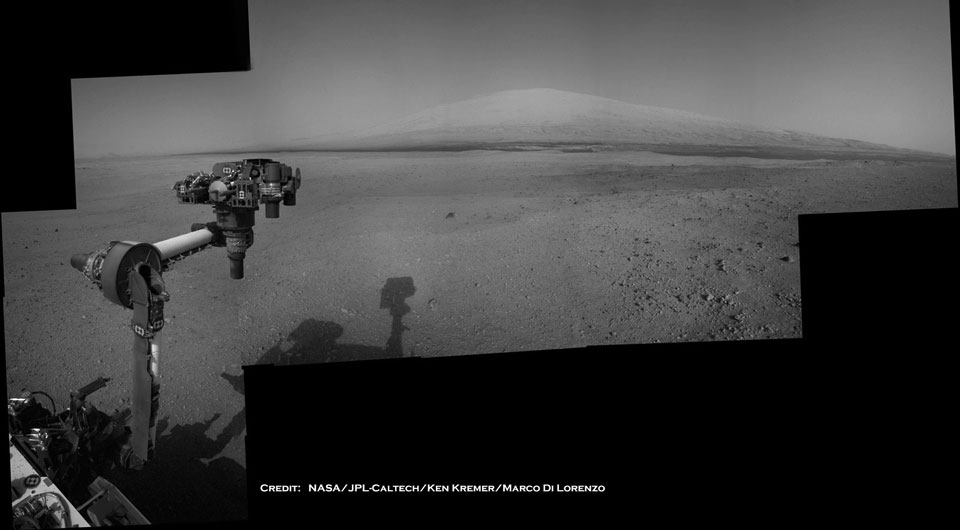
Curiosity points her robotic arm at Mount Sharp, her driving destination. Published on APOD Aug. 27, 2012 and at NBC News on Aug. 21, 2012.

Engineers have carefully checked out nearly all of the powerful science instruments, including the first of its kind rock zapping laser. Among other tasks, the Mastcam color camera is collecting high resolution images at points along the way so the scientists can create a 3D map of Mount Sharp, the rover’s ultimate driving destination.

Perhaps in about a year or so, Curiosity will reach the base of Mount Sharp and begin climbing up the side of the 3.6-mile (5.5-km) high mound in search of hydrated minerals that will shed light on the duration of Mars watery past.

The mission goal is to ascertain whether the Red Planet was ever capable of supporting microbial life, past or present and to search for the signs of life in the form of organic molecules during the two-year primary mission phase. Curiosity is equipped with a sophisticated array of 10 state of the art science instruments far beyond any prior rover.

The science team also deployed the 7-ft. (2.1-meter) long robotic arm and tested the science instruments in the turret positioned at the terminus of the arm. Curiosity flexed her mighty robotic arm for the first time on Aug. 20 and aimed the hand-like tool turret squarely at Mount Sharp.

If you want to see exactly where Curiosity is headed and why she was sent to Gale Crater, just take a look at the mosaic assembled by Ken Kremer and Marco Di Lorenzo which was selected to appear on Astronomy Picture of the Day on August 27, 2012. Curiosity is pointing with her robotic arm right at Mount Sharp, the huge 18,000-foot (5.5-kilometer) tall mysterious mound that covers the center of the 96-mile (154-km) wide Gale crater. Our Curiosity mosaic was also featured on the front page of NBC News in the link below. Several more of our original Curiosity mosaics showing the rovers traverse appeared at NBC, most recently on Sept. 26 at the link below.

NASA
Curiosity points to mars destination
See a crescent moon in martian sky

The layered sediments in Mount Sharp could unveil the geologic history of Mars stretching back billions of years and reveal why the planet transitioned from an ancient, wet period of flowing liquid water on the surface to the dry, desiccated era of today.

Astronomy Outreach by Dr. Ken Kremer

Amateur Astronomer’s Inc (AAI) at Union County College: Cranford, NJ, Nov 16, 8 PM, “Curiosity and the Search for Life on Mars (in 3-D)”.
AAI Website: http://www.asterism.org

STAR Astronomy Club at Monmouth Museum, Brookdale Community College, Lincroft, NJ. Dec 6, 8 PM. “Atlantis, the Premature End of NASA’s Shuttle Program and What’s Beyond for NASA.”
Ken Kremer: Spaceflight magazine & Universe Today

Please contact Ken for more info or science outreach presentations:
Email: kremerken@yahoo.com website: www.kenkremer.com
http://www.universetoday.com/author/ken-kremer/

Posted in October 2012, Sidereal Times | Tagged , | Leave a comment

AAAP Mourns the Passing of Member Bryan Hubbard.

AAAP mourns the passing of member Bryan Hubbard. Bryan was an active member of AAAP who helped with Starquest and public outreach on many occasions. He was also editor and contributor to Sidereal Times for several years. We send our condolences to his family.

His online obituary may be found here.

Posted in September 2012 | Tagged , | Leave a comment

From the Director

Ludovico D’Angelo, Director

I hope everyone is having a bearable summer with this heat. As a result, there hasn’t been much opportunity to get out and do some observing. The heat haze is a real downer, but I hope that some of you have gone on vacations to nice clear sky areas and enjoyed the nature and sky around you. Write an article for ST and share your experiences.

My summer finds myself on vacation in Minnesota one again. We go every year. This year I brought my large binoculars, but never had a chance to use them for astronomy. We did see the great bald eagle that inhabits the lake again.

At the last AAAP Board meeting, we discussed several things (see Board minutes in this issue.) We will have a picnic on September 15th for all members (time and venue to be announced). We will look into Starquest for October or November, and we will have a 50th anniversary dinner in November in lieu of our November meeting. Stay tuned for more on these upcoming activities. Kate Otto has been working diligently to secure guest speakers for our up coming year. We are planning some work parties for both Washington Crossing and Jenny Jump. Plus we are looking into a major donation for the observatories.

As always, all these activities cannot be done by a certain few. We encourage all of you to speak up or volunteer to help plan and implement all these activities. And add more too!

I understand that Gene Ramsey, long time member and Observatory Chair, had undergone major heart surgery. As of this writing, he is recuperating slowly and will be out of commission for several months. I have appointed Jeff Bernardis as temporary Observatory Chair. Any issues with the observatory should be addressed to him. Lets all keep Gene in our thoughts for a speedy recovery.

Posted in August 2012, Sidereal Times | Tagged , | Leave a comment

From the Program Chair

Kate Otto, Program Chair

Prof. David Spergel

Prof. David Spergel

Our monthly lectures will resume on September 11, 2012 at 8:00 pm in Peyton Hall with a lecture from AAAP’s friend, Prof. David Spergel, Chair of the Princeton’s Department of Astrophysical Sciences. Prof. Spergel’s talk is entitled “Illuminating the Evolution of the Universe with the Cosmic Microwave Background”.

Prof. Spergel is well known for his theoretical astrophysics work with Wilkinson Microwave Anisotropy Probe (WMAP) observations of the microwave background radiation to determine cosmological parameters. In fact, two papers that he co-authored are the two most cited papers in science over the past decade according to the website Incites. This lecture by one of the superstars of theoretical astrophysics should be fascinating so do not miss it.

The November monthly program will be held on Sunday, November 4th, between 4:00 and 8:00 p.m., instead of Tuesday, November 13th.   AAAP is holding a special dinner meeting celebrating the start of our 50th Anniversary of successful Amateur Astronomy in Princeton.   I hope that you will mark your calendar for this event.  We are looking for volunteers to help us plan all of the 50th Anniversary year activities.  More information will follow.  In the interim, please let one of the officers know if you are interested in getting involved.

Posted in August 2012, Sidereal Times | Tagged , , | Leave a comment

From the Outreach Chair

David Letcher, Outreach Chair

On Sunday August 12, the D & R Greenway Organization and AAAP are hosting a ‘Perseid Meteor Shower party’ at a recently acquired preserve known as the Cider Mill Grasslands Preserve in E. Amwell Township, Hunterdon County. The event is from 10:00 PM to Midnight and is one of the programs that introduces the general public to the Greenway’s lands and encourages them to get outdoors.

I sent out a map to the AAAP membership recently. So far we have about 8 – 10 AAAP volunteers who will be there to provide some background on meteor showers and some telescopes for viewing the sky.

Posted in August 2012, Sidereal Times | Tagged , , | Leave a comment

Treasurer’s Report

Michael Mitrano, Treasurer

The AAAP’s fiscal year ends on June 30, and this represents my fifth year-end report to members. Again this year showed a surplus and our financial position remains very strong.

A fiscal year 2012 income statement and balance sheet was sent to all members with Sidereal Times.

Membership Chart

Membership Chart

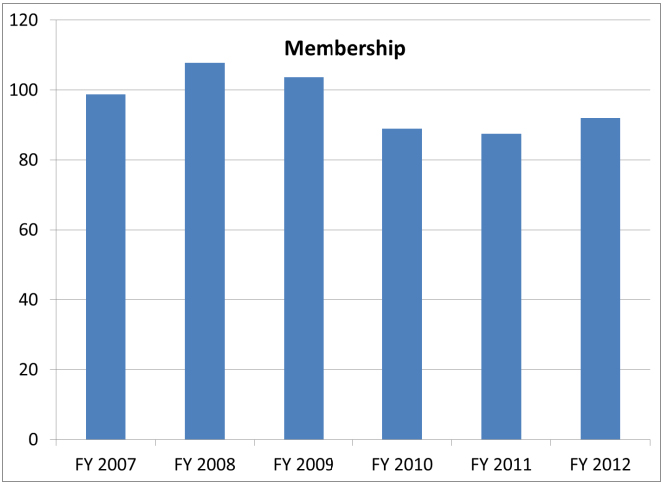
The year ended with 92 paid members. As the chart shows, this is an improvement over the past two years but is down from our recent high in FY 2008.

As noted earlier, StarQuest revenues almost exactly covered the event’s cost. Observatory expenses were not very high this year, with no major repairs or improvements needed. The largest non-routine expense for the year was our new graphic table cover, which is the $378 expense shown in “miscellaneous.”

For these reasons and because of our membership and outreach income, the AAAP had a surplus of $1,220 for the year. Combined with previous years, results, the association’s cumulative surplus was $21,994 on June 30. FY 2012 was our 6th year of surplus and leaves us very well positioned to continue our programs of education and outreach. Please let me know if you have any questions about the AAAP’s finances.

Posted in August 2012, Sidereal Times | Tagged , | Leave a comment