Looking at Stars from the Top of a Mountain

 by Robert Carnevale ©

I have come to where I’ve always been.
The other hills seems quite at rest,
no telltale sign of thoughts like mine
milling like fireflies about their crowns.

The stars keep on with their burning.
How can we say they don’t care
where there’s no caring to begin with?
I am glad they don’t stoop to our question.

I knew before I came up here
that I would not be able to stay –
where I’ve always been, always will be –
still, it seems strange I can’t be where I am.

Jiménez wrote: “I am not I.”
And yet the world is still the world,
and these stars, with few exceptions,
are the same ones that always turned there.

Up here I am the strange one.
I should be granite. I should be light.
I should be space. I should be wind.

And yet, however unlikely,
I am as real and as present
as they are.

Yes, it’s the dark shows us the stars but, even more,
it is the stars show us the dark.
I really would stay if the night would.

But it would be rude of me to turn my back
on a star that has no back to turn
on the worlds it has set turning.

Thank you to David Kaplan for finding this gem.

Posted in November 2014, Sidereal Times | Tagged , | Leave a comment

Snippets

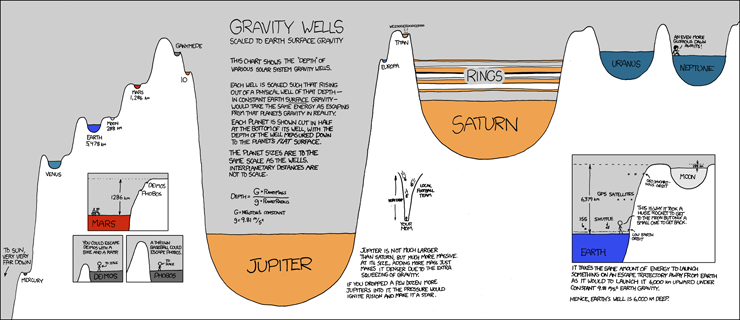
Gravity Wells According to XKCD (contributed by Michael Wright)

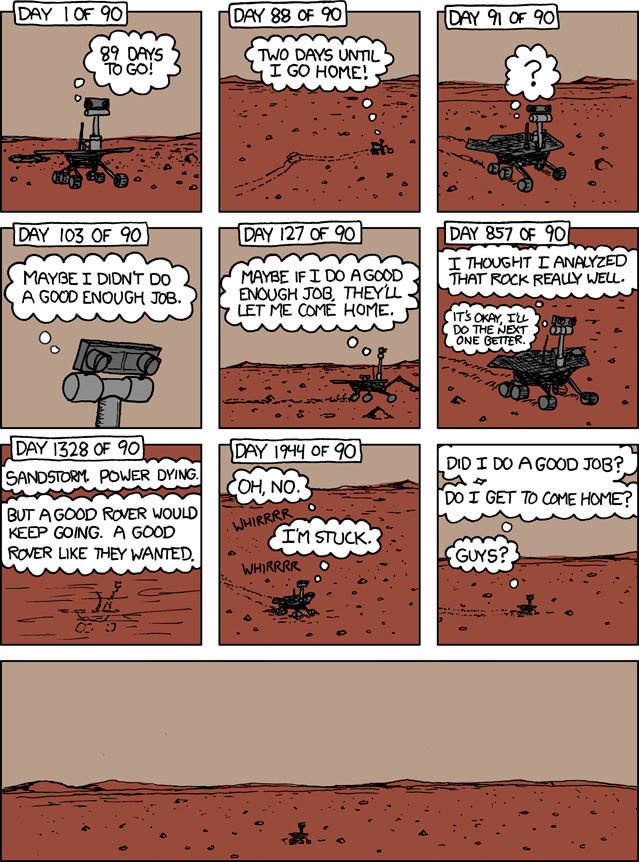
Rover Humor from XKCD (contributed by Ira Polans)

Cosmigraphics (contributed by David Kaplan)

Over thousands of years, humans have tried to represent the universe in graphic form, whether in manuscripts, paintings, prints, books or supercomputer simulations.

http://www.nytimes.com/2014/10/14/science/space/in-cosmigraphics-our-changing-pictures-of-space-through-time.html?smid=nytcore-ipad-share&smprod=nytcore-ipad

The Violent Universe (contributed by Ed Sproles)

Here is another free online class may be of interest:

EdX is running another class taught by Paul Francis and Brian Schmidt of Australian National University.  Brian Schmidt is a 2011 Nobel Prize winner in physics.  The class just started so you can join and catch up.

The class is titled “The Violent Universe” and covers White Dwarfs to Supernovae and black holes.  You can do as much or as little as you like in viewing the lectures and doing the problem sets.

A fun sideline in their courses is a “mystery” world where their universe obeys somewhat different laws.  They disclose a little more each week; it is a puzzle to figure what is going on in this world using the observations provided.

 Just Google “The Violent Universe” to find it in EdX.

Gerry Neugebauer, Pioneer in Space Studies, Dies at 82 (contributed by David Kaplan)

Dr. Neugebauer’s biggest achievement was in detecting and interpreting infrared radiation emanating from outer space to provide insights about the universe that radio waves or X-rays cannot.

http://www.nytimes.com/2014/10/03/us/gerry-neugebauer-pioneer-in-space-studies-dies-at-82.html?smid=nytcore-ipad-share&smprod=nytcore-ipad

Photo Nightscape Awards (contributed by Michael Wright)
The first edition of the Photo Nightscape Awards, PNA, has just ended…. 
The PNA (international photography awards) rewards the authors of nightscapes, growing trend of astrophotography. The PNA is openned to all ! Photographers and astrophotographers, pro and amateurs, adults and juniors participated and won great rewards offered by our partners :
Trip to ESO in Chile, Trip to the Alqueva Dark Sky Reserve in Portugal, binoculars and telescopes…
We are delighted to honor them in this video of the most beautiful pictures received for the first edition in 2014.

The first edition of the PNA was a great success, well beyond the of the astronomy borders! The second edition is coming and will begin in February 2015!  To participate or for more information, please send an email to: pna@cieletespace.fr

Posted in November 2014, Sidereal Times | Tagged | Leave a comment

Antares Rocket Launch Ends in Catastrophic Failure from NASA Wallops – Eyewitness Account

by Dr. Ken Kremer, AAAP, Universe Today

NASA WALLOPS FLIGHT FACILITY, VA –  Moments after a seemingly glorious liftoff, an Orbital Sciences Corp. commercial Antares rocket suffered a catastrophic failure and exploded into a spectacular aerial fireball over the launch pad at NASA’s Wallops Flight Facility on the eastern shore of Virginia that doomed the mission bound for the International Space Station on Tuesday, October 28.

The 14 story tall Antares rocket blasted off on time at 6:22 p.m. EDT from  the beachside Launch Pad 0A at the Mid-Atlantic Regional Spaceport (MARS) at NASA Wallops on only its 5th launch overall.

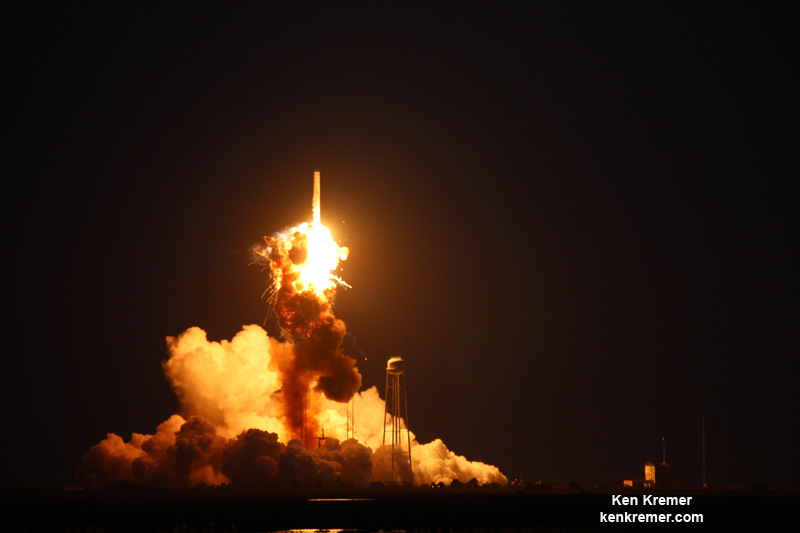
Orbital Sciences’ Antares rocket explodes into an aerial fireball seconds after blastoff from NASA’s Wallops Flight Facility, VA, on Oct. 28, 2014, at 6:22 p.m. Credit: Ken Kremer

Orbital Sciences’ Antares rocket explodes into an aerial fireball seconds after blastoff from NASA’s Wallops Flight Facility, VA, on Oct. 28, 2014, at 6:22 p.m. Credit: Ken Kremer

I was an eyewitness to the awful event and photographed the launch from the press viewing site at NASA Wallops from a distance of about 1.8 miles away.  I never expected to see anything like this, although it’s always possible because space is a risky business.

My Antares interview with NBC News correspondent Tom Costello appeared the next evening on NBC Nightly News with Brian Williams on Oct. 29, along with a bunch of my launch explosion photos.  Watch the entire NBC News report here

Watch my Antares interview with at Universe Today on Oct 31 here

The highly anticipated 1st night launch of Antares would have wowed tens of millions of spectators up and down the eastern seaboard from South Carolina to Maine.
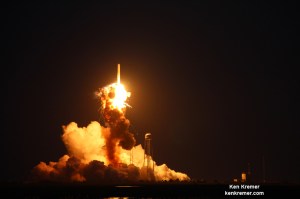
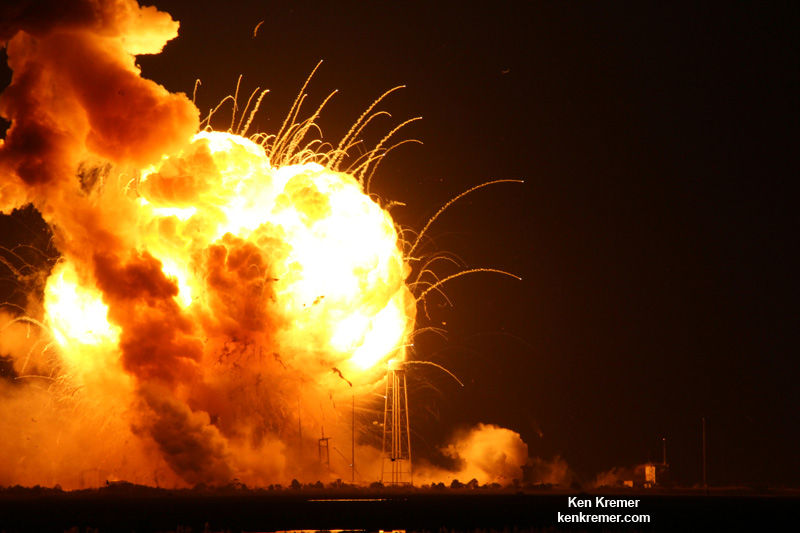
Base of Orbital Sciences’ Antares rocket explodes moments after blastoff from NASA’s Wallops Flight Facility, VA, on Oct. 28, 2014, at 6:22 p.m. Credit: Ken Kremer

Base of Orbital Sciences’ Antares rocket explodes moments after blastoff from NASA’s Wallops Flight Facility, VA, on Oct. 28, 2014, at 6:22 p.m. Credit: Ken Kremer

Antares was carrying Orbital’s privately developed Cygnus pressurized cargo freighter loaded with nearly 5000 pounds (2200 kg) of science experiments, research instruments, crew provisions, spare parts, spacewalk and computer equipment and gear on a critical resupply mission dubbed Orb-3 bound for the International Space Station (ISS).

It was the heaviest cargo load yet lofted by a Cygnus. Some 800 pounds additional cargo was loaded on board compared to earlier flights. That was enabled by using the more powerful ATK CASTOR 30XL engine to power the second stage for the first time.

Everything appeared normal at first. But within about five seconds or so there was obviously a serious mishap as the rocket was no longer ascending. It was just frozen in time. And I was looking directly at the launch, not through the viewfinder of my cameras.

Something was noticeably amiss almost instantly as the rocket climbed only very slowly, barely clearing the tower it seemed to me. The rocket failed to emerge from the normal huge plume of smoke and ash that’s purposely deflected away by the flame trench at the base of the pad.

I was stunned trying to comprehend what was happening because it was all so wrong. It was absolutely nothing like the other Antares launches I’ve witnessed from the media site.

I knew as a scientist and journalist that I was watching a mounting disaster unfolding before my eyes.

Instead of ascending on an accelerating arc, a mammoth ball of fire, smoke and ash blew up the entire sky in front of us like a scene out of hell or war. Literally the sky was set on fire unlike anything I’ve ever witnessed.

A series of mid-air explosions rocked the area. I could feel a slight pressure wave followed by a mild but noticeable heat wave passing by.

Then the rocket began to fall back to Earth. Then the ground blew up too as the rocket pieces hit the ground and exploded into a hail of smithereens in every direction.

By this time our NASA escorts starting yelling to abandon everything in place and head immediately for the buses and evacuate the area. The ground fire spread mostly to the northern portion of the pad and the expanding air-borne plume also blew northwards. The ground fire was still burning over a half hour later.

Thankfully, everyone got out safe and there were no injuries due to the excellent effort by our NASA escorts trained for exactly these types of unexpected circumstances.

It’s heartbreaking for everyone’s painstaking efforts to get to the point of liftoff after years of effort to fulfill the critical need to resupply that station with the science equipment and experiments for which it was built.

A prime suspect in the disaster could be the pair Soviet-era built and US modified AJ26 engines that power the rocket’s first stage.

Another AJ26 engine failed and exploded during acceptance testing on May 22, 2014 at NASA’s Stennis Space Center in Mississippi. An extensive analysis and recheck by Orbital Sciences was conducted to clear this pair for flight.

“The root cause will be determined and corrective actions taken,” Frank Culbertson, Orbital’s Executive Vice President and General Manager of its Advanced Programs Group, said at a post launch briefing at Wallops.

For complete details check out my articles, photos and cell phone video online at Universe Today and NBC News:

http://www.nbcnews.com/nightly-news/nasa-orbital-sciences-look-answers-rocket-explosion-n237051

http://www.universetoday.com/115787/catastrophic-failure-dooms-antares-launch-to-space-station-gallery/

http://www.universetoday.com/115796/antares-commercial-rocket-destroyed-in-devastating-fireball-video/

http://www.universetoday.com/115826/antares-launch-calamity-unfolds-dramatic-photo-sequence/

http://www.universetoday.com/115856/launch-pad-damage-discernible-in-aftermath-of-catastrophic-antares-launch-failure-exclusive-photos/

http://www.universetoday.com/115863/weekly-space-hangout-oct-31-2014/

Astronomy Outreach by Dr. Ken Kremer

Orion and SpaceX Launches Dec 4 & 9: NASA Kennedy Space Center, FL. Evening outreach at Quality Inn, Titusville, FL.

The Future of NASA’s Human Spaceflight Program with Orion and Commercial Astronaut Taxis: March 2015, DVAA, PA

Please contact Ken for more info, science outreach presentations and his space photos. Email: kremerken@yahoo.com   website: www.kenkremer.com, http://www.universetoday.com/author/ken-kremer/

Posted in November 2014, Sidereal Times | Tagged , , , | Leave a comment

From the Director

Rex

by Rex Parker, PhD  director@princetonastronomy.org

A crispness to the skies and a sense of urgency with the temperatures give October an auspicious feel for amateur astronomers.  New constellations well positioned include Perseus, Andromeda, and Pegasus – three of the original constellations of the famed Almagest thought to be written by second-century astronomer Ptolemy.  It’s impossible to ignore the Milky Way stretching overhead to the southern horizon, and the great galaxy in Andromeda (Messier 31) can be discerned by naked eye in mid-evening if light pollution isn’t too severe.  Indeed, that galaxy was visible without aid and a glorious sight in telescopes under the pristine clear skies at StarQuest last weekend in north Jersey.  Pegasus, the winged horse constellation, is seen by some today as merely a big empty square of stars (what was Ptolemy thinking?) and devoid of deep sky objects.  Yet the databases list nearly a hundred “NGC” and “IC” deep sky objects (star clusters, galaxies, and various nebulae) within the great square.  Though challenging, some of these are accessible to AAAP members through the 14-inch Celestron telescope at the club’s Washington Crossing Observatory, though of course many are visible only with electronic enhancement (CCD, DSLR or video cam). Pegasus is also a good test of limiting magnitude, because a dozen stars inside the square are magnitude 6 or brighter, the level generally considered a threshold for good skies.  I counted ten at StarQuest.

A much more visible and dynamic celestial event takes place on October 8 early in the morning.  A total lunar eclipse will be in progress as the sun rises here in central Jersey.  You’ll need to have a clear view of the western horizon in the early morning hours.  In counterpoint to the rising sun, the moon sets with the eclipse in totality, adding a twist to previous recent eclipses.  The next total eclipse of the moon at our location won’t occur till next September, after which we’ll have to wait for a total eclipse here until 2018 when there are two (there are partial and penumbral eclipses before then).

As the pictures and articles in this issue attest, StarQuest 2014 was a great success with some of the clearest, darkest skies we’ve ever had.  I’d like to give special thanks to Michael Wright for the “heavy lifting” organizing of the event and for the creative and very cool Solar System Walk (a scale model of the solar system on the grounds of the conference center) which surprised us all with the immense distances between the planets!  Special thanks also to Ludy D’Angelo for the excellent StarQuest Trattoria!

Our tradition of great speaker presentations continues this month (7:30 pm, Oct 14 at Peyton Hall) with a talk on the future of human spaceflight by Dr. Ken Kremer of Universe Today, AmericaSpace, and AAAP.  Check out the article in this issue and the AAAP website (http://www.princetonastronomy.org/) for more info.

Important note:   AAAP meetings at Peyton Hall now begin at 7:30 pm.

Posted in October 2014, Sidereal Times | Tagged , | Leave a comment

Next AAAP Meeting – October 14 at 7:30 p.m.

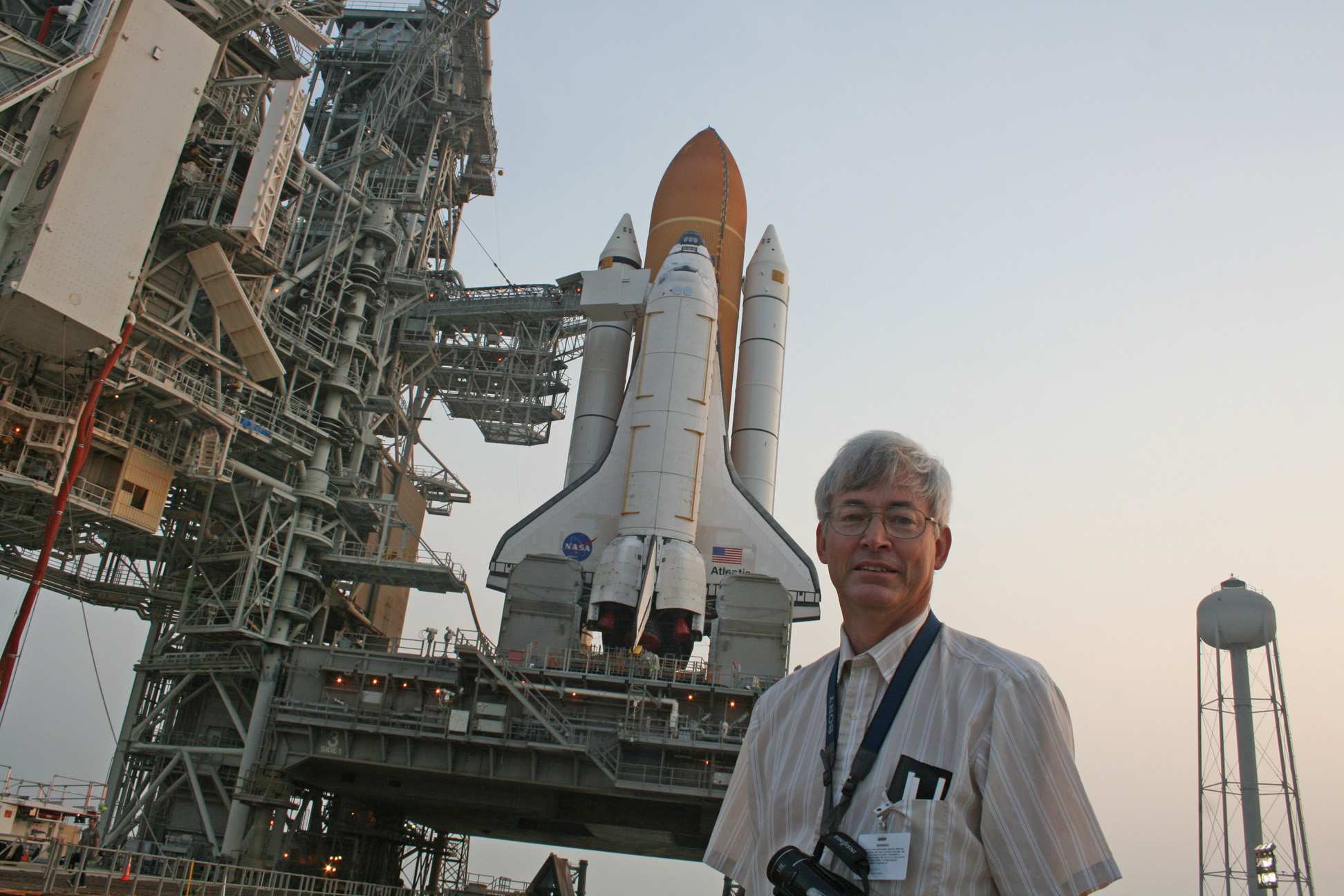
IMG_3410a_STS 135_ Ken KremerAAAP’s next meeting and lecture will be on Tuesday, October 14 at 7:30 p.m. in Peyton Hall.  AAAP member and NASA Ambassador, Dr. Ken Kremer, will present “What’s the Future of America’s Human Spaceflight Program with Orion and Commercial Astronaut Taxis”, an eyewitness account of NASA’s future plans to resume launching humans to space from American soil. NASA’s new Orion and commercial capsules from Boeing and SpaceX will end our dependency on Russia. Ken will give an inside accounts of NASA’s multipronged strategy to develop private astronaut ‘space taxis’ to Earth orbit and for ambitious human expeditions to deep space with Orion to the Moon, asteroids and Mars. Ken will discuss the critical Fall 2014 launches of Orion from the Kennedy Space Center and Antares/Cygnus from Wallops Virginia and how you can see them. Ken will briefly give an update NASA’s Mars rovers and orbiters including Curiosity and MAVEN. Ken will have a selection of his Space photos for sale.

Ken Kremer is a journalist, Ph.D. research scientist, speaker and photographer based in New Jersey. His space and Mars imagery and writings have been widely published on TV, magazines, books and websites including National Geographic, NBC, ABC, BBC and Fox News, PBS NOVA TV, Scientific American, APOD, NASA, Aviation Week, Astronomy, Astronomy Now, Space.com, Spaceflight Now, Spaceflight, New Scientist, Planetary Society, Popular Mechanics, AmericaSpace, Universe Today, NASA Watch, Wired, Science News, All About Space, NPR, Mars Society, International Year of Astronomy, 2010 Year in Space Calendar and the covers of Aviation Week, Spaceflight and the Explorer’s Club. Ken’s Curiosity Mars mosaic is on permanent display on the US National Mall at the Smithsonian National Air & Space Museum, Washington, DC.

Ken Kremer website – http://www.kenkremer.com

Posted in October 2014, Sidereal Times | Tagged , | Leave a comment

October 7 Board Meeting

The next meeting of the AAAP Board will be at 7:30 p.m. on October 7, 2014 in Room 140 of Peyton Hall.  All members are invited to attend.

Posted in October 2014, Sidereal Times | Tagged | Leave a comment

Minutes of September 9, 2014 AAAP Meeting

by James Poinsett, Secretary

Director Rex Parker opened the meeting with a brief introspective of the AAAP and expressed his thanks to Princeton University for the use of their facilities.

The Board meetings are scheduled for this coming year. They will be on October 7, 2014, January 6, 2015, April 7, 2015 and July 7, 2015.  All are on the first Tuesday of the month.

The meeting opened by discussing members recent astronomy experiences. Rex discussed his recent Perseid experience in California. Bill, Saul and Kate also shared their recent observations.

A “Telescope of the Month” feature was introduced. Rex started this off by showing and talking about his Celestron C-11. He also briefly mentioned a video technology proposal for discussion later in the business portion of the meeting.

Program Chair Kate Otto introduced this month’s speaker, Aram Friedman. A large portion of Aram’s talk was about his experiences viewing and recording the 2012 Transit of Venus from Hawaii.

The business meeting began with a discussion on improving member and public observing at the Washington Crossing observatory. Rex presented a technology proposal to use live video imaging and suggested using a camera from Mallincam, www.mallincam.net. Larry Kane will head a committee to come up with a proposal by the October board meeting. The main concern was about the added wires creating tripping hazards.

Mike Wright discussed StarQuest planning. Ludy D’Angelo will handle the cooking and meal planning. The star party information has been sent to other clubs and the publicity has been taken care of. We are still looking for activities for the daytime.

Outreach Chair David Letcher reminded everyone about the October 30th viewing party at the Unionville Winery. Bear Tavern School is having a Sunrise Science program and is looking for volunteers to speak about astronomy topics. David will again be hosting his classes in Backyard Astronomy the first four Fridays in October.

Gene Ramsey informed us that the staff at the park is greatly reduced, and they are not locking the gate properly. The park is not insisting on our using the Church Rd. entrance so we can continue using the entrance by the soccer fields. Be sure to be considerate of campers and hopefully we can continue using that entrance.

Larry brought us up to date on the activities of the Friends of Washington Crossing Park.

Kate said we have speakers through December.

Larry will bring in a telescope for October’s “Telescope of the Month”.

Meeting was adjourned.

Posted in October 2014, Sidereal Times | Tagged , | Leave a comment

From the Outreach Chair

by David Letcher, Outreach Chair

We at AAAP are becoming quite popular in the world of star parties. Our first star party was held on Saturday evening, September 20th. Volunteers Gaspar Bakos and Habib Ahson led the show. According to Gaspar the star party at Plainsboro Preserve went very well. There were about 20-25 people, half of them kids. They observed the constellations, Saturn, Alcor & Mizar, Albireo, M13, M11, M57, M27, and Andromeda with M32. All-in-all the evening was enjoyed by all. Thanks Habib and Gaspar!

Two more star parties are on the schedule for October.

  • Tuesday evening, 10/21 will see us at the Linwood Middle School in North Brunswick, NJ. This school has become one of our regular sites. We have one volunteer so far. More would be better.
  • Thursday evening, 10/30 will see us at the Unionville Winery in Ringoes, NJ. The winery staff claims they have dark skies and an interesting mulled wine. So far, two volunteers that have signed up.

Another opportunity just came up: a star party at Rider College in Lawrence, NJ on the evening of Friday, November 7th. A newly hired assistant professor of astronomy and physics will entertain students and parents with an early evening lecture and an observing session starting around 8 p.m. AAAP is cordially invited to bring our scopes and help out. It is their parents’ weekend.

Finally, yours truly will offer four lectures on backyard astronomy at the Nature Center in Washington crossing Park on the first four Friday evenings in October. The lectures begin at 7:30 p.m. and end at 8:30 p.m. Afterwards, participants will be encouraged to go to our observatory for viewing the things I talked about. This is the third year I have done these classes.
Respectfully submitted,

Posted in October 2014 | Tagged , | Leave a comment

Observatory Video Project

By Larry Kane, Assistant Director

Following up on a suggestion from Director Rex Parker, a group of members met at the observatory on Wednesday, September 17 to discuss the possibility of adding video viewing.  Several configurations of video equipment and compatible telescopes were discussed, all with the objective of being able to provide the best viewing experience to the visitors of our observatory.  The discussion, which is still ongoing, covered questions of available video hardware now on the market, hardware compatibility with our telescopes, new telescopes that might meet our needs, and the placement of a monitor within the observatory that would allow the public to participate in the viewing.

The discussion is continuing, and will be on the agenda of the next AAAP Board meeting on October 7 at 7:30 in Peyton Hall.  It was agreed that the ultimate goal will be to make any video system that is purchased and installed, a part of a long range program designed to ensure that our club is vibrant and growing.  Input is welcome from any interested AAAP member.  If you are interested in being a part of the development of this project, please come to the next Board meeting in on Oct. 7 at 7:30 pm in Room 140 of Peyton Hall.  The project will also be discussed at the next AAAP meeting on Tuesday, October 14 also.  Whether or not you can make either of these meetings, feel free to send your ideas to me.

Posted in October 2014, Sidereal Times | Tagged , | Leave a comment

Clear Dark Skies Enjoyed at StarQuest 2014

by Michael Wright

SQ LogoAAAP held our annual star party from Friday, September 26 to Sunday, September 28, 2014 at the Hope Conference and Renewal Center, Hope, NJ.  On both nights, skies were clear; transparency was excellent and seeing was very good.  In my admittedly limited experience, these were the best skies I have ever seen in NJ, even at Hope.  The dust lanes in the Milky Way, the Andromeda Galaxy and the Double Cluster were visible to the naked eye.  Only dew limited our observing time.

Thank you to everyone who helped make this year’s party a success, particularly Chef Ludy D’Angelo, Jim Poinsett, the kitchen crew and everyone who shared their passion for astronomy.

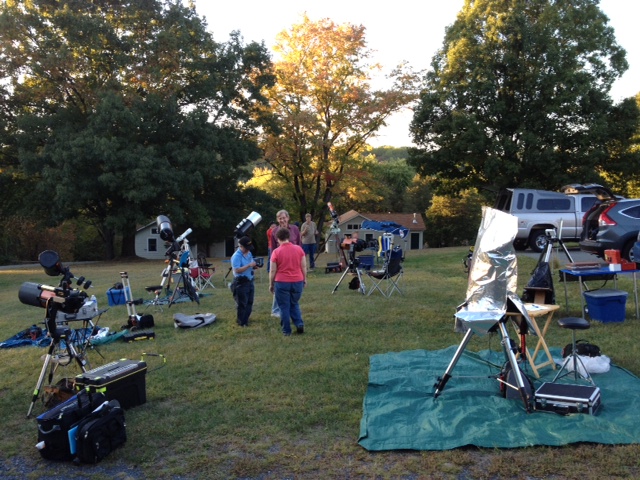
The observing field.  Credit: Rex Parker

The observing field. Credit: Rex Parker

2014-09-26 16.51.38

Gene Ramsey supervises mounting of Larry Kane’s OTA.  Credit: Michael Wright

2014-09-26 16.54.18

Brian Van Liew gets ready for imaging.  Credit: Michael Wright

2014-09-26 16.52.45

Bill Murray and his Teeter push-to Dob. Credit: Michael Wright

SQ5

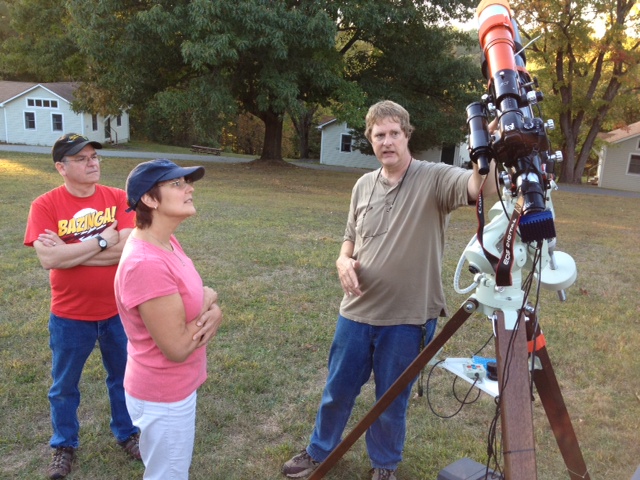
Brian Van Liew explains imaging to Michael Wright and Lynn Sian Credit: Rex Parker

2014-09-27 11.34.33

Larry Kane, Rex Parker, Michael Wright, Jim Poinsett and Gene Ramsey pause for a photo on the Solar System Walk. Credit: Lynn Sian

On the solar system Walk, Jupiter appears to hover at the edge of the driveway.  To scale, Mars is invisible to the left of the lodge.

On the Solar System Walk, Jupiter appears to hover above the driveway. Set to scale, Mars is invisible by the right corner of the lodge.  Credit: Rex Parker

Posted in October 2014, Sidereal Times | Tagged | Leave a comment

Congratulations Mangalyaan Team, Congratulations India!

by Prasad Ganti

 After a long journey of 300 days in the vacuum of space, Mangalyaan, India’s Mars Orbiter Mission was finally captured by the gravity of Mars. A nation heaved a sigh of relief, yours truly included. Congratulations followed from all over the world. NASA, ESA, even rival China celebrated in India’s joyous moment. I want to highlight some of the challenges involved and cover some basics of space travel.

 Why is it a big deal sending a spacecraft towards Mars? The low-budget spacecraft was a big deal for a developing nation. It demonstrated the mastery the technology required to maneuver one’s way in the wilderness of space. Prime Minister Modi stated that it cost India less than making of the acclaimed science fiction movie Gravity.

 What are the challenges in these kinds of mission? Firstly, getting the trajectory right. The distance between New York and Mumbai is fixed at about 9000 miles. It does not change with time of the day or at night or in a different season. A plane takes slightly less or more time depending on whether the winds are favoring or against. But the distance never varies. Mars is a planet orbiting the Sun, very much like Earth does, except that it is farther from the Sun. The position of both planets on their orbits coincide very rarely. One needs to correctly determine when is the right time to launch the spacecraft so that it can reach Mars. Because both Mars and Earth are moving platforms, it is like a shooter standing on a moving platform trying to shoot at a target, which is on another moving platform. Timing is everything. Trajectory is important for spacecraft as much as it is important in spin bowling in cricket.

 Once the spacecraft is flung into space with a massive thrust,  it leaves the Earth’s orbit and goes into an orbit around the Sun. Its orbital radius increases constantly until it approaches that of Mars. It then chases Mars and it slows down enough to be caught in the gravity of Mars. It travels relatively faster, and it needs to apply brakes. Too much deceleration and it would crash into the atmosphere of Mars and get destroyed. Too little deceleration and it will shoot past Mars with no chance of making another attempt. Why? Because an additional change in speed or direction will require burning of fuel. Fuel is a scarce commodity because it has to be lifted off the Earth. It is very expensive to lift one pound of any material into space. That exercise itself needs lots of thrust and fuel.

 Once slung into the orbit around the Sun, the engines are mostly shut down because a body just keeps orbiting around the Sun unless something disturbs it. Periodically some fuel is burnt to raise the orbit towards Mars. When it reaches Mars, the engines need to be restarted after going through all the ravages of space, which by itself a major challenge. It is achieved by sending signals from the command center on the Earth. Once engines start, lot of fuel must be burnt (about half an hour worth of it) to slow the spacecraft down to be captured by Mars. This is a very precision exercise. This is where other countries lost their spacecraft on their maiden voyages, and India got it right on its first attempt.

 How did India do it ? By studying the failures of other countries. Like Isaac Newton once said, “If I have seen further it is by standing on the shoulders of giants.”  Steve Jobs once said that  Amazon came up with the idea of a tablet with its Kindle, but Apple carried the idea a little further with the iPad. India carried the earlier ideas a little further. If no other nation sent a spacecraft to Mars, Mangalyaan might not have succeeded. Additionally, they kept the design and the payloads very simple and light. They did not carry the same scientific instruments which others carried. By the same token, their instruments are not trivial and complement what other spacecraft and rovers are doing on Mars. Let us wait for the science to begin. Mangalyaan is supposed to study the methane and analyze the atmosphere to look for signs of life. Life could have been there in the past, if not now.

 Will it help India while millions are starving? Certainly. Technological capability results in businesses, both on Earth and in space. Our mission was cheap, but the technology was not cheap. Cheaper educated manpower using local low-cost components and some ingenuity made the mission cheaper. India is already launching satellites into space for other countries because India is a low-cost carrier like a discount airline,  Businesses build economies and benefits to the masses, not subsidies or distribution of wealth.

 I don’t think we should view it as a space race. Supremacy over China and Japan? Every dog has its day. Someday they will zoom past India. Whatever the scientific findings are, it eventually benefits humanity. It adds to mankind’s pool of knowledge.

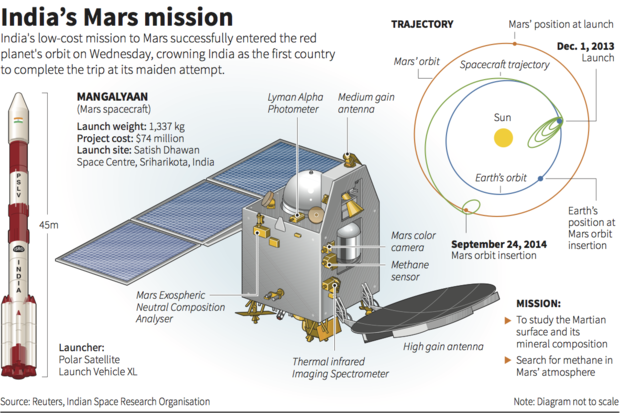
 My kudos to all the space scientists and the engineers involved in this mission. I found a great picture in the news reports, which I reproduced below. It gives the orbital trajectory which the spacecraft took, the positions of Mars and Earth at launch time and when it at reaches Mars, the instruments carried, and the rocket that launched Mangalyaan.

Mangalyaan
Posted in September 2014, Sidereal Times | Tagged , , , | Leave a comment