From the Assistant Director

by Larry Kane, Assistant Director

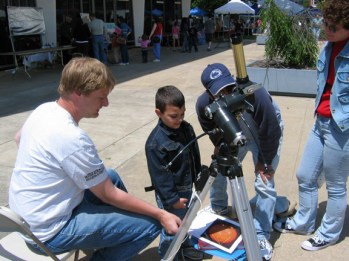
As a trustee of the Washington Crossing Park Association (WCPA), I want to urge members of the AAAP to consider joining the WCPA.  This organization is strategically placed to intercede with agencies of the State of New Jersey in issues involving the park in which our observatory is located.  In addition to hosting and facilitating the expected history related events and remembrances that make the park both famous and unique, the WCPA assists the AAAP in our outreach efforts at our observatory.   For example, over the weekend of April 29, we will be hosting 115 boy scouts and their adult scout leaders from the Northern New Jersey Scouts.  On both Friday and Saturday nights we can show them some of the wonders that the Spring skies offer for viewing.   We can during the day, set up solar telescopes to view the nearest star to us.   I hope that you will consider joining the WCPA.  Membership is $25.00 a year.  Please go to the website below for the application.

http://www.washingtoncrossingparkassociation.com/join

Another activity I am working on is Communiversity Day in Princeton.  This year it will be held on Sunday, April 17, from 1:00 PM to 6:00 PM.  This will be the fourth time the AAAP has participated.   It is a rare opportunity to set up solar telescopes on Princeton’s campus and talk to literally hundreds of people of all ages.  We have lots of handouts, courtesy of Astronomy Magazine, for the event.  I am hoping that we get a good turnout from the AAAP membership to join us at our table and/or to enjoy the event.  Communiversity Day normally draws over thirty thousand people in one afternoon.  Please contact me if you can lend us a hand.  Hope to see you there.

We are still considering a group trip to view the Total Solar Eclipse in August of 2017.  From what I have been able to gather, the best place to be, and the one having the best chance of clear skies is in Oregon.  While there are closer venues, e.g. Illinois, Tennessee, Kentucky or the Carolinas, these states may not offer the best chances for clear skies.  If you would be interested in joining in on this group “expedition,” or if you have any ideas of where we might be able to go as a group, please let me know.  Send your thoughts to me at this email address: assist.director@princetonastronomy.org
Posted in April 2016, Sidereal Times | Tagged , | Leave a comment

Outreach Report

by David Letcher, Outreach Chair

SSSAAAP participated in a number of star parties held at local elementary schools this past academic year, which a few of our members made possible. Last November we visited the Newell school in Allentown, NJ, and the Stuart Country Day school in Princeton.  We were also invited to visit the Constable Elementary school in Kendall Park last October but that was cancelled on account of the inclement weather. We visited the Princeton Day school earlier this year too.

Communiversity happens on April 17th this year!  AAAP’s volunteers have brought their telescopes to the event the past few years and, hopefully, will do it again this spring.

Our next star party on April 29th is a big one!  A group of about 115 scouts and their adult leaders will visit the observatory on the evening of Friday, April 29th! Obviously the scheduled key holder team will need lots of help that night. We’ll need additional members to bring their telescopes to the observatory to supplement the club’s supply in the observatory.

We will also host a cub scout troop at our observatory on Saturday evening, June 11th of this year.  Volunteers are needed for this event.

We have been invited by the Boy Scouts of America’s Washington Crossing Council to help at ScoutFest 16 at the Hunterdon County Fairgrounds in Ringoes, NJ.  ScoutFest 16 runs from October 7 to October 9 and will offer fun and exciting exhibits and activities to 3000-4000 scouts, family and guests representing Cub Scouting, Boy Scouting, Varsity Scouting, Venturing, Sea Scouts and Exploring.

ScoutFest’s main programs and activities will occur on Saturday from 9:30 am to 3:30 pm on Saturday October 8. Imagine giving a star party to 3000 – 4000 scouts!  Lots of scopes and volunteers needed if we go.

AAAP continues to support local school teachers and PTA/PTO groups by our volunteer members setting up their telescopes out in the school yard so children and their parents and grandparents can view nighttime sky objects.

Our AAAP has a reliable group of six to ten volunteers who consistently attend these star parties year-after-year and for that we are thankful.


Posted in April 2016 | Tagged , | Leave a comment

What’s All The Flap About?

By Michael Mitrano, Treasurer (Photo credits: David Skitt)

unnamed-6On the weekend of March 19, 2016, Gene Allen, John Delaney, Dave Skitt and I rebuilt the south gable end of the Washington Crossing Observatory’s roof.  Where once there was the flap that we needed to haul up before opening the roof, you will now find a section of wall permanently fixed to the block structure of the observatory.  This season, all you need to do to open the roof is unlatch the four corner turnbuckles and turn the crank.

unnamed-16We undertook this project to create higher roof clearance over the south telescope pier, which now holds only our special Hastings refractor.  That south pier now has an excellent Paramount mount that it is capable of supporting two telescopes, just as we have two scopes mounted on the north mount.  However, the south pier is taller, leaving less than an inch of clearance between the top of the mount and the gable end opening when the old flap was raised.  This greatly limited the diameter of the scope
that could be mounted alongside the Hastings on the south mount.

unnamed-17Initially we considered replacing the flap with a larger flap, but realized that tree growth over the years has concealed the south horizon that was made visible by raising the flap.  Replacing the flap with a fixed wall simplified construction and lightens the weight of the movable roof, as well as making it easier for all of our members to operate the observatory.
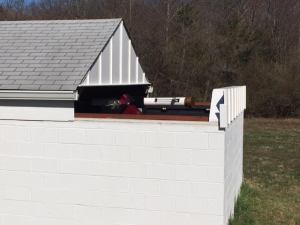
We will be adding ventilation to the gable and installing a brush-style sweep seal to keep light snow from blowing through the horizontal gap between the moving and fixed portions of the gable wall.

unnamed-4Thanks to the Board for supporting this and the construction team for making this happen.  We bid goodbye to the flap and hello to new telescope possibilities on the south mount.
Posted in April 2016, Sidereal Times | Tagged , , | Leave a comment

March 2016 AAAP Meeting Minutes

by James Poinsett, Secretary

  • Larry Kane called the meeting to order and introduced Prasad Ganti
  • Prasad then introduced the speaker for the evening, Dr. Neta Bahcall and her lecture “The Dark Side of the Universe”.
  • After the lecture Larry reminded the group that there will be a board meeting on Tuesday, March 29th at the West Windsor Library at 7:00 PM.
  • The club has reserved a table at Communiversity on April 17th. Volunteers are needed.
  • The last weekend of April, the 29th and 30th, there will be a Boy Scout Jamboree in Washington Crossing State Park. There will be 150+ scouts along with 30-40 adults. The observatory will be open both Friday and Saturday nights. Volunteers are requested for daytime solar observing.
  • A nominating committee is needed to set a slate of officers for election in May.
  • Observatory notes
    • Water has been turned on
    • The main gate to the park is broken. The club discussed the possibility of buying a chain and reflectors to assist the park. Gene will discuss the possibility of opening the gate for the season early giving the park several months to repair it. Another idea was brought up that it is not our problem, it is the park’s problem and we should have nothing to do with fixing or replacing it due to liability concerns.
    • The work on the new gable end should be finished by the time you read this.
  • The speaker next month is Jim Green from NASA.
  • April 1st and 2nd is the Stokes Star party. Be forewarned, it is a bare bones star party, there is not food available on site, you must bring your own.
  • There will not be a Super Science Saturday at the NJ Museum this year.
  • NEAF is the 9th and 10th of April.
  • The meeting was adjourned.
Posted in April 2016, Sidereal Times | Tagged , , | Leave a comment

Treasurer’s Report

By Michael Mitrano, Treasurer

Thus far in our fiscal year that ends in June, we have 88 members.  Our dues revenue at this point is close to what it was a year ago at the same date.

Total revenue for the fiscal year to date is about $7,600.  During the last month we’ve had additional spending for materials to rebuild the south gable and for wintertime electricity use. Our surplus for the fiscal year to date is about $3 thousand.

On a cumulative basis, the AAAP’s surplus is about $26 thousand.

Posted in April 2016, Sidereal Times | Tagged , | Leave a comment

Star Distances

by John Church

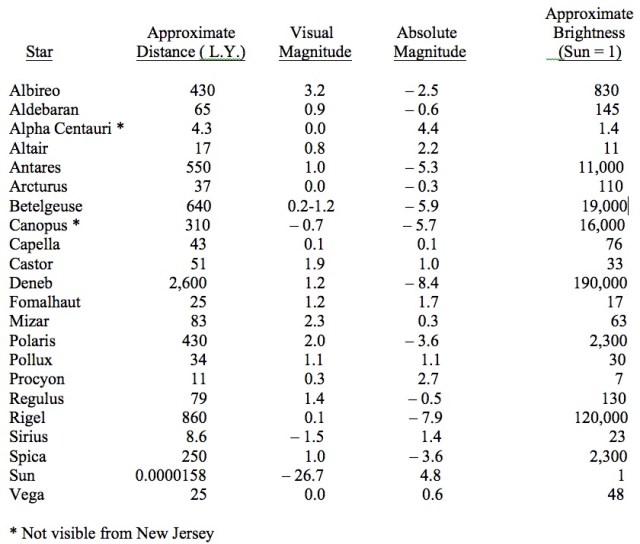
At last November’s business meeting it was mentioned that on public nights at the observatory, team members are often asked how far away a particular star is. To help us answer these questions, I’ve generated a list for some of the better-known stars.  I’ve also added data for visual magnitudes, absolute magnitudes (i.e. how bright each star would appear if it were at the standard distance of 10 parsecs or 32.6 light-years), and its approximate brightness relative to our puny little Sun.  In the case of multiple stars, which many of these are, the values are for the primary.

If the Sun were at this standard distance, at magnitude + 4.8 it would be barely visible to the naked eye in a moonless central NJ clear night sky.  But note Deneb, which has an absolute magnitude of  – 8.4.  If it were at this distance it would be 4 magnitudes brighter than Venus at its best – about like a 5-day-old Moon – greatly interfering with our modest view of the summer Milky Way and easily visible by day. Rigel, if similarly placed, would not be far behind in the winter sky.  Monster stars like this have been called “galactic beacons.”

More comparisons:  If the Sun were at the actual distance of brilliant Sirius, it would be of 2nd magnitude, i.e about the same as Castor or Polaris.  And, at the distance of Deneb, it would only be of magnitude 14.4, about as dim as Pluto appears from Earth.  Shrimp though the Sun is in the grand scheme, it’s still our favorite star.
Screen Shot 2016-04-02 at 10.31.39 AM

Perhaps this table could be posted on the observatory wall for convenient access.

Congratulations John for submitting the 500th article to Sidereal Times!

Posted in April 2016, Sidereal Times | Tagged , , | Leave a comment

Astronomers Livid About Green Laser Ban

by Michael Wright

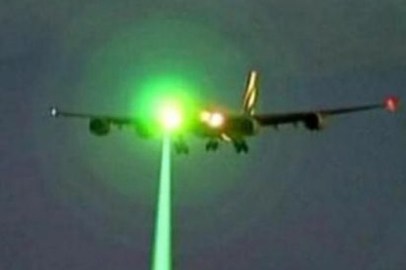
plane-laser-630-620x413Wilbur Dixon describes himself as a space enthusiast and a lifelong amateur astronomer who happens to own a green laser. Dixon of Princeton, NJ insists he’s not a “laser nut – just an astronomy nerd” who is tired of intrusions upon his personal freedoms. So, when he read about a ban on green lasers passed by the NJ State Legislature last month, the he lit up.

“I can’t believe they’re trying to do this in New Jersey,” Dixon said. “The worst light pollution in the country is taking away my God-given right to enjoy the night sky, but now I can’t even point out the few remaining objects we can see in NJ.”

Bill 760 has outraged green laser owners across the state because it would ban the sale and use of green lasers except by law-enforcement.

“It sounds like one of the more extreme pieces of gun control legislation,” said Dewey Cheatham, a professor at the Rutgers Law School.

The bill, if signed by Governor Christie, would require laser owners to pay a registration fee of $10 per laser per year, undergo a state police criminal background check and submit detailed personal information for a registry that would include fingerprints, Social Security numbers, birth dates and passport-sized photographs.

Applicants who are denied registration would be required to surrender their green lasers to the state police. Anyone who violates the law could face a fined or jail time.

Because no permit is needed to own a green laser, it is difficult to say how many New Jerseyans own one.

The District of Columbia and several states, including California, Hawaii, New York and Michigan, require some form of registration for green lasers, according to information compiled by the American Astronomical Union’s Committee for Legislative Action. A few states have imposed guidelines for laser owners in specific areas.

Critics of New Jersey’s proposal are vocal in their opposition. “People from Newark and Trenton support it, but people from the dark-sky areas like the Pine Barrens say I’m a Nazi,” said state Rep. Eileen Wright, who represents Essex County.

­­­Wright said she proposed the measure as a means to apprehend criminals responsible for flashing planes at Newark Liberty Airport.

“I’m not in favor of taking away people’s right to bear lasers,” she insisted. “They would just have to register them — like they register a vehicle every year. I want to make it safe for all people across the state.”

The United Astronomy Clubs of New Jersey immediately took a firm stance against the bill and urged its 35 members to contact lawmakers and oppose it. The organization contends that a green laser registry is a step down the slippery slope towards banning light buckets in NJ.

“The UACNJ is fundamentally opposed to any sort of green laser registry for law-abiding citizens,” spokeswoman Cassy O. Peia­­­­­ said, adding that lawmakers should focus on “dealing with the criminal element” rather than placing the burden on law-abiding laser owners.

In only a month, the issue has become so polarizing that one of the bill’s original sponsors, Mick Stupp, a Mercer County Republican, has withdrawn his support. “I have some concerns because this is more punitive than it needs to be,” Stupp said. “There are many law abiding astronomers who use green lasers at star parties to educate the public.”

Sparky Wyer, Professor of Electrical Engineering at NJIT advocates a technological solution to identify laser abusers. He says that lasers can be easily modified to produce a very fast, pulsed code similar to morse code, that would identify an abuser’s personal information. The code would be undetectable to the eye, but a sensor he developed would detect and read the code.  The detectors would be installed on all commercial and military aircraft. If the aircraft is flashed with a laser, the abuser’s personal information would be transmitted to local law enforcement authorities for apprehension. Wyer says “Astronomers are pretty handy so I have posted instructions to modify their lasers on my website: http://www.aprilfool.com.”

Posted in April 2016 | Tagged , , | Leave a comment

Star Wars – The Force Awakens

by Prasad Ganti

unnamed-2The seventh “Star Wars” movie was released in December of 2015. After almost a decade after Disney bought the franchise from George Lucas, there were uncertainties over how much would it stick to the original cult classic. Would it excite the fans as much as the original two trilogies did earlier? The fans came back in droves. The excitement reverberated in the box office coffers. By all measures, it was an amazing success.
I am a Star Wars fan. It inspires me like no other series. Rich in imagination are those fabulous worlds beyond our planet Earth: desert planets, icy planets, planets with strange creatures, strange dwelling structures, strange vehicles in stranger surroundings, different kinds of spacecraft zipping across the galaxy and so on.

Probably the human mind tires of the familiar sights we see in our daily lives – roads, cars, malls, airports etc. Anything newer looking is a welcome sight. Sometimes we develop contempt for the familiar. The same sights may look awesome to someone from an earlier age or from another planet which does not have advanced technology. We long for new and different places; planning a new vacation as soon as we come back from the current one. The Pyramids of Egypt and the beaches of Caribbean are enchanting for the same reason.

Usually it is difficult to sustain the creativity beyond one movie. That is why part 2 and part 3 are usually not all that interesting. Not so with Star Wars. Each of the seven movies has been freshly creative, not just an extension of the first successful one. Different concepts with an underlying common thread has been the hallmark of this franchise.

An empire stretching across the galaxy also stretches our imagination. The speed of light becomes the limiting factor for radio waves or spacecraft across such huge distances. It takes 20 minutes for radio signal to reach neighboring Mars. The Voyager 1 and 2 spacecrafts which left the Earth in the 1970s have barely reached the edge of the solar system. A hyper-drive for the spacecraft, and a hyper-wave relay for superluminal communication are the inventions in science fiction to overcome these limitations. We may not have these technologies for centuries to come.

It is not just the technology developments, but also the development of the mind. The Jedi are mentally as strong as their sabre fighting capabilities. There are many parallels between the Star Wars and Isaac Asimov’s Foundation series. Like Star Wars, Foundation consists of two trilogies, the second foundation focusing on the mental powers. Stretching across the galaxy, Star Wars was conceived by George Lucas with no mention of the Foundation.

Although a lot of things in Star Wars are different than the world we live in, one thing is the same: the baser instincts of human beings to fight with each other, to be territorial and to invent deadlier and deadlier arms to destroy on a vast scale. May be it is the Darwinian survival of the fittest instinct.

As Albert Einstein said after the dropping of the atom bomb, “Everything has changed except human thinking”. Good versus evil is at the core of the plots. Not only in Star Wars, but across wider variety of genres. “May the force be with you.” is the mantra of Star Wars, an equivalent of the present day “God bless you”. Evil seems to be winning most of the time until much later. The good then makes a comeback. Can the plots be equally creative and innovative, as the technologies and the other worlds are? Regardless, inspiring millions of people and firing their imaginations enough to cough up billions of dollars is no mean achievement.

Posted in April 2016, Sidereal Times | Tagged , | Leave a comment

Snippets

compiled by Michael Wright and David Kaplan

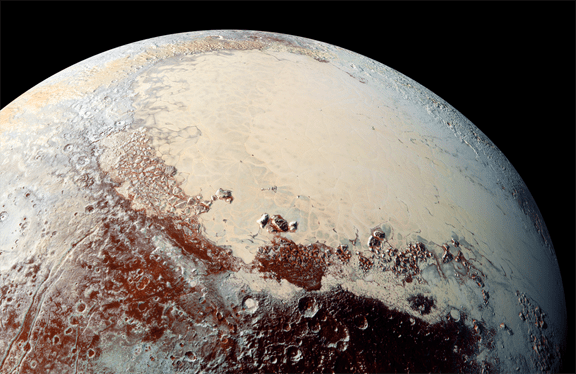
A color image of Sputnik Planum, the region known as Pluto's "heart," which is rich in nitrogen, carbon monoxide and methane ices. Credit NASA/Johns Hopkins Applied Physics Laboratory/Southwest Research Institute


A color image of Sputnik Planum, the region known as Pluto’s “heart,” which is rich in nitrogen, carbon monoxide and methane ices. Credit NASA/Johns Hopkins Applied Physics Laboratory/Southwest Research Institute

What We’ve Learned About Pluto
The story of Pluto is largely a story of ice. On Earth, the only ice is frozen water. On Pluto, nitrogen, methane and carbon monoxide also freeze solid. The most striking feature that NASA’s New Horizons spacecraft saw when it flew past Pluto last July was a heart-shape region now named Tombaugh Regio after Clyde Tombaugh, the discoverer of Pluto. The left half is covered by mostly nitrogen snow; the right side is more methane ice.

Dawn spies new detail in Ceres’ bright spot
The US space agency’s Dawn satellite continues to return remarkable images from the dwarf planet Ceres, in particular from its collection of bright spots in Occator Crater.

Project Greenglow and the battle with gravity
Scientists are debating whether it’s possible to harness the power of gravity for interstellar space travel.

Hubble telescope spies stellar ‘land of giants’
Astronomers use the Hubble Space Telescope to investigate a clutch of monster stars on the edge of our Milky Way Galaxy.

A ‘Tail’ of Two Comets
Two comets that will safely fly past Earth later this month may have more in common than their intriguingly similar orbits.

Astronomers Discover Colossal ‘Super Spiral’ Galaxies
A new class of behemoth spiral galaxies has been uncovered using NASA archival data.

Europe’s New Mars Mission Bringing NASA Radios Along
Two NASA radios aboard the European Space Agency’s Mars mission that launched today are engineered to provide communication relay service for rovers and landers on Mars.

Mars Mission Blasts Off From Kazakhstan
The ExoMars spacecraft consists of an orbiter that will measure methane and other gases in the Martian atmosphere and a lander that will study dust storms.

NASA Targets May 2018 Launch of Mars InSight Mission
NASA’s InSight mission to study the deep interior of Mars is targeting a new launch window that begins May 5, 2018.

Who was Caroline Herschel?
Caroline Herschel is the subject of a Google doodle, but what was her contribution to science?

Watching the heavens: The female pioneers of science

Why the forgotten women of astronomy are being celebrated 100 years on.

Ten Years of Discovery by Mars Reconnaissance Orbiter
True to its purpose, the big NASA spacecraft that began orbiting Mars a decade ago this week has delivered huge advances in knowledge about the Red Planet.

NASA’s K2 mission: The Kepler Space Telescope’s Second Chance to Shine
How engineers devised a clever solution to give NASA’s Kepler spacecraft a new mission.

Dawn’s First Year at Ceres: A Mountain Emerges
NASA’s Dawn mission commemorates the spacecraft’s first year at Ceres with new images of a mysterious mountain.

Dark Mercury’s ‘pencil lead crust’ revealed
The planet Mercury may once have been encased in an outer shell of graphite, the same material used as pencil lead.

Gravitational waves: Tests begin for future space observatory
The European Space Agency’s Lisa Pathfinder probe begins testing the technologies needed to detect gravitational waves in space.

Hubble sets new cosmic distance record
The Hubble Space Telescope spies a galaxy that existed more than 13 billion years ago, very close to the dawn of star formation.

Versatile Instrument to Scout for Kuiper Belt Objects
The CHIMERA instrument at the Palomar Observatory near San Diego is using hi-tech cameras to locate near-Earth asteroids and objects in the Kuiper Belt.

Radio flash tracked to faraway galaxy
Astronomers pinpoint the source of an explosive ‘fast radio burst’ for the very first time, and use it to measure the density of the cosmos.

Astronaut Capt Scott Kelly’s year in space
A selection of some of the stunning images posted on social media by astronaut Capt Scott Kelly

5 Ancient Sites Built to Align with the Spring Equinox
Architecture that works with astronomy.

Posted in March 2016, Sidereal Times | Tagged , , | Leave a comment

Director’s Report

by Assistant Director Larry Kane

This month I am filling in for our Director, Rex Parker, as he is off exploring the natural wonders of New Zealand.  No doubt, he is more interested in the ecology and grandeur of this mini-continent than in the hunt for the “one ring that binds them all.”  On behalf of the AAAP, I am hoping that Rex brings back many stunning pictures, and, perhaps a talk about his trip.

This month, on Sunday, March 20 at 12:30 AM, we will witness the “spring equinox.”  At this time, the Sun will shine directly on the equator and the hours of daylight and night will be nearly the same.  It is also the time when the Sun crosses the celestial equator.  These events have been widely celebrated in the Northern Hemisphere as witnessing a time of rebirth with the cold of Winter relinquishing to the hope of a warmer Spring.

After some discussion with Director Rex and other members of the AAAP, I have decided to take on another two-year term as trustee and AAAP representative on the Board of the Washington Crossing Park Association (WCPA).  As the interests and goals of both organizations often overlap, I will do my best to ensure that the AAAP remains an integral part of the park and its programming.  When events, developed and presented by the WCPA, are of interest to the AAAP, I will make sure that our organization is made aware of them.  The importance of a working relationship between these two organizations cannot be over emphasized and I encourage all AAAP members to consider becoming members of the WCPA.  You can contact me for details.

I cannot write to the AAAP membership without reminding everyone about the TOTAL SOLAR ECLIPSE VISIBLE OVER MUCH OF NORTH AMERICA ON AUGUST 21, 2017.  An effort has begun to look into a AAAP group trip to view the eclipse.  Initial investigations have determined that the best place to view it may be in Oregon.  While this will definitely be a hike for us, the closer locations in parts of Kentucky, Tennessee, North Carolina and Illinois, are more likely to have cloud cover.  As this is a once in a lifetime chance for many of us to see such an event live, we should consider going to a place where we have the best chance of actually seeing it.  Stay tuned, as I am still putting together preliminary data and will, shortly send out a survey to gauge interest within the AAAP.  Again, please contact me if you have any suggestions or questions.

Clear Skies,

Larry

Posted in March 2016, Sidereal Times | Tagged , , | Leave a comment