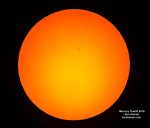
Minutes of the April 11, 2017 meeting of the AAAP

by James Poinsett, Secretary

• The director, Rex Parker, called the meeting to order.

• There will be a night sky refresher at the planetarium of the NJ State Museum on Saturday, May 13th at 10:00 AM, all members are welcome to attend.

• There are members nights scheduled at the WC Observatory on Saturday May 27th and Saturday June 24th. All members are welcome, refreshments will be available.

• Mercer County Park Association is planning a campout on the summit of Baldpate Mountain on the night of August 11th for a Perseids viewing party. They have asked our assistance as night sky guides.

• Some club members are meeting near Monmouth, Oregon for the August 21st total solar eclipse. If you want more information contact Larry Kane or John Church.

• It is election time and the current Board of Directors has agreed to run for another term. If anyone else is interested please notify Gene Allen to have your name added to the slate. The current board is director:

     o Director – Rex Parker
     o Asst. Director – Larry Kane
     o Treasurer – Michael Mitrano
     o Program Chair – Ira Polans
     o Secretary – Jim Poinsett

• Rex sadly informed us that former director Dick Perry has passed away.

• There is a proposal to add Outreach and Observatory Chair positions to the board of directors. The procedure for doing this will be discussed at the next board meeting.

• There is a proposal to add a committee to help the Outreach Chairperson, the board will discuss this at the next meeting.

• Participation in outreach events has fallen off, please make every attempt to help the club reach potential new members by participating in outreach events.

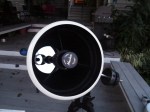
• There was some discussion on how much of the night sky are we seeing through the C14 telescope at the observatory. It was concluded that using the Nagler31 eyepiece we are seeing about 1/31000th of the night sky.

• Communiversity was held on April 30th, AAAP had a table at the event.

• The Stokes Star Party was held on April 21st and 22nd.

• Larry has the logo and will be ordering shirts, details to follow at the next meeting.

• The meeting was adjourned.

Posted in May 2017, Sidereal Times | Tagged , | Leave a comment

quantum entanglement.

by Theodore R Frimet

pass the uranium, please.

It was 10 marbles for 99 cents, plus shipping, and I couldn’t resist. Imagine, uranium embedded into glass. Not a new thing, of course! Uranium glass has been around before there was electric light. Imagine having a uranium glass vase, seated by the window, catching glancing photons from the setting sun. And glowing…green. Aside from radioactive glass being, well, very cool, and out-right geeky, I was becoming transfixed on some purposeful use of uranium marbles.

It started with an attempt to find a science book, on line, in MP3 format from our local library. And I was not disappointed. I found, Entanglement, by Amir D. Aczel and installed and downloaded Overdrive onto my iPhone as quickly as I could. Azcel thoroughly presents the topic and makes it a point, to repeat key concepts and re-weave them into the storyline. Although more of a history of science, there were many tidbits that got my juices going. And my mind seemed to wander off to new horizons.

The new horizon seemed to become entangled. I found old thoughts, become washed anew. Last year, during one of our AAAP Friday night observation, I shared a thought with an astronomer that the nebula that we were viewing, was gas a-glow from ultraviolet light emanations from the white dwarf, contained within. Reradiating light, it seems, was perfectly rational. Photons, being well, photons, would excite electrons in the nebula to higher energy states, only to settle down into a lower energy state, and re-emit a photon in the process. Hence the glowing. What I was unaware of, was that there is also a process called down-conversion. And now, being titillated with a new concept, I was apt to apply it..somehow..somewhere..

I gleefully put together an email to a scientist that knows how light propagates thru a medium, and started my suggestions on green glass, and somehow ended up asking if gravitational lensing, causing Einstein rings, entangles light. Re-reading the email, I must have bit my lip, because, at the least, I never suggested having two or more telescopes aiming at the phenomena to capture entangled photons. And of course, he may have been a physicist, however, he was no astronomer. So the thought may have been lost on him in its entirety. No matter, as the light coming forth from such distant objects inherently are highly incoherent. Having had their presumed entangled photons come into contact (measurement) with other cosmological hooligans, they became less fuzzy. They collapsed their wave functions long ago.

I learned, from the auditory text, that science has been able to entangle photons, and more complex items, such as 2,000 atoms of Rubidium. Hardly stellar stuff…not just yet. So I set myself up and got insightful when the author spoke of spontaneous parametric down-conversion (SPDC). As evidenced thru the application of laser experiments and non-linear crystals; two crystals were specified, one was lithium iodate, the other barium borate. And both exhibited a faint halo – with rainbow color. That meant that not all the laser light was emitted as expected. When measured, it became apparent that for every one photon in, we get two out, and more specifically, the frequency of the two output photons was one half the frequency of the input. Later analysis proved the light was a good source of quantum entanglement. The phenomenon, according to the author of my latest fling, was discovered in 1970 by DC Burnham & DL Weinberg. The Wikipedia listing gives credit to additional authors. The implementation of SPDC as a source of entangled photons, for experiments related to coherence, was done by the likes of Leonard Mandel (May 9, 1927 – February 9, 2001) and others (another Wiki reference).

So, I found my jumping off point. It was Astronomy Day at Jenny Jump, UACNJ, and we had 20 minutes or so to kill, while a member went about finding an adapter for the present speaker’s laptop. Two other club members, helped kill time on entanglement. And my idea of entanglement of photons from Einstein Rings, and White Dwarfs, got shot down really fast. So I played my Ace card, and suggested that the UV input into a uranium crystal, yields a frequency one half of that input. UV being about 778 Ghz, green light 545 (thanks Google), Perhaps we have two photons out, for every one, in? Nope, not exactly. The math simply does not work, here. However, this is my delusion, so we march on to say we have a new source of entanglement. Nothing new under the sun, I’m told, and because I am dealing with a macro system, and coherence isn’t likely. But I persist. I want to focus the green fuzzy uranium light thru a beam splitter. With one source hitting a cut-out triangle target, and the second source becoming the ghost. Expecting much from my marbles, I want to see quantum entanglement in action.

And then the brighter of the four of us, asks me a question. What exactly is entanglement? I started to tell him how a photon becomes entangled, but he interrupts me, and says, “no, what is the cause of entanglement”. I say, give me a few seconds to think on that. And then I remember seeing an article with a picture that shows some concentric circles. And I seem to recall that there were several points of circular intersection that were referred to as “entanglement”. I also recall, at this time, learning that many different wave forms, say multiple sin and cosine waves can contribute and add to one wave form. And that one wave can represent, something, say like an electron. So the “particle” aka electron, is as spread over many probabilities as is the many waves that can represent it. And I put together the two thoughts (either of which may have been highly inaccurate) and tell my friend: “When one wave function intersects with another, the point of intersection is the entanglement.”

So when my marbles arrive, I’ll count them out, and have some fun. I am assured as long as I don’t grind the glass down for ingestion, uranium glass is presumed safe. I did order a low cost UV light source, and some eye protection, as the UV is probably more damning than the uranium will ever be. I may not ever get a chance to focus really huge telescopes onto Einstein Rings, however, in a few days, I will be able to find my marbles.

Posted in May 2017, Sidereal Times | Tagged , | Leave a comment

The Search for Extra-Terrestrial Life in the Universe

A book by Bangladeshi author Obaidur Rahman

Cover of Obaidur Rahman, a Bangladeshi author's new book "The Search for Extra-Terrestrial Life in the Universe".

Cover of Obaidur Rahman, a Bangladeshi author’s new book “The Search for Extra-Terrestrial Life in the Universe”.

Click here for the PDF version of the book.

Posted in May 2017, Sidereal Times | Tagged , | Leave a comment

Recycling rockets.

by Prasad Ganti

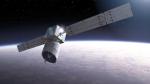
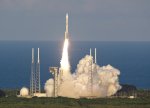
Space X recently launched its flagship rocket Falcon 9 to send cargo to the International Space Station. It was almost a routine launch, barely indistinguishable from the others except for one feature. The first stage of the rocket was flying for the second time. In essence it was being reused. This reuse planted a significant milestone in the history of space launches.

Space is a vastly complex business and very expensive too. Mainly due to the single use of the rocket which launches a spacecraft. In a multi stage rocket used to launch any significant payload, the first stage drops back to the Earth after giving a big initial boost to the payload. Typically, that dropping was into an Ocean or a Sea where it became debris. Space X in an effort to reuse the first stage, tried to take baby steps towards recovering and refurbishing the first stage.

After all, nobody uses a bus or a train or a plane or a horse for one trip only. But getting to the multi-use was not easy. The rockets which powered the spacecraft to the Moon in the 1960s and 1970s were all single use. An attempt was made to build a reusable space vehicle. The result was the Space Shuttle. It took off strapped to a rocket, and came back and landed like an airplane. It needed extensive refurbishment before launching again. Each of the hundreds of heat protecting tiles underneath the Shuttle had to be carefully inspected and replaced. Eventually, the economics did not work in its favor. Much like the supersonic Concorde airplane which does not run anymore. The Space Shuttle also got relegated to the museums like the Concorde.

Space X designed its first stage to come back and touch down gently either on a floating barge or on land. Success followed after initial stumbles. One of those recovered first stages was refurbished and used for the latest launch. That completed the cycle of recovering, refurbishing, and relaunching. This cycle is expected to be repeated over and over again to reduce the cost of future space launches.

The way Space X recovers the first stage is by leaving some fuel unburnt. After separation from the main rocket, the leftover fuel in the first stage is used to reignite the engines on the rocket in a series of burns, to help the vehicle reenter the Earth’s atmosphere and then slow down for landing. This technique is known as supersonic retro propulsion.

Now that the concept of recycling the first stage has been proven, SpaceX’s new goal is to begin reusing rockets within 24 hours of landing, with just an inspection and refueling like for many of the passenger and cargo jets.

Space X is not the only game in the town. Blue Origin, owned by Amazon Chief Jeff Bezos. Although Blue Origin rockets have not gone into space yet, but it did get to the edge of the space. And reused its New Shepard suborbital rocket five times last year. In the bargain, Blue Origin won the prestigious Collier Trophy. Collier Trophy is given for the greatest achievement in aeronautics or astronautics in America, with respect to improving the performance, efficiency, and safety of air or space vehicles. It is a healthy competition between the private space companies – Space X, Blue Origin, Orbital Sciences etc.

What happened to aviation a few decades back is now happening for space launches. Boeing 707 ushered in the jet age. Then Boeing 747 made cheap intercontinental travel possible. In the coming years, space is going to get its A380 and Boeing 787 Dreamliner. It is exciting times to be living in.

Posted in May 2017, Sidereal Times | Tagged , | Leave a comment

Snippets

compiled by Arlene & David Kaplan

Saturn's north pole known as "the hexagon" - JPL

Saturn’s north pole known as “the hexagon” – JPL

Saturn’s Hexagon in Motion
This colorful view from NASA’s Cassini mission is the highest-resolution view of the unique six-sided jet stream at Saturn’s north pole known as “the hexagon.” This movie, made from images obtained by Cassini’s imaging cameras, is the first to show the hexagon in color filters…more

GJ 1132b planet's thick atmosphere

GJ 1132b planet’s thick atmosphere – BBC

Atmosphere found around Earth-sized planet GJ 1132b
Scientists say they have detected an atmosphere around an Earth-sized planet for the first time. They have studied a world known as GJ 1132b, which is 1.4-times the size of our planet and lies 39 light years away. Their observations suggest that the “super-Earth” is cloaked in a thick layer of gases…more

remains of a 500-year-old explosion

Remains of a 500-year-old explosion – BBC

Violent end as young stars dramatically collide
Scientists have captured a dramatic and violent image of the collision between two young stars that tore apart their stellar nursery. Located in the constellation of Orion, the explosive event happened some 500 years ago sending giant streamers of dust and gas across interstellar space…more
Annie Maunder: A pioneer of solar astronomy - BBC

Annie Maunder: A pioneer of solar astronomy – BBC

Annie Maunder: Plaque to be erected for Strabane astronomer
A plaque is to be erected in Northern Ireland to honor a Strabane astronomer who has a crater on the moon named after her.
Annie Maunder worked alongside her husband, Edward Walter Maunder, at the end of the 19th Century….more

Replacing the CMS's pixel detector - BBC

Replacing the CMS’s pixel detector – BBC

Huge Large Hadron Collider experiment gets ‘heart transplant’
One of the Large Hadron Collider’s huge experiments has been given what’s described as a “heart transplant”. Officials said the replacement of a key component inside the CMS experiment represented the first major upgrade to the LHC – the world’s biggest machine…more
Rows of plumes rise from ice fractures - NYT

Rows of plumes rise from ice fractures – NYT

Plumes From Saturn’s Moon Enceladus Hint That It Could Support Life
Could icy moons like Saturn’s Enceladus in the outer solar system be home to microbes or other forms of alien life?
Intriguing new findings from data collected by NASA’s Cassini spacecraft suggest the possibility. Plumes of gas erupting out of Enceladus — a small moon…more
Posted in May 2017, Sidereal Times | Tagged , | Leave a comment

From the Director

Rex


by Rex Parker, PhD director@princetonastronomy.org

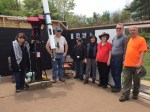
New Season Begins at AAAP’s Washington Crossing Observatory. The late winter surge that Punxsutawney Phil warned about made our preparations for the new season at Washington Crossing a little harder. But we’re ready now — the hardware and software upgrades have come a long way, thanks to Observatory Chairs Dave & Jennifer Skitt and other members. The new Windows-10 PC’s are in place and ready to control the two Paramounts — the sophisticated computer-controlled equatorial mounts now running under “TheSkyX” (Software Bisque’s latest, major upgrade over the previous Sky 6 version). With the recent installation of a Verizon high speed fiber optic internet connection at the observatory, TheSkyX can also be accessed using Teamviewer12 remote software from home PCs.

The Observatory is for all club members. It is our main hub for observing, member gatherings, and public outreach. You don’t need to be an expert, just come out on Friday public nights (Apr-Oct). If you want to become a hands-on observer (or access remotely) and learn more about the celestial sphere, telescope hardware, software, and technical aspects, I urge you to contact me or other Board members, or contact Dave and Jennifer (Observatory committee). We offer specific training for members to become new “Keyolders” who can access the Observatory and its equipment 24/7/365. Also note the members nights coming up (see below).
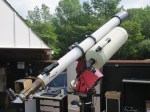
Telescope equipment at AAAP’s Washington Crossing Observatory now includes:
Paramount-ME #1
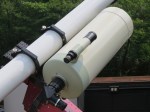
• Celestron-14 Schmidt-Cassegrain telescope (14 inch), D = 355 mm, f/11, FL = 3900 mm
• New Stellarview 80 mm right-angle finder scope on the C14.
• Explore Scientific ED127 refractor telescope (5 inch), f/7.5, FL = 950 mm, triplet air spaced apochromatic refractor.
• Mallincam Xterminator, color video camera attached to the ED127 refractor for live video astronomy on the monitors in the observatory
Paramount-ME #2
• Hastings-Byrne 6-1/4 inch refractor, f/14.6, FL = 2310 mm. Historic instrument dates to 1871, air-spaced doublet lens. Glass and tube original from 1871.
• Takahashi Mewlon-250, 10 inch Dall-Kirkham reflector telescope, with 2 inch TMB Optical dielectric-diagonal and Feathertouch 2 inch Crayford focuser
• New Televue eyepieces, Panoptic 27 mm and 41 mm, for the Mewlon-250

Seeking AAAP outreach co-chair. AAAP is noted for public outreach – we help people of all stages of learning and interest enhance their study of the universe we live in from an astronomy perspective. We need a member or two to step up and help current Outreach Co-Chair David Letcher in the outreach endeavor. This involves communicating with teachers and other educators, community groups, and scout troop leaders to coordinate astronomy events with club members’ participation. These typically involve observing with telescopes at night at our Observatory or on location at schools, parks, and public facilities. Please contact me or David (outreach@princetonastronomy.org) if you can help.

AAAP Activities Coming Up
Night-sky refresher at Planetarium (May 13, 2017). We’re reprising the “night sky refresher” session so that members can improve deep sky skills. The Planetarium’s amazing capabilities will be on display as AAAP member and Planetarium staffer Bill Murray runs the system. Meet on May 13 at 10AM. The Planetarium is located at the NJ State Museum, 205 W State St in Trenton.

Members night star parties at the Observatory Sat. May 27 & June 24. These nights are reserved for AAAP members (friends and family welcome) at our Observatory on May 27 and June 24. A great opportunity to learn more about observing and telescope equipment, and get to know others in the club.

Solar eclipse plans (Aug 21, 2017). Several AAAP members are making plans to view the upcoming total solar eclipse in Oregon. If you’re interested in participating contact assistant director Larry Kane. The chosen locale is near the town of Monmouth OR, where one of our members has a family connection, which is in the path of totality running W to E across the U.S. from Oregon to South Carolina. Of course, a clear sky is key, and August weather considerations are favorable at this site. NJ and surrounding states will see only a partial eclipse, far less impressive than totality.

Posted in April 2017, Sidereal Times | Tagged , | Leave a comment

From the Assistant Director

by Larry Kane, Assistant Director

There are a couple of issues that needed to be brought to your attention:
I wanted to provide the AAAP membership an update on the planned trip to view the total solar eclipse on August 21, 2017. Through determined negotiation, without the benefit of having read The Art of the Deal, I was able to reserve eight motel rooms within an hour drive of where we will view the eclipse. At this point in time, five of these rooms have been requested by AAAP members. So, there are three left. As I have put all of the room reservations on my credit card, I will soon have to relinquish any of them that are not soon, spoken for. So, come one and come all, at least three more of you.

Sunday, April 30 will be the annual extravaganza known as Communiversity Day in Princeton. We have, again, been invited by the organizers from the university to participate in this event which can draw 30,000 people in one day to downtown Princeton. Past events were very successful as we were able to hand out several hundred pieces of literature, talk to hundreds of people, and show them what their closest star looks like in a telescope. We hope to repeat these successes this year. So, I am requesting each of you to become a part of this event by attending, with or without a telescope, and helping to share our knowledge and awe of the cosmos. Please think about it and either contact me to say you will help with the event and/or see me at the next AAAP meeting and give me your contact information so we can help make this the best Communiversity Day ever. If you will not be able to attend the meeting, please send me an email at: assistant.director@princetonastronomy.org . By the way, if anyone has a good lead for affordable flights to Portland, OR, please let me know.

I hope to see everyone to discuss both of these monumental events at the next meeting.

Posted in April 2017, Sidereal Times | Tagged , | Leave a comment

‘The Glass Universe’- April 11, 2017 Lecture

by Ira Polans, Program Chair

The April AAAP meeting is on the 11th at 7:30PM in Peyton Hall on the Princeton University campus. The talk is by author Dava Sobel, author of “Longitude”, on her latest book “The Glass Universe”. After the talk there will be a break for a book signing. Labyrinth books will be on hand with books for purchase. You can save some time by buying your book(s) prior to the signing. They accept payment in cash, checks, or credit card.

In the mid-19th century, the Harvard College Observatory began employing women as calculators, or “human computers”, to interpret the observations made via telescope by their male counterparts each night. At the outset this group included the wives, sisters, and daughters of the resident astronomers, but by the 1880s the female corps included graduates of the new women’s colleges—Vassar, Wellesley, and Smith.

Dava Sobel

Dava Sobel

As photography transformed the practice of astronomy, the ladies turned to studying the stars captured nightly on glass photographic plates. The “glass universe” of half a million plates that Harvard amassed in this period—thanks in part to the early financial support of another woman, Mrs. Anna Draper, whose late husband pioneered the technique of stellar photography —enabled the women to make extraordinary discoveries that attracted worldwide acclaim. They helped discern what stars were made of, divided the stars into meaningful categories for further research, and found a way to measure distances across space by starlight

Their ranks included Williamina Fleming, a Scottish woman originally hired as a maid who went on to identify 10 novae and more than 300 variable stars; Annie Jump Cannon, who designed a stellar classification system that was adopted by astronomers the world over and is still in use; and Dr. Cecilia Helena Payne-Gaposchkin, who in 1956 became the first ever woman professor of astronomy at Harvard—and Harvard’s first female department chair.

Prior to the meeting there will be a meet-the-speaker dinner at 6PM at Winberie’s in Palmer Square in Princeton. The dinner is members-only and seating is on a first-come, first-served basis with a limit of 18 club members. NOTE: Guests will be accommodated only if less than 18 club members wish to attend.

If you’re interested in attending the dinner please contact me at program@princetonastronomy.org. In your request please indicate who’s the paid member and who is the guest (Limit 1 guest per member).

As mentioned last month, we’re planning to schedule a short meeting (of about 30-45 minutes) in April to seek club member’s suggestions for speakers for next year. The proposed meeting dates are April 19, or 26 at about 7PM in Peyton Hall. If you’re interested in participating please email me indicating which days is good for you (in order of preference). We’re particularly interested in suggestions about amateur astronomer related topics. Based on the responses I will schedule the meeting based on member preference and room availability. If you can’t make any of these dates please email me with your suggestions. Please include the speaker’s name, subject matter, and affiliation.

See you on Tuesday, April 11.

Posted in April 2017, Sidereal Times | Tagged , , | Leave a comment

Outreach Report

by David Letcher, Outreach Chair

The weather has been a “thorn in our sides” during this winter and early spring season of 2017. A star party at one of our regular schools, the Stuart Country Day School was scheduled in January but after 3 postponements they decided to wait until next fall to reschedule. A star party at Hopewell Elementary School was scheduled for March 24th but the NWS forecast was for cloudy weather. It was their annual science night so their side of the night was indoors. But Dave and Jennifer Skitt went there anyway and were able to show the children some sky objects as the students and parents left the building on their way to the parking lot. (The NWS forecast was a false alarm!)

Another star party was scheduled for an “astronomy night” in East Brunswick but was postponed until the fall.

I have been getting a slight increase in the number of requests from scout troops, both cub, boys, and girls. The problems for us is that, on the one hand, some are interested in having a volunteer come to one of their meetings, or on the other, a request to visit the observatory on a Saturday night. I have suggested they attend our weekly open houses as one alternative arrangement.

The latest request is for a volunteer to attend a private birthday party and entertain the guests with possible sky views and astronomy knowledge. This is a new type of request. Director Rex has asked us to express our opinions on whether we should engage in such activities.

I have noticed that, over the recent years, it has become a little more difficult to get members to volunteer for star parties; an issue that should be addressed.

Now that sunset is later in the evening, we won’t get any more school requests. They will start up again in the Fall.

Posted in April 2017, Sidereal Times | Tagged | Leave a comment

Treasurer’s Report

by Michael Mitrano, Treasurer

At this point in our fiscal year, which will end on June 30, we have just hit the 100-member mark. Dues revenue at this point is up about 14% from a year ago.

Total revenue for the fiscal year to date is about $6,000, with $1,300 of that from donations received in memory of Gene Ramsey. His extended family was particularly generous in their support.

We have spent about $5,600 during the year for the 4th telescope and related improvements at the observatory. As a result of this planned expense, we show a deficit for the year to date of about $4,300. I expect normal operating costs between now and the end of June to be modest, and likely to be offset by dues income from new or renewing members.

On a cumulative basis, the AAAP’s surplus is about $18 thousand.

Posted in April 2017, November 2014, Sidereal Times | Tagged , | Leave a comment

Member Resolutions for Astronomy 2017

by Rex Parker, Director

Here’s a synopsis of resolutions offered by members during the January meeting at Peyton Hall, shortly after the start of the new year. Encouraging and provocative!

• Do not let every clear sky night go unobserved
• Embark on a program to observe all the Messier Objects
• While I resolve to not make resolutions, nonetheless observe more this year (e.g. comets)
• Learn to use my telescope, get to know telescopes better (multiple)
• Purchase a new telescope
• Refrain from trying to acquire every new astro gadget that comes onto the market
• Acquire suitable binoculars for astronomy (multiple)
• Acquire or build a binocular mount to make binox more capable
• Figure out how to use my iOptron CEM60 mount & solar tracker, assistance welcome
• Make a guide star laser
• Learn about astrophotography; participate in workshop with club’s CCD camera (multiple)
• Become proficient using my video imaging system
• Spend more time using Mallincam video at WC Observatory
• Help ensure that video astronomy experience at WC is as good as it can be — frame grabber, other alternatives?
• Having gotten a handle on polar and go-to alignment, I seek to develop real-time observation capability with a camera.
• Use AAAP observatory more often, per talk with Gene Ramsey before he passed away
• As new Keyholder, get more practice with telescopes at the Observatory
• Introduce one or more persons to astronomy – friend family, neighbor
• Attend a star party at Cherry Springs PA
• View the solar eclipse with other AAAP members in Oregon (multiple)
• Field trip to a radio astronomy site
• Read Sky & Telescope magazine often to be more aware of upcoming events
• Continue to attend AAAP lectures
• Understand basics & advanced astronomy, complement mission of AAAP (multiple)
• Learn about string theory

Posted in April 2017, Sidereal Times | Tagged , | Leave a comment

Elysium Planitia, al dente – to the teeth

Theodore R. Frimet

Really? I went to UACNJ, at Jenny Jump, the other day for a pasta dinner, and let me tell you fellow Astronomers, it was simply scrumptious! Janet and I had taken to the road much earlier, than expected, in an effort to maybe get some solar observations in, by 2 PM. No such luck, though. As we drove up Rt 31, the clouds appeared to open up in “Simpson’s Style” showing the beautiful underbelly of blue skies above. Then, a barometric drop fell into place, probably corresponding with some outer world cosmic effect, dropping in the clouds, by the butt load.

After arriving at Jenny Jump, and with much patience, and reading my current favorite “No State Shall Abridge” by Michael Kent Curtis (Duke University Press 1986), the clouds were put into abeyance by said cosmic beings. UACNJ Membership Chairman (NWJAA member) Chris Callie, stepped up to the plate, grabbed a mount and the Lunt, with its h-alpha filter. He gave me some instruction, and with only a few minutes of cloud gap to spare, I was starry eyed at seeing my first solar prominence. Hurray! The day was saved!

Hours earlier, while sitting, reading and chatting, I speculated on the possibility of a laser inducing a mass drive. Our plasma mass sitting well forward of our space craft, gets bombarded by laser light, increasing its mass and gravitational attraction for our Mars bound vessel. And forward we go into the direction of new habitation. And then the topic of terra-forming bubbled to the surface. And I dissented, like so many abolitionists of 1866 vintage.

Having finally gotten around to reading about CRISPR, for the second time, and no longer grasping at so many proverbial straws, I said “just change the genome”. I mean, why not? Why go to all the effort to make another worlds environment suitable for humans, … so anthropomorphic…, when you can cut and paste a new DNA segment to support vital and basic metabolism for life functions?

Alas, no longer do the time honored verses of “Love is Like Oxygen” from ELO, or the music group, Sweet…

Love is Like Oxygen
You get too much, you get too high,
Not enough and you’re gonna die.
Love gets you high

The new love is to backtrack to our to evolutionary past. There are chemical reactions that provide life sustaining energy sources, other than our Krebs Cycle (aka citric acid cycle, aka tricarboxylic acid cycle, yada yada yada). And it could not be too far a future quest to identify protein complexes that will trap, and coordinate simpler chemical reactions to provide life sustaining energy. Producing the DNA sequence to gang-chain the necessary amino acids to produce said proteins, is becoming, in short measure, kitchen bio-chemistry.

So all that is really required, is to get past the smaller stumbling blocks of CRISPR. One of which is when the DNA repairs itself, incorrectly, before it gets its chance to incorporate the new DNA strip. Which results in genetic mosaics, and is not desirable.

Unfortunately, for moi, I was quickly counter-sniped into it being recommended that I am the first to go thru such a transformation. Fortunately, a calmer mind prevailed, leading us to this article, and the recommendation that we go forward with altering the genome of the nematode (C. elegans). The nematode is one of my most trusted allies in the garden. A close second, comes to mind, in the form of a mosquito. The little biting sucker happens to be, unfortunately, my animal kindred spirit (damn you mother nature). So given a choice between the little biting bastard of the summer, or my friend, the insert larvae hunting search and destroy nemesis, I choose Mr. nematode to become the first inhabitant of Mars.

So gear up your CRISPER/Cas9, because we have a low cost way of inhabiting Elysium.

Posted in April 2017, Sidereal Times | Tagged , | Leave a comment