March 13, 2018 Meeting Minutes

Minutes of the March 2018 Meeting of the Amateur Astronomers Association of Princeton

  • Meeting called to order at 7:30
  • Jim Fling has volunteered to head the Nominating Committee to put together a slate of nominees for the board of directors for next year.
  • Upcoming outreach event at Stuart Day School, about 24 students with parents and siblings. No other events scheduled currently.
  • Communiversity Day in Princeton is April 29th, volunteers and scopes needed.
  • Observatory news
    • Requests for groups to visit the observatory will be handled by Outreach
    • Public night groups will be handled by the observatory
    • Eight members want keyholder training, the weather is making it difficult to schedule training
    • The pointing problem with the refractor is being worked on, the mount is being adjusted.
    • EAA plans will be discussed at the board meeting later in March.
  • The meeting was adjourned.
Posted in April 2018, Sidereal Times | Tagged , | Leave a comment

March 26, 2018 Board Meeting Minutes

Minutes of the March 26, 2018 meeting of the AAAP Board of Directors

  • Meeting started and Rex welcomed and thanked all 14 members and board members present.
  • Nominations update – Nominations chairman, Jim Fling, announced all current board members have volunteered to return for another term in office. Anyone else interested in volunteering to serve on the board please contact Jim Fling.
  • There has not been much interest in the 10 minute member talk before the main speaker at each meeting. The board is looking for ideas to generate more member involvement.
  • The NorthEast Astronomy Forum (NEAF) is April 21-22.
  • Currently there are two parent/child pairs being trained to be keyholders.
  • The board plans to contact all area science teachers to generate more interest in the club and public nights at the observatory.
  • New member Joy S. has set up the AAAP on meetup.com to let more of the public know about our public nights and other club public events.
  • Currently there is no way for members to reach keyholders to request access to the observatory. If a non-keyholder would like access to the observatory they can send their request to the secretary at or another board member the their request will be forwarded to keyholders.
  • Social media was discussed thoroughly, pros and cons. Facebook, Twitter, PrincetonOnline.com will be used more. Contact with NJ newspapers and magazines will be increased.
  • Local colleges will be contacted for the possibility of getting some marketing assistance to increase membership and attendance at meetings. The possibility of becoming a sponsor at the Mercer County Science Fair to increase exposure to high school students was discussed.
  • Treasurer’s report. The current club balance is over $15K with 92 members. An increase of $2500 over last year.
  • Michael Mitrano is now on the board of the Washington Crossing Park Association.
  • The next topic was Electronic Assisted Astronomy. There was much discussion about the possible options. Using the newly donated scope or the refractor on the C-14. Which camera to buy and which software to use. It was finally narrowed down to two cameras, the Ultrastar and the Atik. Whichever camera we get will be mounted on the refracter that is mounted on the C-14. We may obtain a second camera use it for outreach and possibly on a portable scope during public nights. The board authorized Bill and Gene to get the best possible price on one of the two cameras at NEAF.
  • Communiversity is April 29th, volunteers are needed to represent the club.
  • A security system for the observatory is being researched and will be discussed at a future meeting.
  • Rex will talk with the Park commissioner about getting some gravel on the roadways leading to the observatory and also repairing the gates.
  • The focusing unit on the HB refractor is almost ready and will be ready for the public observing season.
  • The meeting was adjourned.
Posted in April 2018, Sidereal Times | Tagged , , | Leave a comment

go fly a kite

by Ted Frimet

“you’re a good man, charlie brown”

Last month, I looked at the astrophotography image, produced by AAAP Club Director Rex Parker, of a blue comet. And was somewhat jealous of what he had accomplished. Well, maybe not jealous as much as knowing what can be done. Rex has talent, and years of experience to back it. This month, Rex reminds us that Proximus Centaurus came to roost, as a preamble to future science, being explored at a AAAP lecture. What a beautiful collaboration of color. This image showcases the star closest to our outside solar system ventures. In this red giants habitable zone, we note the recent discovery of Proxima B. This exoplanet is the target of “The Breakthrough Starshot Initiative”, discussed by this months, AAAP lecturer, Dr. Ed Turner.

The red dwarf Proxima Centauri and surrounding star field. Width of field ~28 arc-min, about the size of the full moon. Alpha Centauri is out of the field ~2 degrees away. Image by RAParker using Skynet/PROMPT5

The red dwarf Proxima Centauri and surrounding star field. Width of field ~28 arc-min, about the size of the full moon. Alpha Centauri is out of the field ~2 degrees away. Image by RAParker using Skynet/PROMPT5

Dr. Turner gave us his time and provided personal insight into the interstellar flight project. Combining advances in micro-electronics, nanotechnology, and photonics, our future generations stand to witness the return of information from Proxima B, precisely 54 years after flight departure. There are many technical hurdles to overcome. Amazingly, in a sense, there are already off the shelf solutions to attach to this scientific venture. Advances in non-related material science, for instance, will form the framework for a thin shell, reflective sail. This is not your parents solar-sail, mind you. Dr. Turner taught us that if we want to get to light speed, we need to leave the fuel behind. The sail material that will be attached to the postage stamp sized space craft, will be pummeled by an intense and coherent, ground based, laser light array. It will be responsible for accelerating the craft to 20 percent of the speed of light. “Meow”, says my photonic cat.

Meow to you, too. I asked why we have to have reflectivity, from the sail. Explained to me, satisfactorily by Dr Turner, and by fellow club Astronomer and Professional Planetarium Technician, William Murray, that there is a double kick. Momentum is imparted when the photon strikes, and on the reverse course (the reflection), there is another kick. This is akin, so I have been told, to a martial artists punch. It was a good analogy, however I remained stuck at the gate.

In my minds eye, I was seeing non-interaction of the photon with the sail, and the creation of virtual particles to do the job of excitation (momentum production). I started to see the quantum mechanics at work, and the emanation of light from the sail material. Untimely for me, I had already asked my question about using Snell’s Law and “reflected” on using refraction. I didn’t quite get it, yet, why we needed two kicks, and reflect light, when we could get one kick and let the light thru – or constrained within the sail – giving many kicks. Watch as one coherent wave goes in, yielding multiple wavelets, tugging at the outer sail in true Minkowski pressure! Not seeing it, yet? Think thru the double slit experiment, or water wave demonstrations. There it lay! My grandmother was a seamstress. Imagine her glee, whilst weaving thru the sail, incredibly small magnetic thread shielding. These intelligent nano-polymers threads will mark the way for a deterministic outcome.

Perhaps the physics of it, is that the cumulative small kicks equals the one big, reflective kick? I don’t think so. Richard Feynman did, years ago. So who am I to argue? In Feynman’s diagram, he would simply sum up all the smaller occurrences of refraction, with two arrows, and “close the triangle”, yielding the squared amplitude of the third side, as a definitive probability. But that was Feynman. And I am only poorly recalling one of his great lectures, again.

It would be akin to a laser light, refracting into an optical resonance chamber, where it would recursively push, like a subroutine caught in an endless loop. At the least, it would be a resource that would be used, repeatedly and not simply reflected back to the ground station. And then the voice of reason whispered into my ear – there will be heat!

Commercial break. I wanted to take that quantum step, and decided almost immediately that heat, is just another electromagnetic emanation. Is it destructive? Then upsample this heat of light into a frequency that is not. Can’t resample the frequency? Then alter the material. I have been mulling around with the idea of finding the correct frequencies to rotate a CO2 molecule. And in doing so, to upend it – so that it does not trap infrared energy. I would imagine that the sail will be fine tuned, so that an active material will permit heat to escape. Actually, this isn’t waste heat. I can’t be sure, if this is Minkowski or Abraham’s domain, however, the heat (or rather, this specific photonic pressure) may further drive momentum. Why not put it to good use? Ok. Maybe I just described a “good movie”, once again? Commercial time is over. In a true opto-mechanical fashion, where light resonates within a cavity, the light can in fact cool the surface, and not heat it, as opposed to what was whispered into my ear, earlier. Let’s continue.

I had to resort to an internet search, this morning. After speaking with Dr Turner, I was convinced that we should have available a tool to teach photonic pressure. After all, those fourth grade school girls, that had the heavens open for them, at Sacred Heart Astronomy Outreach March 2018, will have their next generation children be the recipients of Starshot image data. I wanted them to be agape at the continent wide images, when their adult children show them the Starshot results. I approached our guest lecturer, afterwards, and he suggested likewise. That we should develop and employ a science kit to demonstrate photonic pressure. This sounds like a good idea.

I thought, over the evening, and into the next day, that photonic pressure demonstration will go a long way, in seeding the mind of a child. I remember seeing, in grade school, a Crookes radiometer. However, I do not want to get caught up in the trap of thermodynamics driving this process. Even as amateurs, we have come a long way since Maxwell & Crookes. So, no Crookes. I want photonic pressure to drive this kit. Sensing how to manufacture this; the physical kit would fit in a shoe box, securing a low power laser and a bit of solar sail, within. While wearing the protective eye goggles, with a press of a button, the 4 centimeter square sail would deflect. Or would it? Could it?

The choice of laser might seem easy enough. Perhaps. Aside from making certain it is in fact, low power, the other over-riding principle would be matching frequencies. In terms of light propulsion, I do not have a firm grasp on momentum. Frequency times Planck constant, is all we really have to work with, here. Some have a slip of the tongue, and invite the talk of mass. However, we all know that light is massless (unless by creating a virtual particle, we have measurable mass, i.e. a virtual electron). I am inclined to believe that the frequency must match the material in question, for any deflection to be observed. A few solemn searches turned up what I expected. So for the pretentious Edison’s list of materials, we would have half as many lasers’ to choose from. And might I mention, that the realm of light, that cannot be seen (which is far more available in selection that the visible spectrum), might manage to do damage to our observers, while being, “unseen”?

I am at a crossroads, between material and matching laser light. I have no solution in sight. Maybe it is just best, to order some gold foil from eBay, shine a light on it, and hope for the best? I have a bottle of colloidal gold that can be applied to materials like tissue or plastic wrap. It is left over from the near infrared telescope that sits patiently in the attic, waiting for a reprise. (Oh, the projects you and I have set to the side!) I have no idea if that would work. And even if successful, I might just end up making a poor mans radiometer. Sigh.

I am pestered by the persistent thought of refraction, thru, or within a material, rather than the double kick reflection. And while searching for the truth of it, I found that in a liquid state, a photonics application can either, push or pull. That is, there can be either a push out, or a pull in, on a surface. Fortunately, the two theories that describe either activity, on its own merits, are known as Minkowski or Abrahams’. The theories work out best in empty space. Essentially, as long as there is a refractive index of less than 1, either theory may prove out. The citation below has the first quantitative proof to substantiate Abraham’s theory of photonic push.

Either way, I do not think we could do a kit in a vacuum. The box would collapse, and Schrodinger’s cat would not be meowing, anymore. I think I recall reading that the experimental containers were rather large. It would be desirable to keep it small, and simple, so that anyone can replicate it. However, if I fail to match material science (“a sail”) to a matching low power laser, it is still within the realm of possibilities to demonstrate either a push, or a pull, on a contained liquid to demonstrate photonic pressure. The study reference is from Li Zhang, et al. “Experimental evidence for Abraham pressure of light.” New Journal of Physics. DOI: 10.1088/1367-2630/17/5/053035

Read more about it at phys.org

By the by – this is some serious physics. Photonic pressure can be used to ignite a fusion reaction, called inertial confinement fusion. Momentum exchange is used in a laser cooling technique that stirs atoms into a quantum-mechanical ground state. I can finally relate to what was meant by laser cooling to produce a Bose-Einstein Condensate, in previous reads. At the end of the day, however, I only want to fly a kite. Call me Charlie Brown.

Following video: https://youtu.be/xv4vp9d1VP8

Posted in April 2018, Sidereal Times | Tagged | Leave a comment

Dr. Stephen Hawking

by Prasad Ganti

Dr. Stephen Hawking, world’s most famous contemporary physicist, passed away recently. He belongs to the pantheon of legends like Isaac Newton and Albert Einstein. He contributed significantly to our increased understanding of the Universe. Having read about Newton and Einstein who lived in earlier eras, he is the first living physicist who impressed me to no end.

I first heard about him in the 1980s due to his popular book “A Brief History Of Time”. He had a knack of communicating with wider audiences. He popularized science while still being very much involved with serious research. He mentioned in the book that his publisher warned him that each equation he wrote in the book would diminish the sales. Eventually, it proved to be a best seller. Neither too shallow nor too technical. I loved the book and had a great first impression of him.

While still in college, he developed Amyotrophic Lateral Sclerosis (ALS), a progressive neurological disease commonly known as Lou Gehrig’s disease, made famous by Lou Gehrig, the baseball legend who suffered from its debilitating effects. This disease has been known since the 1870’s through the pioneering neurological work of Dr. Jean-Martin Charcot in Paris. This crippling disease destroys all motor movements of the limbs. Hawking was given a year or two to live. He was obviously depressed. The fact that he overcame the limitations of the disease and grew up to be the most famous physicist speaks volumes about his courage and spirit. This trait alone is good enough to earn our kudos.

When he started his research, the detection of black holes was still in its infancy. Cygnus X-1 was postulated to be the first black hole, but not confirmed. Hawking had a bet with a fellow physicist Kip Thorne, who won the Nobel prize in 2017, that Cygnus X-1 will turn out not to be a black hole. Hawking eventually lost the bet of a Penthouse magazine to Thorne. Lot of water has flown under the bridge since then. Lots of black holes were found. Hawking himself made a monumental discovery pertaining to black holes.

Black holes are largely a product of intense gravity. First postulated as a result of Einstein’s general theory of relativity. The nearly infinite gravity is supposed to create a trap for all matter and radiation including light. Hence the name. Quantum mechanics was invented by a different set of physicists to describe the behavior at the sub atomic levels. In fact, Einstein did not believe in the statistical nature of the sub atomic particles resulting in uncertainty. Hawking worked on marrying the two concepts to come up with the idea that black holes eventually die. His main conjecture was that a black hole is a black body, like Earth or Sun. It has a temperature and should be emitting radiation. Our own Earth emits infrared radiation in the night, while the Sun emits light due to its higher temperature. If a black hole emits radiation, termed as Hawking radiation, it should bleed to death. Slowly but steadily over a long period of time. At the end of its life, it explodes creating a burst of high-energy gamma rays. The untouchable black hole became subject to the laws of death, like any other object in the Universe. This was a revolutionary concept indeed.

Hawking became more popular due to his book, and his work despite the disability. He came up with another book called “A Briefer History Of Time” which was also very well received by the general public at large. Clearly, another great chapter in popularizing science. His life story was depicted in the movie “Theory of Everything” in which Ed Redmayne played the role of Hawking to perfection. Redmayne won an Oscar for the best actor. Due to his handicap, Hawking led a life in an assisted manner. He did not believe in afterlife, or god. His notion was that nothing existed before our Universe with space-time as dimensions started 13 billion years ago. He was very much disturbed by Trump pulling out of Paris accord on climate change. He strategized that mankind should move out to other planets like Mars or even out of our solar system, due to the dangers of the Earth being destroyed due to human behavior or otherwise.

I stand up and salute this wheel chair bound physicist who caused a leap in our understanding of the black holes, and who spoke clearly and loudly through his computer based voice synthesizer. The only thing missing was a Nobel prize.

Posted in April 2018, Sidereal Times | Tagged , | Leave a comment

Snippets

compiled by Arlene & David Kaplan

Nathalie at Salar de Pajonales - NYT

Nathalie at Salar de Pajonales – NYT

In her orbit
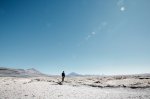
Nathalie Cabrol was 5 when she saw the first moon landing on television. Pointing at Neil Armstrong, she told her mother that this was what she wanted to do. Even before then, she stared up at the stars in the night sky near her home in the Paris suburbs and knew that questions were there waiting for her…more

Steve from the Isle of Lewis -John-GM7PBB/@GM7PBB

Steve from the Isle of Lewis -John-GM7PBB/@GM7PBB

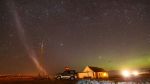
Mysterious aurora Steve seen from Scotland
A mysterious phenomenon dubbed Steve has been spotted by stargazers in Scotland. More properly described as a Strong Thermal Emission Velocity Enhancement, it was seen during displays of the Aurora Borealis overnight.

Astronomers are trying to better understand the phenomenon… more

Artwork -ESA

Artwork -ESA

UK will lead European exoplanet mission
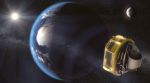
A telescope to study the atmospheres of planets beyond our Solar System will be launched by the European Space Agency in the late 2020s. The mission, to be known as Ariel, was selected by the organisation’s Science Programme Committee on Tuesday. The venture will be led scientifically from the UK by University College London…more

-NASA

-NASA

Curiosity rover: 2,000 days on Mars
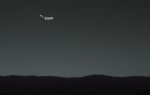
Nasa’s Curiosity rover, also known as the Mars Science Laboratory (MSL), is celebrating 2,000 martian days (sols) investigating Gale Crater on the Red Planet.
In that time, the robot has made some remarkable observations. Here are just a few of them, chosen by the Curiosity science team… more

-BBC

-BBC

Big harpoon is ‘solution to space junk’
Airbus is testing a big harpoon to snare rogue or redundant satellites and pull them out of the sky. Airbus is testing a big harpoon to snare rogue or redundant satellites and pull them out of the sky.
The 1m-long projectile would be attached, through a strong tether, to a chase spacecraft…more

-BBC

-BBC

UK ‘space drones’ look to Proton rocket ride
UK-headquartered start-up Effective Space aims to put up its first satellite servicing “drones” in 2020.
The company has announced an intent to contract with International Launch Services, which manages the commercial flights of the Russian Proton rocket…more

=Julio Cesar Aguilar

-Julio Cesar Aguilar

Cellphones on the Moon? Not So Fast
If a phone buzzes on the moon and no one’s there to answer it, does it make a sound? What does it matter, it’s bound to make news. Two phone companies Vodafone and Nokia said that they planned to build a cellular network in space to support what would be the first privately funded moon landing, planned for next year… more

-BBC

-BBC

Signal detected from ‘cosmic dawn’
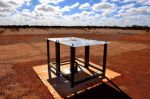
Scientists say they have observed a signature on the sky from the very first stars to shine in the Universe. They did it with the aid of a small radio telescope in the Australian outback that was tuned to detect the earliest ever evidence for hydrogen.
This hydrogen was in a state that … more

-NASA

-NASA

Meet TESS, Seeker of Alien Worlds
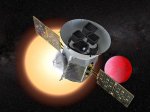
The search for cosmic real estate is about to begin anew. No earlier than 6:32 p.m. on April 16, in NASA’s fractured parlance, a little spacecraft known as the Transiting Exoplanet Survey Satellite, or TESS, bristling with cameras and ambition, will ascend on a SpaceX Falcon 9 rocket in a blaze of smoke and fire… more

-BBC

-BBC

Ghostly galaxy may be missing dark matter
An unusually transparent galaxy about the size of the Milky Way is prompting new questions for astrophysicists.
The object, with the catchy moniker of NGC1052-DF2, appears to contain no dark matter… more

Posted in April 2018, Sidereal Times | Tagged , | Leave a comment

From the Director

Rex


by Rex Parker, Director

Outcome of Voting Last Month. The Amendment and Expenditure both were approved by membership last month, as reflected in the minutes (in this issue). Thanks to all of you who participated. We’re now operating with a 7-member Board and working on the plan for the new astro video camera, discussed below

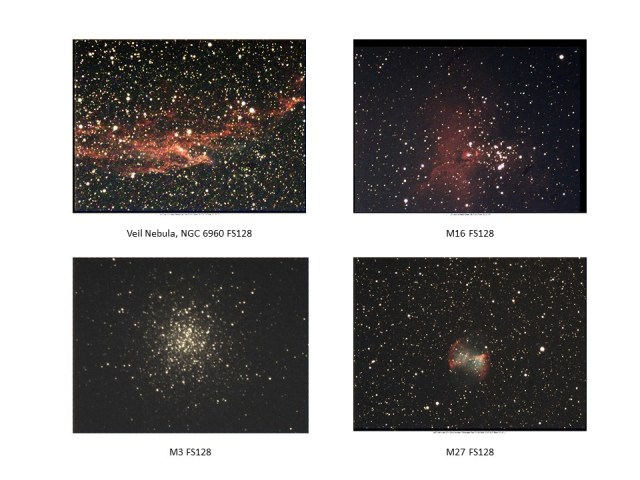
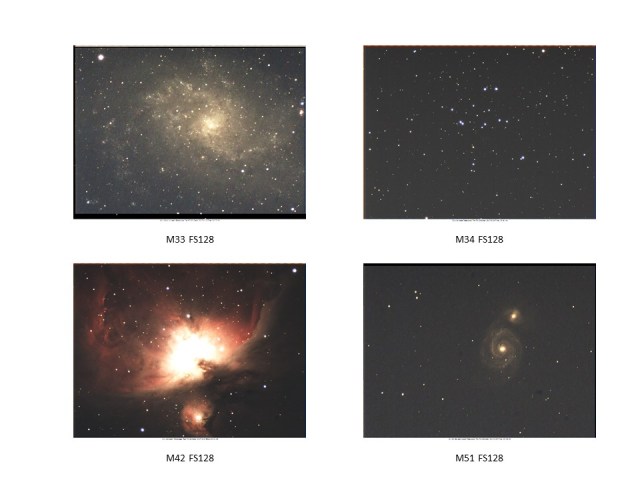
Coming Soon! – Game Changer in “Electronic-Assisted Astronomy” (EAA) at AAAP Observatory. Photos below: EAA screen shots showing deep sky objects as they look in real-time in the field without additional processing. See discussion of equipment and software below.


How the Pictures Above Were Made. EAA refers to near-real-time “live” imaging with relatively brief exposures (seconds) displayed on a laptop or PC monitor in the field or observatory. Such images don’t have the same quality as “real CCD imaging” that you see on the web and in magazines which use multiple long exposures (many hours in total) and extensiveand often tedious post-processing. But there’s almost no waiting, it’s happening right in front of you. The club began exploration of EAA a few years ago with the Mallincam color video setup at the Observatory, with great success. Of course, technology changes quickly. The newer CCD cameras are game changers: improved sensitivity, larger CCD sensor size, very fast download rates, small size and weight, and very low power requirements. This allows field use with only a laptop for power supply. Examples include cameras using the Sony EXview HAD CCD sensors such as the Sony ICX825 series. New software, usually camera-specific, is key to the near-real-time display of the RGB color images on the laptop. Software quickly aligns and stacks multiplebrief exposures, so that exact polar alignment is not needed and lightweight portable motor-driven equatorial and tracking alt-az mounts can be used with sucess. Truly a new game.

Recent tests by members have convinced me that this is where AAAP should be. At StarQuest and at the Observatory last fall I tested the Starlight Xpress Ultrastar-color, a CCD camera the size of a 1.25” eyepiece. The screen capture images above show the “real-time” display with no further processing beyond live align/stack/mean of 4 to 10 second exposures by Starlight Live software. The camera was used with these telescopes: (1) AAAP Observatory’s Mewlon-250 (10”), a powerful but “slow” f/12, 3000 mm focal length scope reflector telescope on a Paramount; (2) At StarQuest, with my Tak FS128 (5”), f/8, 1000 mm focal length refractor on a 25 year old Celestron GP mount only roughly polar-aligned.

The Famed Herschel Objects. While folks may have different astronomy observing interests most are keen to see the famous deep sky objects such as the Messier list. But what about the Herschel 400 list? The latter is renowned as an accessible subset of William Herschel’s 1864 General Catalogue of Nebulae and Clusters, the basis of the current New General Catalogue (NGC) as described by guest speaker Michael Lemonick in January. The Herschel 400 objects are all potentially visible at our latitude – they were first found by Herschel in England. My wife and I visited the Herschel house in Bath, England a decade ago. It was fantastic to see the mirrors and a remake of the telescope that William and Caroline Herschel used to discover Uranus and nebulae, on display in the very house where they lived and worked (photos below). The telescope mirror was speculum metal, an alloy of copper and tin. While our skies aren’t nearly as dark as Herschel’s in the 1700-1800’s, our equipment today is definitely better – especially when we bring EAA into the picture! How the Pictures Above Were Made. EAA refers to near-real-time “live” imaging with relatively brief exposures (seconds) displayed on a laptop or PC monitor in the field or observatory.

Board of Trustees Meeting March 26. We’ll hold the next board meeting at Peyton Hall on Monday March 26 at 7:30 pm. Among the agenda items will be a discussion of specific CCD cameras for EAA

Posted in March 2018, Sidereal Times | Tagged , | Leave a comment

From the Program Chair

By Ira Polans

The March meeting will be held on the 13th at 7:30PM in Peyton Hall on the Princeton University campus.

The talk is by Princeton University Professor Ed Turner regarding the “The Breakthrough Starshot Initiative: A “Funded” Interstellar Flight Project

The Breakthrough Starshot Initiative (BSI) is an ambitious program to send tiny spacecraft to nearby stars within a few decades, traveling at about twenty-percent the speed of light. Starshot will combine advances in micro-electronics, nano-tech and photonics (lasers). These interstellar probes are likely to carry artificial and perhaps sentient intelligences. Will machine based AGIs be better for exploring and occupying the Galaxy than biological intelligences? It may turn out that the stars will belong to synthetic awarenesses – our very different descendants.

Prior to the meeting there will be a meet-the-speaker dinner at 6PM at Winberie’s in Palmer Square. If you’re interested in attending please contact program@princetonastronomy.org no later than Noon on March 13.

We are looking for volunteers to give a 10 minute talk on an astronomy related topic at a future meeting. If you’re interested in giving one please see me at the meeting or contact me at program@princetonastronomy.org.

We look forward to seeing you at the dinner or at the meeting!

Posted in March 2018, Sidereal Times | Tagged , | Leave a comment

From the Outreach Chair

by Gene Allen

The Outreach Team was invited by a teacher at Stuart Country Day School to introduce star gazing to a class of 4th grade girls plus their parents and siblings. The original date was heavily clouded but the rain date of February 27 started out perfectly clear.

Being only two nights before Full Moon denied us most of the constellations and many of our favorite sights, but we started by showing a bit of lunar detail with the terminator not quite at the southeastern edge. The Pleiades were nicely visible even naked eye, but the nice Mizar-Alcor double was not. Orion was faint but we managed to show The Great Nebula in binoculars and resolve four stars of the Trapezium in a 10” Dobsonian.

An Astronomers Without Borders OneSky, a 5” Newtonian in a tabletop Dobsonian mount, saw First Light and represented itself very well as a $200 starter scope, though it needed a stool to be low enough for the girls.

High clouds encroached to end the program early but the originator declared it a great success.

Ted Frimet, John Giles, David Letcher, and myself participated tonight. Outreach events are entered into the website calendar for everyone to see. Any members who would like to join us for any event or join the Outreach Committee, please write to outreach@princetonastronomy.org.

Posted in March 2018, Sidereal Times | Tagged | Leave a comment

February 13, 2018 Meeting Minutes

by Jim Poinsett, Secretary

Minutes of the February 2018 Meeting of the Amateur Astronomers Association of Princeton

  • The meeting was called to order at 7:30.
  • Director Rex explained the amendment to the constitution that was to be voted upon, adding outreach and observatory chairs to the board of directors.
  • Voting was conducted and the result was 46 yes and 0 no. The amendment passed.
  • A second vote was taken on the expenditure of up to $2000 for a new camera and accessories for the observatory. All members present voted yes.
  • There was discussion on the new camera. Three models were possibilities:
    • Atik Infinity
    • Starlight Xpress Ultrastar
    • Mallincam Star Vision
  • There are reviews on all three on the Cloudynights forum. All three will be good for public nights and member use.
  • Observatory –
    • Work continues on the focusing end of the HB refractor. It is anticipated it will be ready for the public season.
    • The observatory duty calendar will be out soon. (It is out now).
    • The columns that hold the roof when it is rolled back continue to degrade. Whether to repair or replace is the main question. Discussion will be continued at the next meeting and the board meeting.
  • Bill Murray discussed training keyholders on what to see in the sky this spring and what will be good to show the public. A date will be picked soon, probably in April.
  • There are several Planetarium/Observatory combination nights planned. The first two on the 11th and 18 of May and the second set on the 12th and 19th of October.
  • The planetarium is planning a special presentation on November 24th called “Choosing Your first Telescope”. They would like several members to show up and set theirs up in the lobby for people to see and ask questions about.
  • John Church announced that the HB equatorial head has been found. It is being refurbished and will be put back in use.
  • There was an outreach event at the Stuart Country Day School on Feb 27th. Check the calendar on our website for more Outreach opportunities.
  • The meeting was adjourned.
Posted in March 2018, Sidereal Times | Tagged , , | Leave a comment

if a tree falls in the forest

and you’re on the wrong side of the park…

by Ted Frimet

An additional observers account of AAAP outreach at the Sacred Heart:

Materials brought to site included:

8” Meade SCT (15 year old scope, alt-az in equatorial mount equivalent install – pointed North, acquired from a Long Island outreach, refurbished, manual only mode. 25mm eyepiece with a passable diagonal).

6” Celestron (Newtownian, German equatorial mount, tripod legs collapsed to accommodate the viewers height, 20mm eyepiece)

15 x 70 Celestron binocular (strap intact for safety, I insist that only a parent or teacher is allowed to put the strap on the student.) small spotting scope – to hand to an observer in the event that binocular or mounted telescopes are not student accessible.

All the above are manual, & all were designated for hands on activity by the kids, or parents. I have done 10 or more outreach (literally just outside our observatory) sessions, last year, using some combination of the above.

Bringing that experience, here at Sacred Heart highlights a few iotas:

When the hands-on scope was set up and ready, almost immediately after announcing its availability, a line grew. This was after the public use of the existing telescopes on the field had already been established, and interest may have waxed and waned.

The “lead” 4th grade astronomer, after being briefed on her Meade 8” SCT telescope, set on teaching others, in line, how to operate in turn.

As the 8” SCT was getting its work-out, I brought out the 15 x 70 Celestron binoculars and handed them off to the first parent, that had none.

I later noted that a fellow astronomer was assisting in acquisition of a star using telrad, on the “hands-on” scope. I breathed a sigh of relief, that the telescope was not unattended, while I was completing a setup, a few feet away.

It is at times like this, that learning functionality trumps true location of a star in a field.

We concur that it is acceptable for a fourth grader to learn how to move a fork mounted or equatorial scope, and not be too concerned with the accuracy of her stellar acquisition.

I continue to observe just how those faces light up, each time they find a star in a telrad center ring, and acquire a star in their eyepiece, of their own accord.

I heard the lead teacher, clearly, when she remarked about one or few stars, and Orion’s nebula. And this must have been concurrent with the various targets, preset by club astronomers, at their scopes.

The “ok to touch and move” display works well enough, when the observer is left to learn, at her own pace. Working independently, she now becomes free of any preconceived notion of what astronomy is. As no adult is choosing for her, I find our budding astronomer forming her own, lasting opinion, experientially.

By the time I had set up the 6” Newtonian reflector, the crowd had diminished. However, I had repossessed the binoculars in time to entertain two parents, and their two girls.

The girls were agape with wonder as they viewed the moon, and the parents had a good view, as well. And further had the opportunity to compare the views from a 6” Newtonian versus the “double” 70mm ocular.

I was surprised when one of the parents discussed the merits of the moons terminator line. And how the moon light interfered with stellar viewing.

A brief engagement in conversation revealed to them that I am from Bucks County.
And one Mom let me know that they were from Newtown, Pennsylvania.

Posted in March 2018, Sidereal Times | Tagged | Leave a comment

Hastings Byrne Refractor – Focuser Re-Fitment

by Tom Swords

On one of the last public evenings in October in 2017, I was at the Observatory with Jen and Dave Skitt to observe some double stars after we had closed. Dave and I noted that the focuser on the Hasting Byrne refractor was loose in the optical tube. Upon tightening the screws as best we could, it was still not stable.

Now, I am a long focal length refractor fan and know for certain that a loose fitting focusing assembly cannot provide the stable optical-mechanical alignment that is necessary to set and hold accurate collimation. Collimation in a refractor is simply defined as coaxial alignment of all optical-mechanical assemblies and having co-planar alignment of the objective lens surfaces to the eyepiece. In essence: centered and square.

I mentioned to Dave that I would like to investigate and see about repairing this assembly. I contacted and met with John Church, the curator of the instrument. He showed me a mechanical drawing of the scope and gave me a detailed oral history and recounted work that had been done to it. With that information and some additional investigation, I developed and then presented my plan at the October AAAP board meeting to seek approval to proceed with a repair. Approval was granted and on Nov 20th I began.

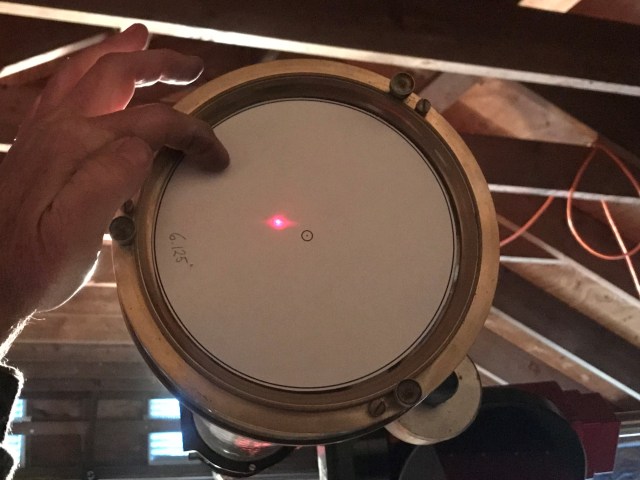
To start, I installed a laser collimator and noted where the optical centerline (laser dot) landed on the objective lens. The dot was where my finger tip is placed in the picture below. Think of that spot as the center of field seen at the eyepiece. It is far from the ideal optical-mechanical center.
We also observed that the collimation was not aligned. There should be a single point of light.

The Work Begins
The first step was to check and square the rear of the optical tube assembly (OTA) where the focuser is mounted. Upon correcting that and re-mounting the focuser, installing the laser collimator indicated that we had brought the mechanical centerline to within .75 inches of center. Quite an improvement however, the focuser was still not mechanically stable and centered in the tube.


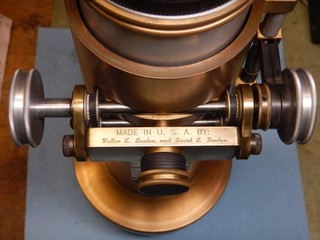
At my home shop, I disassembled the focuser, cleaned and lubricated the mechanism and replaced the rubber tension washers. The interior of the focuser tube was repainted in flat black. The patina of the focuser was left as is with the exception of the maker’s marks.


Next up was the most challenging part of this project. Properly fitting the focuser to the optical tube.

First, a bit of history is required. In 2002 the original focuser had mechanically failed and was replaced by the current focuser donated to AAAP from BD Instruments. It is a custom made Crayford style device weighing 12.5 lbs, constructed of brass, steel and aluminum. However, upon initial fitting in 2002, it was found that focus could not be reached. The OTA was shortened by 1 inch to achieve focus.

Also notable was that the original focuser mounted on the outside of the tube (i.e., the tube slipped inside the focuser). However, the shank of the replacement focuser mounts inside the tube, with machine screws drawing the tube tight to the shank.

The Hastings Byrne OTA is tapered along its length; its diameter is greater in front (at the lens cell) to less in back (at the focuser). When shortened, one inch of the original round section of the OTA supporting the focuser was removed. The result was that part of the new focuser shank was no longer securely in contact with the tube walls. That is why the focuser would become “loose” over time. This can be thought of as a round cylinder inserted into a cone that opens wider.

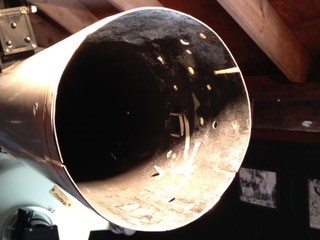
The OTA ID was measured to be .120” bigger than the shank of the focuser. In addition there was a soldered “lap seam” inside the tube. Unlike today’s seamless aluminum telescope tubes, telescopes constructed in the 1870’s were made in sections of steel or brass. The seams were then soldered with lead and the sections riveted together to form longer tubes.

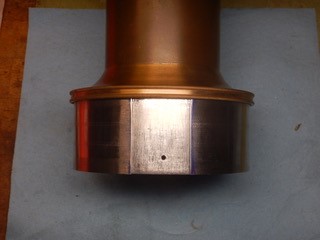
So I set about constructing a “shim” of mild steel that would be fitted on the focuser shank in order to make up for the space in the larger section of the tube. It also would require a gap to accommodate the lap seam inside the tube. It was constructed from 16ga mild steel that was rolled and then ground to a custom fit between the shank and the ID of the OTA. The final thickness of the shim was .055” and that provided a .010” clearance fit to the tube.


The OTA itself had burrs and dents that were removed along with some gentle expanding to remove the taper of the tube and provide a closer fit of the focuser shank.


After many hours of grinding, trial fittings and adjustments, the shim and focuser were installed on Feb 14th for final trials. The original 6-32 sized fasteners were used initially. The hose clamp, shown in the photo, holds the shim in alignment on the shank while the whole piece is being inserted into the tube. The optical train was then laser aligned to be within .250” of center and the OTA was re-collimated using a refractor collimation tool.


The First Trial
On Sunday Feb 18th, Jen, Dave, my wife (Karen) and I went to the observatory for the trial run.
We decided to use double stars for testing. Viewing began with a 17MM eyepiece @136X. We started in Orion and all of us immediately noted how considerably brighter the views were. Despite the variable viewing conditions doubles were split very cleanly.

The Trapezium in M42 was perfect and if viewing conditions were better we might have seen the E & F components. We viewed 4 stars in Sigma Ori.
Meissa @4.5” separation was very sharp and defined.

Still in Orion, Jen steered us to HD 33055, a Mag9 double @ 2.4” separation that was split perfectly.

We went to Cancer and checked Iota Cnc and Tegmine. Beautiful.

Last target was Algeiba in Leo. I decided to test at high power to see if we could observe an “airy ring”. A 8mm eyepiece for 289X was used.

We observed two perfect spheres with first diffraction rings on each! The rings would come and go, break and reform as the atmosphere played above us. The trial was a success!

The following week, the focuser was removed and the shank was drilled and tapped for larger
10-32 button head socket screws that provide increased torque for mechanical stability. It was reinstalled on Feb 26th. The mechanical alignment was adjusted to be within .125” of center. The OTA was then re-collimated. The finder scope and grab handle were re-installed. Although there is still some cosmetic finish work to be completed on the tube, the telescope is ready for service.

On Feb 27th, Jen, Dave and I did some observation along with re-calibration of the T Point table in TheSkyX. This was done so as to correct the pointing of the mount since the optical center of the telescope had moved with the improved optical-mechanical alignment. Although sky conditions were less than ideal, observation showed that collimation was correct.


I feel privileged to have worked on this historic instrument and would like to thank the AAAP board and John Church for allowing me to do so. It’s ready to observe more of the Heavens and better than ever for its 200 year anniversary in 2079!

Posted in March 2018, Sidereal Times | Tagged , | Leave a comment

Ice Cream Has No Bones

Feynman was here.

by Ted Frimet

A pleasant lecture was had by all, at last Tuesday’s meeting in Princeton. Paul Halpern was informative, and entertaining as he discussed his book on Richard Feynman. And then I stepped into the trap I laid for myself. When Dr. Halpern was discussing Feynman’s thoughts on electrons moving forward, and backward in time, (evidently the math works, so I’ve been told) I asked a neophyte question if this was akin to quantum tunneling, with an electron paying the price of time, as it passes thru no space, at all. Our author was quick to point out that this theory of the realm of quantum theory was akin to the 1920’s time frame. After prodding him gently, as one would stir a Gridnard reaction into place, Paul helped me out by reminding all that the motions of this particular electron (or positron – depending on your time movement) was taking place in the 1950’s. Oh, Richard – we could have used a smoke and joke, here!

Time is relative. Questions and answer time, doubly so. And when the time came for Q&A, I too heard crickets. I bounded and twisted from my chair, knowing how the speaker felt, and at once queried you all – as if you had no question of your own to offer? And begged my way into asking of the good professor, “whatever happened to Ms. Bell?” You know the answer we got. And the floor was opened and I rejoiced in hearing and listening to all of you participate.

Feynman finally moved me. You see, I’ve been reading “New Quantum Universe” by Tony Hey, and Patrick Walters (which leaves out the math). You now have a clue as to where I am studying Quantum Physics (circa 1980). And although I had been taught, previously that Richard Feynman was difficult to learn from, I ushered into my living room, in the comfort of my own home, the YouTube channel that hosted his 1979 lecture from New Zealand. Auckland, I recall? And I learned that Richard is the man! Funny, bright, succinct, and yes, easy to understand. Why, I even drew reference from Feynman’s work. I compared it to a recent review I am working on. I am critiquing the graphic art in a 50 minute video discussing the underpinning of Snell’s Law. But you don’t want to hear of that until I finish the graphical critique. Stay tuned, because I’ll give a shout out to the author, here, in Sidereal Times, when the bun is out of the oven.

I am writing this second essay, because I wanted to relay to you what I’ve learned, recently. That Buddhists teach that once the mountains are mountains. And then you realize they aren’t. And then, they resolve to be mountains, once again. Boy, I really butchered that thought. Feynman helped me re-engage our reality of light. That is, when light “hits” matter, it causes the electron quantum state to either excite, or cascade into a lower level (basically). And in doing so, emits a photon of its own. Sometimes two or more. Depends on your physics. This photon, may in its terminus, reach your eyes.

So my mountain, as I explain it to you, may be lit by suns afar. However I never get to see the reflected light. It is in fact, re-radiated by the electrons of that matter, itself. As Amateur Astronomers, you get this immediately, as we turn our attention to White Dwarfs emitting non-visible Ultra Violet energy, being absorbed by a non-visible veil of a Nebula to be re-radiated by a now – visible Nebula. Ah, essays of old come to roost once again. However, when you look at the paint on the walls, it just doesn’t seem that the wall color isn’t reflected. At least, at first, until you grasp at the electrons doing the physics provide you with the privilege of seeing the wall color. Illusion of light prevails. Things are quite what they seem. And we rely on our brains to fill in the missing pieces, and help us maintain our sanity, less we stop to ponder the true nature of matter and energy.

I laughed out loud when Richard Feynman talked about a physicist that might not accept the light coming from their meal, when presented with a real steak on a plate. Poorly paraphrased here, he mused to the audience that those scientists that would refute the light, would end up being very hungry physicists. I suspect they would be selected out of the gene pool, for sure.

I have to stop now, and eat dinner. And do so before the cat photons eat the chicken tenders.

Posted in March 2018, Sidereal Times | Tagged , | Leave a comment

Poohs’ Hunney Pot

asteroid velocity reprise

by Ted Frimet

I attended a presentation on asteroid occultation and IOTA, hosted at Montclair State University, by NJAG member Albert Carcich. I found Alberts lecture and slide presentation on measuring asteroid size and shape to be very appealing, and an deceptively easy topic to grasp. A thought quickly developed. Could I use the results of one chord, instead of many, to rough estimate an asteroid diameter? Probably not, I’ve been told. Of course, you would have to be at midline, during measurement and lucky. And lacking the negative reports of the “shadow boundaries” during an an asteroid eclipsing a star, the results would be sketchy at best. In fact, I have been told that it is inherently flawed. I agree. Not knowing my head from my tail, I reached out, once more.

I reached out to IOTA membership, and they were very helpful. I was hopeful that knowing how to calculate an asteroid Vt, that the occultation shadow velocity would prove out a ratio, that might divulge its hidden metrics. Either there were no takers, or my education was so lacking that I failed to materialize the math. Probably the latter. As such, I am vying to move forward. I have attempted purchases on the cheap, used copies of: The “Explanatory Supplement to the Astronomical Almanac” by J. Meeus and “Textbook on Spherical Astronomy” by R.M. Green. And Astronomical Tables of the Sun, Moon, and Planets, by J. Meeus. Regretfully, I am unable to locate a copy of the Supplement to the Astronomical Almanac, at a low enough cost. However the Tables, and Textbook should confound and confuse me for a least a few months to come! UACNJ member, Kris Kootale, will set aside another tome, for me to borrow – Meeus’ Astronomical Algorithms, next time we meet on observers duty for 2018 at Jenny Jump.

I will have a tool at my disposal. It is the Occult program. Since the many supported algorithms are very complex, they do not lend themselves to easily being implemented by hand. Certainly not by me! Using Occult, however, I will have a proven staple to compare any results I obtain, otherwise. I should be downloading and fidgeting with software, before any of my books arrive from the U.K., or elsewhere.

There is NOVAS code, available on the Navy’s MIL website for occultation study. However it has been decades since I’ve used Fortran, and I don’t think it a good idea to reverse engineer any C programs. There is, as good fortune even smiles on us all from time to time – a Github site where the code sits ready for compilation. Here, too, I will take a pass, having decided on taking the longer road to knowledge. I am as foolish in my math pursuits, as I am at the eyepiece of a telescope. Perhaps, during my travels I will write snippets of Visual Basic code in .NET with a fully functioning interface. I own that skill. That might even help the next traveler on their way. The next IOTA meeting, in Suffern – NY, is a full week before NEAF. I plan to attend both.

Last AAAP meeting I reached out to membership, voicing my concerns on the CLEA software model, Astrometry of Asteroids. Member Matthew Rapp’s suggestion was fully grounded when he recommended using the sample files to learn from. Being Mac based, and confusing the install with previous software that was buggy, I had my concerns. I was happy to find out that I didn’t need to create a Virtual Machine to install Astrometry. My current installation of Bootcamp, running Windows 10, was more than sufficient. I did, however find it necessary to move forward with the more advanced Astrometry toolkit, which provided me with access to star catalogues not found in the student version.

And now a pause for errata on last months essay, “How to Haul Tail”. I have since revisited the FITS files. I have taken notice that there are two places for observation times and dates in the FITS file format. Please take note that using either FITS header field results in same outcome of 2,208 elapsed seconds.

For asteroid Griqua image 0: First occurrence of the FITS field for date time group:
DATE-OBS= ‘2017-12-27T01:30:21’ /YYYY-MM-DDThh:mm:ss observation start, UT

Second occurrence of the FITS field for date time group:
DATE = ‘2017-12-27′ / Date at start of exposure, UT
TIME-OBS= ’01:30:06.154’ / Time at start of observation, UT

For asteroid Griqua image 7:
First occurrence of the FITS field for date time group:
DATE-OBS= ‘2017-12-27T02:07:06’ /YYYY-MM-DDThh:mm:ss observation start, UT

Second occurrence of the FITS field for date time group:
DATE = ‘2017-12-27′ / Date at start of exposure, UT
TIME-OBS= ’02:06:53.926’ / Time at start of observation, UT

Onwards! I wanted to refine my hunt for asteroids, by learning how to extrapolate their locations in an astrophotography image. Using the Skynet image frame center as the target “home” position was sufficient. The Skynet observers user interface easily communicated that information to me. I have noticed some drift, as the asteroid falls out of the field of view, during some endeavors. I decided that if I was going to continue to calculate and refine asteroid metrics, I was in need of a more precise measurement method. Using the Astrometry program, I can now select navigational, also known as, reference stars. The program effortlessly interpolates the asteroid location, in RA and DEC. It appears to be highly precise, and a decent tool for this student of Amateur Astronomy.

The same can be accomplished in Afterglow software, provided for in the Skynet interface. This post processing tool provides a window into the associated Digital Sloan Survey (DSS) images. You can select any point, on a corresponding frame and read off the correct RA/DEC coordinate. However, there is presently no way to overlay the asteroid image onto a DSS, as they are in two different non-corresponding proportions. You could “point and guess”, however I wanted something a bit more precise. Enter Toolkit for Astrometry.

There are a couple of user interface “traps” in the Astrometry tool kit, however none of them are fatal. For instance, the interface may ask you to load a CD – as I have neither the CD and my Mac Book Pro doesn’t sport a CD ROM interface. I successfully click “no”, and flawlessly move on with the program. A sensitive area to some, however to me was just a passing inconvenience, is that some message boxes will populate with invisible content. I found a quick solution by employing two monitors. After moving the message box to the second, auxiliary monitor, the box properly populated, and I was able to click away my response. I subscribe the error not to the program, but to how it interfaces with my systems graphics card, and subsequent operating system. The interface issue lay with a “screen refresh” routine. Otherwise, please know that the program is intuitive, and easy to use.

Just like my first night out at Jenny Jump, versus skies that were not as dark, it is easy to get lost among the stars. My astrophotography of 1362 Griqua, being limited to 4 second exposures, would only express the brightest objects in frame. And using Astrometry, I would be bombarded by stars of 20th magnitude or more. What to do? Skynet to the rescue! Using the astrometric tools afforded by Afterglow, I selected the navigational stars that would help me in my asteroid hunt.

Deploying Astrometry. Shown below are the reference star results for magnitude = 22 or brighter. This is followed by the magnitude data for Griqua FITS 000, and FITS 007 at 4 seconds exposure. Note that Afterglow photometry, by itself, does not provide RA and DEC.


I then applied a magnitude limit of 16 to the Astrometry initialization file. And proceeded to select three or more reference stars. Below is the result for Griqua FITS 000, followed by FITS 007. Immediately below the reference star images you will find JPEGs from Skynet for comparison.



The Griqua asteroid, in both Skynet images appears to hold steadfast in center of frame.
This becomes an ideal test to recalculate and refine tangential velocity, using Astrometry coordinates.

Here are the Astrometry coordinates as reported for:
    Griqua (0) =
    RA = 0h 27m 52.99s Dec = -24° 59′ 22.5”

    Original Griqua (0) observers data from Skynet:
    RA/Dec: 00:27:52.198 | -24:59:39.468

    and Astrometry, this time, for Griqua (7) =
    RA = 0h 27m 55.43s Dec = -24° 58′ 51.8”

    Original Griqua (7) observers data from Skynet:
    RA/Dec: 00:27:54.559 | -24:59:11.705

Below is the sample astrometric solution for Griqua (0).

    2018/02/17 4:26:17 PM
    Image 1 – Astrometric Solution

    Image File Name: GRIQUA_2335994_LUM_000S.FIT
    Object: Griqua 1362
    Observation Date: 2017 December 27, UT: 01:30:21
    

Target Object:
    x = 515.4494, RA = 0h 27m 52.99s
    y = 510.9753, Dec = -24° 59′ 22.5″
    m = 15.07 (No Filter)

Estimated errors cannot be calculated!
    N(=3) is minimum for selected solution type.
Estimated Error in Magnitude (Sigma): 0.03(3)

    Field Center:
    x = 512.0000, RA = 0h 27m 53.13s
    y = 512.0000, Dec = -24° 59′ 23.1″

    Plate Constants for Linear Solution:
    Scale = 0.5865 “/pixel, Field Wd. = 10.01′, Ht. = 10.01′ Notes:

    (X = a*x + b*y + c)
    a = 2.8460361E-06, b = -6.0589289E-09, c = -1.5222572E-03

    (Y = d*x + e*y + f)
    d = -9.6308291E-09, e = -2.8407851E-06, f = 1.5439454E-03

(1) Star not used in astrometric solution.
(2) Star not used in magnitude solution.
(3) Magnitudes are unreliable due to errors in reference star magnitudes and passband differences.

Using last months essay, “How to Haul Tail”, I have followed the same procedure to calculate the tangential velocity of asteroid 1362 Griqua. However, this month, we substitute the Astrometric’s solution for the asteroid coordinates:

    Griqua observation 0 – DEC
    24 degrees 59 minutes 22.5 arc seconds
    (24 x 3600) + (59 x 60) + 22.5 = 89962.5

    Griqua observation 7 – DEC
    24 degrees 58 minutes 51.8 arc seconds
    (24 x 3600) + (58 x 60) + 51.8 = 89931.8

    Griqua observation 0 – RA
    0 hours 27 minutes 52.99 seconds
    (0 x 3600) + (27 x 60) + 52.99 = 1672.99

    Griqua observation 7 – RA
    0 hours 27 minutes 55.43 seconds
    (0 x 3600) + (27 x 60) + 55.43 = 1675.43

    DEC difference = 30.7 arc seconds
    RA difference = 2.44 seconds

I am keeping the time difference, from the already published essay, which was 2207.772.

I found an additional math error that I overlooked in the FITS file format, today. Without passing judgment on the essay precision – I calculated for both, and found a 3 second difference.

After “rounding” the angular velocity the answer ended up the same, as 0.021
    2.44 x 15 x cosine (-25) = 33.171
    sq root of ( ( 33.171 * 33.171) + ( 30.7 * 30.7 ) )
    sq root of (1100.32 + 942.99)
    sq root of (2042.81)
    =45.198

    45.198 / 2207.772 = 0.021 (angular velocity)
    Tangential Velocity = (Angular Velocity x Distance) / 206265
    Vt = (0.021 x 287306800) / 206265
    Vt = (6033442.8) / 206265
    = 29.25 km/s

I have calculated that using Astrometry reference stars, and interpolated coordinates, 1362 Griqua, is moving at a higher measured velocity of 29.25 km/s versus last months calculation (using Skynet data) at 26.5 km/s.

Using an online calculator, we arrive at a solution that results in a 10 percent difference. I am inclined to believe that this is a sufficient precision shift. I will be dipping my hand in the Astrometric’s hunney pot, from time to time, now. Which will make future amateur asteroids analysis a sweeter preoccupation.

Posted in March 2018, Sidereal Times | Tagged , | Leave a comment