by Rex Parker, PhD director@princetonastronomy.org
Next Meeting at NJ State Planetarium – Bring Friends & Family. We want to see you in person at the season finale monthly meeting on Tuesday June 9 (7:30pm) at the NJ State Museum Planetarium in Trenton https://www.nj.gov/state/museum/explore-planetarium.shtml. There is convenient parking at the lower entrance level next to the planetarium (205 West State St). This will be the last meeting until Sept, and will be held in-person-only (no Zoom). The Planetarium is a great space-theme environment for kids and adults, so bring family and friends. With its 52- foot dome and state-of-the-art 8K ultra-high resolution projection system it provides, the Planetarium is more capable now than ever before. AAAP has a long history with the Planetarium and our mutual contributions to astronomy outreach. For more info on the presentation by planetarium leader Dr. Jacob Hamer, please see Victor’s article below.
Why a New Telescope for the Observatory? At the last meeting the membership discussed and voted on the Board’s proposition to fund acquisition of a new telescope and imaging device for the club’s Washington Crossing Observatory. The results of the vote are posted in the Secretary’s report in this issue. Here I offer further rationale for this proposal.
In order to offer the best hands-on astronomy experiences to members and the public, AAAP continually seeks to improve the capabilities of our Observatory. First built by club members in the late 1970’s on about 1 acre of park land leased by the state, the Observatory recently underwent significant capital improvements to rebuild the columns and rewire the electricity. Now we want to stay near the cutting edge with technologic advances in astro-imaging while still offering direct visual observing through telescopes. Most importantly, newer technologies can better break through the barrier of light pollution plaguing central New Jersey.
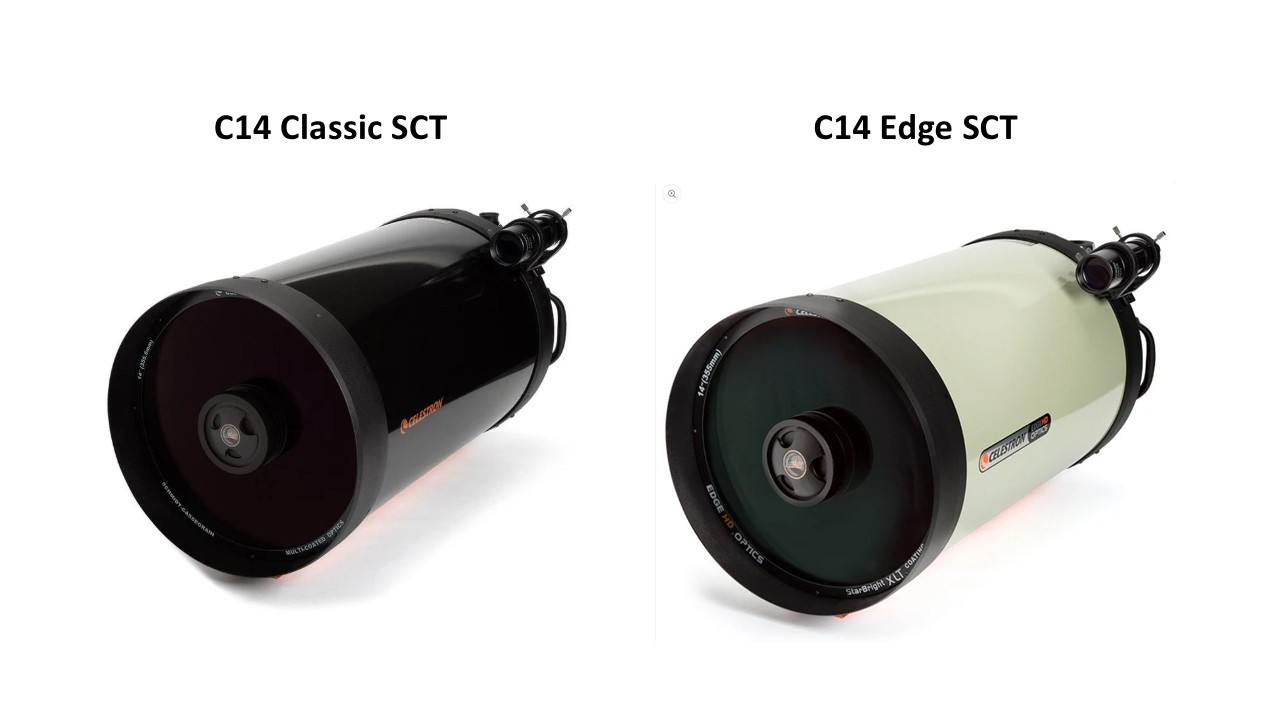
At the Observatory on a very capable Equatorial mount (known as a Paramount ME) sits a 20- year old Celestron 14” Schmidt Cassegrain telescope (SCT). The SCT was a great breakthrough in optical design in its day but shows severe limitations when coupled with modern astro cameras. This is because it was designed as a visual instrument way before CMOS imaging sensors changed astronomy. Image sensors require a larger evenly illuminated area at the focal plane than eyepieces do. While we get good on-axis imaging performance with the C-14 using the ZWO ASI-294 camera (a micro 4/3 sensor), the off-axis performance is far from optimal with pronounced vignetting. Larger sensor formats which could theoretically increase the field of view (APS-C and full frame) are a no-go on the SCT.
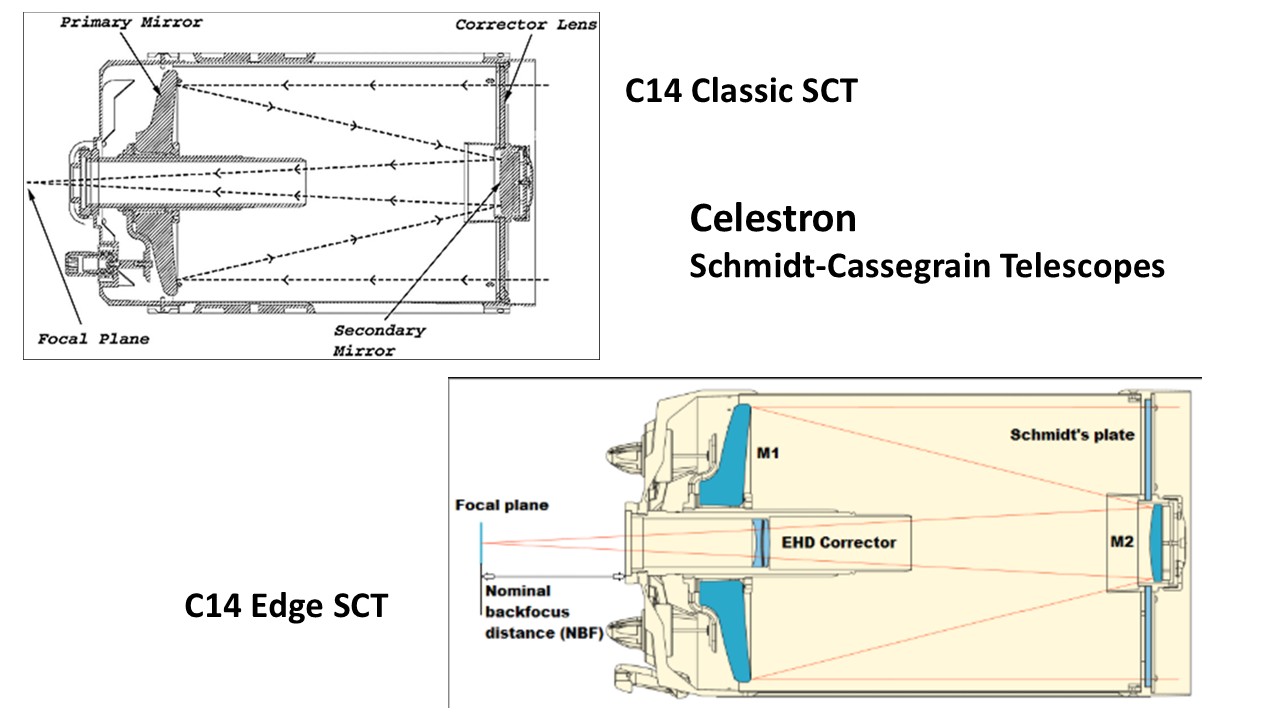
In order to overcome these problems in the age of imaging, Celestron conducted substantial R&D, resulting in the production of an advanced optical SCT design called the Edge series. The Edge is an advanced, flat-field, aplanatic series of telescopes. It is designed for both visual observation and imaging with astronomical CMOS astro cameras including full-frame sensors. It is this design which we now propose to acquire for the AAAP Observatory, a Celestron Edge-14 HD. A picture is worth a thousand words – see the Figures below showing the optical design differences of the Edge series. I also urge you to check out Celestron’s white paper describing the technical advances in the new design: https://s3.amazonaws.com/celestron-site-support-files/support_files/edgehd_whitepaper_final.pdf
Figures below: Images provided by Celestron. The Edge SCT design improves upon the optical design of the original and makes it a superb imaging telescope while keeping direct visual capabilities.