
by Victor Davis, Program Chair
June Meeting at NJ State Museum Planetarium
The June, 2026 monthly meeting of the Amateur Astronomers Association of Princeton will take place at the planetarium of the NJ State Museum in Trenton. The museum is located at 205 West State Street. There’s plenty of parking behind the museum next to the planetarium. The club’s meetings always take place the second Tuesday of each month September through June. The June meeting is traditionally held at the planetarium at the customary time: 7:30 pm. The meeting date is Tuesday, June 9, 2026, and marks the end of the academic year before our usual hiatus during July and August. As usual, the meeting is open to AAAP members and the public. The evening’s guest speaker will be Dr. Jacob Hamer, Assistant Curator of Planetarium Education at the NJ State Museum. Dr. Hamer will start the evening with the planetarium’s latest sky show, then present a live lecture entitled “An Astronomer’s View of Climate: Milankovitch Cycles.”
Please note that due to technical constraints and copyright issues, this meeting will not be livestreamed or recorded for future perusal. You must participate in-person at the planetarium.
No “Meet the Speaker” Dinner
Since the meeting will take place at the planetarium and not on the Princeton University campus, there will be no “meet the speaker” dinner this month.
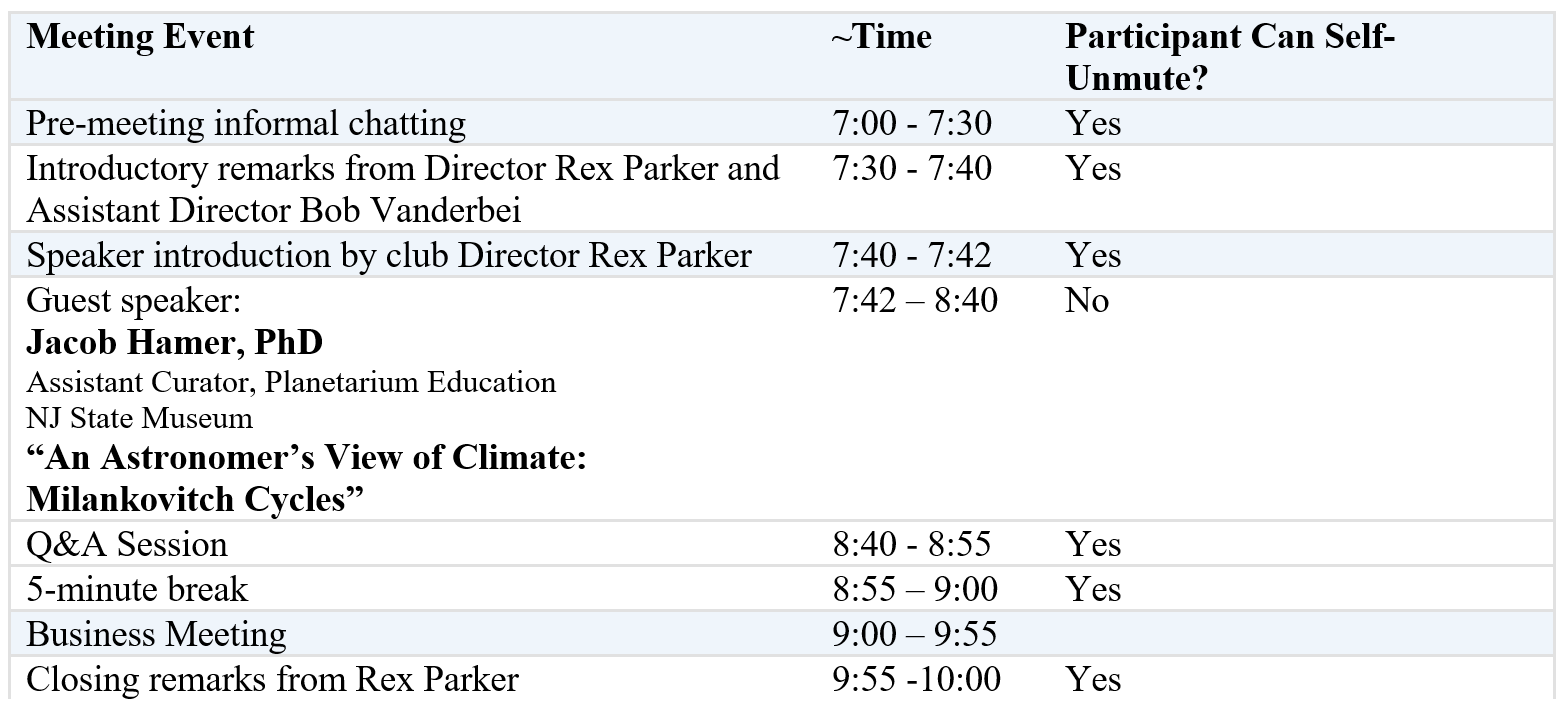
Here’s the anticipated agenda for June 9th 2026’s monthly meeting of the AAAP:
Featured Speaker:
Jacob Hamer
Assistant Curator, Planetarium Education
Jacob.Hamer@sos.nj.gov
An Astronomer’s View of Climate:
Milankovitch Cycles

An Astronomer’s View of Climate: Milankovitch Cycles
Over the last 800,000 years glacial ice caps miles deep advanced and retreated across North America at least eight times. These cyclic changes in Earth climate are connected to small cyclic variations in Earth’s orbit called Milankovitch cycles. Join us in the planetarium to hear about how astronomy and climate science are intimately connected, and how New Jersey rocks have something to say about these cycles!
Jacob Hamer, PhD
Dr. Hamer is Assistant Curator of Planetarium Education at the NJ State Museum. He received his BA in Physics and Mathematics from CUNY Macaulay Honors College at Hunter College. During his undergraduate studies he conducted research on galaxies at the American Museum of Natural History. He received his PhD in Astronomy and Astrophysics at Johns Hopkins University, where he carried out research on the interactions between close-in exoplanets and their host stars.
AAAP Video Library
AAAP’s library of monthly meetings is available on the club’s YouTube channel. Stay tuned for updates on when the edited version of May’s meeting featuring science journalist John Horgan will be publicly available.
And now, something completely different:
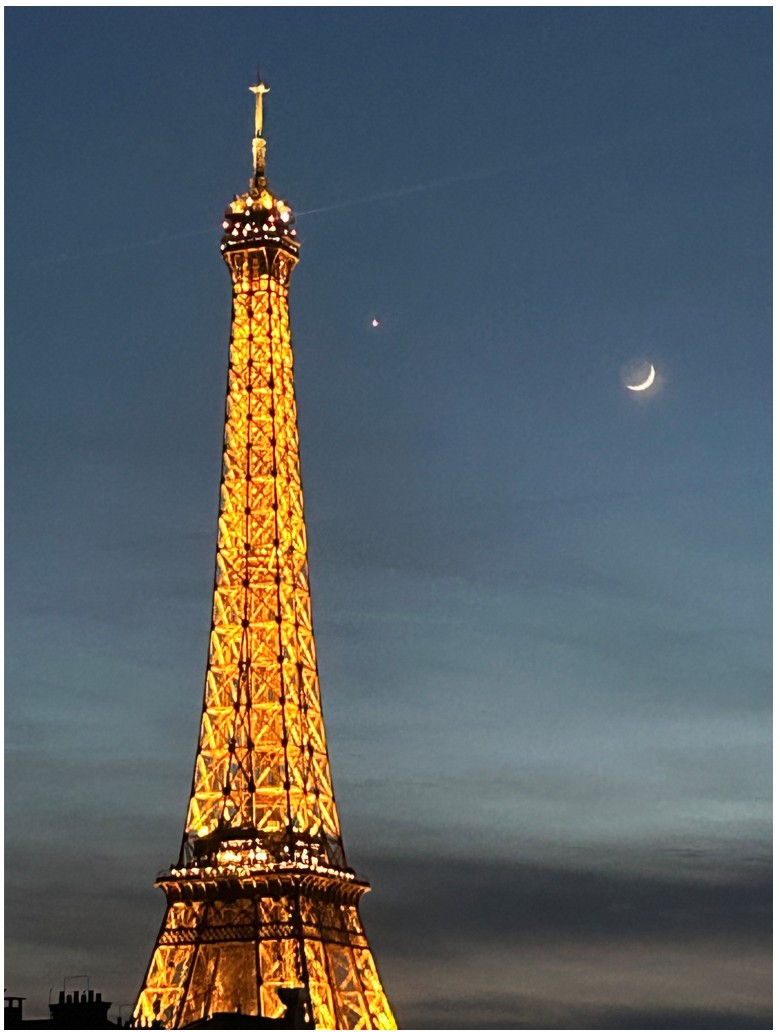
On May 18th, Venus and the crescent Moon made a striking pair in the WNW sky. Here’s the apparition with a possibly recognizable architectural object in the foreground.
Manhattanhenge 2026
Manhattanhenge is back! During this biannual event, the rectangular grid of Manhattan’s streets aligns precisely with the setting sun. Crowds of people all over Manhattan block traffic and aggressively elbow pedestrians to witness the sublime sight of the sun illuminating the canyons of buildings along Manhattan’s streets. In 1811, New York’s linear-minded city planners laid out Manhattan’s midtown streets in a rectangular grid aligned 29 degrees east from geographic north. Had they laid out the streets due east-west, Manhattanhenge would occur twice a year on the equinoxes. However, a trip from the Bronx to Battery Park would probably splash you into the East River. In any case, this 29 degree rotation moves the alignment dates elsewhere into the calendar. Astro-popularizer Neil DeGrasse Tyson coined the term Manhattanhenge to make the connection between urban life and the pre-historic circles of stones used to signal the change of seasons.
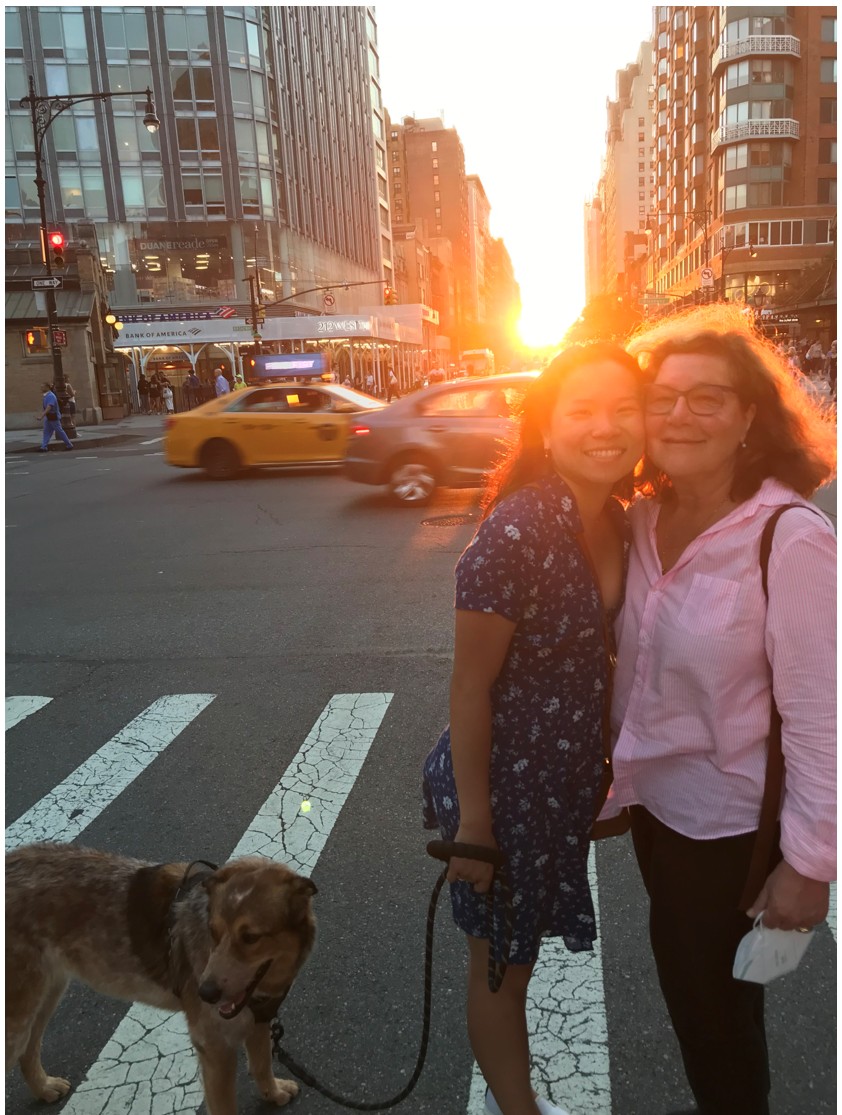
If you missed the alignment on May 28 and May 29, you won’t have long to wait for the next one. It occurs on Saturday, July 11 at 8:20 pm EDT (full sun visible) and Sunday, July 12 at 8:21 pm EDT (half sun visible). The best spots from which to watch are locations as far east as possible that have unimpeded views across the Hudson River to New Jersey. Examples are 14th Street, 23rd Street, 34th Street, 42nd Street and 57th Street. The snapshot below is cheating a bit; it was photographed on July 11, 2022 at 72nd Street.
A look ahead at future guest speakers:
| Date | Featured Speaker | Topic | |
| Sep. 8, 2026 | Michael DiMario Chair of AAAP’s Astro-imaging SIG K2mjd@outlook.com  | Dr. DiMario will present a primer on astro-imaging. | |
| Oct. 13, 2026 | Becka Phillipson Assistant Professor in Physics Villanova University | Prof. Phillipson, originally scheduled to be October 2025’s guest speaker, is an unconfirmed prospect to try again in 2026. |
As always, members’ comments and suggestions are gratefully accepted and much appreciated. Thanks to Ira Polans and Dave Skitt for setting up the online links and connecting the meeting to the world outside Peyton Hall.
victor.davis@verizon.net
program@princetonastronomers.org
(908) 581-1780 cell


