by Theodore R. Frimet
baby its cold outside
Before our end of season, our Observatory Chair hosted a couple of school aged teenagers that needed to make celestial observations on a particular Friday night. Skipping ahead from the experiences of pointing out various stars, the likes of Vega, and Capella, and being somewhat dumbfounded on Polaris (sneaky North star hiding amongst the tree tops and rafters of many a barn), the student chilled to the bone, spoke out between gritted, shivering teeth, “It’s cold out here”. Welcome to Amateur Astronomy, I said.
Last night being no exception to the length of time it takes to properly prepare an amateur, we find yours truly, chilled to the toes. Experiencing unusually warm temperatures for a deep winter’s spell, and being reminiscent of our good fortune this past November, I decided to ditch the Muc-Lucs in favor of a second layer shirt, long johns, and two pairs of socks. Should have brought the Muc-Lucs. Yes, I make mistakes. Hopefully, during the course of this essay, I will fix one or few along the way. And of course, open the wounds of my personal ignorance, as I plod thru new Hypotheses, – and just like a favorite potato recipe – it may be served half-baked. I reckon that my science may not recover, as well as my toes have.
There is no undoing Newtonian classical physics, or the answer of our own respected Professional Astronomer, William Murray. When asked about the velocity relationship during the ellipse orbit of an asteroid, Bill correctly points out that as the asteroid approaches our sun, it increases in velocity. Of course what I failed to really ask Bill, is to provide me with all of my answers to unasked questions and to be a mind reader. I sobbed so quietly as I removed Sol from my sight, expecting the asteroid velocity to purr like a kitty cat in a planetary side-car. The sun persists. Gravity is real. And a gravity well reaches out to the depths of our solar system. The extremis points in the ellipses are areas of acceleration, if not in velocity, are then most certainly changes in direction.
Our asteroid travels in an ellipse and gains momentum on each pass around the sun. Hmmmmm…not unlike the lore of science fiction shows where our space travelers must hurl their craft around the sun to gain needed momentum to make it to Jupiter in a few less months than strategically laid out at the beginning of their fare – our NEO’s are forever gaining speed. Going faster, and faster and eventually reaching, “terminal” escape velocity. Emboldened with the momentum to breach the gravity well of Sol, they faithfully return to the OORT cloud for further dispensation of plans divulged by the sky gods of old. That is unless they don’t have the mass necessary to escape despite the increase in their velocity bank account.
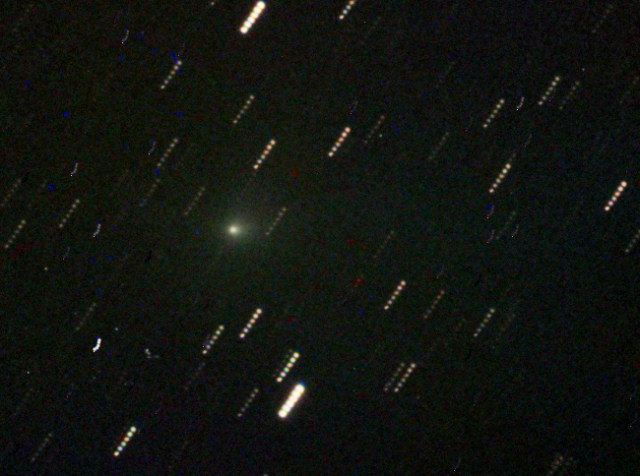
Having some more amateur fun, here, run the clock backwards and decrease the velocity on each pass, to approximate the entry speed of this heavenly body. You’d have to wait awhile for this months eyeful to rewind on my pretentious timepiece. As she punches her time clock, to be on the job, only every 20,000 years. Enter C/2016 R2.
You can jump to the bottom of the essay, or suck it up, put on that 80 lb rucksack soldier, and tramp up that 30 degree incline in the wastelands of the desert. You decide. As there is no return once you enter the next paragraph.
You can’t fix stupid? Sure you can. Be patient, and get thru all of the long reptilian length sentences until you strike gold. Ah, you are still here? Good. Then I hand you the olive branch of tangential velocity to correct last months poor mans calculation of linear velocity.
Working side by side with a lab paper from “A Manual to Accompany Software for the Introductory Astronomy Lab Exercise Edited by Lucy Kulbago, John Carroll University 11/24/2008” I hurriedly excerpt some bits and tidbits to reach another conclusion as to how fast asteroid 1362 Griqua was moving in last months video.
First let’s calculate the angular velocity. I tried avoiding this last month – as this explains why I invented Griqua units of measurement. Alas, the truth be known. You and I must brave the winter of our discontent and move on to newer, richer pastures and relish in the truth that will bear us out in the end – a method and a resulting number that is closer to reality.
So that I do not get lost in the labyrinth of my own observations, I am noting here that Skynet 1362 Griqua observation # is 2335994, and the ID and location of image 0 and image 7 are:
ID: 19892011 RA/DEC: 00:27:52.198 / -24:59:39.468
ID 19892018 RA/DEC: 00:27:54.559 / -24:59:11.705
Both imaged on Prompt-5 telescope employing a Lum filter, and 4 seconds exposure.
The Universal Time (UT) stamp on my first image (image 0) is 01:30:06.154, and on my last (image 7) is 02:06:53.926. Whew! That was a mouthful !
We convert the hours, and minutes to seconds to make the math easier, multiplying minutes by 60 and hours by 3600.
01:30:06.154 = 5,406.154 s
02:06:53.926 = 7,613.926 s
Now take the difference, which will result in the time that passed between observations of image (0) and image (7) at the telescope: 7,613.926 – 5,406.154 = 2,207.772 s
The time elapsed was 2,207.772 seconds !
That was some pretty basic arithmetic. Now we have to delve a little deeper into the frugal realm of Pythagoras.
c (squared) = a(squared) + b(squared)
Or if you will permit me to flaunt my limited mathematical prowess:
c = the square root of ( (a*a) + (b*b) )
Hurray for right ascension and declination. They are the known coordinates of where we looked into the night sky. They happen to have a happy relationship as right angles to each other.
If you would, “one goes up” while “the other goes down”. No? How about, “right ascension or RA” is like horizontal direction, and “declination or DEC” is our vertical direction?
Still no?,…ummm..ok – my bad – I’ll try again – RA and DEC are two legs of a right triangle and we are going to solve for the hypotenuse. Yup, sorry. You asked teacher back in high school, “what am I going to do with geometry?” – well, here it is, my fellow budding amateur.
Take the DEC values, from above, and convert the coordinates to arc seconds. Multiply the minutes by 60 and the degrees by 3600. Sounds familiar, doesn’t it?
24:59:39.469 = 89,979.469 arc seconds
24:59:11.705 = 89,951.705 arc seconds
Now take the difference to find the change in DEC for our images:
89,979.469 – 89,951.705 = 27.764 arc sec
Take the RA values, from above, and convert the coordinates to seconds. Again, multiply the minutes by 60 and the hours by 3600.
00:27:54.559 = 1,674.559 seconds
00:27:52.198 = 1,672.198 seconds
Now, take the difference to find the change in RA for our images:
1674.559 – 1,672.198 = 2.361 sec
Our noteworthy author points out that our RA system is a grid of bent lines from earth bound pole to pole. And that the closer to the poles, the less space between the lines. And the closer to the equator, the more space between the lines. This curvature issue is solved by introducing the cosine into our math.
Another way to look at this, is that the circles that circumscribe the earth, as we vary the latitude, get smaller and smaller as we work our way to either North or South pole. That is what the cosine is there for.
First convert the DEC to degrees by dividing the arc seconds by 3600:
27.764 / 3600 = 0.00771222 degrees
change in RA(adjusted) in arc-seconds = RA in seconds X 15 X cosine(DEC in degrees)
[note: the declination in degrees is NOT the difference, it is the actual DEC rounded off to the nearest degree]
= 2.361 X 15 X cosine(-25)
Pray tell – where doeth the “15” come about, you query?
Tarry you not the Ides of March, as they dare not wary you!
Quoting the Astrometry Bard, straight out of the student manual, p5:
“This may sound strange, but an hour of right ascension is defined as 1/24 of a circle, so an hour of right ascension is equal to 15 degrees.”
Well, not so strange to us, is it? Amateurs know that RA is measured in hours, minutes and seconds conforms neatly to the idea of our Earthly rotation.
i.e., 1 x hr = 15 deg, 2 x hr = 30 deg, 3 x hr = 45 deg, …, 24 hr = 360 deg.
= 2.361 X 15 X cosine (-25)
= 2.361 X 15 X (0.9063)
= 32.097
Back to old Pythagoras:
take the square root of:
(32.097 * 32.097) + (27.764 * 27.764)
(1030.210) + (770.840) = 1801.050
…
= 42.439 arc seconds
Calculating the angular velocity of asteroid Griqua on December 27, 2017 is:
=42.439 / 2207.772 seconds
= 0.019 arc seconds / second
( yes-sir-ree Bob! that be “arc seconds” per “second” ! )
Now onto the clear blue waters of Tangential Velocity of my beloved Griqua.
We need to know its angular velocity (already calculated as above), and its distance. Since I have no parallax data to provide us with (which would be used to calculate distance to the asteroid) we will peer into one of NASA’s databases to find our distance, on the evening of December 27, 2017, and use the starting time of observation for our starting point in time. However, as we look into a National solution, we find none. So we expand our search to include those found across the pond.
Plugging in our date time group, for our first and last observation into the ephemerides generator, located at the AstDyS-2 sponsored by ESA, and being observant to enter the telescopes’ location at Cerro Tololo, observatory code: 807, I get a delta (distance to asteroid from Earth) that varies from 1.9204 astronomical units (AU) to 1.9206 AU. Let’s use 1.9205, shall we? Lets take a look at the ephemerides data here.
According to a Wikipedia article, last referenced on Wednesday, January 24, 2018 at 16:46 PM EST, the definition of an Astronomical Unit (AU) has been defined exactly as 149597870700 meters, since 2007.
1 AU = 149,600,000 km
1.9205 AU * 149,600,000 = 287,306,800 km
Tangential Velocity = (Angular velocity X distance) / 206,265
Vt = (0.019 X 287,306,800 / 206,265
Vt = 26.5 km/s
Applause, if you please!
Now, fair warning, dear amateur. There is no rest for the weary. And the faint of heart need not travel the road less taken. You may skip the EPILOGUE and feast your eyes on the tantalizing video of a blue tailed comet, as linked at the end of this essay as my timeless gift to you!
EPILOGUE:
Here is a tad of math, that fellow UACNJ member Eric Leonard schooled me on. As an aside to correcting mistakes in units, above, Eric was singularly responsible from rescuing me from my inability to reconcile finite mathematics and integrating my renewed awareness of the celestial sphere into real geometric examples.
Where I shamelessly plodded along and entered values into formulae, Eric was tireless in his approach in making rock solid certain that I walked away from this enterprise, knowing my DEC from my RA.
For more on Eric Leonard, please subscribe to Eric’s “Math From The Gut” videos series on Test Driving Pythagorean Theorem.
Now, let’s visit below, to be rock solid on where the number “206,265” comes from.
First off, let’s state the following, that 206,265 is equal to (360 * 3600) / (2 PI)
In the above statement, 360 is in degrees, and 3600 is in arc seconds per degree, and where 2 PI is the value of a unit circle.
360 degrees * 60 = the number of arc minutes that go around the circle.
360 degrees * 3600 = the number of arc seconds that go around the circle.
one arc second = 1/(360 degrees * 3600)
The relationship of the distance around the unit circle to its degree measurement is as follows:
2 PI km / (360 degrees * 3600 arc seconds/degree)
Inverse the above, plodding our relationship into the denominator:
1 / (360 degrees * 3600 arc seconds /degree) / 2 PI km
Which brings us to rekindling the tangential velocity equation, first found on p25, of the Student Lab Manual, Astrometry of Asteroids, cited earlier in this essay:
Vt = (angular velocity x distance)
—————————————————————
(360 degrees * 3600 arc seconds / degree) / 2 PI km
In the above equation, briefly study the denominator. In its construct, the denominator’s “numerator” holds our number of arc seconds in a circle. And in the denominator we have 2 PI, which is the diameter of a unit circle. Above the “big line”, we will find our angular velocity multiplied by the distance to the asteroid (measurement courtesy ESA ephemerides).
Let’s revisit the equation with a slightly improved understanding of the “206,265” origins.
Still not on board with 206,265 ?
As a quick reprise, here is the brute math of it: [360 * 3600 / 2PI = 206265].
Velocity = (Angular velocity X distance) / 206,265
Let’s do our math a little differently, here (holding off on the distance value, for just for a bit!)
Divide the Angular velocity by 206265 which yields:
v = 0.0000000921 km / s on a unit circle
Generically speaking, we can state an “x” value for km/s, as found below:
(x km /s along a unit circle) * 287,306,800 km / 1 km
And for clarity, re-write it with the “big line” of division, here:
(x km / along unit circle /s ) * (287,306,800 km along comet circle)
———————————————————————————————————————————
1 km along unit circle
Substituting our previous result (v = 0.0000000921 km/s on a unit circle) for the “x km/along unit circle/s), we show the math as found below:
Vt =
(0.0000000921 km/s along a unit circle * 287,306,800 km along comet circle
————————————————————————————————————————————
1 km along unit circle
Vt = (0.0000000921 km/s ) * (287,306,800 along comet circle)
Vt= 26.5 km/s along comet circle
I have restated the equation, below, with correct unit notation, and all with the help and timeless assistance of Eric Leonard.
Vt = (0.019 arc seconds / second x 287,306,800 km) / 206,265 arc seconds / km along a unit circle
Vt = 26.5 km/s
Note: since “arc seconds / second” has the unit “seconds” in the denominator
and “arc seconds / km” has Km as 1/km as in it is in the denominator
then it follows that after we cancel out units, we are left with: km/s
Having already done the “walk of shame” on my 1362 Griqua video, you can note, here, and there that I’ve researched velocity of record as follows:
I used Google translator on the below website link – a German wikipedia. It records the velocity of 1632 Griqua having an average orbital velocity of 16.59 km / s. Which would be a much higher velocity than I have reported in this video. Here is the link to the translation (Sunday, December 31, 2017 9:40 AM EST)
A Russian wiki records the velocity of 1362 Griqua at 16.016 km/s. Here is a link to this translation (Sunday, December 31, 2017 10:03 AM EST):
So, bearing in mind the calculations that have preceded us, according to German and Russian Wiki records, their 16.59 – 16.01 km/s is pretty darn close to our calculation, as performed by this amateurs essay of 26.5 km/s. And is astounding more precise than the “Griqua units” of lore which previously resulted in faux calculation of 430 km/hr.
Let us ballpark our numbers of precise mathematical measurement of 26.5 km/s and either way you rate it, Griqua was hauling tail thru our neck of the solar system – just the other day – astronomically speaking, that is.
You’ve struggled with the math. And slugged it thru my stream of consciousness writing style. And for all of that effort, may I bestow a token of my appreciation upon you:
a blue comet.
Enjoy!
P.S. – Skynet, the Robotic Telescope Network, hosted by UNC Chapel Hill, under study by many of our club members, permits us the opportunity to employ multiple telescopes located around the world. And perhaps, given the chance opportunity to revisit parallax, for a home grown distance calculation by observation, we can schedule two or more telescopes to observe the same NEO, in space and in time. I look forward to your participation and contributions, thru Skynet, or the clubs forthcoming acquisition of Electronically Assisted Astronomy (EAA), or your home observatories. Thank you for reading, -Ted
ἐπίλογος – Cassius:
“The fault, dear Brutus, is not in our stars,
But in ourselves, that we are underlings.”
(Julius Caesar, Act I, Scene III, L. 140-141).
We are not trying to stop a monarch of Rome. The sense of it is that many score years will pass us all by. Then, a youngster gives a fleeting thought to how fast an asteroid travels thru space.
We have given this future amateur astronomer, our pause, our here and now…and paid the purse with mental coin, emerging with a few neural pathways intact.
Here lay your underling. I am yours truly. I have beaten a plowshare back into a sword and cleared a minor path to “brute” understanding of a minor planet’s tangential velocity calculation.
If it be not accurate, perhaps we can put it safely to bed, in the knowledge that it is, at its core, more precise than a “Griqua” guess.