From The Director

by Rex Parker, PhD
director@princetonastronomy.org

Next Meeting at the Planetarium – in Person Only – Bring Friends and Family!  We want to see you (and your family and friends) in person at the next monthly meeting of AAAP on Tuesday June 10 (7:30pm) at the NJ State Museum Planetarium in Trenton https://www.nj.gov/state/museum/explore-planetarium.shtml.  This is the last meeting of the academic season and will be held in-person-only, as the planetarium dome show does not suit Zoom presentation.  The planetarium completed an extensive upgrade recently, and the 52-foot dome is equipped with a state-of-the-art ultra-high resolution 8K projection system.  AAAP has a long history with the planetarium and interactions with the museum are an important part of our outreach efforts.  For more info on the presentation and speaker please see Victor’s article below.

The Diameter of a Star.  What do you find compelling as you learn more about astronomy?  Perhaps a long-standing question still unanswered is in your mind.  Our club can be a forum for addressing these discussions, for example each month there is an opportunity for you to give the Unjournal Club presentation at the meeting (the 10-min member talk following intermission).

I have long been curious about how a star’s diameter can be determined directly.  All who have used a telescope have noticed how a planet shows a disc but a star only shows as a spot, no matter how great the telescope.  In fact, the larger the telescope the smaller the image is, though brighter.  Closer examination shows one or more dark rings around the star, diffraction rings caused by interference of the light waves by the optics.  This is the key to the method Michelson used in the very first determination of a star’s diameter (Figure below, left panel).

Ever since the amazing on-site presentation to AAAP from the LIGO Observatory, I have been totally fascinated with interferometry.  If you missed that, here’s the YouTube recording,  https://www.youtube.com/watch?v=lR6pcV0KoBc.  Long before LIGO’s gravity wave breakthrough, Albert Michelson developed light interferometry and used it for many discoveries.  The one that gets most attention is the 1887 Michelson-Morley experiment at Case Western University that disproved “luminiferous aether” as the medium for propagation of light waves.  This was the major breakthrough in physics that enabled Albert Einstein to set forward his theory of special relativity in 1905.

Closer to what we ourselves see through telescopes is Michelson’s innovative measurement of the diameter of a star using interferometry in 1920.  He had conceived the idea as early as 1890 and succeeded in getting the diameter of Jupiter’s moons.  Decades later he experimented with the 40-in refractor at Yerkes, and was invited by George Ellery Hale of Mt Wilson in California to set up his stellar interferometer on the 100-inch Hooker Telescope (Figure below). This led to successful measurement of the angular diameter of the red giant star Betelgeuse (150 light years distant) to be 0.047 arc-sec. The geometric solution to the calculation is described in the paper reproduced in the figure below and we should note that an accurate distance to the star is necessary for this method to work. The interferometric measurement led to a calculated Betelgeuse diameter of 240 million miles, which in our solar system would extend to the orbit of Mars.  Below is a picture of the first pages of a contemporary journal article describing the feat. This measurement of a star’s diameter brought the highest precision ever to astronomy, and proved to be a key breakthrough as the understanding of the galaxy unfolded at Mt Wilson with Hale, Edwin Hubble, and colleagues.

Figure.  An image of the first 3 pages of the article, Betelgeuse: How its Diameter Was Measured, by Chant, C. A., Journal of the Royal Astronomical Society of Canada, Vol. 15, p.133, April 1921.  Archive from the NASA Astrophysics Data System.

Posted in June 2025, May 2025, Sidereal Times | Tagged , , | Leave a comment

In case you are dying from suspense…..

by David A. Ackerman

Here’s the fourth page of the Chant article on measuring the diameter of Betelguese.  I needed to know how it worked out and the end of the story just increased the suspense.  Answer, of course, they nailed it.  Gotta love optics! 

Posted in Sidereal Times | Leave a comment

From The Program Chair

by Victor Davis, Program Chair

A Change of Venue
The June, 2025 meeting of the AAAP will take place in the planetarium at the NJ State Museum in Trenton. Traditionally, the club’s last meeting of the academic year takes place in the state planetarium, and includes the planetarium’s prerecorded sky show and the guest speaker’s live presentation. This month’s guest speaker is Dr. Jacob Hamer, Assistant Curator of Planetarium Education at the New Jersey State Museum. He’ll present the planetarium’s sky show and the film “Spark: The Universe in Us” and his live presentation “Tides in the Solar System and Beyond.”

As usual, the meeting will be the second Tuesday of the month, this month June 10, 2025. Doors of the planetarium will open at 7:00 pm and the meeting will begin promptly at 7:30 pm. Members and the public are invited.

Attending Live is Your Only Option
Due to copyright constraints on the prerecorded portions of the program and complications with streaming visuals that are projected onto the planetarium’s dome, the June meeting will not be available on Zoom or streamed on YouTube. There is ample parking outside the planetarium; 205 West State Street, Trenton, NJ.

Also, due to the change in venue, there will be no “meet the speaker” dinner this month.

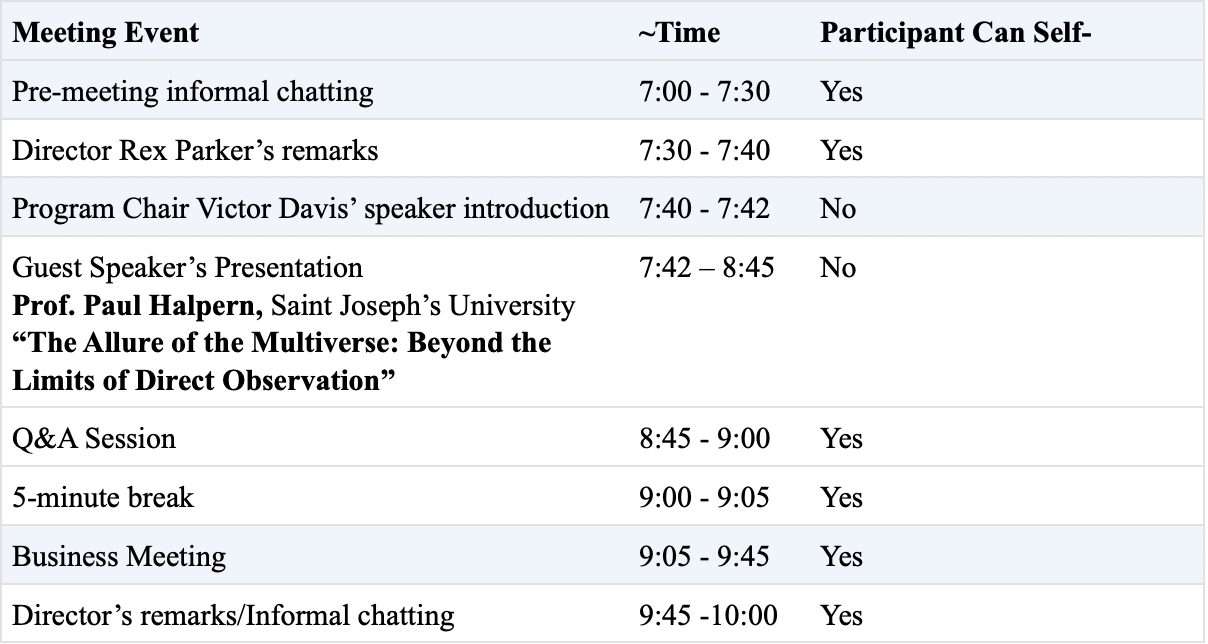
Here’s the anticipated agenda for June, 2025’s monthly meeting of the AAAP:

Featured Speaker:

Jacob Hamer, PhD

Assistant Curator, Planetarium Education

New Jersey State Museum

Jacob.Hamer@sos.nj.gov

“Tides in the Solar System and Beyond”

Tides in the Solar System and Beyond
To those of us living near a coastline, the tides are a familiar celestial cycle. We directly experience ocean tides resulting from the cosmic ballet of Earth and Moon, but much more extreme tidal interactions happen elsewhere in our Solar System. Dr. Hamer will discuss why tides happen, and show examples of tides in the universe. Beyond our Solar System, tides may actually spell destruction for giant planets orbiting very close to their stars.

Jacob Hamer
Dr. Hamer is Assistant Curator of Planetarium Education at the NJ State Museum. He received his BA in Physics and Mathematics from CUNY Macaulay Honors College at Hunter College. During his undergraduate studies he conducted research on galaxies at the American Museum of Natural History. He received his PhD in Astronomy and Astrophysics at Johns Hopkins University, where he carried out research on the interactions between close-in exoplanets and their host stars.

A look ahead at future guest speakers:

DateFeatured SpeakerTopic
July-AugustNo Monthly Meetings
September 9, 2025Edwin L. Turner
Emeritus Professor of Astrophysical Sciences
Princeton University
elt@astro.princeton.edu
“Why a Universe Devoid of Extraterrestrial Life is Quite Plausible”
 
A discussion of why there’s little foundation for the popular expectation that life in the universe may be common.
October 14, 2025Becka Phillipson
Assistant Professor in Physics
Villanova University
rebecca.phillipson@villanova.edu
Prof. Phillipson is an astrophysicist who leverages statistics, nonlinear dynamics, and machine learning to study the explosive and highly variable characteristics of exotic astrophysical objects such as black holes and neutron stars.

Thanks to Bill Thomas for suggesting this speaker.
November 11, 2025Romain Teyssier
Professor of Astrophysical Sciences and Applied and Computational Mathematics
Princeton University
teyssier@princeton.edu
Prof. Teyssier’s main research activity is to perform simulations of cosmic structure using supercomputers in order to understand the origins of stars and galaxies.

The YouTube recording of May’s AAAP meeting featuring Princeton Professor James Stone has been edited and uploaded for public viewing. Visit AAAP’s YouTube channel for recordings of monthly meetings going back several years.

As always, members’ comments and suggestions are gratefully accepted and much appreciated. Thanks to Ira Polans and Dave Skitt for setting up the online links and connecting the meeting to the world outside Peyton Hall.

victor.davis@verizon.net
program@princetonastronomers.com
(908) 581-1780 cell

Posted in June 2025, Sidereal Times | Tagged , , , , , , | Leave a comment

Minutes of the May 13, 2025 Meeting

by Gene Allen, Secretary

Director Rex Parker opened the meeting in Peyton Hall at 1931. There were 36 attending and 23 online. He introduced Nomination Chair Dan Opdyke who reported that no additional nominations had been submitted and he called for a vote for the slate. Hands of 27 members were counted in person and an additional 7 online exceeded the required quorum of 32. Those elected for a one year term are:

Director: Rex Parker
Assistant Director: Bob Vanderbei
Treasurer: Ira Polans
Secretary: Gene Allen
Program Chair: Victor Davis
Observatory Co-Chairs: Jennifer & Dave Skitt
Outreach Chair: Bill Murray

Program Chair Victor Davis introduced our speaker for tonight, James Stone, Professor Emeritus at Princeton University and Member of the Institute of Advanced Study. His talk was entitled Accreting Black Holes

Twenty minutes of questions and a break followed the talk.

At 2102 Member Maiya Qui gave an Unjournal Presentation about Variable Stars: RR Lyraes & More. Maiya’s presentation would have been impressive if presented by a professor, and was even moreso when one realizes that she is a high school sophomore.

Rex convened the business meeting at 2113 with 25 attending in Peyton Hall.

Treasurer Ira Polans reported that 22 members have responded with interest in a field trip to the National Air & Space Museum Udvar-Hazy Center at Dulles International Airport. They chose to self-drive and stop at the Franklin Institute on the return. Details will be worked out for a date in September.

Rex reported on an April 16 New York Times article Astronomers Detect a Possible Signature of Life on a Distant Planet ( https://www.nytimes.com/2025/04/16/science/astronomy-exoplanets-habitable-k218b.html ). Hycean world K2-18b has an atmosphere of hydrogen and methane and exists at a distance that would permit liquid water on its surface. A large amount of dimethyl sulfide was detected in its atmosphere, and on Earth it is only produced by life. Please see his article in the May issue of Sidereal Times on the AAAP website for more detail. Rex concluded his report with a pitch to join the American Astronomical Society, “a community of astronomers and advocates for science.”

The AAS publishes multiple scientific journals as well as Sky & Telescope magazine. Membership in the AAAP qualifies you to join as an Amateur Affiliate member ($56 dues for 2025). In the current environment where science is being shunned and critically defunded, those of us who respect science need to support such organizations. < https://aas.org/join/classes-membership-and-affiliation >

Observatory Co-Chair Dave Skitt and Member Michael Mitrano reported that we are still awaiting the state permit to replace the failed service lateral to the observatory. The electrical contractor selected to do the replacement has received some questions from the state, an encouraging indication of some action. Until the repair can be completed a generator will be supporting Public Nights. For now, Keyholder Training has been suspended.

Outreach Chair Bill Murray reported that a group will be coming from the planetarium to the observatory on Friday, May 23, so additional member scopes are needed. He reported that 10 members have volunteered to bring scopes to Mercer Meadows on June 7 but there is plenty of room for more.

Dave Skitt reported that he has received a donated 8” Dobsonian with a Star Sense appliance that uses a smartphone to give it push-to guidance.

Rex reminded everyone that the June meeting will be held in the Planetarium of the NJ State Museum in Trenton.

The meeting was adjourned at 2148.

As of May 12, we have 211 active members. So far in CY2025, renewals number 46 and expirations number 26, giving us a 64% retention rate. We have added 17 new members.

Submitted by Secretary Gene Allen, May 20, 2025

Posted in June 2025, Sidereal Times | Tagged , , | Leave a comment

Book Reviews

by Tony Vinayak

In the past couple of months, I read a few books that delve into astronomy – some more than the others. Here is a short overview to help you decide if they are to your taste:

A Brief History of Time Keeping

The book delves into the art and science of keeping track of passage of time. We’ve all seen those sundials, hourglasses, grandfather clocks, and take for granted the quartz crystal buzzing away in that Rolex that is part of the heirloom. What mechanism does your iPhone use for telling time? Google it

The book is a fascinating journey through ages as humans discovered the periodicity and variations of days and seasons. How did we come to define 24 hours in a day and 60 minutes in an hour, rather than stick to decimal system? How did we arrive at the unintuitive distribution of number of days in each month of the year with no well-defined mathematical pattern? How long has the modern-day “Gregorian” calendar been around, and how did it come about? Lots of history covered in the book.

In latter chapters the book also delves into my favorite topic: General Theory of Relativity, how gravity bends light, and, gasp, how gravity impacts time and its consequences on timekeeping.

The book does delve into fair bit of physics along the way, so it is definitely for those who like that subject.

Our Moon

The book’s author was actually on one of our monthly meets, which spurred me to get a copy of the book.

If you were to be walking around on moon, would there be any odor you would smell? Is it all black-and-white on its terrain, or are there some dashes of color? Why do astronauts feel disoriented when they walk on moon? Is moondust for real? How was moon created billions of years ago? Does the phase of moon really have impact on our moods? Is it a coincidence that human menstrual cycle is similar in duration as a lunar month? How much did people know about moon before Galileo peered through his telescope? Why does moon still hold fascination for human landings and exploration?

If these are the questions that pique your interest, then this book is for you. Rebecca is a science journalist who did a thorough research on moon to compile this dossier. The editing could’ve been a bit tighter though as, as times, the book gets a bit repetitive. All in all, a fascinating read.

An Astronaut’s Guide to Life on Earth

Col. Hadfield is a Canadian astronaut who made several trips to space aboard the Space Shuttle and Soyuz spacecrafts and spent a good amount of time on the International Space Station (ISS). This book is his memoir of his experiences: the prep work that goes into becoming and Astronaut, what the lift-off experience is like, life inside the ISS, the hard landing upon return.

Book explains in much detail how life in space is different from life on earth. Absence of gravity manifests itself in very many surprising ways in space. When you brush your teeth, you have no choice but to swallow the toothpaste (yuck). Your spine grows a couple of inches due to decompression. You invariably get congested in your sinuses since the fluids have nowhere to settle. Your cardiovascular system atrophies due to gross underuse. But those magnificent views from up there! It takes a day of recovery on earth for every day spent in space. Col. Hadfield spent five months in space in his final mission, so the recovery time upon arrival was inordinate.

A well-written book, with much attention to detail. Enjoyed it. I still harbor the desire for space tourism – hopefully it will be an affordable reality in my lifetime!

Posted in June 2025, Sidereal Times | Tagged , , | Leave a comment

The North Star of Indian Cosmology

by S. Prasad Ganti

Famed Indian astrophysicist and cosmologist Dr. Jayant Narlikar has recently passed away. What follows is my tribute to this great scientist. Narlikar worked under the tutelage of Fred Hoyle, the eminent British astrophysicist and cosmologist at Cambridge. Narlikar and Hoyle were two main backers of the Steady State Theory that attempted to explain the history of our universe, claiming that the universe was always expanding and new matter was being created to keep the universe at a constant density. The theory lost ground to the Big Bang theory when more evidence came to light in the form of Cosmic Microwave Background (CMB) radiation, and Narlikar and Hoyle eventually accepted the Big Bang theory and redeemed their careers with other significant contributions. 

Backing the wrong horse is not a sin in itself. Until strong evidence is discovered for a particular theory, other competing theories are fair game. That is how scientific research thrives and should be conducted. Groupthink has no place in such endeavors. 

Narlikar was the son of an eminent mathematician. After his stint at Cambridge with Hoyle, he came back to India to work at TIFR (Tata Institute of Fundamental Research).  He popularized cosmology in India and fostered a new generation of cosmologists. He set up the Inter-University Center for Astronomy and Astrophysics (IUCAA), which created collaborations between different universities. Narlikar was a prolific writer who wrote numerous articles, books and TV programs, covering popular science as well as science fiction. I call him the Carl Sagan of India, since Sagan is known for popularizing astronomy in the US via his books, lectures and famous TV series, “Cosmos”.

During the later part of his career, Narlikar worked on finding the origins of life. He conducted experiments to find out if life existed higher up in earth’s atmosphere. By putting bio sensors in hot air balloons rising to the stratosphere, he detected 3 species of microbes which survive in the ultra violet (UV) ray filled environment. They had become UV tolerant in an extraordinary demonstration of evolutionary adaptation. Narlikar’s premise was “panspermia”, the hypothesis that life on earth originated from outside and was transported here. It was a profound contribution that enriched the fields of microbiology, astrobiology, and environmental science.

Around the same time, Hoyle worked and contributed significantly to understanding the nucleosynthesis process which powers the Sun. Until then, people were unsure whether it was chemical processes like burning of coal or atomic/nuclear processes that fired the Sun. Hoyle proposed that nuclear fusion combines hydrogen atoms to form helium, creating energy. Hoyle also came up with an explanation of how stars can create all the elements heavier than helium. Hoyle predicted that an unstable form of carbon was a stepping stone to produce heavier elements all the way up to iron in stars. This form of carbon has now been recreated in labs. Hoyle’s work helped us understand the powering of the sun and other stars of all sizes in our universe.

To conclude, here is a little known work of Narlikar and Hoyle: as late as 1993, they worked with another scientist, Geoffrey Burbidge, and proposed a model which tried to attribute the CMB to thermalized starlight instead of the Big Bang. Called ‘Quasi Steady State Cosmology’ (QSSC), it proved to be mathematically elegant. It is still a fringe theory which did not cause any revolutions, but the thinking behind it was sophisticated. 

Although neither Narlikar nor Hoyle won a Nobel prize, they had significant contributions to astrophysics and cosmology. Narlikar is remembered as one of the great Indian cosmologists, and his legacy will endure in our minds forever.

Posted in June 2025, Sidereal Times | Tagged , , , , , | Leave a comment