…And The Moon

by Jeff Beck

I just got started with lunar, solar and planetary photography with a CMOS camera (I had done lunar and solar with a DSLR previously).  Here is a recent shot (12/8) of the moon with an ASI585MC Pro camera on a Meade 8″ SCT operating at f/6.3.  Image captured and stacked with ASI Studio, and further processed in Photoshop, primarily for color balance.

Posted in January 2025, Sidereal Times | Tagged , | Leave a comment

Snippets

compiled by Arlene & David Kaplan
-NYT

Interstellar “tunnel” found that connects our solar system to other stars Space can surprise even those who spend their lives studying it. People often think of our solar system as just a few planets and a bunch of empty space.Yet new observations suggest we have been living inside a hot, less dense region, and that there may even be a strange cosmic channel connecting us to distant stars…more
-NYT
-livescience

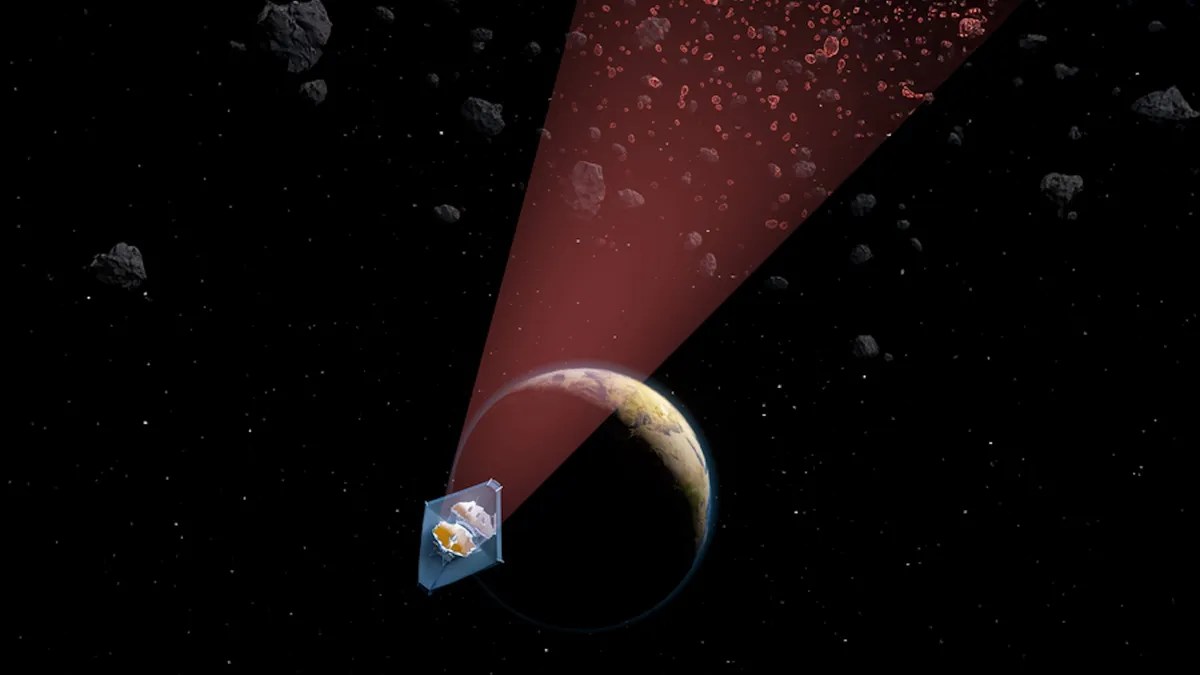
James Webb telescope spots more than 100 new asteroids between Jupiter and Mars — and some are heading toward Earth Astronomers analyzing archival images from the James Webb Space Telescope (JWST) have discovered an unexpectedly vast population of the smallest asteroids ever seen in the asteroid belt between Mars and Jupiter. The finding could lead to better tracking of the tiny but powerful space rocks that are likely to approach Earth…more
-NYT

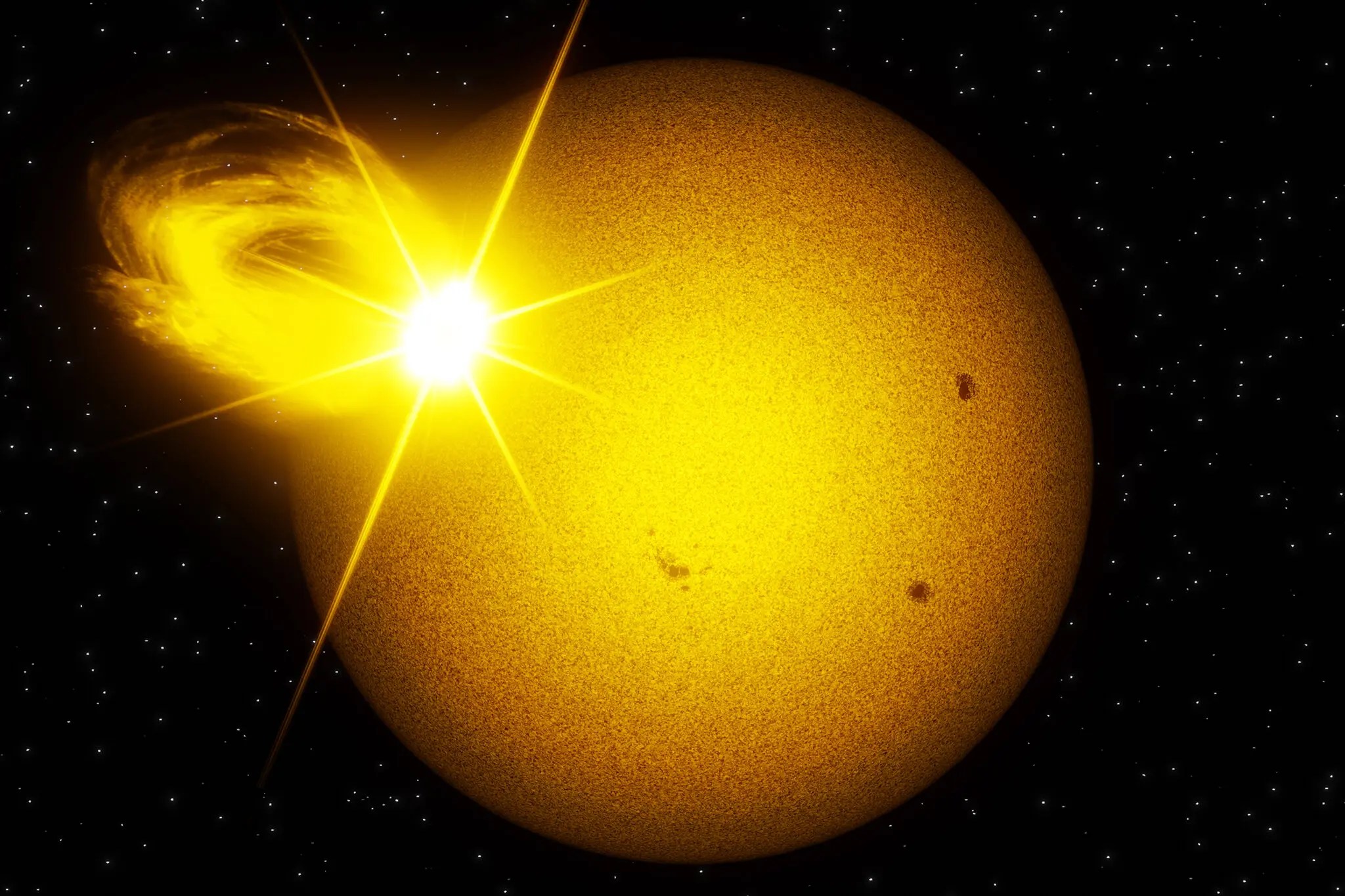
Superflares Erupt From Stars Like Our Sun Once Every 100 Years Our sun is a violent place. Bursts of radiation snap off the solar surface with the strength of millions of volcanic eruptions. Hot plasma churns and spews, streaming particles that can harm astronauts and satellites in space and damage electrical systems on the ground. They can also brighten up our skies with colorful lights. But scientists have observed even bigger explosions….more
-NASA

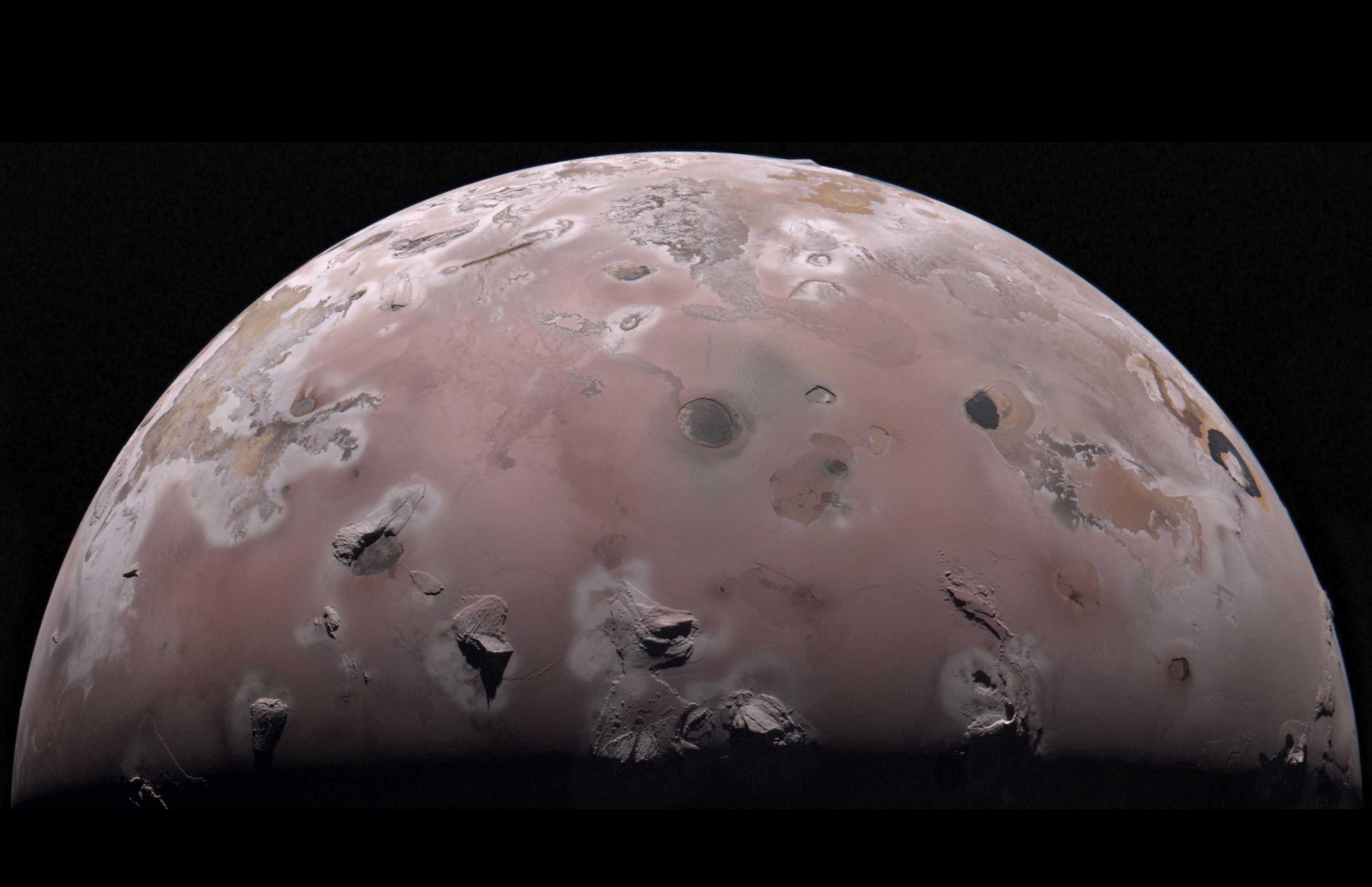
NASA’s Juno Mission Uncovers Heart of Jovian Moon’s Volcanic Rage Scientists with NASA’s Juno mission to Jupiter have discovered that the volcanoes on Jupiter’s moon Io are each likely powered by their own chamber of roiling hot magma rather than an ocean of magma. The finding solves a 44-year-old mystery about the subsurface origins of the moon’s most demonstrative geologic features…more
-NDTV

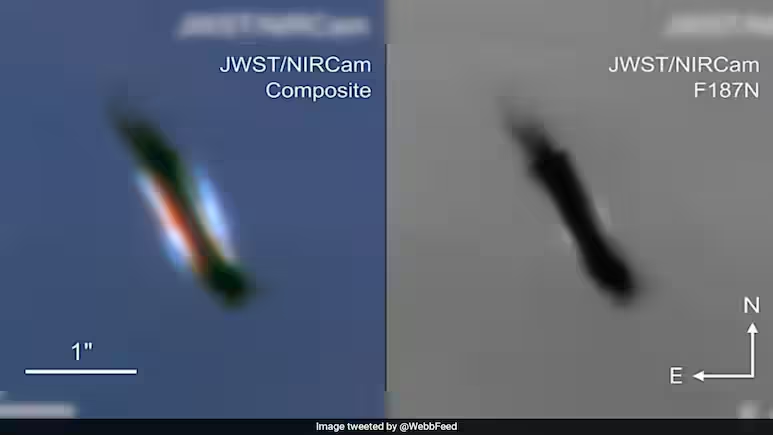
Astronomers Find Frozen Water Beyond Solar System Using James Webb Telescope In a groundbreaking finding, the James Webb Space Telescope (JWST) has discovered frozen water in a distant protoplanetary disk, located outside our Solar System. This remarkable detection was made possible by the JWST’s advanced Near-Infrared Camera (NIRCam), which captured high-resolution images of the disk…more
-alternet

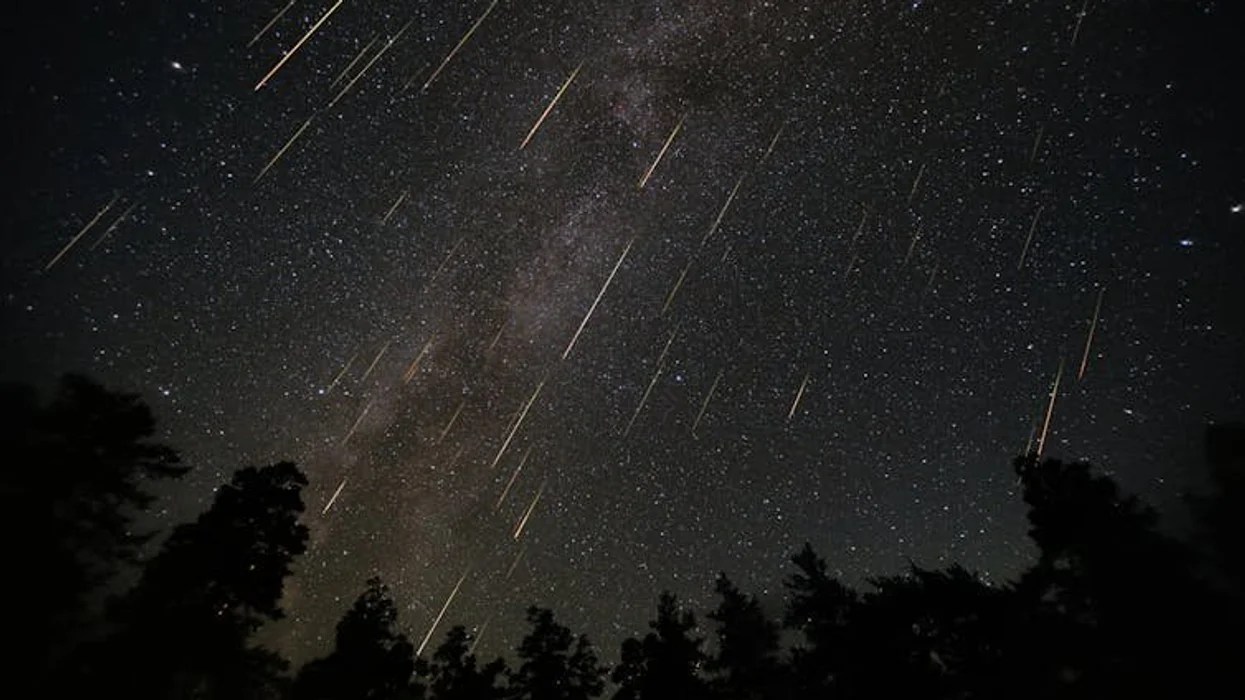
New research shows most space rocks crashing into Earth come from a single source The sight of a fireball streaking across the sky brings wonder and excitement to children and adults alike. It’s a reminder that Earth is part of a much larger and incredibly dynamic system. Each year, roughlymore

-Mashable

At 2 a.m., an unexpected event led to a surprise planet discovery The astronomical confusion started at 2 a.m ET on June 26, 2023. Scientists using the powerful James Webb Space Telescope sought to observe a planet beyond our solar system (an exoplanet) called Kepler-51d, an unusual “puffy” world with a cotton candy-like density. But it passed into view two hours earlier than expected. That’s strange for a planet…more
-CNN.com

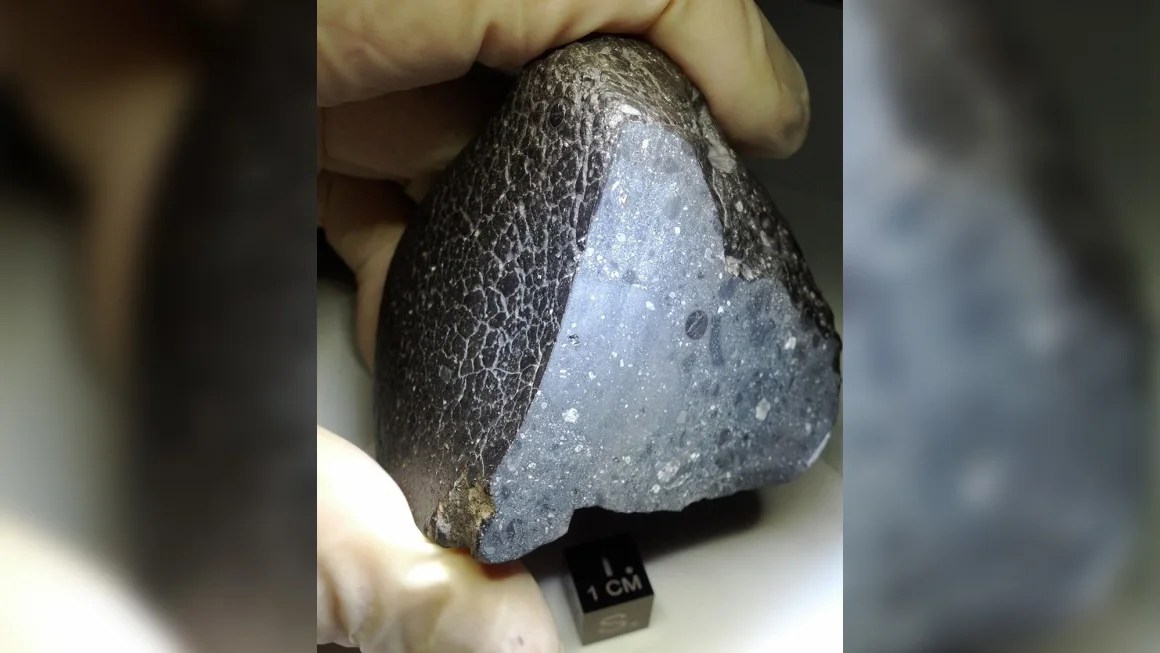
‘Black Beauty’ was found on Earth in 2011. Now, scientists say it has revealed a new clue to life on Mars A mineral trapped within a Martian meteorite that fell to Earth has revealed traces of water on Mars that date back 4.45 billion years, according to new research. The zircon grain may contain the oldest direct evidence of ancient hot water on the red planet, which may have…more
-earth.com

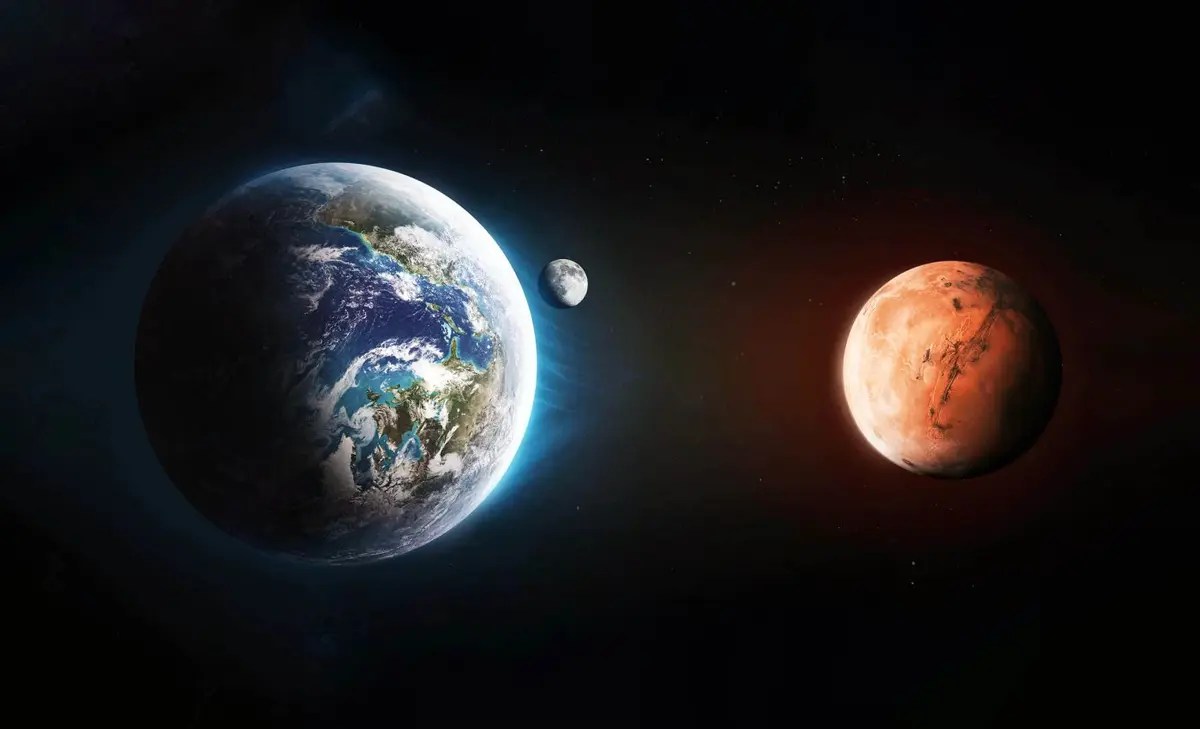
Mars’s gravity pulls Earth closer to the Sun, warming our climate New research hints at a fascinating and completely unexpected connection between Mars’s gravitational field and Earth’s climate. Geological evidence spanning over 65 million years suggests that deep-sea currents on Earth undergo recurring cycles of strength every 2.4 million years…more
-cosmosmagazine

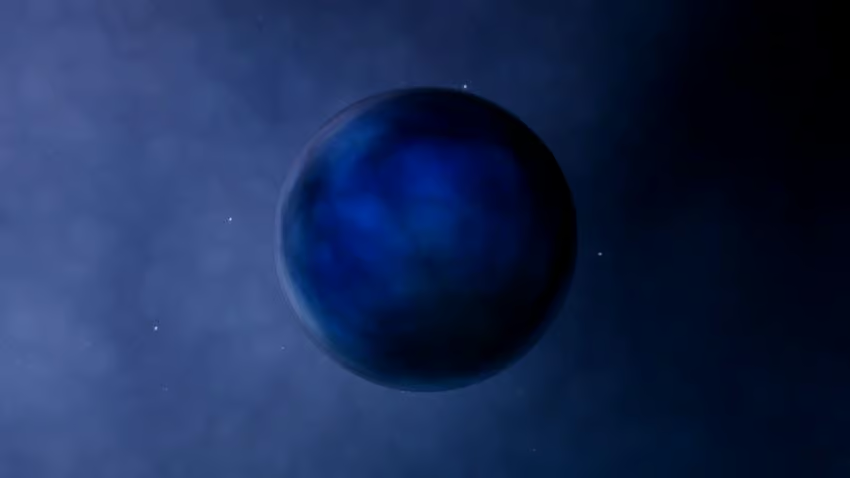
Evidence mounts for undiscovered planet in Solar System The possibility that there might be a large, unknown planet lurking in the outer Solar System far beyond Pluto has long been a staple of science fiction. But for the past decade, astronomers have been finding it increasingly likely that something big – often called Planet X – might actually be out there…more

Posted in January 2025, October 2024, Sidereal Times | Tagged , | Leave a comment

From The Director

by Rex Parker, PhD director@princetonastronomers.org

Meeting December 10 at Peyton Hall.  We hope to see you in person at Peyton Hall on campus for the next monthly meeting on Dec 10 (7:30pm).  Our speaker will be Jesse Christiansen, Senior Scientist at NASA’s Exoplanet Science Institute at Caltech in Pasadena.  She will describe her research and the overall status of exoplanet discoveries. Exoplanets are planets beyond our solar system orbiting other stars, an area of astronomy that has taken off exponentially over the past 20 years with over 7000 total having been detected.  For a bit more background check out the NASA Exoplanet Science Institute website, NExScI.  More information on the presentation at AAAP can be found below in program chair Victor Davis’s section.  The meeting will also be available via Zoom (see AAAP website for link) and recorded on YouTube; past meeting recordings can be found here: https://www.youtube.com/@amateurastronomersassociat1439

At each month’s meeting we reserve a slot after the break for the Unjournal Club, in which members have the floor (and screen) for 10-15 min to discuss recent astro-related magazine articles, books, or other personal astronomy experiences and projects to share with fellow members. Last month, for example, we had a very cool presentation by member David Ackerman about his progress in making, programming, and using a spectroheliograph to image the sun in astonishing detail. To give an unjournal club presentation send an email to me or the Program Chair to hold a place on the agenda Dec 10.  This can also be done via Zoom if you are attending virtually.  Please remember that if you want to share astro images or other slides live in the auditorium, experience has shown that it’s better for connecting with the Peyton Hall projector and Zoom input to bring the file on a USB drive to insert into the laptop already connected up front during the meeting.

December Observing:  Early Winter Jewels in Taurus (the Hyades and Crab Nebula). Looking upwards toward the eastern sky in early evening in December, the rising constellations of winter offer striking forms that we recognize at a glance, reminding us of the oncoming solstice and holidays. One of my favorite constellations, Taurus, is well positioned for small telescope and binocular observing. At low power/wide field, the Hyades open cluster makes a beautiful sight forming the “V” near the red giant star Aldebaran.  The Hyades is the closest star cluster to us, a mere ~140 light years distant and about 70 light years across; the denser central group is about 10 light years in diameter. The Hyades in Greek mythology were the five daughters of Atlas and were half-sisters to the Pleiades. Based on the Hertzsprung-Russell diagram, the Hyades are much younger than our own sun at around 600 million years. 

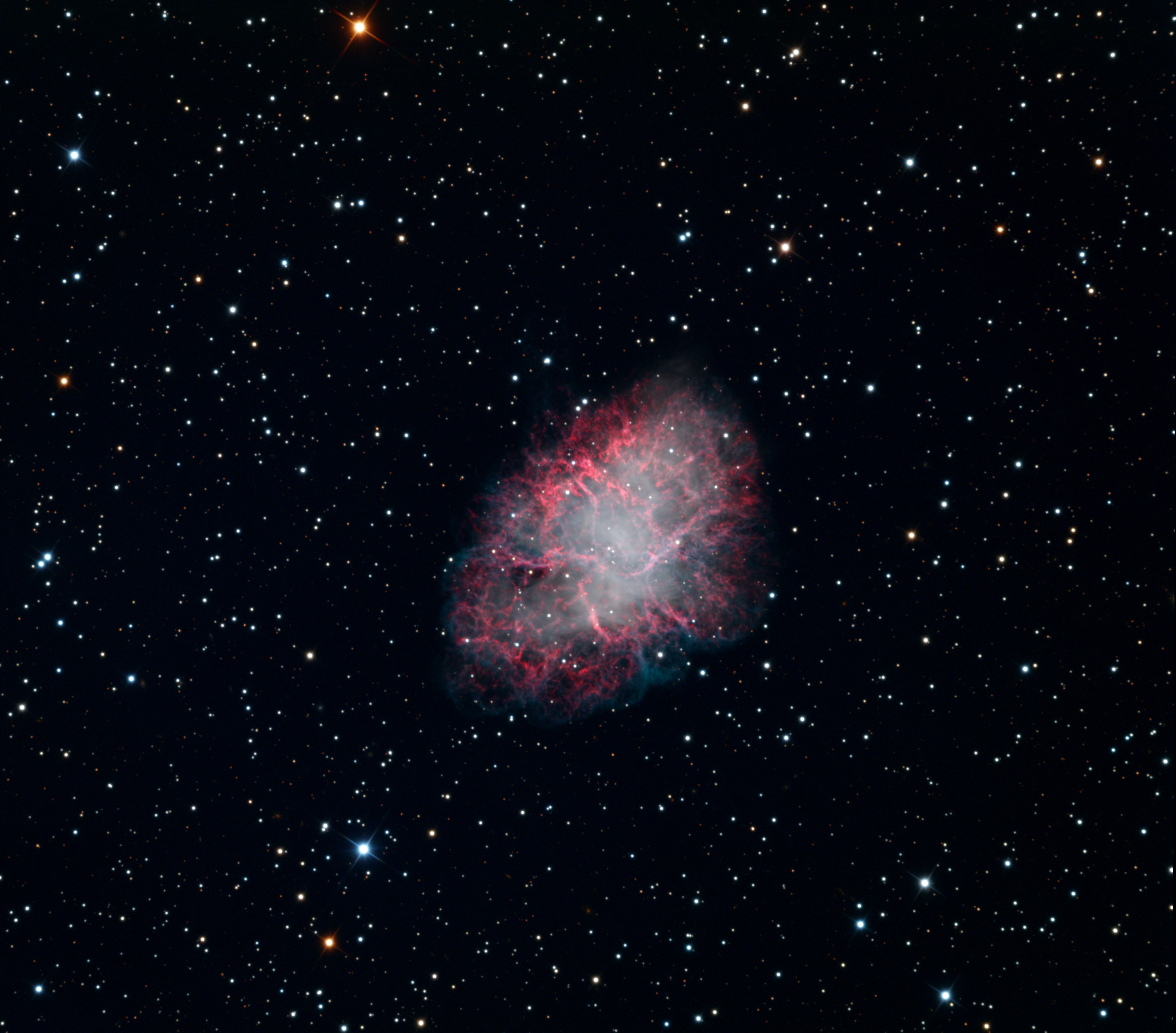
Also in Taurus is one most amazing sights one can see and photograph in amateur telescopes, Messier 1 – the Crab Nebula.  The astrophoto below shows the eerily glowing filamentous detail in M1, which covers an area of about 6 x 4 arc-min.  To see M1 visually, larger telescopes have the advantage, and waiting for culmination on a clear moonless night plus using a deep-sky filter will help.  The annals of both Chinese and Arab history revealed notations which correspond to 1054 AD of a reddish-white new star shining as bright as Venus in the daytime sky for weeks. The supernova explosion resulting in M1 must have been impressive to see.  Early observations of M1 as a radio source showed that the intensity of the emitted radiation increased with increasing wavelength, that is, it generates “non-thermal radiation”. The mechanism for this effect remained for many years one of the deep mysteries of astrophysics, and eventually in the late 1950’s was understood as an example of the synchrotron mechanism.  The synchrotron process at the core of M1 is based on a binary pulsar at the center, the subject of the 1993 Nobel Prize in Physics won by Princeton University’s Russell Hulse and Joesph Taylor. The Princeton team drew heavily on observations of M1 in their research in the 1970’s, leading to the theory of binary pulsars and subsequent tests of General Relativity.  This was the topic of a memorable AAAP talk back in the 1990’s by Russell Hulse (who was also a longstanding AAAP member). 

Messier 1, the Crab Nebula in Taurus.   Astrophoto by Rex Parker, data from Mt Lemmon AZ and Adam Block using the Shulman 32” telescope and SBIG CCD camera).

Posted in December 2024, November 2024, Sidereal Times | Tagged , | Leave a comment

From The Program Chair

by Victor Davis, Program Chair

December Meeting

The December, 2024 meeting of the AAAP will take place in Peyton Hall on the campus of Princeton University on Tuesday, December 10th at 7:30 PM. As usual, the meeting is open to AAAP members and the public. Participants can join the meeting in-person at Peyton Hall or log in to the Zoom session as early as 7:00 pm to chat informally before the meeting begins. The evening’s guest speaker is Jessie Christiansen, Senior Scientist at NASA’s Exoplanet Science Institute, whose talk is entitled, “The Search for Earth 2.0: Why We Think It Exists, and How We’re Going to Find It.”

Options for Attending the Meeting

You may choose to attend the meeting in person or participate via Zoom or YouTube as we’ve been doing for the past few years. (See How to Participate below for details). Due to security concerns, if you log in before the host has set up internet connectivity in Peyton Hall, you may need to wait in the Waiting Room for a few minutes until the host is prepared to admit you into the meeting. You’ll need to unmute yourself to make comments or ask questions. It’s polite, though not required, for you to enable your camera so other participants can see you. A week or so after the meeting, the video of the lecture and Q&A will be posted on AAAP’s public YouTube channel.

The traditional “meet the speaker” dinner will be held at Winberie’s Restaurant & Bar, One Palmer Square, Princeton, NJ. Reservation is for 5:45 pm. Please advise the Program Chair if you plan to attend.

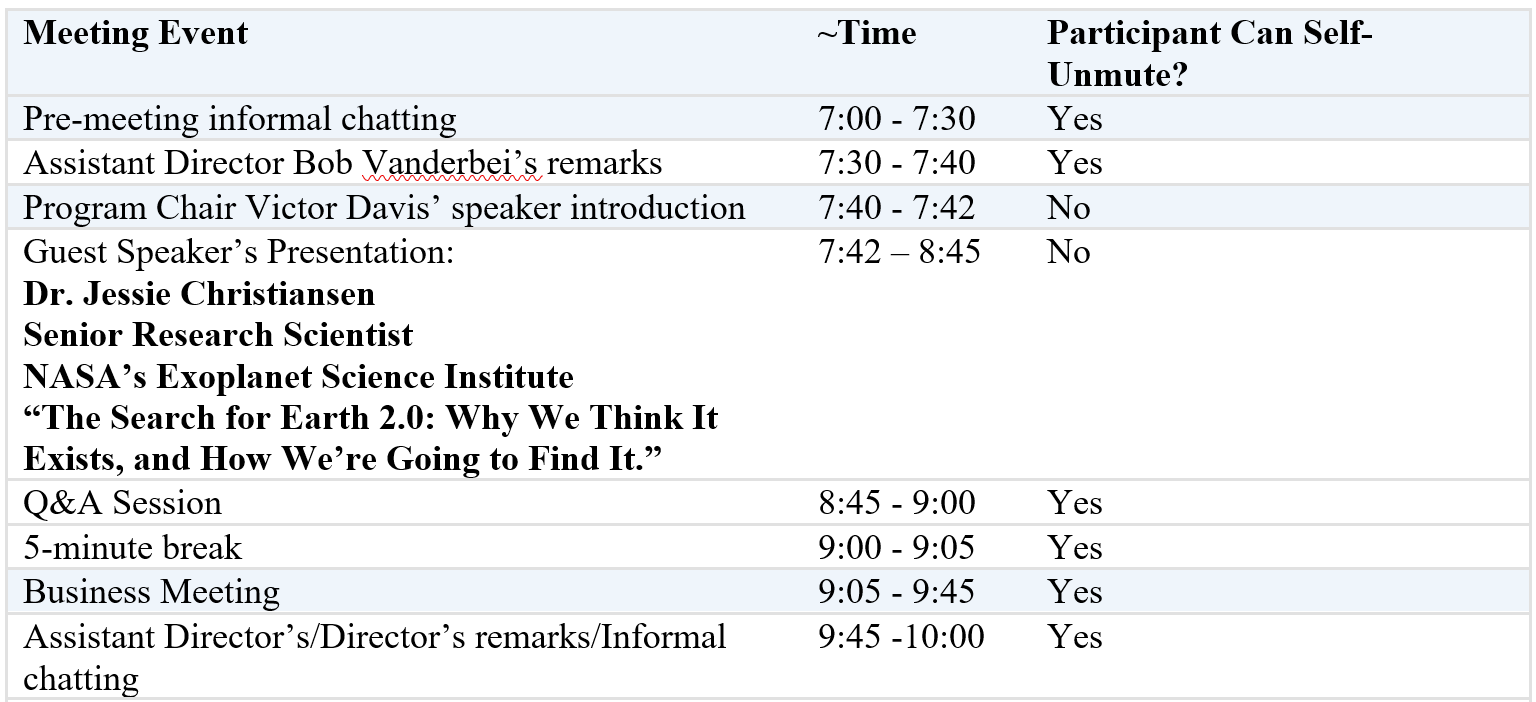
Here’s the anticipated agenda for December, 2024’s monthly meeting of the AAAP:

(Times are approximate)

Getting to Peyton Hall
The parking lots across the street (Ivy Lane) from Peyton Hall are now construction sites, unavailable for parking. We’ve been advised by the administration of the astrophysics department that we should park in the new enclosed parking garage off Fitzrandolph street and walk around the stadium and athletic fields. Here’s a map of the campus and walking routes from the parking garage to Peyton Hall. The map shows the recently completed East Garage. Not shown is an access road Sweet Gum that connects from Faculty Road to an entrance at the lower left corner of the garage. Stadium Road connects from Fitzrandolph Road to another entrance at the opposite corner (and higher level) of the garage. It’s about a 10-15 minute walk from the parking garage to Peyton Hall.

The Search for Earth 2.0: Why We Think It Exists, and How We’re Going to Find It.
For thousands of years, we’ve wondered if the Earth is unique, or if there are other Earths out there to find. In just the last 30 years, we’ve progressed from merely wondering if planets exist around other stars to knowing that almost every star we see has planets. Ambitious planet searches have been probing further and further, finding planetary systems of an incredible – and incredibly surprising! – variety. However, we have yet to discover another planet that might be like Earth – a rocky planet orbiting just the right distance from a Sun-like star to have liquid water on its surface. NASA has a audacious new plan for a next-generation flagship telescope that will directly image Earth-like planets around nearby stars, but it will take all of our ingenuity and technical prowess to achieve this incredible feat. Dr. Jessie Christiansen, Chief Scientist of NASA’s Exoplanet Science Institute, will walk us through the past, present, and future of our hunt for Earth 2.0.

Jessie Christiansen
Dr. Christiansen hails from Australia, and earned her PhD from the University of New South Wales. She’s been a Postdoctoral Research Fellow at the Center for Astrophysics, Harvard/Smithsonian, part of the Kepler science team at NASA’s Ames Research Center and the SETI Institute, and has been a Staff Scientist and now Senior Scientist at NASA’s Exoplanet Science Institute at Caltech. She’s Project Scientist of the NASA Exoplanet Science Archive. Dr. Christiansen has won numerous awards for scholarship and exceptional science and engineering achievement. She’s published extensively in research topics related to the detection and characterization of exoplanets and their atmospheres. Dr. Christiansen is committed to supporting diversity in science and mentors children and women in the areas of science, technology, engineering, and mathematics. She’s a frequent explainer of science at professional colloquia, to the public, and on broadcast media.

How to Participate (Links)

Meeting link Meeting link
Click the above icons for Zoom and YouTube
Zoom Meeting ID: 830 6908 5296 and
Passcode: 812904

Date Featured SpeakerTopic
January 12,
2025
Rebecca Boyle
rebecca.b.boyle@gmail.com

Rebecca Boyle, science writer, essayist, and Contributing Editor to Scientific American, will discuss her new book, “Our Moon: How Earth’s Celestial Companion Transformed the Planet, Guided Evolution, and Made Us Who We Are.”  Suggested by Ira Polans.

As always, members’ comments and suggestions are gratefully accepted and much appreciated.

victor.davis@verizon.net
program@princetonastronomers
(908) 581-1780 cell

Posted in November 2024, Sidereal Times | Tagged , , , , , , | Leave a comment

Minutes of the November 12, 2024 AAAP Board Meeting

by Gene Allen, Secretary

A brief meeting was convened in Peyton Hall at 2200 following the monthly meeting.

In attendance were:

Rex Parker, Director
Bob Vanderbei, Assistant Director
Michael Mitrano, Treasurer
Victor Davis, Program Chair
Dave Skitt, Observatory Co-Chair
Bill Murray, Outreach Chair
Gene Allen, Secretary

Bill explained that the UACNJ Board meets this coming Saturday to consider his proposal for the reactivation of the AAAP observatory at Jenny Jump State Park. The proposal was detailed in the Board Minutes of September 4, 2024. Michael Mitrano explained that we need only add back the Jenny Jump location to our liability coverage that was removed a few years ago. It does increase our premium but not by much. A unanimous vote approved the change.

Dave reported challenges with acquiring the foam carpet square for the observatory. The needed total comes close to the $1,000 that the Board can approve without putting it to the membership. With tax it likely exceeds $1,000. We are tax exempt, but only when using an organization check, not when purchased by one of our members. There is currently a substantial discount in effect that will expire shortly. A unanimous vote formally approved the purchase up to $1,000. Michael will coordinate with Dave to execute the purchase.

Posted in December 2024, Sidereal Times | Tagged , , | Leave a comment

Minutes of the November 12, 2024 Meeting

by Gene Allen, Secretary

Director Rex Parker opened the meeting in Peyton Hall and on Zoom at 1938. There were 41 in attendance.

Rex noted views and images of comet C/2023 A3 and the unusual sighting of the aurora borealis here in central New Jersey. Spiral galaxy M33 transits (is at its highest point in the sky) tonight at 2200 and is perfectly positioned for imaging. The Pleiades, M45, are also well positioned for viewing naked eye or with binoculars but in a telescope need a super wide field of view.

Program Chair Victor Davis introduced Dr Manuel Cuesta, a Postdoctoral Research Associate at Princeton University. His lecture was “Remote Observations of Solar Dynamics and Results from the Parker Solar Probe.”

Questions and a break followed his talk.

The meeting reconvened with an Unjournal Presentation by Member David Ackerman describing the spectroheliograph he built and the images it has yielded.

The question period had run long and technical challenges starting the lengthy Unjournal Presentation left little time for general discussion without unduly delaying a Board of Directors meeting that needed to follow.

The meeting was adjourned at 2155.

As of November 11, we have 214 active members. So far in CY2024, renewals number 114 and expirations number 48, giving us a 70% retention rate.

Posted in December 2024, Sidereal Times | Tagged , | Leave a comment

X-Ray Telescopes

by S. Prasad Ganti

All the X-ray telescopes are in space. None on the ground. There are optical, infra-red, radio telescopes on the ground, but not X-rays. For the simple reason that X-rays coming from outer space cannot penetrate the earth’s atmosphere. Fortunately for us, else we would have been toast. No life would have been possible on earth. 

Chandra is an X-ray telescope, up in space since 1999. It recently completed 25 years in space. It was expected to last only five years, but had performed excellently for the last quarter of a century. X-rays, in minor doses, help with medical imaging of body inners. But in outer space, the dosages are very high and result from a supernova remnant or a black hole. An X-ray telescope helps in studying such cosmic objects. 

Chandra is an engineering marvel which has the cleanest pairs of mirrors. There are 4 pairs which are polished to the smoothness of a few atoms and are precisely aligned. X-ray telescopes require much higher levels of precision than optical telescopes because the wavelength of X-rays is much smaller than visible light. The unevenness of the surface of the mirror should be much less than the wavelength. Chandra’s great accomplishments have been the discovery of Cassiopeia A, which is the remnant of a supernova. The discovery of the Bullet cluster provided evidence of dark matter. Hundreds of black holes were also discovered.   

There are 2 X-ray observatories which have been launched in the last three years. To study the polarization of X-rays from extremely bright objects (not visual but in X-ray terms). Polarimeter is an instrument which is used to study the polarization of the X-rays, basically the alignment of electric and magnetic fields. They are always perpendicular to each other, but which direction is the electric component is the question. Polarization of X-rays can reveal the source from where they are coming and also the magnetic fields and the geometry of the source region. Initial observations of the Crab nebula, powered by a neutron star at its core; and the Cygnus X1 black hole X-ray binary are very encouraging. 

Another X-ray observatory called the Einstein probe, is a joint mission by the Chinese Academy of Sciences, European Space Agency (ESA) and the Max Planck Institute for Extraterrestrial Physics. Its goals are to identify and study new and transient sources of high-energy X-rays. The events are very short lived and shift from location to location, with very little chance of repeating at the same location. Such events are triggered by inactive black holes and merger of neutron stars. It was launched in Jan, 2024. 

The Einstein probe  has a Wide-field X-ray Telescope (WXT), with a lobster like eye with a 180 degree field of view. The telescope inspired by the crustacean eyes works by reflection rather than refraction. The wide field helps the telescope to observe a large swath of the sky at a time.   

The X-ray observatories form a part of the multi messenger astronomy where observations are made in several parts of the electromagnetic spectrum like radio waves, infrared waves, light, x-rays, and gamma rays. The instruments and the observatories are different engineering for each part of the electromagnetic spectrum. Except for x-rays and gamma rays, the rest of them can be observed using ground based observatories as well. 

Given below is the picture of Chandra X-ray telescope, courtesy NASA.

Posted in December 2024, Sidereal Times | Tagged , | Leave a comment

A Message from Princeton University Press

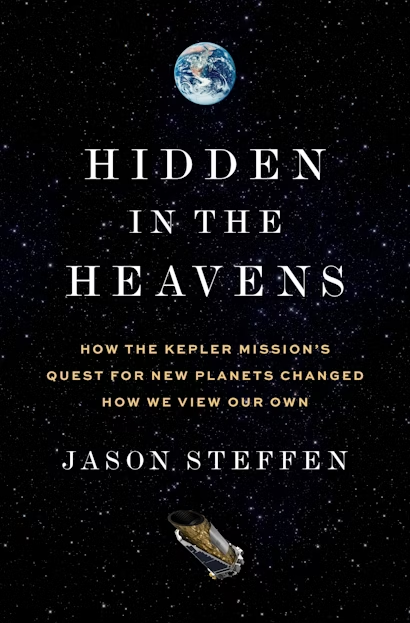
Stay starstruck this November with Princeton’s spell-binding collection of books on astronomy, including the brand-new Hidden in the Heavens, a NASA insider’s account of the Kepler mission and its bewildering discoveries. Take some time to learn from women who broke down barriers and changed the face of modern astronomy in The Sky Is for Everyone. Then it’s time to pack your bags to go Back to the Moon, one scientist’s inspiring vision, and onward to explore the real science behind interstellar expeditions in A Traveler’s Guide to the Stars. Your holiday gift list won’t be complete without touring the most spectacular sights in astronomy as observed in Welcome to the Universe in 3D, the New York Times bestseller from Neil deGrasse Tyson, Michael A. Strauss, J. Richard Gott, and Robert J. Vanderbei.

Princeton titles make stellar choices for holiday or donor gifts, book clubs, and to share with astronomy club members. For information on ordering and available discounts, email Barbara_Tonetti@press.princeton.edu.

Price:$29.95
ISBN:9780691242477 
Published (US):Oct 29, 2024
Copyright:2024
Pages:272
Size:6.13 x 9.25 in.
Illus:8 page color insert + 4 b/w illus.
Main_subject:Physics & Astronomy

An insider’s account of the NASA mission that changed our understanding of planets, planetary systems, and the stars they orbit.

Jason Steffen, a former scientist on NASA’s Kepler mission, offers a unique, inside account of the work of the Kepler science team, mapping the progress of the mission from the launch of the rocket that carried Kepler into space to the revelations of the data that began to flow to the supercomputer back at NASA—evidence of strange new worlds unlike anything found in our own solar system.

Price:$19.95
ISBN:9780691253916 
Published: Oct 31, 2023
Pages:504
Size:5.25 x 8 in.
Illus:72 b/w illus.
Main_subject: Physics & Astronomy

An inspiring anthology of writings by trailblazing women astronomers from around the globe.

Trimble and Weintraub bring together essays by women who reached for the stars in this uplifting anthology. . . . Filled with moving testimonies and awe-inspiring discoveries, this is a wonderful tribute to the joys of science and the tough road many women had on the way to forging their careers.

Price:$29.95
ISBN:9780691215235 
Published: Nov 1, 2022
Copyright:2022
Pages:304
Size:5.5 x 8.5 in.
Illus:10 b/w illus.
Main_subject: Physics & Astronomy

A scientist’s inspiring vision of our return to the Moon as humanity’s next thrilling step in space exploration.

Just over half a century since Neil Armstrong first stepped foot on the lunar surface, a new space race to the Moon is well underway and rapidly gaining momentum. Laying out a vision for the next fifty years, Back to the Moon is astrophysicist Joseph Silk’s persuasive and impassioned case for putting scientific discovery at the forefront of lunar exploration.

Price:$22.95
ISBN:9780691215471 
Published: July 11, 2023
Copyright:2023
Pages:304
Size:5.5 x 8.5 in.
Illus:16 page color insert. 37 b/w illus.
Main_subject: Physics & Astronomy

A concise and accessible introduction to exoplanets that explains the cutting-edge science behind recent discoveries

In The Little Book of Exoplanets, Princeton astrophysicist Joshua Winn offers a brief and engaging introduction to the search for exoplanets and the cutting-edge science behind recent findings. In doing so, he chronicles the dawn of a new age of discovery—one that has rapidly transformed astronomy and our broader understanding of the universe.

Posted in December 2024, Sidereal Times | Tagged | Leave a comment

Snippets

compiled by Arlene & David Kaplan

-NYT

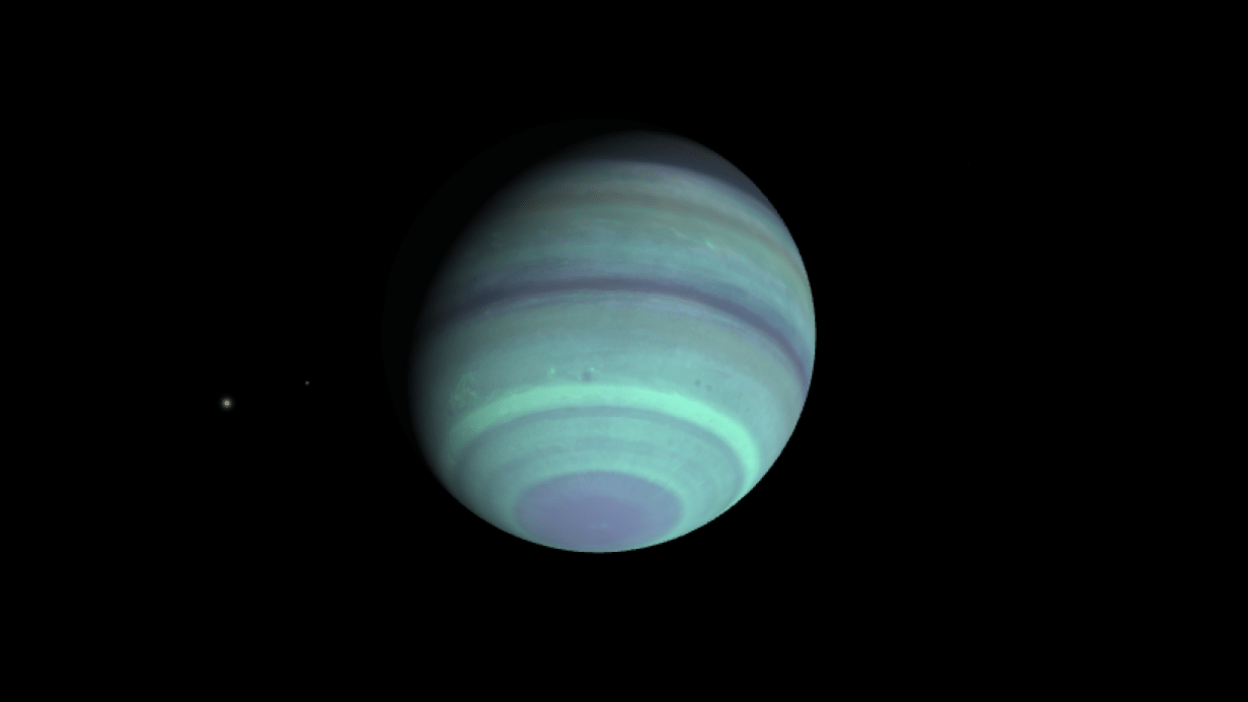
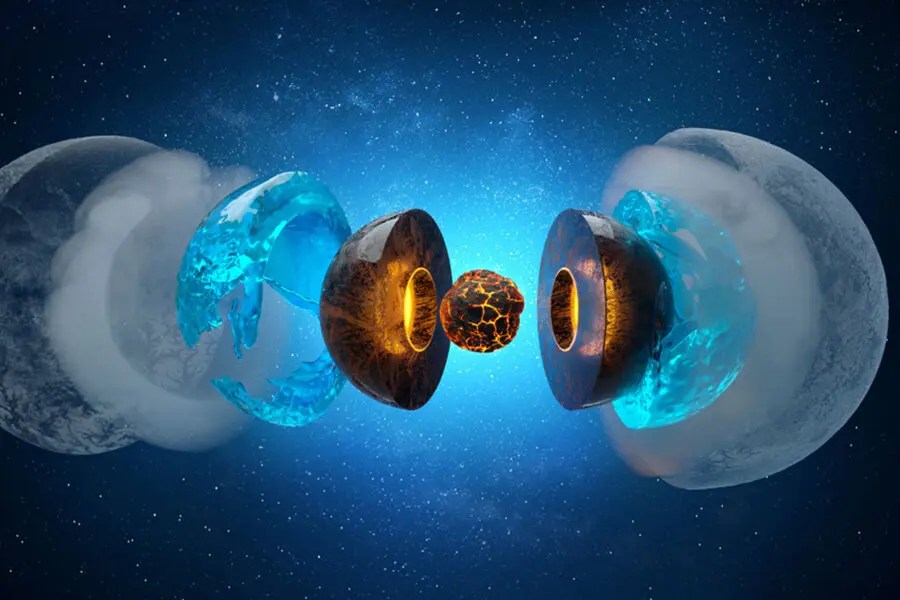
Vast Oceans of Water May Be Hiding Within Uranus and Neptune We might finally understand what’s going on inside Uranus and Neptune, and the answer is pretty surprising: They may each contain an ocean of water. “We didn’t really know anything before,” about their interiors, said Adam Masters, a space and planetary scientist at Imperial College London. “So this hypothesis is very compelling.”…more

-NYT
-NYT

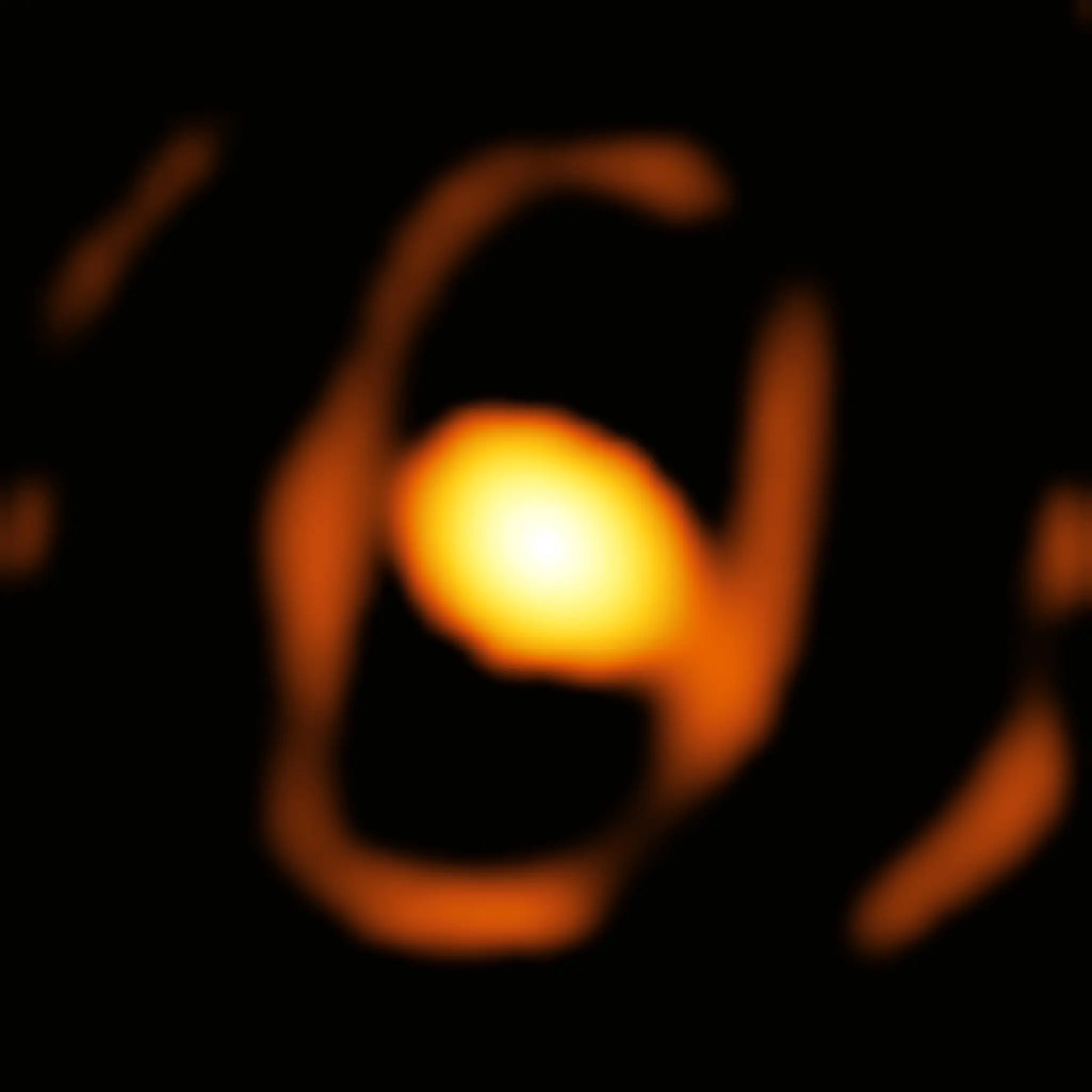
First Close-Up of Star Outside Our Galaxy Shows a Giant About to Blow In a stunning scientific and technological feat, a group of astronomers said Thursday that it had managed to take the first close-up picture of a star in another galaxy. Not only was the image a distance record for such cosmic intimacy, but the star, bulging like an overripe fruit, looks as if it is getting ready to explode…more

-NYT

Can Axions Save the Universe? The search is on for some of the flimsiest lumps of matter and energy ever dreamed up by physicists. They are darker than night, barely more substantial than a thought, and named after a laundry detergent. But axions, as they are called, could constitute most of the matter in our universe, forming the unseen skeletons of galaxies and chains of light that adorn the skies of astronomers….more

-NYT

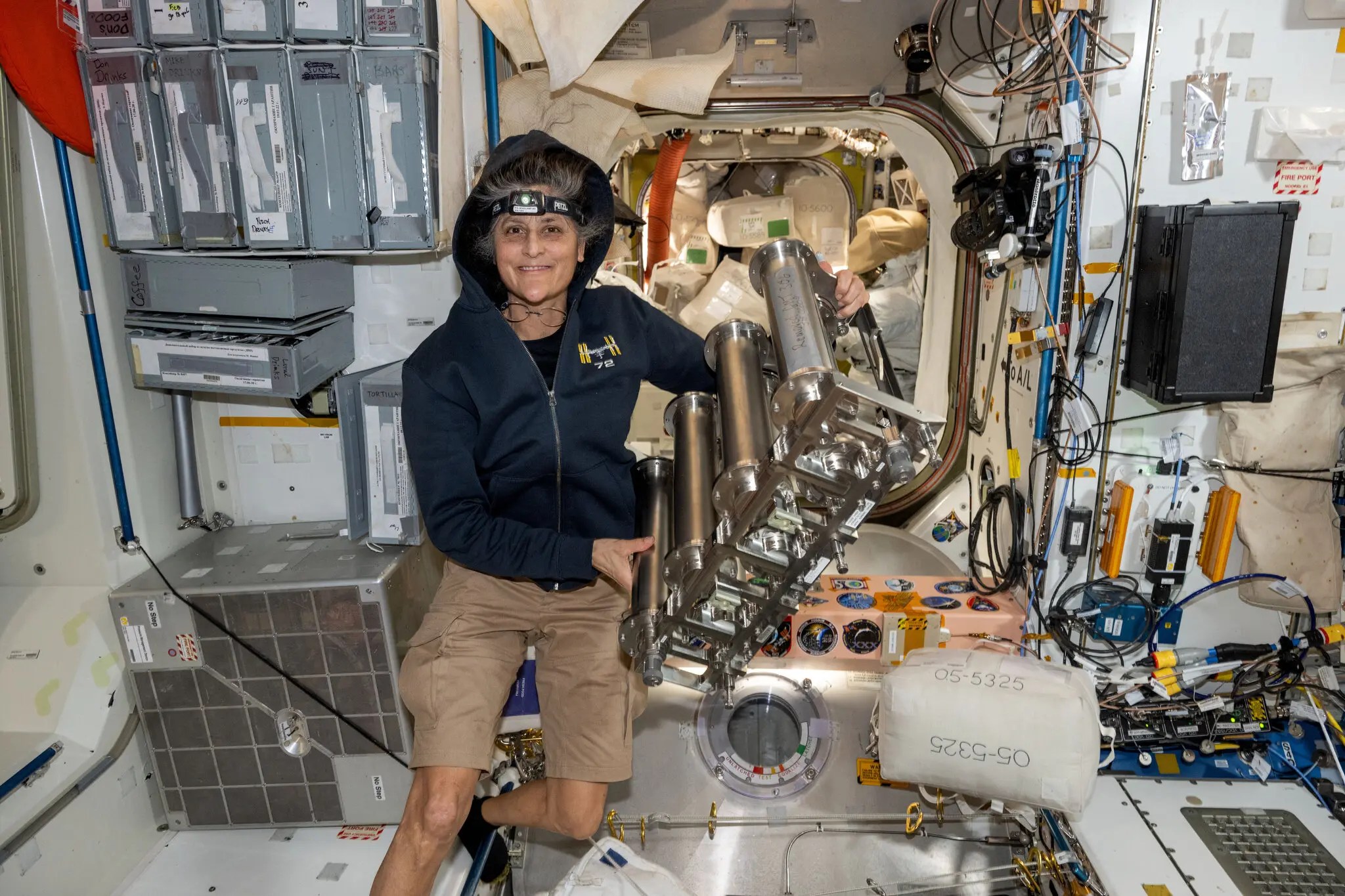
NASA Says Space Station Astronaut Is in ‘Incredible Health’ Suni Williams, a NASA astronaut currently on the International Space Station, is healthy and not suffering from any medical problems, NASA’s top medical officer said on Thursday. The unusual pronouncement was prompted by news articles suggesting that Ms. Williams was experiencing health problems…more

-NYT

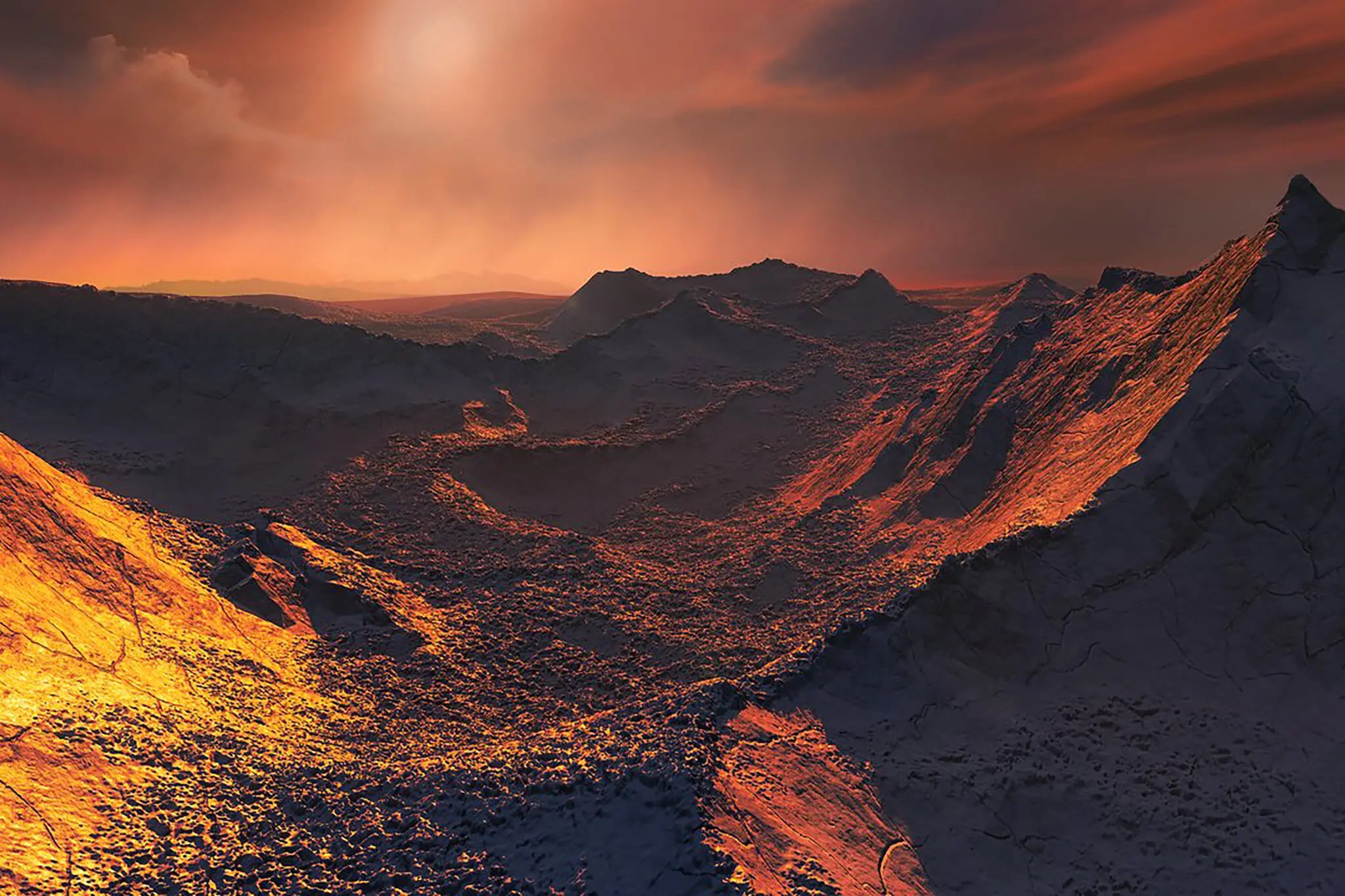
Barnard’s Star Finally Has a Planet, and Possibly More Barnard’s Star is a dim, reddish ball of gas just six light-years away from Earth in the constellation Ophiuchus. It is the nearest stand-alone star to our sun, but with only one-fifth the mass, it is so dim that no one knew it was there until 1916, when the astronomer Edward Emerson Barnard recorded its image on a photographic plate…more

-spacenews

New EU space commissioner outlines priorities The new European Union commissioner responsible for space says he will focus on improving European competitiveness and security in space, including passage of a long-delayed space law. Andrius Kubilius formally started his tenure as the European Commissioner for Defence and Space on Dec. 1 after members of the European Parliament confirmed him among a slate of 26 commissioners Nov. 27 for five-year terms….more

-NYT

An Asteroid’s Destruction May Have Given Mars Rings, Then Moons Something’s not quite right about the moons of Mars. They are too small — Phobos is 17 miles across, and Deimos is a mere nine miles in length. And they aren’t round, but lumpy, misshaped objects. Frankly, they don’t resemble moons at all…more

-NYT

SpaceX Starship’s Sonic Boom Creates Risk of Structural Damage, Test Finds SpaceX’s new Starship rocket far exceeds projected maximum noise levels, generating a sonic boom so powerful it risks property damage in the densely populated residential community near its South Texas launch site, new data suggests…more

-livescience.com

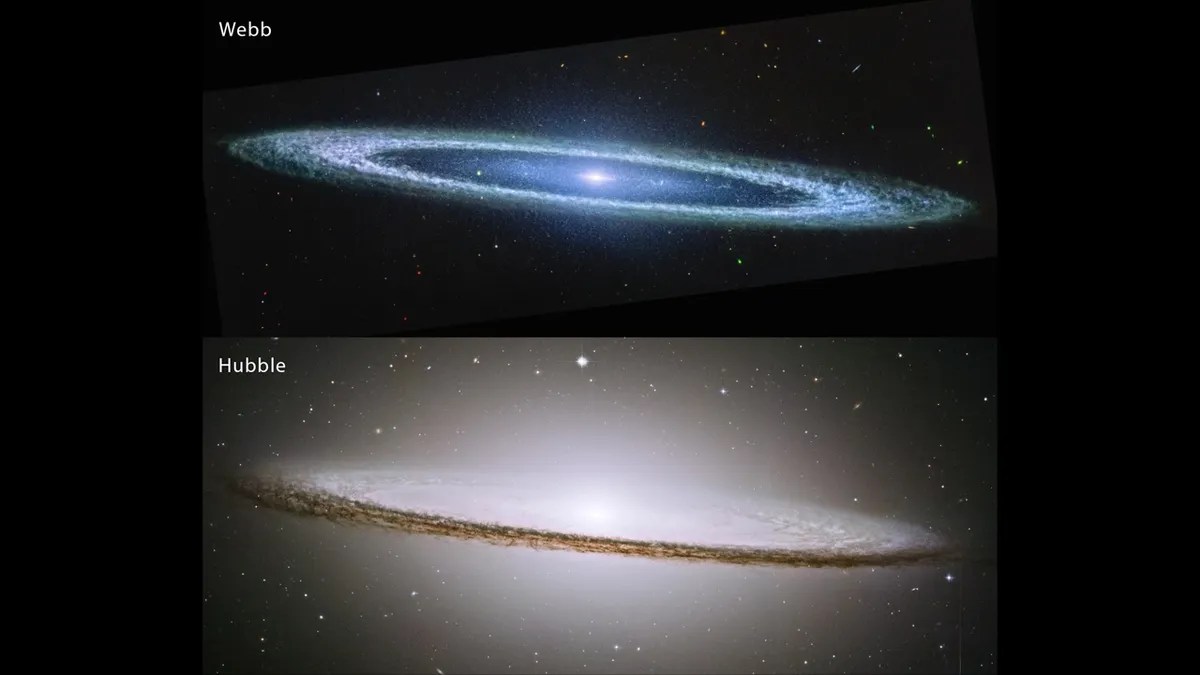
Space photo of the week: James Webb telescope spots a secret star factory in the Sombrero Galaxy It may have been first discovered in 1781, but the aptly named Sombrero Galaxy has never looked like this. This striking new perspective on an icon of the deep sky comes from NASA‘s James Webb Space Telescope, which has rendered the spiral galaxy that looks like a broad-brimmed Mexican hat both in high resolution and at mid-infrared wavelengths for the first time…more

-uchicago.edu

Two Black Holes Are Giving the Cosmos a Fright One is a serial killer, on the verge of devouring its second star in five years. The other is part of what astronomers are calling a black-hole triple, the first known instance of a three-body system that includes a black hole, which is not supposed to be part of the mix, according to standard astrophysics…more

Posted in December 2024, October 2024, Sidereal Times | Tagged , | Leave a comment

From The Director

by Rex Parker, PhD director@princetonastronomers.org

Meeting Nov 12 at Peyton Hall.  We hope to see you in person at Peyton Hall on campus for the next monthly meeting on November 12 (7:30pm).  Our speaker will be Princeton University post-doc Manuel Cuesta from the Dept of Astrophysics, who will discuss his heliophysics research with the Parker Solar Probe.  A lot has been accomplished since launch of the Parker Solar Probe by NASA in August 2018.  The craft was designed and built by Johns Hopkins Applied Physics Laboratory and was named after physicist Eugene Parker, professor emeritus at Univ of Chicago.  For more information about the guest speaker on Nov 12 see program chair Victor Davis’s section below. 

Also at the Nov 12 meeting, member David Ackerman will give a member talk (“unjournal club” after the break) on progress in building and using a spectroheliograph.  This is an optical instrument designed to study the sun at a single wavelength (monochromatic light).  He’ll describe making the instrument using 3-D printing and other methods and will show recent solar data from this instrument of the sun in action at its current peak of activity.

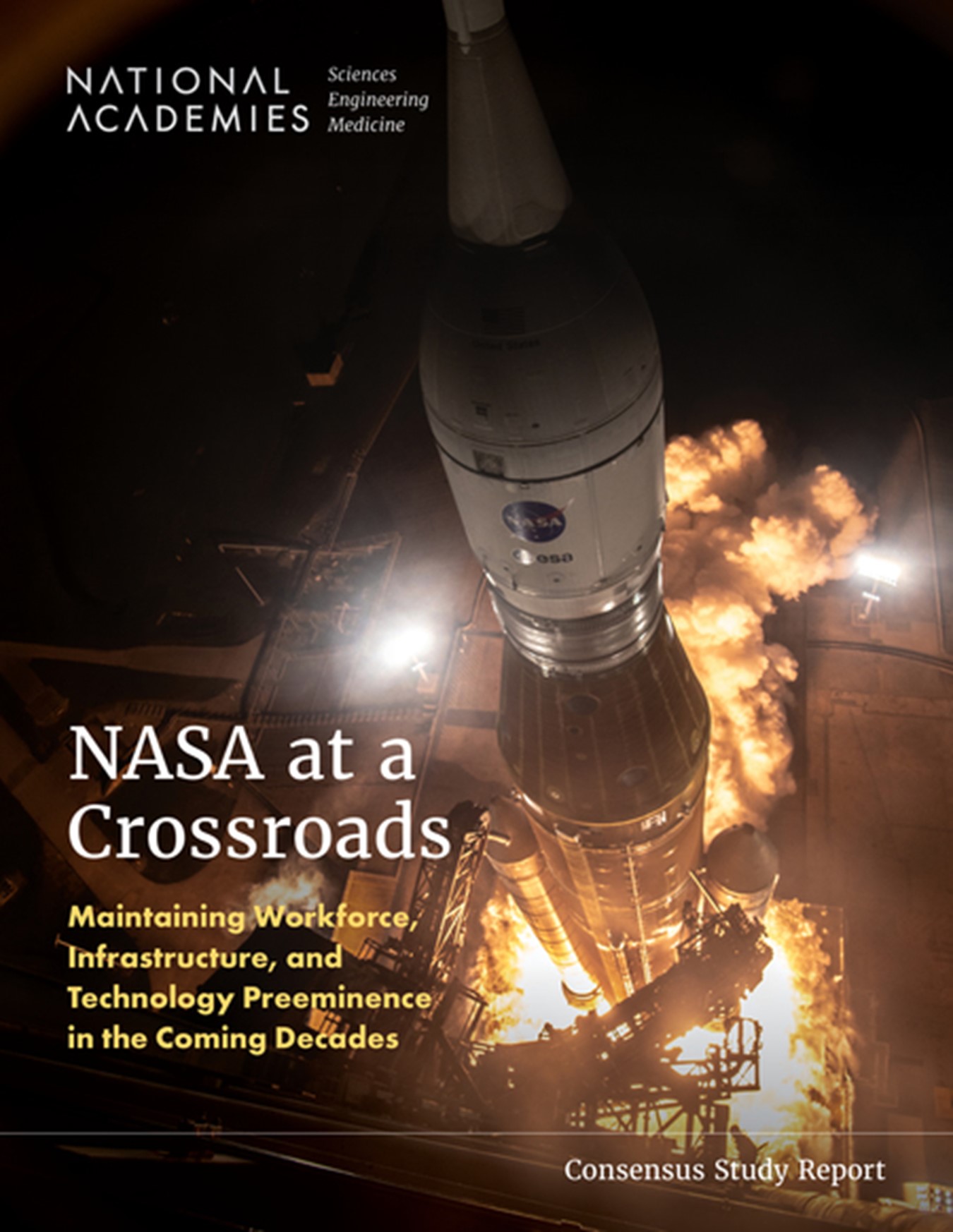
The NASA Situation and What We Can Do.  The Parker Solar Probe is a great recent example of the engineering and science prowess of NASA and collaborators.The Oct 14 launch of NASA’s Europa Clipper on a SpaceX Falcon Heavy rocket was good news and some relief especially after Hurricane Milton crossed Florida and narrowly missed Cape Canaveral the prior week.  Yet despite success in recent science missions and plans to send humans to the moon and Mars in the Artemis and Gateway projects, a sweeping new report from the National Academies of Sciences, Engineering, and Medicine has elevated worries about the future of the space agency.

As I described at the Sept 8 meeting, the “NASA at a Crossroads” report by the National Academy highlighted the results of an in-depth analysis.  It revealed serious deficiencies of NASA’s infrastructure which are critical to future space missions (Figure below, and website https://nap.nationalacademies.org/catalog/27519/nasa-at-a-crossroads-maintaining-workforce-infrastructure-and-technology-preeminence). “Overburdened and underfunded” were terms describing several operations, such as the Deep Space Network, the world-wide array of giant radio antennas supporting interplanetary missions including the Mars rovers operated by JPL.  Without the Deep Space Network, image data from James Webb Space Telescope would not make it to earthside.  The ability to fund NASA’s aging core is especially difficult because of the huge expenses needed for the future lunar and Mars projects.  Most alarmingly, the Academy report described an erosion in engineering expertise, including challenges in being able to recruit top talent in comparison to other organizations and companies.  In other words, the prestige of NASA is not as attractive as it once was in the minds of people entering or advancing in the engineering and scientific fields.

Can we as amateur astronomers do anything to influence the attractiveness to young people of science and engineering education and career tracks in the US?  Nature deficit disorder is a term describing the loss of time spent in the natural environment, especially damaging for kids growing up in cities who may never experience a dark starlit night with milky way glowing overhead. It seems that this has a dampening effect on the psyches of young people as well as adults who might otherwise be much more interested in space sciences and engineering.  As time goes on, the educational pipeline of talented young people finds career outlets in other directions away from the natural sciences and engineering.  So, this is where we as amateur astronomers and space exploration enthusiasts might be able to help.  AAAP’s focus on outreach and bringing astronomy to the public and students can inspire and enable others to find that essential curiosity and love for the celestial sphere and nature as a whole.  We can do our part to help engage people of all ages in embracing astronomy and space sciences.  What else?  This is worthy of more discussion at our upcoming meetings, and I welcome your input.

Looking for Field Trip Proposals.  In years past we’ve had some memorable astronomy field trips for AAAP members.  Most notable was the guided nighttime tour of the US Naval Observatory along with the Smithsonian Air & Space Museum in Washington in Nov 2015.   We also had an excellent local tour of the Princeton Plasma Physics Lab back in Feb 2015.   I would like to hear proposals from you – ideas for astro field trips.  One that comes to my mind is the ”other” Smithsonian Air & Space Museum — the Udvar-Hazy Center near Dulles airport in the DC area.

After the Break.  One of the ways we promote astronomy is to highlight member activities in the second half of our monthly meetings, after the break. We also reserve a slot after the break for the Unjournal Club, in which members have the floor (and screen) to discuss recent astro-related articles from the journals and magazines or other personal astronomy experiences and projects to share with fellow members.  Just shoot an email to me, or to the Program Chair, to hold a place at upcoming meetings.  If you have images, slides, or other content to share, please note that it’s best to bring them on a USB drive to insert into my already-connected laptop to show during the meeting.

Check Out the AAAP YouTube Channel.  Our monthly meetings at Peyton Hall are simulcast live via Zoom, and the recordings are converted to YouTube and (after editing) posted on the AAAP YouTube Channel.  The videos are a great way to view the meetings you may have missed or review parts that may have been hard to grasp, since some of our topics do go pretty deep.  The AAAP YouTube channel currently offers over 60 videos produced inside AAAP during the last few years (thanks to Victor, Dave, and Ira!) and has gathered well over 9000 views to date.  Beyond recordings of the meetings and guest speaker presentations, it features how-to videos, cool celestial events from the observatory, astro video sessions from member telescopes, and interviews with knowledgeable club members. Here’s the link: https://www.youtube.com/@amateurastronomersassociat1439

Posted in November 2024, Sidereal Times | Tagged , | Leave a comment

From The Program Chair

by Victor Davis, Program Chair

November Meeting

The November, 2024 meeting of the AAAP will take place in Peyton Hall on the campus of Princeton University on Tuesday, November 12th at 7:30 PM. As usual, the meeting is open to AAAP members and the public. Participants can join the meeting in-person at Peyton Hall or log in to the Zoom session as early as 7:00 pm to chat informally before the meeting begins. The evening’s guest speaker is Princeton Postdoc Manuel Cuesta, who will give a talk on remote observations of solar dynamics, including recent research using the Parker Solar Probe.

Options for Attending the Meeting

You may choose to attend the meeting in person or participate via Zoom or YouTube as we’ve been doing for the past few years. (See How to Participate below for details). Due to security concerns, if you log in before the host has set up internet connectivity in Peyton Hall, you may need to wait in the Waiting Room for a few minutes until the host is prepared to admit you into the meeting. You’ll need to unmute yourself to make comments or ask questions. It’s polite, though not required, for you to enable your camera so other participants can see you. A week or so after the meeting, the video of the lecture and Q&A will be posted on AAAP’s public YouTube channel.

The traditional “meet the speaker” dinner will be held at Winberie’s Restaurant & Bar, One Palmer Square, Princeton, NJ. Reservation is for 5:45 pm. Please advise the Program Chair if you plan to attend.

Here’s the anticipated agenda for November, 2024’s monthly meeting of the AAAP:

(Times are approximate)

Getting to Peyton Hall
The parking lots across the street (Ivy Lane) from Peyton Hall are now construction sites, unavailable for parking. We’ve been advised by the administration of the astrophysics department that we should park in the new enclosed parking garage off Fitzrandolph street and walk around the stadium and athletic fields. Here’s a map of the campus and walking routes from the parking garage to Peyton Hall. The map shows the recently completed East Garage. Not shown is an access road Sweet Gum that connects from Faculty Road to an entrance at the lower left corner of the garage. Stadium Road connects from Fitzrandolph Road to another entrance at the opposite corner (and higher level) of the garage. It’s about a 10-15 minute walk from the parking garage to Peyton Hall.

Remote Observations of Solar Dynamics and Results from the Parker Solar Probe
One of the key discoveries leading up to the space age was the solar wind, which permeates interplanetary space throughout the heliosphere. Dr. Cuesta will review the history of remote observations of such solar dynamics.  He will discuss the impact of space physics research involving the investigation of space weather with the goal of predicting extreme solar events, which cause large disruptions of the solar wind. Coronal mass ejections, for example, usually carry with them enhanced particle populations accelerated to very high energy. These high energy particles and mass ejections of plasma sometimes ram into the Earth, causing power-grids to shut down, increasing radiation exposure to people in mid-flight, and communication disruptions. The Parker Solar Probe mission is the project that aims to answer many of the unsolved questions in field of space physics, such as sources of particle acceleration and their mechanisms, the main driver(s) of the solar wind, and the coronal heating problem. Dr. Cuesta’s  presentation gives some of the first results from this mission and some current topics of ongoing research in the Space Physics Group here at Princeton University.

Manuel Cuesta
Dr. Cuesta earned his Ph.D. in Physics at the University of Delaware. For his thesis, he worked on the radial evolution of turbulence intermittency in the solar wind in comparison to well-known quantities in hydrodynamic turbulence, as well as anisotropy and compressibility, finding that the solar wind in many ways behaves like a wind tunnel.  He has analyzed data measured in situ via numerous spacecraft missions including NASA’s Parker Solar Probe, Helios 1, Advanced Composition Explorer, Wind, Magnetospheric Multi-Scale, and Voyager 1. He was awarded the Donald L. Turcotte Award from the American Geophysical Union in recognition of his outstanding dissertation research for potential contributions to the field of nonlinear geophysics. He currently conducts research at the Department of Astrophysical Sciences at Princeton University relevant to energetic particles and their interaction with solar wind dynamics. 

How to Participate (Links)

Meeting link Meeting link
Click the above icons for Zoom and YouTube

Date Featured SpeakerTopic
December 10, 2024
Jesse Christiansen
christia.ipac.caltech.edu

Dr. Christiansen is Senior Scientist at NASA’s Exoplanet Science Institute at Caltech. She’ll describe her research and the current status of Exoplanet discoveries. 
January 12,
2025
Rebecca Boyle
rebecca.b.boyle@gmail.com

Rebecca Boyle, science writer, essayist, and Contributing Editor to Scientific American, will discuss her new book, “Our Moon: How Earth’s Celestial Companion Transformed the Planet, Guided Evolution, and Made Us Who We Are.”  Suggested by Ira Polans.

As always, members’ comments and suggestions are gratefully accepted and much appreciated.

victor.davis@verizon.net
program@princetonastronomers
(908) 581-1780 cell

Posted in November 2024, Sidereal Times | Tagged , , , , , , | Leave a comment

Minutes of the October 8, 2024 Meeting

by Gene Allen, Secretary

Director Rex Parker opened the meeting in Peyton Hall and on Zoom at 1934. There were 35 in attendance and 43 were noted online.

Rex reported that the 2024 Nobel Prize in Physics has been awarded to Princeton University Professor Emeritus Dr John Hopfield. Rex did some research and found that there are an impressive 79 Nobel laureates among PU faculty.

He continued to say that fall observing targets are coming into view and comet C/2023 A3 is expected to present great views as it emerges from behind the Sun. Saturn is just past opposition, so at its brightest for the year, with its rings nearly edge on. The launch of Europa Clipper to study that moon of Jupiter up close and personal is imminent.

Program Chair Victor Davis introduced St. Joseph’s University Professor Paul Halpen and his lecture, “The Allure of the Multiverse; Beyond the Limits of Direct Observation.” It is based on his similarly titled book, “The Allure of the Multiverse: Extra Dimensions, Other Worlds, and Parallel Universes.”

Questions and a break followed his talk. Books were available for purchase and Dr Halpen was signing them.

Rex reconvened the meeting at 2116 with 11 in attendance. He described astrophotos which include landscape elements as enabled and championed by PhotoPills software. Planetary astrophotography discussion ensued, dealing with image scale and the rate of retention of frames during stacking. In general, the best results are obtained with the highest gain and shortest exposure plus an image scale appropriate to your observing conditions. Retention rates chosen during stacking varied from 20% (Rex) to 50% (Member Tom Swords) to 100% (Assistant Director Bob Vanderbei). The best planetary results, regardless of technique, generally require a bazillion exposures.

A number of members are planning to try to capture the comet at the low western horizon available at the soccer fields near the observatory in the middle of next week.

Outreach Chair Bill Murray reported upcoming outreach events on 10/10, 10/18, and 10/22 which will have passed before these minutes publish. Hopefully additional members will turn out to support these events. A fourth event is on November 2, from 1730-2230 at the Mercer Meadows Pole Farm. If you can bring a scope please let Bill know.

Merchandise Shop Lead Facilitator Rich Sherman reported the changeover to winter clothing articles has been accomplished. Due to frequently long lead times on fulfilling orders, he recommends ordering very early for Christmas. He reported that the AAAP has profited $350 from merchandise sales and recommends the book “Before the Big Bang.”

The meeting was adjourned at 2155.

Posted in November 2024, Sidereal Times | Tagged , | Leave a comment