From the Program Chair

John Church, Program Chair

Our January 11th regular meeting was unfortunately snowed out.  Dr. Ken Kremer’s talk on “What’s Beyond For NASA,” which was to have taken place at that meeting, is now scheduled for our May 10th meeting.  We shall just have to wait a few months for what is sure to be a fine presentation from Ken.
Froney Crawford

Froney Crawford

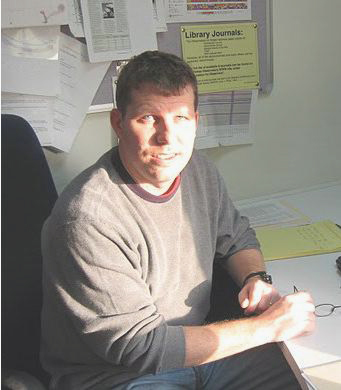
Hoping this time for better weather, we will be having Dr. Fronefield (Froney) Crawford speaking to us on February 8th at 8:00 pm. His subject will be “New Searches for Old Pulsars.”  Dr. Crawford is an assistant professor at Franklin and Marshall College in Lancaster, PA, where he teaches astronomy and physics and conducts research with students on a variety of radio pulsar projects. Prior to coming to F&M, he taught at Haverford College and worked at Lockheed Martin Corporation. He received his B.A. from Williams College and his Ph.D. from MIT.  He and his wife, two children and pet chickens live in Chester County, PA.

Dr. Crawford’s subject will be radio pulsars, which have long been established as excellent laboratories for the exploration and study of a wide range of fundamental questions in physics.  Of particular interest is the class of very old “millisecond pulsars” (MSPs): pulsars that have spun down over time through magnetic braking but which have subsequently been spun up through mass accretion from a binary companion to very fast (millisecond) spin periods. These objects can then be observed in some cases after the accretion phase as highly stable, pulsed radio sources.  Although MSPs are important to study, they have traditionally been difficult to find in large-scale pulsar surveys owing to several important selection effects which hinder their detection. Advances in both observing and computational technology reduce these selection effects and are major drivers for surveys for new pulsars, millisecond or otherwise. He will discuss some of his recent efforts to find and study new radio pulsars (including old MSPs), some results from these searches, and some of the goals and challenges that he and his students will face with future surveys.

There will be a “Meet the Speaker” dinner at 6:00 pm before the meeting. Please email j.church@mindspring.com by noon on Tuesday, Feb. 8th for a reservation.  I will respond with the dinner location, which has yet to be determined; it will be at either the Sports Bar (old Sotto) or the Triumph Brewing Company, close to one another on Nassau Street in Princeton.  To insure a place or places at the table, it will be very important to make all reservations by noon on the 8th.

Concerning future programs, on March 8th we will be having Tim Brandt, a graduate student in Princeton’s Department of Astrophysics, to speak on Type Ia supernovae and the search for their progenitors.  Tim has recently been using the 8.2-meter Subaru telescope on Mauna Kea in Hawaii.  On April 12th we will have Michael Molnar speaking on “The Star of Bethlehem,” a topic he has extensively researched.  Michael will be signing copies of his book on this subject during the intermission.  As mentioned above, we will be hearing Ken Kremer’s talk on May 10th.  To round out our current session, on June 14th we will be treated to another presentation by Bill Murray in the New Jersey State Museum Planetarium in Trenton.

Posted in February 2011, Sidereal Times | Tagged , | Leave a comment

Treasurer’s Report

Michael Mitrano, Treasurer

Membership has increased by one to 65 members, and a successful outreach effort with the Lawrenceville Elementary School yielded a $100 donation in January.  After the payment of our annual insurance premium – the AAAP’s single largest expense – our fiscal year to date surplus is just over $2,000.

On a cumulative basis, our surplus is about $20,400.

Posted in February 2011, Sidereal Times | Tagged | Leave a comment

From the Outreach Chair

By David Letcher, Outreach Chair

Friday, January 21st was a cold and windy night (with apologies to Edward Bulwer-Lytton, Washington Irving, Charles M. Schulz, Alexandre Dumas, George Sand, and many others who have used similar kitsch phrases.)

Many thanks to Jeff Bernardis, John Giles, and me for volunteering to give our Star Party at the Lawrenceville Elementary School’s “Science and Discovery Night” on January 21st.

While the children and their parents spent most of their time indoors eating good snacks and experimenting with many science projects, we three outdoor astronomers showed Jupiter, the Great Nebula in Orion, and, later in the evening, the Moon, when they came out to see us.

Not bad considering we were observing from a sidewalk position near the school directly underneath what has to be the brightest parking lot light I ever saw.  Night vision was only a figment of our imagination!

But all in all, we did have fun and we did receive a generous donation of $100.00 for our Association.  Long underwear anyone?

As of this writing, I am not aware of any impending Star Party requests but I’ll let everyone know if any come in.  In the meantime we can look forward to a new season of open house nights starting in April.

Posted in February 2011, Sidereal Times | Tagged | 1 Comment

SnippeTs

Compiled by Bryan Hubbard

NASA’s LRO Creating Unprecedented Topographic Map of Moon

Published: Friday, December 17, 2010 – 17:21 in Astronomy & Space

NASA’s Lunar Reconnaissance Orbiter is allowing researchers to create the most precise and complete map to date of the moon’s complex, heavily cratered landscape. “This dataset is being used to make digital elevation and terrain maps that will be a fundamental reference for future scientific and human exploration missions to the moon,” said Dr. Gregory Neumann of NASA’s Goddard Space Flight Center in Greenbelt, Md. “After about one year taking data, we already have nearly 3 billion data points from the Lunar Orbiter Laser Altimeter on board the LRO spacecraft, with near-uniform longitudinal coverage. We expect to continue to make measurements at this rate through the next two years of the science phase of the mission and beyond. Near the poles, we expect to provide near-GPS-like navigational capability as coverage is denser due to the spacecraft’s polar orbit.

Article link: http://esciencenews.com/articles/2010/12/17/nasas.lro.creating.unprecedented.topographic.map.moon

Black Holes and Warped Space: New UK Telescope Shows Off First

Published: Thursday, December 9, 2010 – 19:33 in Astronomy & Space

Spearheaded by the University of Manchester’s Jodrell Bank Observatory and funded by the Science and Technology Facilities Council, the e-MERLIN telescope will allow astronomers to address key questions relating to the origin and evolution of galaxies, stars and planets. To demonstrate its capabilities, University of

Manchester astronomers turned the new telescope array toward the “Double Quasar”. This enigmatic object, first discovered by Jodrell Bank, is a famous example of Einstein’s theory of gravity in action.

The new image shows how the light from a quasar billions of light years away is bent around a foreground galaxy by the curvature of space. This light has been travelling for 9 billion years before it reached the Earth. The quasar is a galaxy powered by a super-massive black hole, leading to the ejection of jets of matter moving at almost the speed of light – one of which can be seen arcing to the left in this new e-MERLIN image.

Article link: http://esciencenews.com/articles/2010/12/09/black.holes.and.warped.space.new.uk.telescope.shows.first

ESA’s Mercury Mapper Feels The Heat

Published: Tuesday, January 18, 2011 – 11:05 in Astronomy & Space

Key components of the ESA-led Mercury mapper BepiColombo have been tested in a specially upgraded European space simulator. ESA’s Large Space Simulator is now the most powerful in the world and the only facility capable of reproducing Mercury’s hellish environment for a full-scale spacecraft. The Mercury Magnetospheric Orbiter (MMO) has survived a simulated voyage to the innermost planet. The octagonal spacecraft, which is Japan’s contribution to BepiColombo, and its ESA sunshield withstood temperatures higher than 350°C.

Article link: http://esciencenews.com/articles/2011/01/18/esas.mercury.mapper.feels.heat

NASA Prepares To Launch Next Earth-Observing Satellite Mission

Published: Thursday, January 20, 2011 – 17:02 in Astronomy & Space

NASA’s newest Earth-observing research mission is nearing launch. The Glory mission will improve our understanding of how the sun and tiny atmospheric particles called aerosols affect Earth’s climate. Glory also will extend a legacy of long-term solar measurements needed to address key uncertainties about climate change. Glory is scheduled to launch from Vandenberg Air Force Base in California on Feb. 23 at 5:09 a.m. EST. It will join a fleet called the Afternoon Constellation or “A-train” of satellites. This group of other Earth-observing satellites, includingNASA’s Aqua and Aura spacecraft, flies in tight formation.

Article link: http://esciencenews.com/articles/2011/01/20/nasa.prepares.launch.next.earth.observing.satellite.mission

Swift Survey Finds ‘Missing’ Active Galaxies

Published: Thursday, January 20, 2011 – 17:34 in Astronomy & Space

(This is a very interesting article and well worth reading – Bryan)

Seen in X-rays, the entire sky is aglow. Even far away from bright sources, X-rays originating from beyond our galaxy provide a steady glow in every direction. Astronomers have long suspected that the chief contributors to this cosmic X-ray background were dust-swaddled black holes at the centers of active galaxies. The trouble was, too few of them were detected to do the job.

Since 2004, Swift’s Burst Alert Telescope (BAT), developed and operated at NASA Goddard, has been mapping the entire sky in hard X-rays with energies between 15,000 and 200,000 electron volts — thousands of times the energy of visible light. Gradually building up its exposure year after year, the survey is now the largest, most sensitive and most complete census at these energies. It includes hundreds of active galaxies out to a distance of 650 million light-years.

Astronomers assumed that there were many active galaxies oriented edgewise to us, but they just couldn’t be detected because the disk of gas attenuates emissions too strongly.

Article link: http://esciencenews.com/articles/2011/01/20/swift.survey.finds.missing.active.galaxies

Posted in February 2011, Sidereal Times | Tagged | Leave a comment

Mars Rovers Celebrate 7th Anniversary on the Red Planet

By Ken Kremer,  AAAP, Spaceflight magazine & The Planetary Society

NASA’s twin Mars rovers Spirit and Opportunity surely rank as one of the greatest triumphs in the history of space exploration.  Seven years ago this month the dynamic duo landed on opposite sides of the Red planet on Jan. 3 and Jan. 24, 2004.  They were originally designed to operate for just 90 Martian days, or sols, with an outside possibility they might last a few months longer.

In actuality – during the extended mission phase – they have endured light years beyond the mere 3 month “warranty” proclaimed by NASA as the mission began with high hopes following the nail biting “6 minutes of terror” as the twins plunged through the Martian atmosphere and with no certainty as to the outcome of the landing.

Since 2004, the rovers longevity has far exceeded all expectations and no one on the science and engineering teams that built and operate the twins can believe they lasted so long and produced so much.

Spirit and Opportunity have accomplished a remarkable series of scientific breakthroughs, far surpassing the wildest dreams of all the researchers and NASA officials.  Indeed both rovers are currently positioned at scientific goldmines on the red planet’s surface.

Opportunity is still alive and trekking across the Martian plains, now 84 months into the 3 month mission. By the time of her last dispatch from Gusev crater, Spirit had lasted for nearly six years of bonus mission time.

Photo 1: Spirit’s Last Picture Show - for now. Spirit’s final panoramic mosaic was taken on Sol 2175 in February 2010, a few weeks before entering hibernation mode in March 2010. Credit: NASA/JPL/Cornell, Marco Di Lorenzo, Kenneth Kremer

Photo 1: Spirit’s Last Picture Show - for now. Spirit’s final panoramic mosaic was taken on Sol 2175 in February 2010, a few weeks before entering hibernation mode in March 2010. Credit: NASA/JPL/Cornell, Marco Di Lorenzo, Kenneth Kremer

Spirit last communicated with mission controllers back on Earth on March 22, 2010. The rover had entered hibernation mode as the autumn sunlight available to power her life giving solar arrays was diminishing. NASA hopes to reawaken Spirit from a long slumber and reignite her illustrious campaign of exploration and discovery.

No one is giving up hope for Spirit and NASA is stepping up operational efforts to contact the plucky rover since the amount of Springtime Martian sunlight is now increasing over the next few months.

Although Spirit has been stalled at a place called ‘Troy’ since April 2009. she made a significant science discovery at that exact spot.  Spirit examined the soil in great detail and found key evidence that water, perhaps as snow melt, trickled into the subsurface fairly recently and on a continuing basis.   Our photomosaic herein shows the very last panoramic view taken by Spirit at ‘Troy’.

While driving on the western edge of an eroded over volcanic feature named ‘Home Plate’, she broke through a hard surface crust (perhaps 1 cm thick) and sank into hidden soft sand beneath. At ‘Troy’, Spirit discovered that the crust was comprised of water related sulfate materials and therefore found further evidence for the past flow of liquid water on the surface of Mars – a great science discovery!


 Photo 2: The Long Journey of Opportunity: This collage of two maps and a new close up panorama of Santa Maria crater (bottom right) shows the route traversed by the Opportunity Mars rover during her 7 year long overland expedition across the Meridiani Planum region of Mars. Opportunity arrived at the rim of Santa Maria Crater on Dec. 16, 2010 on Sol 2451.  The mosaic of Santa Maria at bottom right was taken by Opportunity about 5 meters from rim on Sol 2451.   Credit: NASA/JPL/Cornell, Marco Di Lorenzo, Kenneth Kremer. This map mosaic published in the Jan. 17, 2011 issue of Aviation Week & Space Technology magazine, p. 45.

Photo 2: The Long Journey of Opportunity: This collage of two maps and a new close up panorama of Santa Maria crater (bottom right) shows the route traversed by the Opportunity Mars rover during her 7 year long overland expedition across the Meridiani Planum region of Mars. Opportunity arrived at the rim of Santa Maria Crater on Dec. 16, 2010 on Sol 2451. The mosaic of Santa Maria at bottom right was taken by Opportunity about 5 meters from rim on Sol 2451. Credit: NASA/JPL/Cornell, Marco Di Lorenzo, Kenneth Kremer. This map mosaic published in the Jan. 17, 2011 issue of Aviation Week & Space Technology magazine, p. 45.

Meanwhile, Opportunity is blazing a trail of discovery in the Meridiani Planum region of Mars. She is currently exploring the stadium sized Santa Maria Carter which holds deposits of water bearing minerals that will further elucidate the potential for habitability on the Red Planet.

The rover arrived at the western edge of the relatively fresh impact crater on Dec. 16, 2010 (Sol 2451).   This intermediate stop on the rover’s 19 km long journey from Victoria Crater to giant 14 km wide Endeavour Crater will provide important ground truth observations to compare with the orbital detection of exposures of hydrated sulfate minerals.

Opportunity is driving to different vantage points around the steep walled crater and snapping a series of gorgeous Martian vistas.   The rock-strewn crater is a Martian geologists dream. The robot was imaged on New Years Eve in exquisite high resolution from Mars orbit while parked at the sharp edge as she was simultaneously snapping a multitude of awesome views peering inside the stunning and scientifically interesting crater.

Santa Maria is just 6 km from the western rim of Endeavour which shows spectral signatures of phyllosilicates, or clay bearing minerals, which formed in water about 4 billion years ago and have never before been directly analyzed on the Martian surface.

Photo 3: Opportunity’s surface view of Santa Maria on New Years Eve Dec 31 while being photographed overhead from Mars Orbit. Opportunity took this panoramic mosaic just meters from the crater rim on Dec. 29, 2010 (Sol 2464). Note rover tracks near rim at left, relatively clean solar panel at right and numerous ejecta rocks. Credit: NASA/JPL/Cornell, Kenneth Kremer, Marco Di Lorenzo.

Phyllosilicates form in neutral aqueous conditions that could have been more habitable and conducive to the formation of life than the later Martian episodes of more harshly acidic conditions in which the sulfates formed, that Opportunity has already been exploring during her 7 year long overland expedition.

Opportunity remains healthy and has abundant solar power for the final leg of the long eastward march to Endeavour which will resume in mid-February and should arrive at later in 2011.

Read more in my new 7 Year Anniversary stories online at Universe Today:

http://www.universetoday.com/82784/7-years-of-opportunity-on-mars-and-a-science-bonanza/

http://www.universetoday.com/82293/nasa-redoubling-efforts-to-contact-spirit/

Read my cover story about the Mars Rovers and Robonaut R2 in the Feb 2011 issue of Spaceflight magazine: http://www.bis-spaceflight.com/sitesia.aspx/page/184/id/2318/l/en-gb,en-gb,en-us

Please contact me for more info or science outreach presentations:

Email: kremerken@yahoo.com website:  www.kenkremer.com

Editors Note: Ken and Marco’s panoramic photomosaic entitled “Opportunity at Santa Maria Crater” was featured on Astronomy Picture of the Day on January 29, 2011.  Congratulations guys!!

Posted in February 2011 | Tagged , , , | Leave a comment

January 2011 Meeting Minutes

There are no meeting minutes for January 2011 because the meeting was cancelled due to snow.

Posted in February 2011 | Tagged | Leave a comment

From the Director

By Ludovico D’Angelo, Director

Happy New Year! To everyone in AAAP, I am wishing you a grand new year and clear skies! I hope everyone has dug out of the great storm of 2010. I was in Minnesota where there was already at least 20 inches on the ground (or more) and everyone didn’t seem to mind at all. While there I encountered a teacher that is part of my wife’s family. We got to discuss astronomy (my favorite subject!). During our discussions he mentioned that his school had an observatory. I asked how much it was being used and he said it was not currently being used. I asked why and he essentially said that no one knows how to use the equipment and there was no formal program or person to run the works. So apparently it had not been used for many years. The school has a science program that covers astronomy, but no resources in order to have the type of first hand experience with a telescope (at least at the school). I hear this kind of story every so often and I am sorry to hear them. But on the other hand, he did mention checking out the book “Sizing Up the Universe” and was thinking of utilizing it as a teaching tool.

The club has received a donation of an 8” Celestron SCT on an older CPC mount configuration. Once we check it over and determine it’s usability, we will need to decide how it should be utilized.

I hope that some of you got out to see the eclipse of the Moon last month. It was a clear night, and I think there were several members out doing photography. We had a great meeting last month with a wonderful presentation by Dr. Gott and Dr. Vanderbei. Thanks again to Dee Bosch for providing all the goodies after the presentation.  Next meeting we will have Ken Kremer back to give us an update of the goings on at NASA and the future of the space program.

See you all on January 11th!

Posted in January 2011, Sidereal Times | Tagged | Leave a comment

From the Program Chair

By John Church, Program Chair

Our very successful and well-attended December 14th meeting featured Prof. (and AAAP member) Bob Vanderbei  and Prof. J. Richard Gott of Princeton University discussing their new National Geographic book, “Sizing Up the Universe.” The book has many of Bob’s photos taken from his own driveway.  Their presentation was excellent, and the authors signed many copies of their book during the intermission.

On January 11th we will have our own Dr. Ken Kremer to speak on “The Space Shuttle, The Space Station, and What’s Beyond for NASA.”  The talk will include many of Ken’s photos and descriptions from personal behind-the-scenes visits to the Kennedy Space Center at Cape Canaveral, where Ken has a press pass.  This should be a highly educational meeting and we hope to have another large crowd. Those so interested will have the opportunity to purchase some of Ken’s unique memorabilia of these visits during the intermission.  Please see Ken’s website:  http://www.rittenhouseastronomicalsociety.org/Dr.Kremer/K.htm for more background.

There will be a premeeting dinner at 6:00 pm.  Please email j.church@mindspring.com by noon on Tuesday Jan. 11th for a reservation and the dinner location.

On February 8th, Dr. Fronefield (Froney) Crawford from Franklin & Marshall College in Lancaster, PA, will be speaking on the topic of “New Searches for Old Pulsars.”  Further details will be available in the February issue of Sidereal Times.

Programs for March and May will be announced later.  On April 12th we will have Michael Molnar speaking on “The Star of Bethlehem,” a topic he has extensively researched. Michael will be signing copies of his book on this subject during the intermission.  And on June 14th, we will be treated to another presentation by Bill Murray in the New Jersey State Museum Planetarium in Trenton.

Posted in January 2011, Sidereal Times | Tagged | Leave a comment

December 2010 Meeting Minutes

By Larry Kane, Secretary

1.      Director Ludy D’Angelo called the meeting to order and announced that he has received two emails from people who want to donate an 8” telescope and other astronomy related equipment to the AAAP.  Ludy will check out the condition of the equipment.

2.      Secretary’s Report:  There was no report.

3.       Vice President’s Report:  VP Jeff Bernardis is working on some things with Gene Ramsey

4.      Treasurer’s Report:  The Treasurer’s Report appears in another section of the Sidereal Times.

5.      Outreach Report:  Outreach Coordinator David Letcher indicated that the Riverside School event that was scheduled for this evening, was canceled by the school and will not be rescheduled in December.

6.      Website:  Webmaster John Miller and member Michael Wright gave a progress report on the project to develop the Sidereal Times as a blog and interactive medium.

7.      Observatory Report:  Gene Ramsey announced that he and John Church had

winterized the observatory just before Thanksgiving.  Gene and Jeff Bernardis are investigating improvements to the security system.  Gene   suggested that the AAAP purchase an air compressor to do some of the winterization work at the observatory.  Member John Giles gave an update on the repair to the refractor’s Losmandy mount.

8.      Program Chair: John Church provided the names of the speakers who will be doing our monthly lectures through the remainder of the year.  The lectures for March and May of 2011 are still open.

9.      The upcoming lunar eclipse was discussed and it was noted that the AAAP will not be doing a formal event for the occasion.  Also, Ludy announced that on January 2, the planets Jupiter and Uranus will be very close together, closed enough to be seen in the same field of view with a small telescope, and he is planning an event at the observatory.

10.  Member Rex Parker asked if anyone has seen the DVD archives of Sky and Telescope magazine.  He indicated that if it is reviewed well, the AAAP should consider buying a copy and make it available to the membership through the library

11.  A suggestion was made that the AAAP obtain a copy of member Bob Vanderbei’s new book and make it a prize for Star Quest.

12.    Sidereal Times:  Next deadline is December 29

Posted in January 2011, Sidereal Times | Tagged | Leave a comment

Treasurer’s Report

By Michael Mitrano, Treasurer

As the calendar year (but not our fiscal year) draws to a close, the AAAP is in solid financial shape.  We have at this point 64 paid members — two more than at the same time last year.  Total revenue from dues, contributions, and the sale of calendars and astronomy items is about $3,100.  General expenses this far are less than $600.  Together with the surplus from StarQuest, the Association’s year-to-date surplus is about $2,900. This will be reduced by about $1,000 when our insurance is paid.

On a cumulative basis, our surplus is now roughly $21,400.

Posted in January 2011, Sidereal Times | Tagged | Leave a comment

Opportunity Rover Snaps Gorgeous Panoramas of Santa Maria Crater and Intrepid Crater

By Ken Kremer

The Opportunity rover is sending back a multitude of awesome views of Santa Maria Crater since arriving at the western edge on Dec. 15 (Sol 2450).   This intermediate stop on the rover’s 19 km long journey from Victoria Crater to giant 14 km wide Endeavor Crater certainly looks to be well worth the trip.

Santa Maria is just 6 km from the western rim of Endeavour which is surrounded by phyllosilicate clays – which formed in water and have never before been directly analyzed on the Martian surface.

Opportunity has been on a swift advance over smooth terrain since departing from Intrepid crater in mid-November which was named in honor of the Apollo 12 mission which landed two men on the moon 41 years ago in November 1969.

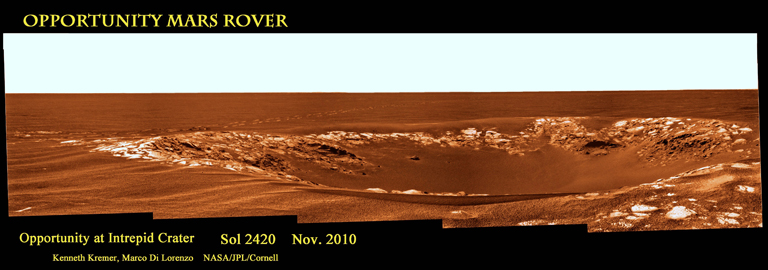
Intrepid Crater

Opportunity arrived at ‘Intrepid’ Crater on Mars during November 2010 and drove around crater rim. See rover wheel tracks at left. Intrepid crater was named in honor of the Apollo 12 lunar module named 'Intrepid' – which landed two men on the moon on 19 November 1969. Mosaic Credit: Kenneth Kremer, Marco Di Lorenzo NASA/JPL/Cornell

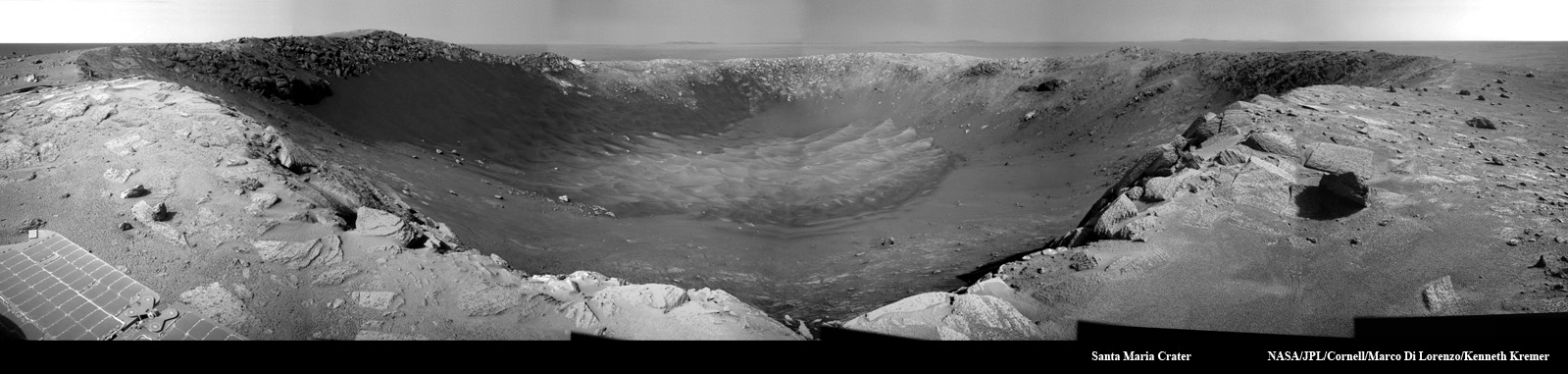
Santa Maria appears to be relatively unweathered and fresh.  The crater is 90 meters in diameter.  A multitude of inviting rocks and boulders from the impact ejecta are strewn about making this a Martian geologists dream.

After initially driving to a distance of about five meters from the rim on Dec. 16 (Sol 2451), Opportunity has now carefully crawled even nearer to the precipice of the craters steep cliffs.   The rover snaps a series of panoramic images at each stop to document the site scientifically and esthetically.

The team back on Earth must tread with extreme caution as Opportunity creeps ever closer to the edge lest she fall off a cliff.  Opportunity is now positioned close enough to point her cameras directly at the steep walled cliffs and towards the sand dunes at the crater floor unveiling another stunningly gorgeous Martian vista.

Panoramic view of Santa Maria Crater

Panoramic view of Santa Maria Crater taken by Opportunity Mars rover about 5 meters from the rim on Dec 16, 2010 on Sol 2451. Water bearing materials are located at the southeastern edge of the rim located roughly at the center of this image. Credit: NASA/JPL/Cornell, Kenneth Kremer, Marco Di Lorenzo

Compare the panoramic mosaics from Sols 2451 and 2454 above and below – created by Ken Kremer and Marco Di Lorenzo  for Universe Today – as Opportunity pulled up to the rim in stages and began exploring the crater environment from different vantage points.

Santa Maria Crater - Sol 2454

Opportunity drove closer to within 5 meters of the rim on Sol 2454 and snapped this gorgeous panoramic vista revealing interior steep cliffs and sand dunes. Credit: NASA/JPL/Cornell, Marco Di Lorenzo, Kenneth Kremer

The rover handlers are highly adept at precisely maneuvering the 175 kg vehicle back and forth inside the danger zone at crater rims. After all Opportunity has been on a crater tour for her entire 7 year extended mission to the red planet and controllers at NASA’s Jet Propulsion Laboratory (JPL) have honed their driving techniques at countless locales both treacherous and dazzling.

High priority activity on the west side of Santa Maria includes collecting a series of high resolution stereo panoramas which will be used to create a digital elevation map in 3D.   JPL engineers will move Opportunity in a counterclockwise direction around the rim before heading to Endeavour crater.

Opportunity will drive to an area on the southeast portion of Santa Maria that shows exposures of water bearing sulfate.

Opportunity will stay at Santa Maria through the upcoming Solar conjunction which starts in late January and ends in mid-February.  The rover will remain stationary during that period and conduct a lengthy investigation of a specific spot using the instruments on the robotic arm – which include spectrometers, a microscope and the rock drill known as the RAT or Rock Abrasion Tool

Opportunity remains healthy, has abundant solar power for the final leg of the eastward march to Endeavor and celebrates 7 years on Mars on 24 Jan 2011.

More details in my articles online at Universe Today: http://www.universetoday.com/81838/opportunity-shoots-awesome-views-of-santa-maria-crater/

http://www.universetoday.com/81738/landfall-at-santa-maria-for-opportunity-on-mars/

http://www.universetoday.com/81789/powerful-mars-orbiter-directs-opportunity-to-clays-and-hydrated-minerals/

Ken Kremer:  Spaceflight magazine  & The Planetary Society
Please contact me for more info or science outreach presentations at  kremerken@yahoo.com or my website:  www.kenkremer.com

Posted in January 2011, Sidereal Times | Tagged , , | Leave a comment

December 21, 2010 Lunar Eclipse

by Ken Kramer

Two Red Moons

Taken in "bonechilling" Lawrenceville, NJ with a 250 mm Canon lens at about 1 sec exposure. Totality was a brilliant crimson to blood red and looked to be dripping with blood droplets - almost unreal. Credit: Ken Kramer

Further details in my story online at Universe Today:
http://www.universetoday.com/81923/red-moon-red-planet/

Posted in January 2011, Sidereal Times | Tagged , | Leave a comment