Spring Time is for Galaxies

by Rex Parker

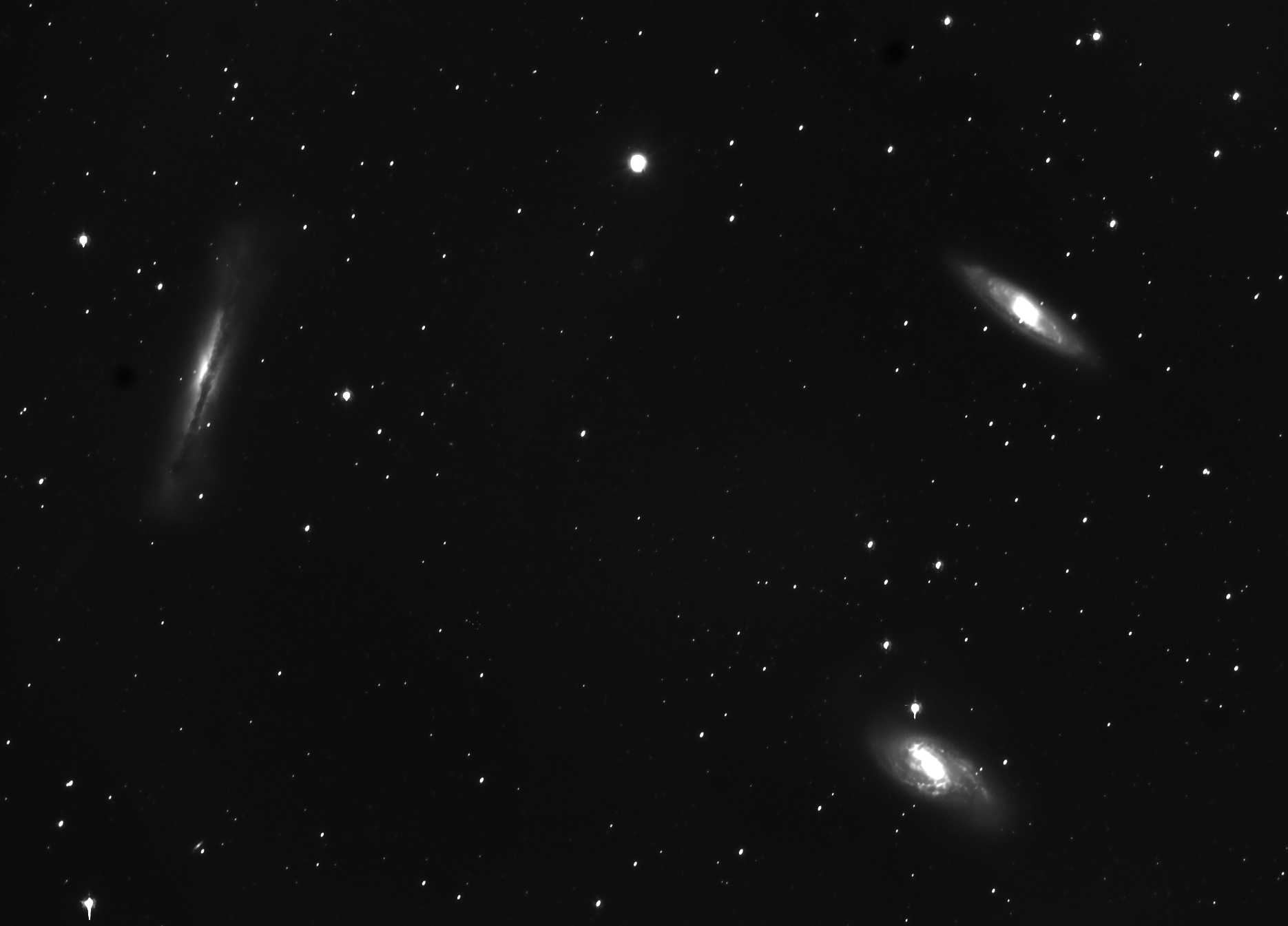
With the passing of the equinox it’s time to start searching for the great sweep of galaxies in Leo and Virgo.  This is absolutely the best time of year for observing galaxies both visually and astrophotographically.  In the last week of March, I set up my Takahashi FS128 at f/6 to get a fairly wide field of view (~1 degree).  Tracking was accomplished using a Losmandy G11 mount off my deck in Titusville, and an SBIG ST-10XME was used to capture the images below.

Leo Triplet (or Leo Trio) - M65, M66 and NGC3528 (north is to upper left, 120 min. exposure) Credit: Rex Parker

Leo Triplet (or Leo Trio) - M65, M66 and NGC3528 (north is to upper left, 120 min. exposure) Credit: Rex Parker

A section of Markarian’s Chain of galaxies in Virgo. A dozen or more galaxies are visible in this image. The large round one near the center is M86. (north is up, 75 min exposure) Credit: Rex Parker

The parade of galaxies is seldom more fun than on these spring evenings in Jersey.  Head on out to the AAAP observatory in Washington Crossing Park to see more.

Posted in April 2011, Sidereal Times | Tagged , , | 1 Comment

Miss Mitchell’s Telescope, Part 2

by Michael Wright

The Business End of the Vassar Telescope 	Credit: Mr T in DC (CC license)

The Business End of the Vassar Telescope Credit: Mr T in DC (CC license)

Last month I wrote about Maria Mitchell’s connection to the Vassar Telescope, which is on display at the National Museum of American History of the Smithsonian.  This second installment covers the telescope itself and its maker, Henry Fitz.

Vassar College purchased “an Achromatic telescope objective object glass 12 inches aperture, 12 3/8 inches in diameter” from Henry Fitz for $2500 according to the April 6, 1863 minutes of the Trustees.  Also, they record that there were only four larger glasses in the US at the time.  In September, 1863, the Trustees contracted with Henry Fitz “to mount & furnish said object glass in all respects conformable to the annexed specifications for the sum of two thousand & three hundred dollars.”  The specifications were as follows:

Style the general style of mounting shall be the Fraunhofer Equatorial.

Iron The Bolster, Saddle, the declination box, the adjustable weights, the two axes & the counterpoise may be of iron.  The counterpoise is to be globular & ornamental.

Circles The circles shall be the best-variety of brass with inlaid silver plate for the division marks.  The Declination circle shall be twenty inches in diameter & accurately divided to read to thirty seconds of arc; & the Right Ascension circle shall be eighteen inches in diameter & divided to read to four seconds of time.  Both circles shall be furnished with vernier & reading glasses.

Tube The tube of the Telescope shall be made of mahogany with rosewood finish & well polished.

The finder scope was to be “of the best quality & whose object-glass shall be three inches in diameter set in a tube of like material and finish as the main tube.”  Eyepieces were to be one set of eight “positive” (Ramsden) eyepieces and one set of nine “negative” (Huygens) eyepieces of powers ranging from “50 to 1500” for direct observation.  (150x?).  The balance rods, which I believe are the two long rods with brass balls at one end, were required to be “firm & of tasteful pattern with brass adjustable weights.  The rods may be of wood but must be seemly and neatly attached with brass mountings.”  In addition, Henry Fitz was to provide a “prismatic mirror for diagonal views”, a filar micrometer, a ring micrometer, a Bond’s and Dennision’s spring governor and a spectroscope.  As one can tell from the photo above, this was a handsome instrument, but how did the optics perform?  Perhaps not so well.  In 1868 shortly after installation, Alvan Clark & Sons reground the lens to such a degree that they considered it their own according to Deborah Jean Warner in Alvan Clark and Sons Artists in Optics.

So who was Henry Fitz?  Fitz was a contemporary of better known telescope maker Alvan Clark.  Born in 1808 in Newburyport, Massachusetts, Henry Fitz became a locksmith and well-known amateur astronomer by the 1830s.  In 1839, he traveled to Europe to learn about astronomical and photographic optics.  While there, he established connections with French glass-suppliers, learned the new Daguerreotype photographic process and learned lens making from English and German opticians. Upon returning to the US, he patented an improved Daguerreotype camera and opened a successful optical business in Baltimore, which allowed him to experiment with optics. In January 1845, he succeeded in producing a high-quality achromatic lens.  Later in the year, he made a six-inch refractor, which received a gold-medal at the American Institute Fair.  With earnings from public stargazing with the telescope, Fitz launched into making telescopes full time.

Fitz’ innovative lens-grinding techniques allowed him to produce large, high-quality objectives using lower-quality, cheaper glass so American’s did not have to rely on expensive imports from Europe.  This contributed to the proliferation of American observatories during the mid-19th century.  His important telescopes are as follows:

  • 1848,  a six-inch refractor for Lt. James Gillis for his Chile expedition – The objective was tested against and judged equal to a high-quality German import demonstrating that Fitz could produce high-quality objectives.
  • 1849, a 5.6-inch telescope for Erskine College, which was his first observatory instrument
  • 1849 or 1850, a 6 3/8-inch refractor for Robert Van Arsdale of Newark, New Jersey
  • 1851, another 6 3/8-inch refractor for South Carolina College
  • 1852, an eight-inch refractor for Haverford College
  • 1856,  a 9 ¾-inch refractor for West Point Academy – This $5000 telescope was 14 feet long and came with 13 eyepieces.
  • 1857, 12 ¼-inch for the University of Michigan in Ann Arbor – At the time, this was the largest American-made telescope and the third largest refractor in  the world.  It is probably the most important surviving Fitz telescope because it has the largest objective untouched by later refiguring.  It is still on its limestone pedestal and in working condition after 154 years.
  • 1861, a 13-inch for the Allegheny Observatory in Pittsburgh.  Eleven years later, the lens was stolen and held for ransom.  (Even criminals new the value of a big scope back then!)
  • 1861, Fitz delivered his largest and most innovative telescope, a 16-inch refractor with a two-element corrector lens midway down the tube, to William Vanduzee of Buffalo, New York.  This was the largest telescope in the world at the time.
  • 1863, a 13-inch refractor for Dudley Observatory in Albany, N.Y.

At the time of his death in 1863, Henry Fitz had plans for a 24-inch scope and was working with Lewis Rutherfurd on a telescope for astrophotography.  The later scope was completed one year later by Henry’s 16-year old son, Harry, who carried on the business for another 20 years.  Henry Fitz’ techniques were state-of-the-art for his time.  As testing procedures rapidly improved, many of his objectives were refigured by other artisans, so few Fitz objectives remain in their original condition.

This brief biography of Henry Fitz was distilled from the Journal of the Antique Telescope Society, Volume 6, Summer 1994, revised 1995, 2000.  The journal contains more detailed information on Fitz, his telescopes and his lens-grinding techniques. Also, NMAH has an interesting podcast about his workshop, which was donated intact to the museum in the 1950s.

The next time you are in Washington, DC be sure to visit the Vassar Telescope at the entrance to the science and technology wing of the National Museum of American History and enjoy this beautiful icon of 19th century American astronomy.

Posted in April 2011, Sidereal Times | Tagged , , , , | 4 Comments

Perfect Landing Concludes Final Mission of Space Shuttle Discovery

by Ken Kremer, AAAP, Spaceflight magazine & The Planetary Society

Space Shuttle Discovery Lands at the Kennedy Space Center

Space Shuttle Discovery Lands at the Kennedy Space Center, Credit: Ken Kramer

Farewell Discovery!  The epic voyages of Space Shuttle Discovery now belong to history. The final magnificent mission of Space Shuttle Discovery and her all-veteran, six-astronaut crew wrapped up on March 9 with a safe landing at the Kennedy Space Center in Florida at 11:57 a.m. EST after a flawless mission.  Steve Lindsey commanded the STS-133 flight and was joined by Pilot Eric Boe and Mission Specialists Alvin Drew, Steve Bowen, Michael Barratt and Nicole Stott. Discovery’s 13-day flight ended after a journey of more than five million miles on a joyous and bittersweet note. I was watching from just a few hundred yards away at the shuttle landing strip.

The entire NASA shuttle team is proud of the accomplishments of the Space Shuttle Program but sad that the program is ending so soon.  The sentiment from everyone involved with the shuttle program from top management to the flight team to the astronauts corps is that the orbiters could be safely and usefully flown for many more years.

Discovery Crew at Post-Landing News Conference

Discovery Crew at Post-Landing News Conference, Credit: Ken kremer

The STS-133 mission was the 39th and final flight for the illustrious orbiter which first flew in 1984 and is NASA’s longest serving orbiter.  NASA Shuttle managers emphasized that the safe conclusion of the STS-133 mission was due to the hard work of everyone on the team and the absolute requirement that everyone stay totally focused on getting the done job correctly and perfectly. “Spaceflight doesn’t come easy,” said Bill Gerstenmaier, Associate Administrator for Space Operations. “We need to stay focused, keep our heads down and recognize that this is not easy. I think Discovery’s legacy will be the future.”

Altogether, Discovery spent a full year in space during the 39 missions, orbited Earth 5,830 times and traveled 148,221,675 miles during a career spanning 27 years.  “We wanted to go out on a high note and Discovery’s done that,” said Mike Leinbach, shuttle launch director. “We couldn’t ask for more. It was virtually a perfect mission conducted by a perfect flight crew and a perfect ground crew. I couldn’t be happier.”

The primary goal of the STS-133 mission was to deliver the “Leonardo” Permanent Multipurpose Module to the ISS.  Leonardo was attached to the ISS as a new and permanent habitable module that will provide extra storage and living space for the six person ISS crew.  Also aboard Discovery was R2, or Robonaut 2, which is the first humanoid robot in space. R2 was unpacked from Leonardo a few weeks later and become an official member of the station crew.

Discovery Towed from the Shuttle Landing Facility to Orbiter Processing Facility-2

Discovery Towed from the Shuttle Landing Facility to Orbiter Processing Facility-2, Credit: Ken Kremer

Discovery will now be decommissioned over the next few months and then be prepared for a museum display, most likely at the Smithsonian National Air and Space Museum in Washington, D.C.

Next month I’ll report about my up close visit on top of Launch Pad 39A with Space Shuttle Endeavour for her final flight on the STS-134 mission.

Read Ken’s STS-133 articles online at Universe Today, The Planetary Society & CWEB:

Discovery Lands to Conclude Historic Final Flight to Space

Discovery’s Last Launch and Landing Captured in Exquisite Amateur Videos

Robo Trek Debuts … Robonaut 2 Unleashed and joins First Human-Robot Space Crew

NASAs Navy tows Discoverys Last Rocket Boosters into Port Canaveral – Photo Album

Discovery Docks at Space Station on Historic Final Voyage with First Human-Robot Crew

Landing and Towback of Discovery: Photo Reports: 1763 1759

Astronomy Outreach

Yuri’s Night at West Windsor Arts Center: West Windsor, NJ, April 12, 5:30 – 9 PM, “50 Years of Human Spaceflight from Yuri Gagarin to the Space Shuttle and Beyond”. Website:  http://www.westwindsorartscenter.org/
Yuri’s Night Home Page: http://yurisnight.net/

Amateur Astronomers Association of Princeton: Princeton, NJ, May 10, 8 PM  “Whats Beyond for NASA: Shuttle, Station, Orion, SpaceX & Robots”. Website: http://www.princetonastronomy.org/

International Astronomy Day at the Franklin Institute: Philadelphia, PA, May 7, “The Search for Life on Mars”

Rittenhouse Astronomical Society (RAS) at the Franklin Institute: Philadelphia, PA, Jun 9, Wed, 7 PM.  Opportunity Mars Rover Update”, “ NASA Flybys of Comets Hartley 2 & Temple 1.” Website: http://www.rittenhouseastronomicalsociety.org

Ken Kremer:  Spaceflight magazine, Universe Today & The Planetary Society

Please contact Ken for more info or science outreach presentations:

Email: kremerken@yahoo.com website:  www.kenkremer.com

http://www.universetoday.com/author/ken-kremer/

Posted in April 2011, Sidereal Times | Tagged , , | 2 Comments

From the Director

by Ludovico D’Angelo, Director

This month we hope to have our regular meeting at Peyton Hall. I was just informed by email that there is a possibility that the hall may be needed for mid term exams. Although we have never had this problem before, we will keep everyone informed if there is a change in meeting place. If everything works out, our meeting will be on March 8th at 8 PM at Peyton Hall.

This last month seemed to be very busy for me. One thing I did do was to give a star party at my church as a fundraiser. So I set up my binoculars, my small Meade ETX-90, and my Celestron 9.25 SCT. I used the binoculars for general viewing. The small scope was set to the Moon (it was ½ full). The large scope was set to Jupiter in the early evening, then to the Orion Nebula, the Double Cluster, and a few double stars and other objects. It was a very clear night, cold, and everyone enjoyed the views I was able to provide. And it amazes me that everyone experiencing viewing the night sky was so blown away by it. I had young children to older adults, about 25 in all. The big reaction was the view of the Moon, as the viewers came to understand the surface in great detail, the more excited they got. Especially the children, the cries of joy, I can only hope that they will continue to look up and have an interest in one of the most basic natural sciences there is: Astronomy.

At our last meeting, we determined that the club picnic would be June 4th. So mark your calendars, we will send information about where as we approach the date. We open the observatory to the public again starting in April.

I will be sending out some emails inviting other members to be part of the process of nominating chair. Nominations committee is responsible for finding nominees for Director, Assistant Director, Program Chair, Secretary, and Treasurer. Nominations can be made by anyone; you can also nominate yourself for one of the positions. If you are interested in helping your club’s management and growth, please be generous with your interest and time. Drop me an email if you have questions.

See you all on March 8th!

Posted in March 2011, Sidereal Times | Tagged | Leave a comment

From the Program Chair

by John Church, Program Chair

Tim Brandt

Tim Brandt

On March 8th we will be having Tim Brandt, a third-year graduate student in Princeton’s Department of Astrophysics. to speak on Type Ia supernovae and the search for their progenitors. Type Ia supernovae are believed to be the thermonuclear explosions of carbon-oxygen white dwarfs.  They are also “standardizable candles”: objects whose luminosity can be calculated from detailed light curve observations.  This has made them useful distance indicators out to redshifts of ~1, and led to the discovery of the accelerating
universe.  However, we still do not know how the white dwarf is
destabilized.  The two leading hypotheses are that it accretes mass
from a companion main sequence or giant star, increasing the central
temperature and pressure, or that it merges with another white dwarf.

Tim will also discuss his more recent work as part of the Strategic exploration of Exoplanets and Disks with Subaru (SEEDS)collaboration using the 8.2-meter Subaru telescope on Mauna Kea in Hawaii.  He is currently trying to characterize the instrument and understand the data, with the ultimate goal of doing statistical analyses on the entire data set. He will provide an overview of the telescope and instrument, and of the challenges in the search for companions of nearby stars.

Tim was born in rural Ohio and grew up outside of Boston.  His undergraduate work was at Yale, where he majored in math and physics.  He did undergraduate research with Meg Urry and collaborators on blazars and active galactic nuclei.  After graduating, he spent two years teaching high school physics at the American School of Kuwait.   At Princeton, he has worked on Type Ia supernova hosts and progenitors, simulations of core-collapse supernovae, scattering by diffuse interstellar dust, and most recently, direct-imaging exoplanets survey. He is also very interested in teaching and is volunteering in a program to teach algebra at local prisons.

There will be a “Meet the Speaker” dinner at 6:00 pm before the meeting. Please email John Church by noon on Tuesday, March 8th for a reservation.  I will respond with the dinner location, which has yet to be determined; it will be at either the Sports Bar (old Sotto) or the Triumph Brewing Company, close to one another on Nassau Street in Princeton.  To insure a place or places at the table, it will be very important to make all reservations by noon on the 8th.

On April 12th we will have Michael Molnar speaking on “The Star of Bethlehem,” a topic he has extensively researched.  Michael will be signing copies of his book on this subject during the intermission.  We will be hearing Ken Kremer’s talk (postponed from January due to the meeting cancellation) on the future of NASA on May 10th.  To round out our current session, on June 14th,we will be treated to another presentation by Bill Murray in the New Jersey State Museum Planetarium in Trenton.

On a personal note, it has been my distinct pleasure to serve as your Program Chair for the 2010-11 season.  It is now time for me to move on to new subjects and to give other members the chance to serve on the Board of Directors and set ongoing goals for the AAAP.  For whoever is selected to be the next Program Chair, I have several possible speakers to suggest for the next session. I wish my successor, who will be elected at the May meeting, all the best as he or she discovers the rewards and pleasures of serving in this highly fulfilling position.

Posted in March 2011, Sidereal Times | Tagged | Leave a comment

February 2011 Meeting Minutes

by Larry Kane, Secretary

The meeting was called to order by Director Ludy D’Angelo.

Secretary’s Report: There was no Secretary’s report

Treasurer’s Report: The Treasurer was not in attendance but the Treasurer’s report appears in another section of the Sidereal Times.

Website: The Director will contact webmaster John Miller and David Zoller about updating the AAAP website.

Program Chair Report: John Church provided the line-up of speakers for the remainder of the 2011 season.  John announced that he will not be running for Program Chair next season and he called for members to step up and volunteer for the position.

Outreach Report: David Letcher reported on the Lawrenceville Elementary School.  The next event will be at the Hopewell Elementary School Science night on March 25.  He will send out an email and ask for volunteers.  Member Bill Murray announced that the original date for the State Museum’s Super Science Saturday has been changed from April 16 to May 7.  It was announced that an elementary school in Summit wants to hold a star party on March 24.  Larry Kane announced that a local paper in Bucks County, PA had a descriptive article on the AAAP.

Other Outreach: Ludy was contacted by the Grounds for Sculpture.  They want to do a large community event in November and invited the AAAP.

Picnic: Ludy announced that we will have one this Spring or early Summer.  He asked for some dates.  Member Dee Bosch volunteered to help coordinate it.  A consensus date of June 4 was agreed to, by those in attendance.

Observatory Report: John Giles reported that he got our refractor mount back from Losmandy. It required a new hand controller that cost $20. He is waiting for some decent weather to put the mount together and test it.  Gene Ramsey said that the Park personnel are not plowing the snow.   He and Jeff Bernardis are still investigating the upgrading of the alarm system.  The goal is to keep the cost under $300.  Rex Parker said tht a former member, Bob Wolf, will donate a G11 GOTO model Losmandy mount that we may be able to use with the refractor.  Ludy raised the issue of adding a third telescope at the observatory.  We might set up a dome next to the observatory.  John Church reported on the physics of measuring whether a mount will work with our refractor, and how efficiently it will do it.  He needs more information about the G11.  It was agreed that we should accept the gift and that we will use it.  We could add a permanent pad outside the observatory.

Sidereal Times – The next deadline for articles is February 23.   Editor Ira Polans announced that co-editor Bryan Hubbard can no longer serve.

Posted in March 2011, Sidereal Times | Tagged | Leave a comment

Community Outreach

by David Letcher, Outreach Chair

I have received two requests for our association to participate in two events in March.  One is for us to bring our telescopes and do a viewing of the skies as part of Hopewell Elementary School’s Science Night on Friday evening, March 25.  Their program, which is an indoor event, starts at 5:30 pm and finishes at 8:30 pm.  However, it has been our experience that as parents and children leave to go home at 8:30, they often come to our telescopes for a view of the sky. So, let me know if you would like to help out.  I’ll be sending out an announcement to our membership with additional details plus the location’s address.

Our second request comes from Victor Davis who tells me he is leading a Star Party in Summit, NJ on Thursday, March 24th, about 6:30 p.m. to 8:30 p.m. no matter what the weather is. Victor would like to recruit a few AAAP members, with or without scopes to come and share their knowledge and enthusiasm. Victor has participated in a program called Project Astro Nova, in which he visited Brayton Elementary School (89 Tulip Street, Summit, NJ) a half-dozen or so times during the school year to teach topics in astronomy. Victor teaches 4 fourth-grade classes totaling about 80 children.  The Star Party will have indoor activities led by the school’s teachers, which will include building a comet out of dry ice, constructing an alien out of cardboard, making scale-model planets out of Play-Doh, and other astronomy-related activities. Outside, Victor and whatever volunteers he can scare up will conduct a constellation tour, an exercise in learning to use star maps, and observing with telescopes and binoculars. Victor admits that Summit, NJ is a bit far afield from Princeton–it’s not far from Newark–but I hope a few adventurous souls will make the trek to his neck of the woods.

Please let me, David Letcher, know if you are willing and able to participate in one or both of these events.  Please contact me via the phone number or email address in the member roster on the AAAP website.

Posted in March 2011, Sidereal Times | Tagged | Leave a comment

Treasurer’s Report

by Michael Mitrano, Treasurer

Membership has now risen to 70 members.  Routine expenses for the year have been in line with expectation and no major unexpected expenses have been incurred.  For these reasons, our surplus for the fiscal year to date is about $2,000. On a cumulative basis, it is about $20,500.

Posted in March 2011, Sidereal Times | Tagged | Leave a comment

Deep-Sky Planner

by Rex Parker

If you have been thinking about ways to improve your observing skills and get more out of the precious hours you spend under the stars, here’s something you might want to try.  A few astronomy computer programs have appeared over the years which fit the niche of observation session planners.  These programs generally combine databases of deep sky objects and stars along with a search engine and spreadsheet/report generator function, user-selectable search filters, and a star chart/planetarium  program.  However, while the concept is a good one, I have found that the star charting aspects of some of these programs leave much to be desired (e.g., DeepSky, an otherwise interesting and useful program which I have used for years).

Many of us are using Software Bisque’s excellent The Sky6 at the AAAP Observatory and/or at home.  The Sky6 is a high-powered, very well-designed planetarium and charting program, especially for deep-sky objects that are hard to find visually.  I recently reviewed the currently available observation planning programs and was pleasantly surprised to learn of Deep-Sky  Planner 5 (by Knightware), which runs on all Windows systems, Vista upwards, including Windows 7 64-bit.  More importantly, it has been developed to interface seamlessly with the Sky 6 and several other popular planetarium/charting software programs out there.  You can set and modify all of the relevant search filters quickly (magnitude, RA/declin, size, object type, etc).  When the database search is conducted and an NGC object of interest is selected, for example, the program automatically flips to Sky 6 with the appropriate NGC object now centered in a field of view which the user specifies.  This is a really neat trick and greatly improves the usefulness of the planner software approach.  Deep-Sky Planner 5 is available as a free trial (with reduced database) and as downloadable full program for $65 (CD disk version slightly more), in my opinion a good deal for what it can do for  observation sessions.  It can also do ASCOM-based telescope control and has other interesting features which I haven’t yet had a chance to try out

(P.S. — I am not in any way affiliated with Knightware, but I can recognize a good program when I see one!)

Posted in March 2011, Sidereal Times | Tagged , | 1 Comment

Miss Mitchell’s Telescope

by Michael Wright

The Vassar Telescope

The Vassar Telescope, Credit: Michael Wright

On a recent trip to National Museum of American History in Washington, DC, I was pleasantly surprised to find this interesting telescope as the landmark object for museum’s science and technology wing.  The description merely stated that the telescope was used by Maria Mitchell, America’s first female professional astronomer, at Vassar College.  The wood and brass refractor aroused my curiosity so I decided to find out why it has such prominent position in the museum.

The Vassar Telescope was donated to the Smithsonian in 1963 by Vassar College, the prestigious NY women’s college.  The instrument was previously installed in the “old” observatory, which was the first building completed on campus.  (They had their priorities straight back then!) The historic observatory is now named after its first director, Maria Mitchell.

When Matthew Vassar recruited Maria Mitchell to teach astronomy at Vassar, she already had a reputation as a skilled astronomer.  Born on Nantucket in 1818 and raised in the Quaker tradition, she learned astronomical calculations from her father. At age 12, she helped her father observe a solar eclipse and calculate the position of their home. By age 14, sailors trusted her with celestial navigation calculations for their whaling voyages. In 1847 at the age of 29, she gained international fame for discovering Comet Mitchell 1847VI (C/1847 T1).  For this discovery made with a telescope from the roof of the Pacific National Bank in Nantucket, she received a gold medal from the new King of Denmark, Frederick VII.  Prior to Maria’s discovery, Caroline Herschel was the only woman to have discovered a comet.

Maria Mitchell, Vassar Telescope & Mary Whitney

Maria Mitchell (seated) and Mary Whitney, her assistant and successor, with the Vassar Telescope. Credit: public domain image

Maria became the first woman member of the American Academy of Arts and Sciences in 1848 and the American Association for the Advancement of Science in 1850.  For a short period, she calculated tables of Venus’ position at the U.S. Nautical Almanac Office.  Despite resistance from Vassar College board members who objected to a female instructor, Maria was the first person appointed to the faculty of Vassar College in 1865, where she taught until shortly before her death in 1888.  In addition to her scientific achievements, she was an advocate for women’s rights and founded the American Association for the Advancement of Women in 1873.  She encouraged her female charges by saying “When [women] come to truth through their investigations… the truth which they get will be theirs, and their minds will work on and on unfettered.”

We especially need imagination in science.  It is not all mathematics, nor all logic, but it is somewhat beauty and poetry.” –Maria Mitchell

The association with this remarkable astronomer and activist partly explains the telescope’s historical significance.  Next month I’ll tell more about the scope and it maker, Henry Fitz.

Posted in March 2011, Sidereal Times | Tagged , , , | Leave a comment

Space Shuttle Discovery Blasts off on Final Flight

by  Dr. Ken Kremer

STS133 on the Pad

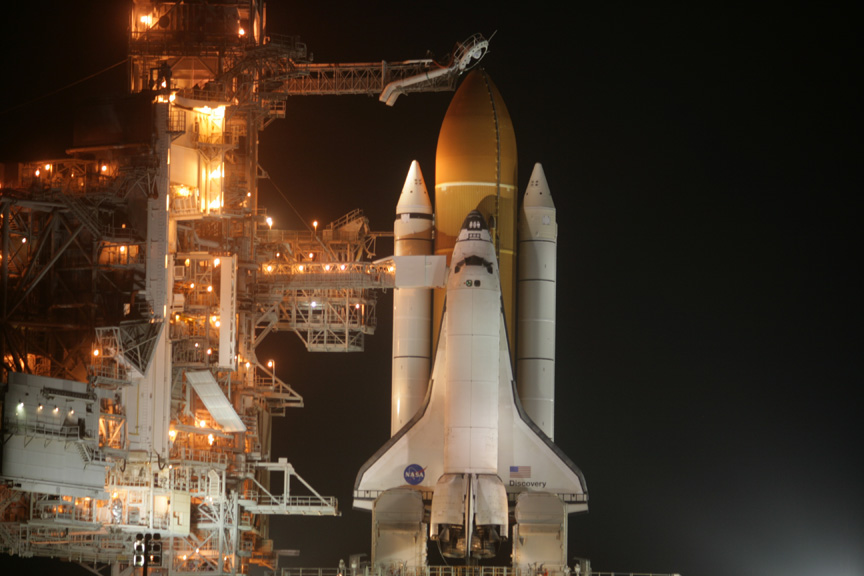
Space Shuttle Discovery poised for launch at pad 39 A at the Kennedy Space Center. Credit: Ken Kremer

In a truly dramatic finale to her very last launch, Space Shuttle Discovery blasted off to space at 4:53 p.m., Thursday, Feb. 24, with just two seconds to spare after an unexpected last minute computer glitch with Air Force tracking computers threatened to delay the liftoff yet again despite otherwise perfect launch conditions.

Air Force officials suddenly reported a “NO GO” for launch just 20 minutes before the planned liftoff at 4:50 PM.  Critical range safety computers that track the shuttle after launch and ensure the safety of the public abruptly malfunctioned, forcing the Air Force to scramble for a quick solution to fix the mysterious problems.

Meanwhile NASA’s Shuttle Launch Director Mike Leinbach ordered the insertion of an unplanned hold at T minus 5 minutes into the countdown to try and buy some time.

With the clock ticking down relentlessly to the very end of the narrow 10 minute launch window and no word of a rapid resolution from the Air Force, it seemed as though everyone’s hopes would be dashed and the launch would again be scrubbed.  The shuttle cannot launch without a fully functional range safety tracking system and approval from the Air Force.

All systems on board Discovery, the payloads and the weather had at last coalesced perfectly to support a blast off following numerous technical delays over the past three and one half months.

Large crowds of excited spectators had gathered along the beaches, parks and roadways of Florida’s Space Coast in expectation of a fabulous viewing experience for this historic final launch of Discovery.  The Kennedy Space Center (KSC) alone was packed with more than 40,000 onlookers from all across the globe.   The crowds have been increasing in size as the remaining shuttle launches dwindle to a few.

It was a nail biter to the last second as the Air Force worked on the computer issues in the few minutes remaining and no information was forthcoming.

Finally, the Shuttle integration manager Mike Moses received a verbal OK from Air Force officials that the computer problems were fixed and NASA could resume the countdown just seconds before the launch window would have expired.

STS 133 Blasts Off

Launch of Space Shuttle Discovery on Feb. 24 at 4:53 p.m. from launch pad 39 A at the Kennedy Space Center. Credit: Ken Kremer

In all the history of the Space Shuttle program, this type of problem with the Air Force range safety system had never occurred so close to the final moments of a shuttle launch.

“Well, it was kind of an exciting last few minutes of this countdown,” Leinbach told reporters at the post launch news briefing.

“Several of us have been around for many, many countdowns and this was one for the record books. … This was Discovery’s last (launch), a great way to go out. She gave us a little bit of a fit today, but it’s a great way to get [Shuttle Commander] Steve Lindsey and his crew on orbit.”

“I’m very, very proud of my launch team and all the rest of the people who worked so hard on Discovery.”
STS 133 Speeds Downrange

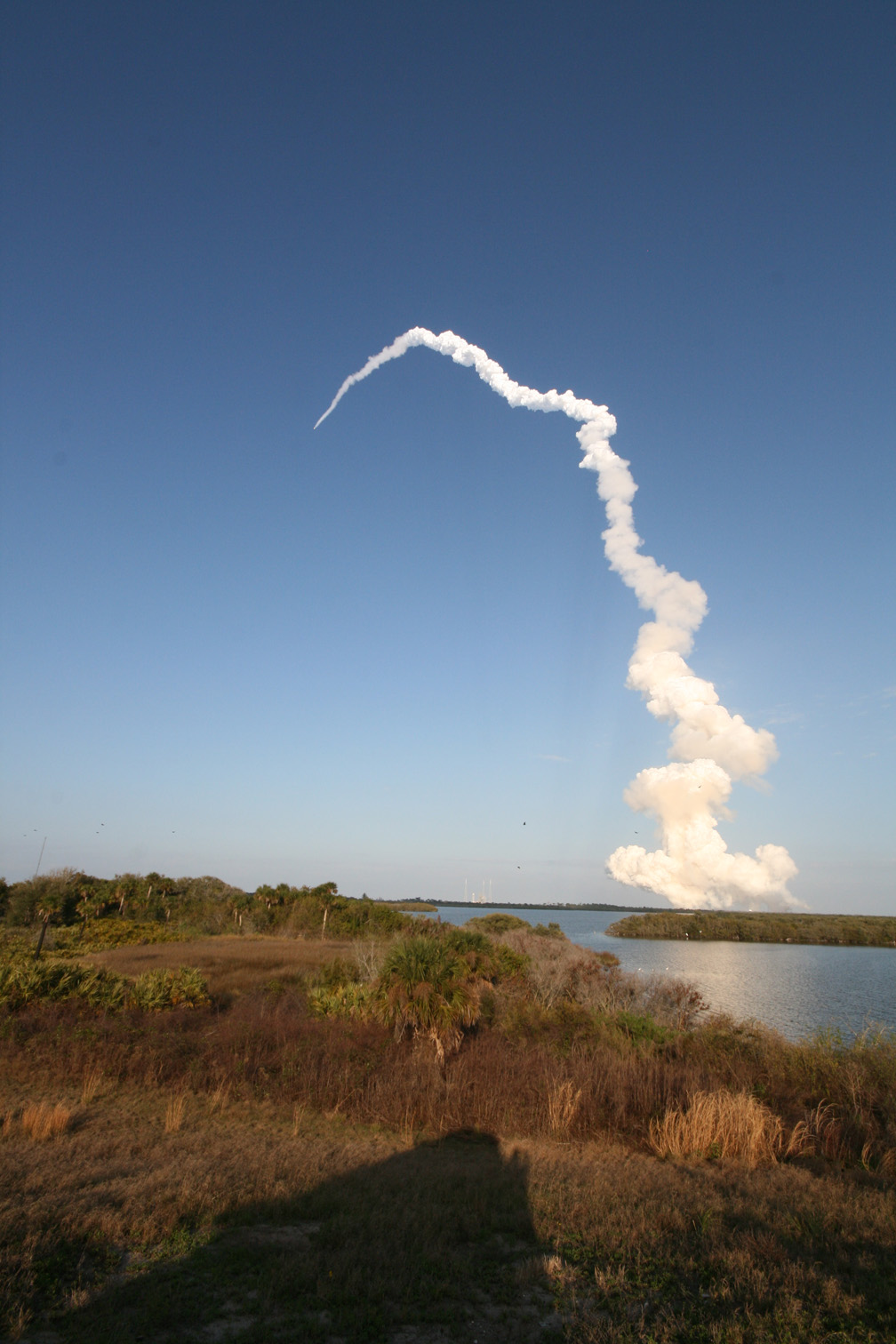
Discovery’s Arc to Orbit on Feb. 24. Credit: Ken Kremer

After the months long wait, Discovery’s final liftoff was absolutely spectacular. The solid rocket boosters and shuttle main engines ignited and thrust Discovery on a thunderous ascent off the launch pad into a gorgeous clear blue sky.

The near deafening sounds were even louder than usual. The blazing orange flames from the rocket engines were astonishingly bright like a giant blow torch burning right through the heavens.

The all veteran astronaut crew of five men and one woman aboard Discovery achieved orbit after the eight and one half minute climb to space on the orbiters 39th mission. Also aboard was the R2 Robonaut which is the first humanoid robot in space. R2 will become an official member of the crew.
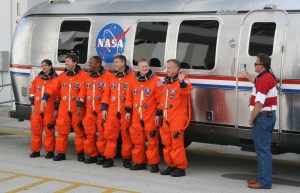
STS 133 Crew

The six person crew of Space Shuttle Discovery in their orange launch and entry flight suits wave to spectators before heading to the launch pad in the Astrovan. From left are Mission Specialists Nicole Stott, Michael Barratt, Alvin Drew and Steve Bowen; Pilot Eric Boe; and Commander Steve Lindsey. Discovery will deliver the Permanent Multipurpose Module, packed with supplies and critical spare parts, as well as Robonaut 2 to the ISS. Credit: Ken Kremer

The primary goal of the STS-133 mission is to deliver the “Leonardo” Permanent Multipurpose Module to the ISS.  Leonardo will be attached to the ISS as a new and  permanent habitable module that will provide extra storage and living space for the six person ISS crew.
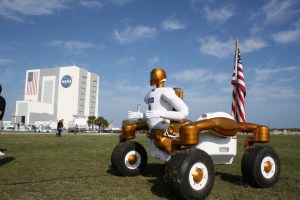
Robonaut R2

The twin brother of the R2 Robonaut awaits launch of Space Shuttle Discovery on the STS-133 mission, its 39th and final flight to space. Credit: Ken Kremer

Discovery is set to dock at the ISS at 2:16 p.m. on Saturday, Feb. 26. The mission’s two spacewalks will focus on outfitting the station and storing spare components outside the complex. The 11 day flight is due to conclude with a landing back at KSC on Monday, March 7.

Read my STS-133 articles online for Universe Today, The Planetary Society and Sidereal Times:

Robots Arrive at Kennedy Space Center
Discovery and Robonaut Unveiled for February 24 Blast Off
Discovery GO for February 24 Launch
Discovery’s Final Countdown Restarts
Discovery Docks at Space Station on Historic Final Voyage with First Human-Robot Crew

Astronomy Outreach by Ken Kremer

Rittenhouse Astronomical Society (RAS) at the Franklin Institute: Philadelphia, PA, Apr 13, Wed, 7 PM.  “Opportunity Mars Rover Update”, “ NASA Flybys of Comets Hartley 2 & Temple 1” Website: http://www.rittenhouseastronomicalsociety.org

Amateur Astronomers Association of Princeton: Princeton, NJ, May 10  8 PM “Whats Beyond for NASA: Shuttle, Station, Orion, SpaceX & Robots”. Website: http://www.princetonastronomy.org/

International Astronomy Day at the Franklin Institute: Philadelphia, PA, May 7, Sat, “The Search for Life on Mars”

Email: kremerken@yahoo.com website:  www.kenkremer.com

Posted in March 2011, Sidereal Times | Tagged , | Leave a comment

From the Director

By Ludovico D’Angelo, Director

Snow! And more snow! And very cold! I used to never mind it, but this year it’s bugging me. It’s stopping or delaying many things. Our last meeting canceled (a rarity!), very cold observing nights, very cold Outreach nights. But you know what’s coming? SPRING! March and April bring chances at Messier Marathons. Maybe we could do one, maybe it won’t snow, or rain, or sleet, or hail. Who am I kidding, this is New Jersey, and it’s going to do all of that.

Our last meeting was cancelled, as you all know, because of snow. If ever there is a doubt in your mind if a meeting will be cancelled or not, go to the website, it will be posted prominently on the home page. We also Twitter the announcement for those of you who link to Twitter. Ken Kremer’s lecture will be rescheduled to our May meeting. Please join us for our next meeting on February 8th at 8 PM.  Let’s hope for no precipitation.

Very soon, as it gets warmer again, we’ll be making plans for activities in the Spring and Summer. We will have a club picnic sometime in the Spring. We open the observatory to the public again starting in April. We’ll be doing some equipment upgrading from another generous donation to the club.  Also, there will be Super Science day at the State Planetarium coming up soon.

Also, we will soon be looking for another round of nominations for the next Board of Trustees of the club. This needs to be done by the May meeting. We need a volunteer to lead a nomination committee by our March meeting. We will be taking nominations for Director, Assistant Director, Program Chair, Secretary, and Treasurer. And we still are in need of a membership chair/committee. More help with public outreach, and needing more keyholders. If you are interested in helping your club’s management and growth, please be generous with your interest and time. Drop me an email if you have questions.

See you all on February 8th!

Posted in February 2011, Sidereal Times | Tagged | Leave a comment