Minutes of the June 14, 2016 AAAP Meeting

by James Poinsett, Secretary

  • Rex called the meeting to order.
  • Gene introduced the newest keyholder, Tim Donney.
  • John announced that Sky and Telescope has accepted the story about viewing the Mercury Transit through the Hastings/Byrne refractor, the third century that instrument has viewed such an event.
  • Rex brought up the subject of adding another scope to the mount with the refractor.
  • Treasurer Michael Mitrano reported that club treasury is in excess of $25000. He also stated that some money needs to be spent or dues reduced.
  • It was brought up that the observatory has been modified to allow a larger scope on the south mount with the refractor, there is plenty of space to fit any scope the club could afford.
  • Discussion was held on the proposal to spend up to $10K to purchase an extraordinary to add to the observatory. Points that were brought up include:
    • A scope that would stand out and make the club more attractive to new members.
    • A larger dedicated hydrogen-alpha solar scope.
    • An exceptional planetary scope.
  • A motion was made to spend up to $10K on a scope to be decided upon by a committee. The motion was seconded and a vote was held. The motions passed 35 yes votes to 0 no votes.
  • There were several volunteers for the committee, Rex will host a conference call to get the process started.
  • Gene brought up his concern that the columns supporting the roof of the observatory needed to be inspected for wear and tear, Jim McHenry knows a mason who will inspect them for us and make a recommendation.
  • Gene also expressed concern about the park’s ability to maintain the gates and roads to access the observatory. Larry will speak with the Friends of WC Park to see what may be done.
  • The topic of getting an internet connection at the observatory to update software. Jim McHenry will look into getting a wireless 4G connection.
  • Ira and the program committee were thanked for the excellent lecture series this past season.
  • Larry brought up that it is time for a new batch of AAAP shirts. More discussion will be held in the future.
  • Gene shared a thank you letter for our outreach from Hopewell Elementary School.
  • We have two volunteers to help Surabhi with Sidereal Times.
  • Meeting was adjourned.
Posted in Mid-summer 2016, Sidereal Times | Tagged , | Leave a comment

Because Rust Never Sleeps

by Michael Wright

Corrosion Technology lab

Corrosion Technology lab

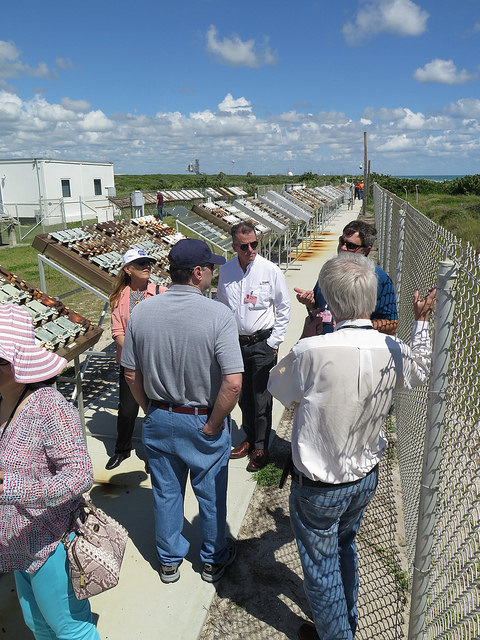
In May, I ran a workshop in Orlando on “Successful Preservation Practices for Steel Bridge Coatings”. Representatives from NASA presented at the workshop and invited the participating experts from various Departments of Transportation to tour their Corrosion Technology Laboratory and Beach Atmospheric Exposure Site at Kennedy Space Center.

Why was NASA invited to a workshop on bridge painting? NASA has been dealing with corrosion since the early years of the space program because Kennedy Space Center and Cape Canaveral Air Force Station are in one of the most naturally corrosive environments in North America. Launch facilities are exposed to salty ocean air, high ambient air temperatures, UV light and 5000°F engine exhaust. When the Space Shuttle began launching with solid rocket boosters, corrosion at the launch pads became even more severe due to the solid rocket exhaust. Every shuttle launch dumped the equivalent of 70 tons of hydrochloric acid on Launch Complex 39, pads A & B.

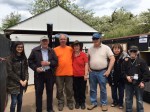
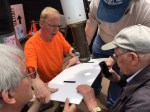
Team visits lab

The Corrosion Technology Laboratory has developed corrosion protection standards used program-wide and new methods to evaluate and test materials and coatings. They are currently working on more environmentally friendly coatings, and “smart” coatings using micro-capsules and micro-containers that can detect, indicate and heal corrosion. More detailed information is on their website: http://corrosion.ksc.nasa.gov

I was very impressed with the pride that our NASA hosts had in the space program and their dedication to keeping the NASA’s personnel and facilities safe.

In addition to visiting the Beach Atmospheric Exposure Site, we toured the Space Station Processing Facility where the International Space Station’s modules were prepared for launch. This facility now prepares experiment packages going to the ISS. For example, botanists are developing packages that will be used to grow plants to sustain astronauts traveling to Mars. The packages are sent up to the ISS where the astronauts grow the plants in micro-gravity.

Check out pictures of both facilities and a few other cool sites at KSC in my Flickr album.

Posted in Mid-summer 2016, Sidereal Times | Tagged , , , , | 1 Comment

Snippets

compiled by David Kaplan

Proxima b: An artist’s impression Photo: NYTimes

Proxima b: An artist’s impression Photo: NYTimes

One Star Over, a Planet That Might Be Another Earth
Another Earth could be circling the star right next door to us. Astronomers announced on Wednesday that they had detected a planet orbiting Proxima Centauri, the closest neighbor to our solar system. Intriguingly, the planet is in the star’s “Goldilocks zone,” where it may be neither too hot nor too cold. That means liquid water could exist at the surface, raising the possibility for life…more

Atmospheric Dynamics Mission (ADM-Aeolus). Photo: BBC

Atmospheric Dynamics Mission (ADM-Aeolus). Photo: BBC

Aeolus space laser catches a following wind
Europe’s Aeolus space laser mission, which is designed to make unprecedented maps of Earth’s winds, has reached a long-awaited key milestone. Engineers at Airbus in the UK have finally managed to bolt together all the elements of the satellite after overcoming major technical challenges.

Aeolus is now set for several months of testing before being sent into orbit next year…more

The nova eruption. Photo: BBC

The nova eruption. Photo: BBC

Star snapped before and after nova explosion
Astronomers have captured rare images of a tiny star before, during and after it exploded as a “classical nova”. In this type of binary system, a white dwarf sucks gas from a much bigger partner star until it blows up – about every 10,000 to one million years. Now, a Polish team has caught one in the act using a telescope in Chile…more

Nova lifecycle. Photo:Nature

Nova lifecycle. Photo:Nature

The awakening of a classical nova from hibernation
Cataclysmic variable stars—novae, dwarf novae, and nova-likes—are close binary systems consisting of a white dwarf star (the primary) that is accreting matter from a low-mass companion star (the secondary).

From time to time such systems undergo large-amplitude brightenings. The most spectacular eruptions, with a ten-thousandfold increase in brightness, occur in classical novae …more

 Photo:ESA/NASA

Photo:ESA/NASA

Don’t Let Them Tell You You’re Not at the Center of the Universe
Misconception: The universe started someplace.
Actually: The Big Bang didn’t happen at a place; it happened at a time, namely 13.8 billion years ago, according to the best cosmological data….more

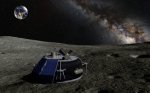
An artist’s conception of Moon Express’s MX-1 lander. Photo: NYTimes

An artist’s view. Photo:NYTimes

Florida Company Gets Approval to Put Robotic Lander on Moon
A small start-up has received the green light from the federal government to do something that NASA has not done for more than four decades: land on the moon. Moon Express, based in Cape Canaveral, Fla., announced Wednesday that it had received approval from the FAA to set a robotic lander on the moon…more

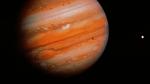
The huge storm, seen here by Voyager 1 in 1979, apparently creates a high-altitude hotspot. Photo: BBC

A high-altitude hotspot. Photo:BBC

Jupiter’s Great Red Spot ‘roars with heat’
Jupiter’s Great Red Spot – a hurricane three times bigger than Earth – is blasting the planet’s upper atmosphere with heat, astronomers have found. Using measurements from an infrared telescope in Hawaii, a UK and US team found evidence for temperatures as high as 1,500C – hundreds of degrees warmer than anywhere else on the planet…more

Unknown galaxies. Photo: NYTimes

Unknown galaxies. Photo: NYTimes

South African Telescope Spots 1,300 Unknown Galaxies
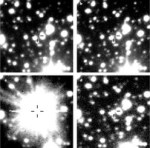
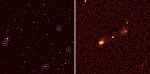
Left: A patch of sky about as big as the full moon where the MeerKAT telescope discerned the radio glow of about 200 galaxies. Only a few (circled) had been previously observed; Right: A distant galaxy with an explosive core powered by a black hole…more

Posted in Mid-summer 2016, Sidereal Times | Tagged , , , | Leave a comment

From the Director

Rex


by Rex Parker,  Director

June 14 meeting – quorum needed for proposal below – please participate in the motion. We’ll be meeting at the NJ State Museum Planetarium, our tradition each June. Bill Murray, AAAP member and staff technical guru at the Planetarium, will be running the show. See Ira’s section in this month’s Sidereal Times.

Capital expenditure proposal at June 14 meeting: Authorize expenditure of up to $10,000 to acquire a telescope for the Observatory. Specifically the idea is to purchase a telescope to co-mount with the Hasting 6” refractor on the second Paramount at the club’s Washington Crossing Observatory. The goal is to obtain the new scope in time to support this summer’s observing season. The treasury can readily absorb the expenditure. I will also appoint and chair a committee to decide on the specific telescope.

AAAP by-laws state: “For expenditures or appropriations in excess of $500 per meeting, a quorum of 40% of the membership shall be required; up to 25% of the membership may be represented by written and signed absentee ballot on an expenditure question that has been previously published in the Association’s monthly newsletter.”

Rationale and recommendation for the proposed new telescope. One of our greatest assets is the Observatory at Washington Crossing State Park. It enables the direct experience of astronomy for our members and provides the stage for public outreach where we connect with hundreds of kids and adults every year. As detailed in the plan reviewed by the Board 2 years ago, the goal is to upgrade the telescopes and instruments and computer/software systems to improve the quality of the experience at the Observatory. Some of the equipment has indeed been upgraded. To complete the plan, the current proposal is to acquire an instrument that compliments the existing telescopes. It would be primarily used visually but should be capable of digital imaging as well.

The recommendation, discussed at the March Board meeting, is to identify a telescope designed to excel at planetary/lunar/double star observing as well as the smaller deep sky objects such as planetary nebulae. Candidates (likely “used” scopes) include a 6” apochromatic refractor, 10” Maksutov-Cassegrain reflector, Dall-Kirkham Cass (such as a Takahashi Mewlon), or maybe a dedicated solar scope. At least two used telescopes have been identified to date that fit the requirements. There will be time to discuss which scope and why over the next several weeks, but the time to conduct the procedural requirement is June 14 if we want to acquire it this summer.

Seeking a new Co-Editor of Sidereal Times. We seek a member with the “right stuff” to succeed Michael Wright as co-editor of the ST, along with Surabhi Agarwal who will continue. Sidereal Times is the official voice of AAAP and is updated on-line monthly as a blog on our website. The co-editor manages written contributions from members and has the opportunity to apply creative writing skills and become proficient in WordPress. This is a visible and high status role in the club and brings internet visibility to the editors and contributors and the club as a whole. Please contact me and/or Surabhi if interested.

Plan to attend Jersey StarQuest Oct 28-30. If you’d like to get away from light pollution with your telescope but wonder where to go and safely observe in public places, Starquest is an opportunity to observe under some of the better skies in the NJ area. AAAP will host the annual Jersey StarQuest Oct 28-30, 2016 at the Hope Conference and Renewal Center in Hope, NJ. This family-friendly event is located in northern Jersey (north of Jenny Jump State Forest). If you don’t own a scope, this is an excellent event to observe through many different kinds and learn more about telescopes and mounts. The venue offers a fine observing field with electricity under good skies, modern bunkhouses, showers, and group lobby area with kitchen. Registration will be walk-in with modest pay-on-arrival fee. Mark your calendar!


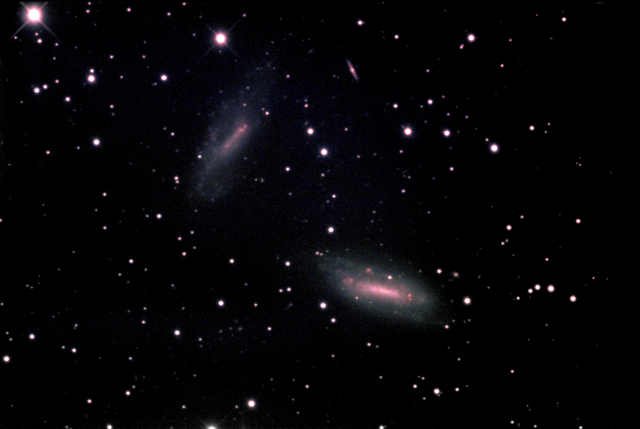
NGC672, interacting galaxies in the constellation Triangulum. Credit: Rex Parker, 2016, www.rexparkerpixels.com

NGC672, interacting galaxies in the constellation Triangulum. Credit: Rex Parker, 2016, http://www.rexparkerpixels.com

Posted in June 2016, Sidereal Times | Tagged , , | Leave a comment

AAAP June 14, 2016 Meeting – NJ State Planetarium

by Ira Polans, Program Chair

New Jersey State Museum

New Jersey State Museum

The June meeting of the AAAP, and our last until next September, will take place on June 14th at the Planetarium of the New Jersey State Museum in Trenton. The meeting will start at 7:30 PM.

In addition to our normal club meeting attendees will view a live star talk as well as our new science show at the Planetarium, “Asteroid: Mission Extreme”.

There is plenty of parking in front of the planetarium entrance behind the museum.

Museum is located at – 205 W. State Street, Trenton, NJ 08625

We look forward to seeing you at the meeting.

The program committee is beginning to look for speakers for September and beyond. If you have any suggestions please email program@princetonastronomy.org.

Posted in June 2016, Sidereal Times | Tagged , , , | Leave a comment

Minutes of the May 10, 2016 AAAP Meeting

by James Poinsett, Secretary

  • Assistant Director Larry Kane called the meeting to order and introduced the chairman of the nominating committee, Bill Murray.
  • Bill read the slate of candidates for officers for the 2016/2017 club year and asked if there were any other members interested in running for office, no one volunteered. The election was held and the slate was elected unanimously, there were 40 members present and voting.
  • Larry continued the meeting after the lecture and thanked everyone who participated in communiversity, we had a very good day.
  • Michael Mitrano, the treasurer, had no news to report.
  • Secretary Jim Poinsett sent an email to all members requesting they respond to confirm their email address. If you didn’t receive that email please email secretary@princetonastronomy.org to confirm your email.
  • Gene Ramsey gave the observatory report.
    • We had a good day for the Mercury transit. There were 10 telescopes at the observatory for viewing. An article is being written for Sky and Telescope about using it being the third century the H/B refractor was used to view a Mercury transit.
    • There was poor weather for the scout jamboree. We still managed to show them the observatory and telescopes. There was a brief window of clear sky for viewing on Saturday night.
  • Two representatives from Jenny Jump were visiting to discuss our rarely used observatory. They suggest sharing/leasing it with a NY club that is interested or possibly giving it up entirely. The discussion on this will continue at future meetings.
  • Michael Wright has stepped down as co-editor of SideReal Times. A new co-editor is needed. Let Surabhi know if you are interested.
  • Two nights of a planetarium/observatory program are planned, they are May 13th and 27th.
  • The Cherry Springs Star Party is June 2-5, a group is planning on meeting there. Speak with Rex Parker or Bill Murray if you are interested.
  • Dave Skitt is setting up tax-exempt status with a computer vendor for the club. Soon we will have the new computers and software that was approved for purchase.
  • There being no further business the meeting was adjourned.
Posted in June 2016, Sidereal Times | Tagged , | Leave a comment

Telescope Longevity

by John Church

Our historic 6¼-inch Hastings-Byrne refractor, with its objective lens dating from 1879, was ready for the morning of May 9th and the transit of Mercury. We comfortably followed and photographed the transit with a 55-mm Plossl eyepiece and a solar filter specially made by observatory co-chair Dave Skitt.

Members and guests came throughout the day to enjoy this fairly rare spectacle, averaging only 13 times per century. Most of those transits that could be seen here seem to get clouded out. This time, the clouds stayed away until not long before third and fourth contacts, so we didn’t get to see the end of it, although some members did observe second contact.

The first Mercury transit at which it was used was in 1881 by its original owner, Charles Rockwell, in Honolulu (Sky & Telescope for March 1979, p. 294-300). Several AAAP members made the much shorter trek to this writer’s home in Princeton Junction for the Nov. 10th, 1973 transit. The scope was being stored there while our observatory was still in the planning stage.

This scope has also been used to time two consecutive transits of Venus, which are far rarer than transits of Mercury. These were in 1882 (again by Rockwell) and 2004, at our Simpson Observatory in Washington Crossing State Park. The 2012 transit was too low in the western sky to be seen at the observatory even if the weather had allowed it, but some members did glimpse it briefly from a garage rooftop in Princeton. The next one won’t be visible here until 2125. We can hardly wait.

Posted in June 2016, Sidereal Times | Tagged , | Leave a comment

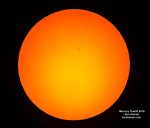
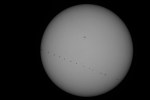
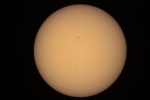
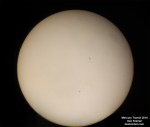
Mercury Transit, May 9th, 2016

Mercury crosses the face of the sun just 13 times a century. Most recently it did on May 9th. Our club members gathered at the observatory and viewed the event together. Some of our member astrophotographers took some wonderful pictures.

Posted in June 2016, Sidereal Times | Tagged | Leave a comment

Galaxies too die

by Prasad Ganti

About three decades ago, when I came out of college I heard that all Stars are born and eventually die, it was a shocking revelation for me. Like it is for a child who learns that a human being or an animal can die. Innocence, based on the permanence of the Sun, got shattered. Recently I heard that even galaxies die. So what is next ? Will the Universe die sometime ? Let us look at what death means in each of these cases.

A star is formed when a huge mass of gas, mostly hydrogen, comes under the influence of gravity and gets squeezed into the shape of a ball. This raises the temperature and stokes the nuclear furnace whereby the hydrogen atoms fuse to form helium and release enormous amounts of energy. Once all the hydrogen turns into Helium, the star goes into death throes. There could be other nuclear reactions fusing helium to higher elements like Carbon, all the way up to Iron, before the star ultimately dies. Depending on the mass of the star, the death and the ultimate state takes different forms. Medium stars like Sun will blow out and end up as a compact white dwarf. While heavier stars will blow up as Supernovas and end up as a compact neutron star. There are many other subtle variations of the ultimate state possible, but this is the gist.

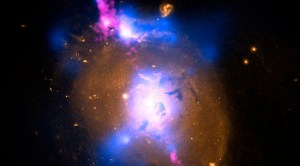
Rare & dying: Giant radio galaxy found 9mn light yrs away from Earth.  Photo credit: NASA

Rare & dying: Giant radio galaxy found 9mn light yrs away from Earth. Photo credit: NASA


Stars and their planets were one of the earlier astronomical structures to be formed in the Universe. Later the solar systems accumulated to form higher structures like a galaxy. Then galaxies accumulated to form a local cluster of galaxies, and then a super cluster. Galaxies typically contain millions or billions of stars each. Star formation happens all the time in galaxies. And stars die too. The cycle of birth and death continues. Stars use hydrogen as a fuel and cook higher elements and at the end of their lives spew them back, which forms the raw material for the next generation of stars.

Gravity is the master sculptor in the Universe. The same force discovered by Sir Isaac Newton as responsible for the fall of an apple from a tree to the ground, is responsible for creation of stars and their planets, the galaxies, clusters of galaxies etc.

While stars are formed from gas and dust, they breathe the gas until the end of their lives. And star formation makes Galaxies active and lively. Gas feeds the star formation in any galaxy. If the gas is stripped away by either the external or internal forces, the star formation will stop. Once the star formation stops, the galaxy will be alive as long as the existing stars are alive. As these stars die, the galaxy reaches its death throes. One of the likely culprits is overcrowding. if a galaxy is in a busy group or cluster, its collection of gas from the surrounding environment might face disruption, commencing the strangulation process. The same gravity which leads to clustering and crowding in the first place, can also lead to overcrowding and strangulation.

Maybe the same concept extends to higher structures like local clusters and super clusters. Will the Universe be the next to die ? We will not be around to see our Sun die, or our Milky Way die. Certainly not for the Universe to die. We can only speculate as to what may happen. As per our current understanding, the Universe is expanding at an accelerating rate due to the dark energy. What does the death of the Universe mean ? Even if all the galaxies die, the vacuum of the space is supposed to possess some energy. Will this energy die down ? Will space as such cease to exist ? Or, will the dimensions, including time, simply vanish ?

Seems like human learning is more of a relentless journey towards a direction but without a destination.

Posted in June 2016, Sidereal Times | Tagged , | Leave a comment

Snippets

compiled by David Kaplan

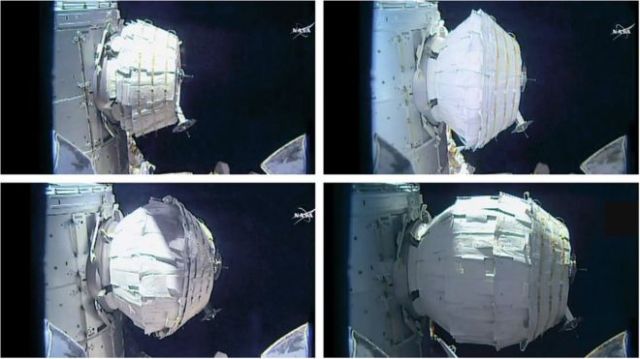
The Bigelow Expandable Activity Module (Beam) has been opened up on the space station.

The Bigelow Expandable Activity Module (Beam) has been opened up on the space station. Photo Credit: NASA

A new, expandable “room” has been opened up on the space station.The Bigelow Expandable Activity Module (Beam) is a demonstrator for the type of habitats that may be used to build future orbiting labs.

Kepler discovers new exoplanets.

Kepler discovers new exoplanets.

Kepler telescope discovers new planets. As David Shukman reports NASA’s Kepler telescope has discovered more than 100 Earth-sized planets orbiting alien stars. It has also detected nine small planets within so-called habitable zones, where conditions are favorable for liquid water – and potentially life.

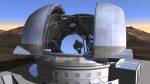
European Extremely Large Telescope (E-ELT)

European Extremely Large Telescope (E-ELT)

E-ELT: Contract to construct giant telescope The European Extremely Large Telescope (E-ELT) will be the biggest optical and infrared observatory ever built, with a primary mirror nearly 40m across.

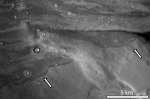
Tsunami-borne sediments on Mars

Tsunami-borne sediments on Mars

Evidence of ancient tsunamis on Mars Scientists think they see evidence of two huge tsunamis having once swept across the surface of Mars.
They point to satellite data suggesting a major redistribution of sediments over a large region at the edge of the Red Planet’s northern lowlands.

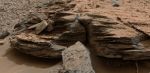
50cm high Whale Rock on Mars

50cm high Whale Rock on Mars

Curiosity rover: The reward for ‘whale watching’ on Mars Whale Rock. It’s got quite a story to tell. When scientists first saw it in images returned from NASA’s Curiosity rover on Mars, they really weren’t sure what to make of it.

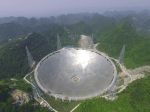
China's Five-hundred-meter Aperture Spherical Telescope.

China’s Five-hundred-meter Aperture Spherical Telescope.

China’s Science Revolution
China is super-sizing science. From building the biggest experiments the world has ever seen to rolling out the latest medical advances on a massive scale and pushing the boundaries of exploration from the deepest ocean to outer space – China’s scientific ambitions are immense.

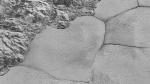
Pluto's Sputnik Planum

Pluto’s Sputnik Planum

Pluto’s Sputnik Planum explained
The spectacular, flat landscape that dominates the left side of Pluto’s icy “heart” can now be explained, say scientists.

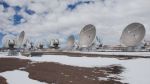
Alma: Sixty-six dishes are scattered across the plateau

Alma: Sixty-six dishes are scattered across the plateau

Alma telescope peers into space from Chile’s mountains
Single telescope of revolutionary design, composed of 66 high-precision antennas located at 5,000m altitude on the Chajnantor plateau.

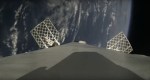
Falcon-9 camera captures landing.

Falcon-9 camera captures landing.

Onboard camera captures SpaceX rocket landing
An onboard camera has captured the successful landing of SpaceX’s Falcon 9 rocket, returning from space after launching an Asian communications satellite.

Posted in June 2016, Sidereal Times | Tagged , | Leave a comment