Lovejoy to Orion

by Brian Van Liew

M42B. Credit: Brian Van Liew

M42B. Credit: Brian Van Liew

Mid-December I had a chance to get out under a clear moonless night to do some imaging. It started out as night for imaging comet Lovejoy. I had a map showing its approximate location for each day. After some time searching with no success. I wasn’t going to let the night be a wasted effort. I had a clear shot at Orion so I set out for M42 – The Great Orion Nebula with my new camera. I had acquired a new tool to focus my scope, and this night was going to be my first attempt at using it with my new Starlight Xpress camera. I wanted to use a Bahtinov mask for focusing. I had used these masks on other OTA1s with my DSLR, but this was the first time using one with my new camera. The mask creates diffraction spikes that tell you where you are in focusing the scope. Short test exposures would reveal the diffraction spike pattern, which one can easily interpret on the laptop screen. After a few test shots I was able to get my setup in focus, and it was time to click. Argh! Clouds! Yes, a bank of clouds had snuck up behind me and covered my skies. It was now a waiting game to see if this was going to be a short term hold up or a deal breaker for the night. In about a half hour, the cloud cover left as quickly as it came. So I went back to my rig to pick up where I had left off.  I slewed my mount, and once it came to rest, I took a test shot again to see if I was on target. I wasn’t happy with the framing of the nebula. If I played my cards right I could move the mount manually to allow me to get the Running Man Nebula in the image, which is next to the Orion Nebula. So I watched the planetarium software on the laptop as I moved the mount by hand. It would show me in real time where the mount is pointed. I took another test shot and bingo. It looked good so now was showtime. I got my guider running and set the laptop to image for 2 minute subframes and take a total of 60, which would give me a total of 2 hours on the image. Being that M42 is bright as far as DSO2s go, I did not want to go any longer as I was already saturating the Trapezium area. I was willing to sacrifice this because I wanted to get the finer dimmer wisps of the nebula. After I checked to make sure I didn’t leave the mask on the imaging scope (been there, done that) it was time to let my setup do its thing.

After all the images where taken I rolled the rig into the garage and called it a night. Next evening I aligned, stacked, averaged and calibrated the 60 captured images of the nebula using Astro Art5. This is also what I use to run the imaging and guiding camera.  I then use Photoshop to tweak the final image to what you see here.

Posted in February 2015, Sidereal Times | Tagged , , | Leave a comment

Armchair Astrophotography – Messier 74

by Michael Wright

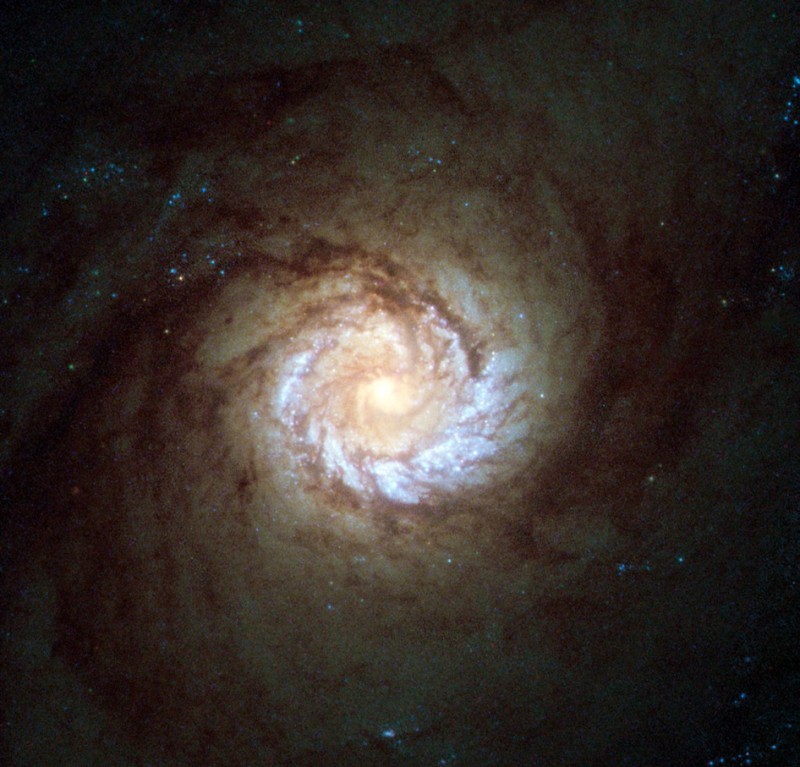
Messier 74

Messier 74, a composite image made from three exposures taken by the Hubble Space Telescope Wide Field Camera 3 through F814W, F555W and F435W filters. Credit: NASA/ESA/Michael Wright

There is one other aspect of this pursuit that I also find compelling – a primordial or “spiritual” component that is hard to deny. It is difficult not to be awed by a night under extreme dark skies and a brilliant canopy of stars. the Milky Way, zodiacal light, meteors, naked eye galaxies… all reminders that I need no longer dream of being an astronaut. I am already on a spaceship that is hurtling through space, and I am just a tourist taking a few photographs out the “window.”

~ John A. Davis, Astrophotographer, from his description of his photograph entitled “Cocoon over North America, 2011” in the Starstruck exhibit at the Michener Museum, Doylestown, PA January 2015

Posted in February 2015, Sidereal Times | Tagged , , | Leave a comment

Interstellar

by Prasad Ganti

InterstellarOne of my favorite all time great scientists postulated that time and space are relative, which means that they do not seem to be as straight forward as they appear to us Earthlings. Under normal circumstances, they are very straight forward, but once conditions change, they show different colors. In essence, this is Albert Einstein’s theory of relativity. The recent movie “Interstellar” is based on these “out of this world” concepts proposed by the genius who lived and taught in our neighborhood of Princeton.

Special theory came first, which said that time can slow down depending on how fast a clock is moving. Clocks slow down in a fast-moving train. Next came the General Theory which said that space curves in the presence of mass. More massive a body is, more is the space curvature. The curvature is implied by bending of light in gravitational fields. Gravity also impacts time. Clocks slow down in the presence of gravity.

There are several implications of these seemingly unearthly concepts. Nothing in the Universe can move faster than the speed of light. Seems like the sculptor of the Universe ordained such a speed limit that can impose severe limitations on space travel. Probes takes nearly 6 months to reach Mars, which is in the vicinity of the Earth, and much longer for interstellar travel; a human lifespan being trivial in comparison.

Fortunately Einstein’s same theories come to our rescue during interstellar journeys. The faster our spaceship travels, the slower our clocks will run, which means that human beings on interstellar journeys will age less than their counterparts on the Earth. The movie portrays this concept well when a father who left his young daughter back home, comes back to see her as an old woman while he is still young. The father is young not only because he traveled in space at high speeds, but also because he spent time near a black hole.

Black hole is an idea that rose from Einstein’s theories. It is a gravitationally intense place presumably caused by compacting mass to incredible densities. Just imagine a garbage compactor working ceaselessly to compress further and further until a black hole is formed! Since a gravitational field bends light, and the field is so intense in a black hole, the light just keeps bending in and in until it is totally trapped within the black hole. It cannot come out, so no one can really “see” a black hole but one can feel the presence as one approaches it. Astronomers use the movement of other bodies in the vicinity to deduce the presence of a black hole. In the movie, it is depicted by a halo of light surrounding a very dark region.

The next implication of Einstein’s fabulous theories rises from the curvature of space, which means that our Universe is not a flat region of space stretching on and on for trillions of light years. It curves itself into oddball shapes. It is speculated that the space curvature can result in a journey back to the starting point after traveling for billions of light years; going round and round in circles!

The concept of a “wormhole” comes up as a result. It is a tunnel or a shortcut between seemingly distant points in space. One of the astronauts in the movie illustrates this idea by folding a paper and poking a hole using a pencil from one side of the paper to the other side indicating the short cut, while the paper itself is curling around to the same point.

Another implication is that gravity can be created. Artificial gravity is used in the spacecraft to reduce the effect of weightlessness. As a result, the astronauts feel like they are sitting in their living room, rather than floating in space. The movie shows the spacecraft rotating as it moves ahead in its journey. This rotation causes the artificial gravity.

All these pieces come together in making the complete movie: an Earth in danger of getting destroyed, a small mission of astronauts to find a new home, a spinning spacecraft on an arduous journey accelerated by entering a wormhole right to emerge somewhere else to find alternatives to our home, including the vicinity of a black hole! An excellently woven tapestry of Mr. Einstein’s ideas, colored by human frailties and ulterior motives!

Posted in February 2015, Sidereal Times | Tagged , | Leave a comment

Flawless Orion Launch Ignites NASA’s Exploration Roadmap

by Dr. Ken Kremer, Universe Today and AAAP

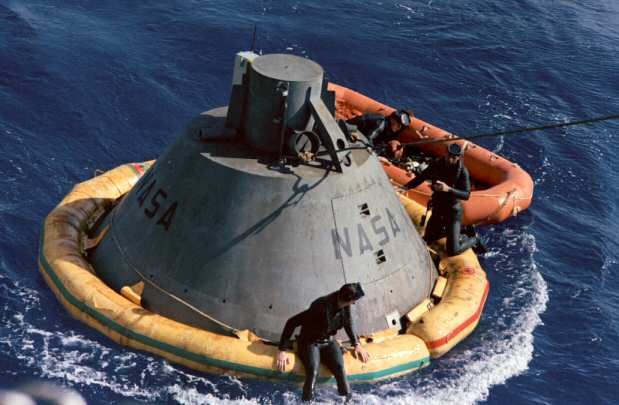
IMG_5998_1a_Orion_Ken KremerKENNEDY SPACE CENTER, FL – NASA’s exploration roadmap aimed at sending humans to Mars got off the ground magnificently with the flawless launch and landing of the agency’s new Orion deep space capsule on its maiden voyage on Friday, Dec. 5, 2014. I attended the launch and had a prime viewing location from inside Cape Canaveral Air Force Station on nearby Space Launch Complex 41 just two miles away and reported online for Universe Today and AmericaSpace websites.

“The first look looks really good from a data standpoint and will help us as we go forward,” said Bill Gerstenmaier, NASA’s Associate Administrator for the Human Exploration and Operations Directorate, at the post landing media briefing at the Kennedy Space Center. “We as a species are meant to press humanity further into the solar system and this is a first step. What a tremendous team effort.”

Orion roared to orbit atop the fiery fury of a 242-foot tall United Launch Alliance Delta IV Heavy rocket – the world’s most powerful booster – at 7:05 a.m. EST from Space Launch Complex 37.

The unpiloted test flight of Orion on the Exploration Flight Test-1 mission carried the capsule farther away from Earth than any spacecraft designed for astronauts has traveled in more than four decades. Humans have not ventured beyond low Earth orbit since the launch of Apollo 17 for NASA’s final moon landing mission on Dec. 7, 1972.

The first stage of the mammoth, triple-barreled Delta IV Heavy generates two million pounds of liftoff thrust and was the only rocket powerful enough to launch Orion and achieve its intended goals.

During the two-orbit, 4.5-hour flight, Orion reached an altitude of 3,604 miles above Earth, about 15 times higher than the International Space Station.

At about 4 hours and 15 minutes, the capsule began its high speed re-entry through the atmosphere at speeds approaching 20,000 mph, which tested the 16.5-foot wide heat shield at speeds approximating 85% of the reentry velocity for astronauts returning from voyages to the Red Planet.

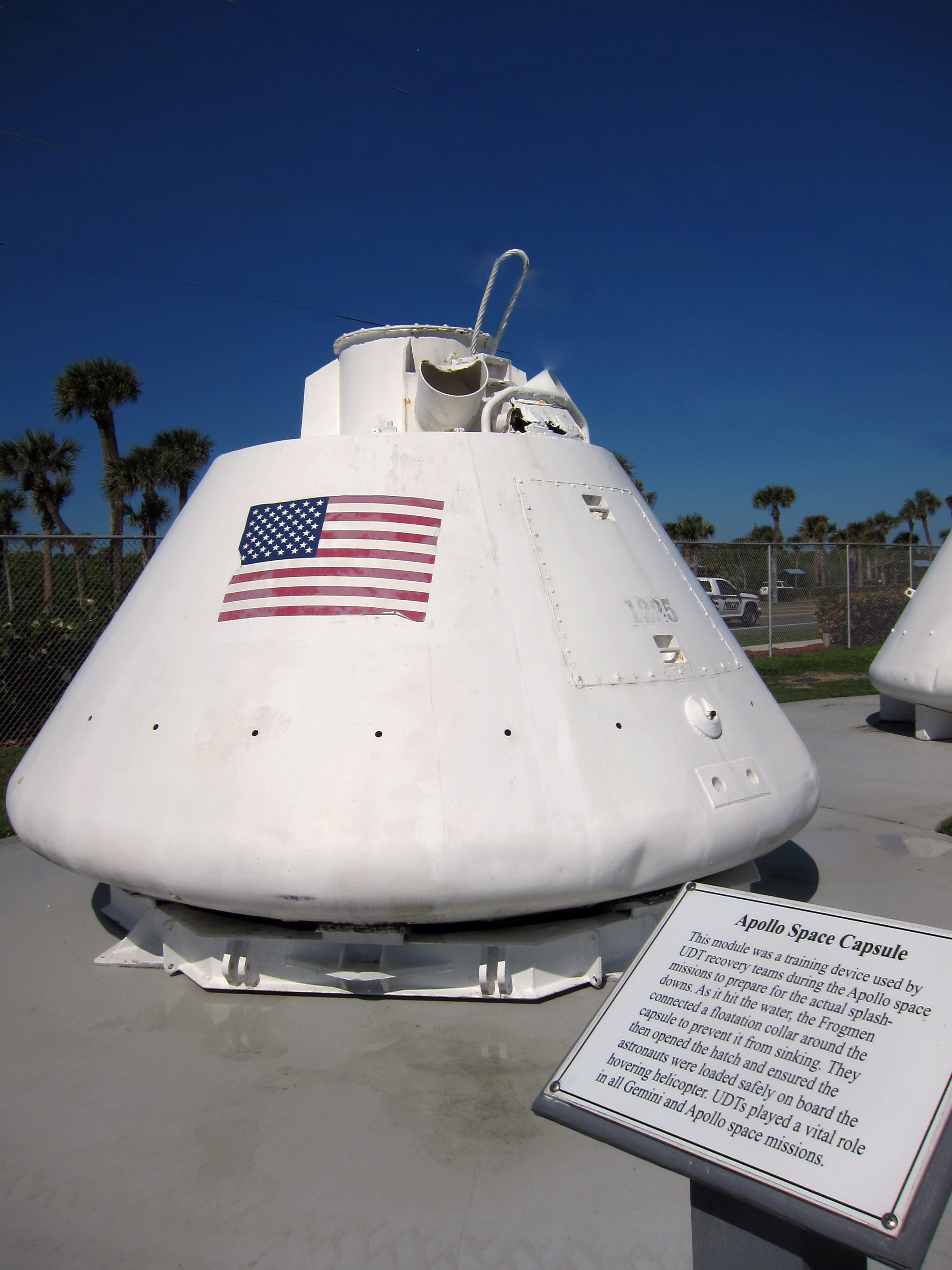
The capsule survived the scorching 4,000ºF temperatures in a successful test of the heat shield and thermal protection tiles before splashing down on a trio of parachutes in the Pacific Ocean at 11:29 a.m. EST. The capsule was recovered by US Navy divers and returned to the Kennedy Space Center on Dec. 19 for detailed analysis and eventual relaunch in 2018.

For complete details check out my articles and photos at Universe Today and AmericaSpace:

http://www.universetoday.com/116947/mars-era-opens-with-spectacular-blastoff-of-nasas-new-orion-crew-spacecraft/

http://www.universetoday.com/117483/nasas-first-orion-crew-module-arrives-safely-back-at-kennedy-space-center/

http://www.americaspace.com/?p=74189

Astronomy Outreach by Dr. Ken Kremer

The Future of NASA’s Human Spaceflight Program with Orion and Commercial Astronaut Taxis: March 6, 2015, DVAA, PA. http://dvaa.org

MMS, Orion and SpaceX Launches: March 11-13, NASA Kennedy Space Center, FL. Evening outreach at Quality Inn, Titusville, FL

NASA Mars Rovers and the Future of Human Spaceflight: April 18/19, NEAF, Rockland Community College, Rockland, NY.

Please contact Ken for more info, science outreach presentations and his space photos. Email: kremerken@yahoo.com   website: www.kenkremer.com http://www.universetoday.com/author/ken-kremer/

Posted in February 2015, Sidereal Times | Tagged , | Leave a comment

Snippets

by David Kaplan

The Planetary Society announced that it would send the first of two small spacecraft testing the technology of solar sails into orbit in May.
http://www.nytimes.com/2015/01/27/science/hoping-to-set-sail-on-sunlight.html?smid=nytcore-ipad-share&smprod=nytcore-ipad

Astronomers say they have discovered a gigantic ring system around a distant planet – the first such structure discovered outside our Solar System.
http://www.bbc.co.uk/news/science-environment-31001936

The largest image of the Andromeda Galaxy (Messier 31) has recently been unveiled by NASA. Made up of an astonishing 1.5 billion pixels, a total of 600 high-definition television screens are required to view the entirety of the image.
http://www.viralglobalnews.com/science/andromeda-galaxy-revealed-1-5-billion-pixel-image-video/28418/

Researchers have decoded ancient recordings from fragments of an asteroid dating back billions of years to the start of the Solar System.
http://www.bbc.co.uk/news/science-environment-30916692

The Royal Photographic Society calls for entries into the International Images for Science competition:
http://www.rps.org/exhibitions-and-competitions/competitions/international-images-for-science

What astrobiology can tell us about the fate of the planet.
http://www.nytimes.com/2015/01/18/opinion/sunday/is-a-climate-disaster-inevitable.html?smid=nytcore-ipad-share&smprod=nytcore-ipad

The Town Without Wifi: Greenbank, WV
http://www.washingtonian.com/articles/people/the-town-without-wi-fi/?utm_source=pocket&utm_medium=email&utm_campaign=pockethits

Astrophysicists studying the unstable “stellar monster” Eta Carinae unveil fresh insights and a 3D model of the destructive maelstrom at its heart.
http://www.bbc.co.uk/news/science-environment-30721794

Astronomers measure Saturn’s position with unprecedented accuracy thanks to a continent-wide radio telescope.
http://www.bbc.co.uk/news/science-environment-30743935

Scientists say a pair of supermassive black holes appear to be spiraling toward a galaxy-wrecking collision that could release as much energy as 100 million supernova explosions.
http://www.nytimes.com/2015/01/08/science/in-a-far-off-galaxy-2-black-holes-dance-toward-an-explosive-union.html?smid=nytcore-ipad-share&smprod=nytcore-ipad

Posted in February 2015, Sidereal Times | Tagged , | Leave a comment

From the Director

Rex


by Rex Parker, PhD

director@princetonastronomy.org 

Help Make 2015 a Great Year for Astronomy! We have several projects and opportunities in motion to help make this the most meaningful, accessible, and really fun year ever for astronomy in the AAAP. Stay tuned to Sidereal Times — the official voice of the AAAP – and our website: www.princetonastronomy.org to catch the latest updates on events and activities that you can participate in. Upcoming events include our regular public lecture meetings on the 2nd Tuesday of each month, now at a new location on the Princeton campus as Peyton Hall undergoes HVAC renovation. We are also planning a special field trip to PPPL on February 4. I will send an e-mail announcement with sign-up instructions during the last week of January.

Slipping through the Lion’s Paws.  If the sky is clear on January 7-8 after 10 p.m., look at the constellation Leo rising in the east, as the waning gibbous moon slips right between the Lion’s front paws. Jupiter is the moon’s brilliant companion on the 7th, rivaled by Leo’s brightest star Regulus on January 8 (each only 5 degrees away from the moon on those dates). The name Regulus is a derivative of Latin “Rex”, little king or prince – so, Lion King? Thanks to its sky position on the ecliptic, this star is occulted by the moon often, and by Venus, Mercury, and asteroids rarely. The March 2014 occulation by the asteroid Erigone would have been the brightest star occultation ever recorded in N.America. I say “would have been” because cloudy weather blocked the entire path, and it went unseen. So, philosophically, was there an occultation? Spectroscopic studies have revealed a four-star system:  Regulus A, a bright young main-sequence blue-white binary star with white dwarf companion (not directly observable) is famous for being an extremely fast rotator with a period of only 16 hours and a mass 3.5 times our sun, giving it an unusual oblate shape.  Regulus B and C are fainter main-sequence companions about 170 arc-seconds from “A”, so they are visible in amateur telescopes – what colors do you see? Yes, this is an observing challenge!

Colors of the Season. I just can’t resist sharing this image:  the Great Orion Nebula (M42), a vast gaseous birthplace of new stars about 3500 light years distant on the next spiral arm of the Milky Way. The colors are real, as captured by the RGB Bayer matrix filters of the CCD camera and telescope.

M42

M42, the Great orion Nebula, taken from Titusville NJ Credit: Rex Parker Equipment: Starlight Xpress SXVR-M25C camera, AG Optical 12.5-in iDK telescope, Paramount-MX.

The Dome Goes to Carolina Skies. As discussed at recent meetings, we sorted through over twenty responses to our ad on Astromart and reached a decision on the fate of the dome. The three-meter aluminum Observa-Dome goes to Carolina Skies, an astronomy club with connections to Pitt Community College, East Carolina University and the nature/science learning center “A Time for Science” in Grifton, NC (Greenville area, eastern NC). On December 20, Michael Mitrano, John Giles, Jeff Bernardis and I met in Pennington with Tim Christensen and Charles Goodman from Carolina Skies to load the dome and ancillary equipment onto the large truck they had driven up from North Carolina. The dome will become part of their substantial efforts to expand outreach with observational and imaging astronomy in the lowlands of east Carolina, a dark sky area relatively free of light pollution, and much in need of science outreach to the community. For more information see this link. http://www.atimeforscience.org/programs/carolina-skies-astronomy-club/

Dome

Tim Christensen and Charles Goodman (Carolina Skies/ Pitt Coll./ E. Carolina Univ.) flank Michael Mitrano, John Giles, and Jeff Bernardis (AAAP) as the three-meter Observa-Dome is loaded for transport to eastern North Carolina on Dec. 20, 2014.

Believe in the Future – Astronomy Equipment in Memory of Thomas Dixey. AAAP has accepted a very generous donation of astronomy equipment by John Dixey and family of Manalapan NJ, in memory of John’s uncle, Roy Thomas Dixey. Tom was a self-taught expert astronomer, always willing to share with family, friends and neighbors.  His devotion to the science and outreach was evident as astronomy reflected his personal writings and beliefs — Tom believed that the stars held many answers.  He taught himself calculus, physics and other sciences to better understand, and this helped him find peace after losing his wife years earlier.  His personal dedication to learn and share reflects what is possible when someone truly has a passion for something important.  The telescopes and other donated equipment are significant and too extensive to list here, but we will have the opportunity to sort out best placement in the next several months. The AAAP honor’s Tom by accepting these fine instruments and books for the benefit of our club, for members’ observing and learning, and for public outreach and sharing, all part of the AAAP’s mission.

Posted in January 2015, Sidereal Times | Tagged , | Leave a comment

From Backyard to Mountaintop: The Adventures of History’s Best Worst Telescope

AHphoto2014by Michael Wright

Our first meeting of the new year will be on Tuesday, January 13, 2015 at 7:30 p.m. in a new location:  Bowen Hall (see Princeton campus maps for building and parking locations).  Alan Hirshfeld, Professor of Physics at the University of Massachusetts Dartmouth and an Associate of the Harvard College Observatory will present a talk entitled “From Backyard to Mountaintop: The Adventures of History’s Best Worst Telescope”.

The 36-inch reflector of English amateur astronomer Andrew Common made its way from a London backyard to a Yorkshire estate and ultimately to a mountaintop observatory in California. This little-known telescope, built in 1879 and still operating today, revolutionized celestial photography and proved to 19th-century astronomers that the future of cosmic discovery lay in the camera, not the human eye.

Alan Hirshfeld, Professor of Physics at the University of Massachusetts Dartmouth and an Associate of the Harvard College Observatory, is the author of Parallax: The Race to Measure the Cosmos, The Electric Life of Michael Faraday, and Eureka Man: The Life and Legacy of Archimedes. He is a regular book reviewer for the Wall Street Journal and has contributed to Sky & Telescope, the American Journal of Physics, BBC History Magazine, and American Scientist. He has made radio and television appearances on NPR, PBS, and C-SPAN and lectures nationwide about science history and discovery.

Visit the author’s website/Contact the author: www.alanhirshfeld.com

Posted in January 2015, Sidereal Times | Tagged , , , , , | Leave a comment

Treasurer’s Report

by Michael Mitrano, Treasurer

The membership renewal count has crept up to 46, which is 16 % fewer than had renewed at the same time a year ago. I will be sending reminder postcards to those who have not yet renewed.

Our annual insurance bill has been paid, and a deposit has been made on the Mallincam camera to be used for video astronomy at Washington Crossing. The balance of about $1,800 will be due in mid-February when the back-ordered camera is ready to ship.

On a cumulative basis at this date, the AAAP’s surplus remains about $25 thousand.

Posted in January 2015, Sidereal Times | Tagged , | Leave a comment

Minutes of the December 2014 Meeting

by James Poinsett, Secretary

  • Rex opened the meeting at 7:30 and asked members to tell about any astronomy related activities
    • Gene talked about how he witnessed the launch of the Orion capsule
    • Rex went to the “Starstruck” exhibition at the Michner Museum.
  • There will be a tour of the PPL on February 4th, Rex will send out an email and organize it
  • Kate introduced this meeting’s speaker Vera Gluscevic and her talk titled “How do you collect dark matter?”
  • Rex informed the club that he will not be at the January general meeting. Larry Kane will lead the meeting.
  • Club members were invited to meet at the Princeton Market Fair theaters on Sunday, Dec 14th for the 4:30 show of the movie “Interstellar”.
  • The next meeting will be at Bowen Hall unless we at notified otherwise.
  • Articles need to be submitted by Dec 29th for the next edition of Sidereal Times.
  • The club was asked to approve the article for the Doylestown Non-Profit newsletter. Jim Poinsett will see that this is done.
  • The video technology committee has narrowed down the choices for the equipment and will make a “final” decision soon.
  • The Washington Crossing Park replaced the gate leading to the observatory but did not replace the club lock. Gene will follow up on this to get the lock replaced so we have access to the observatory.
  • The repairs to the observatory were postponed due to injury to the contractor.
  • A recipient for the donated dome has been found. East Carolina State University is the recipient, they do outreach for the poor and disadvantaged in the area. It is scheduled to be picked up on December 20.
  • A suggestion was made to mount the refractor on the donated paramount mount after raising the post to make it easier to view objects at or near the zenith. A second computer will be needed to operate the mount. They are just waiting for a break in the weather to see how everything will fit. Rex brought up that the plan is to discuss if the Hastings refractor is the best scope for the future of the club, not to make the refractor work at all costs.
  • The club’s newest keyholder is Freddie Missell.
  • The donation can at the observatory raised just over $60 this year.
  • Gene thanked all who donated refreshments for the clubs winter observing night that took place the weekend before Thanksgiving. It was brought up that many members did not know the event was taking place and that all club events should be announced by email several times.
  • Ludy told the club he has a friend involved with the Orion capsule that will be willing to speak to the club when he makes his way up here.
  • The Friends of Washington Crossing Park acknowledged our donation and on February 22nd they will be having a discussion on revolutionary war battles at the firehouse on Route 29. A table is available to us if we want to distribute literature and information on the club.
  • A motion was made and seconded to adjourn the meeting.
Posted in January 2015, Sidereal Times | Tagged , | Leave a comment

Update on the Hastings-Byrne Refractor

by John Church

At the December AAAP meeting, Gene Ramsey, Dave and Jen Skitt, and the writer reported their progress on a plan to upgrade the refractor mount to make it more usable for both club members and the general public.

To review, there are two issues that need attention. First, the donated Losmandy GoTo mount that was installed in 2014 has not worked out well; it has a steep learning curve and other disadvantages. Fortunately we have a donated computer-capable Paramount which we believe can be readily mounted on the original cast-iron pier. The Paramount should also be able to take the current plate that holds the refractor onto the Losmandy.

Second, when pointed at objects higher than about 60 degrees above the horizon, the eyepiece has always become inconveniently low. Replacing the Losmandy with the Paramount will raise the entire OTA about 8 inches more above the floor, and it should still clear the roof when it is being rolled off.

This height gain alone should be helpful, but in addition we also propose moving the tube about a foot more up in its rings, which would give a total gain in eyepiece height of about 20 inches for the higher altitude objects. This will of course require that the assembly be rebalanced around the declination axis, but the existing sliding weight at the upper end of the tube should be able to compensate for this. Balance around the polar axis should not be affected.

Philosophically speaking, different sets of observers have legitimate and totally understandable preferences for the kinds of objects that they like to observe and possibly photograph. To accommodate these different interests, we feel that having two distinct types of fine telescopes in the observatory, each with its own special advantages, is very beneficial. The C14 is good for deep-sky objects and the refractor is good for solar system objects and open clusters, where its sharp definition and wide coma-free field of view can make for a rewarding observing experience. Additionally, the latter types of objects are often more appealing to the general public than deep-sky objects, as well as being much more easily accessible under the observing conditions that typically prevail in our area.

Another advantage of the refractor is that its objective and tube are always close to ambient temperature. It therefore needs very little equilibration time after the roof is opened. The large primary mirror of the C14 can take much longer to equilibrate and give images steady enough to appreciate, especially during the warmer months when the building heats up significantly during the day. Irregular air convection currents due to slow internal cooling within the wide tube can also be an issue.

Club members already know about the history of the refractor, and this background is typically of great interest to visitors. They also appreciate the opportunity to use a classic 135-year-old instrument that can provide excellent views of the moon, planets, open clusters, multiple stars, and some of the brighter deep-sky objects. Of the three objectives that Hastings ground himself, this is the only one still in active use as far as is known.

If we are successful in the remounting project, the next step would be to make the instrument fully computerized and have it operated by The Sky software in the same way that the C14 is operated. It would need its own computer, as of course any instrument would.

Here are photos of the lunar craters Copernicus and Tycho that I took on High Contrast Copy film and processed in my darkroom. The jagged shadow of the central peak in Tycho can be compared with the same area in a closeup taken by Lunar Orbiter V. Using a 2x Barlow gave an EFL of 4600 mm and therefore a large image scale, bringing out details down to nearly 1 arcsecond.


Even better resolution can be obtained visually. Watching the shadow play as the terminator creeps across the floor of a crater in the period of half an hour or so can be entertaining and educational to members of the public, and sometimes even to us hardened observers!

Posted in January 2015, Sidereal Times | Tagged , , , , | Leave a comment

Astronomy Calendar Sale

Our annual astronomy calendar offering was nearly a sell-out at the last meeting.  We have two left and they are available for $10 to the first two members who e-mail Michael Mitrano at treasurer@princetonastronomy.org.

If you are interested:

  1.  Please send the e-mail indicating your interest and confirming your postal mailing address.
  2. Wait for a response from Michael which will confirm that you are one of the two first to respond.
  3. Following confirmation, send the $10 check to the AAAP at P.O. Box 2017, Princeton, NJ  08543.
  4. He will mail you the calendar.
Posted in January 2015, Sidereal Times | Tagged , | Leave a comment

Astro Imaging from New Jersey

by Brian Van Liew

I started out imaging with various mono Starlight Xpress cameras years ago, but over the past few years, I have been imaging with a modified DSLR. Recently, I picked up an older camera and had the chance to see how rusty my imaging skills have gotten. The Starlight Xpress SXV-M25C is a model that I have been looking for but never found for sale. It is a few years old, and there are newer versions of it available now. However, I was quite happy to get the older version. I bought it used on Astromart from a fellow who lives in Poland. I spent many days emailing with him to discuss the purchase. Once I pulled the trigger, it only took a week to make the trip to me. It was in good shape and made the trip without any issues.

Now I needed to run the camera to see if it was in working order. I had to spend time with my friend Bill Nagel who also has experience with Starlight Xpress cameras to get familiar with a software package that I had not run in many years. After a visit and a few emails between us, I was ready for some serious first light.

I selected an object that was in the best part of the sky at my home, which is from zenith to west/northwest. I configured my imaging rig for the appropriate FOV to cover the object and get a good image scale with the sensor in my new camera. I choose to go for IC 5146 a.k.a. the Cocoon Nebula. I set up my rig on my driveway and prepared for the imaging session. I was able to get it up and running without any big problems. My guiding looked good so now it was time to gather the subs. After a test shot to verify the pointing and the focus, I set it up to take fifty 300-second images for a total exposure time of over four hours. I pressed go and off it went. There was nothing more for me to do but catch up on a TV show and to check once in a while that everything was going according to plan. After the 50 subs had been collected, I moved my rig into the garage. Now that I had the lights (sub images of the Cocoon Nebula), I need to take three darks of the same exposure time of 300 seconds, several bias frame subs and flat field subs to correct for any imaging train vignetting and dust spots on the sensor. Then I’m off to bed to get some rest.

The next day I aligned/stacked and calibrated the light subs on my PC. Again, this is where Bill was able to give me more advice. So once the PC was finished, I had a calibrated image of the Cocoon Nebula. At this point, you can adjust the image to your liking and taste. I typically use Photoshop to do this post-processing work and try not to spend too much time working the image. Here is my final result.

Cocoon Nebula. Credit: Brian Van Liew

Cocoon Nebula. Credit: Brian Van Liew

There is a lot more that I haven’t covered in detail. If you would like any advice or would like to know how to do your own imaging, feel free to talk to me at one of the monthly meetings or you can email me at brian@princetonastronomy.org. I can’t make any promises that I will be able to answer all of your questions, but I will try to do my best.

Posted in January 2015, Sidereal Times | Tagged , , | Leave a comment