Editor’s Pick

Of Ancient Star-Gazers and Story-Spinners 

Posted in September 2020, Sidereal Times | Tagged , | Leave a comment

Snippets

compiled by Arlene & David Kaplan

-NOIRLab

Amazon Satellites Add to Astronomers’ Worries About the Sky Welcome to the age of the satellite megaconstellation. Within the next few years, vast networks, containing hundreds or even thousands of spacecraft, could reshape the future of Earth’s orbital environment. Much of the attention on these strings of satellites has been placed on the prolific launches of SpaceX and OneWeb, but the focus is now turning to Amazon…more

– Jamie Law-Smith and Enrico Ramirez-Ruiz

New observations of black hole devouring a star  Astronomers have found a previously unseen type of object circling a distant star. It could be the core of a gas world like Jupiter, offering an unprecedented glimpse inside one of these giant planets. Giant planets like Jupiter and Saturn have a solid planetary core beneath a thick envelope of hydrogen and helium gas…more

-NASA/JPL-Caltech

Where Are Stars Made? NASA’s Spitzer Spies a Hot Spot. The most massive stars in the universe are born inside cosmic clouds of gas and dust, where they leave behind clues about their lives for astronomers to decode. The nebula known as W51 is one of the most active star-forming regions in the Milky Way galaxy. First identified in 1958 by radio telescopes, it makes a rich cosmic tapestry in this image…more

-NASA, ESA, 

Hubble Maps Giant Halo Around Andromeda Galaxy  In a landmark study, scientists using NASA’s Hubble Space Telescope have mapped the immense envelope of gas, called a halo, surrounding the Andromeda galaxy, our nearest large galactic neighbor…more

– NASA/JPL

Scientists find closest known asteroid to fly by Earth  On August 16, 2020, the Zwicky Transient Facility, a robotic survey camera located at the Palomar Observatory near San Diego, spotted an asteroid that had, just hours earlier, traveled only 1,830 miles (2,950 kilometers) above Earth’s surface. Designated 2020 QG, the asteroid is the closest known to fly by Earth…more

NOIRLab/NSF/AURA/P.Marenfeld/William Pendrill

Citizen Scientists Discover Dozens of New Cosmic Neighbors We’ve never met some of the Sun’s closest neighbors until now. In a new study, astronomers report the discovery of 95 objects known as brown dwarfs, many within a few dozen light-years of the Sun. They’re well outside the solar system, so don’t experience heat from the Sun, but still inhabit a region astronomers consider our cosmic neighborhood…more

-ALMA ( ESO / NAOJ / NRAO ), Rizzo et al.

A distant Milky Way look-alike                                                 Astronomers at the Max Planck Institute for Astrophysics, using the Atacama Large Millimeter/submillimeter Array (ALMA), have revealed an extremely distant and therefore very young galaxy that looks surprisingly like our Milky Way. The galaxy is so far away its light has taken more than 12 billion years to reach us: we see it as it was when the Universe was just 1.4 billion years old…more

-BBC

Astronomy photographer of the year 2020 shortlist
A competition to find the best pictures of space, has shared a shortlist of the top 35 images entered into the competition. Around 5,200 entries were sent in to The Astronomy Photographer of the Year 2020, from 70 countries around the world! This one was taken by Andy Casely who lives in Australia, using a special telescope and a camera….more

Posted in September 2020, Sidereal Times | Tagged , | Leave a comment

From the Director

Rex


by Rex Parker, Phd director@princetonastronomy.org

Zooming AAAP Meetings this Fall.
It’s no surprise that we won’t have access to Peyton Hall auditorium in the near future, so we’ll be patient and go with Zoom this fall. Our May and June zooming experiments mostly succeeded, for example we were able to do formal membership voting for the Board and for a Capital Expenditure. We had about 55 members participating both times and it all seemed to go reasonably smoothly. Speaking of members, our ranks have increased by 11 since July putting us around 120 members total.

It hasn’t escaped notice that the migration to virtual meetings unleashed some of the bounds of space for getting guest speakers. Recently the Board entertained ideas of bringing in distant big name speakers for new topics. While Ira is working on that, we would like to hear your suggestions for speakers or topics from the next year. Right now the sky’s the limit!

The Board also decided this summer that we will make our monthly Zoom meetings open to the public, since our meetings with guest speakers have always been open to the public. This means we’ll all need to cooperate and be patient during the Zoom sessions to ensure they remain courteous, coherent, and enjoyable for all.

Unveiling AAAP Video Productions!
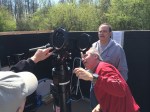
Accepting that we’re stuck in this virtual world for a while, let’s think about ways to connect with each other as members. Beyond the guest lectures at meetings, which tend to focus on deep science topics, there seems to be a gap (aka “opportunity”) in ability to share favorite astronomy ideas and “how-to” information and stories with each other. This is especially so with the current restricted access to the Observatory, our favorite gathering place for hands-on astronomy. We propose new approaches to bring members together, shining a light on experiences with telescopes and astro-technology and sharing other celestial insights. The idea has taken form: let’s use video technology to create “how-to” and AAAP-relevant content for members. This is not to compete with the Mount Palomars of the world, rather it is for members to learn and get to know others in the club. I’d like to credit member Rich Sherman, an expert videographer, for proposing the idea and running the first video shoots/interviews. The initial “guinea pigs” were me and Bill Murray, with John Miller and Dave Skitt in the queue. The featured videos are being posted on the website under the Club Astrophotography tab. We’re hoping more members will step up to record video sessions – if you’re interested please send me a note and let’s discuss setting it up.

Update on Observatory Repairs and Opening.
The resolution authorizing $9500 for observatory repair passed at the June 09 meeting by unanimous vote (43 yes). We’re in the process of getting State administrative approval of the construction plan, and still hold out hope of scheduling this fall with the contractor.
Meanwhile, the Observatory is closed to the public right now. But it is open to AAAP Keyholders, who must pre-schedule with the Observatory Chair (observatory@princetonastronomy.org) before going out there, so we can keep tabs on the restricted numbers allowed out there. Anyone at the Observatory grounds or building at WC State Park must wear a mask and practice social distancing. Other members can also go to the Observatory so long as the number limits are not exceeded, but you’ll need to be with a Keyholder – inquiries should be directed to the above e-mail.

Seeking Volunteer for Co-Editor of Sidereal Times.
We are seeking a member with the “right stuff” to help edit and produce content provided by members as Sidereal Times co-editor, along with editor Surabhi Agarwal (who also serves as AAAP web-master). Experience with WordPress is a plus but “on-the-job” training is a great way to learn. Because of its status as official publication of the AAAP, and given our internet visibility, this is a very important position in the club. Please send me and/or Surabhi a note if you’re interested (director@princetonastronomy.org; editors@princetonastronomy.org).

From Comet to Gas Giant in a Single Night!
In this seemingly endless summer a couple of celestial events have popped up to vie for our attention, a welcome distraction from other news that need not be mentioned here. The splendid comet designated C/2020 F3 NEOWISE (an acronym for Near-Earth Object Wide-field Infrared Survey Explorer, the NASA space telescope that discovered it) transitioned from pre-dawn to after sunset in July and ascended the early evening sky under the bowl of the Big Dipper.

As alluring as the comet was, two other celestial wonders have made their presence known in the southern sky in early evening. A smart phone astronomy app would be one way to quickly find these planets, and they are bright enough that they stand out even in our light pollution compromised skies. The great Jovian planets Jupiter and Saturn – gas giants! – both reached opposition in late July. That’s when they’re at their closest position to earth in their orbits, which happens once a year due to earth’s orbit. Jupiter and Saturn themselves have orbital periods of 10 and 11 earth-years. This is also why they transit a little before midnight now, meaning that they reach their highest altitude in the sky and cross the celestial meridian before midnight (the meridian is the line joining both poles with the zenith point). In addition you’ll notice Jupiter and Saturn have reached their brightest, with magnitudes ~ -2.7 and 0.1, respectively. In fact Jupiter is brighter than any star or planet in our skies, except Venus when it is at the far side of the sun relative to earth. Recall that the magnitude unit is a scale worked out centuries ago, with the brightest to dimmest stars seen by naked eye ranging from magnitude 1 to 6, each magnitude number being 2.5 times brighter than the next so that 6 magnitudes spans ~100-fold difference in brightness.

Both Jupiter and Saturn are great sights if you’re lucky to have a small telescope. In fact both show surprising detail even with binoculars if held steadily enough. For instance, you can see the 4 Galilean moons of Jupiter, discovered by Galileo himself in 1609 using a small telescope, which had been recently invented. Notice how the positions of the 4 moons relative to each other and the planet change, even in the course of a couple hours in the same evening. If you had a big enough telescope to see the details of the surface of Jupiter you’d notice the surface changing in the span of a few hours as well. Amazingly, Jupiter rotates on its axis once every ~10 hours! Under good conditions you will notice the “stripes”, prominent bands of different shades of yellow in the hydrogen atmosphere. There is also the famous Great Red Spot, a violent storm that has been observed on Jupiter for over 300 years and can be seen under very good seeing conditions in a small scope.

A few degrees to the left (east) of Jupiter you’ll see Saturn, brighter than other stars in the sky at this time, though much dimmer than Jupiter because it is twice as far away. Imagine the line between them. This is an arc along the ecliptic, the plane in which all the planets’ orbits lie. (Except Pluto, one of the reasons it was demoted from planet status a few years ago). Saturn’s rings are visible in binoculars and especially pronounced in even a small telescope. Galileo was the first to see Saturn’s rings, though he thought they were moons on either side of the planet. The rings are actually made up of solid material, largely water ice, aggregated over millennia into discs around the planet due to Saturn’s immense gravity and dynamics. Their angle of inclination, or tilt, toward earth changes in the course of its orbit around the sun. While viewing Saturn that other bright point of light you may see in the scope is Saturn’s largest moon Titan. Well-named, as it’s the largest moon in our solar system, Titan was once hypothesized to be a possible place for life, though the current thinking is that this is highly unlikely and that it is an inhospitable place, suitable for science-fiction scenes but not likely biological ones.

The photos below were taken from my back yard in Titusville using a 5” refracting telescope with 5X Powermate (giving focal ratio f/40 and focal length 5000 mm) and using an SBIG ST-10 astronomy CCD camera. If you’re interested in learning more about astrophotography check out the new “how-to” videos being posted on this AAAP website (discussed above), and visit my own astrophotography website featuring New Jersey-based imaging at www.rexparkerpixels.com. Feel free to send me a note if you want to talk about the various approaches to astrophotgraphy and astrovideo.

Posted in Mid-summer 2020, Sidereal Times | Tagged , | Leave a comment

From the Assistant Director

by Larry Kane

As was mentioned at our last on-line business meeting, I volunteered to form a committee/task force to look into raising funds to pay for the observatory repair project. I would like to hold the first on-line, Zoom or otherwise, meeting of this group in furtherance of this effort. I am open to suggestions for a meeting day and time. We can try to do the meeting with “Google Duo”, “WhatsApp”, “Zoom” or any other platform that may be available to us.

If you are interested in helping out on this fund raising effort, please contact me by email or call me at 609-273-1456. Thanks and I know that with the creative talent available in the AAAP, we can complete the restoration of our observatory without breaking our treasury in the process.

In hoping every one I doing all that they can to remain safe and healthy, and I am wishing all Clear Skies,
Larry Kane, Assistant Director

Posted in Mid-summer 2020, Sidereal Times | Tagged , | Leave a comment

From the Program Director

by Ira Polans

Adam Burrows, Professor of Astrophysical Sciences at Princeton University, is the Director of the Princeton Planets and Life Certificate Program. Well-known as a pioneer in the theory of exoplanets, brown dwarfs, and supernovae, he has written numerous influential papers and reviews on these subjects during the last ~30 years. He has collaborated with more than 250 co-authors on more than 350 papers and given more than 300 invited talks and colloquia. He is a member of the National Academy of Sciences, a member of the American Academy of Arts and Sciences, a Fellow of the American Association for the Advancement of Science, a Fellow of the American Physical Society, the 2010 Beatrice M. Tinsley Centennial Professor, and a former Alfred P. Sloan Fellow.

Dr. Burrows will talk on “Core-Collapse Supernova Theory”. Using university’s state-of-the-art code Fornax he and colleagues have simulated the collapse and explosion of the cores of many massive-star models in three spatial dimensions. This is the most comprehensive set of realistic 3D core-collapse supernova simulations yet performed and has provided very important insights into the mechanism and character of this almost 60-year-old astrophysical puzzle. Importantly, most multi-D models explode without artifice by the neutrino mechanism, aided by the effects of neutrino-driven turbulence. Dr. Burrows will present detailed results from this suite of runs and the novel conclusions derived from their new capacity to simulate many 3D, as opposed to 2D and 1D, full physics models every year. This new capability, enabled by a new algorithm and modern HPC assets, is poised to transform our understanding of this central astrophysical phenomenon.

Posted in Mid-summer 2020, Sidereal Times | Tagged , , , | Leave a comment

Minutes of the June 9, 2020 AAAP General Meeting (virtual / online)

by John Miller, Secretary
with additions: Larry Kane, Assistant Director

● This was the second virtual / online general member’s meeting of the AAAP since the club’s inception. Attendees were invited to participate via the cloud-based Zoom communications software. About 51 people were logged on at 7:45 p.m. This process was instituted for the safety of participants due to the global Covid -19 pandemic. The Princeton Campus remains in lock-down.

● Director Rex Parker brought the meeting to order about 7:30 P.M. Among other general comments, he recommended the web site: “thinkastronomy.com.” [ lk]

● AAAP Member Bill Murray gave the main presentation titled: “How Stars Got Their Names.” The online meeting began with 54 participants, via Zoom software.

● Assistant Director suggested the formation of a task force or committee for the purpose of raising funds to pay for the planned observatory pillar repairs. R. Parker stated this was a good idea, giving L. Kane the responsibility for moving the idea forward. Some suggestions were made by other attendees for instituting this idea. Among these suggestions:
   1. Member Ralph Marantino recommended approaching Johnson & Johnson, Inc. since that company had give the AAAP a grant for a telescope purchase years ago.
   2. Possibly selling the name of the observatory.
   3. Approaching the Charles Hayden Foundation.
   4. Contacting NJ State senators and assembly representatives for State funds. [ lk]

● A discussion was held on how to implement “Phase 2” of the club’s Covid -19 related activities. Observatory Chair David Skitt described his current broadcasts, emanating from the observatory and his home via social media. An attendee raised the question whether we could establish a YouTube Channel for these broadcasts. D. Skitt added he is also working on a video system to feed, real-time, to a large screen placed outside the observatory. [lk]

● A club capital expenditure requested for the observatory pillar repair remains $8,500 per the original contractor estimate. Director Parker recommended an additional $1,000 be budgeted as a buffer for unforeseen added costs. This suggestion was passed by most board members.

Posted in Mid-summer 2020, Sidereal Times | Tagged , , , , | Leave a comment