UACNJ Resumes Saturday Evening Programs

Jenny JumpJoin UACNJ for a free program at our facilities in Jenny Jump State Forest every Saturday evening from April 4 to October 31.
Our free Saturday evening programs begin at 8:00 PM. Following a lecture on an astronomy-related topic, the public is invited to view the night sky* through our telescopes until 10:30 PM.


Programs and speakers for the month of April:

  • 4/4/2015 What’s up in the April Sky? Lonny Buinis, RVCC
  • 4/11/2015 Naked Eye Astronomy, Jim Norton, NWJAA
  • 4/18/2015 Meteorites, Walter Rothaug, RAC
  • 4/25/2015 Pluto: The Arrival of New Horizons, Jason Kendall, WPU

Please visit http://www.uacnj.org for a list of other topics and speakers.
*weather permitting

Posted in April 2015 | Tagged | Leave a comment

From the Observatory Co-Chairs

by David Skitt, Observatory Co-Chair

John Church, Gene Ramsey and David Skitt install Hastings-Byrne on Paramount ME.  Credit: Jen Skitt

John Church, Gene Ramsey and David Skitt install Hastings-Byrne on Paramount ME. Credit: Jen Skitt

The Hasting-Byrne refractor has been successfully mounted to the “new” Paramount ME mount and the existing cast iron pier! The roll-off roof clears the mount with just over an inch to spare. Keyholders, please be aware the roof flap must be pulled up as high as it can go to safely clear the scope.

After a few adjustments and balancing, we could successfully slew the telescope to the mounts’ ‘home’ position. John Church, Gene Ramsey and I are still working on determining what the optimal ‘park” position should be so, as of this writing, the scope is not quite ready for prime time use. More to come in the upcoming weeks.

John Church and Gene Ramsey point the way.  Credit: Jen Skitt

John Church and Gene Ramsey point the way. Credit: Jen Skitt

Posted in April 2015 | Tagged , , , | Leave a comment

Wanted: Hydrogen-Alpha Scope

by Michael Wright

I received this message from our friends Pat and Mary Hayes. Can anyone help them out?

Hi Mike,

Pat and I were reflecting on what an outstanding club the AAAP is.  It is only when we are away do we appreciate how very advanced it is whether in upgrading its outreach program, supporting astrophotographers, the quality of guest lecturers and the immense knowledge, freely shared, by the members to the “newbees”.  We miss everyone.  Hope you are well.

On a separate note, Pat and I are looking at buying a hydrogen-alpha scope.  Could you put an enquiry into the Sidereal Times to see if anyone has one that they may want to sell?  Otherwise we will go online to see what may be available.

Thanks for your help.

Pat and Mary Hays
Haysgroup2@hotmail.com


Posted in April 2015 | Tagged , | Leave a comment

DSLR Astrophotography

by Freddy Missel

The picture of the moon was taken using my Sony DSLR and my Meade ETX90. I created the photo with an 1/200 second exposure and an ISO of 1600.

The picture of the moon was taken using my Sony DSLR and my Meade ETX90. I created the photo with an 1/200 second exposure and an ISO of 1600.


This picture of the Orion belt is taken in my backyard. The image was exposed for 30 seconds and an ISO of 1600.

This picture of the Orion’s Belt was taken in my backyard. The image was exposed for 30 seconds and an ISO of 1600.

The picture of the moon was taken at the unionville vineyard using a Sony DSLR. The image was made with a 30 second exposure and the ISO at 800.

This picture of the moon was taken at the Unionville Winery using a Sony DSLR. The image was made with a 30 second exposure and the ISO at 800.

Posted in April 2015 | Tagged , , | Leave a comment

Dinosaur Detectives

by S. Prasad Ganti

Both children and adults alike are fascinated by dinosaurs, the supersized “terrible lizards” of the past. Although they became extinct long ago, imaginations were stoked when Michael Crichton brought them to life in his sci-fi novel “Jurassic Park”. Steven Spielberg brought those creatures to life when he made the novel into a movie. Dinosaurs lived long before human beings appeared on the earth hundreds of millions of years ago and perished about sixty-five million years ago. The movie “Jurassic Park” claimed to be sixty-five million years in the making! So, what caused the extinction of these species?

It was long postulated that the birds replaced dinosaurs. The missing link between the two seemingly dissimilar species was the discovery of skeletal pieces of Archaeopteryx. This creature looks partly like a bird and partly like a dinosaur. The evolution of birds from dinosaurs still does not explain the reason dinosaurs ceased to exist on planet earth. Understanding and investigating natural history is not easy. The further you go into the past, more the things become fuzzier. Only part of the artifacts may still be around. Newer techniques needed to be developed to date such fossils.

Related to the existence and extinction of species on earth has been the many changes that the Earth has undergone in about four billion years of its existence: starting off as a hot ball soon after the solar system was formed, cooling off, chemical changes, atmospheric changes, and the appearance of first signs of life as single-celled organisms about three billion years ago. Also important are collisions with other extraneous bodies like the asteroids which are remnants of the formation of our solar system.

The Cambrian explosion occurred around half a billion years ago when the number of species exploded all around the globe. This happened in the ladder of evolution after multicellular organisms appeared and introduction of sex had ensured variety and survivability of the offspring. The Cambrian explosion has nothing to do with any kind of physical detonation like a nuclear blast. Natural historians believe that there have been five mass extinctions to date since the Cambrian explosion. The last of which happened about sixty-five million years ago when the dinosaurs became the casualty. This last one has been investigated in detail, but the details on the ones before are only sketchy.

Enter the father-son duo of Luis Alvarez and Walter Alvarez. Luis is  the famous Nobel prize-winning physicist who travelled on the plane that trailed the Enola Gay when it dropped the first atom bomb on Hiroshima in the Second World War. His son Walter became a geologist. He discovered a peculiar layer of sixty-five million year old rock that which forms a distinct narrow. The layer contains iridium, a chemical element that is found in abundance in the asteroids. The same layer with very similar age was found in several parts of the world.

The father and son duo with a highly skeptical group of scientists developed  the idea that an asteroid came from the space to wipe out the dinosaurs on the earth. The size of the asteroid, the speed with which it burrowed into the earth and the aftermath of the explosion on the climate, including blocking of the sun and stopping most photosynthesis, were modeled in great detail. The earlier volcanic eruption at Krakatoa about a hundred years ago served as a backdrop for this study. The final nail in the coffin was the finding of the impact crater below the sea near the Yucatán peninsula in Mexico. This is where an asteroid, several miles across, came crashing down, caused a giant explosion and wiped out the giant species, along with others of varying sizes.

The establishment of this cause was a major triumph for the dinosaur detectives. The fact that climate change has happened in the past and asteroid collisions have been frequent, does remind us of the potential perils that can strike us. We cannot take the safety of our home planet for granted. Of course, there is no reason to despair either. We just need to be aware of history so that we are better prepared to deal with future disasters.

Posted in April 2015 | Tagged , , | Leave a comment

Snippets

Submitted by David Kaplan except as noted

Keeping up with Rosetta
Rosetta’s comet is spinning down. The comet being observed by Europe’s Rosetta satellite is very gradually spinning down, most probably because its jets of gas and dust are acting like braking thrusters. BBC

Somewhere on Mars a Burger King…only kidding!Possible fatty acid detected on Mars. A fatty acid might be among organic molecules discovered on Mars by NASA’s Curiosity rover. BBC

Australia Finds ‘Huge Asteroid Impact’
Scientists in central Australia discover what they say is a 400 km-wide underground asteroid crater – the largest impact area ever found. BBC

Mars Rover Detects ‘Useful Nitrogen’
The Curiosity rover makes a detection of nitrogen compounds which provide further evidence that ancient Mars would have been a habitable world. 
BBC

What is the point of the Large Hadron Collider?
David Shukman explores the justifications for the £4bn ‘atom smasher’ buried under Geneva. BBC

Dark Matter Flits Through Collisions
A long-running study shows dark matter coasts unscathed through galactic collisions, betraying a ghostly lack of interaction with the known Universe. BBC

The Mission of Scott J. Kelly
NASA hopes to learn more about physical and psychological effects of space travel from the mission of Scott J. Kelly, who will have spent more time in space than any American when he returns. NY Times

Astrophotography Talk Forum Forum at Digital Photography Review
DPR

Ants In Space Grapple With Zero-G
A study finds that ants on board the International Space Station still use teamwork to search new areas, despite falling off the walls of their containers for up to eight seconds.
BBC

Mercury ‘Painted Black’ by Comets
The mystery of Mercury’s dark surface can be explained by a steady dusting of carbon from passing comets, research suggests.
BBC

NASA Releases Tool Enabling Citizen Scientists to Examine Asteroid Vesta
NASA (submitted by Michael Wright)

Don’t Try This at Home Guys
Green Light Laser Surgery (submitted by Michael Wright)

Signatures of Earth
A group of international scientists, including AAAP’s 50th Anniversary panelist Lisa Kaltenegger, has created a catalog of reflection signatures of Earth life-forms that provides researchers with a tool to help identify life on exoplanets. PNAS (submitted by Michael Wright)

Supermoon vs. Minimoon: Sizing Up Earth’s Satellite
The so-called “supermoon” has an impressive name, but just how super is the actual event? Taking the true measure of the supermoon means following Earth’s satellite at different points on its trip around the planet. Space.com (submitted by Robert Vanderbei)

Take Stunning Moon Shots From Your Driveway more from Space.com (submitted by Robert Vanderbei)

Posted in April 2015 | Tagged | Leave a comment

NASA Launches MMS Satellite Quartet to Orbit to Study Magnetic Reconnection in 3D

by Dr. Ken Kremer, AAAP and Universe Today

A United Launch Alliance Atlas V rocket with NASA’s Magnetospheric Multiscale (MMS) spacecraft launches from Cape Canaveral Air Force Station, Space Launch Complex 41, on Mar. 12, 2015, Florida.  Credit: Ken Kremer- kenkremer.com

A United Launch Alliance Atlas V rocket with MMS spacecraft launches from Cape Canaveral Air Force Station, Space Launch Complex 41. Credit: Ken Kremer

KENNEDY SPACE CENTER, FL –  NASA’s constellation of state-of-the-art magnetospheric science satellites successfully rocketed to orbit on March 12, during a spectacular nighttime launch on a mission to unravel the mysteries of the process known as magnetic reconnection.

The $1.1 Billion Magnetospheric Multiscale (MMS) mission is composed of four formation flying satellites blasted to Earth orbit atop a United Launch Alliance Atlas V rocket from Cape Canaveral Air Force Station, Florida, at 10:44 p.m. EDT.  The four spacecraft were stacked like pancakes on top of one another inside the nose cone.

Magnetic reconnection is a little understood natural process whereby magnetic fields around Earth connect and disconnect while explosively releasing vast amounts of energy.  It occurs throughout the universe.  NASA’s fleet of four MMS spacecraft is the first mission devoted to studying this  phenomenon. Scientists believe that it is the catalyst for some of the most powerful explosions in our solar system.

The night launch of the venerable Atlas V booster turned night into day as the 195 foot tall rocket roared to life on the fiery fury of about one and a half million pounds of thrust,  thrilling spectators all around the Florida space coast and far beyond.

The two stage Atlas V delivered the MMS satellites to a highly elliptical orbit.  They were then deployed  from the rocket’s Centaur upper stage sequentially, in five-minute intervals beginning at 12:16 a.m. Friday, March 13.  The last separation occurred at 12:31 a.m. About 10 minutes later at 12:40 a.m., NASA scientists and engineers confirmed the health of all four spacecraft.

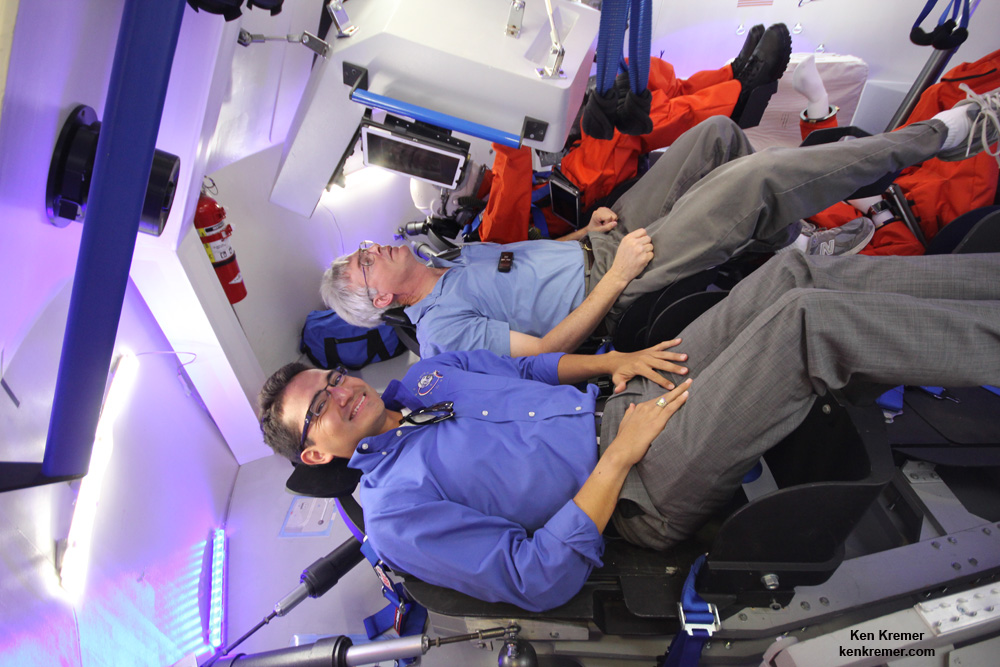
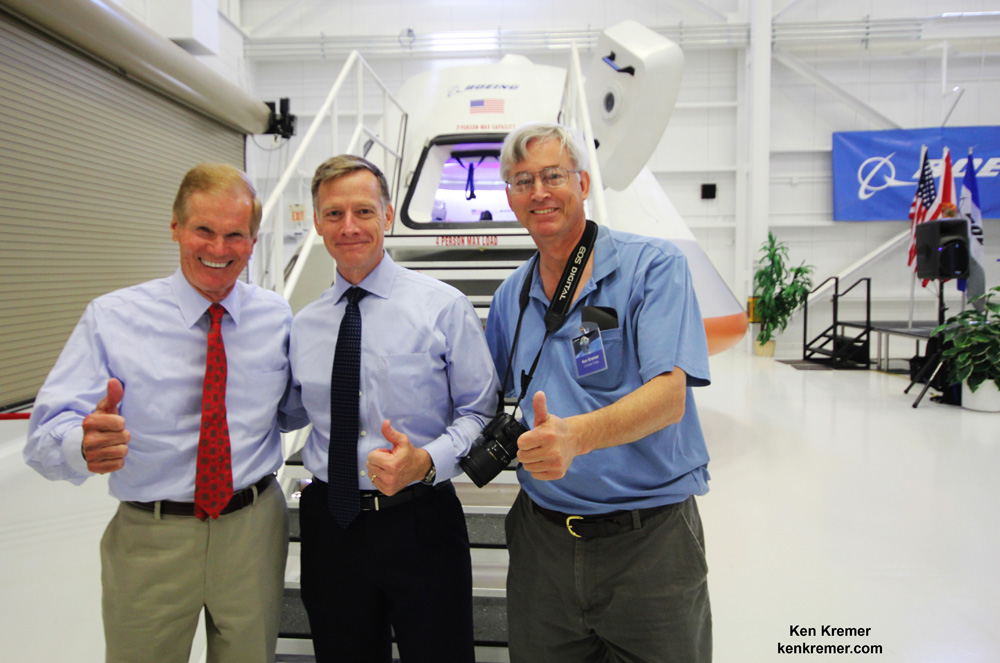
NASA Administrator Charles Bolden and Ken Kremer inspect NASA’s Magnetospheric Multiscale (MMS) mated quartet of stacked spacecraft at the cleanroom at NASA’s Goddard Space Flight Center in Greenbelt, Md., on May 12, 2014. Credit: Ken Kremer- kenkremer.com

NASA Administrator Charles Bolden and Ken Kremer inspect NASA’s MMS quartet of stacked spacecraft at NASA’s Goddard Space Flight Center. Credit: Ken Kremer

Each of the identically instrumented spacecraft are about four feet tall and eleven feet wide.  The deployment and activation of all four spacecraft is essential to the success of the mission, said Jim Burch, principal investigator of the MMS instrument suite science team at Southwest Research Institute (SwRI) in San Antonio, Texas.

“We’ve never had this type of opportunity to study this fundamental process in such detail,” said Burch.

They will fly in a pyramid formation to conduct their science mission, spaced about 10 miles apart. That separation distance will vary over time during the two-year primary mission.  Deployment and calibration process will last about six months. Science ops start September 2015.

MMS measurements should lead to better models for yielding better predicting space weather and the resulting impacts on life here on Earth and aboard the ISS.  Magnetic reconnection is also believed to help trigger the spectacular aurora known as the Northern or Southern lights.

An Atlas V rocket with four MMS satellites is poised for blastoff at Cape Canaveral, Florida on Mar. 12, 2015.  Credit: Ken Kremer- kenkremer.com

An Atlas V rocket with four MMS satellites is poised for blastoff at Cape Canaveral. Credit: Ken Kremer

The probes were built at NASA Goddard Space Flight Center in Maryland where I visited them in the clean room.

For complete details check out my articles and photos at Universe Today:

http://www.universetoday.com/119373/nasas-mms-satellite-constellation-blasts-to-orbit-to-study-explosive-magnetic-reconnection/

http://www.universetoday.com/119319/nasa-unravels-mysteries-of-magnetic-reconnection-with-nighttime-blastoff-of-mms-satellite-quartet-watch-live/

http://www.universetoday.com/119095/nasas-magnetospheric-multiscale-mms-spacecraft-set-for-march-blastoff-to-study-earths-magnetic-reconnection-events/

Astronomy Outreach by Dr. Ken Kremer

SpaceX Launches:  Apr 11-13, NASA Kennedy Space Center, FL. Evening outreach  at Quality Inn, Titusville, FL

NASA Mars Rovers and the Future of Human Spaceflight: April 18/19, NEAF, Rockland Community College, Rockland, NY.

Please contact Ken for more info, science outreach presentations and his space photos. Email: kremerken@yahoo.com   website:  www.kenkremer.com http://www.universetoday.com/author/ken-kremer/
Posted in April 2015 | Tagged , , , | Leave a comment

Next Board Meeting – March17, 2015

Date/time:        6:45 pm on March 17

Place:               West Windsor Branch, Mercer County Library
333 North Post Rd, Princeton Junction NJ 

All AAAP members are invited to attend.

RSVP to director@princetonastronomy.org

Posted in Sidereal Times | Leave a comment

Connecting Dark Matter Halos with the Galaxy Center and the Super Massive Black Hole

Tuesday, March 10, 2015 at 7:30 p.m – Bowen Hall, Princeton University

The AAAP welcomes Princeton University observational astrophysicist Andy Goulding as its March 10th guest speaker. Dr. Goulding graduated from the University of Durham (UK) with a MSc in Theoretical Physics in 2007, and in 2010, completed his doctoral dissertation at the UK Institute for Computational Cosmology on the identification of the full population of active galactic nuclei in the nearby Universe. Goulding moved to the US to take a position as a Smithsonian research fellow at the Harvard-Smithsonian Center for Astrophysics in Boston, and moved to Princeton University in 2014 as a research associate in the department of astrophysical sciences.

Andy’s research is concentrated around the understanding of the physical mechanisms by which all supermassive black holes at the centers of galaxies grow, and the investigation of the interplay between black hole growth, in the form of Active Galactic Nuclei, and the properties of their host galaxies. Using some of the largest and sophisticated telescopes ever constructed, he studies how known observational and theoretical relations between black holes and their galaxies become established: Are black holes hidden from our view by the same material that causes them to grow? If so, how did this fuel arrive at the black hole, and what is its geometric configuration – does the geometry affect the rate at which the black hole grows? What was the trigger for the growth of the black hole; does dark matter have a role to play in this; and are growing black holes preferentially found in particular galaxies?

Don’t miss this exciting presentation describing some of the more cutting edge, dynamic research occurring in the current astrophysics community.

Posted in March 2015, Sidereal Times | Tagged , , | Leave a comment

From the Director

Rex


by Rex Parker, PhD
director@princetonastronomy.org 

Upcoming AAAP events.  We’re working on a variety of activities to make this the most accessible and fun year ever for astronomy in the AAAP.  In addition to the regular public meetings each month on the Princeton campus, here are a few upcoming events being planned for members to participate in. More detailed info will be forthcoming next month.

  • Field trip to the US Naval Observatory in D.C. (spring)
  • Members-only special night at Washington Crossing Observatory (spring)
  • Regular public open house Friday nights at the Observatory (April-Oct)
  • Observing weekend at the renowned astronomy dark sky site, Cherry Springs State Park in northern Pennsylvania (July)
  • Easy road trip to see the famed Bell Labs Horn Antenna, Holmdel NJ, where the cosmic microwave radiation was first discovered (summer)

The recent AAAP tour of Princeton Plasma Physics Lab was a hit, with  about 25 members participating in a private, behind-the-scenes look at the leading U.S. center for fusion energy and plasma physics research (see PPPL article and photos elsewhere in this issue).

Beware the Ides of March? From history and the arts, a sense of danger accompanies the phrase “beware the Ides of March”.  Back in 44BC, Julius Caesar was forewarned by a seer that he’d come to harm not later than the Ides of March, a prophecy which came to pass and drastically changed the Roman Republic.  Okay, admittedly I’ve not seen Shakespeare’s “Julius Caesar” where the famous line is spoken, but at least have met his heir Octavius in “Antony and Cleopatra” at McCarter this winter.  The Roman calendar was based on moon phases with the Ides occurring at mid-month (day 15 for March) corresponding to the full moon.  So really the Ides of March no longer casts a foreboding spell but announces the end of winter and rebirth of spring with the coming equinox!

Spring is galaxy season.  With the equinox, we can begin getting outdoors again in both day and night.  More galaxies can be seen in moderately-sized telescopes in spring than any other season, with the incredibly dense galaxy clusters in Virgo leading the pack. If you’ve never seen a galaxy through the eyepiece of a good telescope, this spring will be a great opportunity to try it.  Upgrades now underway at AAAP’s Washington Crossing Observatory from our recent equipment acquisition and video astronomy technology project will make it even more fun.  We hope that recent and long-time members will come out to experience the celestial wonders “hands-on” this spring.  Those interested in learning to use the equipment for your own studies and to be a part of our extensive public outreach programs are urged to attend the regular meetings and talk to Observatory co-chairs, Gene Ramsey and Dave & Jennifer Skitt to develop a plan for your training (e-mail:  observatory@princetonastronomy.org).

Should AAAP join the Night Sky Network?  Here’s an opportunity for AAAP to join a national organization of affiliated astronomy clubs with connections to NASA/JPL.  The Night Sky Network is a coalition of amateur astronomy clubs designed to bring astronomy and the excitement of NASA missions to communities. Applying for club (free) membership can bring several benefits that are described on the Network website, https://nightsky.jpl.nasa.gov/index.cfm.  The Network is a partnership of amateur astronomy clubs, the Astronomical Society of the Pacific, and other organizations.  The goal is to help amateur astronomers share knowledge, time and telescopes to bring amazing and emerging aspects of astronomy to the public. Ongoing research by the Astronomical Society of the Pacific and the Institute for Learning Innovation shows that amateur astronomers need and desire support of their outreach efforts. The Night Sky Network was inaugurated and has been expanded to help meet these needs.  Please browse their website, and we can discuss it at the AAAP meeting on March 10.

Messier-106, a Seyfert galaxy in Canes Venatici. Image taken by Rex Parker in Titusville NJ. Equipment: SXVR-M25C camera, AG Optical 12.5-inch Dall-Kirkham astrograph, Paramount-MX mount. Processed in Maxim DL v.5 and PS-CS5.

Messier-106, a Seyfert galaxy in Canes Venatici. Image taken by Rex Parker in Titusville NJ. Equipment: SXVR-M25C camera, AG Optical 12.5-inch Dall-Kirkham astrograph, Paramount-MX mount. Processed in Maxim DL v.5 and PS-CS5.

Color in the deep sky — under New Jersey skies? The beautiful intense colors in astrophotos of the Messier and other deep sky objects, with glowing reds and blue-greens emitted by vast ionized hydrogen and oxygen gas clouds among the stars, have become familiar sights on NASA and Hubble internet sites and in those big glossy coffee table books. Galaxies also emit intense light energy in the violet, blue, and red bands due to numerous regions where young stars are being born (the H-II regions). But the deep sky color pallet is actually quite subtle and almost never visible in a telescope eyepiece due to the limits of human eye physiology and the faintness of the light captured by the telescope.  We rely on CCD imaging techniques which fortunately have advanced remarkably over the past 15 years or so.

Experts, often working in high altitude desert locations with very dark skies, usually approach color astro-imaging using the “LRGB” method.  Here many subframes are taken over the course of several hours with a high sensitivity monochrome CCD through a telescope using a sequence of color filters (Luminance, Red, Green, Blue = LRGB).  The individual filtered subframes are then calibrated and combined and balanced in the computer to create the final color images.  Here in central Jersey our less-than-pristine skies introduce serious challenges even with top-notch equipment.  Moon and skyglow backgrounds along with light pollution gradients conspire with changing weather, humidity, and seeing conditions over the course of a single New Jersey night, often introducing nearly intractable noise and light gradients in the LRGB-derived images.

NGC4631, the “Whale Galaxy” in Coma Bernices. Image by Rex Parker, taken in Titusville NJ.  Equipment: SXVR-M25C camera, AG Optical 12.5-inch Dall-Kirkham astrograph, Paramount-MX mount.  Processed in Maxim DL v.5 and PS-CS5.

NGC4631, the “Whale Galaxy” in Coma Bernices. Image by Rex Parker, taken in Titusville NJ. Equipment: SXVR-M25C camera, AG Optical 12.5-inch Dall-Kirkham astrograph, Paramount-MX mount. Processed in Maxim DL v.5 and PS-CS5.

But there is hope for New Jersey astronomers!  Whether you are considering astrophotography, or are already on the learning curve, you don’t necessarily have to buy that remote property or telescope time-share in the desert southwest.  After more than 12 years using the LRGB imaging method, I began to consider whether a “one-shot color” astronomical CCD camera would potentially produce better results under New Jersey skies.  The much reduced hardware complexity and lower weight and telescope balancing issues with one-shot color cameras add to their potential attractiveness over the LRGB technology.  The one-shot color approach uses a CCD sensor with a Bayer-matrix of RGB filters directly on the sensor itself (like terrestrial DSLR cameras). Once acquired the images are “de-Bayered” to convert to color using software after many subframes are calibrated and stacked.  The idea of using a one-shot color camera disputes much of the expert advice out there, which warns that these cameras are unsuited to light-polluted areas.  I wanted to test whether this was true, and theorized that the ability to capture all colors simultaneously in each subframe could actually minimize the noise/gradient issues which change over the course of an imaging run here in New Jersey. Further, it is proposed that the final resolution could equal that of the LRGB method if the image scale is appropriately selected (that is, CCD pixel dimensions must be carefully matched to telescope focal length).

Perhaps it should have been obvious that testing this hypothesis during winter would mean working in near-zero temperatures – that slowed things down a bit for me! The images above are a couple of first attempts (from February) to see color in galaxies imaged from central New Jersey using the one-shot color CCD method. The plan going forward is to make comparisons of both color approaches for a variety of deep sky objects, to determine if the one-shot color method is truly a better option than LRGB for our local sky conditions.

Posted in March 2015, Sidereal Times | Tagged , | Leave a comment

From the Assistant Director

by Larry Kane, Assistant Director 

On, Sunday, February 22, the Washington Crossing Park Association successfully pulled off its first major event.  It was held to celebrate the birthday of George Washington.  Over eighty people attended the event to hear three academic historians describe the role of New Jersey in the American Revolution and the major battles that took place here.  Because the AAAP made a donation of $100 to the WCPA, the group made our club a co-sponsor of the event.  My wife Marlene and I staffed the AAAP table at the event and we took advantage of the opportunity to talk about astronomy in general and the AAAP in particular.  I have attached a picture of our table.

Marlene Kane at the Washington Crossing Park Association event. Credit: Larry Kane

Marlene Kane at the Washington Crossing Park Association event. Credit: Larry Kane

I am urging that all AAAP members and friends consider joining the Washington Crossing Park Association.  The group was formed to, and works toward maintaining and improving the park in which our observatory is sited.  The result of the passage of question number 2 on last November’s election ballot was to drastically reduce funding for parks and preservation.   In response, the WCPA is working to inform the public and those organizations with a stake in the maintenance and improvement New Jersey’s state parks.  For more information about ballot question 2 and its ramifications, please see me.

On Wednesday, February 25, I attended a hearing of the Federal Energy Regulatory Commission in Ewing Township.  This single hearing in Mercer County was called to gather information on the PennEast natural gas pipeline that will be built through Mercer County and end in Hopewell.  Many residents with relevant scientific backgrounds testified on the negative environmental impact and potential explosive danger that the proposed 36” pipeline poses.   The proposed pipeline route will take it within a quarter mile of the observatory.  Stay tuned for further developments.

Posted in March 2015, Sidereal Times | Tagged , | Leave a comment

In Memoriam: Tony Miskowski

by John Church

Tony Miskowski, an active AAAP member from the 70’s and 80’s, passed away on February 22nd. Tony was one of the chief builders of our observatory in Washington Crossing State Park in the late 70’s. He had a warm personality and was physically strong and capable. I remember him lifting heavy rocks out of the foundation ditch that nobody else could even budge and climbing up on the roof beams to help finish their attachments. The photo below shows Tony in the red plaid jacket helping to raise the east beam into place.

Erecting the Roof Beams at Washington-Crossing Observatory  Credit: Dick Perry

Erecting the East Beam at Washington-Crossing Observatory Credit: Dick Peery

Tony never missed our picnics and would customarily bring a hearty dish of kielbasa that was a great favorite of everyone’s. Those were memorable times indeed.

Posted in March 2015, Sidereal Times | Tagged , | Leave a comment