Minutes of the October 11, 2016 AAAP Meeting

by James Poinsett, Secretary

  • Rex called the meeting to order and gave a brief outline of the night agenda
  • The lecture was by Steven K. Korotky titled “Restoration of the 6 ½ inch Prin telescope of the Daniel Schanck Observatory.”
  • Larry talked about a club get-together with the WC Park Association and about the August solar eclipse. He reported that all motel rooms are filled near Monmouth Oregon, just south of Salem. He has a couple of rooms reserved, see him to inquire about availability.
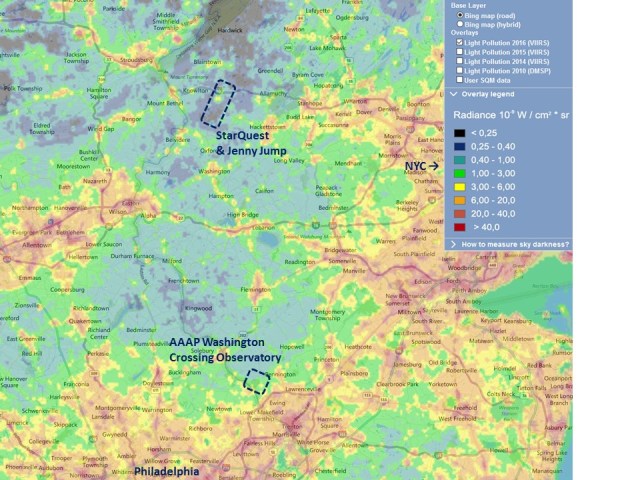
  • Next up for discussion was AAAP’s Jersey StarQuest. It will be walk in registration, no prior commitment needed. Low cost with no meals provided. The main reason for attending is the much lower amount of light pollution and to hob nob with fellow club members. A light pollution map was shown and it clearly showed how much less pollution there is at the Hope Center and at Jenny Jump.
  • We were shown a simulation of the ESA lander on Mars. It was supposed to happen a day or two after the meeting.
  • The treasurer’s report stated that so far over 30 members had paid for this year and the treasury was a healthy $20K despite all the expenditures for the observatory over the past year. The club has also received $700 in donations in memory of Gene Ramsey.
  • Sky 10 should be installed soon at the observatory.
  • We have 3 outreach requests, a 9 year old girls birthday party, 11/5 at the observatory and 11/18 Science night in Upper Freehold.
  • The club will make or obtain an aperture mask for the Mewlon telescope for lunar observing. Also the Mewlon is not parking properly, be careful when closing the roof until the problem has been corrected.
  • A suggestion for signs on Bear Tavern Rd. that would point to the observatory. Using a symbol or simply AAAP would indicate where to turn for those who are trying to find us. Street sign quality is desired.
  • A liaison with WC Park to replace Gene is needed. Larry volunteered to step in.
  • Our webmaster is still looking for ideas and feedback for the site. A suggestion was made for a forum page or possibly Google groups.
  • The next meeting will be on Nov 8th, election night. The speaker is Dr. Jim Stone.
Posted in November 2016, Sidereal Times | Tagged , | Leave a comment

The Astronomical Vantage Point

By Prasad Ganti

Last winter, I was driving across Pennsylvania in the middle of the night from the western border with Ohio to the south eastern border with New Jersey. I saw Orion the hunter, the most prominent constellation in the winter skies. It rose from the east and rose higher and higher in the sky. As I turned south, I saw the Canis Major constellation with the brightest star Sirius. The dark skies in the rural areas providing a good astronomical feast for the eyes. With straight highways and almost no traffic, frequently stealing glances at the sky was a pleasant memory.

A thought then stuck me. How do the stars and star formations look from different vantage points. The vantage points could be on the Earth. They could be on another planet in our solar system. Or some point in our Galaxy or some other point in the Universe. I am sure the sky would look different. But just how different? Let us start with our home, the Earth. I did not observe the sky significantly from any country other than the US. I remember seeing the winter sky in India a few years back. But the light pollution in populated cities is a major deterrent. The Orion looked similar from India. It is so significant in size that I am assuming it looks very similar from whole of the northern hemisphere.

The skies look differently from the southern hemisphere. In countries like Australia, New Zealand, Chile, Argentina etc. In the northern hemisphere, the pole star or the north star (called the Dhruv in India) stays at the same position in the sky night after night. It is visible at different points from the northern hemisphere but not at all from the southern hemisphere. It is higher up in the sky when approaching the north pole. It is lower in the sky as we approach the equator. In the southern hemisphere, the equivalent of the north star is the southern cross. This is not visible from the northern hemisphere at all. Our nearest star (other than our own Sun) is the Alpha Centauri, which is about four light years away. This is visible only from the southern hemisphere. Similarly, the hazy cloud called the Large Magellanic Cloud  is also visible from the southern hemisphere only.

If we go to Mars, how will it look ? Probably similar to what is on Earth. The north and south hemisphere and the seasons (because the axis of Mars is also titled like the Earth) offer different views. But from the interplanetary space, the glare of the sunshine may block all the views of the stars, unless we pass into a planet’s shadow. Far from the Sun, like Pluto or the Kuiper belt, the Sun itself looks very faint, almost like a star rather than as Sun, the view may be more uninhibited with the whole dark sky at the same time.

In the interstellar space, the view will certainly be different, depending on where in the Universe we are located. The constellations will not be visible. Each point will have its own constellations. That is different shapes which can be interpreted as confirming to a pattern. Then there are two phenomena which will produce totally different views. First is the visual binaries. The two stars which appear very close to each other, because they are on the same line of sight from the Earth. Actually they may be very far from each other, but being on the same straight line, appear to be very close to each other. The line of sight will be different from any other place in the Universe. But from that vantage point, there could be other pairs of stars which appear as visual binaries. Those set of stars may not be visual binaries as seen from the Earth.

Second phenomena is the Gravitational lensing. If a star is hidden by a massive object (like a galaxy) in the line of sight from the Earth, the hidden star will appear as a ring around the massive object. Produced due to bending of star light by the massive object.This ring is called the Einstein’s ring. Since this phenomena has something to do the line of sight, it will not look like an Einstein’s ring from a different point in the Universe. Likewise, that point may have its own Einstein’s rings.

I am sure there is a place in the Universe where both Milky Way and the Andromeda galaxies will look as small and hazy lumps. Where would it be ? Can we dream of reaching there ?

Posted in November 2016, Sidereal Times | Tagged | Leave a comment

Snippets

compiled by David Kaplan

View from Planet Nine towards the sun. NYT

View from Planet Nine towards the sun. NYT

If Planet Nine Is Out There, It Tilts Our Solar System
Most people think the eight planets in our solar system orbit the sun along a straight plane, like a disc on a record player. But actually, that plane is slightly tilted, and now astronomers think they know why: The elusive Planet Nine….more

Thousands of galaxies. Hubble Deep Survey. NYT

Thousands of galaxies. Hubble Deep Survey. NYT

Two Trillion Galaxies, at the Very Least
The scale of the universe, already unfathomable, just became even more so: There are about 10 times as many galaxies as previously thought.
Previous estimates were that there were perhaps 200 billion galaxies in the observable universe. One might well ask — what difference does it make?….more

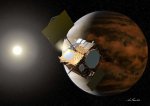
Akatsuki Probe orbiting Venus. NYT

Akatsuki Probe orbiting Venus. NYT

Venus: Inhospitable, and Perhaps Instructional
Venus is not a placid paradise — that much we know. In addition to searing surface temperatures, wind in the upper atmosphere howls at up to 250 miles per hour, carrying clouds around the planet once every four days. The Japanese space probe Akatsuki, now in orbit around Venus, seeks to solve the mystery of so-called super-rotation….more

Bright spot possible cloud on Pluto. NYT

Bright spot possible cloud on Pluto. NYT

Pluto May Have Clouds, New Data Indicate
Pluto is hazy, with a chance of clouds.
Findings from NASA’s New Horizons spacecraft include images showing seven small, bright spots that might be clouds floating just above Pluto’s surface.
Scientists working with data from NASA’s New Horizons spacecraft, which flew past Pluto last year, are presenting some of their latest results this week in Pasadena, Calif., at a meeting of the American Astronomical Society’s Division for Planetary Sciences….more

Sunlit part of Jupiter. NYT

Sunlit part of Jupiter. NYT

Juno Hobbled but Healthy After Glitch, NASA Says
Hours before a close flyby of Jupiter on Wednesday, NASA’s Juno spacecraft experienced a malfunction that scrambled plans for peering deep into the planet.
At 1:47 a.m. Eastern, the spacecraft put itself into “safe mode” and restarted its computer. Juno’s instruments shut down, scuttling observations that were to take place as it passed 3,000 miles above Jupiter’s clouds….more

Gigantic ring system of J1407b. NYT

Gigantic ring system of J1407b. NYT

Distant Ringed Object Could Be ‘Saturn on Steroids’
About 400 light years from our solar system, there is a celestial body that looks like Saturn on steroids.
Its rings are about 200 times larger than its counterpart here, measuring about 75 million miles in diameter. The ring system is so large, in fact, that scientists aren’t sure why it doesn’t get ripped apart by the gravity of the star it orbits….more

Posted in November 2016, Sidereal Times | Tagged , , , | Leave a comment

From the Director

Rex


by Rex Parker, Director

October 11 Meeting. Hope to see you at Peyton Hall auditorium on the Princeton Campus for our next meeting (7:30 pm Oct 11). Please see Ira’s article in this edition of S.T. for information about the guest speaker. In addition to the lecture, we’ll discuss significant upcoming events – Jersey StarQuest 2016 (below) and emerging plans for the Jenny Jump Observatory.

Let Us Know What You’re Thinking. If you’ve recently joined, are considering becoming a member, or have been an amateur astronomer in AAAP for years, we want to hear from you! We draw upon an amazing pool of local and regional talent to provide members and public with monthly guest lectures, such as recent speakers from Princeton University Astrophysics, NASA, IAS, Rutgers, Columbia, and several high tech companies. We operate an Observatory at Washington Crossing Park with state-of-the-art telescopes, and are active in public science/astronomy outreach. Please give us some feedback – we’re interested in your views, positive or otherwise. You can reach me at director@princetonastronomy.org, or you can contact other Board members using the addresses listed on our website (“Contact Us” tab).

Jersey StarQuest, Oct 28-30, 2016. The observing event of the year for amateur astronomers in our area is fast approaching. Held each year at the Hope Conference and Renewal Center http://camphope.org/ in north Jersey, StarQuest is all about deep sky telescopic observing at one of the best locations in the state (see below about light pollution and the quality of this site). Hope Center offers clean bunkhouse accommodations or camping on-site and a kitchen for cooking if desired. No meals are provided by the club; restaurants are within a few minute drive. Even if you don’t own a telescope, here’s your chance to learn hands-on about astronomy and observing and make new friends. Here’s how we’ll organize the event.

  • Walk-in registration, no advance payment, no pre-registration. You can decide to attend at the last minute. We ask that you send in a non-binding intent-to-participate form (distributed by e-mail) to help us estimate needs for the Conference Center.
  • This is a chance to meet other amateur astronomers and make friends in the club. Attendees are encouraged to observe through other telescopes on the field. You’re also welcome to bring family and invite other interested people who are not yet members.
  • Low costs (the Club subsidizes the event). Per night fees: $20 adults, $10 children (6-12), regardless of bunkhouse or tent/RV camping. No meals will be provided though the Center’s kitchen will be available. Hot and cold drinks will be provided throughout the weekend.

Why Go to Hope NJ (StarQuest site) or Jenny Jump to Observe? Light pollution limits the contrast of deep sky objects seen in telescopes – galaxies, nebulae, and star clusters. While it’s easy to see that this depends on your location, how do you know just where to go to improve visibility? Until recently, available light pollution maps offered low resolution and accuracy because they were based mainly on population density charts. But the latest maps using satellite-based physical data have markedly improved resolution and reliability. For example, extensive satellite imaging data from the Earth Observation Group of NOAA’s National Geophysical Data Center was used by Slovenian GIS expert Jurij Stare to create a new high resolution light pollution map using Bing map overlays. The data for these maps comprises nighttime radiance composite images from the Visible Infrared Imaging Radiometer Suite (VIIRS). VIIRS is a scanning radiometer by Raytheon on board the Suomi National Polar-orbiting Partnership weather satellite managed by NOAA and NASA. Radiance, the radiant flux per unit solid angle, is visually perceived as luminance and interpreted as skyglow. The SI unit of radiance (watts/cm2*sr) can be converted to the SI unit of luminance (candelas/m2), and to the unit reported by the Sky Quality Meter (magnitudes/arc-sec2) familiar to amateur astronomers. Indeed, user-entered Sky Quality Meter data constitutes one of the map layers on the light pollution map created by Jurij Stare.

You can see in the screen shot below (or by going to the website) the gradients in light pollution across our region, and compare your home to the AAAP facilities at Washington Crossing and the darker skies at Jenny Jump and Jersey StarQuest near Hope NJ. That’s one more good reason to attend StarQuest this year! The detailed, high resolution maps are available on-line at: http://www.lightpollutionmap.info/#zoom=4&lat=5759860&lon=1619364&layers=B0TFFFF

Dark Sky Map September 2016

Dark Sky Map September 2016

Light pollution in the NJ area and around the globe. from satellite radiance data. Map screenshot used by permission of the author, Jurij Stare, www.lightpollutionmap.info. Bing map layer by Microsoft. Data credit and global-wide VIIRS image: Earth Observation Group, NOAA National Geophysical Data Center.

Posted in October 2016, Sidereal Times | Tagged , | Leave a comment

From the Assistant Director

by Larry Kane

I am starting the logistical work to put together an AAAP trip to view the total solar eclipse on August 21, 2017.   While it seems to be an event far into the future, if we wait too long, there will be few choices available for us. Therefore I will put forth some options that are open to us now.

We are fortunate that our fellow AAAP member, and club historian, John Church has made some inquires on our behalf. His brother lives very close to the path of totality in Oregon. A potential viewing site on private property that is within the path of totality is available for our use. It is located near Corvallis Oregon. While I have not, yet, identified hotels or motels, I can do this once I have a general number of interested members. With a number of members who are very interested, I can also begin a search for affordable airline flights. If we can get a group of at least ten or twelve interested members, we should be able to qualify for discounts.

So I will make an announcement of all this at our next membership meeting, but in case you cannot attend the next meeting on October 11, please let me know if you are interested in this exceptional group activity. If you think you might want to be a participant. Please send your name and a statement of interest to my email: assistant.director@princetonastonomy.org.

Posted in October 2016, Sidereal Times | Tagged , | Leave a comment

Restoration of the 6-1/2 Inch Prin Telescope of the Daniel S. Schanck Observatory

by Ira Polans

Steven K. Korotky

Steven K. Korotky Ph.D.

Our next speaker is Steven K. Korotky, former Senior Research Scientist at Bell Laboratories. In his talk on October 11, he will summarize the history of the Schanck Observatory including its renovation, recount the journey of the Prin telescope, and provide an update on his work to restore and reinstate it as the scientific centerpiece of the historic astronomical observatory.

The renovation of Rutgers University’s Daniel S. Schanck Observatory was recently completed in time for the celebration of the 150th anniversary of its original dedication on June 18, 1866. However, absent from the observatory for more than two decades has been its third and last working telescope – the 6 and 1/2 inch refractor fabricated by Georges Prin in 1929. Earlier this year the Prin telescope was located and the process of restoring it and reassembling it in the Schanck was begun.

Hope to see you at 7:30 P.M. at Peyton Hall on October 11, 2016.

Posted in October 2016, Sidereal Times | Tagged , | Leave a comment

Minutes of the September 13, 2016 AAAP Meeting

by James Poinsett, Secretary

Minutes of the September 2016 Meeting of the AAAP

  • Club director, Rex Parker, called the meeting to order and reviewed the club happenings since May of last year.
    • The May 9th Mercury Transit
    • The new telescope in the observatory, a Takahashi Mewlon – 250
    • FIOS has been installed at the observatory
    • The board has resolved to continue AAAP’s commitment to the Jenny Jump observatory
    • StarQuest 2016 will be the weekend of October 28-30, no pre-registration required. It will be primarily an observing event. No food will be provided.
  • The lecture was by Dr. Jia Lin, it was titled “Neutrinos, their discovery, detection and future prospects”.
  • After the lecture we spent some time remembering our friend Gene Ramsey with pictures and stories about him. He will be missed.
  • Jenny Jump observatory was the next subject of discussion.
    • The club received a request to refurbish and utilize our observatory or give it up.
    • The board has decided to re-commit to the observatory. One option would be to share the observatory with AAI. The AAAP would still own the lease and the equipment but both clubs members would be trained to use it.
    • The main problem is the roof does not open all the way.
    • Bill Murray and Gene Allen will chair a repair committee, several more members volunteered to be on it. October 8th is the most likely date for a work party to attempt repairs.
    • A motion was made to authorize up to $1000 for repairs to the observatory. The motion was seconded and the board members present voted unanimously to approve the motion.
  • The Stokes Star party is on November 5th & 6th. It is a no frills party.
  • StarQuest is set for Oct 28-30, the Hope Conference center has been booked.
Posted in October 2016, Sidereal Times | Tagged , | Leave a comment

The First Public Night Without Gene

by Kevin Mooney

When Gene Ramsey was asked why he preferred to view an astronomical object through a telescope eyepiece as opposed to the computer screen, he would respond by saying “there was no substitute for having the light from a distant object touch his optic nerve.” Gene, who oversaw the marriage between computer technology and astronomy at the Washington Crossing Park Observatory, saw great value in new technology, but also kept technology in its proper space. With Gene, it was that special human touch between him, the public and club members who shared his enthusiasm for astronomy that will endure. This photo was taken during the public night that very appropriately coincided with the day of his funeral. For me to say he will be missed hardly captures what needs to be said. But he will be missed.


Gene RIP

Posted in October 2016, Sidereal Times | Tagged , | Leave a comment

O, For a Dark Night Sky

by David J. Kaplan

The city’s night sky
Holds the moon aloft,
A dim orb.

Constellations—incomplete,
The drinking gourd dismantled
Cassiopeia banished.
Orion dismembered.

O, for a dark night sky,
Which shimmers
In both mind and eye.

When meteors from heaven sent,
Toward Earth their voyage bent

With an arc as wide
As a child’s smile.

Posted in October 2016, Sidereal Times | Tagged | Leave a comment

Rocket Science

By Prasad Ganti

Recently, SpaceX’s rocket Falcon 9 blew up on the launch pad, after having had several successes with Falcon 9 in the past. A further failure last year was reported when its rocket blew up in space. Regardless, the company has been successful and is a good example of a private enterprise making it into the space launching business, thereby breaking the monopoly enjoyed by NASA.

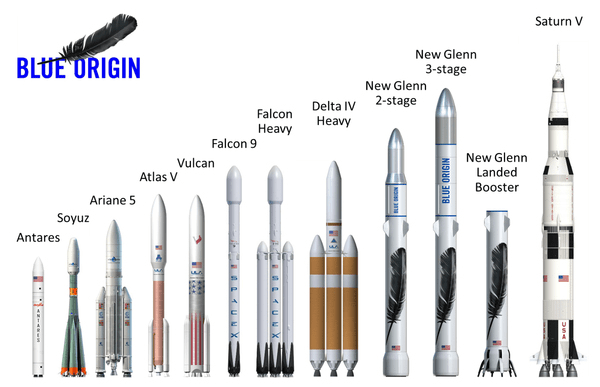
Blue Origin, the company launched by Jeff Bezos, the founding CEO of Amazon, has lofty ambitions and announced their New Glenn Stage 2 and Stage 3 rocket. Notwithstanding the taunts Bezos was throwing at SpaceX’s failure, the future bodes well for both companies, as well as Orbital Sciences Corporation’s Antares and Paul Allen’s Vulcan rockets.

A multitude of rockets make me ask the question of what are the differences between them. In terms of size, power, capabilities etc. For instance, how is the BMW 700 series of cars different than the 300 series ? Also, how is Boeing 777 different than 747 or Airbus A380 different than 320 ? I saw a picture published by Blue Origin showing the different rockets standing next to each other. Given below is the picture which caught my imagination.
Photo Credit:  SpaceX
Clearly, Saturn V rocket which took Neil Armstrong and his fellow astronauts to the moon, stands head and shoulders above the others. Though the others are getting closer. The New Glenn rockets are next in the line. They represent the future and have not stood the test of the time yet. Delta IV heavy is next in line. It also has two solid booster rockets strapped to it. It is used to launch heavy payloads into space.

Falcon Heavy is a powerful version of Falcon 9. The two solid rocket boosters attached to its sides indicate the power. Atlas V is currently in use while Vulcan is from the new venture promoted by Paul Allen, the founder of Microsoft. These two spaceships look comparable. Of course, the specifications do vary. Ariane 5 is the workhorse of the European Space Agency. Routinely launching commercial payloads from French Guiana in South America. Likewise Soyuz is the workhorse of Russia and has been in use for a long time now. Antares rocket from Orbital Sciences had some successes in the recent times, another private venture vying to get contracts from NASA.

Other than the sizes we have seen here, they differ in terms of the engines used, the number of stages employed, and the fuel utilized etc. Solid rocket boosters use solid fuel which produces more push per pound than the liquid fuels. But it is difficult to stop once lit. Hence it used in the first stage of a rocket. Liquid fuels are more controllable and used in the later stages of a rocket burn cycle. Cryogenic engines generate more thrust per unit of fuel and are used as the final stage to deliver heavy payload into the space.

Though not shown in the picture, other countries have rockets too like China, Japan and India. Rocket launches are becoming more democratic: both amongst countries as well as companies. Still Rocket Science is hard and unforgiving as the recent disasters prove. But the future seems to be bright for space launches.

Posted in October 2016, Sidereal Times | Tagged , | Leave a comment