From the Program Chair

By Ira Polans

The December AAAP meeting will be held on the 12th at 7:30PM in Peyton Hall on the Princeton University campus. The talk is by AAAP member William Murray on “The Life and Legacy of Charles Messier”.

Bill’s talk is an examination of the life of the famed 18th century French astronomer Charles Messier and a look at how his work 200 years ago affects amateur astronomers today. Charles Messier is best known today for his catalog of 110 “Messier objects”. The purpose of the catalog was to help astronomical observers, in particular comet hunters, distinguish between permanent and transient objects in the night sky. These objects turn out to be some of the best nighttime objects to introduce the public to.

We are still looking for volunteers to give a 10 minute talk at future club meeting. If interested, please contact me at program@princetonastronomy.org. Please let me know the topic and your availability.

There will not be a meet-the-speaker dinner prior to the club meeting.

We look forward to seeing you at the December meeting!

Posted in December 2017, Sidereal Times | Tagged , , | Leave a comment

November 14, 2017 Meeting Minutes

by Jim Poinsett, Secretary

  • After the presentation and the break Rex called the meeting to order.
  • Rex talked about light pollution and how LED lights blue shift and cause problems for viewing and astrophotography. He stressed the need to influence local authorities to use phosphor converted LEDs.
  • He also talked about how the spectra of light reflecting off the atmosphere of extra-solar planets is being analyzed for signs of life.
  • The subject of an interactive calendar for the website to sign up for outreach events was discussed. No current solution was known, additional research is needed.
  • How to make it clearer for visitors to our website to request an outreach event was brought up. Several suggestions were made .
  • The possibility of moving our website to a new hosting company was discussed. The possibility of getting increased space with our current hosting company is also a possibility. A report will be made at the next meeting.
  • As of the meeting date the observatory was not winterized and is fully operational.
Posted in December 2017, Sidereal Times | Tagged , , | Leave a comment

November 6, 2017 Board Meeting Minutes

by Jim Poinsett, Secretary

  • Minutes of the November 2017 Board Meeting of the AAAP
    • The meeting was called to order at 7:30
    • The first topic of the evening was about making the outreach chairperson and observatory chairperson positions members of the Board of Directors. The only negative brought up was the occasional difficulty of obtaining nominees for some of the board position. The main positive aspect was it would emphasize the importance of these positions. The board voted unanimously to put the amendment to a vote by the members. The members will be notified and the voting will take place after the first of the year.
    • Membership dues are now payable through PayPal.
    • The club policy on speaker expenses was brought up and it was decided that there does not exist a policy, expenses are handled on a case by case basis. It was decided to leave it that way.
    • It was decided to add a 10 minute presentation by a member at the beginning of each meeting. Volunteers are wanted and encouraged to speak up.
    • The SkyNet astrophotography program is continuing. Currently 23 members have signed up for accounts and 9 have used minutes.
    • Observatory topics were covered next
      1. There are several pieces of equipment at the observatory that are not being used, SBIG ST-10 CCD camera, Optec TCF autofocuser and an Optec IFW auto filter wheel. Since no one has used this equipment is several years the board has decided to sell it.
      2. The current Mallincam is a low resolution, NTSC analog camera. Possible replacements and costs will be presented at the next meeting.
      3. The need for gravel on the observatory driveway. A proposal will be prepared for the next meeting.
      4. There are some focusing issues on the Hastings and Mewlon scopes. The tapered end of the focuser on the Hastings is causing problems, it needs to be squared. Tom and John have offered to do the work to repair it.
      5. The possibility of the Mewlon needing collimation was discussed, the procedure has been found. The possibility of thermal issues causing focusing problems was discussed. Procedures to lessen the thermal issues will be tried before doing a collimation.
      6. The need to update and improve the alarm and security system at the observatory was discussed. Since we have internet access the board decided it would be appropriate to buy a system rather than pay a monthly fee to a monitoring service. Dave will put together a list of options.
    • A membership coordinator position was proposed. While the need to attract new and younger members was acknowledged it was decided not to create another position.
    • The board discussed buying an EAA telescope for outreach purposes. More research needs to be done before a decision will be made.
Posted in December 2017, Sidereal Times | Tagged , , , | Leave a comment

Skynet exposed

by Ted Frimet

dare you seize the galaxy?

Hello Everyone,

I am new to Skynet and am trying to get started.  I have watched the videos but am confused on a couple things and would appreciate any advice.

For my first photo, I am trying to photograph M101.  Since these dimmer objects have a longer exposure time and use up credits quickly, I’d like to get this first shot right.  

Here are my questions:
1) Filters.  In the video, the lady drags in a separate screen from out of nowhere that gives more details about which filter is recommended for her demo shot on Saturn.  I can’t find this “recommendation” screen anywhere, so my questions are:  where is the screen located?  Do you have a recommendation on your own experience for a filter for galaxies (M101 magnitude 7.86) ?  

2) Exposure Time.  I see in the video that there is a recommended maximum exposure time. For M101 it is 120 with HiLum filter.  When you take your images, do you just choose the max time or will it be overexposed?

I see M101 can be photographed by a couple telescopes, but at a later time.  How do I select what time I want to request the telescope to take the image?  And when you set the time, is it our DST time or GMT or local time at the telescope?

Many thanks,

Rich

To answer your question on “which filter is recommended for her demo shot on Saturn”, click on the below link,

Click to access lab1.pdf

and search for “PROCEDURE: A. OBSERVE WITH SKYNET

3. Observe Planets.

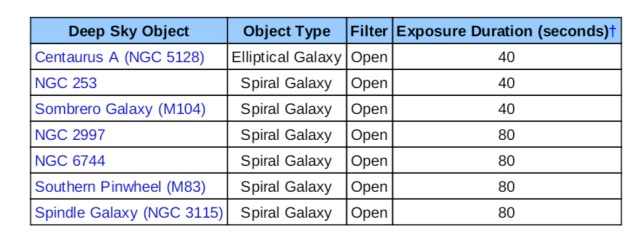
You will find the below table, which will list Saturn, its recommended filter, and exposure duration, as found in the above PDF.

Here is a copy of that table:

It isn’t too intuitive to find the “V” filter on Skynet. You are probably selecting telescopes, then filters which are supported by those telescopes.

I might suggest you reverse your selection process. That is, choose the filter first, and select from the list of telescopes then presented that offer those filter options.

Look for this graphic on Skynet:
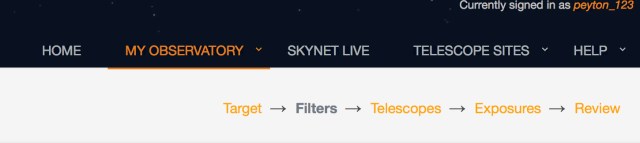
As you can see, I have selected “Filters” after assigning my target. On the filters page, you will find the recommended “V” filter for Saturn. The selection looks just like this:

Where GenG (generic G’reen” is listed as “V”, greenish filter.
 Or you might try the Astrophotography Green filter.

Moving onto the second part, of your first question… Do you have a recommendation on your own experience for a filter for galaxies (M101 magnitude 7.86) ?

In the same referenced Skynet Lab, there is a table for recommended exposures and filters. The “open filter” setting is recommended for Spiral Galaxies.
Here is a shot of the Whirlpool galaxy at 30 seconds exposure, with Open filter setting:


We arrive at your second question.  I see in the video that there is a recommended maximum exposure time…When you have taken your images, do you just choose the max time or will it be overexposed?

The maximum time is presumed to keep the camera from overexposing. Having said that, go ahead and experiment. I haven’t tried past the maximum exposure time. You might find Skynet software presenting you with a warning, and a limitation on scope selection. See below:

I really enjoy your third and final question. It’s the best! How do I select what time I want to request the telescope to take the image?  And when you set the time, is it our DST time or GMT or local time at the telescope?

In the Skynet user interface, where you select your filters, and telescopes, you will find an advanced options. It will appear just below your AAAP time account information.

Select the check box titled “Delay the start of this observation until …UTC.” And fill in a time.

At first blush, and for a few entries, you may enter incorrect information. It happened to me.

If you are permitting Skynet to automatically choose the next available telescope, then it will, of course, make any adjustments to ephemeris data and time parameters for you.

Here is a referenced link on the web for EST to UTC conversion. https://www.worldtimebuddy.com/est-to-utc-converter

Rich, the 800 lb gorilla in the room is that when you are selecting a target, and it is in the “horizon” window then all is well.

A horizon graph, like the one below, may provide you with a good chance of getting an image:
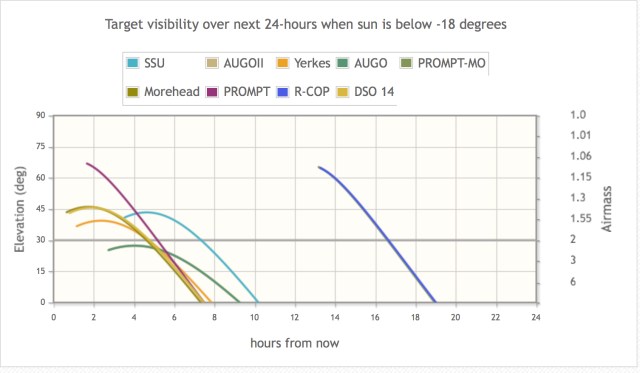
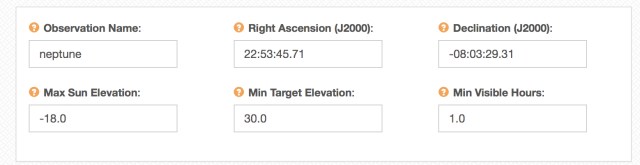
However, if there is no target visibility (nothing above the 30 deg elevation marker – or a complete lack of “colored” lines – then cancel your request, and choose another target. This will most likely happen with planets. Alternatively, you could change the minimum visible hours from “1.0” to, say, 0.5 and try to squeak in an observation.
I hope that this has been of some help for you, and our readers, and enriches the experience with the Skynet Robotic Telescope Network.

Rex had a really good solid reply. It appears below:

Thanks Ted, those comments are really helpful in answer to Rich’s questions.  I’ll add a couple of other thoughts here.   

The CCD cameras in Skynet have anti-blooming sensors (e.g., KAF-16803), beneficial for imaging dim objects such as galaxies.  If a pixel registering a brighter area (e.g., galaxy core) becomes saturated (exceeds well depth capacity) it will not bloom vertical streaks the way non-anti-blooming CCD sensors do.  At longer exposures pixels corresponding to fainter regions of the object continue to increase in value as brighter pixels max-out (at the well depth value for the sensor), improving the overall image character by showing fainter regions with greater intensity.   

120 sec is a good starting point for galaxies.  Try “bracketing” a few exposures to see how this affects the image.  My SSRO group using PROMPT2 at Cerro Tololo uses 30 minute sub-frames for all deep sky work, and here at home in NJ I use 15 minute sub-frames.  However, as mentioned at the meeting, exposures of this length need active autoguiding to correct small tracking errors (otherwise even very small errors lead to trailing, out-of-round stars).  Skynet generally does not make auto-guiding available to the user due to complicating features, although it’s possible that at deeper levels in the user priority chain guiding may be possible.  

Luminance (L) filters are really IR cutoffs and are used mainly to attain parfocality with the other R,G, B filters.  Any filter in the light path causes a small but significant change in focal length, so not having a filter would cause problems.  Having to adjust focus for filter changes is inefficient.  Color imaging of deep sky objects is done by taking a series of L, R, G, and B filter frames and combining in software to make the color composite.  The luminance (L) filter has the greatest sensitivity (highest quantum efficiency) since the others filter out broader wavelengths.  It’s interesting to compare pixel brightness data for the same object at constant exposure times with L compared to R, G, and B filters.   

— Rex

Epilogue:

I had inquired to Rich if we could use his follow-up, and publish results. Below, is our Amateur Astronomer’s first image taken from Skynet. It is M51 with its histogram adjusted in Afterglow software, ranging: min 40 max 99.2. The histogram feature, is a constraint on how much “white” and how much “black” will show thru in the final image.

Way to go, Rich! Awesome!!

Posted in December 2017, Sidereal Times | Tagged , | Leave a comment

Voyagers on a Grand Tour

by Prasad Ganti

For forty years, they have been traveling towards the outer solar system and beyond. They are the twin space probes Voyager 1 and Voyager 2. Fueled by nuclear energy in the form of plutonium based thermal generators, Voyager 1 is the only man made object that cleared the boundary of our solar system and is in the interstellar region, the space between stars. Voyager 2 is fast approaching this milestone. They have gone further than any other man made object. Their engines and instruments are running for longer time than any other man made machine.

These space probes embarked on what is known as a Grand Tour. A tour of all the outer gaseous giants, namely Jupiter, Saturn, Uranus and Neptune. It is known as the Grand Tour because all these planets were aligned, an event which happens once in 175 years. It happened in the 1970s and was predicted by Gary Flandro of Jet Propulsion Laboratory earlier in 1964. When this alignment happens, a single space probe can visit each of these planets using the gravity assist of the earlier planet. When it reaches Jupiter, it uses the gravity assist of Jupiter to fling itself towards Saturn and so on. This way, all the four outer planets can be reached faster and with minimum amount of fuel.

The variable distances between the planets and the gravity assists are unique to space travel. We do not find such a concept on Earth. The distance between London and New York is always the same, as far as the human horizon of time can see. The distance between the planets varies because each is moving around the Sun at different speeds, and not in lockstep with each other. The Earth from where the space probes are launched, is itself a moving platform. So are the destination planets. The space probe gains the Earth’s momentum at the time of launch. When it reaches a destination planet, it can be a fly by or get captured by the planet’s gravity. If fly by, it can get a gravity assist like a slingshot, bends its path slightly, and hurl itself at a higher speed towards the next destination. Thus the planet’s momentum gets added to that of the space probe’s. It is like getting a push for free. This concept was amply demonstrated by the earlier probe Mariner 10 which visited Venus and Mercury in 1973-74.

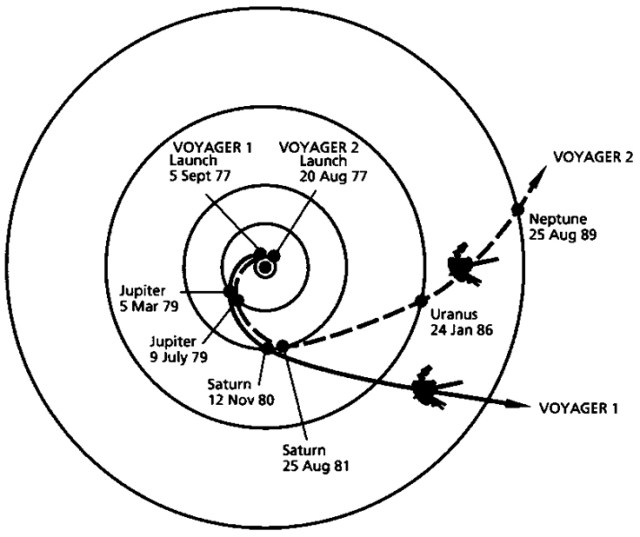
NASA started planning for the twin space probes Voyager 1 and 2 to go on the Grand Tour. The initial plan was to visit Jupiter and Saturn only and later decide on Uranus and Neptune. Both the Voyagers were launched in 1977 within two weeks of each other. They reached Jupiter in 1979. Voyager 1 reached Saturn in 1980 and then went to its largest moon Titan. After that, it moved away from the planetary plane towards the interstellar space. It is important to note that the planets all move around the Sun in almost a single plane, like on the surface of a table. Voyager 1 just moved away from the surface of the table upwards. It could not visit any other planets along this path.

Voyager 2 reached Saturn in 1981. After evaluation it was found that Voyager 2 can proceed to Uranus which it reached in 1986. Voyager 2 next proceeded to Neptune in 1989 after which it left the planetary plane towards the interstellar space. While Voyager 1 went above the surface of the table, Voyager 2 went below the surface of the table. Voyager 1 entered heliopause in 2012. It has since entered the interstellar space, beyond the confines of our solar system.

We learnt a lot about the outer planets and their moons due to the data gathered by the instruments aboard these space probes. Several cameras and spectrographs captured the details and sent them back to Earth. NASA’s deep space network receives such signals from distant space probes. The radio antennas with dishes 200 feet across in California, Australia and Spain catch these feeble signals. Voyager 1 is about 1.3 billion miles away and the radio signal takes about 19 hours to reach us.

The nuclear fuel in the Voyagers is expected to last till 2025. What will happen after it runs out of fuel ? They may loiter around in the interstellar space for some time until captured by another star. Certainly they will not be able to send us any signals back. The golden record, which contains a sample of human music and pictures may be found by some other civilization. The probes will not be able to leave our galaxy as they would need to attain speeds of about a million miles per hour to do so.

The less sophisticated but reliable technology is still working like a charm. Compared to the more complex cell phones and computers we have to throw away every few years.

Below is a picture of the trajectories of the two space probes, courtesy NASA.

Posted in December 2017, Sidereal Times | Tagged , | Leave a comment

Snippets

compiled by Arlene & David Kaplan

Ross 128 & its planet - NYT

Ross 128 & its planet – NYT

A Nearby Earth-Size Planet May Have Conditions for Life
There’s a new place to look for life in the universe. Astronomers announced on Wednesday the discovery of an Earth-size planet around a small red star in our corner of the galaxy. The planet could hold liquid water and conditions favorable for life…more

Long erupting 'Zombie' star -BBC - BBC

Long erupting ‘Zombie’ star -BBC

‘Zombie’ star survived going supernova
It’s the astronomical equivalent of a horror film adversary: a star that just wouldn’t stay dead.
When most stars go supernova, they die in a single blast, but astronomers have found a star that survived not one, but five separate explosions…more

Babylonian Tablet - NYT

Babylonian Tablet – NYT

Signs of Modern Astronomy Seen in Ancient Babylon
For people living in the ancient city of Babylon, Marduk was their patron god, and thus it is not a surprise that Babylonian astronomers took an interest in tracking the comings and goings of the planet Jupiter, which they regarded as a celestial manifestation of Marduk…more

The brightest parts of the UK are getting brighter - BBC

The brightest parts of the UK are getting brighter – BBC

Light pollution: Night being lost in many countries
A study of pictures of Earth by night has revealed that artificial light is growing brighter and more extensive every year. Between 2012 and 2016, the planet’s artificially lit outdoor area grew by more than 2% per year…more

Black hole mergers - BBC

Black hole mergers – BBC

‘Routine’ detection of space ripples
Gravitational waves have been picked up from another black hole merger. It is the fifth time such an event has been validated, and the sixth occasion overall that ripples in space-time have been detected from far-off phenomena. The LIGO-VIRGO collaboration, whose laser labs sense the waves, issued the news via a simple press release…more

Posted in December 2017, Sidereal Times | Tagged , | Leave a comment

From the Director

Rex


by Rex Parker, Director

Dark Skies, Our Eyes, and Outdoor Lighting.
Nearly three-fourths of all Americans reside under skies where the Milky Way is not visible. It’s natural as we age to lose some night sky acuity, as our upcoming guest lecturer, author James Chen, will discuss on November 14 (see the section by Program Chair Ira Polans in this issue). But in addition to aging eyes, worsening light pollution translates to further loss of night vision especially in NJ and the northeast. Among several aspects to this issue, one that I want to bring to your attention is skyglow, the increased sky brightness arising from light scattered by aerosols and molecules in the atmosphere.

Initial optimism for replacing outdoor lighting fixtures with energy efficient solid state LED luminaires, originally thought to reduce light pollution, has recently turned to concern within the astronomy community. As installation of the new LED technology expands around the country, it has become apparent that the relatively blue-rich LED spectrum actually worsens visual skyglow. This unfortunately diminishes the ability of the dark-adapted eye to see stars and the Milky Way, and worsens the contrast of faint deep sky objects in telescopes. Compared to the yellow-shifted emission spectra of the historically most used lighting fixtures, high or low pressure sodium vapor, the adverse effects of blue-rich LEDs are an ominous new threat to our remaining natural night skies.

This emerging well-intentioned effort to replace older outdoor lighting fixtures with newer LED lighting is going to make our astronomical lives more difficult because of the shift in light source spectrum. Most of the discussion about these light sources concerns their favorable electricity usage and profile for normal light adapted (photopic) vision, which is physiologically distinct from night (scotopic) vision. Scotopic vision is dependent on the eye retina’s rod cells which are sensitive to shorter wavelengths of light (blue to green) and insensitive to longer wavelengths (red). This is why light sources richer in short wavelengths stimulate our dark adapted vision and make artificial sky luminance we perceive as skyglow. A recent report by US Naval Observatory astronomer Christian Luginbuhl describes this situation in depth (Journal of Quantitative Spectroscopy & Radiative Transfer 2014, 139: 21–26.) Another good discussion of the topic including several spectrum examples of the various lighting types can found here: http://www.flagstaffdarkskies.org/for-wonks/lamp-spectrum-light-pollution/.

One solution to the problem is to promote a change to yellow/amber-filtered LED sources, which are becoming available from manufacturers. I urge AAAP members to become more informed by reading up on these complex issues and spreading the message to use amber filtered LEDs whenever possible, while there is still a chance to make widespread changes.

Skynet Update. Taking other steps to mitigate skyglow and loss of night vision, to date 26 members have requested Skynet accounts, and 9 of us have taken images with the Skynet robotic telescope network. Our arrangement with the University of North Carolina, Chapel Hill, Physics and Astronomy Dept, provides remote astrophotography access using state of the art telescopes, mounts, and CCD cameras and software. The instruments are located at observatories spanning the globe. This is an exclusive benefit of AAAP membership, as we seek to gauge interest among members for deeper learning about astro-imaging technologies and approaches. If you’re interested but haven’t yet taken the plunge, send me an e-mail note and I’ll provide you with an account to log-in to the system.

Mark Your Calendar for Next Year’s StarQuest. At last month’s meeting we voted to continue the Jersey StarQuest tradition next year. We’ve reserved Oct 5-6, 2018 at Hope Center in north Jersey where the effects of light pollution are less than around Princeton. The deep sky observing conditions at Starquest-2017 last month were among the best we’ve had in New Jersey, reminding us why we pursue such a challenging avocation as seeing faint, distant galaxies and nebulae with our own equipment through our own eyes!

Posted in November 2017, Sidereal Times | Tagged , | Leave a comment

From the Program Chair

By Ira Polans

James Chen

The November AAAP meeting will be held on the 14th at 7:30PM in Peyton Hall on the Princeton University campus. The talk is by James Chen on his book “Astronomy for Older Eyes”. This month we are introducing a new format to the meetings. After the Rex’ introductory comments one of our members will give a 10 minute talk on an astronomy related topic. This will be followed by the guest speaker’s presentation. Then there will be the regular break followed by the business meeting.

Jim Chen’s book is for the aging amateur astronomy population, including newcomers to astronomy in their retirement and hobbyists who loved peering through a telescope as a child. Whether a novice or an experienced observer, the practice of astronomy differs over the years. This guide will extend the enjoyment of astronomy well into the Golden Years by addressing topics such as eye and overall health issues, recommendations on telescope equipment, and astronomy-related social activities especially suited for seniors.

Many Baby-Boomers reaching retirement age are seeking new activities, and amateur astronomy is a perfect fit as a leisure time activity. Established backyard astronomers who began their love of astronomy in their youth, meanwhile, may face many physical and mental challenges in continuing their lifelong hobby as they age beyond their 55th birthdays. That perfect telescope purchased when they were thirty years old now suddenly at sixty years old feels like an immovable object in the living room. The 20/20 eyesight has given way to reading glasses or bifocals. Treasured eyepieces feel all wrong.

Growing old is a natural process of life, but astronomy is timeless. With a little knowledge and some lifestyle adjustments, older astronomers can still enjoy backyard observing well into their seventies, eighties and even into their nineties.

During the break James’ book will be available as part of a book signing.

Our first 10 minute talk will be given by Peter Wraight. Peter will talk about two topics “A Different Approach to Building Astronomical Binoculars” and “A Generalized Coordinate and Finder System for Locating Celestial Objects” For the first topic Peter will present binocular designs that attempt to overcome some of the drawbacks of regular binoculars for astronomy. Two examples will be shown: one using 100 mm f/4 objective lenses and the other using 6 inch f/5 mirrors. The second topic is about the Tri-Finder system a fully generalized star reference coordinate system which enables a telescope to be pointed to within 0.5 degrees of any absolute position in the sky by only using two guide stars of 3rd magnitude or brighter. This accuracy is available over the entire sky and is achieved without any specific alignment or precision of the telescope mount.

If you are interested in giving a 10 minute talk at a future meeting please contact me at program@princetonastronomy.org. Please let me know the topic and your availability.

Prior to the meeting there will be a meet-the-speaker dinner at 6PM at Winberie’s in Palmer Square in Princeton. If you’re interested in attending please contact program@princetonastronomy.org no later than Noon on September 12.

If you have suggestions for speakers please send them to program@princetonastronomy.org. Please provide the speaker’s name, topic, and affiliation. Thanks!

We look forward to seeing you at the September meeting and the dinner!

Posted in November 2017, Sidereal Times | Tagged , , | Leave a comment

October 10, 2017 Meeting Minutes

by Jim Poinsett, Secretary

Minutes of the October 2017 Meeting of the AAAP

• Rex called the meeting to order at 7:30

• Two speakers for the evening

    –  Arshad Jiliani showed the video he compiled of the trip to Oregon to view the total eclipse taken by a group of club members. He also answered some questions during a brief Q&A session afterwards.

   –  Rex Parker explained how to sign up and use the club membership to take photos using the Skynet Robotic Telescope Network. It is a free benefit for all club members interested in using it.

• After the break, the first topic discussed was the club sponsored star party, Star Quest. This year was possibly the best weather ever for the event, everyone who was able to attend had a great time. Next years event will be held on the weekend of October 5-6, 2018. A change in pricing will be discussed at the board meeting as the fee charged only covered about 50% of the expense.

• The observatory was the next item discussed. This has been a very good year for the observatory with few weeks to go. The equipment has held up very well.

   –  The Mewlon’s image is less than ideal. It needs to be collimated. Takahashi sells a tool to do this, it is about $400 but would also be adaptable for use on member owned scopes. The board will discuss buying it at the next board meeting.

   –  A discussion was held on the need for better monitor for the video camera. The possibility of needing a higher resolution camera was also brought up as an alternative. Further discussion will be held before the next viewing season.

   –  The topic of security at the observatory was also brought up. With the additional equipment better security is warranted and with the addition of internet access better security is readily available. Several options will be prepared for the board meeting in December.

• The program committee is looking for members to give about a 10 minute presentation at our meetings. Anyone interested in showing or discussing a topic that interests them please let the program chair know.

• There being no more business do discuss, the meeting was adjourned.

Posted in November 2017, Sidereal Times | Tagged , , | Leave a comment

Videos of Total Solar Eclipse taken by AAAP members.

Total Eclipse Story 2017 – by Arshad Jilani

The sky and horizon at totality – submitted by Joy Saxena, shot by Pallavi Narain

Time lapse video of the sky before, during and after totality – submitted by Joy Saxena, shot by Pallavi Narain

Posted in November 2017, Sidereal Times | Tagged , , | Leave a comment

Gravity Waves and the Higgs Boson

by Prasad Ganti

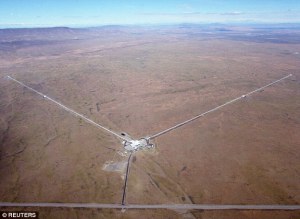
Aerial view of LIGO. Credit - Dailymail

Aerial view of LIGO. Credit – Dailymail

Gravity waves have been in the news for the last two years or so. Firstly, when the hundred year old prediction of Albert Einstein came true. Gravity waves were discovered when two black holes collapsed into one, about a billion light years away. The feeble vibrations of space-time was heard by two well engineered and sensitive detectors called LIGO (Laser Interferometer Gravitational-Wave Observatory). Few more such observations have been made over the last two years. The most recent one resulting from a neutron star collapsing into a neutron star.

When a massive star, tens of times heavier than our Sun dies, it ends up as a neutron star and possibly a black hole. Being so dense and compact, both of them represent gravitational extremities. Neutron stars can be detected by radio and optical telescopes but black holes can only be detected indirectly.

Weiss, Thorne, Barish

Weiss, Thorne, Barish

Upon finding the evidence for a century old prediction by the all time great physicist Einstein, the Nobel prize for Physics in 2017 was awarded to Kip Thorne, Rainer Weiss and Barry Barish for their work on gravity waves. These waves were undetected for a century mainly because they are very very weak. They result from very violent cosmic events like merger of gravitationally intense objects like black holes and neutron stars. These events do not happen frequently in our galaxy. Certainly not in our neighborhood. If they did, we would not exist anymore. Happening at far away distances, the waves travel at the speed of light, and get attenuated on the way to almost the level of insignificance.

Lot of sensitivity in the instrumentation is required to detect such feeble signals. And the noise resulting from other sources needs to be subtracted. Rainer Weiss had analysed the possible sources of background noise that would disturb their measurements. He had also designed a detector, a laser-based interferometer, which would overcome this noise. Basically consisting of two arms in “L” shape running across several miles, with very precise mirrors in both the arms. And a laser beam bouncing back and forth. If there is any disturbance in space-time, the two beams would be out of sync, almost by a whisker. It was necessary to develop new laser technology and invent new materials, as well as construct gigantic vacuum tubes, seismic isolation and other vital technology far beyond what had previously been achieved. Two such detectors were constructed (One in Louisiana and another in Washington state) to eliminate any false alarms resulting from local incidents. Now a third detector in Italy joined the fray.

LIGO. Credit - The Optical Society of America Inc.

LIGO. Credit – The Optical Society of America Inc.

In 1994, when Barry Barish took over as leader for LIGO, he transformed the small research group of about 40 people into a large-scale international collaboration with more than a thousand participants. He searched for the necessary expertise and brought in numerous research groups from many countries. Thus, big science and sophisticated engineering came together. Reminds me very much of the LHC (Large Hadron Collider) in Geneva, Switzerland, which led to the discovery of Higgs Boson, another monumental discovery of this decade. This led to a Nobel prize in Physics to Peter Higgs and Francois Englert in 2013.

Kip Thorne was instrumental in setting up of LIGO. In addition, he was a consultant and an executive producer of the science fiction movie “Interstellar”. The special effects in the movie were pretty close to realty. The graphics team which created the special effects worked very closely with Thorne who worked out several equations to bring a sense of credibility to the imagination. I am glad that Throne won the Nobel prize. Though the prize is not for the movie.

The most recent detection of gravity waves resulted from the collision of two neutron stars. The difference this time being that as soon as the waves were detected, other telescopes and observatories were notified. There was detection of other signals from the same event. Gamma rays were detected by the Fermi observatory in space. Several telescopes detected optical and radio signals as well. It was the first time when multiple scientific devices were able to track a mega cosmic event and study its aftermath.

It is a watershed event in the history of science when such mega projects come together to witness a significant cosmic event, amplifying the human ability to study the cosmos in such detail and depth.

Posted in November 2017, Sidereal Times | Tagged , , | Leave a comment

Fortuna ipsa muta

by Ted Frimet

sheer dumb luck

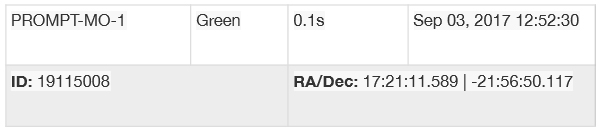
Not everything is as it seems. And sometimes, despite months or years of amateur training, a gain in insight can be chalked up to “sheer dumb luck”. As most of our AAAP club members are aware, I’ve been hunting an asteroid. And J2012 TC4 came into our field of view, quite nicely in fact, on October 11, 2017 – between the wee GMT hours of 04:01:28.432 and 04:04:38.185. Ten images, at 5 second exposure each, were captured with the Prompt-8 telescope, located at Cerro Tololo Inter-American Observatory, Chile.

APERTURE: 0.6 m
FOCAL LENGTH: 4000.0 mm
F-RATIO: 6.6
FILTERS: B, V, R, I, Red, Green, Blue, Lum, Clear
CCD SIZE: 2048 x 2048 (13 um pixels)
FOV: 23.8 x 23.8 arcmins
SITE: Cerro Tololo Inter-American Observatory

Snippet from skynet robotic telescope network prompt 8 status page, Saturday, October 28, 2017.

The telescope location is at latitude -30:10:3.300’, longitude -70:48:19.200’ (negative means“South”). Why, oh why is he giving us coordinates for his telescope? As I learned, a month before making a Near Earth Object (NEO) observation, the number one thing to remember in Outer Space Real Estate is, “LOCATION, LOCATION, LOCATION’ ! ! !

Sounds easy. Yet, here I am weaving a Saturday morning tale of “woe is to me”, for testing the limits of unknown parameters. I unknowingly ran smack dab into ye old Murphy’s Law. I didn’t know that Murph held title to an NEO. Despite being fenced in by my own mistakes, Murph told me that good fences make good neighbors, and he let me take a peek at the old gal for 10 decent exposures.

What went wrong? Nothing really. That is if you do not count the fact that Skynet – and I must stress – PROPERLY – dispatched my observation requests to sites other than Chile. We took a swing by the R-COP telescope, located at Perth Observatory, Australia, as well as a side-step to the Dark Sky Observatory, DSO-17, in North Carolina, USA. Neither of these observations were validated with an asteroid find. And that, my fellow amateurs, is because the detail lay in the ephemeris data.

I was feeling fresh and all squeaky clean from a visit to NASA’s JPL Horizon database for ephemeris data on our asteroid. I wistfully entered data into the Skynet Robotic Telescope Network Advanced mode. At the time of generating the ephemeris data, I changed my locus to the La Serena site, in Chile, where the Prompt telescopes are given astronomical sanctuary. I made specific requests to match the Right Ascension (RA) and Declination (DEC), gleaned from said ephemeris, right into Skynet, with a matching specified “time of capture equals past mid-night”. I was galavanting past midnight (as my Grandmother would say).

And there’s the rub. Skynet is programmed to direct your request to the next available telescope in your observers list. As I didn’t want to get cheesed out of targeting my asteroid, I left in a healthy dose of alternative ‘scopes. Sans the matching ephemeris data. And that’s when ‘ol Murphy stepped in. If you were imaging stars, your location wouldn’t be quite as critical. However, when you are locating a NEO that is one-tenth Lunar distance from the Earth, your location is important. Ouch. Parallax became the answer to a month long question, as I reviewed, and generated movies for the Australian data, some 6 or 7 times, – leading to negative results.

As I may have mentioned to one or few AAAP members, I do not fear the consequences of failure. I endure, and learn from every miss-step I encounter. I am sure that if I had allowed SkyNet to select my RA/DEC, and automatically reassign to telescopes in waiting, all would have been well. However, my ego got in the way, and I felt that exercising an additional degree of control would be for the better. Nope. I built that fence for Murph, all by myself. “Scored an own”, as the British say. As I found out, a month later, my newest neighbor even tossed in a free doorpost, as the DSO in NC, was of course, not located in a La Serena, observers location.

At the time of this writing, I was planning on establishing tighter magnitude measures of 2012 TC4. I was going to make lemonade out of the lemons of R-COP and DSO-17. The elephant in the room, is of course, parallax and that there is no data to measure in those astro-images.

I am planning to program a course of observations of Algol, a variable star, from minimum to maximum, to map out its magnitude (thanks to John Church, AAAP for pointing out the RASC data on the web). And to compare the results to knowns, so as to establish my own candlestick. And then to revisit the 10 successful images taken by Prompt-8 and re-sample the magnitudes, and make some coarse adjustments. Armed with some self-obtained results, I will be able to compare my magnitudes with the NASA data, and decide if the asteroid is closer to being 15 meters or 28 meters wide. Or perhaps, if it emits more light than predicted (thanks to Gregg Waldron, NWJAA for pointing this out) – that I have proof that 2012 TC4 is a younger asteroid, as opposed to being an old beaten space rock, not unlike my neighbor, ‘ol Murph.

Please note that although hundreds of observations were made of this NEO, there were only two observatories that posted videos that focused primarily on the science of the asteroid. That was the Kiso observatory in Japan (whose primary focus is on super-novas), and our video composited from the images taken from Cerro Tololo – whose credit of telescope stewardship can be found with Dr. Dan Reichart of UNC, Chapel Hill, as they hunt for the after glow of gamma ray bursts.

Video, as promised:

Posted in November 2017, Sidereal Times | Tagged , | Leave a comment