A few months ago, AAAP Program Chair, Ira Polans, invited Dr. James Lowenthal of Smith College to lecture our club on a Tuesday night, in Princeton. Dr. Lowenthal wooed us with his Hubble Space Telescope (HST) time, and his nascent discovery of multiple gravitational lensing events. I am especially indebted to Dr. Lowenthal for taking the time, and for extending an invitation to peruse his name, on open source images. All of which can be found as a MAST data retrieval request from, the archival hot seat at STSCI.
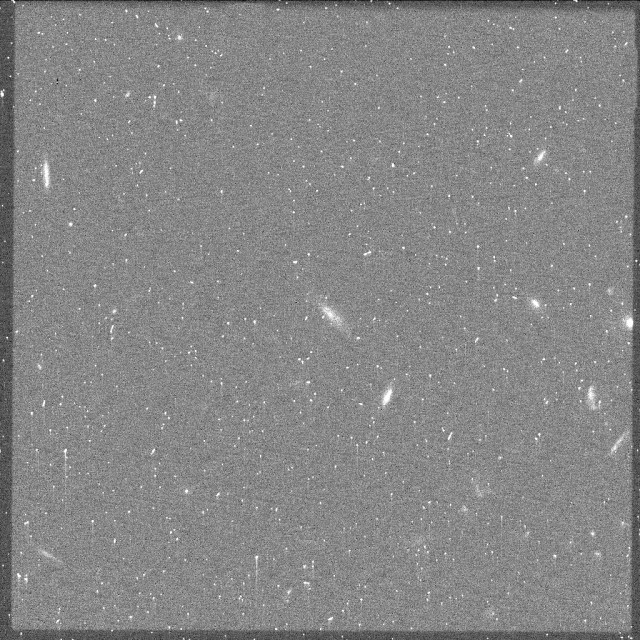
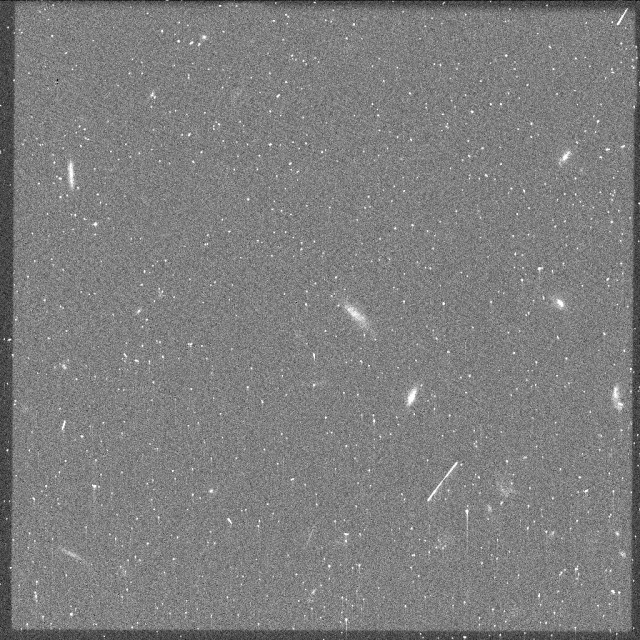
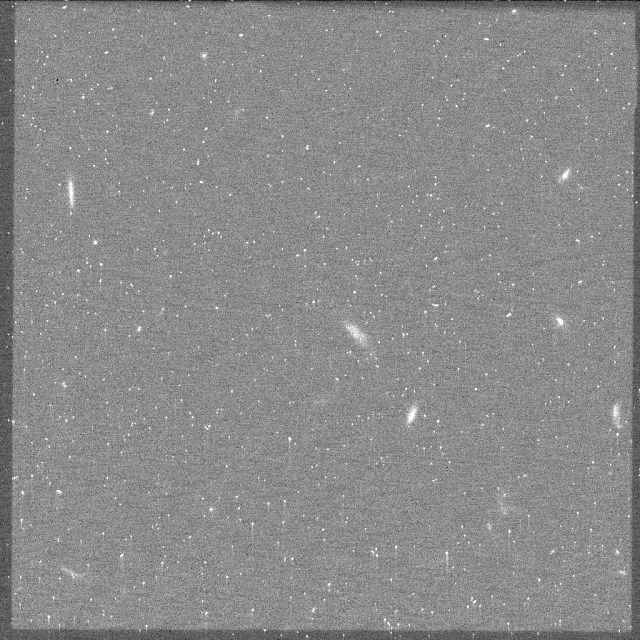
Now that time permits, post lecture of course, we visit, however contritely, three images produced by the progeny of of Dr. Lowenthal’s space telescope time.
We propose deep WFPC2 imaging and STIS slitless spectroscopy of two of our ultra-deep VLA fields. Those 4- and 6-cm maps have 1-Sigma levels of 3 and 11 Mu-Jy, respectively, comparable to VLA observations of the HDF, and show 14 and 9 sources in statistically complete samples. Keck spectroscopy and imaging to B, R, I ~26.5 have identified most of the sources as compact, luminous starbursting and interacting galaxies at redshifts z es1; about 25 at z>1.5. Our goals here are: {1} identify the remaining sources; {2} pinpoint regions of star formation; {3} quantify the incidence of interaction using spatially-resolved kinematics; {4} quantify morphologies; and {5} constrain the evolution of these faintest of radio sources. Only the HDF and one other field have such deep VLA, HST, and Keck data, and there is strong evidence that field-to-field variations are significant. WFPC2 images with F814 will provide the resolution needed to measure morphologies on sub-kpc scales, identify interaction- induced star-formation, and distinguish AGN from non-AGN components. Slitless spectroscopy with STIS will reveal faint emission-line sources invisible in our Keck images and will provide spatially-resolved kinematics, necessary to disentangle the star forming components in interacting systems. The VLA fields extend over some 8 min each, so both WFPC2 and STIS can be used simultaneously.
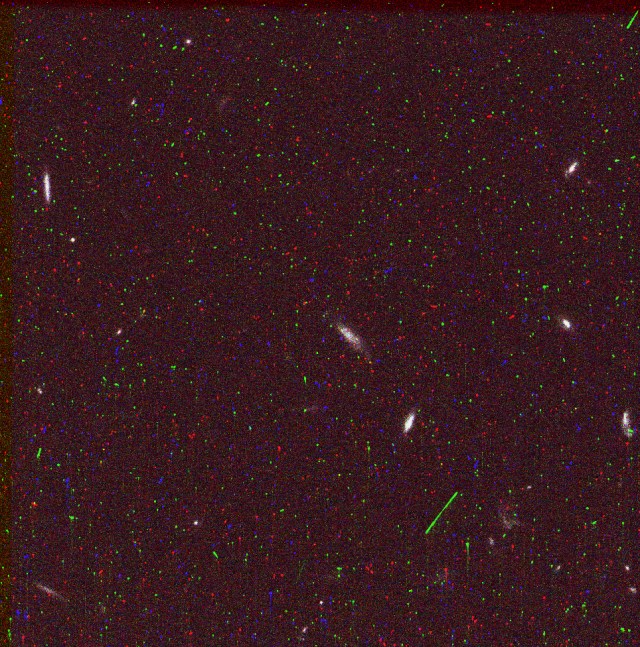
Giddy with the tedious nature of the above abstract proposal, we ventured forth, with the good doctor’s permission, to colorize some, if not all of his open source material. It is in the spirit of this good old graphic digital designers intent; an attempt to highlight what may not have been visible in the plain, and very ordinary black and white deep field HST images, for our lecturers intended purpose.
Clearly, what you are about to view are not the many-color girded view of HST deep space photographs. It is, however, the result of combining three very well related images that represent the gravitational lensing effects that Dr. Lowenthal was studying. It is noteworthy and memorially correct to note, here, that Dr. Lowenthal discovered more gravitational lensing effects, than any other well placed study, in recent memory. I could further enhance the image to produce a self-evident Einstein Ring. However, that would be as mischievous as the HST graphic artist painting an UV emitting White Dwarf, well, white!
So, without further adieu, here is my first, and probably last attempt at false-coloring Hubble Deep Space, highly luminous, and strongly lensed sub-millimeter galaxies. All source images used are public release in the Mikowsky archives, with study done by Dr. James Lowenthal.
red channel:
O5G101010
RA (J2000) 08 44 44.043
Dec (J2000) +44 31 58.56
start time 2001-01-25 14:58:28
end time 2001-01-25 15:05:52
exposure time 400.000
Each frame was “centered-on” in Photoshop, and a minor curve was applied
Further credit to:
Papers related to proposal id:
The morphology of nine radio-selected faint galaxies from deep Hubble Space Telescope imaging — Roche, Nathan D. et al 2002MNRAS.337..840R
In the Verge(1), Loren Grush reports neutrino detection from a Blazar, as does author Daniel Clery in this weeks Science(2).
Good articles, easy to read and learned a pant-lode.
I took a great deal of notes, from the D. Clery write-up, and wanted to get an input on the below. So I scrambled this write up, and posted to my Google+ Astronomy hang-out. So far, no taker on my commentary or question. I suspect that, unlike the multi-messenger service provided to the likes of Blazar identification, and neutrino co-relation, my flaring source of “irridium” will take the slower, anthropoetic observers trail.
Okay. Anthropoetic. I just made that up. So I better come up with some Anthro-poetry, post-haste!
Look out the window and what do you see
A bird, a bee, and a reflection of me
I might need to reconnect with an Astrophysicist or two. Neutrino astronomy is making me daffy! Would someone step up to the plate and recommend one for me? I am being left with the confounded notion that high energy gamma ray producers are knocking head and tails against cosmic rays, accelerating them to evolve to high-energy neutrinos. The likes of up to 400 GeV.
Has Blazar TXS 0506+056 been co-related with IceCube-170922A at 290 GeV ? Despite the alert, and crucial observations across a broad range of wavelengths, a 5-sigma has not been established. Clery reports that IceCube and other observers agree on a one in 740 chance. Still looking for love in the all the wrong places? Scientists will require a confirmation at 1 in 3,500,000 probability for other than coincidence.
Daniel writes, “If the IceCube team is right, blazars could be the first confirmed source of these cosmic rays”. I am pretty sure he was referring to this specific neutrino detection. Or at least, I was hopeful. Although, I didn’t “feel it”. Hence this essay.
Because the different parts of my brain, have a jitter pattern that is unparalleled in all of neuroscience, you know that didn’t sit quite right in ye crawl space. Forgive me my rant, as I recall a Princeton lecture, hosted by our club, given by Dr Jia Liu.
The talk was given on September 13, 2016 at 7:30PM in Peyton Hall on the Princeton University campus. Titled, “Neutrinos: Their discovery, detection, and future prospects” by Princeton University Postdoctoral Fellow Dr. Jia Liu.
I commiserated, this past Friday night, as I substituted on Team One observation duty, with fellow Amateur Astronomer, Thomas Swords. Tom pointed out how our lectures eventually reinforce a knowledge base and understanding for more recent developing events. He was so, spot on!
In her lecture, Dr Liu taught us about the three flavors of neutrinos that evening, long ago, and spoke of the many detectors, then in place. It prompted my to poke a little further, and stir my memory. More jitters.
In his compositional essay, co-editor S. Prasad Ganti, writes:
The “Kamiokande detector in Japan, also known as Super K, detected the first neutrinos from outside of the solar system from the 1987A supernova in the Large Magellanic Cloud, a satellite galaxy of the Milky Way located 160,000 light years away. Ray Davis and Masatoshi Koshiba,the Director of Super K, won the Nobel Prize in Physics in 2002.”(3)
Am I off base, in suggesting that Clery might have been more precise writing: “the first confirmed source of these cosmic rays from a blazar”. I am nit-picking. Am I not? Or did the Super K team not confirm the the first neutrino detection, from outside our Milky Way?
I could yield to the Neutrino Antarctic detector IceCube and the confirmation by the Fermi Gamma Ray Space Telescope. No yielding, unless I feel it. And I am not getting that warm fuzzy feeling. Not just yet. Especially so, when a summary reporting author over looked the Super K.
In the Dalai Lama’s ideation there are three types of wisdom (4). We have already surpassed the first stage of hearing, or reading. As of the time of this essay, I have placed us at the second stage, immersed with the constant familiarity of a topic. Have we arrived, finally at the third stage? Are we able to feel it?
When you feel it, let me know. I don’t want to be out in the cold, during the next confirmed Antarctic light show. I want to believe. Really, believe. Though, Astra inclinant, sed non obligant.
There comes a time in every amateur astronomers life, when they have to come to terms with real astronomy. I used to be fond of saying, from time to time, that “real men eat quiche”. Now-a-days, I am fine tuning my hind-brain to accommodate a phrase, “real amateur astronomers understand what makes a cepheid variable, variable”.
Too long? Yeah, I get that all the time. In a Dale Carnegie course, I was taught to make it simpler, smaller, and with fewer words. How about, “helium sucks light”? That might be more akin to “man bites dog”. For Astronomers, anyway, it entices you to read on. Where is Hubble, when you really need him? Probably lurking in the shadows of my discontent, stroking along with Schroedinger’s cat. Meow.
At one or more points in time, over the last two years, I managed to get confused between type 1A supernovas and Cepheid variables. I know, I know – “how is that even possible”, you ask? It is because in the ven diagram of my mind, I see them both as astronomical distance measurement tools. And now, sitting down to one, or the other, to study, I choose to make short work of the cepheid variable. I do this, because I don’t want to visit fermi pressures on compressed star matter before it nova’s. It is simply not in my wheel house, this fine Fourth of July morning. You know, on second thought, a nova is more akin to galactic fireworks display. And truth be told, it is simply more like fireworks, to me.
However, today I am in a particularly gaffy mood. I have not been able to coordinate two telescopes for a parallax study. Hence, I am not entirely pumped up for a fireworks display. And this is to your benefit, as we get to get a closer look into not what a cepheid variable is, but the more pedantic reason as to the how, or why the light intensity is periodic in the first place. And when we’re done, please do not think the lesser of me, when I suggest, now, that Cepheid Variables are reminiscent of first light in the Universe. Oh, come on now! Keep an open mind for my cat’s’ sake?
I started to draw upon reference to laboratory exercises, on Cepheid Variables and the Cosmic Distance Scale (1). And within their reprint, lurking on a page, I find Shapley’s Calibration. A formula of M = m + 5 – 5 log d. I can’t express my happiness in finding such consolation in a mathematical formulae. That is, having used it, previously in magnitude calculations essays’ of old, it is like stumbling across an old friend. I never knew that math could be that way. I understand, at least from the froth of a good cup of coffee, why professional mathematicians get all gawky eyed. Like adolescents at their first dance party, they see and appreciate simple quantifications.
I’ve read the article, and didn’t want to mess up the virgin grid, provided in the fold-out. Hence, I didn’t forge forward to Baades’ Calibration. Frankly, I didn’t want to get further distracted by how the early distances to Andromeda were poorly estimated. I recall, from recent memory, how I’ve been off by more than 20 percent, in my own error. (Ok, for those of you that remember my early asteroid VT calculations, it had more error than our ancestral astronomers, not named above.) And why should I drag you to the depths of our earliest primordial history, too? Instead, let’s hop over to “The Universe Around Us”, by Sir James Jeans.
Sir Isaac Newtown, gave us gravity with an explanation left to the likes of Einstein, 228 years later. Sir James, it appears, went the same route. “Whatever their mechanisms may be [cepheid variables], observation shews that these stars possess a certain definite property, which proves to be of the utmost value.” (2) Published September 1929, perhaps we are making some progress, as our musing are now only 90 years apart? The Universe(s) may be vast, and the study of its Cosmology appears to us in the blink of an eye. Two shakes of a lambs tail? A blink of thine eye? No, just kidding. Almost a century passes us by, and still it falls upon the shoulders of the amateur to breach the dam, bypass the scholastic, and come to the point! If ye be bored, tarry here, no more. I’ve got more interstellar molasses to wade thru, before I blow up my birthday balloon.
It is a tantalizing read, that is, on the light curves of variables. Especially so, when I muse out loud, “As we go from the ultraviolet to the red end of the spectrum for any particular Cepheid, the light curves flatten out, indicating that the range of variation in luminosity is much wider in the ultraviolet than it is in the infrared” (3). Ah, music to my ears, a delight to the mind to read. Almost, we get the tantalizing taste of a spectrum of color, from the less human visuals of ultraviolet (bugs be damned, as they can sense UV quite well!) to the lovely warm cloaca of infrared. And as we stumble across the work of A.H. Joy, on the interesting characteristic of the period of W Virginis stars (2 to 75 days – ibid p214), a probability occurs to that author. That some “material” is going thru an expansion and contraction. Oh, so close! So close, indeed.
As I peruse The AAVSO Variable Star Atlas (4), a tome, titled, “Sky and Telescope”, pops out onto my table, before me. Ever so hopeful to study matter, over time. Mattei, Mayer and Baldwin, bring to my attention that more than 25,000 stars are variable. (as of the time of their editing, circa 1980). And their time scales ranged from fewer than minutes to centuries. I would be remiss not sharing with you my opinion, that time does not matter, here. That the curtain of gas, that periodically hides the light from my telescope, is what is of importance. Here, it is matter, and not time that I seek. And what is that, which matters most? How do I find it? Do we set the stage, and let Shakespeare determine both our entrance and exit? Let us move to the beginning, and bring to life the Boatswain. He sweeps us aside during the tempest, and conveys that we have enough room to run around the storm!
I crawl from under the weight of my books, my tempest, and key into Wikipedia, https://en.wikipedia.org/wiki/Cepheid_variable (5). It’s author(s), brings to light so simply that it is the veil of Helium that obscures our light. That during the due course of ionizing helium, the ionized gas becomes opaque, even more so, when both electrons are stripped off. The trapping of heat, that is an increase in temperature, causes an expansion. And with this expansion comes a subsequent cooling; it becomes less ionized, permitting contraction, and allowing starlight to escape. It is known as the Eddington Valve (or kappa-mechanism).
I leave you with the pedantic solution we agreed upon, at the beginning, where I suggested that Helium sucks light. If you were to stay the course, with me, to this point – I shall now beg your forgiveness over the time-length of the essay, as the books, were truly so heavy that they imbued their own gravitational effect and were a cause of space-time dilation. Just ask Einstein.
Citations and References:
1) Pasachoff, J. M., & Goebel, R. W. (1979). Laboratory Exercises in Astronomy – Cepheid Variables and the Cosmic Distance Scale. In Reprinted from Sky and Telescope (pp. 241-244). Cambridge, MA: Sky Publishing. p243 referenced, in the essay.
2) Jeans, J. (1934). The Universe Around Us p62 (3rd ed.). NY: The MacMillan Company.
Sir James Jeans, M.A., D.Sc., Sc.D., LL.D., F.R.S.
3) Motz, L., & Duveen, A. (1967). Essentials of Astronomy. p415, Belmont, CA: Wadsworth Publishing Company.
4) Scovil, C. E., & Robinson, L. J. (1980). The AAVSO Variable Star Atlas (2nd ed.). Cambridge, MA: Sky Publ., with The “Sky and Telescope” Guide to the Heavens, Edited by Leif J. Robinson, Sky Publishing Corporation, 1980.
5) Cepheid variable. (2018, June 27). Retrieved July 4, 2018, from https://en.wikipedia.org/wiki/Cepheid_variable. detail: Smith, D. H. (1984). “Eddington’s Valve and Cepheid Pulsations”. Sky and Telescope. 68: 519. Bibcode:1984S&T….68..519S. Eddington’s Valve and Cepheid Pulsations Smith, D. H. Abstract. Please note: No abstract found. Publication Sky and Telescope, Vol. 68, NO. 6/DEC, P.519, 1984 Pub Date: December 1984 Bibcode 1984S&T….68..519S
“The Space Barons” is a book by Christian Davenport. It is the story of how the four billionaires are taking on the mantle of space exploration. To fill a void left by NASA. In the absence of public funding, how the billionaires are investing their wealth in pursuit of their childhood passions for space, and possible long term returns. The four billionaires are – Elon Musk, Jeff Bezos, Paul Allen, and Richard Branson. All four of them share similar goals and dreams, but are approaching in different ways.
There has been no manned space missions after the last moon landing in the 1970s. Except for space stations just a few hundred miles above the earth. US also lost the ability to send astronauts to even this low orbit with the retirement of the space shuttle. Space shuttle has not delivered as promised. The Reusability came with a very heavy price in terms of the cost per launch and also the failure of two space shuttles leading to forteen deaths in space. NASA has relegated itself to unmanned space missions and deep space exploration. Its cheaper, faster, better mantra was slightly effective compared to the past, but still the whole exercise of launches is not as agile.
Elon Musk was an internet entrepreneur who made his money by co-starting and then selling of Paypal. He made good use of the money he made. He started SpaceX, the private company to launch rockets into space. Falcon 1 was the first rocket he built. After several failures, he made progress and moved towards Falcon 9. The number 9 refers to the number of engines the first stage booster has. All the while he fought against the incumbent ULA (United Launch Alliance consisting of Boeing and Lockheed). The chances of his making it was very slim. He did succeed against all odds. NASA also saw a chance in this gritty entrepreneur who was very religious about making the first stage reusable. After a few failures, his Falcon 9 first stage came back and landed. Now it is routine to reuse the first stage again and again. And send supplies on regular basis to the International Space Station. This has altered the economics of the space launches significantly, beating out the ULA launches on both reliability and cost basis. NASA has contracts with SpaceX to deliver cargo and later astronauts into space.
Also, ULA’s rockets used the RD-180 engines for its Atlas V, which are made in Russia. Musk’s engines and the rockets are totally made in the US. Musk has the ultimate aim of building powerful rockets (with 27 engines consisting of 3 Falcon 9 boosters strapped together) to carry people into space and even reach Mars. To colonize Mars as an alternate home to our earth is his vision. In addition, Musk has started the Tesla electric car company and Solar City. A great visionary indeed!
Jeff Bezos of the Amazon fame is another internet entrepreneur who is using his considerable wealth towards larger goals. His company Blue Origin is steeped in secrecy, unlike Musk’s aggressively publicity seeking venture. His rockets named New Shepherd and New Glenn (using BE-4 engine a reliable workhorse, one that could fly again and again at relatively low cost) have done well. Bezos is considered as a tortoise to Musk’s hare like image. He has demonstrated reusability as well. His vision is also to make space launches a commodity. Much like the air travel is today. He conceives of a scenario where millions of people living and working in space. He thinks that earth should be zoned residential and light industrial with heavy industry moving into space. This can happen only when access to space is cheap.
Paul Allen, the co-founder of Microsoft who sold off his stake and left early, invested in building Space Ship One, the first private space plane to go into space and come back and safely land as an airplane. No rocket launches are involved. Designed by the legendary aircraft designer Burt Rutan at Scaled Composites, a mother plane called White Knight one took Space Ship one in its underbelly and then let it go at an altitude. Space Ship one shoots up like a rocket and flies towards space. To fall back, a shuttlecock like design helps it to fall back into earth’s atmosphere without causing much heating. By doing this, Allen claimed the Ansari X-prize for the first private space plane to go to space and come back, twice in a two week period.
But Allen developed some fear while his test pilots were executing the rides into space and back. Richard Branson, the entrepreneur who made his money in the Virgin group of companies, took over the development of Space Ship two from Allen. With the idea of promoting space tourism. Branson made some progress towards this goal, but is not there yet. I am assuming it is only a matter of time before he starts taking people up into space.
In the meantime Allen came back into the space business with the building of a massive plane called Stratolaunch, similar in concept to the White Knight one. It can carry multiple space planes to an altitude and launch them from there. A reusable space plane which can be launched from anywhere in the world and come back and land like a normal aircraft, is his goal.
Each of the four entrepreneurs is democratizing the access to space. Space, which was the exclusive purview of the governments, now has successfully passed on to private hands. With the nimbleness to make quick progress and the efficiencies to lower the costs, the next few decades will never be the same as the past. I am sure space travel will become the mainstay.
Methane ice dunes found on Pluto by Nasa spacecraft
Scientists say they have found evidence of dunes of frozen methane on Pluto. Pluto’s atmosphere was believed to be too thin to create the features familiar in deserts on Earth…more
The Curiosity rover -BBC
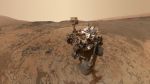
Curiosity rover sees seasonal Mars methane swing
It may only be a very small part of Mars’ atmosphere but methane waxes and wanes with the seasons, scientists say. The discovery made by the Curiosity rover is important because it helps narrow the likely sources of the gas…more
Credit:NASA/JPL-Caltech/MSSS
Life on Mars? Rover’s Latest Discovery Puts It ‘On the Table’
The identification of organic molecules in rocks on the red planet does not necessarily point to life there, past or present, but does indicate that some of the building blocks were present…more
Engineers had to find a way to stop the laser damaging its own optics
Aeolus: Wind satellite weathers technical storm
They say there is no gain without pain, but when the European Space Agency (Esa) set out in 2002 to develop its Aeolus satellite, no-one could have imagined the grief the project would bring…more
The Giant Magellan Telescope, Chile -NYT
Extremely Large, Extremely Expensive: The Race for the Next Giant Telescopes
Even as astronomers await a verdict on construction of a huge telescope on Mauna Kea, they are still trying to figure out how to pay for the next stargazing Goliaths…more
Touching an Asteroid -NYT
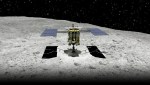
Hayabusa2 Arrives at Asteroid Ryugu
Japan’s Hayabusa2 spacecraft has arrived at Ryugu, an asteroid thought to contain water ice and other materials from the early solar system. If Hayabusa2 is successful, it will study Ryugu in detail…more
Mars’s growing dust storm
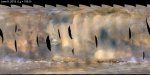
A Huge Dust Storm on Mars Is Threatening NASA’s Opportunity Rover
A vast dust storm blanketing about a quarter of the surface of Mars has threatened NASA’s Opportunity rover, plunging the solar-powered vehicle into what the space agency has described as a “dark, perpetual night.”…more
Young star PDS 70 & baby PDS 70b
Newborn planet pictured for first time
Astronomers have captured this image of a planet that’s still forming in the disk of gas and dust around its star.
Researchers have long been on the hunt for a baby planet, and this is the first confirmed discovery of its kind…more
-EPA
Israeli space probe to land on Moon in 2019
An Israeli non-profit organisation has announced plans to send the first privately-funded pilotless spacecraft to the Moon.
Israel Aerospace Industries’ Ofer Doron said the probe “showed the way for the rest of the world”…more
The proposed lake sits beneath ice near the south pole of Mars
Liquid water ‘lake’ revealed on Mars
Researchers have found evidence of an existing body of liquid water on Mars…more
Members Night at Observatory Saturday, June 16. Hoping third time is a charm after clouds and rain washed us out on May 12 and May 19. Mark your calendar for a Members Night (and family and friends too) at AAAP’s Observatory in Washington Crossing Park on June 16. See the website for info on how to get there (phone 737-2575). Sunset on June 16 is ~8:30 pm, so come around then if you want to see the thin crescent moon, or anytime after till at least midnight.
If you’re a newer member or haven’t been out there for a while, you may be amazed to see the latest equipment in action. The Mallincam video camera has been retired to make way for new technology, including a Starlight Xpress Ultrastar-C color CCD camera on a 5” Explore Scientific apochromatic refractor, and a ZWO ASI-294 color CMOS camera on a 10” Mewlon Cassegrain reflector scope. These are in addition to the Celestron-14 and the legendary 1879 Hastings 6-1/4” refractor set up for visual observing with eyepieces. All telecopes slew around the sky robotically on Software Bisque Paramount equatorial mounts. For more on planetary viewing opportunities next month see below.
Martian Insight. While Jupiter still dominates the southern night sky this month, Mars will brighten rapidly in June and outshine the Jovian planet by the end of July as it reaches perihelic opposition. That means it lies opposite to the sun in our sky, and while this happens every other earth year, the closeness varies from eccentricity in the orbit over the 687 earth day orbital period of Mars (Martian year). This summer Mars will be within 36 million miles of earth, the closest it’s been since summer of 2003. I went back to the archives on my home PC and found these images (below) I took at the 2003 opposition, using a 5” refractor with barlow to give a focal ration of f/40.
Jun 16 (EDT)
Rise time & azimuth
Transit time & altitudeK/th>
Magnitude
Diameter, arcsec
Mars
23:23 119
04:10 28S
-1.7
18
Jupiter
16:57 109
22:07 35S
-2.4
43
Saturn
21:06 119
01:51 27S
0.1
18
These color images were made from separate subframes using an SBIG ST10 CCD camera with red, green, and blue filters, a much more difficult technique than using the new “one-shot color” cameras at the Observatory. The key to planetary imaging is to take many brief frames in order to capture the best ones at those occasional instants of atmospheric clarity. The new cameras have high sensitivity and very fast download rates allowing them to be used (with the right software) as streaming color video or to capture individual frames. The control software (“Starlight Live” and “SharpCap”; read about these online) is reasonably intuitive. It’s hoped that AAAP members will enjoy using these cameras to photograph planets, moon, and deep sky objects. Feel free to contact me or the Observatory or Outreach Chairs if you have questions about use (see the Contact Us tab on the website).
Seeking deeper impressions of Mars, the NASA Mars Insight mission launched successfully a few weeks ago (). The Insight craft is now in interplanetary space bound for Mars. Science instruments on board are designed to measure the interior geophysics of the red planet, including a seismometer and a thermal conductivity probe. The anticipated data will help develop better understanding of how Mars apparently lost its magnetic field in its distant past. If successful the measurements will also provide insight into previous plate tectonic activity and help drive hypotheses on how and when Mars may have lost it’s original atmosphere and water. Deep questions in need of answers!
The June meeting of the AAAP, and our last until next September, will take place on June 12th at the http://www.state.nj.us/state/museum/ in Trenton. The meeting starts at 7:30 PM.
In addition to our normal club meeting, attendees will view the latest show “Dark Universe”. Narrated by astrophysicist Neil deGrasse Tyson, the show celebrates a new age of cosmic discovery as well as its deepest mysteries. Dark Universe features spectacular scenes of recent spacecraft, such as the Galileo probe’s breathtaking plunge into Jupiter’s atmosphere, the most accurate visualizations ever produced, such as a Milky Way galaxy spangled with exploding supernovas, and novel renderings of hotly discussed phenomena, like dark matter.
There is plenty of parking in front of the planetarium entrance behind the museum. Museum is located at –205 W. State Street, Trenton, NJ 08625.
Response to requests for AAAP member support has recently blossomed. We have good numbers for our Solar Observation session, held annually at the Nature Center on Memorial Day weekend and jointly with Washington Crossing State Park. We have outstanding support for opening the Observatory to Scouts on a Saturday, and I hope members will step up in equal or greater numbers for the Hopewell event later in June.
In order to clearly divide responsibilities, we consider any requests for use of the observatory on other than Friday Public Nights, and for Public Night attendance by any group numbering twenty or more, to constitute an Outreach Event. Appeals for support for these events, as well as events at schools and other off-site locations, are conducted by Outreach. These events are entered into the AAAP website calendar, including as much detail about location and group size and age as are available. Names of those who volunteer are added as they step up, but if your name gets neglected, be sure to holler! PLEASE GET INTO THE HABIT OF CHECKING THE CALENDAR OFTEN! Revisions to the website explaining these details are admittedly overdue but have not yet been submitted. Work installing lighting and new cameras in the Observatory have been diverting…
Any members who wish to participate specifically in Outreach Events, and be part of the Outreach Committee, please email. This will not obligate you to every event, but you will be included in the first appeal and have more of a voice in the handling of Outreach Events.
These are the two upcoming Outreach Events on the schedule for June, as copied from the calendar. The calendar entry for the Hopewell event also includes location details.
Saturday, June 9
Cub Scout Pack 44 of Pennington will be camping in WCSP over Saturday night and have asked us to open Simpson Observatory for a total of about 30 Cub Scouts, Boy Scouts, and parents. We will not be open to the general public, so the gates will be reclosed after volunteers enter, and any non-Keyholder Members will need to coordinate entry. Volunteers so far are Tim Donney, Jen & Dave Skitt, Tom Swords, Jim Fling, Luisa & Tim Gong, and Ira Polans. These are all Keyholders so we are indeed well covered, thank you! An Outreach Member bringing an additional scope is David Letcher.
Saturday, June 23
Some 45 families totaling 200 people are expected to participate in the Hopewell Community Campout. AAAP has been asked to bring scopes and binoculars, setting up in advance between the picnic table and the campfire (see attached map) to support a “nature at night” program planned to run from dark for about an hour.
Minutes of the May 8, 2018 of the Amateur Astronomers Association of Princeton
Director Rex Parker called the meeting to order and called upon the nominating committee to run the election of the board of directors. The entire current board was nominated to return and were elected unanimously.
Bill Murray gave a 10 minute talk on Stellafane, the “Shrine to the Stars”. It is the oldest gathering of amateur astronomers in the United States. It is held annually on the new moon weekend in July or August.
New keyholder Scott Smith received his key.
Gene reported that two new cameras were acquired at NEAF and will be installed as soon as possible. Also purchased was an adapter to align the Mewlon with the HB refractor.
Outreach reported that a scout group will be at the observatory on June 9th. Volunteers are needed as it will be a sizeable group.
The possibility of family memberships was discussed and will be discussed at a future board meeting.
It was discovered that Gene Ramsey’s son, Michael, now works for park maintenance. It’s good to have a friend working at the park.
Next meeting is at the planetarium at the NJ State Museum in Trenton.
It wasn’t too long ago when I joined an astronomy forum, at Google+. And yes, the name of the forum is “Astronomy”. Therein lay over 24,000 members; of which there are a dozen contributors during any given week. Most recently, Astronomy forum member Andleeb Atal posted his brief on the “Wow” signal, acknowledged by an Ohio States University telescope program, of August 15, 1977. Astronomer Antonio Paris at Florida’s St. Petersburg College attributed the signal to comet 266P Christensen. He included a second comet possibility, named P/2008 Y Gibbs. Neither long-haired beasty was known to be in existence, in 1977. You will get no argument from me, here, on the time-line.
What I found interesting, is the baseline signal of 1420 Mhz. That is the spectral center line for elemental Hydrogen. Atal notes that were some small discrepancies, noted between the signal residing at 1420.36 (JD Kraus) and 1420.46 (JR Ehman). However, there it hovers at the midline. I would like to lay claim that this side-note became the foundation of new thought, for me; however I would by dying, if not lying about it. Hydrogen, as the most abundant element in the universe, is significantly interesting, all by its lonely self.
What is truly an engaging fact is that not all hydrogen resonates the same way. (doppler shifts -Wikipedia https://en.wikipedia.org/wiki/Hydrogen_line accessed May 7, 2018 8:57 AM) There is truly a very small amount of our universal norm that beats to the tune of 1420 Mhz (mean lifetime of the excited state of around 10 million years; Wikipedia, ibid). Sufficiently so, we are able to listen to it, among the static of the cosmic background radiation. Its hum competes with all sorts of interesting aural phenomenon. Listening to that key chord keeps us sane while existing on our lonely intelligent rock. It is the pervasive thought that life, extraterrestrial intelligent life, will use the universal baseline to pulse encode a message. Comets be damned, we are still searching for a intergalactic dance partner. Shall we dance?
Within the confines of the forum’s articulation, I found myself being perceived as challenging the speed of light. Albert, we will have none of that now. You let over 30 years transpire, while searching to combine electromagnetism with gravity; and appeared to look the other way while Cosmology and Astrophysics unknowingly raced by you. Out of deep respect for a person who simply did not let a thought go by for decades, I will continue to honor the time long tradition of accepting that c is a constant, no matter and where ever you are.
However, some have confused the immutable speed of light with invariant frequency and wavelength. Perhaps this stems from a misunderstanding that pulse encoded messages will not be the same in everyone’s space-time. Forgive me the math mistakes; however you will get to the crux of the idea, right now. If you would, here is what I had to inquire onto my forum participants. Unlike questions, they were more akin to answers.
If the initiator of a signal was in a region of dilated space-time, then their clocks would run at a different rate than ours. For arguments sake, how about twice as slow?
Their counts, per unit time, would be the same as ours. That is, both would be 1420 (Mhz). However, when you stack both transmissions up against each other, one is dilated, one is contracted.
When we receive their baseline broadcast, compared to our local clock, we would have to look for a mid-line of twice Hydrogen (2840 Mhz).
Galaxies, and the stars constrained within, are in motion. And yes, they would need to be moving at speeds close to the light speed, in order for relativity to matter.
However, I am not so sure that space-time is so neat, as to not be [held] accountable for a many clocks theory.
Time passes, and question and answers come and go. Without ado, I am repelled by commentary on Occam’s razor, combined with a coup de grace on not accepting a non-uniformity in space tension. Yes, space-time is tough as an ox. It has the strength several hundred times that of a bar of steel. After receiving the first observation of gravity waves, on September 14, 2015 – we conclude that it took 63 solar masses of two black holes to coalesce and release 3 solar masses of energy to cataclysmically distort space. Yet, I deny neither my fellow commentator invoking Occam, or uniformity in space tension. c prevails, here, untouched. Yet, there is the last question, reserved for the reader who does not know how to ask. In cosmological musing, I offered it below:
I agree. c probably stays the same. Of course, if the medium slows down light; other matter not similarly affected will outpace light in that medium. [cherenkoff radiation].
Here are some notes, I just finished taking a few minutes ago. It manages to mess up the idea that time clocks are not universal; as it related to Einstein over 100 years ago – and still stands correct, today.
Here ya go – I was having an email conversation with our MathFromtheGut, guy:
I was reading and commenting, this morning, on the Hydrogen spectrum line, 1420 Mhz, and how we anticipate intelligent beings to use it as a carrier wave.
My additional comment was relativity related; spatial dilation affects clocks; so 1420 ticks per unit second, there, isn’t my 1420 ticks per unit second, here.
If the clock were twice as slow, I’d imagine my carrier wave to be at 2840 Mhz.
Anyway, stars and galaxies (red-shift aside) are moving at high velocity. Of course I beg the question that they are not moving at light speed.
However, any velocity difference, away or towards us, does compromise a clock, even if slightly.
Then, if we were to look at our common 1420 Mhz (1420.0000) if would be more relativistic to look at 1420.0314; depending on the velocity difference.
Electromagnetic pressure (solar pressure) will increase if the source galaxy velocity is greater.
EM(pressure inc) = Galaxy(v inc) = Gravity(G inc)
Ok. Time for a night cap coffee.
Let me know where this falls apart.
It didn’t fall too far. It held together like the very fabric of space-time. Thor’s hammer couldn’t budge it. It would take collisions of vastly superior astronomical beings to undo Einstein and his building blocks of Faraday, Henry and the treatise of James Clerk Maxwell. And then we return to the opening thrust; the tip of the spear. The Wow signal of 1977, whose base frequency was reported, as two numbers. Now that we have separated the chaff from the wheat, we can now know Wow! for what it is.
A space time dilation effect of 0.00704022% difference
It is a fair supposition that the Wow! signal was initiated from Sagittarius. That much seems to be written in stone. In an effort to avoid an observer paradox in resolving the two observed frequency signatures, I am agreeing that both observed signals came from the same sky region. Aka the same source.
I am adding my hallmark that the signal was split, by the likes of gravitational lensing. This is less mysterious, and it is very compelling. Having the same signal take two paths, and arriving on two different frequencies provides the test bed for a Lorentz transform for time [or distance]. That is, according to either observer, the same signal was received; however on two different frequencies.
I have a radio signal, that passes thru a region in space that splits the signal. One path goes thru “normal” space-time. The other goes thru “time-dilation” – let’s say its clock slows down. However, due to “c” being a constant, both signals arrive at the radio receiver, at the same “time”. The frequencies have shifted by 0.1 Mhz. Show the dilation effect, using Lorentz Transforms. Yup, there’s an app for that. It’s YouTube’s Fermi Lab Presents: “Relativity: how people get time dilation wrong”. Substituting frequency for time in a Lorentz Transform:
V2 = 1/lambda * V1 for our second, time dilated frequency
V2 = lambda * V1 for our first, non-time dilated frequency
Normally viewed, the Lorentz Transforms would be for two different observers. One moving relative to the other. In my special, frequency shifting world, my signals are observing the radios. Yeah, Neo, that will really bake your noodle. Here, have a cookie, and you will be right as rain! Time dilation and length contraction are both side effects of moving thru a regions of space that have different gravity for either of our two signals. (YouTube video: “Travel into the Future with Time Dilation! The Universe Effect Published on Oct 26, 2015, last accessed Sunday, May 6th, 2018 17:54 PM)
A comet, in a presumed elliptical orbit generated the signal captured by two radios. Wow! was not split by lensing. Here, we have two radios, capturing the signal from a comet moving at X kilometers per second. The frequency shift could be chalked up to nothing more than the Doppler effect. We could plot our radios location, and see if at that time, one radio was moving away from the comet, while the other, due to Earths rotation was moving towards it. Of course, it is the comet sending out the waves, and not Earth. So our recipients would be measuring two different wave patterns. Now, instead of me being gleeful of space-time dilation; the proffered frequency difference is related to wave velocities ratios.
I just stubbed my toe. Someone cancel my dance card, please.
A few observations from the “MathFromTheGut guy”. :
First, the frequency differences you’re talking about are tiny. The relativity portion of those frequency shifts will be miniscule compared to the regular, non relativistic doppler shifts. They really can be ignored.
It really goes back to my MathFromTheGut proof of the Pythagorean theorem. The actual H frequency is about 1420.4, not the rounded 1420 MHz as you mention. This means that these two measurements are off by about .05 MHz out of 1420 MHz or about 1 part in 30,000 in different directions.
So, consider a right triangle whose hypotenuse has a length of 30,000. And its SHORT leg has a length of 1. The length of that other leg (VERY close to 30,000) compared to the hypotenuse tells us how much time is slowing down in the hydrogen’s frame of reference compared to the observer. The difference between those leg lengths can be approximated very well as the contribution of the short leg to the hypotenuse’s length. (Review my video if you don’t follow what I’m talking about.)
The contribution of the short leg to the hypotenuse’s length is proportional to its length (1), and to the ratio of that leg’s length divided by the hypotenuse’s length, or 1/30,000. So, this leg contributes 1/30,000th of a unit to a hypotenuse that is 30,000 units long. In other words it affects the hypotenuse’s length by a multiplicative FACTOR of (1/30,000)^2
Conversely, the regular non-relativsitic Doppler effect changes the frequency by a factor of 1 part in 30,000 or 30,000 times more than the relativistic effect! So we really should completely ignore the relativistic effect here.
Doing this the less intuitive way, non MathFromTheGut way…
Setting B (beta) equal to V/C or 1/30,000 our relativistic doppler shift factor becomes
sqrt( (1-B) / (1+B)) = 1 – B = 1 x 3.3333e-05
Conversely, the conventional Doppler shift factor would be…
1 – B = 1 x 3.3333e-05
In other words, the exact same answer to that many decimal places.
Note a B of 1/30,000 –> a velocity of 1/30,000th the speed of light or only 10 kilometers/sec.
MathFromTheGut wants us to know that all values are approximate!
Yes. Actually that helped a lot!
Learn more about MathFromTheGut:
Where you get to learn Proof of the Pythagorean Theorem in Two Blinks!!
Firstly, it makes the doppler answer the “correct” (if not more obvious) answer.
Secondly, if I clung to relativity – the very small number elucidated speaks volumes of just how stiff space-time is.
I was counting on that either number was correct, despite 1420.4 being the “actual” H frequency. I didn’t think that both signals could have been time shifted. And now I do.
It is now obvious since neither reported signal were mid-point H frequency.
Thank you, MathFromTheGut guy, for the correction on the actual H frequency!
I looked up the reference to a few more decimal points, instead of leaning on Atal.
Here it is, below, and citing a few references herein:
The wiki version shows;
1420405751.7667±0.0009 Hz,[2]
Wikipedias citation is: Dupays, Arnaud; Beswick, Alberto; Lepetit, Bruno; Rizzo, Carlo (August 2003). “Proton Zemach radius from measurements of the hyperfine splitting of hydrogen and muonic hydrogen” (PDF). Physical Review A. 68 (5). arXiv:quant-ph/0308136 . Bibcode:2003PhRvA..68e2503D. doi:10.1103/PhysRevA.68.052503.
I’ve put my dancing shoes back on. Don’t worry. “Can you please tell her that mama found her red shoe? She was so worried about that shoe…” -Gravity, scientist Ryan Stone to Astronaut Matt Kowalski (Cuarón, Alfonso, et al. Gravity. Warner Bros. Pictures, 2013.)
266P/Christensen was 3.8055 AU from Earth and moving at a radial velocity of +13.379 km/s; and P/2008 Y2 (Gibbs) was 4.406 AU from Earth and moving at a radial velocity of +19.641 km/s.
The authors data came from: The International Astronomical Union Minor Planet Center, Database: MPEC 2009- A03 P/2008 Y2 (Gibbs); MPEC 2008-U27 266P/Christensen. http://www.minorplanetcenter.net/ accessed on 21 Nov. 2015
10 km/s does co-relate with 13.379 km/s
Calculating the percentage difference we get a 28.9 percent difference.
I may have mistakenly ascribed the doppler shift calculation to a comet velocity, without adjustment.
Perhaps I should note a simpler non-geometry math calculation of:
Which is a number that is eerily close to the radial velocity reported of Gibbs, at 19.641 km/s
tap tap tap. tappidy tapp tapp. Now thats’ tap-dancing!
Editor’s Note: The expansion of the universe, presumably caused by dark energy, can happen at the speeds approaching that of the light and can even exceed the speed of light. This does not violate Albert’s Einstein’s speed limit. Because expansion of the universe is not caused by moving away of galaxies. Instead, new space gets created in between. Like it happened with inflation during he early part of universe’s life when space expanded by orders of magnitude within a short span of time. Sorry Mr. Einstein, you cannot issue a speeding ticket !
You may believe from the title that I will be writing about the beginning of the universe, some formula for the speed of light or my first night out with some new telescope or EAA camera gizmo. Well, I am not. Or not completely. As Observatory Chair, I usually stick to topics about the observatory itself.
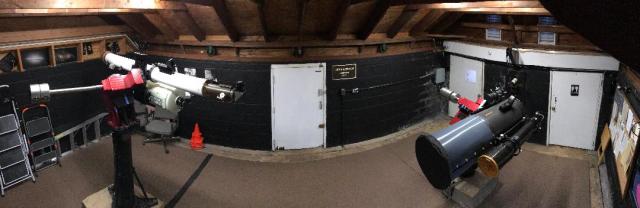
My initial inspiration for the title comes from the fact that the Simpson observatory now has an awesome set of four, bright white LED work lights. These light strips were expertly installed up in the roof rafters by creative board member Gene Allen.
The need for some form of work lighting has been known and chatted about for quite some time as we have been taking strides to improve the observatory and its equipment. Those working under the closed roof were frequently short on available light and cursed the inadequate light producers they may have brought along with them.
So, one recent night, while Gene Allen, Rex Parker, Tom Swords, Larry Kane, Jennifer Skitt and I were tinkering with the Hastings/Mewlon alignment, it was decided to finally remedy the lighting shortcomings. In order to use the lights, there are two corded plugs that drop down from the rafters to plug into 110vac outlets located on the north and south ends of the eastern wall. Just be sure to remove the plugs and stow the cords back up in the rafters before moving/opening the roof.
The results, shown in the panoramic photos of the entire observatory, are dramatic. You can clearly see everything. Thanks Gene!
Speaking of the Hastings/Mewlon alignment, thanks to Rex Parker for acquiring the fully adjustable ADM plate for the Mewlon base. We now have both scopes pointing at the same object in the sky. And, in the process, we managed to bring the Mewlon eyepiece height down to a more comfortable position. This will go a long way in making the Mewlon more pleasurable to use.
Now, on to the inference about first light. Yes, AAAP has recently acquired two new EAA video cameras. The first is a Starlight Express Ultrastar-C installed on the Explore Scientific refractor in place of the Mallimcam camera. The second is a ZWO ASI294MC Pro installed on the Mewlon scope. First light for the new cameras was on May 23rd with the assistance of Rex Parker, Gene Allen, Tom Swords and myself. Initial impressions of the images were highly positive, with the understanding that the results will only get better as our experience with these devices and software grows. Stay tuned for updates.
So there you have it. I spoke about new light, aligned light and first light and it wasn’t too technical.
Thunderbird and his seven girls grew up to know dark skies. Their view was a serene night time walk-about. Every evening, they would naked eye peer into the blackness. Then they would bear witness to the sacred agreement.
Each passing Spring evening, Hehaka the Elk would shelter under Canhasa the Red Willow. And the seven girls awed with wonder seeing them together. If only I were the Elk, and my sisters were the Willow, mused one of seven. I would then know what lay beyond the Earths horizon.
Thunderbird taught the seven girls their relationship with the night sky. He reminded them not to be indifferent to it. They were taught to embrace Oceti the Fireplace and Mato Tipila the Bear’s Lodge, rising in the East. And remember well to say their evening goodbyes to Thunderbird and the Elk, in the setting West.
Time passed, and Earth became a smaller place. Newcomers came to the land where Thunderbird and the seven girls lived. And for awhile, they shared their skies with the newcomers. It was a sharing, after all, gifted from a people that knew the night stories and spoke often of their responsibility to sky and earth.
Over the passing of many seasons, the newcomers commitment was not honored. And Thunderbird grew old and tired. To Tun Win, the Blue Birth Woman, whispered into the ear of Thunderbird. She softly spoke to him his real name. “Wakinyan”, she said. Now gifted with the knowledge of his true nature, Wakinyan, dove from the North and descended into the West, never to be seen again.
The seven girls were troubled. Why, To Tun Win, did you whisper the true name to our father, Thunderbird? He is now gone from us, forever. To Tun Win told the seven girls that they needed to understand the world as being deeply interconnected. That they, the people and the few they privileged, were held accountable to sky and earth. And that the newcomer’s lights’ casted an ugly gray hue.
Wearily, To Tun Win told the seven girls that she longed for seeing Anpo Wicanhpi Sunkaku, the Younger Brother of Morning Star. And to do so with her naked eyes. The gray hue of scattered light kept her from Anpo, she said.
Now forlorn, To Tun Win gathered the seven girls about her. She spoke hesitantly of the passed time for dark skies. She said quietly, “Our reservation has no boundary”. We shared our imaginary lines in the sky. We showed them where we store our history. Where we hunt and where we fish. And despite what stories we tell, we have no real protection.
The newcomers continue to bring the scattered lights. Thunderbird, she exclaimed, is gone forever. He did not protect the night sky. However, you can bring me back my Anpo Wicanhpi Sunkaku.
“How, shall we?”, the sisters asked. Once again To Tun Win whispered softly. Although she spoke to all, each sister felt as if To Tun Win whispered into only her ear.
You must reach out to the seven lands of Mother Earth. You must teach all newcomers. Remind them of their interconnectedness of Sky and Earth. Then they too will know the nightly whisper of To Tun Win. Until the darkness comes back to me, they will only know the story of Thunderbird.
Remember the darkness of the night sky, and pay homage to this relationship. Understand the interconnectedness of the whole World, below and above. Know that you have no higher sovereign authority than to grant, protect, and preserve the night sky.
When you turn off the lights, you unite mother and sun.
It all started with humans observing points of light in the sky with their naked eyes. The quest to understand our planet earth, our solar system, our galaxy, and ultimately the whole universe. Astronomy grew from such humble beginnings. Aided by imagination, technology inventions, growth in science, we have come a long way. And astronomy today is no longer just looking at the sky with the naked eye. Although that task still forms the basis of human curiosity.
Some material for this article has been taken from the book “The Big Bang” by Simon Singh. This book had a great impact on me by laying down the astronomy timeline very clearly. The AI (Artificial Intelligence) part is an addition of my 2 cents. Observation of the skies with naked eye reached its peak with the Danish astronomer Tyco Brahe’s gathering a lot of experimental data which Johannes Kepler used to firmly establish the sun centric model of our solar system with the planets going around. Planets up to Saturn were known and distinguished from stars which stayed relatively fixed in the skies. Comets were known as well.
Hans Lippershey, a Flemish spectacle maker invented the telescope in 1608, which Galileo Galilei made use of. Galileo first observed that Jupiter had four moons and also discovered the rings of Saturn. The telescope extended man’s vision to distant skies. Telescopes became more and more powerful as time went by. Also enabling seeing near objects in much greater detail.
After Galileo, William Herschel was a great user of the telescope. He discovered Uranus, who was the father of Saturn and grand father of Jupiter in Greek mythology. Other than the planets and the stars, there were hazy objects called nebulae. Charles Messier compiled a catalog of 103 nebulae in 1781. These are distant objects, like M31 (31st object in Messier catalog) which is Andromeda, now known as a separate galaxy.
The next milestone came when John Herschel, son of William, started photographing stars. This let the pictures to be analyzed by different teams at future points in time. John Goodricke discovered the Cepheid stars which have variable brightness. Because they go through contraction and expansion cycles. Henrietta Leavitt found a relationship between the period of fluctuation and the apparent brightness by collecting data from a group of Cepheids in the Magellanic cloud. A team of astronomers found the distance to one Cepheid. Henrietta’s graph was used to calculate distances to other Cepheids. Thus Cepheids are known as standard candles.
Edwin Hubble has been the first astronomer to find Cepheids outside the Milky Way and thereby measure the distance to our neighboring Galaxy, namely the Andromeda Galaxy. Finding Cepheids in distant galaxies was not possible. Astronomers made an assumption that the brightest star in all the galaxies have the same absolute brightness. By comparing the apparent brightness, a Galaxy’s distance could be measured.
After Isaac Newton used a prism to split the sunlight into rainbow colors, Joseph Von Fraunhofer, Robert Bunsen and Gustav Kirchhoff built a spectroscope for measuring wavelengths of lights emitted by an object. Each element has its own characteristic emission and absorption line. A great achievement of this technique has been the discovery of an absorption line in sunlight which did not match any element on the earth. It was called Helium. This technique is used to find the contents of a remote object and its atmosphere.
William Herschel accidentally discovered infrared rays. He placed a thermometer in different colors produced by a prism. He tried to measure the temperature of something invisible beyond the red light. He found that portion to be the hottest. Heat radiation is now what is known as infrared rays. In the last half century or so, astronomy galloped to detect other parts of the electromagnetic spectrum, ie. radio waves, infrared waves, ultraviolet waves, x-rays, gamma rays etc. Different telescopes detect different parts of the electromagnetic spectrum. Astronomical objects in the Universe emit more than light. In fact, the complete story of an object can be constructed by detecting emissions at various frequencies.
Radio telescopes began with the accidental discovery of a Bell Labs engineer named Karl Jansky. A radio telescope is set of radio antennas connected to a radio receiver receiving. It does not resemble an optical telescope in any way. Bell Labs also contributed to Astronomy with another accidental discovery of what now is known as cosmic background radiation at microwave frequencies.
Most recent trend has been the discovery of exoplanets. Planets which are outside of our solar system and which can harbor life. Obviously the stars cannot harbor any life. The exoplanetshave to be discovered indirectly, by the dimming of the light from its parent star, or by the wobble it causes to its parent star. It means measuring very subtle variations in light and movement and interpreting the data. This is where AI comes into picture. Recent trends in machine learning involves taking vast amount of data and finding hidden patterns. Quicker than what a human being could have done. In fact with Google’s help, some exoplanets were found using the gathered data. This bodes well for astronomy.
Telescopes have moved to space to avoid the terrestrial disturbances. While bigger and bigger ones get built on the ground. Reams of data is being collected and analyzed by the computers. Big data and AI are coming to the aid. Newer discoveries are being made. We certainly have come a long way from the days of gazing at the night skies or peeping into an optical telescope.