Where Science Fiction meets Science Tea Time…

by Theodore R Frimet

burn baby, burn

K2 kicked up a sand storm this morning. She wandered in and started cursing me out. Why, or why did you click on the Astronomy posts in Linked-In? You should be reading Sidereal Times, old sport!

Evidently, reading science fiction posing as science got under her skin. So much so, she decided to hang out until breakfast was served.

Two eggs, sunny side up, accompanied by two slices of turkey bacon. Coffee, black. Yummy!

The linked-in astro group espoused a certain logic. That there were planets that were destroyed by mutual collisions. Of course collisions could be construed as mutual! After all, what is the sound of one hand clapping? 

Time and time again, we are entertained by the notion that our early solar system was abounded by collision and accretion. How else would be standing on terra firma? If it weren’t for that last great substantive push, we would have neither spin, or stable orbit. Yes, I am barking mad at the moon.

The member artist continues to tease us with the many asteroids that were the result of aforementioned planetary destructions. There aren’t enough pieces in our local cosmic jigsaw puzzle to add up the missing density of two or more bigger silicon rocks. The math didn’t pan out for “where is Vulcan”, let alone, “where is Waldo”?

Getting my mean streak on, due to the anonymity of the morning post, I leave behind my trail of breadcrumbs, just in case meteorites should befell the path before us:

Hi. Nice post, and thought provoking. 

Mars is a protoplanet that lacked the density to retain its atmosphere. I am hopeful that might explain the lack of a life supporting atmosphere on Mars.

The internal temperature of the Sun does not provide for gas giants to form close by, as did the silicate based hard, dense rocky planets.

As for the the “two missing” or non-populated orbits between the gas giants, and the inner rocky planets – sure – there could have been a collision – yet the substantive debris you describe does not support the missing mass.

It is far more likely that the heat, gravity, and the earlier Jovian orbits cleared out the non-populated orbit that you attempted to describe.

My title promised tea time. Please forgive me my gaff, as my prototypical tea turns out to be another cup of Joe.

K2, having read over my recent stab at mediocre astro-lunacy, has something more to say on the matter:

To understand the key interests in self-understanding, one need look no further than the proviso that passions do not pursue the facts. That is self-limiting, and down right dangerous.

Use your reason to pursue your passion. In this fashion, unlike Bruno, you’ll likely not be burned at the stake. -Twasilater.

Posted in June 2020, Sidereal Times | Tagged | Leave a comment

A Storm is Coming

by Theodore R Frimet

I am not asking for solutions for racism. I don’t expect much from me, either. How can I contribute to a movement away from death and destruction while I live in a society that tends to forget yesterdays news? All the while people thrive on reading a 10 word sentence from a racist pundit? I find it hard to compete with that.

Good people are often divided not only by their intuition, their judgments and reasoning can also be askew. Despite being substantially incorrect, they continue clinging to far flung reasoning. All of this misplaced effort is to support their failed judgement system. When their judgements completely collapse, they rely on like minded groups for support. This is in part, is why failed social systems continue to thrive.

I heard on the radio an idea that was easy to validate. That not all members of the police force that wear the color blue are trained for every aspect of their job. Our executive system injects our men and women in blue into every conceivable event that requires policing. In short form, if I were going to serve a Warrant, it requires officers trained in application of force. You wouldn’t however bring that officer to a hostage negotiation, or to talk someone off a ledge?  Would you use Special Weapons and Tactics (SWAT) to serve a warrant? Happens all the time.

The psychology and demands of the uniform are quite different. And therein lay the rub. There are NO laws governing who and in what circumstances officers offer their response. They are expected to do everything. And yes, it is crystal clear that they cannot. We need to seriously decommission the access to weapons and tactics and limit their scope to the origins of the idea to serve and protect.

The civil rights movement started before I was born, and gained traction within the first ten years of my life. If I may make claim to be a child, shaped by the events of our generation of the 1960’s, then we have failed miserably. The horror that we committed against humanity before the civil rights movement are more than echoes of our past. They continue to be the fuel that has been spewed as racist imagery to American’s born since then.

It would go a long way if we could remove racism from the body of the executive. I would start limiting the scope of all police officers. Put them into the jobs that they can be trained for, and never into a position that would put the rest of us into harms way. 

Given the very nature of policing, officers are empowered to not only protect life, are also given lawful access to take away life. The Executive Order that provided oversight, before 2016, was removed. Can I in hindsight, and as a neophyte politicist, even suggest that if oversight remained in place that Mr Floyd would not be murdered? Racism abounds and it will take concerted efforts to make a true and lasting social change.

It should be clear to everyone by now, that the shield and oath of law enforcement will no longer provide protection in a court of law. As a law abiding citizen that has firm belief in the Second Amendment, all have access to the force of arms and a Constitution to make a convincing argument. 

Your services are no longer required. Take a knee, racist, while you can. A storm is coming. It is coming to replace your fallible intuition, broken judgement, and failure to reason with all of America.

Posted in June 2020, Sidereal Times | Tagged , , | Leave a comment

Snippets

compiled by Arlene & David Kaplan

AP Photo

NASA, SpaceX launch astronauts from US soil
Kennedy Space Center- A SpaceX spacecraft carrying two NASA astronauts soared into outer space Saturday — marking the first time humans have traveled into Earth’s orbit from US soil in nearly a decade. Liftoff occurred just after 3:20 pm ET from Florida’s Kennedy Space Center…more

-NASA

SpaceX picture-perfect space station docking
Nineteen hours after a spectacular Florida launch, SpaceX’s Crew Dragon capsule caught up with the International Space Station early Sunday and glided in for a problem-free docking, bringing veteran astronauts Douglas Hurley and Robert Behnken…more

Nancy Grace Roman Space Telescope.

-NASA

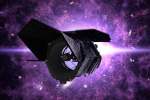
NASA Names Dark Energy Telescope for Nancy Grace Roman
NASA announced Wednesday that one of its most ambitious upcoming space telescopes would be named for Nancy Grace Roman, who pioneered the role of women in the space agency. Dr. Roman was a pioneer at NASA, joining the agency in its early days and becoming its first chief astronomer…more

-Gemini Observatory

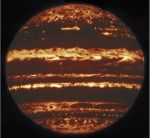
Scientists obtain ‘lucky’ image of Jupiter
Astronomers have produced a remarkable new image of Jupiter, tracing the glowing regions of warmth that lurk beneath the gas giant’s cloud tops. Astronomers have produced a remarkable new image of Jupiter, tracing the glowing regions of warmth that lurk beneath the gas giant’s cloud tops. The picture was captured in infrared by the Gemini North Telescope…more

-Open University

Mars: Mud flows on Red Planet behave like ‘boiling toothpaste’
An international team of researchers wondered how volcanoes that spew mud instead of molten rock might look on the Red Planet compared with their counterparts here on Earth. In chamber experiments, simulated Martian mud flows were seen to behave a bit like boiling toothpaste…more

-BBC

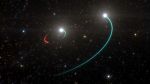
‘Nearest black hole to Earth discovered’
It’s about 1,000 light-years away, or roughly 9.5 thousand, million, million km, in the Constellation Telescopium. That might not sound very close, but on the scale of the Universe, it’s actually right next door. Scientists discovered the black hole from the way it interacts with two stars – one that orbits the hole, and the other that orbits this inner pair…more

PROJECT PHAEDRA – HENRIETTA SWAN LEAVITT #32
Help the Smithsonian transcribe the work of the Harvard Observatory’s women computers and see which stars shine the brightest. PLEASE NOTE: Please follow these special instructions when transcribing these notebooks.

Posted in June 2020, Sidereal Times | Tagged , | Leave a comment

From the Director

Rex


by Rex Parker, Phd director@princetonastronomy.org

Zoom AAAP Meetings for May 12 and June 09.
We hope that you are well and keeping your sense of humor and perspective despite the social and personal challenges of COVID. As you know, club meetings at Peyton Hall and Observatory activities at Washington Crossing Park remain suspended. While we see some positive signs, it is not clear when we will get back to gathering for meetings. So in response, we’re making plans to bring the May 12 and June 09 AAAP meetings to members on-line using the well-established Zoom platform. The Board reviewed available options and concluded that Zoom is the best choice for our next 2 meetings, based on wide-spread acceptance and familiarity, and functionality for groups our size.

For the May 12 meeting we will have a guest speaker, and structure the meeting more or less the same as we do in Peyton Hall. After the talk we’ll hold a members business meeting. So we’ll ask for your patience as well as participation in this experiment, and hope we all become more adept amateur astronomers through the experience. See Ira’s Program Chair section (below) for speaker information and for the Zoom details, and stay tuned for e-mails with more about using Zoom for these meetings. If you haven’t yet used Zoom and would like a pilot run ahead of the meeting, we can offer a practice session before May 12 – stay tuned for emails about this.

Officer Elections – Voting Link.
In order to conduct elections of officers in May, consistent with the by-laws, we sent a link to a specific survey on-line where you can vote on the slate of officers Results will be discussed at the May 12 meeting. If you haven’t yet voted please do so by going to this secure link.

Capital Expenditure Recommendation for Observatory Columns Repair.
The Board recommends the expenditure of up to $9500 for observatory columns (pedestals) repair.  The proposal will be discussed at the May 12 meeting and voted on at the June 09 meeting, each conducted by Zoom.  Our current Treasury balance is sufficient to absorb this amount;  as of March 31 the Treasury balance was slightly over $15,000.  Of course it will be wise for us to raise money in the near future to offset this expense.  I’d like to ask all members to give some thought on ways to generate additional funds .  One example is to donate to the club and apply for a matching gift, if your company or organization has a charitable donation program. We are a tax-exempt 501c3 organization.

The background on this proposal is that the concrete block pedestals that support the roll-off roof of the AAAP-owned observatory at Washington Crossing State Park are in need of serious repair, due to substantial deterioration of the mortar and blocks over time. We have concluded that prompt action is prudent. Options were reviewed by the Board and a few members with engineering and construction expertise over the last half-year, and these were discussed in previous business meetings. We recently obtained cost estimates from professional contractors. The best proposal, from CWC Masonry LLC, of Trenton NJ, is to completely rebuild four pedestals (demolishing and removing the old) on the existing concrete footers which are in good shape. The cost estimate is $8500; the request to authorize up to $9500 helps provide for unexpected issues during construction.

The Bylaws stipulate: … expenditure in excess of $1000 must be recommended by the Board of Trustees and the recommendation must be published in AAAP’s monthly newsletter together with the meeting date on which the expenditure will be voted. The expenditure must then be approved by a majority of the votes cast and not less than 30% of the paid membership. Members not attending the meeting may vote by mailed or e-mailed ballot provided that their ballot is received by the Secretary within 40 days of the meeting.

Next steps:

  • Discuss expenditure proposal at May 12 meeting (Zoom)
  • Members vote on expenditure authorization at June 09 meeting (Zoom)
  • Obtain Park administrative approval (pending)
  • Schedule contractor, execute job, and pay for the work

The Domain of the Amateur Astronomer.
The domain of the amateur sometimes overlaps with the professional. Such was the case with a fascinating Nature Astronomy report which made the mainstream media last week. Two amateur astronomers made the novel discovery of an unusual “teardrop” shaped star. The amateurs carefully analyzed data emerging from NASA’s Transiting Exoplanet Survey Satellite (TESS) and communicated their initial findings to astronomers at MIT and UT-Austin (reference – Handler, Kurtz, Rappaport, et al., Nat Astron, Mar 9 2020). The TESS data revealed unexpected brightness variations of a pulsating variable star named HD74423. The interpretation is that the star attained its ovoid shape due to gravity of a companion red dwarf star with a rapid orbital period, 2 days. The surprise was the dependence of brightness variation on exactly when the observation was made. Tidal forces in the system shift the orientation of the pulsation axis so that the main star forms a teardrop shape in synchrony with the binary orbital period. In their words, “the pulsation mode amplitude is strongly modulated at the orbital frequency; this is the first time that oblique pulsation along a tidal axis has been recognized”. But not the first time that an amateur astronomer contribution has been recognized.

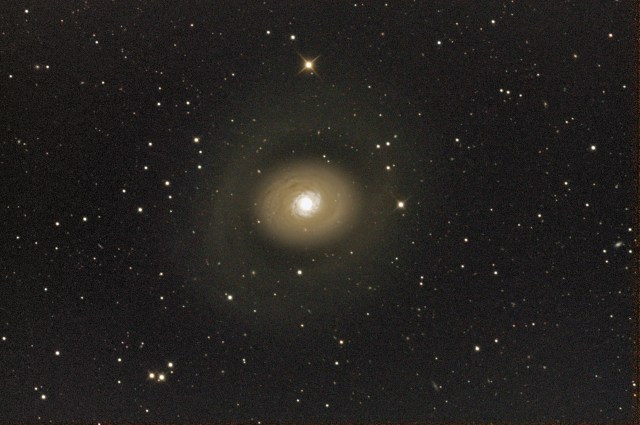
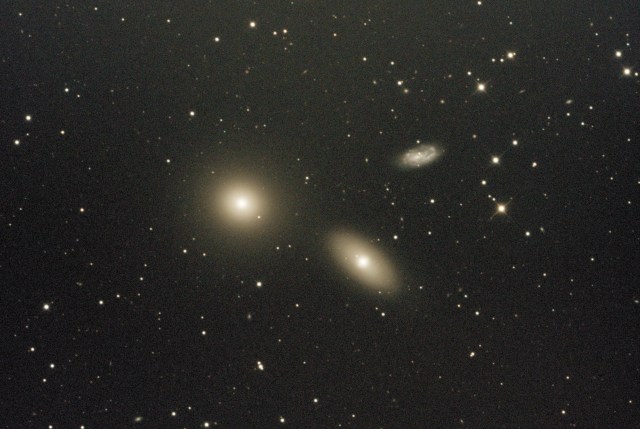
We’re all waiting for the club’s Observatory to reopen. Meanwhile, hopefully you’re getting outside in your yard at home and observing using your own personal telescope. In many ways this is the most essential domain of the amateur astronomer. And here in central NJ we’ve been fortunate to get a few clear nights between spring rainstorms. Below, I offer a few images taken with my own amateur equipment, showing some of the magnificent Messier objects well-positioned now for observing in the early evening. I hope you can get outside to take in some of the views in your own telescope.

Messier 94, sometimes called the “Cat’s Eye Galaxy”, in the constellation Canes Venatici. Astrophoto by Rex Parker from home observatory in Titusville NJ; 12.5 inch telescope with ZWO CMOS camera.
Astrophoto by Rex Parker from home observatory in Titusville NJ; 12.5 inch telescope with ZWO CMOS camera.

Elliptical galaxies Messier 105 and NGC 3384, and spiral galaxy NGC 3389 in the constellation Leo. Astrophoto by Rex Parker from home observatory in Titusville NJ; 12.5 inch telescope with ZWO CMOS camera.

Messier 3, globular cluster in in the constellation Canes Venatici. Astrophoto by Rex Parker from home observatory in Titusville NJ; 12.5 inch telescope with ZWO CMOS camera.

Posted in May 2020, Sidereal Times | Tagged , | Leave a comment

From the Program Chair

by Ira Polans, Program Chair

Monthly Meetings Resume–Virtually

Club Members,

As we, all practice safe social distancing; AAAP is resuming its meetings on Tuesday, May 12 at 7:30 PM using Zoom. (See below for more details).

Please read or print this email as there is a lot of information to review. Most of your questions are answered in this email.

Featured Speaker: Club member Bob Vanderbei is the May speaker and will give a talk on Astro Dynamics. Bob, like most avid astrophotographers, has already taken pictures of all of the interesting stars, nebulae, and galaxies visible in the northern night sky. So, a natural question is: What’s next? One common answer is to take much, much longer exposures to capture interesting faint stuff that wasn’t visible in one’s earlier images of the same target. Another common answer is to go (either physically or virtually) to somewhere in the southern hemisphere where there’s a bunch of cool stuff astro stuff that we can’t see up here in the north. A third answer, which is the one he likes the best, is to revisit objects we’ve already imaged and see if anything has changed. Sometimes things do change. With that in mind, Bob will discuss changes he’s seen and will talk about supernovae, variable stars, the Crab Nebula, the Dumbbell Nebula, and of course Betelgeuse. The image comparisons are surprising and the stories are interesting.

Members are welcome to invite friends and acquaintances by forwarding the link (contained at the end of this email). However, please be aware that we arelimited to 100 participants. Therefore, share your screen rather sharing the link whenever possible.

How to Join the May Meeting: For the meeting, we are going to follow a simple two-step process:

  1. At the end of this email is the information you need to join Tuesday’s meeting. You are welcome to share the link with friends and family. However, we are limited to 100 participants (connections).
  2. The night of the meeting just click on the link in the email and you will be taken to the meeting. You do not need a Zoom account or create one to join the meeting. Nor are you required to use a webcam. We will open the meeting at 7:10 so you have plenty of time to join.

NOTE: If you click on the meeting link and it doesn’t work, simply copy and paste it into your browser.

More Information on Zoom: The Zoom site has many training videos most are for people who are hosting a meeting. If you’re unsure how Zoom works you might want to view the videos on how to join a meeting or how to check your computer’s audio and video before the meeting.

Meeting Agenda

7:10 PM  Meeting Room Opens NOTE: You will not be able to join until the host opens the meeting room.

7:30 PM  Meeting Starts

Opening Remarks (Rex)

Speaker Introduction (Ira)

Featured Presentation (Bob Vanderbei)

Q&A (About 10-15 minutes)

Business Meeting


Virtual Meeting Procedures

  1. For this meeting AAAP is not monitoring chat.
  2. During our trial run, we found that being near your router improves performance. This is not a requirement to join the meeting.
  3. Please do not share your screen during the meeting
  4. Once the meeting room opens you may use the chat feature (if you know how to do this already) and your audio will be on. After the Introduction we will mute all participants and disable self-unmuting. You may continue to use chat if desired.
  5. During the Speaker’s Presentation, please turn off your own video as this helps the presentation run smoothly.
  6. Once the Q&A session begins, we will unmute everybody and enable self-unmuting.
  7. For the business meeting we are going to lock the meeting. This means that if you lose your connection we will do our best to readmit you.


Meeting Invitation

Members are welcome to invite friends and acquaintances by forwarding the link below. However, please be aware that we are limited to 100 participants. Therefore, share your screen rather sharing the link whenever possible.

Amateur Astronomers Association of Princeton is inviting you to a scheduled Zoom meeting.

Topic: AAAP May Meeting

Time: May 12, 2020 07:30 PM Eastern Time (US and Canada)

Join Zoom Meeting

https://zoom.us/j/98466394342?pwd=SHE0ZUZ1UVdwSHM3c3dEZWNVdjZKdz09

NOTE: If you click on the meeting link and it doesn’t work, simply copy and paste it into your browser.

Meeting ID: 984 6639 4342

Password: 674557

One tap mobile

+19292056099,,98466394342#,,1#,674557# US (New York)


Dial by your location

+1 929 205 6099 US (New York)

Meeting ID: 984 6639 4342

Password: 674557

Find your local number: https://zoom.us/u/ab1sLeKqrj


NOTES:

  1.  You do not need a Zoom account or create one to join the meeting.
  2.  You are not required to use a webcam. This means you can join using just an audio or phone connection.
  3. We will open the meeting at 7:10 so you have plenty of time to join
Posted in May 2020, Sidereal Times | Tagged , | Leave a comment

Minutes of the April 22, 2020 AAAP Board of Trustees meeting (online)

by John Miller, Secretary

  • This meeting was initiated via an online video conferencing.session lasting about one hour.

Attendees included:

Larry Kane, Assistant Director
Michael Mitrano, Treasurer
Rex Parker, Director
John Miller, Secretary
Ira Polans, Program Chair
David and Jennifer Skitt, Observatory Co-Chairs
Gene Allen, Public Outreach
Surabhi Agarwal and Ted Frimet, Sidereal Times Editors
AAAP members: Jim Poinsett, John Church, Bill Murray and Tom Swords.

  • An extended topic concerned member-meeting solutions during the Covid-19 crisis. Various conference software solutions were discussed. Rex Parker decided on the Zoom product (being used for this conference). Ira Polans will submit details to the membership. Zoom Pro subscription is about $15. per month.
  • Michael Mitrano submitted the FY balance sheet as of 03-31-2020. It was recommended by John Miller that the report be emailed to the current membership. That was overridden by the Board in lieu of a later version.
  • An online survey (Survey Monkey) was accessed by Rex to poll AAAP members for the required vote for Board of Trustees election, as required by the club by-laws. The survey was emailed to the general membership by John Miller on April 23, 2020.
  • The status of the observatory supports repair was discussed. With Washington Crossing State Park closed, plans for repair are on hold. Rex will talk with the park manager regarding access, scheduling and related issues involving the AAAP. Rex also introduced a motion to increase the repair budget to $9,500 as a buffer.
  • Member Bill Murray reviewed a proposal concurrent with the NJ State Museum’s Planetarium. As a continuing partner with the planetarium, the proposal would coordinate small groups, managed by the planetarium to visit the AAAP observatory as special guests.

Posted in May 2020, Sidereal Times | Tagged , , | Leave a comment

Time

by David J. Kaplan

Time is more ancient than the stars.
It births evolution, yet limits life.
Time stops not for an unwound clock.

Posted in May 2020, Sidereal Times | Tagged , | Leave a comment

O, For a Dark Night Sky

by David J. Kaplan

The city’s night sky
Holds the moon aloft,
A dim orb.

Constellations—incomplete,
The drinking gourd dismantled
Cassiopeia banished.
Orion dismembered.

O, for a dark night sky,
Stars shimmering
In both mind and eye.

When meteors from heaven sent,
Toward Earth their voyage bent
With an arc as wide
As a child’s smile.

Posted in May 2020, Sidereal Times | Tagged , | Leave a comment

Solar observations – with a sextant

by Rafael C. Caruso, MD

On June 2019, a group of AAAP members met in Peyton Hall to attend a two-day celestial navigation course, which I found most enjoyable. The course was taught by Frank Reed, the navigation instructor who currently teaches all navigation classes offered by the Mystic Seaport in Mystic, Connecticut, a maritime museum well worth visiting.  

The objective of this short article is to describe an attempt to determine local latitude and longitude by an observation of the noon sun, and its elegant theoretical background.  These measurements are, in a way, a type of astrometry, the earliest form of astronomy. As this was my first such measurement, I opted to carry it out on from a stationary position on dry land rather than aboard a moving vessel (the fact that I do not own a yacht also played a role in that decision). The boardwalk in Belmar, New Jersey, provided a very convenient “deck” from which to observe the sun and the horizon on Saturday, November 16, 2019, a sunny and blustery day. 

1. Requirements

This determination required three equally essential pieces of information. The devices used in this case to obtain this information are shown in Figure 1.

1. A measurement of the sun’s altitude (H) above the horizon al local noon.

The nautical sextant allows an observer to align the images of sun and horizon, and measure the angle between them. A Freiberger drum sextant, manufactured in 1984 in what was then East Germany was used.  Its drum micrometer is calibrated in increments of 1 minute of arc, which allows estimating measurements to about 0.1 to 0.2 minutes of arc.

2. Precise timing of these measurements. 

A wristwatch with quartz movement, set to Universal time (UT) earlier on the same day, was used in this case. UT may be obtained from the US Naval Observatory Master Clock by dialing (202) 762-1401.  Since no assistant was at hand, a mechanical stopwatch was used to measure the time elapsed between each sextant measurement and its corresponding wristwatch reading. 

3. A knowledge of the sun’s coordinates at the time of measurement. 

The Nautical Almanac, an annual publication, lists the sun’s coordinates for every hour of every day of a given year, among much other information for celestial navigation. The Almanac is published jointly by the US Naval Observatory and the British Nautical Almanac Office. A free version containing the same information is also available online (https://thenauticalalmanac.com)

Sextant, timepieces, and Nautical Almanac.

Figure 1. Sextant, timepiece(s), and Nautical Almanac. This triad provides all the information required to find latitude and longitude (photo by the author).

2. Shooting the Sun

At the moment of local noon, when the sun reaches its highest altitude, the sun crosses the observer’s meridian. This fact is reflected in the etymology of the word, which is derived from “meridies”, Latin for “noon”. For an observer is in a mid-northern latitude, the sun is then due south (conversely, for an observer is in a mid-southern latitude, the sun is due north).

Diagram of a vertical section of the Earth.

Figure 2. Diagram of a vertical section of the Earth, showing the relative locations of an observer and of the sun’s geographic position (GP) when the sun in over the observer’s meridian. Redrawn with modifications from Prinet(1).

Figure 2 shows the position of an observer, depicted as a small circle on the surface of the Earth. Latitude and longitude are unknown to this observer, but we shall assume the observer does know that he or she is north of the equator.  As this measurement takes place in November, the point on the Earth’s surface where the sun is at the zenith (called the geographic position (GP) of the sun), is south of the equator. The blue line tangent to the Earth’s surface is his or her horizon, which is perpendicular to the observer’s zenith. Given the very large distance between the sun and the Earth, all the sun’s rays fall on the Earth essentially parallel to each other, both at the geographic position of the sun and at the observer’s position.  

All the observer does now is to use a sextant to measure the angle of altitude H of the noon sun with respect to the horizon, and to record the exact time of this measurement. As mentioned above, and particularly since the observer may have only an approximate knowledge of the time of local noon, an ideal way to do this to take sun sights starting while the sun’s altitude is still increasing (before noon) and continuing to do so every few minutes until it begins its decline (after noon).

3. Analyzing altitude data

Graph of the sun’s altitude.

Figure 3. Graph of the sun’s altitude as measured with a sextant (Hs) as a function of coordinated universal time (UT)

A graph of the measurements just obtained is shown in figure 3, a plot of altitude (Hs, which refers to altitude H measured with sextant s) as a function of universal time UT. Universal time is equivalent to Greenwich meridian time GMT for a civil day starting at midnight in the prime meridian. In the course of about an hour, from16:15 to 17:15, the sun’s altitude described an arc of an amplitude of 0.5 degrees, with a maximum at local apparent noon. The plot shows that local noon on November 16 occurred slightly before 16:45 hours UT, and that at that moment, the sun’s altitude read from the sextant scale was approximately 30.9 degrees (30° 54’ of arc). 

Celestial navigation textbooks 1-3 recommend tracing a smooth curve through the data points to determine the peak altitude at local noon by inspection. I opted to use a numerical approach, which I have not seen described in navigation manuals, though I assume has been used more than once in the past, since it is quite straightforward. As these data points describe a curve similar to a parabola, one can fit a parabolic function through them and find the function’s equation

Graph of the data points plotted.

Figure 4. Graph of the data points plotted in figure 3, after fitting a quadratic function (a parabola), and its equation. Fractions of UT hours are expressed as decimal fractions.

From the parabola, one can calculate:

a. The time of local noon, obtained from the time value corresponding to the peak or maximum of the curve.  In this case, local noon was at 16.693 hours UT (16h 41m 37s).

b. The sextant reading corresponding to this time, even if the sun’s altitude was not measured exactly then. This is just the highest Hs value of the curve, which is 30.91° (30° 54.5’).

Both values are similar to those estimated by inspection of the graph. The details of this calculation are described in Appendix 1.

Before using this value to calculate a geographic position, some corrections have to be applied to it, to account for the conditions in which the sextant measurement was made. The reasons underlying this requirement are listed in Appendix 2.  After these operations were carried out, the sextant altitude value Hs (30° 54.5’) was corrected to an “observed altitude” value Ho of 31° 6.5’. 

4. Calculating latitude

This calculation relies of the fact that the observer and the sun are on the same meridian at the time of local noon. As mentioned above, the observer knows that he or she is north of the equator, and knows that the November sun is south of the celestial equator. Therefore, their relative positions on opposite hemispheres are as depicted in Figure 5.  

Diagram of a vertical section of the Earth.

Figure 5. Diagram of a vertical section of the Earth, showing the three angles required for a calculation of latitude (ZD, dec, lat). Redrawn with modifications from Prinet(1).

This figure shows that the known value the sun’s altitude H above the horizon allows us to calculate the angle between the sun’s position and the zenith. This is called the zenith distance ZD, which is simply 90° – H. In our case, ZD is 90° – 31° 6.5’ = 58° 53.5’.  

The angle subtended by the larger arc drawn “inside” the diagram of the earth is also equal to ZD, since the sun’s rays are parallel for our purposes. The figure shows that this angle ZD can be visualized as the sum of two angles, the sun’s declination (dec) and the observer’s latitude (Lat).

(As an aside, it’s worth noting that the configuration of these three angles (ZD, dec, and Lat) may be different for other possible relative positions of observer and noon sun, but the latitude calculation always involves a combination of all three of them. I find that drawing a diagram of these angles is a more intuitive and less error prone approach than using any mnemonic).

Therefore, knowing the sun’s declination at local noon allows calculating the observer’s latitude.  This is where the Nautical Almanac becomes essential.

Excerpt of a page of the Nautical Almanac for 2019.

Figure 6. Excerpt of a page of the Nautical Almanac for 2019, which shows the sun’s coordinates for every hour of Saturday, November 16.

The relevant section of the Nautical Almanac page for Saturday, November 16, 2019 is shown in figure 6. The almanac lists sun declination values for every hour of the day.  Note that declination values are designated by convention as N(orth) or S(outh), rather than as the positive or negative values, the notation used in astronomy.   The table entries outlined in red indicate that declination was S 18° 46.0’ at 16:00 hs and S 18° 46.7’ at 17:00 hs.  What we need to know is the sun’s declination at 16h 41m 37s UT, which may be obtained by interpolation as S 18° 46.5’.  The observer’s latitude is therefore:

Latitude = ZD – dec = 58° 53.5’ – 18° 46.5’ = 40° 7’ North

6. Estimating longitude

Although there are more accurate celestial navigation methods for the calculation longitude, a measurement of the time of local noon may also be used to estimate longitude.  This estimation relies on the fact that the geographic position (GP) of the sun changes during the day (see figure 7). At local noon at longitude 0°, the sun’s GP is at some point on the Greenwich meridian. As the Earth rotates, the sun’s GP moves westward at a rate of 15° per hour, and completes a whole rotation of 360° in 24 hours. The angle between the Greenwich meridian and the meridian over which the sun’s GP has moved is called the Greenwich hour angle (GHA) of the sun.  This angle is measured westward from the Greenwich meridian, from 0° to nearly 360°. In the Western hemisphere, local noon occurs later than at longitude 0°, proportionally to the distance in longitude from the Greenwich meridian. Therefore, longitude is equal to the Greenwich hour angle of the sun at local noon2.  

Diagram of the Earth as a sphere, showing the Greenwich hour angle.

Figure 7. Diagram of the Earth as a sphere, showing the Greenwich hour angle (GHA), increasing as the GP of the sun circles westward from the prime meridian. Redrawn with modifications from Karl (2)

To use this fact to estimate longitude, one also relies on the Nautical Almanac. The Almanac lists the GHA of the sun (and other celestial bodies) for every hour of each day. The Almanac excerpt in figure 6 shows that the sun’s GHA was 63° 49.2’ at 16:00 hours UT.  Since GHA is between 0° and 180°, longitude is West of the Greenwich meridian. What we wish to know is the GHA value at the time of local noon, i.e., at 16h 41m 37s. Since we know that GHA increases at 15° per hour, or 0.25° per minute, it has increased 10° 23.4’ in the 41m 37s after 16:00 hours.  Therefore, we can conclude that

Longitude = 63° 49.2’ + 10° 23.4’ = 73° 72.6’ = 74° 12.6’ West

7. Checking coordinate accuracy

At the end of this exercise, we have reached the conclusion that our coordinates are:

Latitude: North 40° 7’ 

Longitude: West 74° 12.6’ 

How accurate is this result? In these days, celestial navigation may be used as a backup if satellite navigation systems such as GPS fail, as it relies on different and independent information. But we may also use GPS as a way to check our celestial navigation results, using these more accurate values as the equivalent of “the answer on the back of the book” in a college math textbook.

The National Oceanic and Atmospheric Administration’s online solar calculator4 lists GPS coordinates of any selected location on Earth, in addition to giving solar position for any time at that location. For our location on the Belmar boardwalk, these coordinates are:

Latitude: North 40° 10.3’ 

Longitude: West 74° 0.9’

As one minute of latitude was historically equivalent to one nautical mile, our error of 3.3’ in latitude is approximately equivalent to a distance of 3.3 nautical miles. 

The length of one minute of longitude varies with latitude, from a maximum of about one nautical mile at the equator, to a vanishingly small distance at the poles.  At a latitude of 40°, a minute of arc spans approximately 0.77 nm. This implies that our error of 11.7’ in longitude is approximately equivalent to a distance of 9 nautical miles. The roughly three-fold difference between the longitude error and the latitude error is not surprising, since the method used here to determine longitude is not an ideal one, and gives only an approximate estimate of longitude.

The great circle distance between the celestial navigation coordinates and the GPS coordinates, obtained with a great circle calculator5, is 9.56 nautical miles. 

In this way, knowing an angle, a time, and having access to data which relate this angle to this time, it is possible to measure latitude and estimate longitude by the noon sun.  Celestial navigation is no longer the most advanced technique to find one’s position, but remains a beautiful achievement of the human mind, and provides a perception of the motions of the earth and sky that is most appealing for an amateur astronomer.

Appendix 1. Fitting a parabola

Numerical routines for fitting a parabola, or any other polynomial function, to data points are included in spreadsheet programs (e.g., Microsoft Excel, or the open source Libre Office), in graphing programs (e.g., Kaleidagraph), and in numerical analysis packages (e.g., Matlab, or the open source Octave).  The best fitting parabola for our data points is shown in Figure 4, in which fractions of UT hours are expressed not as minutes but as decimal fractions, which are required by the numerical routine used.  The curve-fitting program also yielded the equation of this parabola:

− 1.59 t2 + 53.02 t – 411.58

This equation may now be used to find the time of local noon, which is the time t for the maximum Hs value.   For this purpose, one can follow the usual approach to find a maximum of a function. This involves calculating the first derivative of the function: 

− 3.18 t + 53.02 

The maximum t value is obtained by setting the first derivative to zero and solving for t.

In this way, one can determine that local noon occurred at 16.693 hours UT (16h 41m 37s). Finally, one can calculate the sextant reading corresponding to the exact time of local noon. This is just the peak Hs value of the curve, and can be obtained by substituting the peak time (16.693) in the equation of the curve. This results in a value of 30.910° (30° 54.5’) for Hs.

Appendix 2. Applying corrections

This altitude value as measured with a sextant needs to be corrected, to account for the following facts: 

  1. A calibrated sextant may still have a minimal residual error in its angular measurement (which has to be added or subtracted from a reading).
  2. The observer is not at horizon level, but rather at a variable known height above it (in this case, on a modestly elevated boardwalk, 3.2 m (10.6 ft) above sea level).
  3. Aligning the lower limb of the sun with the horizon yields a more accurate measurement than aligning its center, which is the almanac-tabulated value.
  4. The atmosphere refracts rays of light from the sun. This effect is greater if the sun is close to the horizon, and minimal if it is close to the zenith.
  5. Sun sights are taken from the surface of the Earth rather than from its center. The resulting small parallax error is greater if the sun is close to the horizon.

Performing these corrections is considerably simpler that it may seem after reading this list. The observer is able to determine the angular measurement error (known as the index error) of his or her sextant (in this case, 0.3 min had to be added to the reading). The Nautical Almanac contains tables to perform the remaining four corrections. Alternatively, formulas for the same purpose are readily available, and may be entered on a spreadsheet program for ease of use. 

References

  1. Dominique Prinet, Celestial navigation using sight reduction tables Pub. No 249. Friesen Press, Victoria, BC, 2018
  1. John Karl, Celestial Navigation in the GPS age. Paradise Cay Publications, Arcata, CA, 2011
  1. David Burch, Celestial Navigation, a complete home study course. Starpath Publications, Seattle, WA, 2019
  1. NOAA National Oceanic and Atmospheric Administration. Online solar calculator (https://www.esrl.noaa.gov/gmd/grad/solcalc/)
  1. Ed Williams.  Great circle calculator (http://edwilliams.org/gccalc.htm)
Posted in May 2020, Sidereal Times | Tagged , , , , , , | Leave a comment