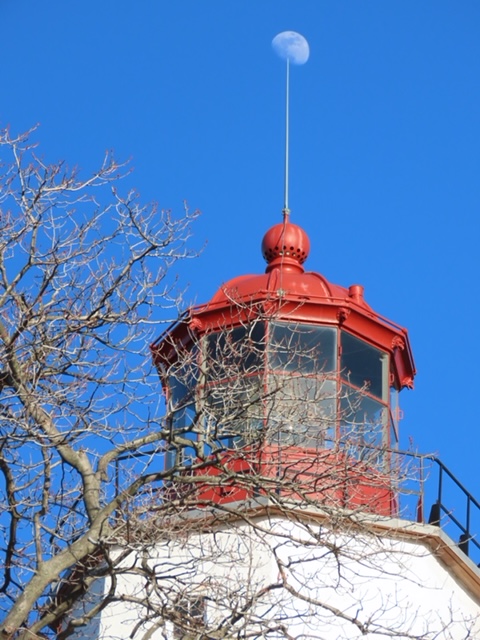
“Lighting the way” – Having some fun with the moon at the end of a fun day. The Sandy Hook Lighthouse is the oldest lighthouse in America (since the original Boston Light was burned down during the American Revolution.)
I enjoyed playing the game of place the moon in a fun position and was able to capture it atop the lighthouse.
📷: iPhone 13 ~ 2/11/22
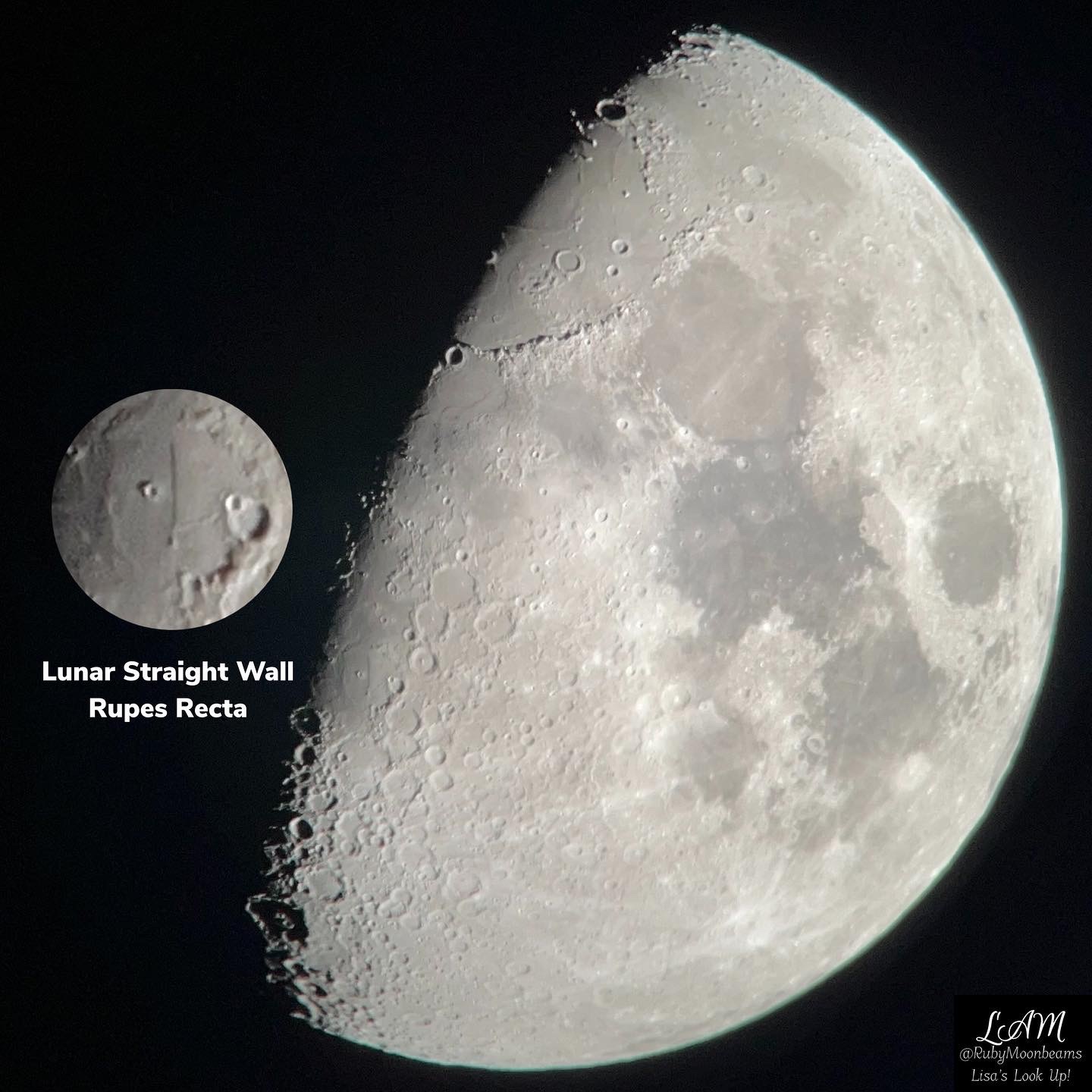
Waxing Gibbous Moon
February 9, 2022 – The day after First Quarter is always a fun time to look for the Straight Wall (Rupes Recta) as highlighted here.
IPhone 13 through Celestron NexStar Evolution 8- 40 mm eyepiece
Sunspots and Prominences 2/9/22
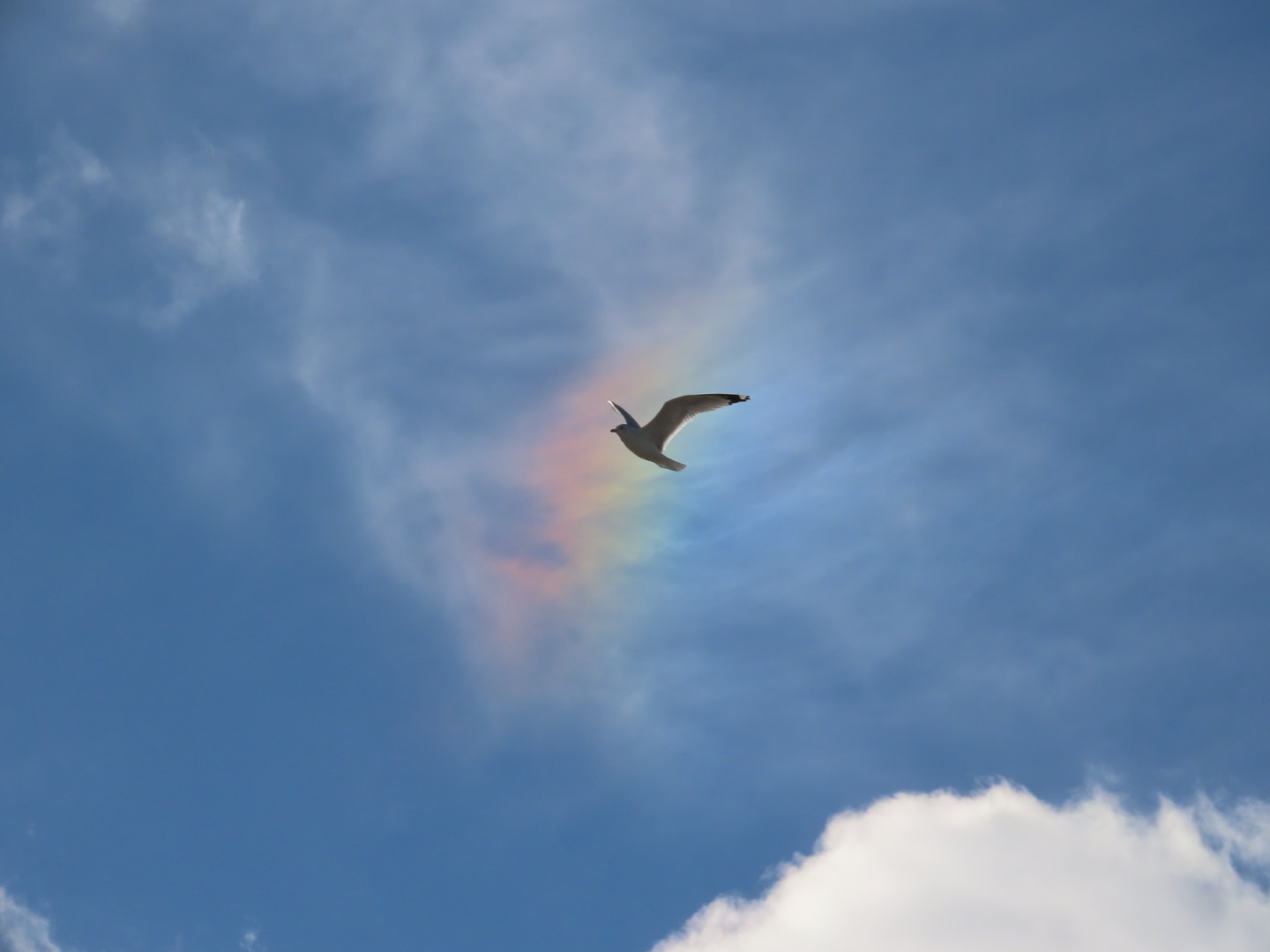
Sundog and a gull
A Ring-billed Gull flies through a sundog on Sunday at the Keyport waterfront Feb 7.
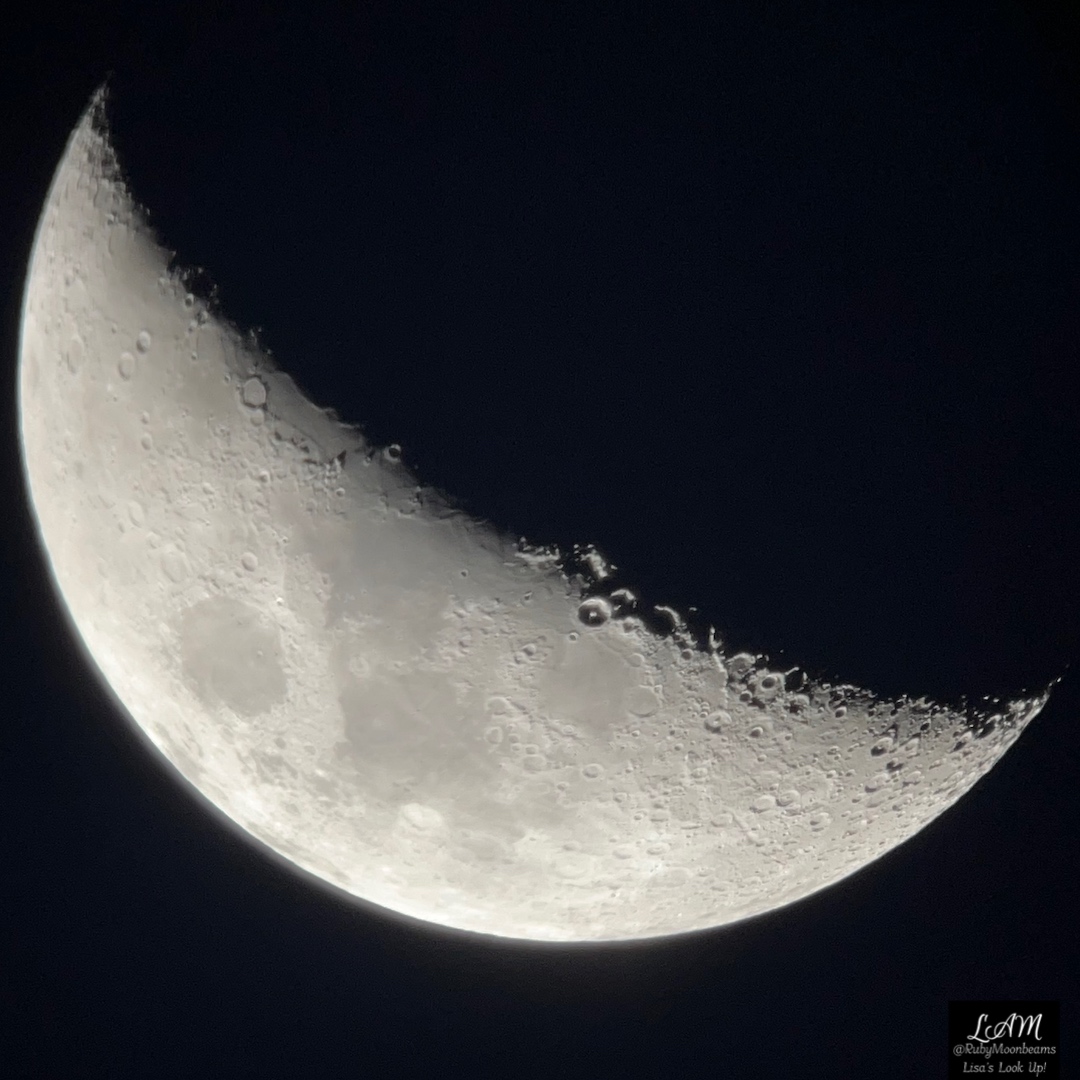
Waxing Crescent moon –
February 6, 2022 – 34%. I love these days around the first quarter. So many features revealed including Theophilus, Cyrillus and Catharina.
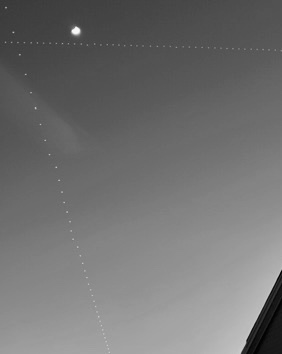
ISS Pass under the moon
February 6, 2022 5:46 PM EST
Equipment: iPhone 11 on a tripod
Processing: extracted from video; cropped for composition, converted to black and white for effect and resized in GIMP
Using the iOS app, “ISS Spotter,” I was able to determine when the ISS would be passing over our house. Visibility began from the Northwest at 5:45 PM traveling to Southeast. This gave me time to set up in my front yard, knowing it would pass horizontally over our home and under the moon. As I was capturing video, an airplane can be seen traveling vertically, which made for an intersection when stacked. 53 images were extracted from video and stacked in Starry Sky Stacker for iOS. I then cropped the image so that the pitch of the roof made for an interesting composition.
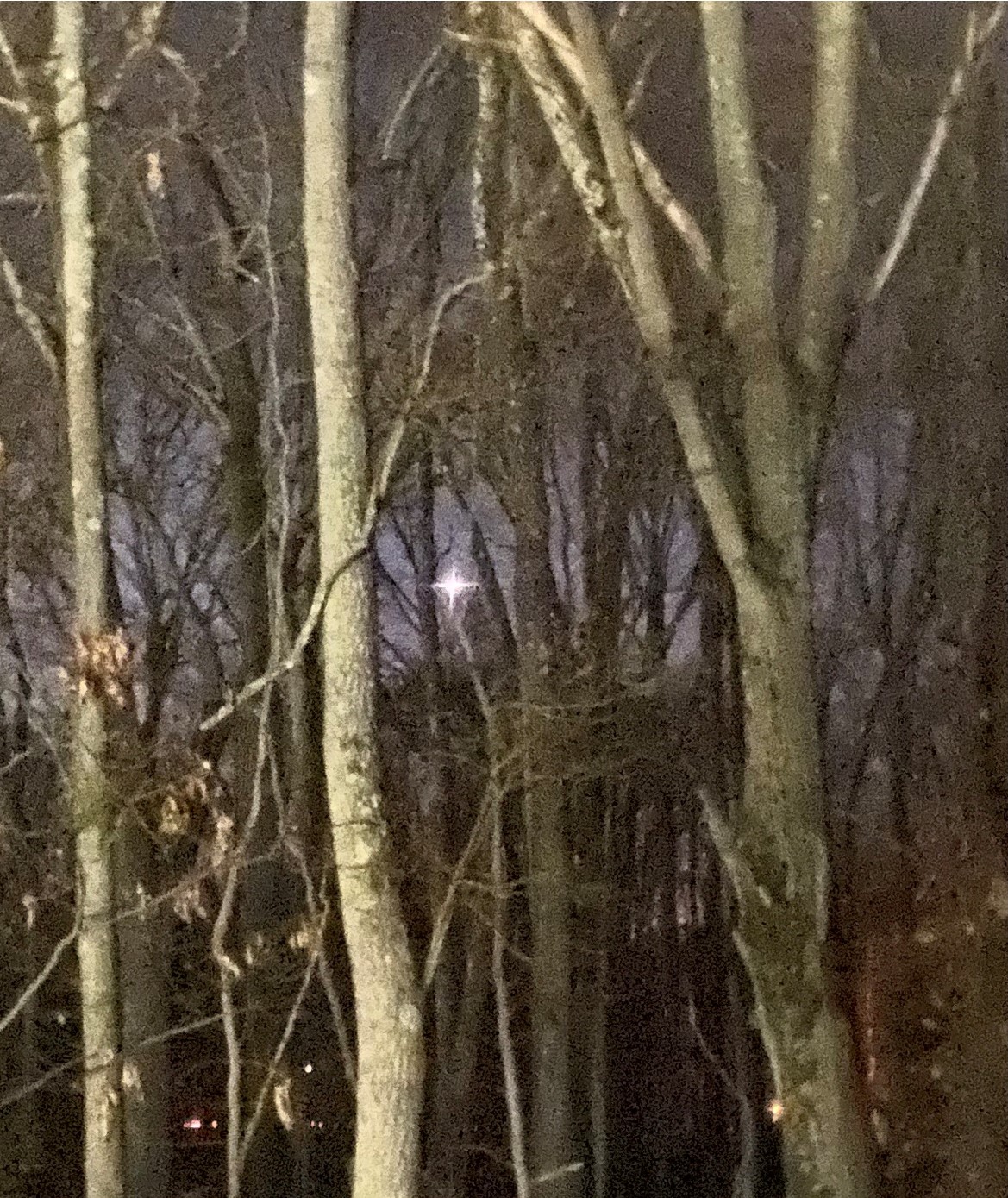
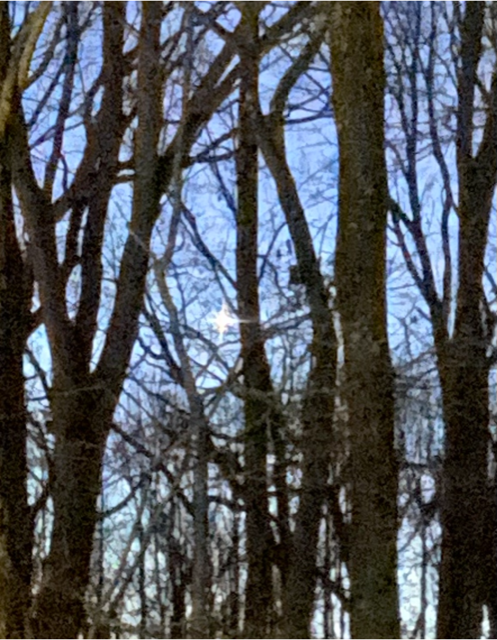
Planet Venus is greeting me every morning, weather permitting. To make sure that I don’t miss her brilliant presence, I leave the window blinds up and ready for the morning ritual. These two pictures were taken on February 10, 2022 between 5:40 and 6:30 A.M.
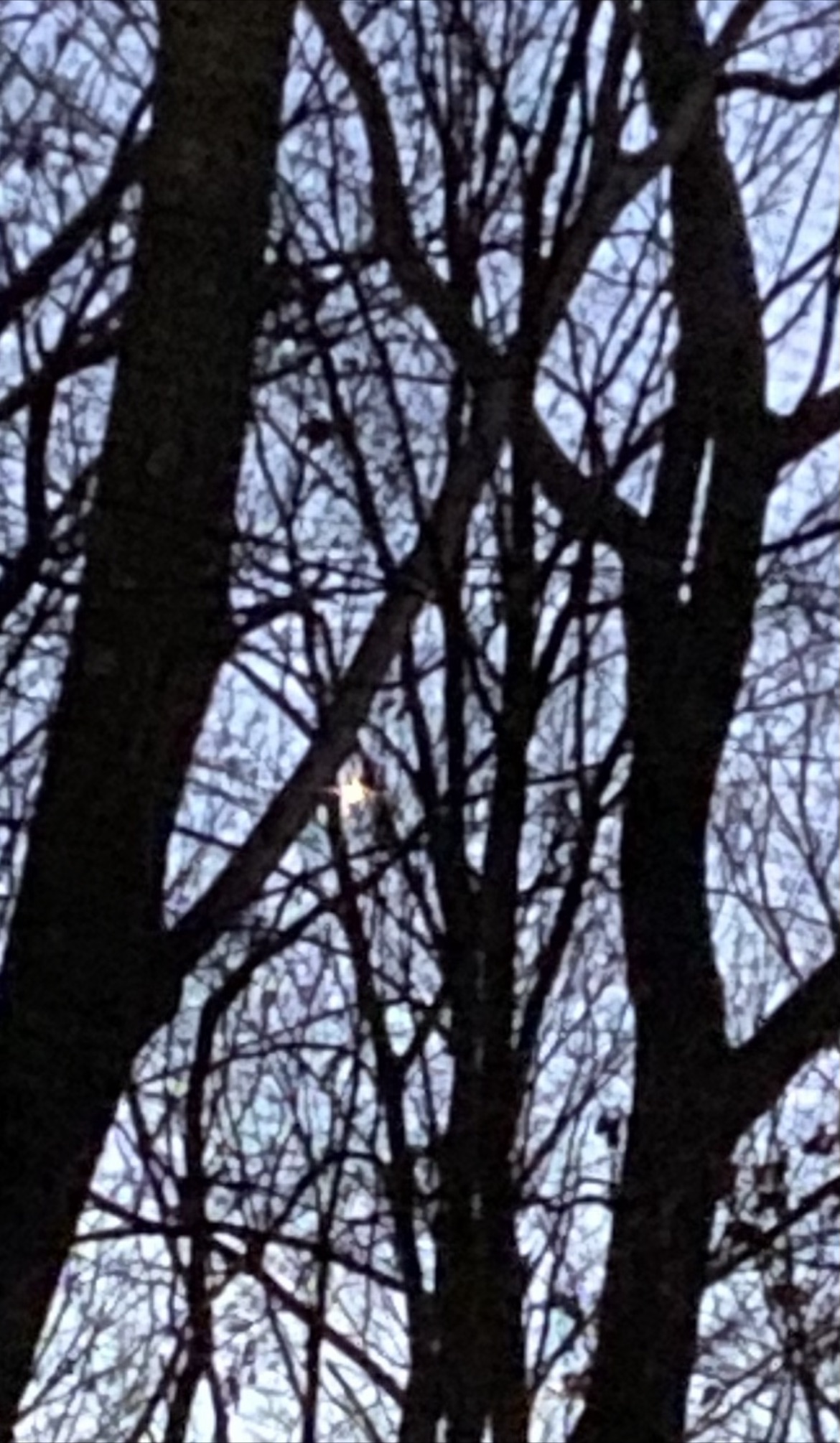
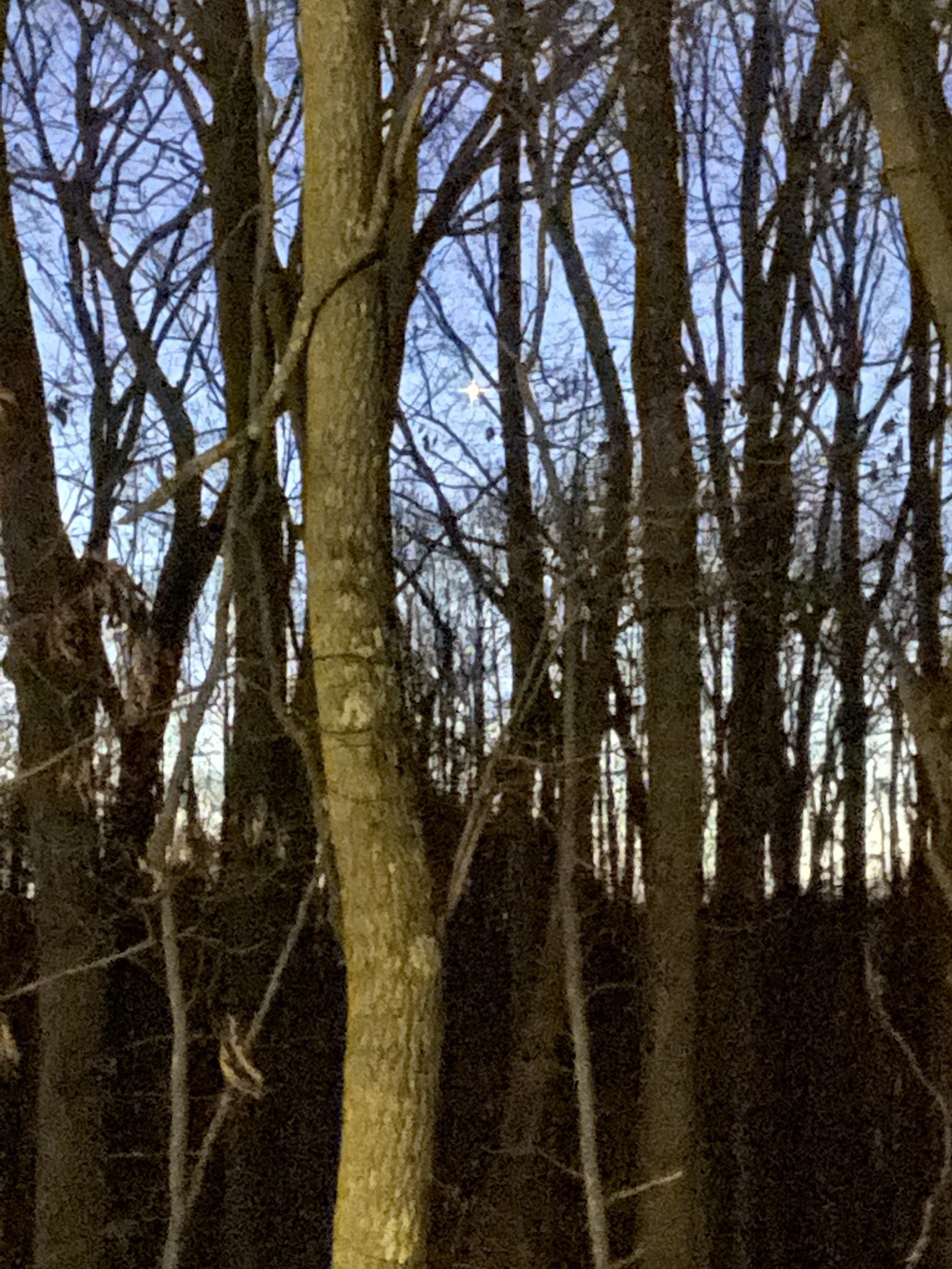
Bare trees during the winter months are permitting me to view the planet Venus. It’s the only time of the year I can wake up to her breathtaking brilliance. These two pictures below were taken on February 23 around 6:30 A.M. from my home in Princeton, NJ.
Iris: Student-built robot rover on track to explore the Moon William “Red” Whittaker may not be a household name, but he should be. The robotics professor has been leading the development of a tiny wheeled robot called Iris, which could become the first uncrewed rover sent by the US to explore the Moon…more
-NYT
Astronomers Find a New Asteroid Sharing Earth’s Orbit Astronomers have discovered a captive asteroid shadowing Earth in its orbit. The asteroid, known as 2020 XL5, is only the second of its type ever seen, shepherded by Earth’s gravity into an orbit that is locked in synchrony with our planet’s…more
-WP
The launch of NASA’s massive SLS moon rocket is delayed again. The much-anticipated rollout of NASA’s moon rocket and capsule to the launchpad at the Kennedy Space Center in Florida for a fueling test will be delayed for another few weeks, the space agency said Wednesday. But after years of setbacks and cost overruns…more
-BBC
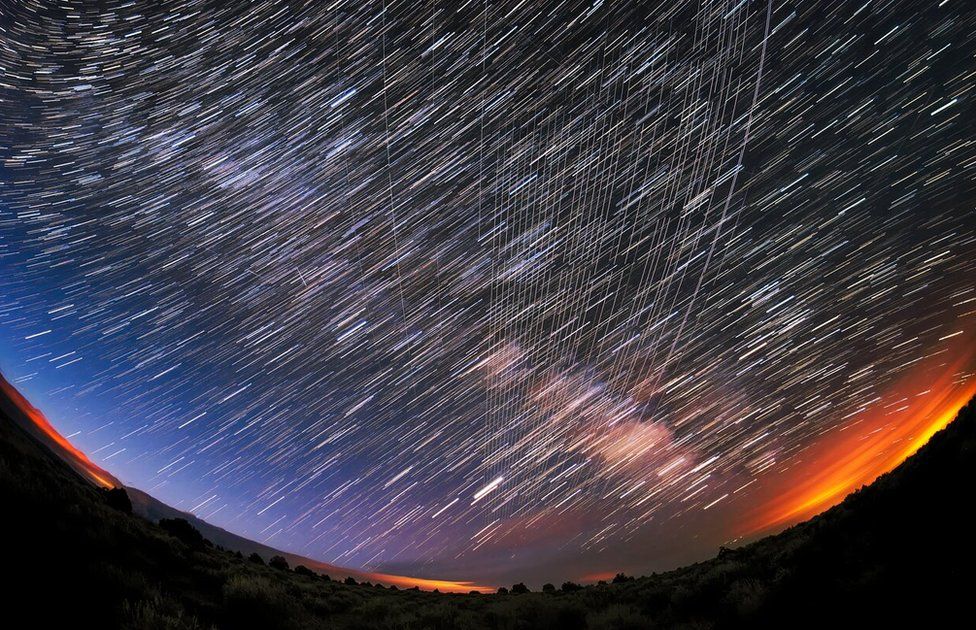
Astronomers stand up to satellite mega-constellations Astronomy is finally putting up a co-ordinated front to defend its interests as thousands of satellites are placed in the sky. Huge networks of spacecraft are being launched that are making it harder to get a clear view of the cosmos…more
-NYT
The First Quadruple Asteroid: Astronomers Spot a Space Rock With 3 Moons Astronomers had already spotted two other rocks orbiting the asteroid known as 130 Elektra, and think more quadruple systems are out there. We already knew the asteroid 130 Elektra was special. Astronomers previously discovered it had two moons, making it a rare triple asteroid system…more
-sNYT
Solar Storm Destroys 40 New SpaceX Satellites in Orbit The geomagnetic incident resulted in the Starlink transmitters drifting back into Earth’s atmosphere, where they will burn up, potentially costing the company about $100 million. Over the past three years, SpaceX has deployed thousands of satellites into low-Earth orbit as part of its business to beam high-speed internet service from space…more
-BBC
James Webb telescope begins to focus its ‘big eye’ Astronomers intend to use the $10bn observatory and its remarkable 6.5m-wide primary mirror to capture events that occurred just a couple of hundred million years after the Big Bang. They want to see the very first stars to light up the Universe…more
– BBC
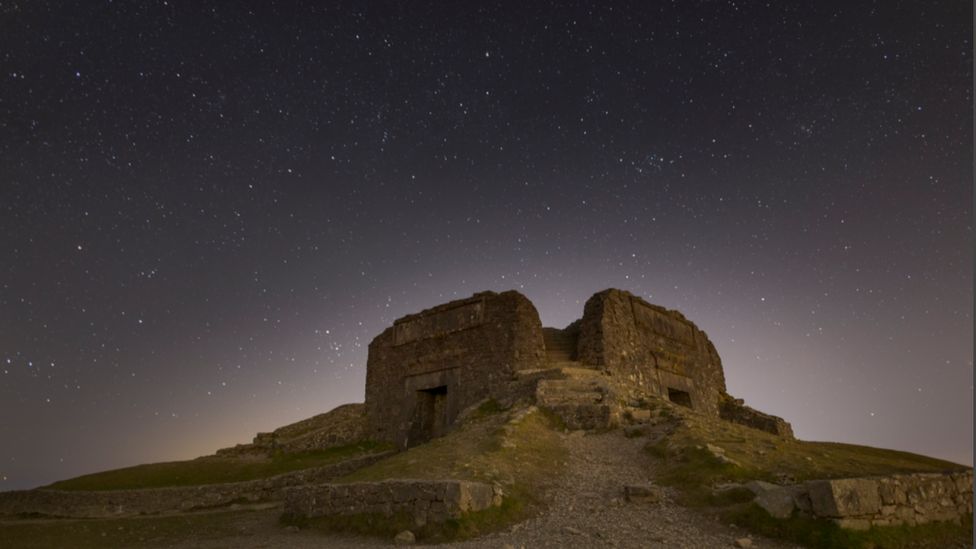
Dark sky: Could Wales soon be home to four zones? A swathe of the north-east Wales uplands could soon be recognised as a hotspot for gazing at the stars. The Clwydian Range and Dee Valley Area of Outstanding Natural Beauty (AONB) plans to submit a bid for global recognition as a dark sky zone…more
-NYT
Beneath a Blanket of Stars It isn’t as easy as it once was to find a dazzling night sky. In search of the Milky Way, our writer headed to Utah, which has the densest concentration of designated Dark Sky places in the world. Roughly 99 percent of the people living in the United States and Europe see only a dim approximation of stars in the night sky, nothing close to the bright firmament…more
On with the Show. As we move into mid-winter it gets harder to do astronomy outside. Better to curl up with a good book or click the link to a seminar for your astronomy experience this month. At the AAAP meeting on Feb 8 we offer a Princeton University guest speaker, Dr. Christopher Spalding, Postdoctoral Fellow in the Dept of Astrophysical Sciences. For info about the talk and the Zoom link see the section below from Program Chair Victor Davis.
Last month’s session with Dr Robert Williams of STScI was one of the best attended (61) since we’ve been Zooming. If you missed that meeting or other recent astrovideo live sessions, see the AAAP You Tube channel (link below). Thanks to Victor Davis, Dave Skitt and Ira Polans for recordings and editing. https://www.youtube.com/channel/UCiJvXfK9DGCmGwiKK_Q6ieg.
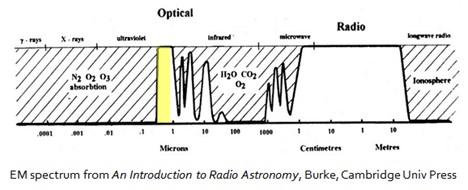
Visualizing Astronomy. What would it be like to see in the infrared? This question arises as we look forward to the commissioning of the James Webb Telescope, which unlike Hubble and most other telescopes was designed to see in the infrared and not the visible spectrum. So why can’t we see outside the visible range (Figure below, electromagnetic spectrum with visible wavelengths in yellow)? This is a circular question that shows that our perception of the universe has been completely shaped by the wavelengths we can see.
The development of sight in animals is a deep topic in evolutionary biology, and in astronomy the limit of eyesight has an obvious major role. As early as 1604 the Renaissance astronomer Johannes Kepler recognized this. His treatise Astronomiae Pars Optica, explores the properties of light and in line drawings the structures of the eye of several animal species are depicted. Two main reasons can be deduced for the limited spectral range of our eyes. Firstly, the earth’s atmosphere absorbs most of the radiation outside this range (Figure above, cross-hatched areas).
This opacity to radiation is due to fundamental properties of atoms and molecules in the gaseous state in the atmosphere and is essential for earth’s hospitality to life. Water vapor strongly absorbs much of the infrared band, which is why infrared astronomy largely relies on orbiting telescopes, hopefully including the Webb. The second major reason is that the molecular biochemistry of photoreception depends on chromophore-dependent biochemical processes which have been fine-tuned over the millennia to absorb light in the 400-700nm range of the spectrum only. A photoreceptor that could detect outside this range was unlikely to be assembled from the proteins and accessory pigments available in evolution. Such a photoreceptor would need a quite different molecular structure beyond the scope of molecules evolving in the history of life. Our perception of the cosmos has earthly underpinnings only now being loosened by the advances of science and engineering.
Speed of an Asteroid. At the meeting last month I tossed out an astro challenge for members with telescopes to observe a celestial object that few people ever see. The challenge was to observe, and for extra credit take images, of the near-earth Asteroid 7482 1994 PC1 on or about the day of its closest approach to earth, ~6pm Jan 18. It would be dim (magnitude ~10.3) but potentially observable from central NJ for only a couple of hours after twilight that night. I have heard that several AAAP members succeeded in the challenge. Here I offer my own observations and a calculation of the speed of the asteroid based on the data collected, illustrating what amateur astronomers can do with today’s equipment.
The original 1994 discovery of this asteroid by R.H. McNaught in Sidings Springs Australia is written up in The Minor Planet Bulletin (vol 24, no.4, Oct-Dec 1997), accessible by internet search. A little over 1 km in diameter, asteroid 7482 is one of about 1600 Apollo objects whose elliptical earth-crossing orbits make them top candidates for a possible collision in the future. In this case, with an orbital period of 1.65 years, one of its close approaches to earth happened on Jan 18, 2022. Predicted to come within 0.013 AU (1.2 million miles) of the earth, 7482 sped by at a distance only slightly greater than the Webb Telescope orbital distance!
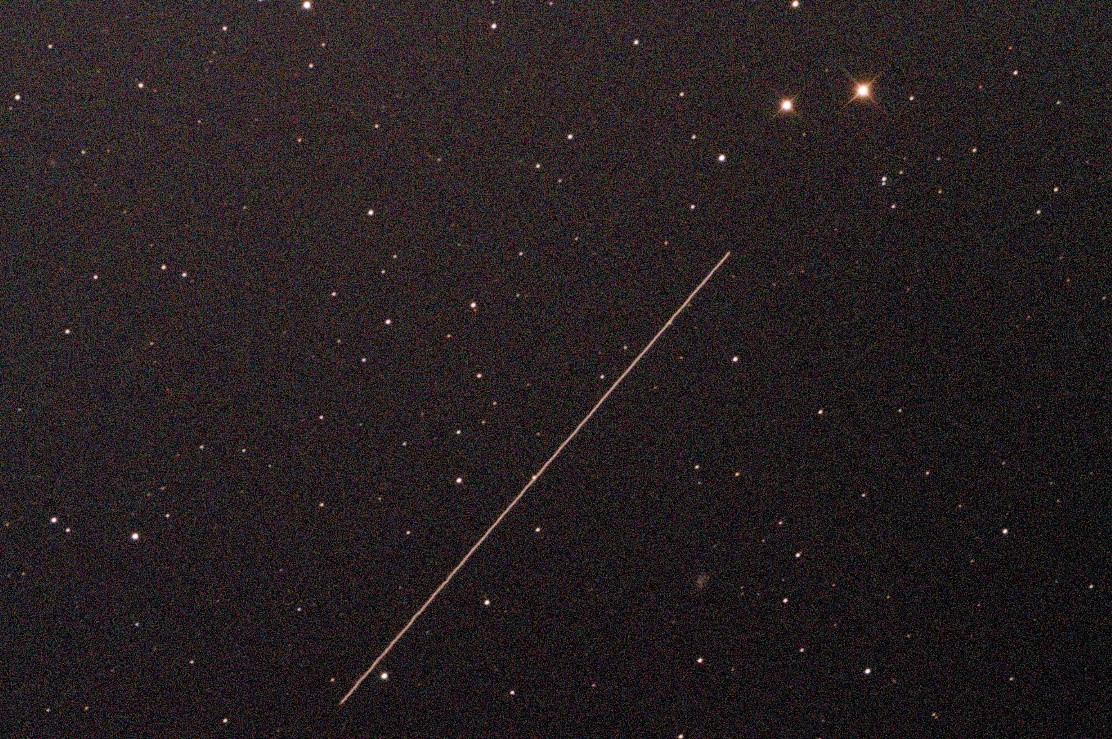
The days leading up to the event were cloudy, but amazingly the clouds over New Jersey dispersed around sunset on Jan 18. With the near full moon rising at 5:40pm, observers had to work swiftly to catch the asteroid between twilight ending and full moon rising. The astroimage below shows the path of the asteroid captured in a 10 min exposure with my 12.5” reflector telescope. The brightest star in this image is 8.8 magnitude, the asteroid 10.3. The speed can be better appreciated in an MP4 movie (click icon under the image below). In the movie below, 58 frames of 12 seconds were combined for a total elapsed time of 11.6 minutes. The asteroid blazed across the sky!
Asteroid 7482 1994 PC1 at close approach on Jan 18, 6:15pm. Image from central NJ using 12.5” telescope and ASI071 camera. The 10 min exposure with tracking on stars reveals the movement of the asteroid as a streak. Click on the icon below for video. Astrophotos by RAParker.
Just how fast is “blazed across the sky”? With the tools of the modern amateur astronomer, we ought to be able to solve this. I measured the distance in pixels movement in the image above using trigonometry (Pythagoras theorem) and used it to calculate angular velocity in radians per minute. Then I used the formula for angular speed ω = θ/t (where ω is angular speed, θ is angle of rotation in radians, t is time); the known scale of the optical system (0.46 arcsec per pixel);and the formula to convert angular to linear velocity: v = r ω. From the data and these formulae I calculated the approximate speed of the asteroid to be 42,500 miles per hour. According to earthsky.org, professional astronomers calculated the speed at 43750 mile per hour, so my error was less than 3%. To give some perspective, the moon in its orbit speeds along at 2288 miles/hr. The asteroid flew by the earth at almost 19 times the speed of the moon!
A little over two years from now, on April 8, 2024 there will be a total solar eclipse that will cross most of North America. While New Jersey will not be within the “path of totality” those in the following cities will see much of the sun’s light blocked out, to the following percentages.
Trenton 89.1%
Newark 90.1%
New York City 89.9%
Cities that will be within the path and, thus will be a witness to the total eclipse include Cleveland, Ohio, Erie, Pennsylvania, Niagara Falls, New York, Buffalo, New York and Rochester, New York. The latter is the closest to Princeton at roughly 340 miles, a five hour, fourteen minute drive. I believe all of these cities have airline access.
While this eclipse is a long way off and many of us have more pressing astronomical and otherwise important things by which we can concern ourselves, I am proposing, that the AAAP start to work on a “field trip” to the Solar Eclipse. So any AAAP member interested in joining the Second AAAP Solar Eclipse Excursion, should send me your contact information and I will start to forward relevant trip information as it is gathered. Send an email to assist.director@princetonastronomy.org. Once an observing location is selected, based on anticipated weather patterns, accessibility, lodging and local astronomy contacts, we can get down to the logistics of the trip.
The February, 2022 meeting of the AAAP will take place (virtually) on Tuesday, February 8th at 7:30 PM. (See How to Join the February Meeting below for details). This meeting is open to AAAP members and the general public. Participants will be able to log in to the meeting as early as 7:00 pm to chat informally with others who log in early. We will not be using the “waiting room;” participants will enter the meeting as soon as they log in. However, you will enter the meeting space with your microphone muted. This will help to remedy some of the background noise we experienced during some previous meetings. Please be aware you must unmute yourself to be heard by other participants.
For the Q&A session, you may ask your question using Zoom’s chat feature or you may unmute yourself and ask your question directly to the speaker. To address background noise issues, we are going to follow the rules in the table below regarding audio. If you are not speaking, please remember to mute yourself. You are encouraged, but not required, to turn your video on.
Meeting Event
Participant Can Speak?
Participant Can Self-Unmute?
Pre-meeting informal chatting
Start All on Mute
Yes
Director Rex’s General Remarks
Yes
Yes
Program Chair Victor’s Speaker Introduction
Yes
Yes
Speaker Presentation
No
No
Q&A Session
Start All on Mute
Yes
5-minute bio break
Yes
Yes
Journal Club presentation by Surabhi Agarwal
Start All on Mute
No
Business Meeting
Start All on Mute
Yes
Director’s closing remarks/Informal chatting
No
No
Only the Business part of the meeting will be locked.
Featured Speaker: Dr. Christopher Spalding, 51 Pegasi b Postdoctoral Fellow in Princeton University’s Department of Astrophysical Sciences. (christopher.spalding@princeton.edu)
Upside-down, Inside-out Solar Systems The planets of our Solar System follow orbits that resemble concentric circles, with the Sun spinning in the same direction as the planets orbit. This “clockwork” picture filled textbooks and research papers alike for centuries. But the past decade of exploring exoplanets has revealed a puzzle: Many of them seem to orbit “backwards”–opposite to the spin direction of their host stars. How could this be? Moreover, these worlds usually exist 10 times closer to their stars than Mercury does to the Sun. Clearly, something very different led to the creation of these “upside-down, inside-out” systems as compared to our Solar System. In this talk, Dr. Spalding describes the weird and wonderful properties of these alien worlds and discusses what they are teaching us about the origin of our own planet Earth.
Christopher Spalding earned his BA and MSci degrees from Cambridge University with first class honors, and his PhD in Planetary Science from Caltech. He has won numerous honors and awards, including the Ray Duncombe Prize for Dynamical Astronomy, a NASA Earth and Space Science Fellowship (NESSF) Graduate Fellowship in Earth and Planetary Science, a 51 Pegasi b Postdoctoral Fellowship, and most recently, and closer to home, a Lyman Spitzer Jr. Postdoctoral Fellowship. Dr. Spalding’s primary research seeks to understand planet formation by way of simple theoretical descriptions of planetary dynamics. He enjoys applying simplified mathematical methods to extract important lessons from problems spanning planetary system formation and architectures, Earth’s long-term habitability, extinction dynamics, and more. He’s active in science education and outreach as a teacher, guest lecturer, and colloquium organizer.
51 Pegasi b is the first planet discovered orbiting a Sun-like star, discovered in October 1995. This gas giant is about half the mass but half again larger than Jupiter, and orbits its star in 4 days. It fits the description “hot Jupiter” typical of the first exoplanets, which were discovered using radial velocity measurements of their host stars. The 51 Pegasi b Fellowship “provides an opportunity for promising recent doctoral scientists to conduct novel theoretical, experimental, or observational research in planetary astronomy.”
AAAP webcast: This month’s AAAP meeting, beginning with Rex’s opening remarks and ending at the beginning of the business meeting, will be webcast live on YouTube and recorded for subsequent public access on AAAP’s YouTube channel. Be aware that your interactions during this segment, including questions to our guest speaker, may be recorded for posterity.
This session will be recorded and saved on YouTube. Send me an email at program@princetonastronomy.org if you have any concerns.
Using Zoom: While we are social distancing, the AAAP Board has chosen to use Zoom for our meetings, based our belief that many members have already have used Zoom and its ease of learning. One of its great features is you can choose whether you want to install the software on your computer or use it within your browser.
How to Join the February Meeting:For the meeting, we are going to follow a simple two-step process:
Please make sure you have Zoom installed on your computer. You do not need a Zoom account or need to create one to join the meeting. Nor are you required to use a webcam.
Following the post-presentation bio-break, Surabhi Agarwal will describe her experiences as a citizen advocate for remedying light pollution. Inspired by Rex’s community activism against light pollution, Surabhi will report on her efforts to fight light pollution in her own community, and encourage the rest of us to do the same.
We hope to make these short presentations a regular feature of our monthly meetings. We’d like to know what members are doing or what members are thinking about in the broad range of topics encompassed by astronomy. A brief ten-minute (or so) presentation is a good way to introduce yourself and the topics you care about to other club members. If you are interested in presenting a topic of interest, please contact either director@princetonastronomy.org or program@princetonastronomy.org.
A look ahead at future guest speakers:
March 8, 2022
Rosanne Di Stefano, of the Center for Astrophysics/Harvard and Smithsonian, led a team who used the Chandra X-ray observatory to search for brightness dips in X-ray binaries. They may have detected a transiting exoplanet in the spiral galaxy M51. To date, all exoplanet candidates (4,000+ and counting) have been discovered within 3,000 light-years of Earth. An exoplanet in M51, 28 million light-years away, would be thousands of times farther away than those in the Milky Way.
April 12, 2022
Paul Daniels, FRAS, an active participant in the Royal Astronomical Society’s Megaconstellation Working Group, will discuss the serious threats to professional and amateur astronomy posed by launching thousands (potentially 100K+) of reflective objects into low Earth orbit.
May 10, 2022
TBA
June 14, 2022
Bill Murray, AAAP Outreach Chair and astronomer at the New Jersey State Museum will once again (following a Covid hiatus) give club members a private sky tour at the museum’s planetarium. He’ll show off the refurbished planetarium’s state-of-the-art Digital Sky 2 8K projection system. This is an opportunity to put aside Zooming and commiserate with astro-buddies in the real world.
Thanks to Bill Thomas, Ira Polans, and Dave Skitt for their valuable advice and assistance.
As always, your comments and suggestions are gratefully accepted.
The meeting was convened on Zoom by Director Dr. Rex Parker at 1930 with the agenda for the evening.
At 1945 Program Chair Victor Davis introduced featured speaker Dr. Robert Williams who presented “Observing Galaxy Formation with the Hubble Space Telescope” from his home. His limited internet bandwidth restricted us to his voice, gave us some dropout issues, and Victor had to run a copy of his slide pack. Among lots of other interesting information, he too modestly described how he had risked his job as director of the Space Telescope Science Institute to point Hubble at an empty patch of sky for 400 orbits. In doing so he captured the momentous, game-changing Hubble Deep Field image. We broke for five minutes at 2101, then reconvened for a briefing on the James Webb Space Telescope and questions.
We transitioned directly to the business meeting at 2125, the Unjournal Club Presentation by member Surabhi Agarwal having been postponed to next month.
Rex briefed us on details about approaching Apollo Asteroid 7482 / Minor Planet 1994PC1, then challenged members to observe and capture images of it on or around its closest distance of 0.013 AU on January 18. Share your experience on Discord and in an article for the Sidereal Times. He encouraged us to watch the Netflix movie “Don’t Look Up” about an Earth-impacting asteroid for “extra credit.”
Rex presented an overview of the AAAP Discord Server, a restricted social media platform launched last month, noting that 45 members had signed on so far. He made an appeal for two or three members to step up to serve as monitors.
Rex announced that he had placed his first order at the AAAP Online Merchandise Shop, and some discussion followed.
Observatory Co Chair Dave Skitt announced that water has been turned off and the toilet winterized in the Observatory. It is not closed to use, but manual flushing, where you bring your own water and then use antifreeze, is now required. Check with Dave for the correct procedure before you go.
Rex reported that the January 7 Astrovideo Live Winter Zoom Session included views from the telescope cameras of members Bill Murray, Rich Sherman, and himself, while Dave and Jen Skitt fired up the C-14 in the Observatory. Members with camera capability are encouraged to join in and contribute to future sessions planned for February 4 and March 4. Other members are invited to enjoy the views and discussions from the warmth and comfort of your own home, as some 15 had done during this session.
Member Tim Gong shared that he has been engaged in photometry and agreed to offer an Unjournal Club Presentation about his effort at the March meeting.
Member Lee Sandberg was encouraged to inquire about the use of the auditorium at the Institute for Advanced Studies while Peyton Hall is denied to us due to both Covid and impending campus construction.
Member Surabhi Agarwal reminded us that 2022 is the Diamond (60th) anniversary of the AAAP. A suggestion was made that a logo be created for this event, and she offered to submit one for consideration. The logo could be applied to various merchandise items.
Discussion about the mechanics of posting images and files on Discord wound down and the meeting was adjourned promptly at 2200.
Between Zoom and the live YouTube feed, approximately 66 people attended the speaker’s presentation. The business meeting began a bit later than usual but 35 were still connected halfway through. Since the beginning of December, 11 new members have joined, bringing our total membership to 191.
Let them draw together the bones of the metal. – Ezra Pound, The Alchemist
I venture that one reason amateur astronomers like their hobby so much is that despite all the turmoil here on Earth, the heavens are generally peaceful, quiet, and predictable. We do have the rare supernovas in faraway galaxies, collisions of comet fragments with Jupiter or even Earth, and other events that temporarily disturb the scene. By and large, however, the universe goes on its way, free and clear of our petty problems and providing a beautiful panorama for us to explore and contemplate.
Ancient civilizations were impressed with the cycles of the moon and planets and the yearly return of the seasons. They constructed many temples and monuments to monitor these phenomena, wanting to know promptly if any baleful influences had come along to disrupt the orderly procession. Eclipses of the sun and moon came in for special study because of their drama, as did the appearances of comets. These were especially sinister, because they came according to no apparent schedule and were therefore thought to presage catastrophes.
I used to regularly observe and time occultations of stars by the moon. When this happens at its dark edge, the event can be quite striking as the star suddenly disappears. Apart from their inherent interest, good timings of these events were scientifically valuable. Predictions for any given location were available from the U.S. Naval Observatory. These were accurate to within a second or two, but not much more than that. The main reason for the uncertainty is that the moon has a very irregular edge; its profile as seen from Earth is constantly changing depending on what the perspective is at any given moment. By collecting enough such timings, mostly by amateurs, professional astronomers could refine the local topography of the moon and even its orbit. Nowadays, using retroreflectors left on the moon by astronauts, highly accurate laser ranging can take care of any remaining orbital adjustments.
It might be thought that our present-day mathematics could precisely predict the orbits of planets. This is true in one sense, but not in another. We do have computer programs that can carry out numerical approximations of the planetary orbits to excellent accuracy. However, due to the mutual gravitational attractions of the planets, it is fundamentally impossible to carry this out on a strictly theoretical basis. Even a simple system consisting of only three mutually attracting bodies cannot be solved exactly, although two can be handled. This inconvenience to us doesn’t bother the planets themselves. Merrily they roll along according to exact laws that they alone know, like T. S. Eliot’s cat who knew its own deep and inscrutable singular name even if no one else did.
Regarding the mechanics involved in computing orbits, the topic of the “speed of gravity” is an interesting one. The prevailing wisdom is that gravitational effects are propagated through space with the speed of light. However, some scientists with special expertise in orbital calculations 1 have proposed that perturbation effects must travel at a much greater speed, otherwise the solar system would be chaotic. Interestingly, computer models of colliding galaxies seem to tacitly acknowledge that gravitational effects occur nearly instantaneously over the enormous distances involved.
Be that as it may, the programs that I mentioned are good enough to locate apparent planetary positions as seen from Earth over many thousands of years. It can be entertaining to try to reconstruct planetary lineups, both at the present and in ancient times. Some years ago I decided to use such a program to try to determine if Jupiter had ever passed directly in front of Saturn, as seen from Earth, in historical times. I could find no previously published record of such a calculation. Even if this kind of event had never occurred, it still would be interesting to see if they had ever come so close to one another that they would have appeared as one body to the unaided eye. This would have been a significant event to the astrologers of yesterday and might have had historical importance as an omen.
Jupiter overtakes Saturn about once every twenty years. Since they move in orbital planes that are not tilted very much with respect to one another, there is always the chance that Jupiter will appear to come very close to or even pass in front of Saturn at these times. I was especially interested in whether this had ever occurred near the bright star Regulus in Leo, Regulus having always been of major astrological importance. The fact that Regulus is also near one of the two points in the sky where the orbits of Jupiter and Saturn appear to cross each other as seen from Earth, makes events near this star even more likely to involve close passes. Fine events with Regulus close by did indeed occur in the years 1793, 940, 86, and 27-26 BC, but not since then. None of these events involved an actual occultation of Saturn by Jupiter.
After doing all the calculations, it became clear that Jupiter had never passed directly in front of Saturn any later than 4000 BC and will not do so any earlier than 2800 AD, these being the limits of the time period for which this particular program is valid. However, they have come so close on several occasions that they would have appeared briefly as one object even to people with very sharp eyesight. These would have been exciting events to witness. The most recent one that would have been really striking was in 1226 AD. Some of us were able to see and photograph them within about 6 arc minutes of each other low in the evening sky in December, 2020.
Who can say whether such apparitions had any real influence on what was happening then, through the interpretations of astrologers? I like to think that they might have. In particular, the complex events of 27-26 BC. near Regulus also had Venus and Mars passing nearby. This may have been taken as a favorable sign for the assumption by Octavian of the formal title of Cæsar Augustus.
Astrologers long ago associated Jupiter with the precious metal electrum, an old name for a naturally-occurring mixture of about one-quarter silver and three-quarters gold as well as for amber, or fossilized tree sap. (The word “electron” is derived from the fact that amber easily takes on a static charge, and we get “electricity”from the same root.) Saturn, on the other hand, was linked with common ordinary lead. Jupiter is bright and attractive in the sky, while Saturn is a dull, slow-moving object. Gold, silver, and lead sometimes occur together in lead ores, but are rarely if ever combined intentionally. As a chemist, I find it interesting that Jupiter and Saturn have also remained unalloyed in the sky within the span of human memory and will continue so for at least another 800 years.
1 See for example T. Van Flandern, “The Speed of Gravity – What the Experiments Say,” Physics Letters A, 250 (1-3): 1-11 (Dec. 21, 1998).
The above article was adapted from Chapter 18 of the author’s book From Eve and Morning, 2003. For more on Jupiter-Saturn events, see the author’s article in the March 1991 issue of Sky & Telescope starting on page 305.
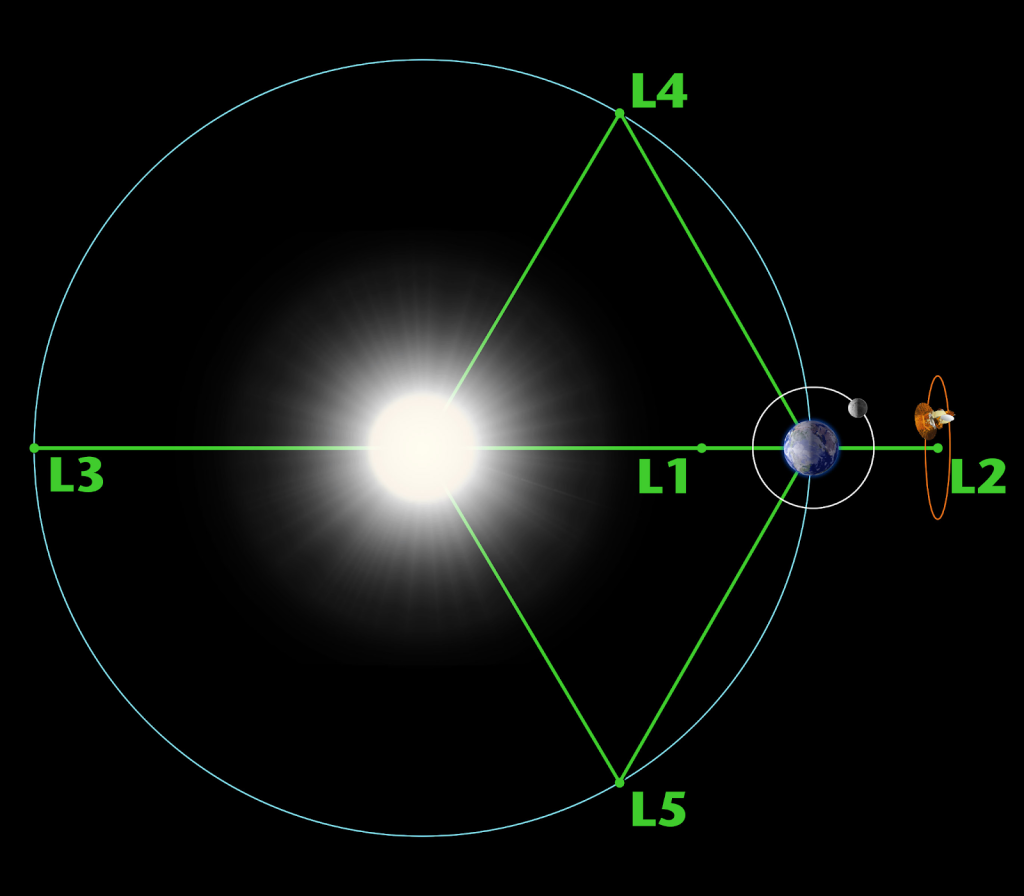
The perilous journey on the ground as well as in the space is complete. Continuing our journey with the James Webb space telescope, which was launched on Christmas day at the fag end of 2021. Some deployment tasks have been completed in space. The solar panels have been unfurled. So have the heat shield and the complex mirror. Each of them is a huge undertaking and a potential point of failure. More importantly, it has reached its home at the L2 Lagrangian point about a million miles away from Earth on the other side of the Sun-Earth axis. Picture given below from the internet shows the L2 Lagrangian point in relation to the Earth and the Sun.
The telescope will be parked here or rather will be moving along with the Earth around the Sun. With some tiny orbiting around the L2 point in a perpendicular plane. With respect to the Earth, it will appear at the same point all the time. Hopefully for the next decade or even longer. The L2 Lagrangian point is named for the French mathematician Joseph Lagrange. It is a point at which the combined forces of gravity due to the Earth and the Sun are supposed to be minimal. It is difficult for me to visualize the forces involved. Lagrange solved this “three body” problem mathematically to arrive at five such points in space named L1 through L5 shown in my favorite picture above. L2 is the most appropriate place for the task at hand, which is to see the vast swath of Universe away from the Sun.
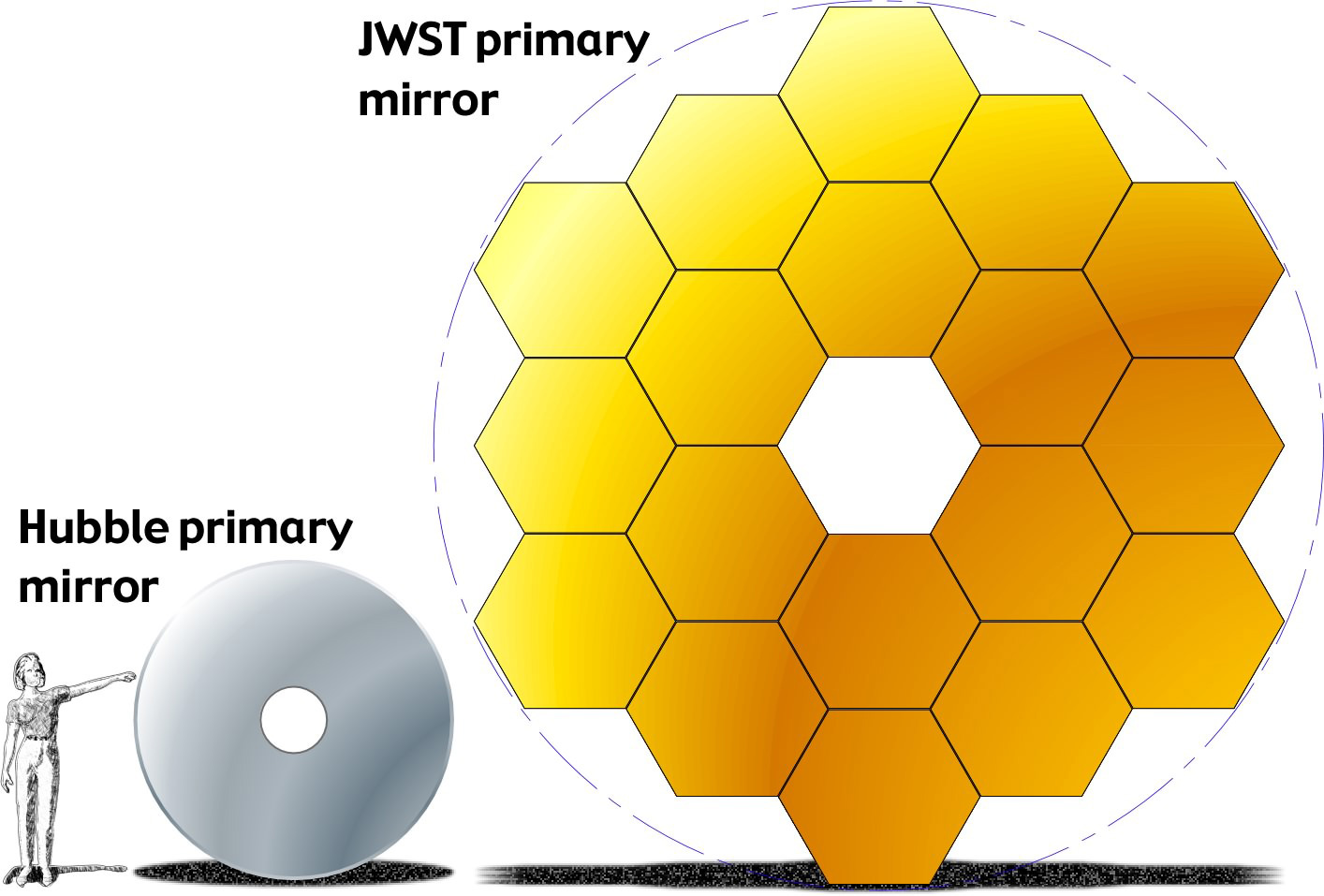
The telescope itself is a piece of engineering marvel. It took ages and cost a lot of money to engineer, construct and test. And finally send it to its home at the L2 point about a million miles away. Several nuances of engineering about this marvel fascinate me. And how human thinking strives to make things better and better. A true successor to the current Hubble telescope, which had a shaky start with a faulty mirror corrected by floating astronauts in space. Hubble has lived beyond its expected lifetime and contributed enormously to our knowledge of the Universe. Webb will be a quantum jump over the Hubble. Comparing and contrasting with Hubble, it weighs much less at 6.5 tons vs. 11 tons for Hubble. Yet its mirror is more than double the size, weighing about a tenth. The mirror has been designed using the divide and conquer technique. Casting larger mirrors is fraught with exponentially larger difficulty and is fragile enough to be sent into space as one piece. It has 18 hexagonal segments, each made of an ultralight metal called Beryllium. This metal has been mined in Utah and exists largely in powdered form and is difficult to work with in forming larger pieces. Each segment is polished to extremely low tolerance and is coated with gold. Gold is a good reflector and never loses its sheen. Hence gold captivates humanity as well ! Another favorite picture of mine given below, courtesy NASA.
The mirror could not be sent into space as one piece due to the real estate limitation of the largest rocket which was used to launch. It had to be folded. A segmented design helped towards this end. And the unfolding went very well once it reached space. What is left before Webb starts doing real science is the process of tuning the giant mirror. It is expected to take the next three months. Why such a long time ?
Firstly, the mirror has to be absolutely perfect to help us take a good peek at the Universe. Each of the 18 segments has an actuator connected to a motor. Commands are given to the motor to move the segment for alignment. And motors do generate heat while operating. Heat is something which Webb cannot tolerate. Since it will be observing the Universe in the infrared region, which is basically heat, it needs to be kept very very cold. The huge sun shield on the side of the telescope facing the Sun does a lot of the shielding. Any heat from the telescope’s internal instruments will not be acceptable. Hence the process is very slow.
The motors can be asked to move only very small distances (about a millimeter) and can operate for only a short period of time each day. It is supposed to be the same speed as the growth of the grass. We are watching the paint dry ! The process is to do some alignment and take pictures of a reference star and then check for clarity. And repeat the process until sufficient clarity is obtained. This iterative slow process will happen over the next three months and then we will hope to have some excellent results and the knowledge thereof. We waited so long. Another three months in the quest for perfection !
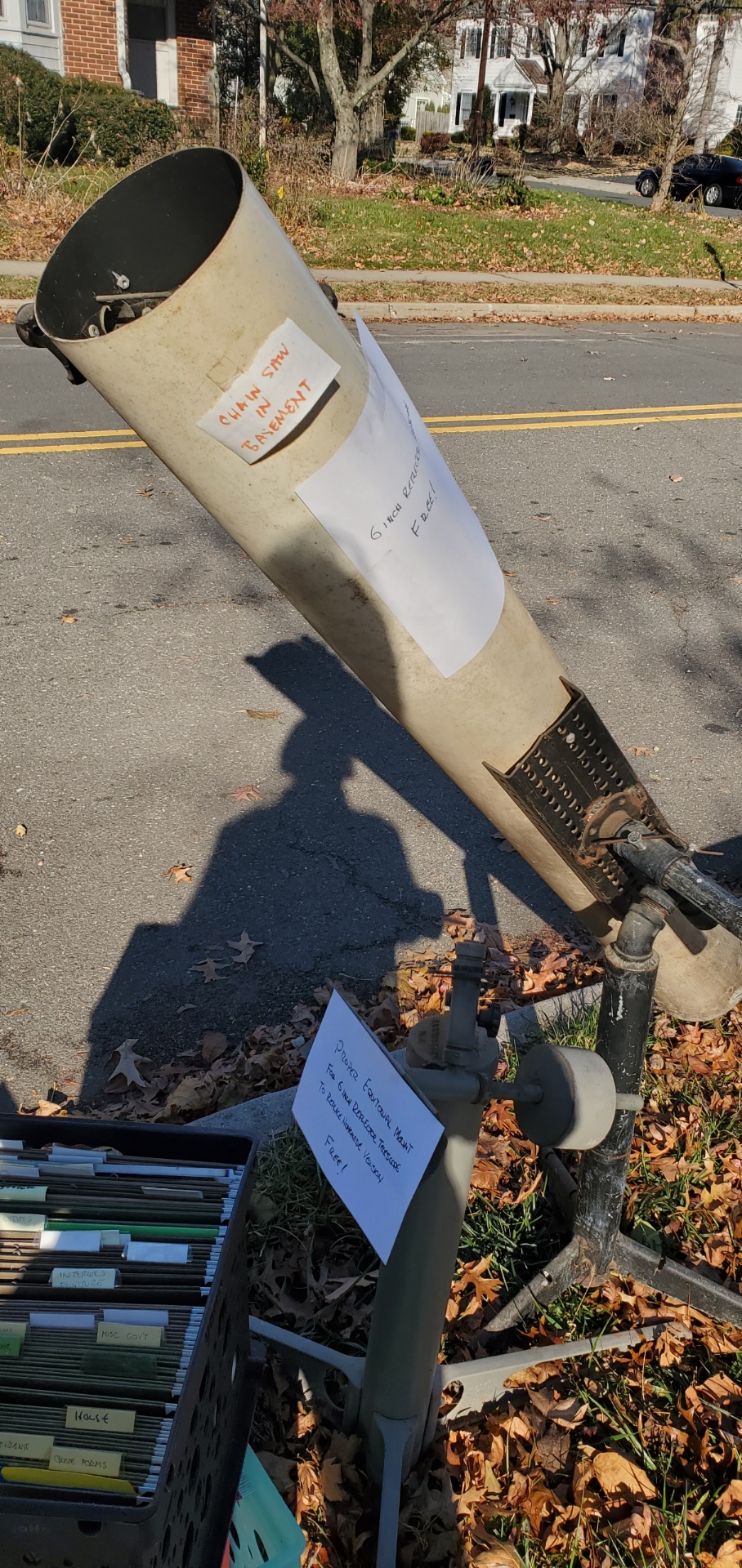
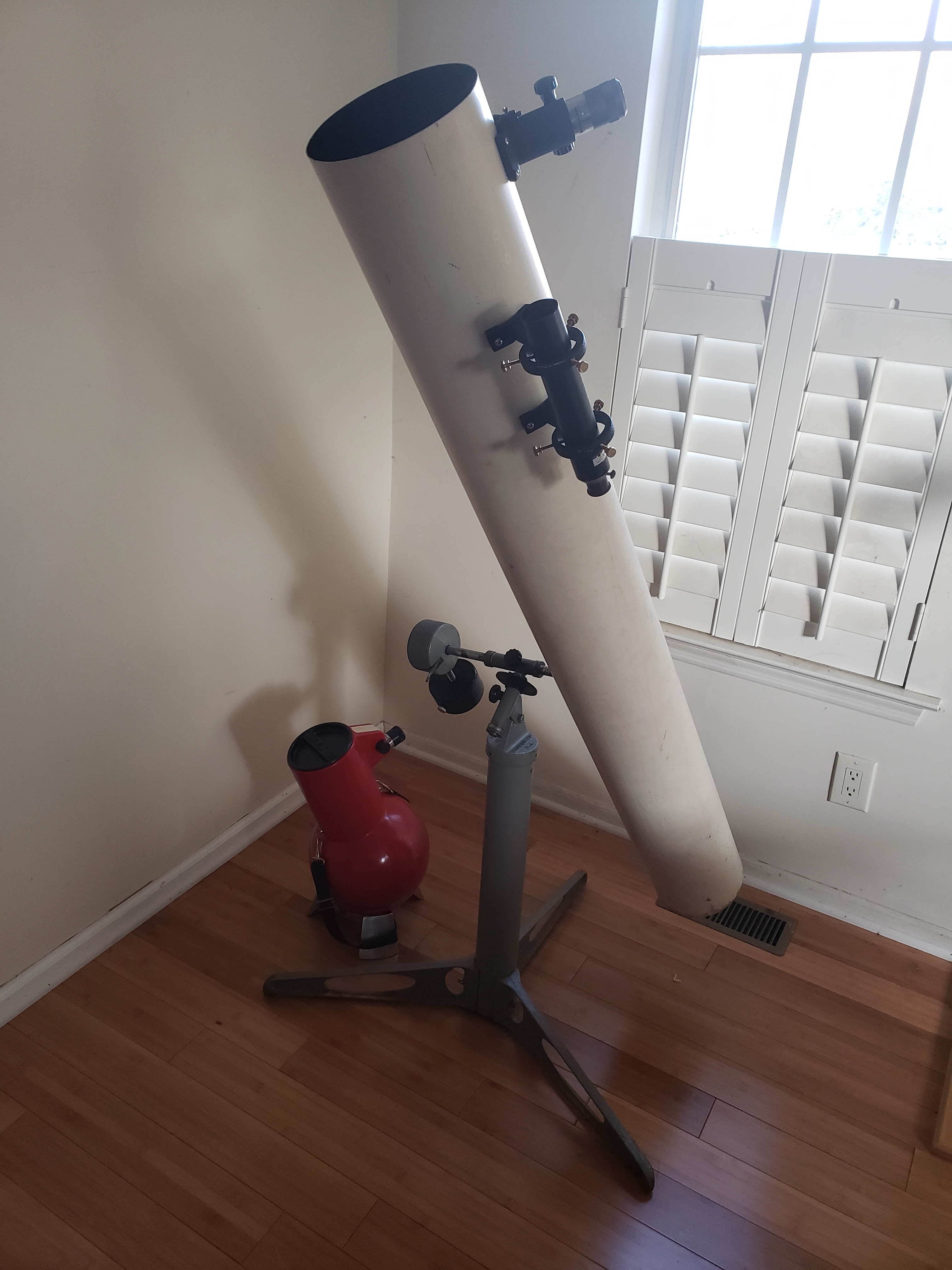
In December 2021, I was given an unexpected early Xmas present. My girlfriend was walking through Princeton when she noticed this interesting collection on the side of the road, and she texted to ask if I wanted it. After I responded immediately in the affirmative, she knocked on the door and got the owner, Bob, to hold it for me in his garage. I should explain that up until this point, my best telescope had been an imported 4.5-inch Bushnell Newtonian; usable, but rather tacky. (As a matter of fact, the big screw holding the azimuth axis together on its mount had snapped earlier in the year – it was plastic.) So you can understand that a 6-inch scope represented a significant step up for me. I drove over a few days later to pick it up. Bob was a spry older gentleman with an enthusiastic attitude. He told us he was moving house, and needed to divest himself of some bulky items. The telescope was an Edmund Scientific scope that he himself had built from a kit his parents gave him in 1964. It was on an equatorial mount, also home built from stock plumbing fittings at the same time, to save a few dollars on a manufactured mount. You can see Bob welding it together in the newspaper clipping. Bob also gave me two original eyepieces and an Edscorp equatorial mount that he had acquired later but had never got around to re-mounting the scope.
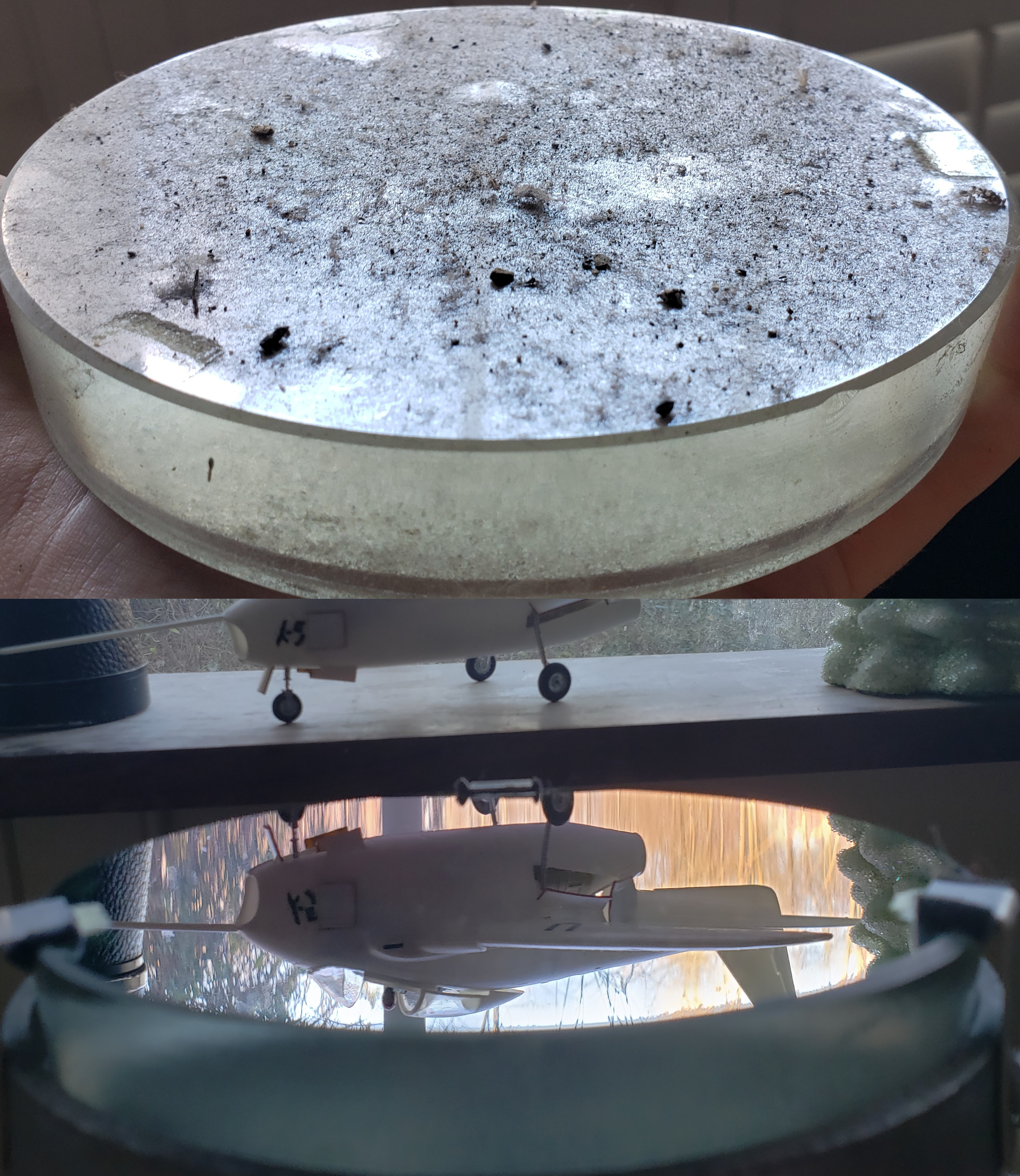
After hauling everything home, I carefully disassembled the instrument to its component parts, which were all covered in a few decades’ worth of grime. The pyrex 6-inch primary mirror was coated in a thick layer of detritus and dead bugs. Miraculously, after giving them a careful wash, both primary and secondary mirrors were in good condition. I put a small dot of red ink in the center of the primary mirror to help with collimation. To protect the optics, I constructed a dust plug for the tube from some layered foam board and hot glue. I thoroughly cleaned every other part of the telescope inside and out, applying a little lithium grease to the movable parts in the focuser and mirror cell. Scrubbing the interior of the tube was quite a reach as it is about 5 feet long. Dividing 5 feet by the 6 inch mirror diameter gives the scope a focal ratio of f/10 or so; more on this later. A lot of the steel screws and nuts that held it together were corroded, or had been replaced with mismatched parts, so I replaced everything with new stainless steel screws and locknuts for security. Although the cream enamel on the aluminum tube still shows plenty of scuffs and scratches, I decided not to re-paint anything. The marks of use should testify to the enjoyment this instrument has provided.
I decided to put the telescope on the Edscorp mount I had been given. The mount first received a thorough cleaning and lubrication. I fixed two stainless bolts in place protruding from the telescope tube, and used wing nuts to fasten it to the plate on the mount. This allows for quick take down and reassembly. However I quickly discovered that the bottom end of the OTA would often hit the mount legs, and the counterweight was not sufficient to balance it. A quick check revealed that this particular mount was actually designed for use with Edmund’s smaller 4.5-inch reflector. The larger mount would have included an RA clock drive and more weight. Nevertheless, this mount seemed sturdy enough to hold the scope, so I moved the mounting further down on the tube and added an extra counterweight. The second weight is fixed to a bolt that I tapped into the original weight at right angles, to achieve balance in both axes. The final result stays where it is aimed and can be quickly adjusted for using heavy eyepieces or camera gear.
Collimation of this telescope is fairly simple. The tricky part is aligning the secondary mirror, which is mounted to a simple brass rod. The rod goes back through a hole in the tube to the eyepiece assembly where it is held in place by a set screw. One must simultaneously hold the mirror in place and tighten the screw while looking through a collimating eyepiece. This operation almost requires three hands, but is made easier using a foam board wedge to hold the mirror at the correct distance from the tube wall to center it. The primary mirror cell employs the common three-screw adjustment system and is relatively easy to align.
A little research revealed a few things. It seems that this particular telescope kit was sold by Edmund from the late 1950’s to early 1970’s as the Super Space Conqueror. At the time, an assembled model would have cost around $200, which is $1800 today adjusted for inflation – it was near the top of their range, and indeed I was impressed by the quality of the components. Apart from the optics and the bakelite focusing knobs, everything is metal, with an aluminium tube and mirror cell and chromed brass focusing gear. At the time, Edmund was also selling 3-inch reflectors with cardboard tubes for 30 bucks!
Oddly, all the printed materials referred to their 6-inch model as having a parabolic mirror with a focal ratio of f/8, meaning that the focal length and tube should be about 4 feet long. Yet my example, with its 5 foot tube, is certainly f/10. I have a small clue as to why this might be. Bob gave me a cardboard star-finder that came with the kit, with the name and address of the Anchor Optical Co. It is shown above with the slip cover he made for it in school, illustrating altitude and azimuth. Anchor was Edmund’s clearing house for their, shall we say, less desirable optical components. Perhaps, to shift a few f/10 mirrors, they sold a version of the kit with a longer tube. If anyone reading has more definite information I would be happy to know it.
I have taken the telescope out on a few of the clearer nights this winter. Using both the originals and some newer eyepieces, I have been able to observe fine detail in many subjects. These include the Moon, Jupiter, Saturn, the Orion Nebula including five distinct stars in the trapezium, the Pleiades, and various other stellar clusters. A video of the Moon crossing my small CCD can be found at https://youtu.be/wTJ8OJwEcxA Although some might consider it primitive in today’s world of off-the-shelf SCT’s with go-to tracking mounts, it has been great fun to restore and use this old Newtonian on its simple equatorial mount. It makes me wonder how much less light polluted the night skies over New Jersey might have been nearly 60 years ago when it was assembled. It has sparked my interest in astronomy again, and I hope this telescope will see another half-century or more of use.
I recently posted a link to Canon’s announcement about its 3.2 megapixel SPAD sensor on the Discord server, but I didn’t see any comments. This is a potentially revolutionary announcement for astrophotographers so I thought I better share a bit more in Sidereal Times.
As a professional photographer, I receive a lot of product release news, but this one stopped me in my tracks. On December 15, 2021, Canon announced that it had developed a 3.2 megapixel SPAD sensor offering “higher resolution than full HD images even in low-light environments.” A SPAD sensor, or Single Photon Avalanche Diode, is an alternative to the CCD and CMOS sensors that are familiar to astrophotographers. Perhaps the key in that jumble of acronyms is “Avalanche.” With SPAD sensors, just one photon of light is needed to reach each pixel in order for a usable image to be created. If you think about digital camera sensors as having a bunch of little buckets across the sensor plane waiting for light to pour in, then a SPAD sensor only needs one photon per bucket. The sensor then creates an “avalanche” of electrons based on just one photon. In contrast, CMOS sensors must wait for more photons to fill up the buckets to create a usable electrical signal, resulting in longer exposure times and electronic noise. And noise is the enemy of astrophotographers.
Source: Canon
SPAD sensors have been around for several years, and firms like Sony and Panasonic offer versions of it. You can read more about the technology online (e.g., 24,000 frames per second, and three dimensional imaging), but I will wrap up with a quick list of potential astrophotography benefits with the new 3.2 megapixel version from Canon.
Clearer images in low to “no light” environments. Please take a look at the far right image above. That image is taken in light imperceptible to the human eye!
Faster images. Because SPAD sensors only need one photon, the “shutter” (which is no longer mechanical but a virtual one that opens or closes the buckets of pixels in mirrorless and astronomy cameras) needs to be open for a fraction of the time that a CMOS sensor requires. Canon claims its new sensor needs only one-tenth the amount of light as CMOS sensors, and I suspect it could become even more efficient over time.
Potentially darker skies. These sensors have immediate applicability in security cameras. So instead of lighting every corner of a warehouse at night, we can turn off the lights and still “see” clearly faces and license plates in color in the dark.
Canon plans to begin manufacturing the new 3.2 megapixel SPAD sensor in the second half of this year, and a new manufacturing plant in Japan will be built to scale production. How long we have to wait until this sensor reaches our astrophotography cameras is uncertain. Once it does, however, we will be enjoying low noise images of deep sky objects that might be imperceptible in our existing CMOS or CCD cameras. And for those who enjoy taking photographs of the night sky and the Milky Way without a telescope, we will be able to throw away those heavy, annoying tripods.
I hope this article is helpful, and that everyone is as excited is I am for the next-generation of astronomy cameras based on SPAD sensors. As Hall of Fame musician Tom Petty sang, “the waiting is the hardest part.”
Very Large Volume Neutrino Telescopes Baikal The Baikal deep underwater neutrino telescope (or Baikal-GVD – Gigaton Volume Detector) is an international project in the field of astroparticle physics and neutrino astronomy. The construction of Baikal-GVD is motivated by its discovery potential in astrophysics, cosmology and particle physics…more
-BBC
Don’t Look Up: What’s the plan to deal with asteroids and comets? It’s understandable if the thought of a comet wiping out all life on earth might be an extra worry you just don’t need right now. But if you’ve watched Netflix movie Don’t Look Up, it might be hard to get the thought out of your mind…more
-BBC
Durham University fiber-optics help largest 3D map of Universe An international team of scientists has produced the most detailed three-dimensional map of the Universe yet. Within seven months, their Dark Energy Spectroscopic Instrument (DESI) has broken all 3D galaxy survey records. A component built by Durham University…more
-Tom Jacobs
Citizen Scientists Spot Jupiter-like Planet in NASA TESS Data Tom Jacobs of Bellevue, Washington, loves treasure hunts. Since 2010, the former U.S. naval officer has participated in online volunteer projects that allow anyone who is interested — “citizen scientists” — to look through NASA telescope data for signs of exoplanets, planets beyond our solar system. Now, Jacobs has helped discover a giant gaseous planet about…more
-WP
What is a Lagrange point, the final destination for the James Webb Space Telescope? The James Webb Space Telescope, launched Dec. 25, has now arrived at the destination from which it will begin its in-depth examination of the distant universe. However, unlike its predecessor, the Hubble Space Telescope, the James Webb Telescope won’t be orbiting Earth…more
-space.com
James Webb Space Telescope marks deployment of all mirrors NASA’s massive new observatory has notched another milestone. After nearly a full month in space, the James Webb Space Telescope, also known as JWST or Webb, is nearly at the end of its deployment work. The complicated series of deployments has seen the telescope transform from its tightly-folded launch configuration to what looks like a real observatory, although science observations remain months away…more
-space.com
Scorching alien planet takes seasons to an extreme Scientists got a close look at an extreme case of seasons thanks to a retired NASA telescope. Researchers used NASA’s Spitzer Space Telescope to film a year on an exoplanet called XO-3b. Conveniently, a year on this world lasts only three Earth days…more
– space.com
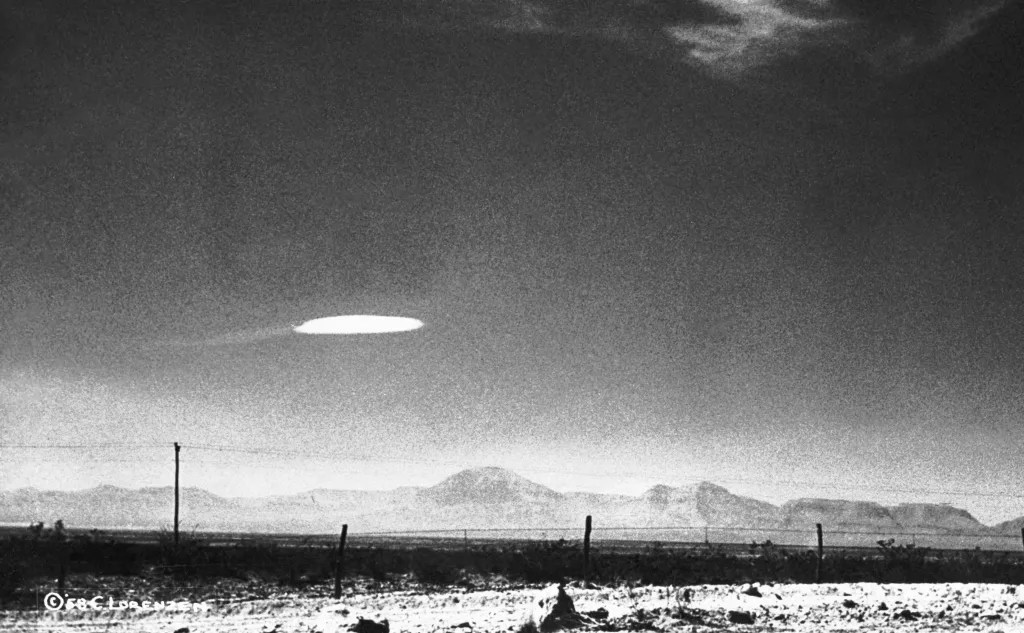
Pentagon launches new UFO office. Not all believers are happy about it. A new office in the Pentagon will investigate sightings of unidentified flying objects (UFOs) — but longtime UFO enthusiasts are skeptical. According to NBC, putting the new “Unidentified Aerial Phenomena” program in the purview of the Office of the Under Secretary of Defense for Intelligence &…more
-NASA
NASA catches sun sending powerful flare into space Our sun just had a medium-sized energy burp. NASA’s Solar Dynamics Observatory (SDO) caught a mid-level solar flare on Thursday (Jan. 20) with a peak at 1:01 a.m. EST (0601 GMT). You can see the flash on the limb, or edge, of the sun, thanks to SDO’s powerful imaging…more