

by Rex Parker, PhD director@princetonastronomers.org
Astronomy in March! Despite evidence to the contrary, climate change hasn’t fully eliminated winter weather in central NJ. The three significant snowstorms we had this year improved over last year’s zero-snow winter. Last month’s AAAP meeting, intended to be in person at Peyton Hall, went to virtual-only at the last minute because Princeton University closed the campus for the big winter storm which swept through that afternoon, though it was a wind/rain event only.
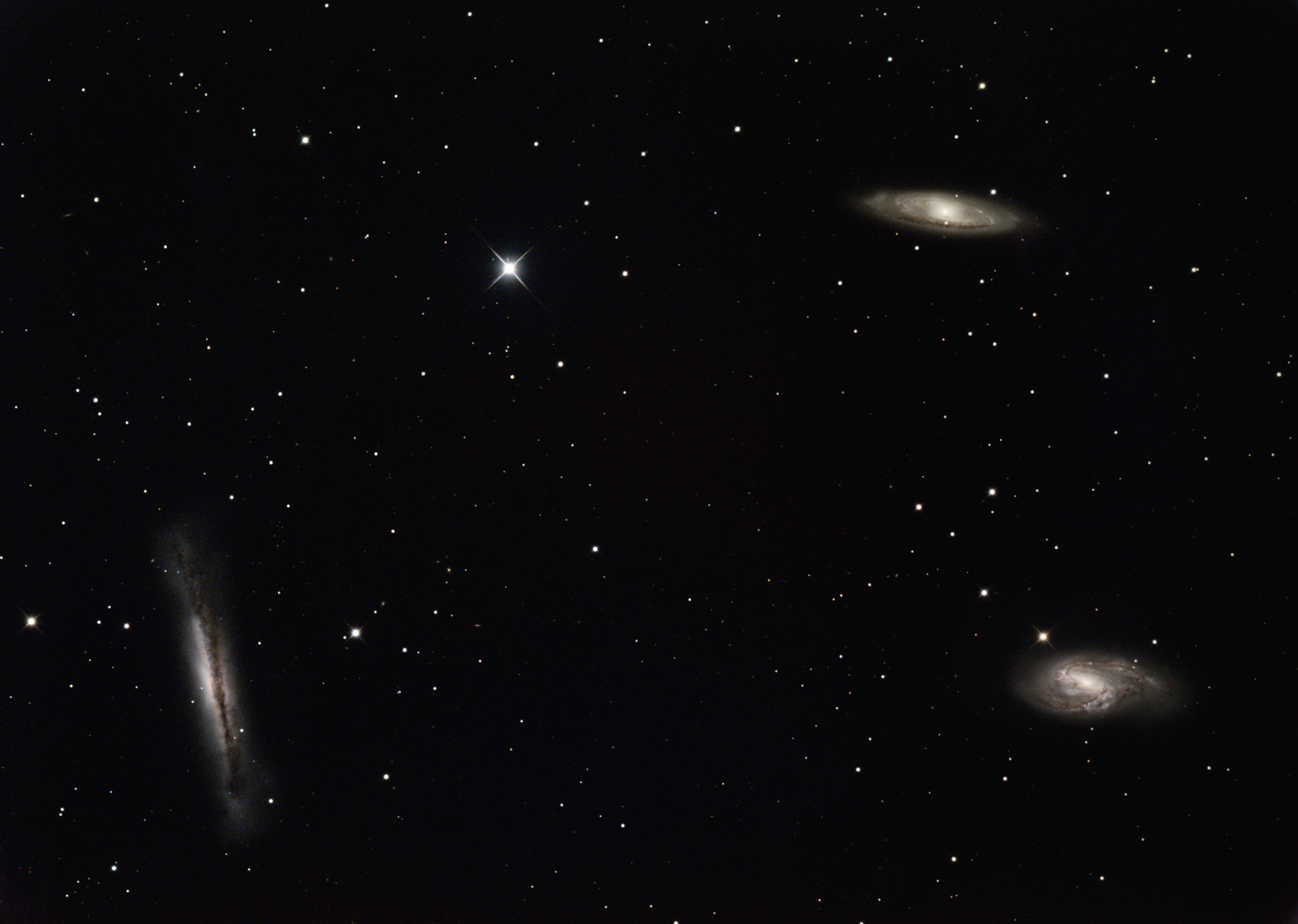
Now that March is upon us it’s time to begin thinking about doing astronomy in the warmer evenings of springtime. In the northern hemisphere spring affords the best chances to observe galaxies in small telescopes (some call it galaxy season). It is possible to observe all or nearly all the Messier objects in a single night from mid-March to early April. The best dates for a Messier Marathon (attempting to observe all 110 objects in one night) are around the new moon (Mar 10), but you could run a Messier 10K any clear night the first half of the month before lunar 1st quarter Mar 17. The constellation Leo holds many Messiers, and is especially well-positioned early in the evening this month. See the current (April) issue of Sky & Telescope article “Exploring the Lion’s Den” for an in-depth look at what can be observed or imaged with small telescopes and cameras in this constellation. On Feb 8, I took the astrophoto below of the famous “Leo Trio” of galaxies. These are visible in an eyepiece of amateur telescopes of about 4-5” or greater aperture so long as a bright moon is not in the sky.
3 Spring Beauties in Leo: The Leo Trio of Galaxies. (left to right) NGC 3628, M65, M66 and NGC 3828. Astrophoto by RA Parker from central NJ using a 12.5” f/6.7 reflector on Paramount MX and ASI2400MC camera.
March 12 Meeting. We’ll convene at Peyton Hall on the Princeton campus for our monthly get-together on Tues March 12 (7:30pm). If you just can’t make it physically, we’ll run a hybrid meeting with Zoom link sent by e-mail to members (also on the website). Remember that the University wants us to park (free) in the garage at 148 FitzRandolph Rd, off of Faculty Rd. That means a 10-15 minute walk around the football stadium to Peyton once you park your car. Our guest speaker will be E.B. Hoffman, PhD candidate at Univ of Maryland and researcher at NASA’s Goddard Space Flight Center. For more information on the presentation and the walking route map to Peyton Hall, see Victor’s article below
Our tradition each month is for a member to give an Un-journal Club, a brief informal and fun presentation to begin the second half of the meeting. “Un-journal” means this is not grad school, you don’t need scholarly journal-like topics, just what you care about in astronomy. PowerPoint slides, JPEG’s, astro-images, travel pictures, book reviews, your imagination is the limit (bring a USB memory stick). To get onto the schedule for an upcoming meeting, please contact me or program chair Victor Davis
Telescopes for Member Use at the AAAP Observatory in Washington Crossing State Park. Contact observatory chair Dave Skitt to learn more about using the club equipment. Here’s a list of current equipment inside the Observatory.
Paramount-ME #1, robotic equatorial mount
- Mount run with TheSkyX planetarium and control software under Win10 computer.
- Celestron-14 Schmidt-Cassegrain telescope, D=355mm (14-inch), f/11, FL=3900mm.
- New Stellarview 80 mm right-angle finder scope on the C-14.
- Explore Scientific ED127 refractor telescope, D=127mm (5-inch), f/7.5, FL=950 mm, triplet air-spaced apochromatic refractor.
- Numerous 2-inch and 1-1/4-inch eyepieces for these telescopes.
- Starlight Xpress Ultrastar Colour CCD camera.
- Starlight Live and SharpCap software cameras.
- Verizon FiOS is available inside the Observatory.
- 24”-32” monitors for viewing the telescope images
Paramount-ME #2, robotic equatorial mount - Mount run with TheSkyX planetarium and control software under Win10 computer.
- Hastings-Byrne 61/4-inch refractor, f/14.6, FL=2310mm. This fine historic instrument is a great planetary telescope, dating to 1879 with the original air-spaced doublet lens and steel tube intact.
- Takahashi Mewlon-250, D=250mm (10-inch) Dall-Kirkham reflector telescope, with -inch TMB Optical dielectric-diagonal and Feathertouch 2-inch Crayford focuser.
- 2-inch and 1-1/4-inch eyepieces, incl Panoptic 27 mm and 41 mm for the Mewlon-250.
- ZWO ASI 294 Pro color CMOS camera
- ZWO ASI Studio, Starlight Live, and SharpCap software set up for EAA cameras


