
by S. Prasad Ganti
More than five decades after the last Apollo flight and three years after the unmanned Artemis I flight to the moon, Artemis II went to the moon along with four astronauts and came back successfully with a splash in the ocean. The spacecraft was not meant to land on the moon. Literally a “round trip” by slinging around the moon and heading towards the earth.
The Artemis series is not a repeat of the Apollo missions. Although both are three stage rockets, Artemis differs vastly from its twin sister Apollo. It is comparatively newer technology. The rocket itself has 4 RS25 engines, compared to five F1 engines on Saturn 5 powered Apollo. The RS25 engines are from the space shuttle era. Two solid rocket boosters are added to the initial thrust. The electronics and computers are far more advanced.
The life support systems are a key component differentiating a manned flight from an unmanned one. The living room in the Orion module for the astronauts is more spacious even with four astronauts instead of three for the Apollo. It even has a toilet ! One of the Astronauts, Christina Koch, became the first plumber in space to fix the toilet which malfunctioned initially.
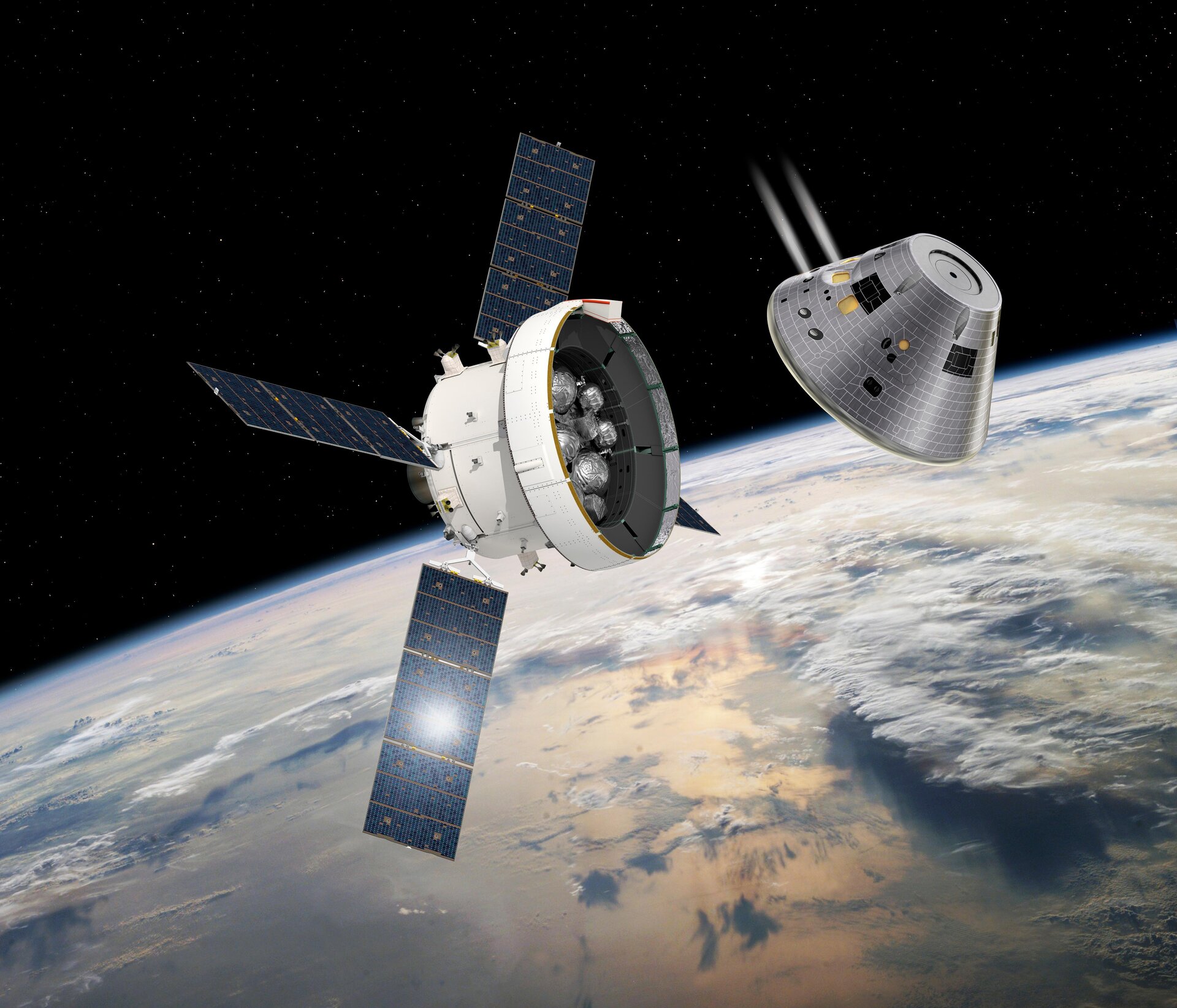
The propulsion and life-support systems in the Orion spacecraft were built by European aerospace company Airbus on behalf of ESA. The picture shown below courtesy ESA shows the components. On the left in the picture is the service module containing the propulsion and life support systems. It has four solar panels. On the right is the Orion spacecraft built by Lockheed Martin.
While Artemis I was a proof of concept unmanned flight before Artemis II could be launched with astronauts. Artemis I had an issue with reentry into the earth’s atmosphere while coming back. NASA tried a skipped reentry which involved a shallow reentry followed by a bounce and then another reentry. Something like an aircraft making a bounced landing on the runway. Landing and then briefly rising into the air and then landing back a second time. This was done to minimize the heat generated. Although the strategy worked, the heat shield could not work well in tandem and some hot gases disrupted the shield from the other side.
Artemis II kept the same heat shield but ditched the skipped reentry. Instead a direct steeper reentry was used, which worked well in the past with the Apollo and the Space shuttle missions. The reentry and the consequent splashdown were uneventful as a result.
Going into the future, Artemis III will demonstrate the docking between Orion spacecraft and the new lunar landers in low earth orbit. The two private lunar landers are being built by SpaceX and Blue Origin.
Artemis IV will land with astronauts on the moon. With the Apollo missions, the space race was with the erstwhile Soviet Union. Now it is with China who is trying to land astronauts on the moon as well. We may end up winning this second space race as well. But, the cost of the program will be an issue again as it was with Apollo.
This time around, the plan is to replace the rocket SLS (Space Launch System) with Space X’s Starship which is still under test. Starship will have a reusable first stage. The first stage will detach itself and come back to earth after pushing hard on the rest of the two rocket stages. This reuse will reduce the cost of the launches significantly. Besides, the newer Raptor engines on the Starship are a good replacement for the Space shuttle era RS25 engines. Along with the first stage, the engines will be reusable as well.
For the future, the lunar program is on a solid footing compared to the Apollo era.


