
by William H Davis
Why do the text books give different redshift equations for the observer stationary versus the observer in motion? Why do we use the equation for the observer stationary when the Earth is clearly moving through space at a high velocity?
An astronomer will observe redshift – ( fe – Δf) or blueshift + ( fe + Δf ) identically with no sign or equation change regardless whether the emitter is in motion or the observer is in motion. This indicates the position of the observer versus the emitter is determinative not which is in motion. Are we using the wrong equation to determine velocity from the frequency ratio? Could this explain the unexpected apparent acceleration of velocity at greater distances?
The correlation of frequency shift to relative velocity by a black box energy balance method:
The effect of motion on the frequency shift observed is affected the relative motion. The system is defined by the fo = fe ± Δf , which results in two equations; blueshift, f(o=)+Δf (multiple of fe) and redshift, f(o=) – Δf ( fraction of f(e) ). There is no law for the conservation of wave length but there is a law for the conservation of energy. There is no direct solution using just wave length z for redshift to determine velocity. The only available energy in the observed system is fe (independent variable) with no external energy going in or out of the system. Velocity away reduces the energy of fo observed and toward increases the energy of fo. The observer’s position versus the emitter determines whether or not red or blueshift is observed, not which is in motion and defines the proper equation.
Non relativistic energy balance solution starting with Planck’s Equation:
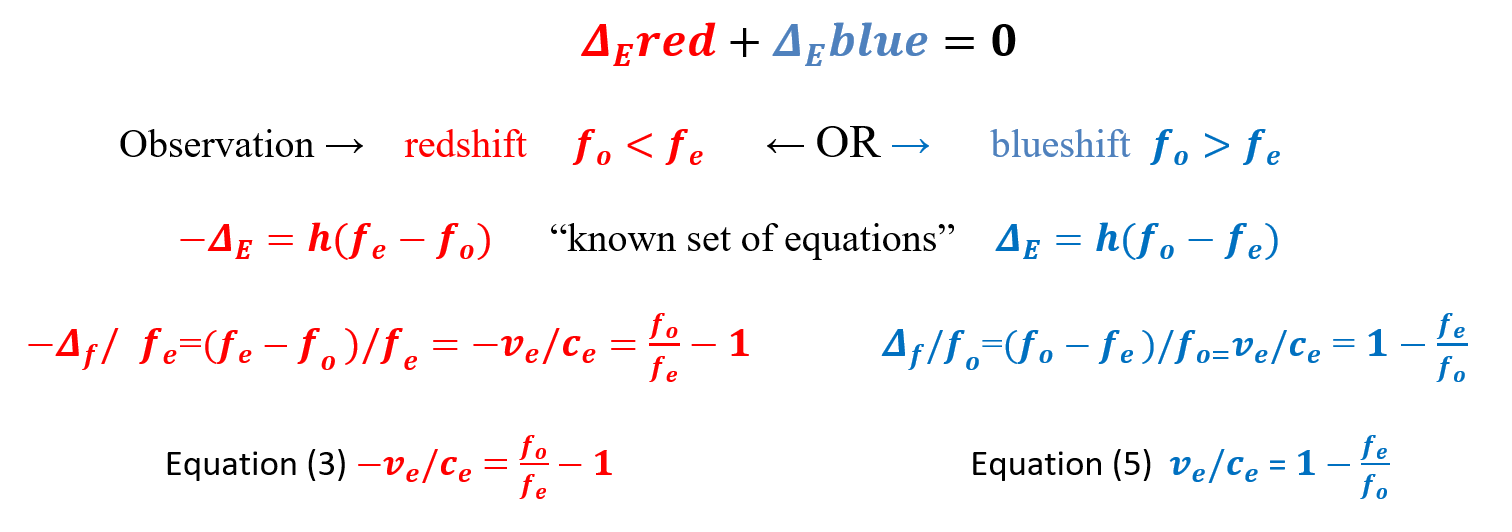
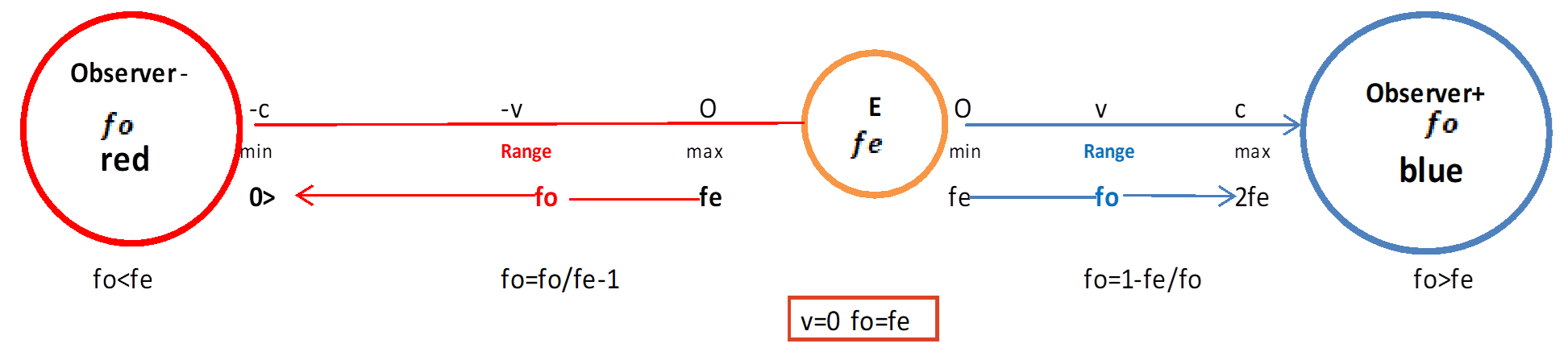
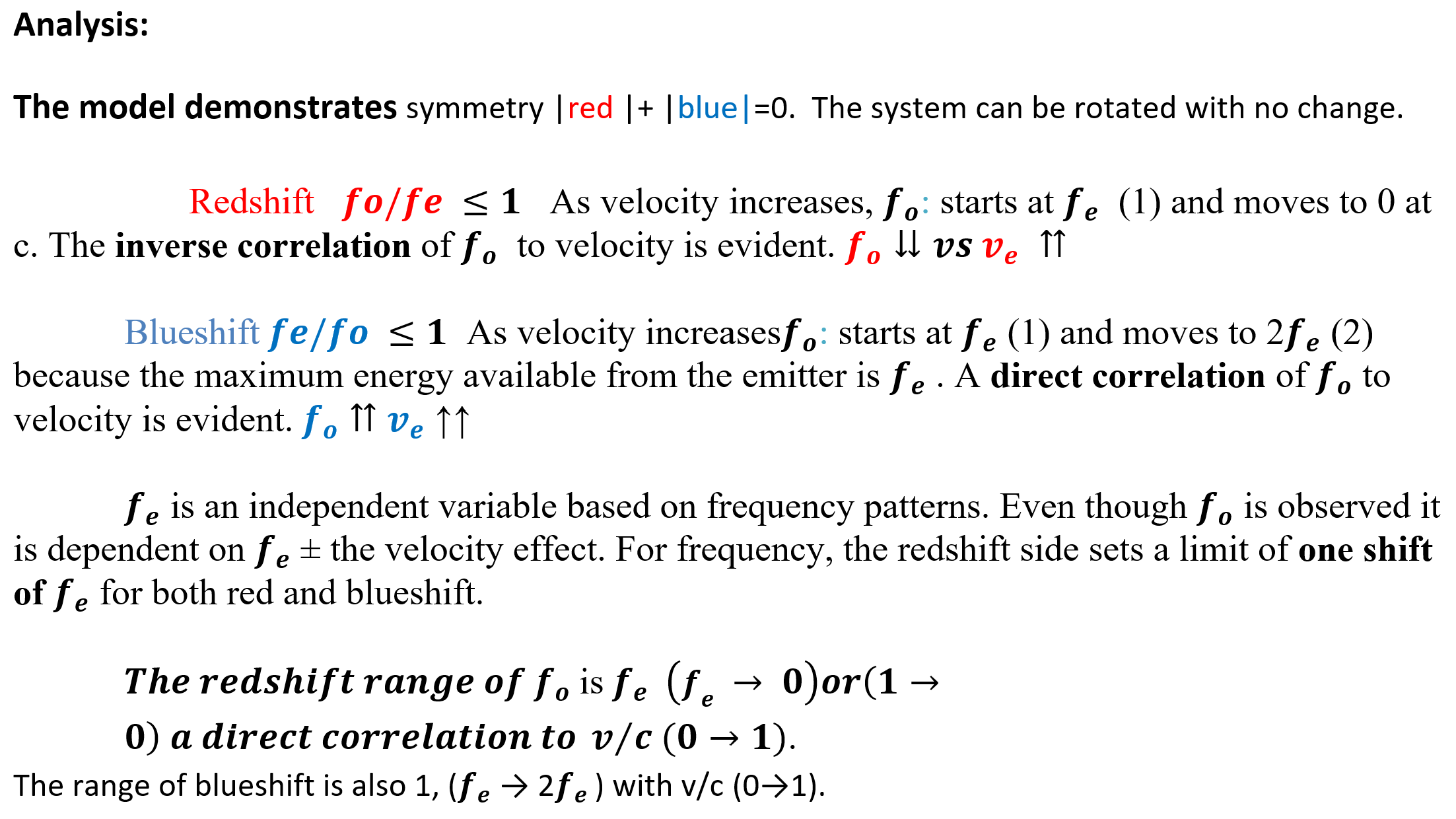
The required denominator for redshift is fe and blueshift is fo with the range in the denominator.
The energy balance is an accurate non relativitistic way to describe the total system of spectral shift. For each shift observed there is an opposite shift that can be observed from a different point of view. The physicist has to pick the correct bound equation to match the shift to determine an accurate v/c. We are presently using the wrong equation (observer stationary) when we know we are in motion? Hr blueshift equation to calculate velocities from redshift. We are using. The result is a multiple of fe creating an exponential type curve to ∞!
There has been a failure to integrate relativity in astrophysics.
Relativitistic Doppler equation applies to all of the degrees of freedom or points of view of Doppler and or frequency shift: This equation has been published and known for years. It is the correct description or model of velocity versus frequency shift.
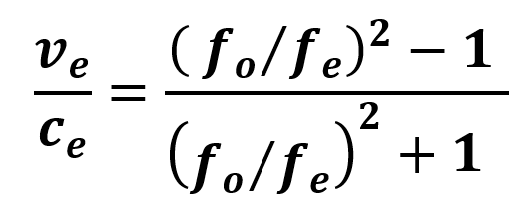
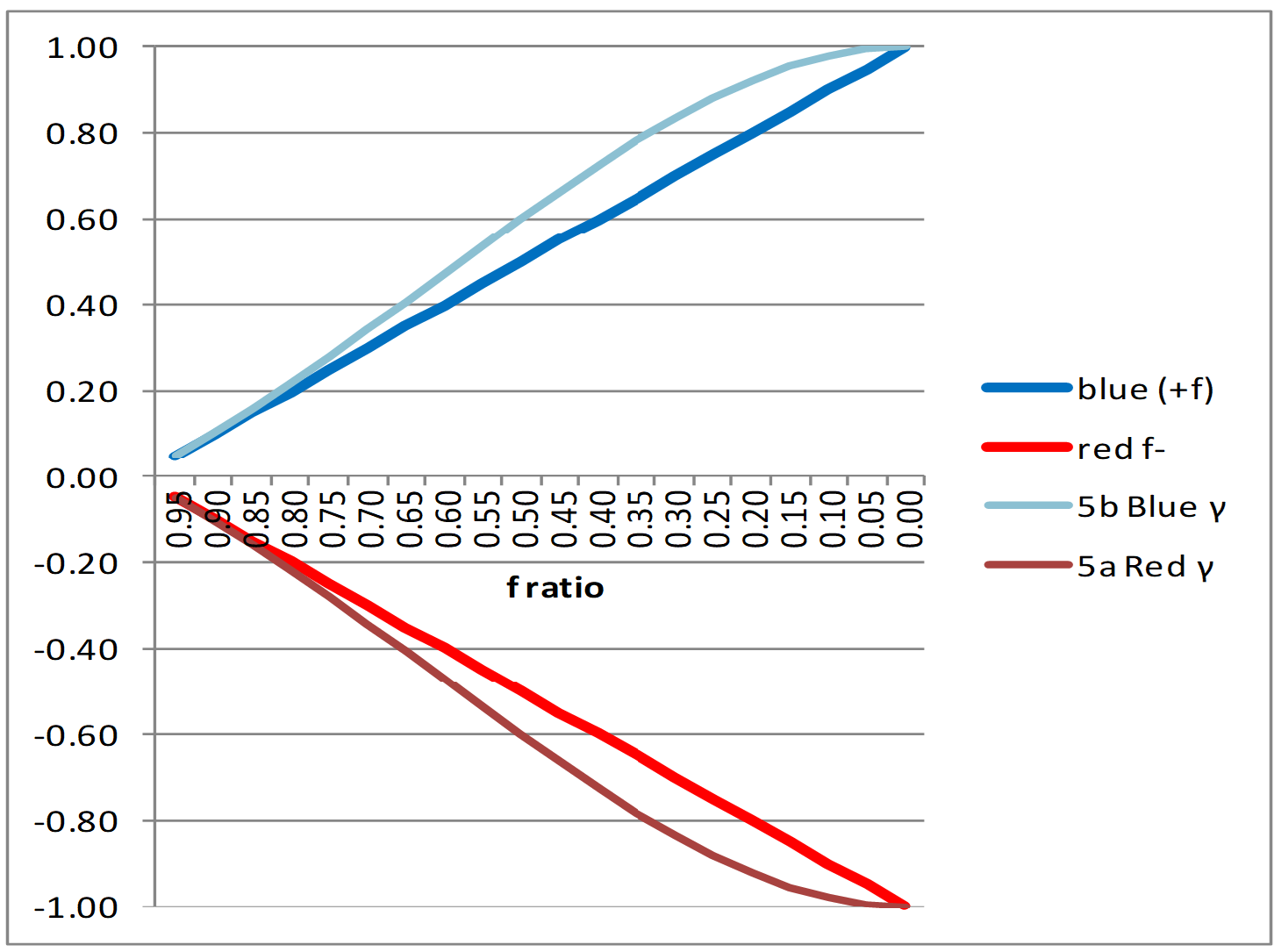
The accurate determination of velocity from the frequency ratio is critical for the accurate modeling of celestial objects. Relative velocity is a critical independent variable for most aspects of the observable universe. If the methods are not accurate or sound, projecting defective models beyond the data for determining distance or anything else is problematic. The most critical error has been choosing the wrong equation to correlate frequency ratio with velocity or v/c. “no privileged frame” is in play?
Using the relativitistic Doppler equation for velocity calculations should eliminate the Dark Energy (pushing on a string) theory.
I would appreciate any comments and recommendations for a path forward.


