by Robert Vanderbei
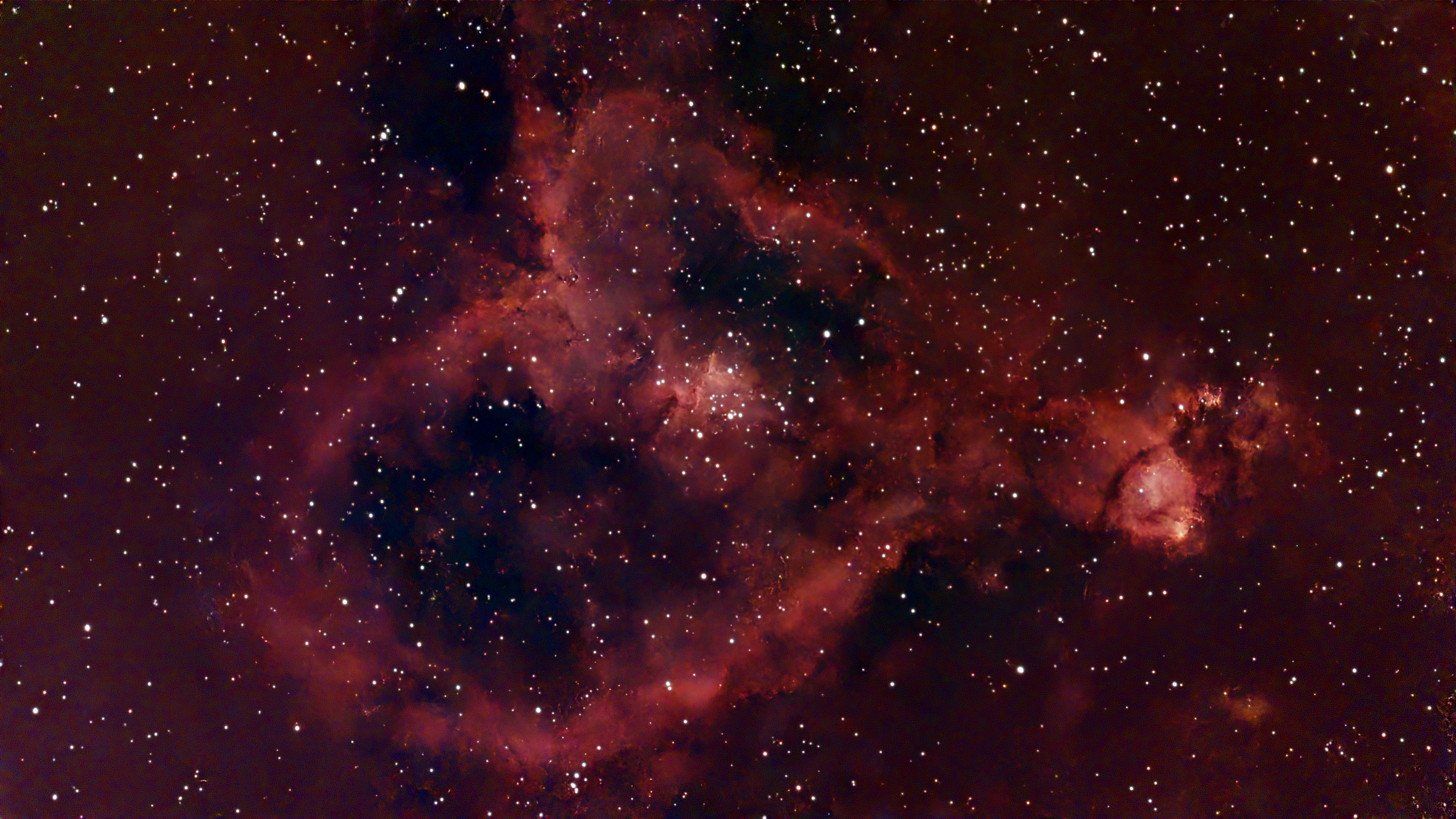
Here’s a picture I took of the Heart Nebula (aka IC 1805) on April 27.
The Heart Nebula is an emission nebula. It resides in the constellation Cassiopeia. It is estimated to be about 7,500 light-years away from us here on Earth.
As you can see in the picture, there is a cluster of bright stars roughly at the center of the nebula. It is called the Melotte 15 cluster. In absolute terms, these stars are very bright–some of them are about 100,000 times brighter than our Sun. But, these stars don’t appear very bright to us as we see them because they (and the nebula) are far away from us. In fact, at the visual level the brightest star in the Melotte 15 cluster is only about magnitude 8.5. The bright stars in the Melotte 15 cluster provide the energy which excites the atoms in the nearby interstellar medium. Most of those atoms are hydrogen at those energized hydrogen atoms produce the nebula’s red glow.
To take this picture, I used my Seestar S30 smart telescope sitting on the walkway just outside the front door of my house. The picture is a stack of 528 10-second exposures that were automatically aligned and stacked by the code built into the Seestar. That’s a total exposure time of 88 minutes.
The images were captured starting a little before 9pm and stopping a little before midnight. The Heart Nebula is circumpolar when viewed from here in NJ. When I took these pictures, it was low in the WNW part of the sky—only about 20 degrees above the horizon.
The Heart Nebula is a large nebula — about 2 degrees in diameter. The Seestar S30’s camera provides a fairly large field of view but not large enough to capture the entire Heart.
Here’s the nice thing… the Seestar software has a “mosaic” option where it can build a wider field of view image. I used the mosaic feature to take this picture. The field of view was upscaled by a factor of 1.5 from the non-mosaic size.