Triple Conjunction

by Brian Van Liew

Triple Conjunction of the Moon, Venus and Mars  Credit: Brian Van Liew

Triple Conjunction of the Moon, Venus and Mars Credit: Brian Van Liew

On the evening of February 20th, I stepped out to see a pleasant view toward the west. I got my Canon camera with a 55-250mm zoom lens and a monopod to get a shot of it before it set any lower. The sight was a triple conjunction of a couple of day old Moon, Venus and Mars. I tried a couple of shutter combinations until I got a good exposure. The camera settings were 1/10 second with the lens zoomed out to 250mm. I was getting cold so I gazed just a bit longer before heading inside as a sight that does not come along often.

Posted in March 2015, Sidereal Times | Tagged , | Leave a comment

A Watchtower in Space

by Prasad Ganti

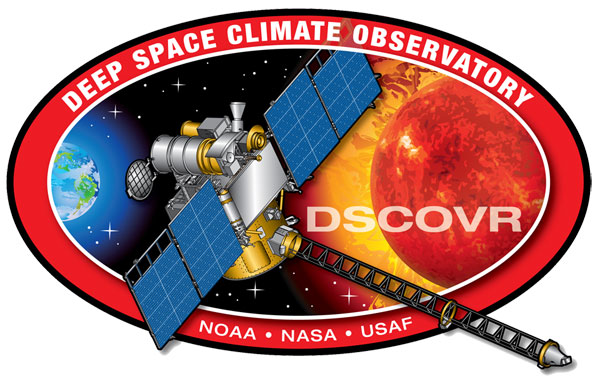
Very recently, a SpaceX Falcon 9 rocket took off into space with a payload. The launch was routine but the payload was something special. It carried a satellite called DSCOVR (Deep Space Climate Observatory). The observatory will take about a hundred days to reach its parking spot which is about a million miles from Earth.

DSCOVR Logo. Credit: NASA

DSCOVR Logo. Credit: NASA

The main mission of the satellite is to watch space weather and report back to Earth. Specifically, it will watch for a torrent of charged particles coming from the Sun towards the Earth, that has the potential to disrupt communications, computers and the power systems on the Earth and electronics in the satellites and the spacecraft near the Earth. The observatory can give advanced warning that such a gusher of charged particles is on its way so that precautionary measures can be taken.

The Sun is a huge nuclear fusion reactor fusing hydrogen together to form helium and held in balance by the collapsing gravitational forces caused by the huge mass and the nuclear forces trying to rip it apart. In the bargain, we get all the heat and light that sustains life on the Earth. The Sun also holds the entire solar system consisting of the planets and their satellites in orbit. This nuclear furnace has gone on for about five billion years since it started and will last for another five billion years until its hydrogen supply will be mostly exhausted.

Due to the hot nuclear reactions, the Sun is a very violent place in the Solar System. At such temperatures, matter exists not as a solid, liquid or a gas, but a fourth state called plasma. Essentially it is a soup of charged particles like protons and electrons not bound to each other. All these interactions result in cyclical solar flares, some minor and some major, much akin to tides and ocean tsunami.

Fortunately for us, Earth has a magnetic field surrounding it. This field results from a hot metallic core consisting of liquid iron and nickel at the center of the Earth. The magnetic field does an excellent job of keeping away the charged particles coming from the Sun but only partially. If the solar flare is very intense, the protection breaks down. It has happened in the past in 1859 during the Carrington Event, which set telegraph wires on fire. Now the Earth is a much more technologically sophisticated place, and the human race has a lot of investment and dependency to lose. Much more is at stake now than ever before in human history. Any early warning system, like our weather prediction system, will be helpful. That is the job that this observatory will be performing.

Lagrange Points. Credit: NASA

Lagrange Points. Credit: NASA

The observatory will be positioned a million miles away from Earth. What is so magical about this number ? One reason is that to observe an object, it is better to be closer than farther away from it. A million miles away from Earth is a million miles closer to the Sun. At that distance, the gravitational pull from the Earth balances the pull from the Sun. The observatory will consume less fuel at this point called the Lagrange point or L1 between the Earth and the Sun.

The observatory has secondary duties of monitoring the climate on the Earth. Beaming back data about ozone and aerosol amounts, cloud height, ultraviolet radiation and other information gathered by its cameras. The observatory is scheduled to last for two years, but it may last longer because it has fuel for five years. I am sure there will be something else after the lifetime of this observatory. Something else to warn us in the future. Something else for me to write about! Certainly, we are living in exciting times!

Posted in March 2015, Sidereal Times | Tagged , | Leave a comment

Snippets

Submitted by David Kaplan except as noted

At the D&R Greenway Trust’s Marie L. Matthews Gallery at the Johnson Education Center until March 20: “High Noon to Midnight Moon: Talismans of the Horizon” submitted by Michael Wright

Living with a Star
Even a slight change in the precariously controlled violence of the sun, an enormous thermonuclear furnace, can have drastic consequences on Earth. NYTimes

Shooting the Moon
A loose-knit group of photographers in Los Angeles meet monthly with a very specific purpose: to make the perfect photograph of planes set against the moon.
NYTimes

Rarely Seen Images From Space Including the ‘Best Selfie Ever’
More than 700 vintage photographs from the early days of space exploration are to be auctioned Thursday. NYTimes

Black Hole’s Blast Stunts Stars
The winds blasted out by supermassive black holes at the centre of galaxies are strong enough to slow the birth of new stars, astronomers reveal.
BBC

Alien Star Invaded the Solar System
An alien star passed through our Solar System just 70,000 years ago, astronomers have announced.
BBC

Mars Rover Finds Stronger Potential for Life
The case for an early Mars that was ripe and ready for living organisms has grown stronger. NYTimes

Collider Hopes for a ‘Super’ Restart
When Large Hadron Collider fires up again after its upgrade, scientists will be hoping to find a new particle they say could “rock the world”. BBC

Mystery Mars Haze Baffles Scientists
Scientists struggle to explain a vast haze that was spotted high above the Martian surface in 2012 by amateur astronomers. BBC

‘Exquisite’ Gravity Probe Leaves UK
UK industry completes construction of the modules that make up the Lisa Pathfinder satellite – a remarkable probe that will test the key technologies needed to detect gravitational waves in space. BBC

Scientist: ‘Try to Contact Aliens’
Scientists at an US meeting have said it is now time to actively try to contact intelligent life on other worlds. BBC

News for NASA’s Jet Propulsion Lab submitted by Michael Wright

‘Bright Spot’ on Ceres Has Dimmer Companion

New NASA Space Cowboy Successfully Deploys Its ‘Lasso’

NASA Earth Missions Expand View of Home Planet

Posted in March 2015, Sidereal Times | Tagged , , | Leave a comment

Astronomical Calendar Update

by Michael Wright

There is an astronomical calendar on the Sidereal Times website for 2015. I created it using Sky Events Calendar, but I’ve found an easier way to build an astronomical calendar that I would like to share.

The United State Naval Observatory provides a free downloadable version of their Astronomical Almanac in iCalendar 2.0 format that can be imported into any calendar program that uses this format such as iCal, Outlook and Google Calendar. This link will take you to their site. Under the “Recent and Upcoming Phenomena” box, there is link to download the “Diary of Phenomena” file.  Import this file into your calendar software to create a new calendar of astronomical event for the year like those listed on Sidereal Times.

I hope you find the calendar useful.

Posted in March 2015, Sidereal Times | Tagged , | Leave a comment

NASA’s First Orion Capsule Returns to Kennedy Space Center – An Eyewitness Account

by Dr. Ken Kremer, Universe Today and AAAP

View of NASA’s first Orion spacecraft after returning to the Kennedy Space Center in Florida on Dec. 19, 2014 after successful Dec. 5, 2014 blastoff.  Credit: Ken Kremer

View of NASA’s first Orion spacecraft after returning to the Kennedy Space Center in Florida on Dec. 19, 2014           Credit: Ken Kremer

KENNEDY SPACE CENTER, FL – After a history making journey of more than 66,000 miles through space, ocean splashdown and a 2700-mile cross country journey through the backwoods of America, NASA’s pathfinding Orion crew capsule was returned to its home base at the Kennedy Space Center in Florida just before Christmas.  I was on hand to witness the event.

“The Orion mission was a spectacular success,” said Jules Schneider, Lockheed Martin Program Manager for Orion at KSC, during the arrival on Dec. 19, 2014. “We achieved 85 of 87 test objectives,” noted Schneider. “Only an uprighting air bag did not deploy fully after splashdown. And we are looking into that. Otherwise the mission went extremely well.” Lockheed Martin is the Orion prime contractor.

Orion flew on its two orbit, 4.5 hour maiden test flight on the Exploration Flight Test-1 (EFT-1) mission that started NASA’s long road to send astronauts beyond Earth and eventually to Mars in the 2030s.
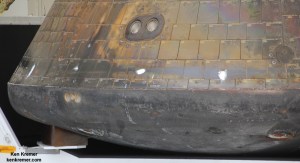
Up close view of trio of core samples taken from Orion EFT-1 heat shield after return to Kennedy Space Center on Dec. 19, 2014.   Credit: Ken Kremer

Up close view of trio of core samples taken from Orion EFT-1 heat shield after return to Kennedy Space Center on Dec. 19, 2014. Credit: Ken Kremer

Along with others, I was able to see the entire Orion capsule from top to bottom, including the exposed, blackened and heat scorched heat-shield which had to protect the vehicle from fiery re-entry temperatures exceeding 4000 F (2200 C).

One of the main objectives was to test the heat-shield during the high-speed atmospheric plummet at about 20,000 mph (32000 km/h) that reached approximately 85% of what astronauts will experience during a return from future voyages to Mars and Asteroids in the next decade and beyond. Engineers took three samples from the 16.5 foot diameter heat shield for analysis.

“The heat shield performed very well and did its job,” Schneider told me. “All of Orion’s system performed very well. And the capsule used only about 90 pounds of its about 300 pounds of hydrazine propellant stored on board. All of the separation events went beautifully and basically required virtually no maneuvering fuel to control the attitude of the capsule. The expected usage was perhaps about 150 pounds.”

Orion spacecraft blasts off atop United Launch Alliance Delta 4 Heavy Booster at Space Launch Complex 37 at Cape Canaveral, Florida on Dec. 5, 2014.   Credit: Ken Kremer

Orion spacecraft blasts off atop United Launch Alliance Delta 4 Heavy Booster at Space Launch Complex 37 at Cape Canaveral, Florida on Dec. 5, 2014. Credit: Ken Kremer

Orion’s test flight began with a flawless launch on Dec. 5 as it roared to orbit atop a United Launch Alliance Delta IV Heavy rocket – the world’s most powerful booster – at 7:05 a.m. EST from Cape Canaveral Air Force Station in Florida.

The unpiloted test flight of Orion on the EFT-1 mission ignited NASA’s roadmap to send humans to Mars by the 2030s by carrying the capsule farther away from Earth than any spacecraft designed for astronauts has traveled in more than four decades. Humans have not ventured beyond low Earth orbit since the launch of Apollo 17 on NASA’s final moon landing mission on Dec. 7, 1972.

For complete details check out my articles and photos at Universe Today and America Space

Astronomy Outreach by Dr. Ken Kremer

The Future of NASA’s Human Spaceflight Program with Orion and Commercial Astronaut Taxis: March 6, 2015, DVAA, PA. http://dvaa.org

MMS, Orion and SpaceX Launches: March 11-13, NASA Kennedy Space Center, FL. Evening outreach at Quality Inn, Titusville, FL

NASA Mars Rovers and the Future of Human Spaceflight: April 18/19, NEAF, Rockland Community College, Rockland, NY.

Please contact Ken for more info, science outreach presentations and his space photos. Email: kremerken@yahoo.com   website: www.kenkremer.com http://www.universetoday.com/author/ken-kremer/

Posted in March 2015, Sidereal Times | Tagged , | Leave a comment

Twenty Years of Astronomy Tips and Tricks

by Michael Wright

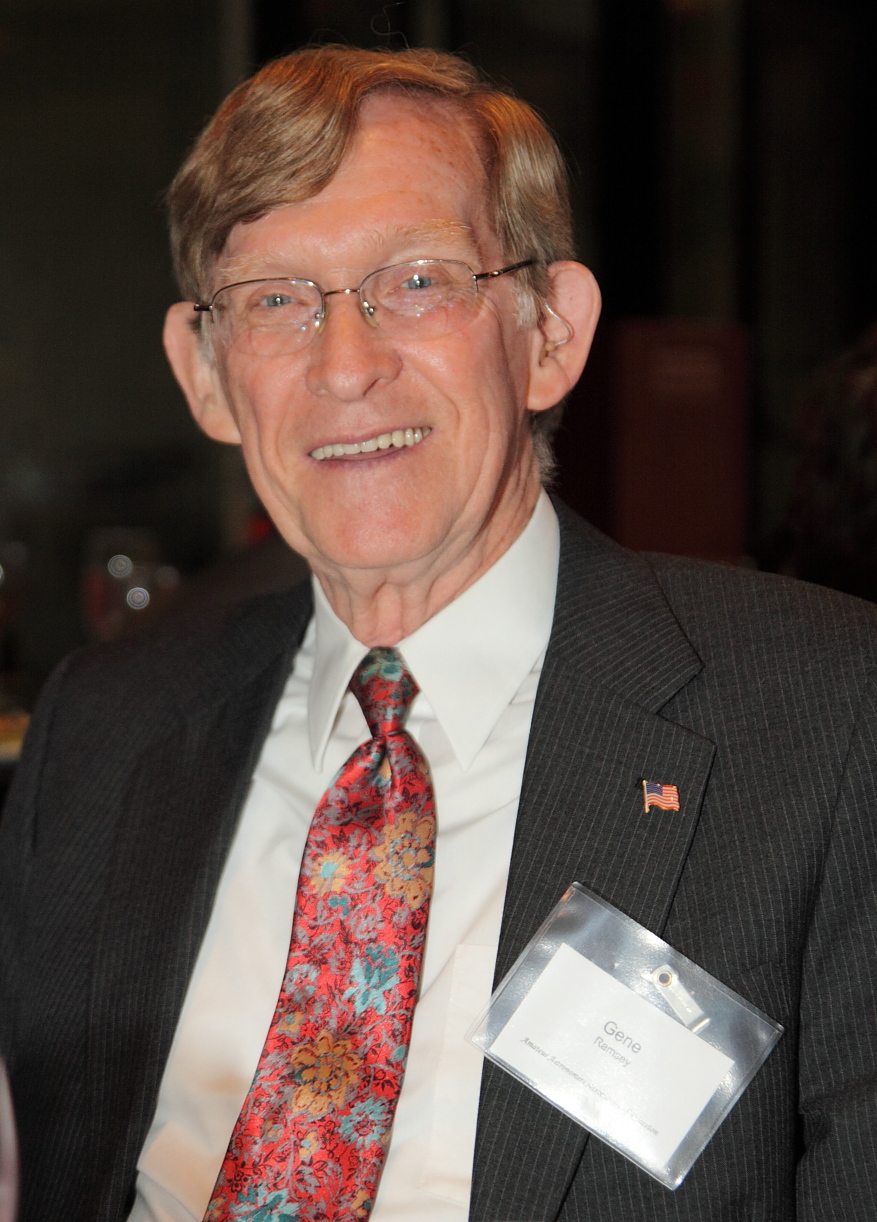
gene-ramseyMembers are in for treat at the next club meeting on Feb. 10, 2015. Observatory Chair and mentor to many, Gene Ramsey, will share tips and tricks that he has learned from 20 years of observing at our Washington-Crossing observatory, star parties and club outreach events. His talk will be about how to save hundreds of dollars on astronomy equipment such as telescopes, eyepieces, 12-volt batteries, observing chairs and magazines such as Astronomy and Sky & Telescope. Also, he will share some of the important astronomical discoveries of the last twenty years such as the dark energy, a massive black hole in the center of the Milky Way, and humans landing on the moon. Don’t miss this opportunity for beginners and veterans alike to learn valuable tips garnered from 20 years of hands-on experience and experimentation.

The meeting will be held at 7:30 p.m. in Bowen Hall.

Posted in February 2015, Sidereal Times | Tagged , , , | Leave a comment

From the Assistant Director

by Larry Kane, Assistant Director 

As the liaison from the AAAP to the Washington Crossing Park Association (WCPA), and as a trustee of that organization, I want to invite members and friends of the AAAP to a special event.  On February 22, George Washington’s birthday, the WCPA is sponsoring a forum and panel discussion entitled “After the Crossing: New Jersey in the American Revolution.”  The moderator is Dr. Richard Veit, Chair of the Department of History-Anthropology, Monmouth University.  Speakers and subjects covered include Larry Kidder – “The 1776-77 New Jersey Chess Match: Washington vs. Howe”; Tim Nist – “Unsung Heroes at the Battle of Monmouth”; and Mark Dilonno – “War in the Watchtungs: Washington’s Battle of Attrition.”  Panelists will be available to talk to attendees, authors will have book signings, and organizations, including the AAAP, will have booths at the  event. So, come for the history, or come to do outreach for the AAAP.

This historical event will be held from 2:00 PM to 6:00 PM at the Union Fire House, 1396 River Rd., Titusville, NJ.  Registration is required and attendees are requested to make a $10 donation.  Members of the WCPA may attend free of charge.  To register, send a response to Washington Crossing Park Association, PO Box 83, Titusville, NJ 08560, contact Bill Marsch by email (wrmarsch@earthlink.net), or contact me at kane@princetonastronomy.org.

Posted in February 2015, Sidereal Times | Tagged , | Leave a comment

Treasurer’s Report

by Michael Mitrano

I have sent reminder postcards to members from last year who have not yet renewed, which has this far prompted six renewals. Our membership count is up to 55, which is ten fewer than at the same point a year ago.

Otherwise, financial activity has been minimal during the month. In February, we expect to take delivery and pay for the Mallincam video camera for the Simpson Observatory.

As an example of astronomical interest even in financial places, I called the AAAP’s bank to inquire about an unexpected charge and got into a conversation with the staff member who has just bought a telescope for her boyfriend.

On a cumulative basis at this date, the AAAP’s surplus remains about $25 thousand.

Posted in February 2015, Sidereal Times | Tagged , | Leave a comment

Minutes of the January 2015 AAAP Meeting

by Jim Poinsett, Secretary

  • Larry brought the meeting to order.
  • Jim Poinsett showed the club the Explore Scientific ED127 Apochromatic Refractor w/accessories and case the club received from the recent donation.
  • Kate Otto introduced the speaker Dr. Alan Hirshfeld, Professor of Physics at the University of Massachusetts Dartmouth and an Associate of the Harvard College Observatory who presented a talk entitled “From Backyard to Mountaintop: The Adventures of History’s Best Worst Telescope”.
  • Michael Mitrano updated the status of the video project for the observatory. The camera has been ordered, we are on a waiting list, it will be about 4 weeks before we receive the camera. The plan at that point is to try out the camera on a variety of telescopes to determine the best scope to purchase, if we don’t already have it.
  • The Observa-dome has been picked up and is out of our hands. Michael has the paperwork from the others items in that donation.
  • The Washington Crossing Park Association is presenting “After the Crossing – NJ and the Revolution” at the Titusville Firehouse on Rt. 29. The AAAP will have a table at the event so we can give out literature on the club, Larry will be there.
  • Michael Mitrano reports the treasury is doing fine.
  • The speaker is all set for the February meeting.
  • Gene Ramsey informed the club that the new gate has been installed and our lock is in place. Currently there is no way to secure the gate open to drive through. He also reminded us that snow plowing in the park sometimes causes problems getting to the observatory. Also so far there is no problem with the roof, the observatory is operational as of the date of the meeting. If any problems do occur Gene will notify the club secretary and he will notify the entire club.
  • Testing on the new paramount mount has been delayed by illness. Dave Skitt has researched mounting plate for the pier we currently have and a custom one is available for approximately $140 – $180.
  • There being no further business the meeting was adjourned.
Posted in February 2015, Sidereal Times | Tagged , , | Leave a comment