From the Outreach Chair

by David Letcher, Outreach Chair

Well, star party season has started with our usual visits. Monday evening, October 28 saw us at the Linwood Middle School in North Brunswick showing Ms. McCarthy’s astronomy class a few sky objects. Unfortunately, there was a thin layer of clouds that prevented us from seeing a lot of objects but we were able to see Venus, the double double in Lyra, and a couple of globular clusters. Thanks to members Jeff Bernardis, Mary and Pat Hayes, David Zahler, Victor Davis and yours truly for volunteering!

Saturday evening, November 2 will see Gene Ramsey and some others visit South Hunterdon High School and do some stargazing with the school’s astronomy class.

Friday evening, November 15th will see a number of volunteers visiting Newell Elementary School in Allentown, NJ. This evening is part of their “Science-Live” night. The visit is one of our regular star parties and is very well attended! Let’s hope for clear skies and lots of volunteers!

Posted in November 2013, Sidereal Times | Tagged , | Leave a comment

Treasurer’s Report

by Michael Mitrano, Treasurer

StarQuest is behind us and member dues continue to come in. At this point, 41 members have paid – one person less than at the same date a year ago. If you’ve not yet paid, please send your check to the PO box.

Expenses have been modest so far this fiscal year, and year-to-date surplus is about $1,600.

On a cumulative basis, our surplus is nearly $24 thousand.

Posted in November 2013, Sidereal Times | Tagged , | Leave a comment

Minutes of the October 8, 2013 AAAP Meeting

by Michael Wright, Secretary

Director Jeff Bernardis opened the meeting by welcoming and recognizing new members.

Jeff announced that former Director Kirk Alexander recently passed away in his home in California after a battle with cancer. John Church remembered Kirk as one of the best AAAP Directors and noted that Kirk organized the 40th Anniversary Dinner. Rex Parker remembered Kirk had a 7-inch Questar on a Losmandy G11 mount that he brought to StarQuest.

Program Chair Kate Otto introduced the speaker for the evening, member Ken Kremer who gave an informative presentation entitled, “NASA’s LADEE and Cygnus Blast Off from Virginia” Ken presented eyewitness accounts of the recent historic rocket launches to the moon and the International Space Station from America’s newest spaceport at NASA’s Wallops Flight Facility in Virginia. He updated us on the latest NASA missions including MAVEN and the government shutdown’s impact on NASA’s operations.

After a brief break, Rex Parker gave a preview of talk that he will give at next month’s Member’s Night about imaging Comet ISON at recent astroimaging workshop that he attended given by Adam Block of the University of Arizona.

Jeff convened the business portion of the meeting.

New Observatory Donation – Plans are in the works to pick up the equipment from the donor’s storage facility on Saturday, October 12, 2013. Dome pieces will be stored in John Giles’ shed. Jeff had hoped to coordinate the pickup at this meeting, but will email or call the volunteers who were not in attendance.

StarQuest – Jeff observed that StarQuest was a success this year and asked for volunteers to organize next year’s event. Mike Wright said that he is willing to organize the event if Ludy will cater it again. Rex Parker suggested that the club hold it in the summer time. Gene Ramsey said that StarQuest was held in the summertime for few years. It was moved to the fall in the hope that weather would be better. The results have been mixed. Michael pointed out that it does not get dark until late in the summer. He will check with the conference center about availability on new moon weekends.

Assistant Director’s Report – Larry Kane reported that there is a “Friends of Washington-Crossing Park” group forming to support the park. The park administration asked AAAP to participate so Larry will be representing the club.

Secretary’s Report – Mike reported that he is setting up email boxes for the officers and committee chairs so they do not have to publicize their private email addresses. Also, he is creating a mailing list that can be used to broadcast emails to the membership. This will avoid the need to download the roster or maintain address books. Mike will maintain the mail list. Jeff said he liked the idea of a mail list for keyholders also.

Program Chair’s Report – Kate reported that the November will be a member’s night. Derek Pitts of Franklin Institute’s Fells Planetarium has agreed to speak in December.

Simpson Observatory – Observatory Chair Gene Ramsey confirmed that the Gemini mount will be installed on Saturday October 26, 2013 by himself, Rex and John Church.

Gene reported that recently 50-80 students and parents from the Chapin School visited the observatory. He requested that members bring their scopes to the observatory on nights when large groups are expected. Large school and scout groups are expected on October 11 and October 19, 2013. Gene said that new member Dan Vorgity, a teacher at South Hunterdon HS, brought his students to the observatory on August 30, 2013. He thanked Bill Murray for helping collimate their telescope that night. Dan said the administration, parents and students are excited about the new astronomy course that he is teaching. He thanked Gene and the club for their help.

Gene said he would like to get rid of the microwave and cart in the observatory. No one objected so he will dispose of it. He suggested that the club sell or donate the 8-inch Dobsonian and solar scope stored in the observatory. Jeff said that it’s important to have scopes available for member’s use so we should keep them.

Outreach Report – Jeff reported that the only outreach event on the calendar so far is Science Night at the Newell Elementary School in Allentown, NJ on Friday, November 15, 2013.

Jenny Jump Observatory – Bill Murray reported that 200-300 people completed the repairs to the observatories at Jenny Jump, including AAAP’s observatory. The rotten wood was replaced and painted, and the electrical enclosure was repaired.

Jeff adjourned the meeting.

Posted in November 2013, Sidereal Times | Tagged , | Leave a comment

The Higgs Boson, Relativity and Gravity Waves

by Prasad Ganti

The 2013 Nobel Prize in Physics was given to Peter Higgs of the UK and Francois Englert of Belgium for postulating a theory that predicted the Higgs boson. Nicknamed the “God Particle”, the Higgs boson is associated with the Higgs field that imparts mass to matter. The Higgs field exists everywhere, even in the vacuum of space. All matter weighs something due to the Higgs field, and the Higgs Boson acts as an intermediary. In 2012, evidence of the Higgs boson was found at the sophisticated Large Hadron Collider (LHC) at CERN, which accelerates protons to very high speeds using large amounts of energy.

The confirmation of this prediction follows the trend of past proposals and proofs. Let us consider Einstein’s General Theory of Relativity. Space becomes curved in the presence of gravity. Hence light, instead of travelling in a straight line, follows a curved path in the presence of gravity. The more intense the gravitational field, the more the bending. This leads to a black hole where gravity is so intense that light keeps bending and bending until it cannot escape out of the “hole”.

Arthur Eddington made a famous observation in 1919, which proved that the light does indeed bend in the presence of gravity. During a total solar eclipse, Eddington and his team measured the shift in position of a known star as it’s light passed nearby the Sun. The shift showed that the light from the star did bend in the presence of the massive Sun. The observation matched the theory perfectly, and Einstein became very famous for his “out of the world” theories. Einstein did get a Nobel Prize for Physics in 1921, but that was not for either the General or the Special Theory of Relativity. It was for the photoelectric effect, which is the basis for all the solar panels today.

Einstein’s General Theory of Relativity also predicts the existence of gravity waves. Massive and fast moving objects in the universe wrench the fabric of space-time and create these waves. Gravity waves should also exist from the time of creation of our Universe. None have been found so far. Will gravity waves to be discovered next?

There are two instruments built in the USA called LIGO (Laser Interferometer Gravity wave Observatory). One is in Louisiana, and another is in Washington State. Each observatory consists of two one-mile long arms constructed perpendicular to each other with laser beams running through them. When a gravity wave hits, it will change the length of one arm and cause an interference pattern. It has not happened so far. Probably the instruments are not sensitive enough to detect the waves or the Earth is obstructing the waves.

Two very sensitive instruments may be built in space using the same interferometry principle. One is called LISA (Laser Interferometer Space Antenna). Three satellites with very sensitive instruments will be positioned at the vertices of a large equilateral triangle. Each side of the triangle will be about a million miles long and positioned between the Earth and the Sun. The project is very expensive and funding is not committed yet. A competing cheaper version based on an atomic interferometer is being considered but is not funded either.

In these days of shrinking space budgets, neither of these projects may take off, but let us hope for the best that some day gravity waves will be discovered! Someday before I die, I would like to pen an article on the discovery of gravity waves!

Posted in November 2013, Sidereal Times | Tagged , , , | Leave a comment

NASA’s MAVEN Mars Orbiter Set to Launch on November 18

by Dr. Ken Kremer

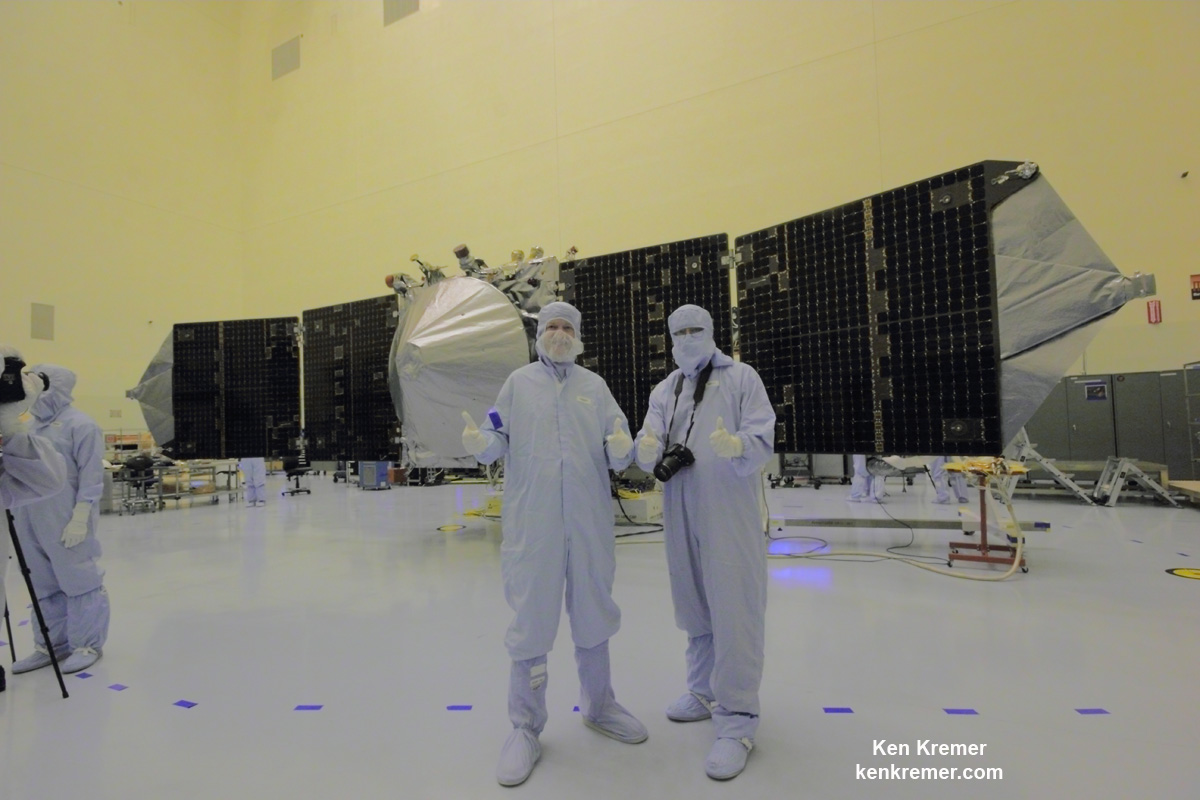
Bruce Jakosky and Ken Kremer stand before MAVEN Credit: Ken Kremer

Bruce Jakosky and Ken Kremer stand before MAVEN. Credit: Ken Kremer

KENNEDY SPACE CENTER, FL, – MAVEN (Mars Atmosphere and Volatile EvolutioN Mission), NASA’s next mission to Mars is scheduled to lift off on Nov. 18, 2013 from Cape Canaveral, Florida on an Atlas V 401 rocket. The 903-kilogram (2000-pound) probe will arrive at the Red Planet in September 2014 after a ten-month interplanetary voyage.

Maven is the first spacecraft from Earth devoted to investigating and understanding the upper atmosphere of Mars. “MAVENS’s goal is determining the composition of the ancient Martian atmosphere and when it was lost, where did all the water go and how and when was it lost,” said CU-Boulder’s Bruce Jakosky, MAVEN’s Principal Investigator in an interview at the Kennedy Space Center.

Scientists hope measurements from MAVEN’s suite of nine science instruments will help answer critical questions like whether the Martian atmosphere was once substantial enough to sustain liquid water on its surface and support life.

I personally inspected MAVEN inside the clean room at the Kennedy Space Center with Bruce Jakosky just prior to the partial shutdown of the US government on October 1. During the ultra-rare viewing opportunity, the solar panels were fully unfurled.

“MAVEN is on schedule and under budget.” said Jakosky as we stood a meter away from the nearly fully assembled spacecraft. “The solar panels look exactly as they will be when MAVEN is flying in space and around Mars.” “To be here with MAVEN is breathtaking,” Jakosky told me. “It’s laid out in a way that was spectacular to see!”

The government shutdown temporarily stopped all work but the mission was granted an emergency exemption after three days of no work. “We are working toward being ready to launch on November 18.” Jakosky told me. “We think it’s very feasible.”

Read more about MAVEN in my Universe Today story.

Posted in November 2013, Sidereal Times | Tagged , | Leave a comment

Juno Portrait of Planet Earth

by Dr. Ken Kremer

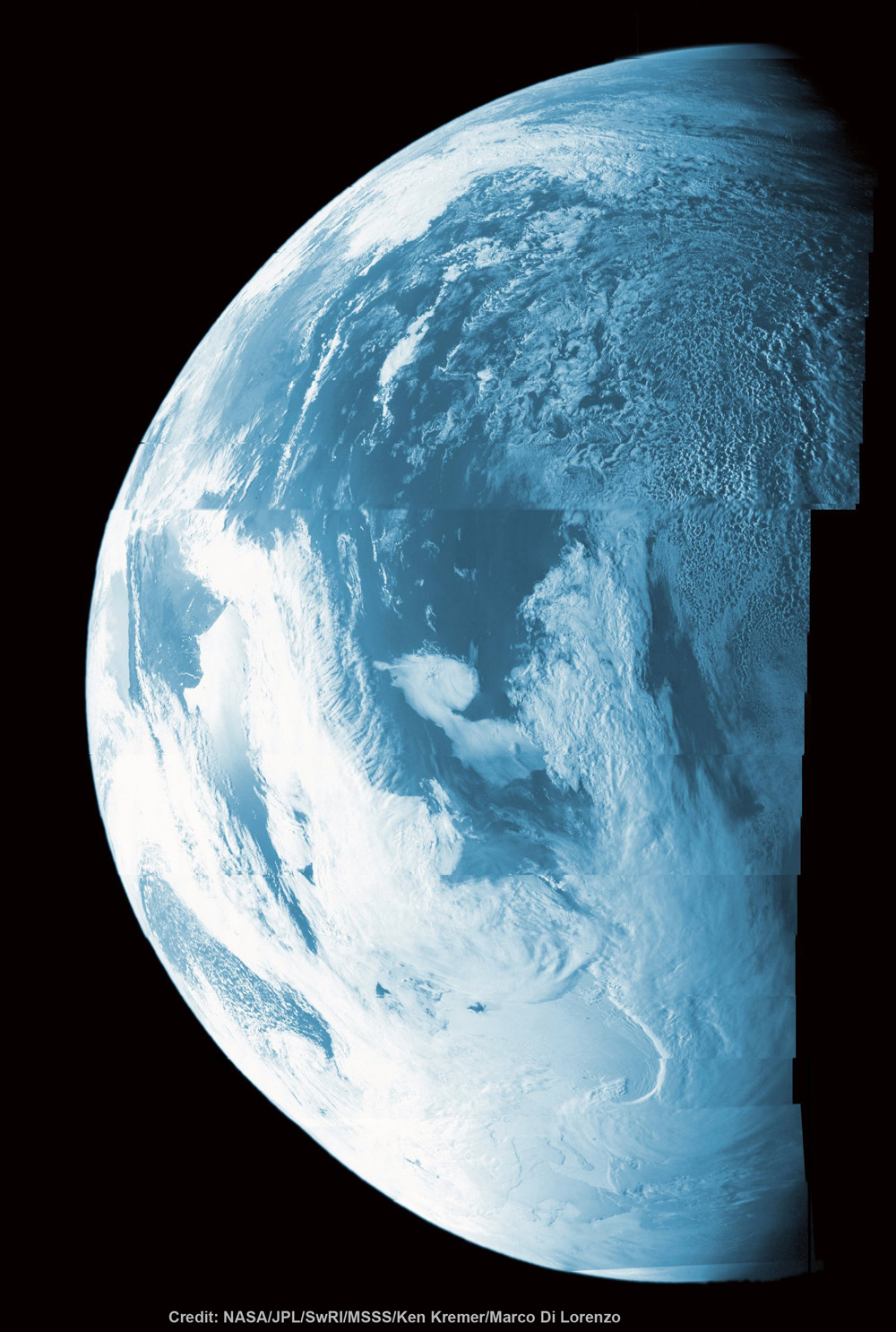
Junocam Earth Mosaic

Junocam Earth Mosaic

This false color mosaic assembled from raw images taken by the Junocam imager shows more than half of Earth’s disk over the coast of Argentina, South America and the South Atlantic Ocean as NASA’s Juno probe slingshotted by on Oct. 9, 2013 for gravity-assisted acceleration to Jupiter. Juno will arrive at Jupiter on July 4, 2016.

Astronomy Outreach by Dr. Ken Kremer
Rittenhouse Astronomical Society: Franklin Institute, Philadelphia, PA: Dec 11, 8 PM, “Curiosity, MAVEN and the Search for Life on Mars” and “Antares ISS Rocket Launch from Virginia.”

Rodeway Inn: Chincoteague Island, VA: Dec 14/15, “Cygnus/Antares ISS Rocket Launch from Virginia.”

Dr. Ken Kremer: Universe Today & AAAP
Please contact Ken for more info, science outreach presentations and his space photos.
Email: kremerken@yahoo.com website: www.kenkremer.com
http://www.universetoday.com/author/ken-kremer/

Posted in November 2013, Sidereal Times | Tagged , | Leave a comment

The Moon is a Harsh Mistress

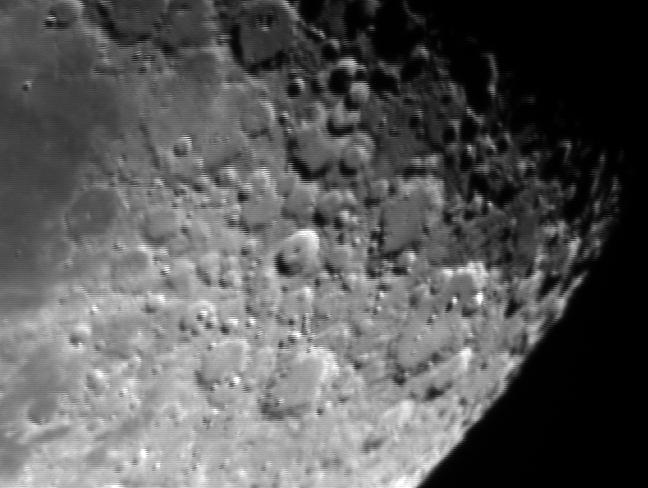
Moon0044Moon0014Member Jim Poinsett took these two shots of the moon this October as part of his first attempt at astrophotography from his backyard using his 8-inch LX-200 and Meade Deep Sky Imager. Well done, Jim!

Posted in November 2013, Sidereal Times | Tagged , | Leave a comment

From the Director

by Jeff Bernardis, Director

As most of you know by now, the Board has decided to withdraw its motion from last month seeking member approval of funding to build a new observatory to house a major donation that was being offered to us. A major part of the donation is a three meter aluminum dome, but it also includes a C14 SCT, a Paramount mount, and imaging equipment.

Before accepting the donation, we decided to make a plan for how we would utilize it, so for the past year or so, five or six dedicated members sought out quotes and approvals for a new observatory. That was the basis for the motion that we were to vote on last month, but the concerns raised at the last meeting brought me to the decision that we should convene a special Board meeting to discuss this matter and possibly amend our motion.

At that meeting, many non-board members voiced their concerns over the proposal. Some of the things we heard were:

  • The C14 SCT is not the best OTA for imaging
  • The planned observatory location would interfere with members bringing their own scopes, plus it would not have ideal horizons.
  • The imaging equipment is possibly outdated; it is approximately 10 years old.
  • Nobody really knows the state of the equipment. It’s been boxed up and sitting a storage facility for several years.
  • Sinking so much money into a facility that would serve a minimal number of members and yet would only be usable on a handful of nights each year is not prudent. We shouldn’t be spending half of our treasury on a single project like this.

I am sure there are many more objections that I’m overlooking. The bottom line is that this is a difficult decision to make. It is, in fact, a decision to be made by the general membership, but it has to be presented to the members as a board recommendation, and I couldn’t, in good faith, recommend that we proceed with so many unknowns and concerns.

I think it was John Miller who suggested that we should simply accept the donation and take stock of what we have. We had been focusing so much on the idea of building the observatory that we lost sight of the fact that the donation came without conditions, and we were not obligated by our acceptance to proceed with construction.

So what we have before us is the following. I have contacted the donor and told him we will accept his donation. He was pleased to hear it. In the next few weeks, we will be traveling down to Medford to pick it up. John Giles has kindly offered to store the dome. John Miller has offered to have the OTA bench tested. We still need to figure out how we will test the mount, and somebody needs to evaluate the imaging equipment.

The decision was NOT made to kill the observatory. That decision has been deferred, and we will face it again, probably in the next few months. We need to keep talking about this in the meetings. As Director, I feel the weight of being a fiduciary for your money. How you feel about expenditures, particularly of this magnitude, is very important to me. Let me know how you feel, both pro and con, so that when the time comes to evaluate this again, we won’t have as many surprises as we had at the last meeting.

Posted in October 2013, Sidereal Times | Tagged , | Leave a comment

Historic LADEE Lunar Orbiter and Antares/Space Station Rocket Launches

Our next monthly lecture will be “Historic LADEE Lunar Orbiter and Antares/Space Station Rocket Launches” by member and science ambassador Dr. Ken Kremer on Tuesday, October 8, 2013. The lecture will begin at 8:00 p.m. in Peyton Hall, 4 Ivy Lane on the Princeton University Campus.

Ken will present eyewitness accounts of the recent historic rocket launches to the moon and the International Space Station from America’s newest spaceport at NASA’s Wallops Flight Facility in Virginia. He will explain how the Fall 2013 launches of the Minotaur V/LADEE lunar orbiter and the Antares/Cygnus rockets were visible to tens of millions along the Mid-Atlantic coast for the first time. Ken will talk about how easy it is for New Jerseyans to witness rockets blasting off just a few hours south of Princeton. Also he will update us on the Curiosity rover and the future of NASA’s robotic and human spaceflight. Ken will have a selection of his space photos for sale.

kenkremerKen Kremer is a journalist, Ph.D. research scientist, speaker and photographer based in New Jersey. His space and Mars imagery and writings have been widely published on TV, magazines, books and websites including National Geographic, NBC, ABC, BBC and Fox News, PBS NOVA TV, Scientific American, APOD, NASA, Aviation Week, Astronomy, Astronomy Now, Space.com, Spaceflight Now, Spaceflight, New Scientist, The Planetary Society, Popular Mechanics, NASA Watch, Universe Today, Wired, Science News, All About Space, Space Quarterly, NPR, Mars Society, International Year of Astronomy, 2010 Year in Space Calendar and the covers of Aviation Week, Spaceflight and the Explorers Club magazines. His Curiosity Mars mosaic is on permanent display at the Smithsonian National Air & Space Museum in Washington, DC.

Dr. Kremer’s website: www.kenkremer.com.

Posted in October 2013, Sidereal Times | Tagged , | Leave a comment

From the Outreach Coordinator

David Letcher, Outreach Coordinator

Ms. Stephanie Williams of the Newell Elementary School in Allentown, NJ has invited us to participate in their science night on Friday, November 15, 2013. This is one of our regular star parties. We have been going there for years. Let me know if you can volunteer. Bring your telescope so we can show the children and their parents the night sky.

My annual fall lectures on backyard astronomy resumed last Friday evening, September 20th. This is the third year for me. These lectures are held at the Nature Center at Washington’s Crossing State Park. We had 18 people in this first session! After the lecture ended at 8:30 p.m., we all walked over to the observatory for an evening of viewing in a very clear, but moonlit sky. Everyone had a great time. We observed M57, the moon, and the Mizar-Alcor system in the handle of the Big Dipper. Some of the volunteers showed people how to identify some constellations, but the brightness of the moon made that a bit difficult.

Many thanks to Larry Kane for assisting me during the lecture and to Gene Ramsey and the team during the observing session. I will present two more successive Friday evening lectures this fall.


Posted in October 2013, Sidereal Times | Tagged | Leave a comment

Treasurer’s Report

by Michael Mitrano, Treasurer

It is early in our fiscal year, but StarQuest has taken place and had a $427 surplus, based on expenses so far received. Total revenue for the event was $1,680, close to that of 2010 and 2008.

Otherwise, expenses since July 1 have been modest. As of September 21, 23 members have paid dues for the current fiscal year. If you are not among them, please send yours along.

On a cumulative basis, our surplus remains about $23 thousand.

Posted in October 2013, Sidereal Times | Tagged , | Leave a comment