From the Outreach Chair

by David Letcher, Outreach Chair

The skies couldn’t have been much clearer than on Thursday, April 14 at the Stuart Country Day School Star Party.  Thanks go to Brian Van Liew, Jeff Bernardis, Gene Ramsey, new members Hamilton Potter and daughter Olivia, and me for a very successful event.  The Moon was near full, but we were able to see the Orion Nebula, Sat-urn, and a few other objects. We all had a very nice time with a nice group of very enthusiastic young women.

The State Museum and Planetarium in Trenton is sponsoring the Super Science Saturday on May 7.  It would be nice to have a few telescopes there for viewing the Sun.  Maybe we’ll see some sun-spots this time!  In the words of their website: “Don’t forget. Bring the entire family for a day of hands-on learning and fun. Explore the many fields of science with more than 20 exhibitors representing astronomy to zoology and everything in between. Encounter new worlds beyond our galaxy in the Planetarium.”


Posted in May 2011, Sidereal Times | Tagged | Leave a comment

I Am the Cosmos

I Am The Cosmos

I Am The Cosmos by Amy

The New Jersey State Museum is proud to present the exhibition, I Am the Cosmos, on view through May 29, 2011. The exhibition, organized by scholar and independent curator Sara Lynn Henry, explores new cosmic art for our era.
In the late 1990s and early 2000s, a new mode of art appeared showing astral, spiral, spherical and constellated forms set into deep space. The dynamics of these forms are suggestive of cosmic processes. A large cohort of artists has resonated with recent discoveries concerning the stars, galaxies, deep space, the Big Bang, dark matter and energy. The stunning photographs from the Hubble Telescope (beginning 1994) and from space probes have made the actualities of deep space phenomena more real for all of us. Images from electron microscopes and high-speed particle collisions have opened up new scientific and visual domains. For some artists, recent discoveries have affected directions they were already undertaking; for others it has opened up whole new terrains.

Unlike earlier 20th century precedents, these 21st century artists plunge us directly into the vastness of time and space. Images are more tangible, astronomically and microscopically informed. Outer-space references multiply, suggesting abstracted star fields, nebulae, comets and cosmic webs of macro and micro phenomena. Spheres expand and explode. Fiery clouds of luminous, roiling atmospheres give birth to metaphoric stars. Galaxies spin and points of light congregate in fathomless dark spaces. Movements are elliptical, spiral and curved, rather than the more static idealized diagonals and perfect circles of the earlier art.

Artists included in the exhibition are David Ambrose, Alice Aycock, C Bangs, Paul Brach, Amy Cheng, Kwang-Young Chun, Russell Crotty, David Hardy, Carter Hodgkin, Ellen Levy, Robert Longo, David Mann, Matthew Ritchie, Dorothea Rockburne, Todd Siler, Barbara Takenaga, John Torreano, Sarah Walker and Marlene Tseng Yu. The exhibition is enhanced by antiquarian objects used by astronomers, and by source material from NASA/Hubble Space Telescope.

The exhibition was funded, in part, by the Friends of the New Jersey State Museum through the Lucille M. Paris Fund.

Posted in May 2011, Sidereal Times | Tagged , | Leave a comment

From the Director

by Ludovico D’Angelo, Director

What does it mean to “do” astronomy?  This has been a question posed to me on several occasions. And I have various answers for this. Does doing astronomy mean looking at the stars and planets with your naked eye, a telescope or binoculars? Looking at computer screens full of data? Taking CCD pictures? There are various amount of aptitude and ability on these issues within the amateur community and our club. Some get into this hobby and then find an interesting thing or two to concentrate on like comet hunting or solar observing. Others like to look at objects, take measurements, and analyze the results. I’m a simple guy, so right now, I just like to look, read about what I’m seeing and enjoy the fresh air. Does doing astronomy mean getting together with a group outside to look at the sky or inside to hear a lecture?  I think doing astronomy is all of the above. It’s social or non-social; all depending on your personality. It’s also participating in any way possible in conversations, writing, taking pictures, or studying: participation in the great and limitless facets of our universe. It cannot be done all at once. It takes time. It takes patience. I hope you will all participate to the best of your ability.

Along with my simple observations, I also enjoy going out to our public outreach events. Lately I’ve been a little busy so I have not been able to attend some of these. But I know David Letcher, our Outreach Organizer, has been doing a great job. One event coming up will be at Stuart Country Day School in April. On Saturday, May 7th, the Superscience Day at the NJ State Museum and Planetarium will be happening. Every Friday night starting April 1st are public nights at our Simpson Observatory. Of course, as I write this, the forecast is for rain, snow, clouds…. typical.

Last week I was up at Jenny Jump to attend a board meeting of United Astronomy Clubs of New Jersey (UACNJ). We are a member club, and we have not had any real representation up there for many years concerning its activities. We also have an observatory there. What I found was a very busy and engaged group of volunteers that are doing many organizational activities to promote astronomy. They have some major astronomical projects going on also. We’ll be talking about this during future club meetings and how we can be more involved with UACNJ. Our observatory there needs some work. The enclosure for our 12” telescope has wood rot in some areas, and it needs a paint job and some maintenance. So I hope we can also organize this in the future.

Our next meeting is in Peyton Hall on Tuesday, April 12th at 8 PM.  See you all there!


Posted in April 2011, Sidereal Times | Tagged | Leave a comment

From the Program Chair

by John Church, Program Chair

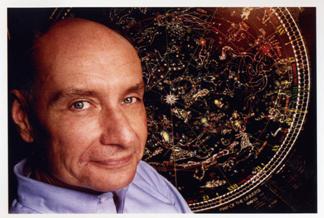
On April 12th, we will be treated to a talk by Dr. Michael R. Molnar on the subject of his researches on the Star of Bethlehem.  Since one of the celestial events he will be discussing occurred in a long-ago April, the timing of his talk is very appropriate. He will be offering copies of his book on this subject for sale during the intermission, which he would of course be glad to sign.

Dr. Michael Molnar

Dr. Michael Molnar

Dr. Molnar is an astronomer, educator, and researcher with a long history in academe and industry. He received his Ph.D. in astronomy from the University of Wisconsin in 1971 and went on to do pioneering research in the field of magnetic stars by using satellite observations. Dr. Molnar served on the research teams for several space missions such as the Orbiting Astronomical Observatory-2 (1971) and Mariner 9 Mars Orbiter (1973).  He has lectured and conducted research at the University of Colorado, the University of Toledo, and Rutgers University.

Dr. Molnar also has a diverse background in industry, where he developed spectrometer and fiber optic systems and managed various computer system projects.  He was National Director of Academics at The Chubb Institute.  A person of wide interests, he is also a maker of violins.

There will be a “Meet the Speaker” dinner at 6:00 pm before the meeting. Please email me by noon on Tuesday, April 12th for a reservation.  I will respond with the dinner location, which has yet to be determined. It will be at either the Sports Bar (old Sotto) or the Triumph Brewing Company, which are close to one another on Nassau Street in Princeton.  To insure a place or places at the table, it will be very important to make all reservations by noon on the 12th.

On May 10th, we will be hearing our own Dr. Ken Kremer’s talk on the future of NASA.  To round out our current session, we will have our traditional presentation by former Director Bill Murray in the New Jersey State Planetarium in Trenton on June 14th.

Posted in April 2011, Sidereal Times | Tagged , | Leave a comment

Losmandy Mount Donated to AAAP

by Rex Parker

In March the club was the recipient of a generous donation by Bob Wolf, amateur astronomer and recent AAAP member. Bob donated a Losmandy G-11 Gemini Go-To mount.  This is a “portable” German equatorial design similar to the classic G11 but with a more robust, DC-servo drive, mechanism instead of stepper motors.  It includes the Gemini Go-To electronics and extensive deep sky database of 41,000 objects.  The mount is in pristine condition and is packed in a Scopeguard transport case.

Gemini GotoAt first the mount seemed to be a solution to the issues we’ve had on the classic G11/refractor mount at the Observatory.  Those problems now appear to be solved by the recent repair efforts of John Giles and others.  Alternatively, the new mount could be a great addition to AAAP’s member observing and outreach activities by providing a solid platform for another telescope in the field adjacent to the observatory.  Ideas for the mount are being considered and options will be reviewed by the Observatory committee. Thanks very much to Bob for this very generous gift which bolsters our capabilities for member and public access to the stars!


Posted in April 2011, Sidereal Times | Tagged , , | Leave a comment

Membership Meeting Minutes March 8, 2011

by Larry Kane, Secretary

The meeting was called to order by Director Ludy D’Angelo.

1.        Bill Murray has accepted the duties of Nomination Chair.

2.        It was announced that the club needs to pay its dues for UACNJ membership, and to send delegates to go to their board meetings.  It was decided that Bill Murray will be the primary and Ludy D’Angelo will be the backup representatives.  The UACNJ will have a booth at the balloon festival.

3.        Two of the editors of Sidereal Times have resigned and a request was made for someone to assume the responsibility of editor.  Ira will remain in his position until a replacement is identified.

4.        The next Board meeting will be held on March 23.

5.        There was no Secretary’s report.

6.        Program Chair report – Current chair, John Church, announced the details of the remainder of the season.

7.        The Treasurer’s report appears in another section of  Sidereal Times.

8.        Webmaster John Miller discussed a misuse of Twitter as a communications tool between members.  He will set up the club’s Facebook page for that purpose.  He suggested that this page be made available to every member. He volunteered to be the administrator.

9.        Member Michael Wright stated that the number of hits on the club’s blog has increased and some members have left comments.

10.     Outreach Coordinator – David Letcher discussed requests that have been received from the Hopewell Elementary School, the Millstone School in Plainsboro and the Stuart County Day School.  The Waldorf School requested that we donate a star party for their fund raiser auction.   The consensus was that we ask them to come to our observatory, but not on a public night.

11.     Observatory Report – Gene Ramsey stated that a keyholder asked him to do a refresher course.  He said that he would do so and invite all keyholders.  John Giles reported that the repaired controller and guider were installed on the refractor but the motors did not respond.  It was decided that the motors may required new grease and the gears may need to be cleaned.  Gene and John Church will check out the mount motors.  Gene and Jeff Bernardis are still getting information on security systems.

Posted in April 2011, Sidereal Times | Tagged | Leave a comment

Board Meeting Minutes, March 23, 2011

by Michael Mitrano, Acting Secretary

Attending were Board members Jeff Bernardis, Ludy D’Angelo, John Church, and Michael Mitrano, and members Michael Wright, David Letcher, and John Miller.  With notice having been properly given, a quorum was present.

1.        John Miller reported that the web site is up to date, except that the 2011 public observing duty rotation has not yet been posted.  Public observing will begin on April 1 with Team 1.  Users of mailing lists other than the roster are cautioned to check the roster each time to make sure that their list agrees with the roster.   John will set up a Facebook group for the AAAP.

2.        David reported that outreach events are upcoming on :

a.        Friday, March 25, at Hopewell Elementary School

b.       Tuesday, March 29 (rain date March 30) at Millstone River school

c.        Wednesday, April 6 (rain dated April 13) at Stuart Day School

3.        David also outlined a proposed astronomy class for the general public — following in the tradition of the course most recently taught by Vic Belanger — to be held at the Nature Center in Washington Crossing State Park for the four Fridays beginning on September 30.  They would take place from 7:30- 8:30 pm and be followed, skies permitting, by visits to the observatory.  The Board endorsed David’s proposal and encouraged him to continue its preparation.

4.        It was also suggested that coffee and conversation time be planned before the Peyton Hall lectures from 7:30-8:00, to encourage member conviviality.

5.        Ludy proposed that members be designated to attend NEAF and obtain donated gifts or purchase items of up to $300 in value as prizes for the next StarQuest.  Ludy and Jeff will prepare a letter to prospective donors and at the next business meeting, we will discuss who will go.

6.        Ludy will attend the UACNJ upcoming board meeting to represent the AAAP and obtain more information about UCANJ plans.  Their symposium coincides again with StarQuest.

7.        Michael Mitrano reported that membership is up to 83 and predicted that it will match last year’s final total.  Cumulative reserves exceed $20 thousand, and he expects a strong surplus for this year.

8.        Michael Wright reported that publicity for lectures is taking place as planned.

9.        Ludy will provide Michael Mitrano with information necessary to send a letter of recognition to the donor of the AAAP’s new Losmandy G-11 Gemini GoTo mount.

10.     The board discussed opportunities to improve its facilities at Washington Crossing and make use of the mount and a recently donated telescope.  This could be a tripod, a permanent outdoor pier and slab, or a second observatory building.  It was resolved that the foundation for any new building would not be hand-dug.  Plans might begin with a slab designed with a later structure in mind.  The board agreed that a planning group should be appointed to consider alternatives, assess their benefits, and estimate costs.

11.     The observatory will need to be ready for opening on April 1 with the water turned on.


Posted in April 2011, Sidereal Times | Tagged | Leave a comment

Treasurer’s Report

by Michael Mitrano, Treasurer

Membership has increased to 85 with many late-in-the-year renewals. We are now only four shy of last year’s full-year membership.  Outreach contributions already exceed last year’s and match the full-year amount for two years ago.  Our routine expenses have remained modest, and the AAAP’s surplus for the year-to-date has therefore risen to $2,500.  On a cumulative basis, the surplus is almost  $21,000.


Posted in April 2011, Sidereal Times | Tagged | Leave a comment

From the Outreach Chair

by David Letcher

Tuesday evening, March 25 proved that the U.S. Weather Service can provide a precise, down-to-the-minute forecast.  Five of us came to the Hopewell Elementary School star party at about 6:30 and so did the clouds!  But, we relied on the forecast and, sure enough, the skies began to clear and the kids showed up.  We had good views of the Orion Nebula, the Pleiades, and Saturn.  Thanks to volunteers Matt Stires, Kevin Burkhart, Gene Ramsey, Jeff Bernardis, and me.

Clear, dark skies on Tuesday, March 29th enabled Jeff Bernardis and me to give a very successful, well-attended star party at the Millstone River School in Plainsboro.  We were able to show the children and their parents the Orion Nebula and Saturn, among other objects.  We even received a $100 donation from the school!

As of this writing, we have another star party on Wednesday, April 6 at the Stuart Country Day School.

I have received a few requests from scout troops too, but it looks like they will generally be satisfied with future visits to our Friday evening open houses.

Posted in April 2011, Sidereal Times | Tagged | Leave a comment

Spring Time is for Galaxies

by Rex Parker

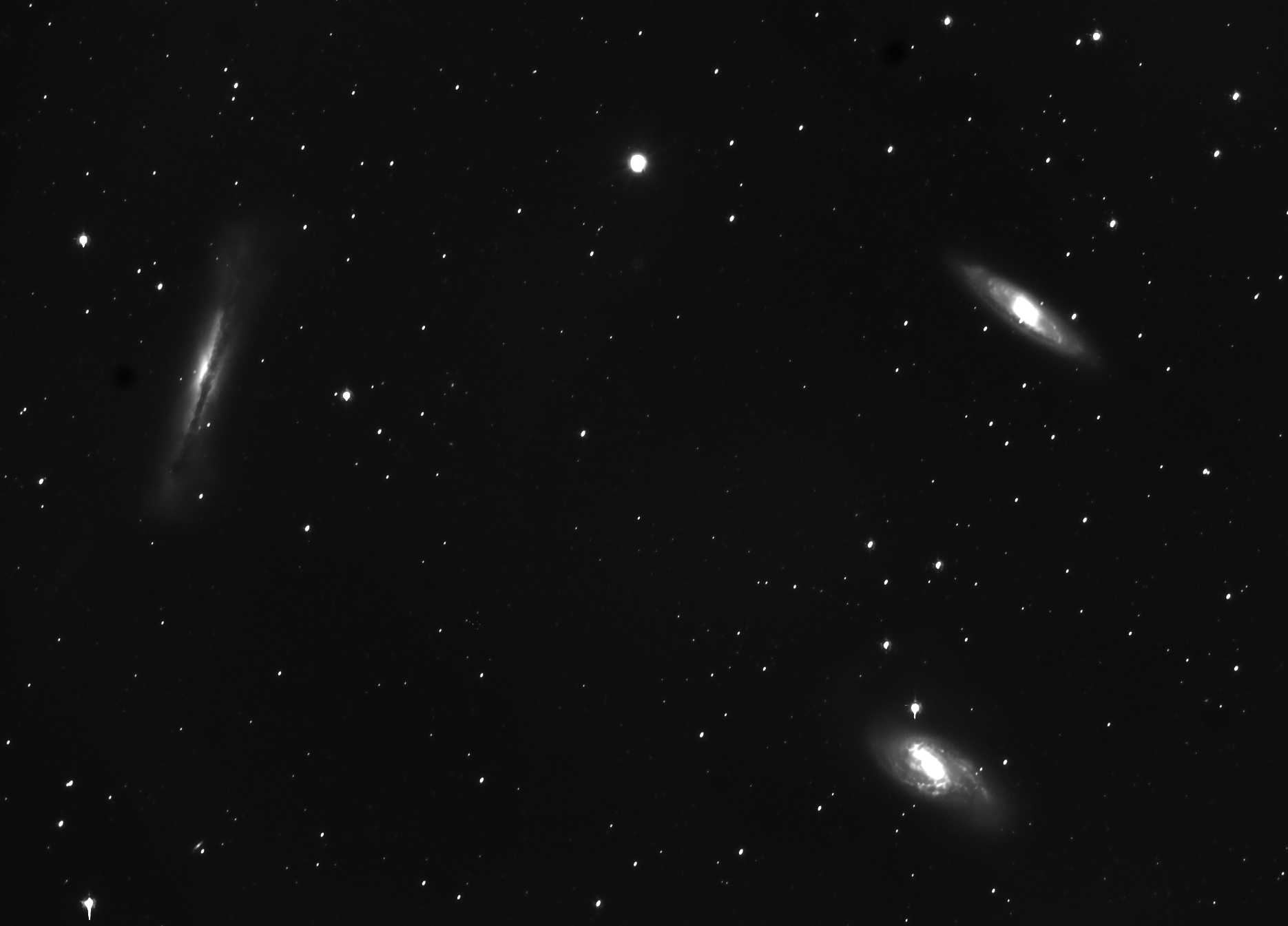
With the passing of the equinox it’s time to start searching for the great sweep of galaxies in Leo and Virgo.  This is absolutely the best time of year for observing galaxies both visually and astrophotographically.  In the last week of March, I set up my Takahashi FS128 at f/6 to get a fairly wide field of view (~1 degree).  Tracking was accomplished using a Losmandy G11 mount off my deck in Titusville, and an SBIG ST-10XME was used to capture the images below.

Leo Triplet (or Leo Trio) - M65, M66 and NGC3528 (north is to upper left, 120 min. exposure) Credit: Rex Parker

Leo Triplet (or Leo Trio) - M65, M66 and NGC3528 (north is to upper left, 120 min. exposure) Credit: Rex Parker

A section of Markarian’s Chain of galaxies in Virgo. A dozen or more galaxies are visible in this image. The large round one near the center is M86. (north is up, 75 min exposure) Credit: Rex Parker

The parade of galaxies is seldom more fun than on these spring evenings in Jersey.  Head on out to the AAAP observatory in Washington Crossing Park to see more.

Posted in April 2011, Sidereal Times | Tagged , , | 1 Comment

Miss Mitchell’s Telescope, Part 2

by Michael Wright

The Business End of the Vassar Telescope 	Credit: Mr T in DC (CC license)

The Business End of the Vassar Telescope Credit: Mr T in DC (CC license)

Last month I wrote about Maria Mitchell’s connection to the Vassar Telescope, which is on display at the National Museum of American History of the Smithsonian.  This second installment covers the telescope itself and its maker, Henry Fitz.

Vassar College purchased “an Achromatic telescope objective object glass 12 inches aperture, 12 3/8 inches in diameter” from Henry Fitz for $2500 according to the April 6, 1863 minutes of the Trustees.  Also, they record that there were only four larger glasses in the US at the time.  In September, 1863, the Trustees contracted with Henry Fitz “to mount & furnish said object glass in all respects conformable to the annexed specifications for the sum of two thousand & three hundred dollars.”  The specifications were as follows:

Style the general style of mounting shall be the Fraunhofer Equatorial.

Iron The Bolster, Saddle, the declination box, the adjustable weights, the two axes & the counterpoise may be of iron.  The counterpoise is to be globular & ornamental.

Circles The circles shall be the best-variety of brass with inlaid silver plate for the division marks.  The Declination circle shall be twenty inches in diameter & accurately divided to read to thirty seconds of arc; & the Right Ascension circle shall be eighteen inches in diameter & divided to read to four seconds of time.  Both circles shall be furnished with vernier & reading glasses.

Tube The tube of the Telescope shall be made of mahogany with rosewood finish & well polished.

The finder scope was to be “of the best quality & whose object-glass shall be three inches in diameter set in a tube of like material and finish as the main tube.”  Eyepieces were to be one set of eight “positive” (Ramsden) eyepieces and one set of nine “negative” (Huygens) eyepieces of powers ranging from “50 to 1500” for direct observation.  (150x?).  The balance rods, which I believe are the two long rods with brass balls at one end, were required to be “firm & of tasteful pattern with brass adjustable weights.  The rods may be of wood but must be seemly and neatly attached with brass mountings.”  In addition, Henry Fitz was to provide a “prismatic mirror for diagonal views”, a filar micrometer, a ring micrometer, a Bond’s and Dennision’s spring governor and a spectroscope.  As one can tell from the photo above, this was a handsome instrument, but how did the optics perform?  Perhaps not so well.  In 1868 shortly after installation, Alvan Clark & Sons reground the lens to such a degree that they considered it their own according to Deborah Jean Warner in Alvan Clark and Sons Artists in Optics.

So who was Henry Fitz?  Fitz was a contemporary of better known telescope maker Alvan Clark.  Born in 1808 in Newburyport, Massachusetts, Henry Fitz became a locksmith and well-known amateur astronomer by the 1830s.  In 1839, he traveled to Europe to learn about astronomical and photographic optics.  While there, he established connections with French glass-suppliers, learned the new Daguerreotype photographic process and learned lens making from English and German opticians. Upon returning to the US, he patented an improved Daguerreotype camera and opened a successful optical business in Baltimore, which allowed him to experiment with optics. In January 1845, he succeeded in producing a high-quality achromatic lens.  Later in the year, he made a six-inch refractor, which received a gold-medal at the American Institute Fair.  With earnings from public stargazing with the telescope, Fitz launched into making telescopes full time.

Fitz’ innovative lens-grinding techniques allowed him to produce large, high-quality objectives using lower-quality, cheaper glass so American’s did not have to rely on expensive imports from Europe.  This contributed to the proliferation of American observatories during the mid-19th century.  His important telescopes are as follows:

  • 1848,  a six-inch refractor for Lt. James Gillis for his Chile expedition – The objective was tested against and judged equal to a high-quality German import demonstrating that Fitz could produce high-quality objectives.
  • 1849, a 5.6-inch telescope for Erskine College, which was his first observatory instrument
  • 1849 or 1850, a 6 3/8-inch refractor for Robert Van Arsdale of Newark, New Jersey
  • 1851, another 6 3/8-inch refractor for South Carolina College
  • 1852, an eight-inch refractor for Haverford College
  • 1856,  a 9 ¾-inch refractor for West Point Academy – This $5000 telescope was 14 feet long and came with 13 eyepieces.
  • 1857, 12 ¼-inch for the University of Michigan in Ann Arbor – At the time, this was the largest American-made telescope and the third largest refractor in  the world.  It is probably the most important surviving Fitz telescope because it has the largest objective untouched by later refiguring.  It is still on its limestone pedestal and in working condition after 154 years.
  • 1861, a 13-inch for the Allegheny Observatory in Pittsburgh.  Eleven years later, the lens was stolen and held for ransom.  (Even criminals new the value of a big scope back then!)
  • 1861, Fitz delivered his largest and most innovative telescope, a 16-inch refractor with a two-element corrector lens midway down the tube, to William Vanduzee of Buffalo, New York.  This was the largest telescope in the world at the time.
  • 1863, a 13-inch refractor for Dudley Observatory in Albany, N.Y.

At the time of his death in 1863, Henry Fitz had plans for a 24-inch scope and was working with Lewis Rutherfurd on a telescope for astrophotography.  The later scope was completed one year later by Henry’s 16-year old son, Harry, who carried on the business for another 20 years.  Henry Fitz’ techniques were state-of-the-art for his time.  As testing procedures rapidly improved, many of his objectives were refigured by other artisans, so few Fitz objectives remain in their original condition.

This brief biography of Henry Fitz was distilled from the Journal of the Antique Telescope Society, Volume 6, Summer 1994, revised 1995, 2000.  The journal contains more detailed information on Fitz, his telescopes and his lens-grinding techniques. Also, NMAH has an interesting podcast about his workshop, which was donated intact to the museum in the 1950s.

The next time you are in Washington, DC be sure to visit the Vassar Telescope at the entrance to the science and technology wing of the National Museum of American History and enjoy this beautiful icon of 19th century American astronomy.

Posted in April 2011, Sidereal Times | Tagged , , , , | 4 Comments

Perfect Landing Concludes Final Mission of Space Shuttle Discovery

by Ken Kremer, AAAP, Spaceflight magazine & The Planetary Society
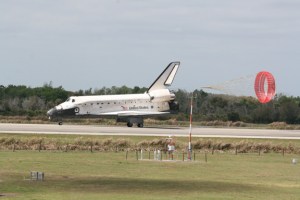
Space Shuttle Discovery Lands at the Kennedy Space Center

Space Shuttle Discovery Lands at the Kennedy Space Center, Credit: Ken Kramer

Farewell Discovery!  The epic voyages of Space Shuttle Discovery now belong to history. The final magnificent mission of Space Shuttle Discovery and her all-veteran, six-astronaut crew wrapped up on March 9 with a safe landing at the Kennedy Space Center in Florida at 11:57 a.m. EST after a flawless mission.  Steve Lindsey commanded the STS-133 flight and was joined by Pilot Eric Boe and Mission Specialists Alvin Drew, Steve Bowen, Michael Barratt and Nicole Stott. Discovery’s 13-day flight ended after a journey of more than five million miles on a joyous and bittersweet note. I was watching from just a few hundred yards away at the shuttle landing strip.

The entire NASA shuttle team is proud of the accomplishments of the Space Shuttle Program but sad that the program is ending so soon.  The sentiment from everyone involved with the shuttle program from top management to the flight team to the astronauts corps is that the orbiters could be safely and usefully flown for many more years.
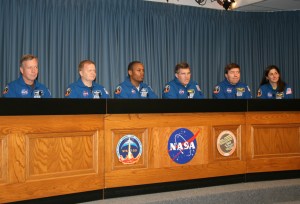
Discovery Crew at Post-Landing News Conference

Discovery Crew at Post-Landing News Conference, Credit: Ken kremer

The STS-133 mission was the 39th and final flight for the illustrious orbiter which first flew in 1984 and is NASA’s longest serving orbiter.  NASA Shuttle managers emphasized that the safe conclusion of the STS-133 mission was due to the hard work of everyone on the team and the absolute requirement that everyone stay totally focused on getting the done job correctly and perfectly. “Spaceflight doesn’t come easy,” said Bill Gerstenmaier, Associate Administrator for Space Operations. “We need to stay focused, keep our heads down and recognize that this is not easy. I think Discovery’s legacy will be the future.”

Altogether, Discovery spent a full year in space during the 39 missions, orbited Earth 5,830 times and traveled 148,221,675 miles during a career spanning 27 years.  “We wanted to go out on a high note and Discovery’s done that,” said Mike Leinbach, shuttle launch director. “We couldn’t ask for more. It was virtually a perfect mission conducted by a perfect flight crew and a perfect ground crew. I couldn’t be happier.”

The primary goal of the STS-133 mission was to deliver the “Leonardo” Permanent Multipurpose Module to the ISS.  Leonardo was attached to the ISS as a new and permanent habitable module that will provide extra storage and living space for the six person ISS crew.  Also aboard Discovery was R2, or Robonaut 2, which is the first humanoid robot in space. R2 was unpacked from Leonardo a few weeks later and become an official member of the station crew.

Discovery Towed from the Shuttle Landing Facility to Orbiter Processing Facility-2

Discovery Towed from the Shuttle Landing Facility to Orbiter Processing Facility-2, Credit: Ken Kremer

Discovery will now be decommissioned over the next few months and then be prepared for a museum display, most likely at the Smithsonian National Air and Space Museum in Washington, D.C.

Next month I’ll report about my up close visit on top of Launch Pad 39A with Space Shuttle Endeavour for her final flight on the STS-134 mission.

Read Ken’s STS-133 articles online at Universe Today, The Planetary Society & CWEB:

Discovery Lands to Conclude Historic Final Flight to Space

Discovery’s Last Launch and Landing Captured in Exquisite Amateur Videos

Robo Trek Debuts … Robonaut 2 Unleashed and joins First Human-Robot Space Crew

NASAs Navy tows Discoverys Last Rocket Boosters into Port Canaveral – Photo Album

Discovery Docks at Space Station on Historic Final Voyage with First Human-Robot Crew

Landing and Towback of Discovery: Photo Reports: 1763 1759

Astronomy Outreach

Yuri’s Night at West Windsor Arts Center: West Windsor, NJ, April 12, 5:30 – 9 PM, “50 Years of Human Spaceflight from Yuri Gagarin to the Space Shuttle and Beyond”. Website:  http://www.westwindsorartscenter.org/
Yuri’s Night Home Page: http://yurisnight.net/

Amateur Astronomers Association of Princeton: Princeton, NJ, May 10, 8 PM  “Whats Beyond for NASA: Shuttle, Station, Orion, SpaceX & Robots”. Website: http://www.princetonastronomy.org/

International Astronomy Day at the Franklin Institute: Philadelphia, PA, May 7, “The Search for Life on Mars”

Rittenhouse Astronomical Society (RAS) at the Franklin Institute: Philadelphia, PA, Jun 9, Wed, 7 PM.  “Opportunity Mars Rover Update”, “ NASA Flybys of Comets Hartley 2 & Temple 1.” Website: http://www.rittenhouseastronomicalsociety.org

Ken Kremer:  Spaceflight magazine, Universe Today & The Planetary Society

Please contact Ken for more info or science outreach presentations:

Email: kremerken@yahoo.com website:  www.kenkremer.com

http://www.universetoday.com/author/ken-kremer/

Posted in April 2011, Sidereal Times | Tagged , , | 2 Comments

From the Director

by Ludovico D’Angelo, Director

This month we hope to have our regular meeting at Peyton Hall. I was just informed by email that there is a possibility that the hall may be needed for mid term exams. Although we have never had this problem before, we will keep everyone informed if there is a change in meeting place. If everything works out, our meeting will be on March 8th at 8 PM at Peyton Hall.

This last month seemed to be very busy for me. One thing I did do was to give a star party at my church as a fundraiser. So I set up my binoculars, my small Meade ETX-90, and my Celestron 9.25 SCT. I used the binoculars for general viewing. The small scope was set to the Moon (it was ½ full). The large scope was set to Jupiter in the early evening, then to the Orion Nebula, the Double Cluster, and a few double stars and other objects. It was a very clear night, cold, and everyone enjoyed the views I was able to provide. And it amazes me that everyone experiencing viewing the night sky was so blown away by it. I had young children to older adults, about 25 in all. The big reaction was the view of the Moon, as the viewers came to understand the surface in great detail, the more excited they got. Especially the children, the cries of joy, I can only hope that they will continue to look up and have an interest in one of the most basic natural sciences there is: Astronomy.

At our last meeting, we determined that the club picnic would be June 4th. So mark your calendars, we will send information about where as we approach the date. We open the observatory to the public again starting in April.

I will be sending out some emails inviting other members to be part of the process of nominating chair. Nominations committee is responsible for finding nominees for Director, Assistant Director, Program Chair, Secretary, and Treasurer. Nominations can be made by anyone; you can also nominate yourself for one of the positions. If you are interested in helping your club’s management and growth, please be generous with your interest and time. Drop me an email if you have questions.

See you all on March 8th!

Posted in March 2011, Sidereal Times | Tagged | Leave a comment