
by Michael DiMario, AAAP Astroimaging Chair
The month of April 2024 has brought out the tremendous skills, innovative engineering, techniques, excitement, and frankly the true astro-grit of AAAP members chasing the April 8, 2024 solar eclipse. Many members, including those whose images are displayed here, traveled to the line of eclipse totality path through the United States from Mexico to Maine. What made this event even more challenging was the typical cloud weather pattern did not behave as typically forecasted with eclipse chasers abandoning their expected clear skies in Texas for the northeast such as New York, Vermont, Maine, or Canada.
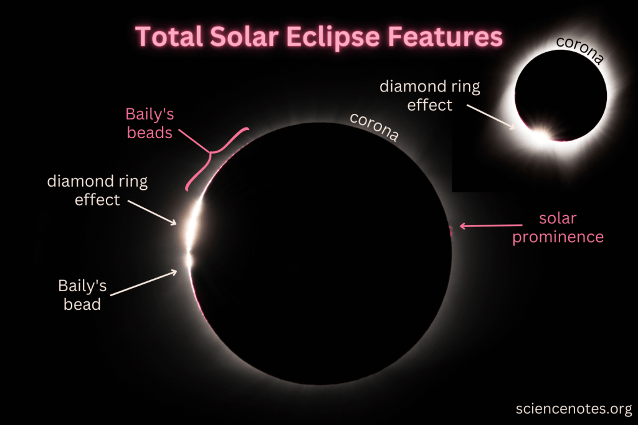
The taxonomy of a solar eclipse and summary consists of the eclipse phases of C1 that is the moment the Moon starts obscuring the sun. C2 is when totality begins. C3 is when totality ends. C4 is when the moon stops obscuring the Sun. The eclipse solar events include the diamond ring effect, Bailey’s Beads, the solar corona, and solar prominences.
The diamond ring effect takes place just before totality and right before it ends at C2 and C3, the Moon nearly fully covers the Sun and a final bright spot of sunlight called the “diamond” remains visible. This bright visual effect resembles a diamond ring, hence the name.
The Baily’s Beads effect, named after the British astronomer Francis Baily, is when light appears around the edge of the Moon during the seconds leading up to totality and just after. Baily’s Beads are caused by sunlight passing through valleys and between mountains on the Moon’s irregular surface. The thin reddish edge is the Sun’s chromosphere.
The solar corona is the Sun’s outer atmosphere, composed of plasma and extending millions of miles into space. The Sun’s intense brightness hides it, but it is visible during totality. The corona appears as a halo of blue-white, wispy light surrounding the dark silhouette of the Moon. The shape of the corona changes over time and the changes may be viewed by comparing past eclipse images of coronas.
The solar prominences are large, bright loops of plasma that extend from the Sun’s surface into the corona. During totality, solar prominences appear as red or pink arches near the edge of the solar disk, sometimes extending out into the corona. At times, a coronal loop may be seen as a well-defined arch-like structure in the corona made up of dense plasma confined and isolated from the surrounding medium by magnetic flux tubes. Coronal loops begin and end at two base points on the photosphere and project into the upper chromosphere and corona.
Image descriptions are edited or authored by Michael DiMario unless noted.
Image capture data are by the imager.
David Ackerman – Eclipse Images
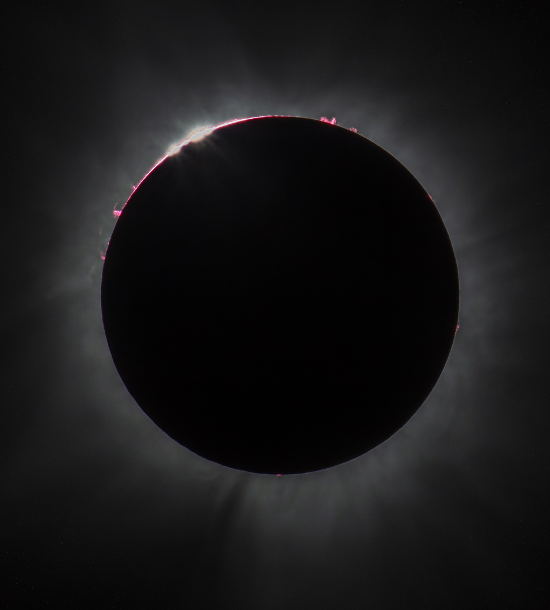
This image shows Bailey’s Beads, solar prominences, the beginning of the diamond ring effect, and the corona. If look closely, faint coronal loops may be seen at the nine to ten o’clock positions.
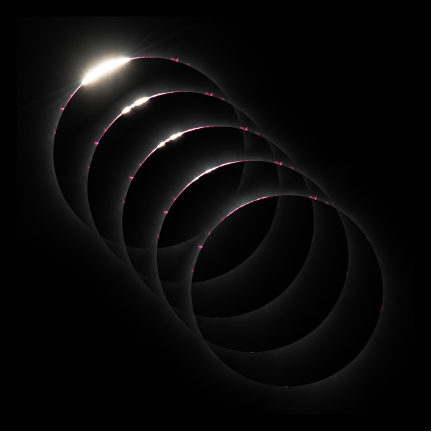
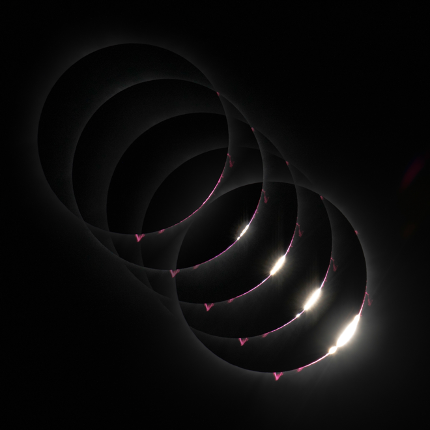
These two images show the eclipse transitioning from C2 to C3 with their corresponding diamond ring effects, Bailey’s Beads, and prominences.
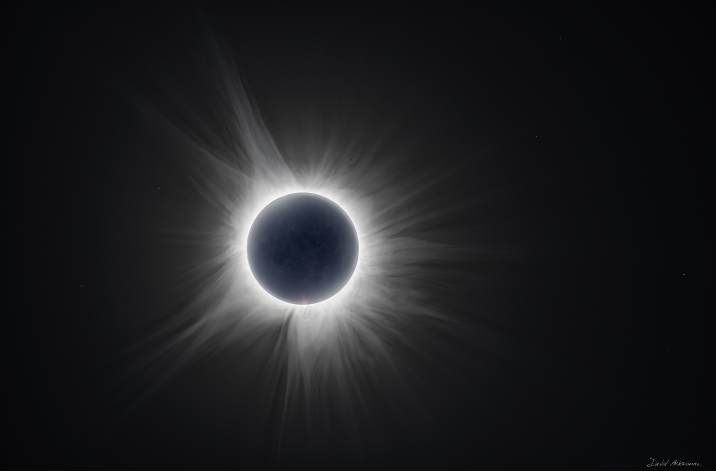
This image shows the corona in all its glory during totality. If look closely, faint coronal loops may be seen at the four, five, and six o’clock positions.
Eclipse images were captured at Magog, QC using a Nikon DSLR with a 400mm + 1.4xTC on an iOptron SkyGuider on a photographic tripod. A total of 1130 frames were captured. David used Solar Eclipse Maestro for hands-off operation requiring an Intel Mac running an antique operating system.
Lisa Fanning – Eclipse Progression
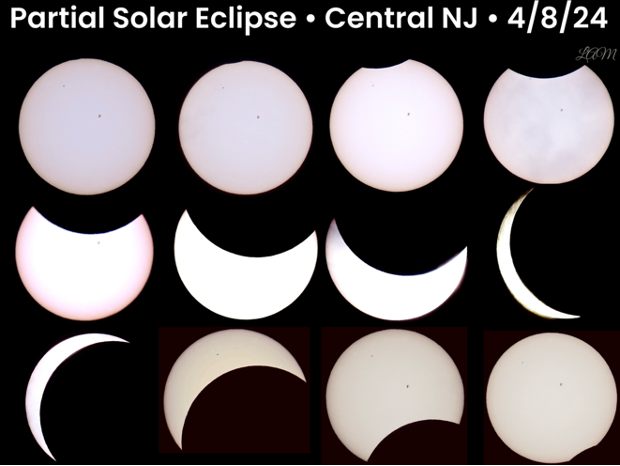
Eclipse was imaged in Morganville at 90% coverage. Image progression was taken with a Canon PowerShot SX70HS with Baader Astrosolar film and assembled in Bazaart.
Dave Wilton – Eclipse Composite Captured Hand Held
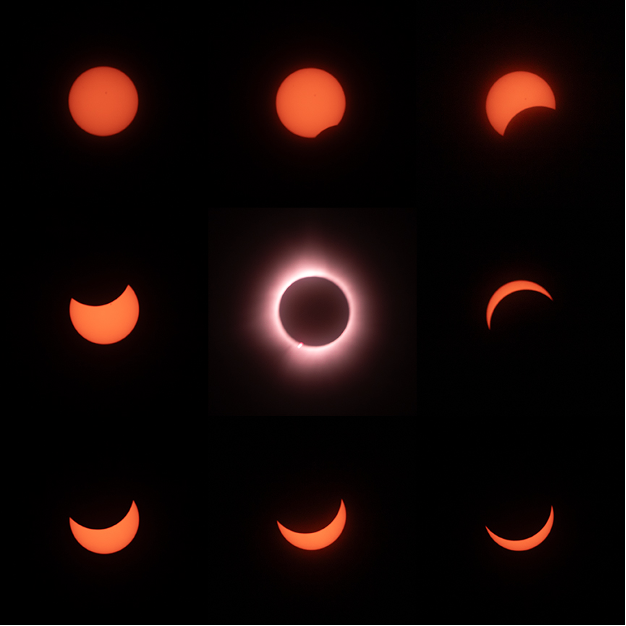
The eclipse composites were taken manually and handheld using a Canon 6D Mark II and Redcat 51. The tripod was inadvertently left behind in the garage. The eclipse images are exceptional given that it is nigh impossible to hold a camera and long lens, in this case a Redcat 51 refractor, steady while trying to magnify the view on the camera screen to get good focus. There was also light cloud cover which obscured the outer corona.
Rich Sherman – Eclipse Diamond Ring
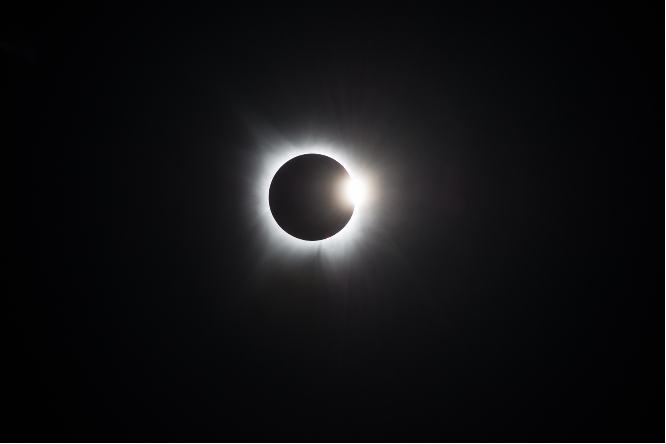
This image of the eclipse’s diamond ring effect was taken in Dallas, TX
It was captured with a Nikon d800 camera, 480 mm focal length at ISO 200, f/8, at 1/8th of a second. It was processed using Lightroom.
Purnendu Gupta – Eclipse Prominences and Bailey’s Beads
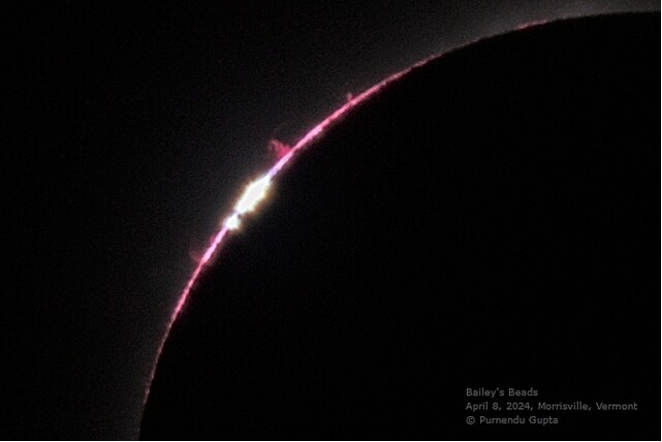
Image reveals the plumes of prominences rising from the red arc of chromosphere. The thickness of the arc corresponds to 10,000 km that could house the Earth. There is a hint of the solar corona in the background. Still visible are tiny white portions of the Sun, the photosphere, shining through the lunar craters and valleys forming Bailey’s Beads.
Robert Vanderbei – Eclipse Totality and Prominences
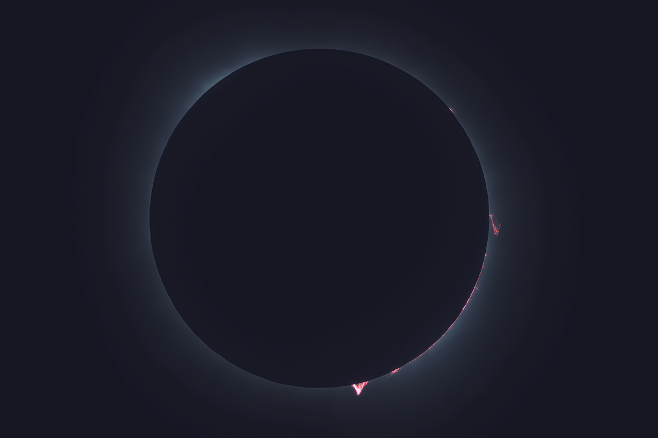
Total eclipse image captured using a 3.5” Questar and ZWO ASI2400MC Pro camera. Images processed with SharpCap Pro Sequencer; location was Plattsburg, NY.
Michael DiMario – NGC 2477 Electric Guitar Open Cluster
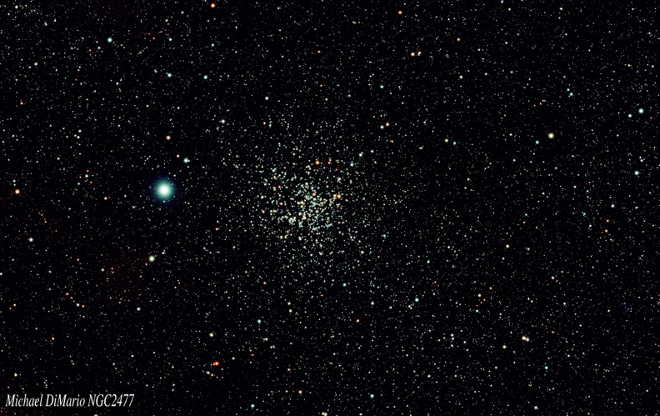
NGC 2477 was imaged with a Takahashi FSQ-85ED Baby Q with a ASI 2600MC Pro camera and an Antilla Triband filter of 60 sub-light frames at 90 seconds each; processing in PixInsight.
NGC 2477 Electric Guitar open cluster image was taken March 31st at Big Cypress National Preserve in southwest Florida. This open cluster is typically a southern object and was taken about 25 deg above the southern horizon. Located about 2300ly – 6200ly, it is comprised of about 300 stars in the constellation Puppis. Star on left is b Pup, a rotating variable star believed to be a binary.
Lisa Fanning – Lunar X and Lunar V at First Quarter
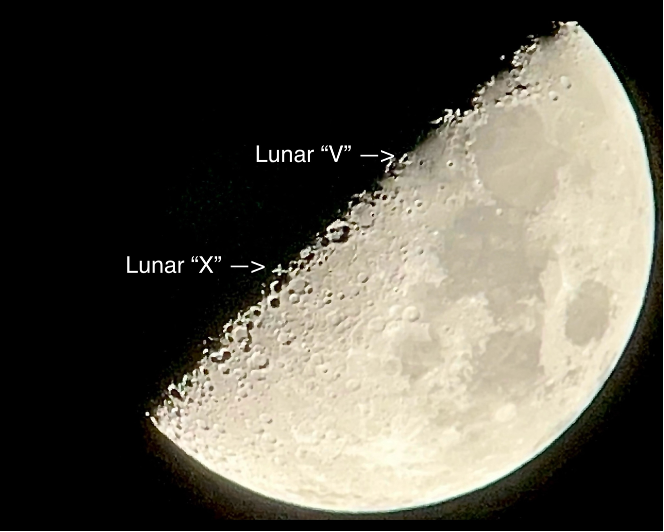
Lunar First Quarter terminator image captured the Lunar X and Lunar V features of April 15, 2024 using an Apple iPhone 13 digiscope adapter attached to a Swarovski Optik Spotting Scope.
Lunar X is a “clair-obscur effect” where light and shadow creates the illusion of the letter ‘X’ on the rim of the Blanchinus, La Caille and Purbach craters. The Lunar V is also visible, formed by Ukert crater and several small craters.
Michael DiMario – NGC 3372 Carina Nebula
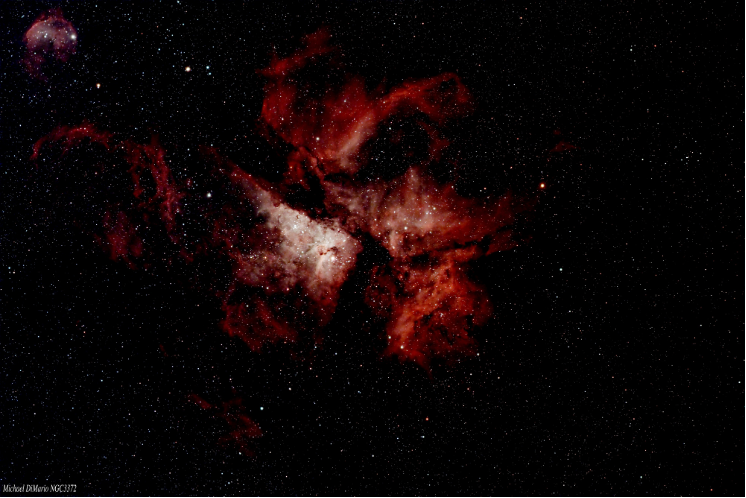
NGC 3372 Carina Nebula image comprised of 23 subframes at 30 sec using a Takahashi FSQ-85ED, Antilla Triband filter, and ASI 2600 MC Pro camera; processed in PixInsight.
NGC 3372 Carina Nebula was imaged March 31st at Big Cypress National Preserve 1-2 degrees above the southern horizon making it a very difficult object to capture. NGC 3372 Carina Nebula is one of our Galaxy’s largest star-forming regions spanning over 300 ly at a distance of 7,500 ly. The Carina Nebula is home to young, extremely massive stars, including the variable Eta Carinae, a star with well over 100 times the mass of the Sun. Eta Carinae is the bright star next to the central dark notch in this field. The difficulty of imaging near the horizon is the amount of air mass that light of your target must pass through. The number of air masses at the horizon is 40. That is, stellar light passes through 39x more atmosphere than at the zenith. To check out the effects on magnitude and the derivation, see https://asterism.org/resources/atmospheric-extinction-and-refraction/.
Joshua Verma – Total Solar Eclipse Prominences
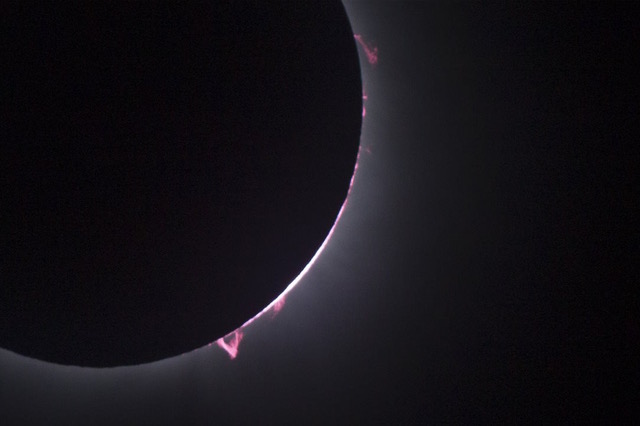
This total eclipse image with prominences was captured in Cleveland, Ohio. As the official photographer of Nottingham Baptist Church, Joshua used a Skywatcher Star Adventurer, Evostar 72ed, and Canon EOS 500D and an Orion telescope for others to use. With snacks and drinks provided for all 50 people at the event, it turned out quite fun; many memories were made. A lot of people wanted to take a look inside the telescope, which provided a much closer look at the sun than they could get with the glasses. Most thoroughly enjoyed it, especially during the end of totality when the pink triangle “sun mountain” was visible. The clouds, rather than completely hindering the experience, actually created a nice effect during totality, reflecting light in such a way to create a white halo in the sky.


