NASA’s OSIRIS-Rex Begins Trailblazing Asteroid Sampling Mission

by Dr. Ken Kremer

KENNEDY SPACE CENTER, FL – Bound for asteroid Bennu, NASA’s OSIRIS-REx robotic explorer began a trailblazing 7 year round trip sampling sortie on Sept. 8 in search of the origin of life with a spectacular sky show – thrilling spectators, including myself, ringing the Florida Space Coast.
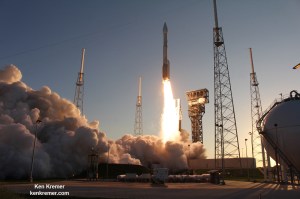
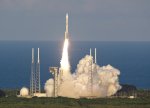
United Launch Alliance Atlas V rocket lifts off on Sept 8, 2016 from Space Launch Complex 41 at Cape Canaveral Air Force Station carrying NASA’s OSIRIS-REx spacecraft on the first U.S. mission to sample an asteroid.  Credit: Ken Kremer/kenkremer.com

United Launch Alliance Atlas V rocket lifts off on Sept 8, 2016 from Space Launch Complex 41 at Cape Canaveral Air Force Station carrying NASA’s OSIRIS-REx spacecraft on the first U.S. mission to sample an asteroid. Credit: Ken Kremer/kenkremer.com

Hordes of space enthusiasts from all across the globe descended on the Kennedy Space Center region to witness a once in a lifetime liftoff to the carbon rich asteroid – which could potentially bring back samples infused with the organic chemicals like amino acids that are the building blocks of life as we know it.

NASA’s Origins, Spectral Interpretation, Resource Identification, Security – Regolith Explorer (OSIRIS-REx) spacecraft departed Earth atop a United Launch Alliance Atlas V rocket under crystal clear skies on September 8 at 7:05 p.m. EDT from Space Launch Complex 41 at Cape Canaveral Air Force Station.

Everything went exactly according to plan for the daring mission bolding seeking to gather rocks and soil from Bennu – using an ingenious robotic arm named TAGSAM – and bring at least a 60-gram (2.1-ounce) sample back to Earth in 2023 for study by scientists using the world’s most advanced research instruments. The space rock measures about the size of a small mountain at about a third of a mile in diameter.

“We got everything just exactly perfect,” said Dante Lauretta, the principal investigator for OSIRIS-REx at the University of Arizona, at the post launch briefing at the Kennedy Space Center. “We hit all our milestone within seconds of predicts.
The ULA Atlas V rocket integrated with OSIRIS-Rex on top thundered off the Cape’s pad 41 and shot skyward straight up along an equatorial path into Florida’s sun drenched skies.

From every vantage point the rocket and its ever expanding vapor trail were visible for some 4 or 5 minutes or more. From my location on the roof of NASA’s Vehicle Assembly Building (VAB) the rocket finally arched over nearly straight above us and the sun produced a magnificent thin and nearly straight shadow of the vapor trail on the ground running out to the Atlantic Ocean towards Africa.

OSIRIS-REx separated as planned from the Atlas V rockets second stage to fly free at 8:04 p.m. on Sept. 8 – 55 minutes after launch. The pair of solar arrays deployed as planned to provide the probes life giving power. The spacecraft was built by prime contractor Lockheed.

Dr Dante Lauretta, principal investigator for OSIRIS-REx at the University of Arizona, Tucson, and Dr. Ken Kremer, Universe Today point to NASA’s OSIRIS-REx asteroid sampling spacecraft inside the Payloads Hazardous Servicing Facility at the Kennedy Space Center on Aug. 20, 2016.  Credit: Ken Kremer/kenkremer.com

Dr Dante Lauretta, principal investigator for OSIRIS-REx at the University of Arizona, Tucson, and Dr. Ken Kremer, Universe Today point to NASA’s OSIRIS-REx asteroid sampling spacecraft inside the Payloads Hazardous Servicing Facility at the Kennedy Space Center on Aug. 20, 2016. Credit: Ken Kremer/kenkremer.com

“The primary objective of the OSIRIS-Rex mission is to bring back pristine material from the surface of the carbonaceous asteroid Bennu, OSIRIS-Rex Principal Investigator Dante Lauretta told me in a prelaunch interview in the KSC cleanroom with the spacecraft as the probe was undergoing final preparations for shipment to the launch pad.

“We are interested in that material because it is a time capsule from the earliest stages of solar system formation. It records the very first material that formed from the earliest stages of solar system formation. And we are really interested in the evolution of carbon during that phase. Particularly the key prebiotic molecules like amino acids, nucleic acids, phosphates and sugars that build up. These are basically the biomolecules for all of life.”

After a two year flight through space, including an Earth swing by for a gravity assisted speed boost in 2017, OSIRIS-REx will reach Bennu in Fall 2018 to begin about 2 years of study in orbit to determine the physical and chemical properties of the asteroid in extremely high resolution.

While orbiting Bennu in 2018 it will move in close to explore the asteroid for about two years with its suite of science instruments, scanning in visible and infrared light. After a thorough site selection, it will move carefully towards the surface and extend the 11 foot long. TAGSAM will snatch pristine soil samples containing organic materials from the surface over just 3 to 5 seconds.

Watch my up close videos captured directly at the pad with the sights and sounds of the fury of launch.  https://youtu.be/04mLUFBBR7I

For complete details about ULA’s Orbital ATK Atlas/Cygnus launch see my recent articles and photos at Universe Today:
http://www.universetoday.com/127831/bound-for-bennu-osiris-rex-begins-trailblazing-asteroid-sampling-sortie-for-lifes-origins-sunset-launch-gallery/

Astronomy Outreach by Dr. Ken Kremer

Nov 2-4: “GOES-R launch and Curiosity on Mars.” Kennedy Space Center Quality Inn, Titusville, FL

Please contact Ken for more info, science outreach presentations and his space photos. Email: kremerken@yahoo.com   website: www.kenkremer.com http://www.universetoday.com/author/ken-kremer/ https://www.facebook.com/kremerken1

Posted in October 2016, Sidereal Times | Tagged , , | Leave a comment

Snippets

compiled by David Kaplan

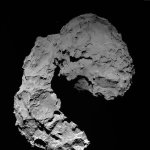
Comet 67P

Comet 67P. Credit: NYTimes

Rosetta Mission Ends With Spacecraft’s Dive Into Comet
Rosetta, the first spacecraft to orbit a comet, is dead, setting down in a final embrace with its companion of the past two years.

Radio signals from Rosetta flatlined at 7:19 a.m. Eastern after it did a soft belly-flop onto Comet 67P/Churyumov-Gerasimenko at a speed of two miles per hour, slower than the average walk… more

An artist’s rendering of the 30m Telescope. NYTimes

An artist’s rendering of the 30m Telescope. NYTimes

Under Hawaii’s Starriest Skies, a Fight Over Sacred Ground
MAUNA KEA, Hawaii — Little lives up here except whispering hopes and a little bug called Wekiu.

Three miles above the Pacific, you are above almost half the oxygen in Earth’s atmosphere and every step hurts. A few minutes in the sun will fry your skin… more

Jack Garman in 1968

Jack Garman in 1968. NYTimes

Jack Garman, Whose Judgment Call Saved Moon Landing, Dies at 72
On July 20, 1969, moments after mission control in Houston had given the Apollo 11 lunar module, Eagle, the O.K. to begin its descent to the moon, a yellow warning light flashed on the cockpit instrument panel… more

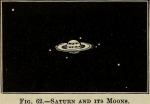
From the 1875 book Elements of Astronomy. (Photo: Internet Archive/Public Domain)

From the 1875 book Elements of Astronomy. (Photo: Internet Archive/Public Domain)

Space Art Propelled Scientific Exploration of the Cosmos—But Its Star is Fading Fast
In a serpentine building that snakes through the Connecticut countryside, a strange meeting took place this past July. A group of four scientists from NASA, including an astronaut, a robotics expert, and the agency’s deputy administrator, conferred with some 30 painters, sculptors and poets… more

Chesley Bonestell (Photo: Wikimedia)

Chesley Bonestell (Photo: Wikimedia)

Meet the Father of Modern Space Art
Twenty-five years before Neil Armstrong set foot on the lunar surface, Chesley Bonestell showed humanity a view from Saturn’s moon. The image was an astonishingly beautiful painting titled Saturn as seen from Titan… more

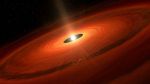
Young star TW Hydrae

Young star TW Hydrae

Star’s dust cloud gives birth to giant planet
Astronomers have discovered signs of a baby planet developing around another star… more

Posted in October 2016, Sidereal Times | Tagged , , , , | Leave a comment

Gene Ramsey

AAAP members share a deep sense of loss for the death on September 9, 2016 of our esteemed astronomer and friend, Gene Ramsey. Gene was AAAP’s long-time Observatory co-chair, one of our most expert observers, and a wizard at dreaming up and making gizmos and accessories to use with telescopes and mounts. He’ll be remembered for his love of astronomy and generosity with knowledge and experience which he freely shared with members and public, young and old alike. Gene deserves immense credit for the development and improvement of the AAAP’s Washington Crossing Observatory and our core group of observers known as Keyholders, many of whom Gene personally trained. His creativity and craftsmanship are evident in the various enhancements he made to the equipment at the observatory through the years. The enthusiasm he effused led to many remarkable nights under the stars for dozens of our members, and literally hundreds of kids and adults fortunate to share an evening with Gene. What a tremendous life he lived, full with meaning right to the end! His legacy will shine in the memories within AAAP each night we spend under the stars.

Posted in September 2016, Sidereal Times | Tagged | Leave a comment

From the Director

Rex


by Rex Parker, Director director@princetonastronomy.org

Return to Peyton Hall! Monthly meetings begin Sept 13 (7:30 pm). A very big THANK YOU to the University and Dept of Astrophysical Sciences for the opportunity to use Peyton Hall auditorium for our meetings again this year.

Astronomy at AAAP in the ‘Summer of Sixteen’. No lull in the action this summer! Exciting developments in and around the club included brushes with history, and new ways to expand member access to astronomy. Here are some of the important AAAP events of the summer:

  • Making history – 3 centuries of Mercury transits with the Hastings 6” refractor. On May 9 another Mercury transit of the sun was observed with this historic telescope – we now claim 3 transits over 3 centuries (1881, 1973, 2016), a unique attainment seemingly unmatched anywhere. Thanks to John Church, Bill Murray, Gene Ramsey, Larry Kane, Dave and Jenn Skitt, and others for making it happen. The Dec 2016 issue of Sky and Telescope will feature an article and photo about this historic achievement.
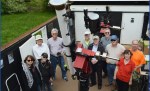
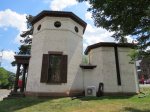
  • More history – 150 years of the Rutgers Schanck Observatory. Ten AAAP members attended a celebration hosted by the Rutgers Cap & Skull Society, unveiling the renovated Schanck Observatory on the Queens campus. The presentation included the heritage of the structure and restoration of the telescope, and noted that our 6” Hastings refractor once was in the Schanck (ca. 1904-1937) before the Galileo Club acquired it.
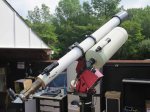
  • New Takahashi Mewlon 250 telescope at Washington Crossing Observatory. This very high quality instrument, a Dall-Kirkham Cassegrain reflector telescope with 3-meter focal length, excels at high resolution views of the planets, moon, and deep sky. I want to thank the telescope search committee: Bill Murray, Larry Kane, Jim Poinsett, Arshad Jilani, John Church, Jim McHenry, and Jeff Bernardis; and Ira Polans, Dave Skitt, Jennifer Skitt, Gene Ramsey, and Michael Mitrano also weighed in.
  • More upgrades at WC Observatory. Changes underway this summer include modernizing the computers and preparing for the jump to The SkyX software to control the two Paramount-ME’s. The Mallincam/5”refractor works better than ever with a new video monitor, and the latest Celestron-14 has performed notably better than the previous telescope, which was sold. We are planning to install Verizon FiOS and aim to have high speed internet access at Washington Crossing Observatory soon.
  • Fate of AAAP’s UACNJ Jenny Jump Observatory. After consideration of the issues and challenges around our observatory and equipment, the Board of Trustees on Aug 23 resolved to continue AAAP’s commitment to the United Astronomy Clubs of New Jersey Observatories at Jenny Jump State Forest. A proposal to repair the observatory and upgrade equipment is being developed, including a possible shared use and maintenance partnership with the north Jersey club, Amateur Astronomers Inc (AAI).

Jersey StarQuest (Oct 28-30). Once again we’ll be hosting the Jersey Starquest astronomy weekend at the end of Oct at the Hope Conference and Renewal Center http://camphope.org/. This is an observing-oriented event involving both Friday and Saturday nights at one of the best, relatively dark sky locations in the state. The Hope Center is located just north of I-80 a few miles north of Jenny Jump forest, and offers clean bunkhouse accommodations or camping on-site and a kitchen for cooking if desired. Restaurants are within a few minute drive. Even if you don’t own a telescope, here’s your chance to learn hands-on about astronomy and observing. To make it easier to participate, here’s how we’ll organize the event.

    • Walkin registration, no advance payment, no pre-registration needed. You can decide to attend at the last minute. We will ask that you send in a non-binding intent-to-participate form (to be distributed soon) to help estimate needs for the Hope Conference Center.
    • AAAP member oriented event, a chance to make friends in the club. You’re also welcome to invite family and friends who may not yet be members.
    • Reduced prices: the cost per night is $20 for adults and $10 for children (ages 6-12), regardless of choice of bunkhouse or tent/RV camping.
    • No meals will be provided by the club. You should bring your own food and plates etc. The Center’s kitchen will be available, and we may self-organize for carry-out food from local establishments. Hot and cold drinks will be available throughout the weekend.


Posted in September 2016, Sidereal Times | Tagged , | Leave a comment

Neutrinos: Their discovery, detection, and future prospects – September 13, 2016

By Ira Polans, Program Chair

Dr. Jia Liu

Dr. Jia Liu

The first talk of the 2016-2017 season is on September 13 at 7:30PM in Peyton Hall on the Princeton University campus. The talk is on “Neutrinos: Their discovery, detection, and future prospects” by Princeton University Postdoctoral Fellow Dr. Jia Liu.

Dr. Liu’s work currently focuses on weak lensing non-Gaussian statistics, using N-body ray tracing simulations as a tool to study the large scale structure of our universe. The ultimate goal of this work is to understand the nature of dark energy, the total mass of neutrinos, and other cosmological parameters.

Dr. Liu also spends time observing AGNs at optical telescopes, hoping to find super-massive black-hole binaries!

Prior to the September meeting there will be a meet the speaker dinner held at Winberies, Palmer Square in Princeton at 6PM. If you wish to join please email program@princetonastronomy.org no later than noon on September 13.

Please come and join us for what will be an informative and interesting talk!

Posted in Mid-summer 2016, Sidereal Times | Tagged , , | Leave a comment

From the Assistant Director

by Larry Kane

After a discussion with Director Rex Parker, he and I concluded that we want to invite our membership to a relaxed evening at the Gravity Hill Farm in Titusville. While much has to be planned and confirmed, we are working on putting together an evening of relaxation, pizza, beverages and star gazing with the membership of the Washington Crossing Park Association (WCPA). This will be an event sponsored by the Boards of Directors of both organizations as a thank you to their members. We hope that, we can form a strong union with the WCPA as a way of showing our support for an organization working for the maintenance and betterment of the park that houses our observatory.

Our initial thoughts are to have a “Membership Night Out” in early November.   It is our hope that this pleasant, free of charge, evening of pizza under the stars will become an annual event. It will be a benefit of membership provided to those belonging to each of our organizations. This event will be able to solidify a mutual imperative for all of us, the preservation and improvement of our park.

So start thinking of a weekend evening in the first or second week of November. Think of it as a reward being granted to you as a member of an organization that seeks to be worthy of your support. Stay tuned for more information as things develop.

Posted in September 2016, Sidereal Times | Tagged , | Leave a comment

Conjunction of Venus and Jupiter

By Gene Allen

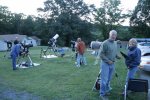
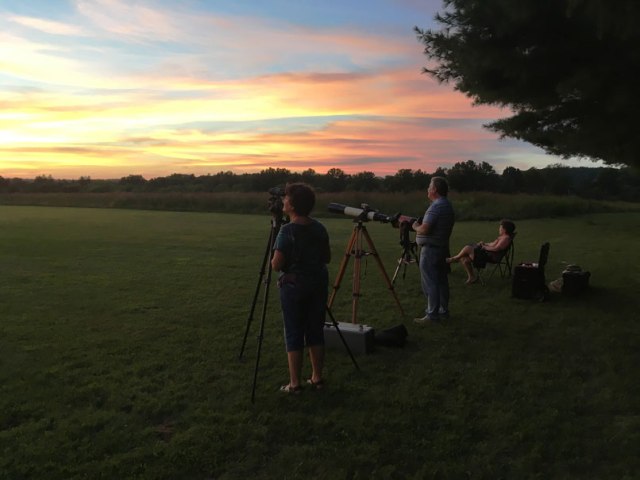
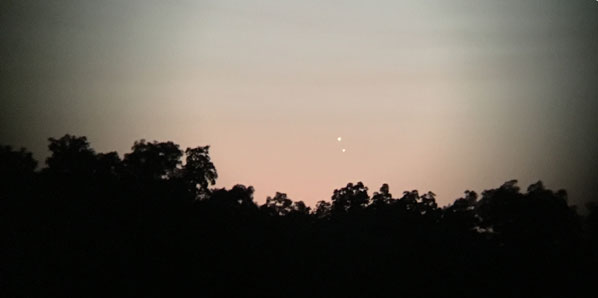
Two couples responded to Bill Murray’s invitation to join him on the soccer fields to try to observe the conjunction of Venus and Jupiter on August 27. When Gene and Seraphine Allen arrived with tripod-mounted binoculars, Bill’s refractor and Dave and Jen Skitt’s SCT were already set up and pointed at Venus. The sun sank below the horizon, and Venus became visible without assistance. As the twilight deepened, we sampled each other’s optics, and both Venus and Jupiter became lovely targets. We even managed an iPhone snapshot through one lens of the little binoculars. It was a simple and fun evening. Thank you, Bill, for inspiring us to try!

Seraphine Allen, Bill Murray and Jen Skitt waiting for a darker sky. Credit: Gene Allen

Seraphine Allen, Bill Murray and Jen Skitt waiting for a darker sky. Credit: Gene Allen


Venus-Jupiter using iPhone SE camera through one eyepiece

Venus-Jupiter using iPhone SE camera through one eyepiece
of Nikon Monarch 7 10×42 binoculars. Credit: Gene Allen

Posted in September 2016, Sidereal Times | Tagged , | Leave a comment

Juno, the wife of Jupiter

By Prasad Ganti

NASA’s Juno spacecraft traveled for five years before reaching Jupiter on July 4, 2016. It will orbit around for 20 months studying Jupiter’s atmosphere before crashing into it. The last spacecraft to visit and study Jupiter was Galileo.

Jupiter, named after the King of Gods in Roman mythology, is the fifth planet from the Sun and the first gas giant. There is supposedly very little core or “land” inside its thick atmosphere. Juno in Roman mythology is Jupiter’s wife. The spacecraft Juno was travelling to meet her husband!

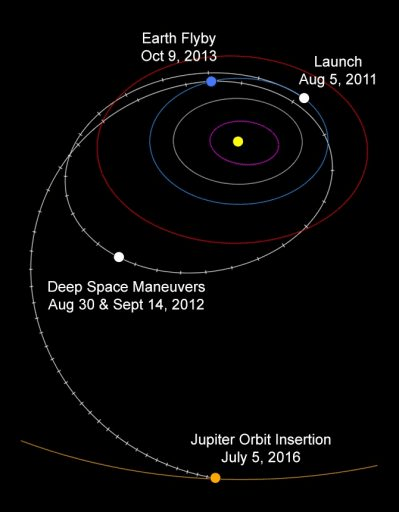
Like any space trajectory, the spacecraft does not travel in straight line from Earth to Jupiter partly because both the planets are moving all the time. The launch platform as well as destination are moving at the same time. A circular trajectory is the most most natural one in space. When launched in 2011, Juno was put into an orbit around the Sun. In 2012, deep space maneuvers, by firing the thrusters, brought it closer to the Earth again. In 2013, it received gravity assist from Earth and was flung towards Jupiter. This maneuver is difficult to imagine but it is like the action of a slingshot. The picture of the trajectory is shown below. Courtesy NASA.

Path of Juno from Earth to Jupiter.

Path of Juno from Earth to Jupiter.

Juno is armed with 3 solar sails on its outward journey. The sails provide power for propulsion as well as the contained electronic instruments. It was also spinning as it sped along. The spinning allows for more stability and orientation. As massive as the planet is, next to the sun, it is the largest body in our solar system. Although it consists mostly of gas, it has an intense gravitational field. Understandably so because huge masses have surrounding gravitational fields of more intensity. The gravitational field is enough to support a structure of about seventy moons, the most significant and largest of which are the Galileans – Ganymede, Europa, Io, and Callisto. Along with its mighty gravity, it also has a very strong magnetic field presumably due to the metallic hydrogen it harbors. Metallic hydrogen is the liquid form of hydrogen which exists under the intense pressure of Jupiter’s atmosphere. It does not exist anywhere on Earth, but has been produced only in laboratories under extreme pressure and temperature for a tiny fraction of a second.

Juno’s mission is to map out Jupiter’s gravitational and magnetic fields. Additionally, it will try to find more about the interior structure of the gas giant. Its findings might reveal if the planet has a rocky core or none at all. There is a great red spot on the planet which is supposed to be a storm raging for more than a thousand years. Juno will try to ascertain its depth.

All the electronic equipment aboard the spacecraft is enclosed in a Titanium vault to shield it from the intense radiation. In addition to the data from the sensors, the JunoCam will also send back close up pictures of the planet.

The famous science fiction writer Arthur C. Clarke has speculated that there is an Earth sized diamond in the middle of Jupiter’s core. Is it really there ? Is it just metallic hydrogen ? Well, hopefully, Juno will provide the answers !

Posted in September 2016, Sidereal Times | Tagged , | Leave a comment

Snippets

compiled by David Kaplan

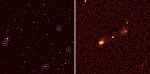
Unknown galaxies. Photo: NYTimes

Unknown galaxies. Photo: NYTimes

South African Telescope Spots 1,300 Unknown Galaxies.
A patch of sky about as big as the full moon where the MeerKAT telescope discerned the radio glow of about 200 galaxies. Only a few (circled) had been previously observed; Right: A distant galaxy with an explosive core powered by a black hole.

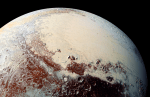
Pluto’s “heart” Photo: NYTimes

What We’ve Learned About Pluto
In the year since NASA’s New Horizons spacecraft flew by Pluto, the dwarf planet has maintained its icy heart. But closer analysis of the trove of data collected by the space probe reveals intriguing clues to other possible features.

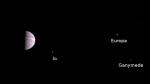
 Juno probe returns photo. Credit: BBC

Juno probe returns photo. Credit: BBC

Juno probe returns first in-orbit Jupiter photo
The American space agency’s new Juno mission to Jupiter has returned its first imagery since going into orbit around the gas giant last week.

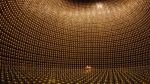
Inside the Super-Kamiokande detector in Japan

Inside the Japanese Super-Kamiokande detector

Flavor changing neutrinos give insight into Big Bang
The question of why are we here perhaps means different things to different people, but in the field of particle physics it is a question that we may be close to finding an answer to.

Dwarf Planet, the Latest of Many

Dwarf Planet, the Latest of Many. Photo: NYTimes

Astronomers Discover New Likely Dwarf Planet, the Latest of Many
The neighborhood beyond Neptune is becoming ever more crowded, with astronomers announcing this week the discovery of another likely dwarf planet.

Black hole 'feasting'. Photo: BBC

Black hole ‘feasting’. Photo: BBC

Cardiff University astronomers observe black hole ‘feasting’
Astronomers at Cardiff University have observed a supermassive black hole preparing to “feast” in a galaxy one billion light years from Earth.

Low-cost satellites to Moon's orbit. Photo: BBC

Low-cost satellites to orbit Moon. Photo: BBC

British partnership to send low-cost satellites to Moon’s orbit
A British partnership has announced plans for low-cost lunar missions and space exploration. Goonhilly Earth Station in Cornwall and Surrey Satellite Technology Ltd plan to send a “mother ship” to transport satellites beyond Earth’s orbit.

It is being called a “new model of low-cost, high-value, space exploration”.

Juno mission

Juno mission. Photo: BBC

What would it be like to fall into Jupiter?
What would it be like to fall through Jupiter’s many gaseous layers? And what is at the center of the planet? Is there a solid core?

Osiris-Rex launch

Osiris-Rex launch

NASA Launches Osiris-Rex Spacecraft to Retrieve Asteroid Pieces
The craft is set to return to Earth in seven years with bits of a nearby asteroid that would give scientists a window on some of the material that made up the early solar system.

Posted in September 2016, Sidereal Times | Tagged , | Leave a comment

From the Director

Rex


by Rex Parker, Director

New Telescope for the Observatory. After the vote at the June meeting the new telescope acquisition proposal was approved by the membership (34 “yes” votes). For the record, the previously stated need for a 40% quorum was outdated (my mistake); current by-laws require “majority of the votes cast and not less than 30% of membership”. A big thanks to several members who volunteered to serve on the telescope search and selection committee: Bill Murray, Larry Kane, Jim Poinsett, Arshad Jilani, John Church, Jim McHenry, and Jeff Bernardis; Ira Polans, Dave Skitt, Jennifer Skitt, Gene Ramsey, and Michael Mitrano also weighed in. A telescope interest survey in late June elicited 35 member responses and helped sort out priorities. The selection committee reviewed many options and through four teleconferences the following candidates were considered:

     • 16-22” f/5 Dobsonian Newtonian, tabled the idea for future consideration.
      • Parallax 14” f/7 Newtonian, decided against due to ergonomics of eyepiece position.
      • 6” TMB apochromatic refractor, decided against due to similarity to Hastings 6”.
      • TEC 8” f/20 Maksutov Cassegrain, decided against due to smaller aperture.
      • Luton Optics 10” f/20 Maksutov-Cassegrain.
      • TEC 10” f/20 Maksutov Cassegrain.
      • Takahashi Mewlon 250 10” f/12 Dall-Kirkham Cassegrain.

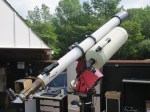
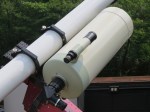
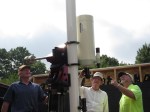
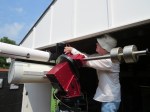
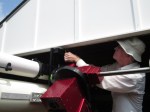
In the end the decision came down to the Cassegrain designs, and the Takahashi Mewlon 250 was selected. This very high quality instrument has a 3-meter focal length and excels with high resolution and very good contrast. The outstanding optical quality of the Mewlon mirrors and the Dall-Kirkham Cassegrain design are especially well suited for planetary/lunar observing, but the scope is also very capable with deep sky celestial objects as well. There are several reviews on the internet available, such as the Cloudy Nights forum, which help to understand just how special this telescope is. The telescope, Feathertouch focuser, and mounting hardware were received in late July. On July 30, Gene Ramsey, Tom Swords, and I mounted the Mewlon onto the Paramount ME alongside the Hastings refractor. Some pictures are below and more are posted on the website. Let’s have some good member turnouts at the Observatory this Aug and Sept to try out the new telescope.


Takahashi Mewlon 250 acquired by AAAP mounted on the Paramount ME alongside the historic Hastings refractor at the Observatory Jul 30. Working on the scope are Gene Ramsey, Tom Swords, and Rex Parker.

Posted in Mid-summer 2016, Sidereal Times | Tagged , , | Leave a comment