AAAP member Tom Swords, in consultation with John Church and with my assistance, is currently working to improve the connection of the focuser for the Hastings-Byrne refractor to the tube assembly. We have become aware that the focuser attachment screws would loosen over time, allowing the heavy focuser to wobble. While the views through this F/15 refractor are still wonderful and a de-focused star test shows no noticeable distortion of the airy disk, misalignment of the focuser to the optical path is typically not considered ideal. We believe our efforts will not only correct the attachment issue, but also improve the optical alignment and future ability to collimate the telescope.
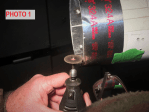
The first task, after removing the focuser, was to square up the end of the steel tube. As John recounted, he and Gene Ramsey were reluctantly forced to shorten the tube when the original, worn out, focuser was replaced with the current one some years ago. In the process of shortening the tube, a slight deviation in the cut was inadvertently introduced. Tom and I identified the deviation and Tom gingerly removed the protruding metal with a small grinding wheel (Photo 1).
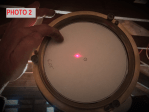
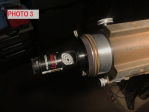
The preliminary result has been to move the optical center of the focuser closer to the center of the lens cell. In Photo 2, Tom’s finger is pointing to where the center point was falling prior to squaring, and the red laser dot is where it is now pointing with the focuser only temporarily attached in the newly squared tube (Photo 3). Further refinements, described below, will likely bring the final alignment even closer to the true center of the lens cell.
Since the historic steel tube is known to have a very slight taper from front to back, a small gap was likely introduced between the new focuser’s outer diameter and the tube’s inner diameter when the tube was shortened. Tom is currently in the process of experimenting with shim material of different sorts, widths and attachment methods to find the best match to remove the wobble the focuser was experiencing. After temporary placement for final adjustments, the existing holes in the focuser will be drilled and tapped for larger screws with increased gripping surfaces.
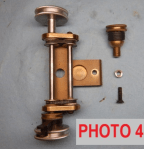
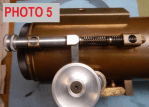
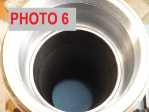
While the cold weather has delayed further work on the project at the observatory, Tom has used the time while the focuser has been in his shop to perform some additional maintenance. Photos 4 shows the freshly cleaned and polished coarse focus rollers and new rubber tension spring washers. Photo 5 shows the freshly cleaned and lubricated fine focus assembly. And finally, Photo 6 shows the freshly painted interior surface of the drawtube.
We hope to have the Hasting-Byrne refractor back in operable condition in the next few weeks. If you have any questions or comments about our work, please feel free to reach out to Tom, John or myself.
No, we haven’t changed the sex of our favored Gemini twins. This title has been haunting my mind, for a few days now.
The Father of Advertising, David Mackenzie Ogilvy bombards my mind with memories of past reads. Among more discrete topics, Ogilvy wrote that sex sells. Well, only that is, if the subject is relevant to that which you are selling.
I could have tried to sell you snake oil, however Draco isn’t in my eyepiece at the moment. And snake oil, I presume isn’t too tasty. Nasty stuff. Very few repeat customers. Hence the title. No snakes, just bare naked ladies.
Oh how, just how do we save the title and write a smidgen of Astronomical significance?
Ah-Ha! Join me on a short journey, where we shove off to a near death experience. Or rather, a Near Earth Object (NEO) that was categorized as potentially hazardous. That’s WordSpeak for ye old end of days. A story, charred down to the boney essentials and filled with magnitude and parallax. Starring of course, a bare naked comet, better known now-a-days as Asteroid 3200 Phaethon.
Phew. The essay that follows is shorter than that intro. Thank the heavens!
I was sitting on the couch a few weeks back, lamenting the clouds that precluded us from enjoying the marvels of the yearly Geminid meteor shower. Yes, a few days had passed. But I hang onto my lamentations. They become the core excuse for not hauling out my 12 inch dob, into the backyard on the least stable viewing nights. Then some smart bloke wrote about the Ursids. Some consolation, I thought! As a newcomer to amateur astronomy, I was pretty certain that Ursid would not be the bees knees, and leave me sulking for another 12 months while waiting for next years Geminids.
Let’s take this back to the couch, again. Perfecting the art of couch potato, remote in hand, my hind brain motions to battle with my forebrain. And won. Out popped a reminder that this evening 3200 Phaethon, a NEO, was an able and willing target. A quick check on regional weather ( that’s fancy astro-speak for looking out the window ) showed the promise of a clear night. Of course, a promise of a clear, stable atmosphere to an amateur astronomer almost always leads to broken promises, and cloudy nights. A sheen of clouds rolled in with hardly any notice. Leaving me to whimper. sigh. Cloudy sky. What to do?
Some of you are aware that I have been cultivating data on the variable star Algol, from minimum to minimum. This continues to be an ongoing project, with 39 out of 69 data points still required to be filled. I’ve been requesting telescope time on those evenings, where and when I can fill the gaps in my data. The two scopes that have been successfully tasked are the fourteen and seventeen inch telescopes at the Dark Sky Observatory (DSO), located in North Carolina. A quick check of my spreadsheet, shows that I have imaged Algol, during 10 (minimum to minimum) sessions, since November 16th, on both DSO-14, and DSO-17. Being fond of the more diffuse star light results of DSO-14, I decided to capture Phaethon, status quo.
Based upon previous observational success with a smaller 28 meter asteroid, J2012 TC4, I cast my line out to 3200 Asteroid Phaethon. I bait my hook with a 10 minute interval, 4 seconds exposure, for 60 images. The proverbial float on the water bobbed up and down. Asteroid on the hook – I cautiously check the first 8 images. Viewing them in quick succession I quickly established that the asteroid was moving out of frame. This was moving much too quickly to produce a viable video. I cancelled the remainder of my Skynet observation. I resubmitted anew at 30 second intervals. Voilà.
Asteroid Phaethon is the remnant of a comet that produced the Geminid’s. Kevin D. Conod, writing for The Star-Ledger composes his article, “N.J. Night Sky: Shooting stars from an asteroid” (updated Dec 9; Posted Dec 9) and can be read here: https://goo.gl/7b5YtK Conod writes briefly to remind us that the Geminid’s parent is Phaethon.
And this now lays a foundation of future thought, for this amateur, that I should pay more attention to asteroids that pass thru other cometary debris fields. And pay homage to the bare naked ladies – those asteroids stripped of their cometary nebulosity and consider them as the source of my yearly visual delights – our dazzling meteorite showers.
Here is the final video of Asteroid 3200 Phaethon:
Some final thoughts and thank you’s. There was a technical error in my first video, where I confused apparent magnitude with absolute magnitude. The error occurred to me after reading a critique by Joe Stieber, a fellow member of UACNJ. I am equally gracious for our AAAP Club President, Rex Parker, taking the time out to vet the video, and make recommendations that were equally helpful. And a shout out to our Observatory Chair, for an early distribution of the asteroid video. And for discovering at a late hour, a broken link on YouTube. Fortunately, the only sacrifice was the 230 or so, original views on the first two published movies. The current count is now 30, views and that can grow, going forward.
Below you will find some of my commentary, on some of the quirks of remotely imaging NEOs as I reached out to Joe, by way of UACNJ posts:
The creator may be in the structure, but the devil is still in the details!
Thank you, for refocusing me – on Asteroid Phaethon.
I rechecked the ephemeris data with the NASA Horizons web interface. I plugged in the longitude and latitude of the DSO-14 telescope location. And the AP Magnitude comes back at 11.8, across the board.
My photometric tool must be measuring “absolute magnitude” and not apparent magnitude.
Stellarium displays an absolute magnitude of 14.60 for this asteroid.
So, the data I measured, as an overall average of 13.94, isn’t too far off the mark for an amateur.
I must make an effort to be clear on “absolute” measurements, versus “apparent”.
After this email, I will make the necessary correction to the video’s text.
I set the telescope exposure time for 4 seconds, at 30 second intervals. So the 60 frames should represent about a half an hour.
However, DSO-14 is a shared resource, and I have lower priority. The reality in time management pushed this to an hour observation, over-all.
As for the “jumps” in magnitude – they are as recorded, and I rechecked four frames. A closer examination might show that lower numbers corresponds to stars being in the field of view. Or not. This will have to wait until I have much more time for evaluation, and a second pot of coffee! (side note to self – use the small mug!)
On the face of it, however – the data is real, and my opinion based upon the data is that the asteroid is not a uniform object for reflectivity.
As for the “orientation” part of the video – showing the asteroid in the vicinity of Pegasus, I rechecked with Stellarium and I am still in the ballpark, so to speak.
When I plugged in the long/lat for the telescope, incorporated my start time, and date and looked for Pegasus – I found the asteroid where I expected it to be.
If there is a discrepancy, it probably comes down to parallax. When observing near earth objects, recording the origin of the telescope is paramount, to getting correct on screen observations.
DSO-14 is located at:
36.253 Latitude
-81.415 Longitude ( or 81.415 W )
The time of the first image taken was on:
December 17, 2017 02;08:12 UTC, which is December 16th, 2017 21:08:12 EST.
I was going to scribe out the date-time groups, however, for brevity sake, I’ll list the first and last data points.
The date-times are UTC.
Happy New Year, and Clear Skies for All !
I bring you tidings of a final essay, as I have spent all of my Shekels from 2017. And have no coin left for another asteroid. I probably have done as much as I can, given the precious tools that were lent to me, by educators, and club members alike.
While researching Elf on a Shelf, I stumbled across Mench on a Bench. I knew it. I should have bought one. Or maybe, I should never have touched the elf. I heard that if you do so, the magic just runs out of ‘em. Or as Bugs Bunny once said to Daffy Duck, “hey doc,No more buwwets?”
I took a keen interest in a website that manages data, by way of a NASA grant, on minor planets. Asteroids, I have learned, are sometimes referred to as minor planets. So full of ego, was I, to continue to read that a recently captured asteroid, temporarily labeled YY897E1, was observed in the deep of space on not less than four occasions. And was rated at 100% desirable for more data. I took the bait. Yes I was hooked, and knew that I would tire on the line. The magnitude, you see, as at 21.6 v. And I had my doubts that I could find an object that faint.
I broke down the NEO confirmation data into four blocks, of 10 minutes each. And asked for 4 seconds exposure 30 second interval images. Not enough bullets, for ‘ol Bugs. The stellar limiting magnitude, if memory serves me correctly, cut out at around 17. To add mischief to miscalculation, the telescope release times were delayed, and did not match my ephemeris data. I, as Mr. Hopeful (a tip of the hat to one my indoor cats, that is Ms. Hopeful, aka Big Pussycat, aka Maybell – around dinnertime) did spy upon three potential variances in the image cache. A pot of coffee later, and with Digital Sloan Survey in hand, two of the hopefuls were stars – and the remaining minor trailing spark of hope was written off as a high speed energetic particle of other worldly origin. (Ok – maybe it was just from our stratosphere. sigh.).
Last man standing with a few coins in hand, I turn my attention to a list of asteroids for 2018 that would make good mention. And fell in love with 1362 Griqua. Wiki records her as 28 kilometers across. That is 1,000 times the diameter of J2012 TC4, imaged back in the day, when I was drunken with Skynet currency. I had my marching orders, now.
After experiencing the elusiveness of YY897E1, imagine my glee, when Griqua lit up my screen! How would I present this object? Well, two ways of course! Once as static, Griqua smiling back to you at center of screen, while the surrounding stars flew by. And once again, as Griqua sailed thru the night sky, leaving her starlets, motionless in awe.
And then I saw the discrepancy. There was an unintended time delay between image 0 and image 1, of 24 minutes, plus some. Not the two minute interval I had hoped for. I asked the Mench for help, but he simply sat there, on the bench, with nothing to say. What could I do ? Of course, ask the Elf to speak to Mr. Claus, on my behalf! However the Elf was out of magic, and her lines of communication had been cut. No direct line to Santa. Beans!
How much wood can a woodchuck, chuck ? is my euphemism for how fast does an asteroid travel thru space? I couldn’t quite wrap my noodle around ideal calculations with J2012 TC4, or 3200 Phaethon (recently imaged) for linear velocity. However, NASA had already calculated the diameter of Griqua at 28 km, and I knew the time frame from which I took pictures. Teeming with errors, I decided to not use Julian calculations (which report down to fractions of a second) and used vernacular minutes and seconds to limit precision within the boundaries of acceptable error.
Measuring the diameter of each asteroid in frame, I arrive at 8 pixels, rounded due to errors in measurement. So, 28 km = 8 pixels. Taking my time, I arrive at the following:
I have recorded 26.13 pixels from one asteroid location (image 1), to the “last” (image 7), over 765 seconds. Griqua is 8 pixels across, in my image. 26.13 / 8 = 3.266 Griqua units.
28 km * 3.266 = 91.5 km
91.5 km / 765 seconds = 430 km/hr
Now, back to my woodchuck:
There was a jump in imaging between my first and second frame resulting in:
1,445 seconds elapsed between a distance of 48.88 pixel distance (center to center).
48.88 / 8 = 6.11 Griqua units.
6.11 * 28km = 171 km
171 km / 1,445 s = 426 km / hr
Griqua, it would seem, and of course, only at first blush, travels around 430 km per hour. Prepare yourself as the mensch on the bench, just established a toe-hold in the boundless world about the elvish kindred, by virtue of chucking wood at the void. At 430 km / hr, that’s some pretty fast wood.
For the linear velocity portion of the video skip ahead to time frame 2.25. For telescope exposure/filter times click here.
The book “The Perfect Machine” is written by Ronald Florence. A fascinating book about the design and construction of the 200 inch telescope at Mount Palomar during the years leading up to the second world war and its immediate aftermath. George Hale, known for his research in solar astronomy, championed the telescope right from the proposal stage all the way into the advanced construction of mirror and the mounts. He died just before its completion. New York Times urged that the telescope be named in his honor.
George Hale was known for his earlier efforts to build the big telescopes for the Yerkes and Mount Wilson observatories. The 200 inch at Mount Palomar was a logical successor to the 100 inch at Mount Wilson which Hale had built. Hale also had other impressive credentials, as a co-founder of Caltech, an officer of the National Academy of Sciences and the National Research Council, and the founder of Journals of Astrophysics. Hale conceived of the design, sold it to the scientific community and other stakeholders at large and got the funds needed to support the project. Lot of detail was written about the casting of the huge mirror. It really stretched the technology envelope of those times. GE first started off the mirror work with fused quartz. Fused quartz had such a low coefficient of expansion, that it would be far more efficient to grind and polish than plate glass. GE ran into trouble using this new material. Corning was assigned the task of casting the mirror. They used Pyrex which is basically borosilicate glass with extremely low coefficient of expansion. It required heating to very high temperatures. And then cooling in a very slow and controlled manner, called annealing, taking months to do so. The tolerances for the cast were very tight. Any imperfection leads to discarding the mirror disk and starting all over again. There were several attempts before the mirror could be finally cast.
Once the mirror disk was ready, it was shipped in a special freight train from Corning factory in New York across the country to Caltech in Southern California. Caltech had an optics and machine shop for grinding and polishing the mirror to its final shape. The train became a spectacle. People lined up all along its route to catch a glimpse. Several trains had to be held up or rerouted to provide clear tracks for the train with this special cargo.
At Caltech, the laborious work of grinding and polishing the mirror and fabricating the mount took several years interspersed by World War II. An equatorial mount was designed with a yoke holding the mirror and the yoke itself moving on a horseshoe bearing. There were three big motors to guide the telescope precisely. One for declining axis, tipping the telescope to be in the great yoke. One right ascension gear was for slewing the telescope, moving at relatively high speed when the observer wanted to point the instrument at new area of the sky. The third gear was for the slow-moving drive that would keep the telescope moving synchronously with the motion of the earth.
The mirror and the mount had to be transported on a huge trailer along a carefully selected route. New roads were laid to the top of Mount Palomar in San Diego county. The assembly of the mirror and the mount within the dome was an extraordinary engineering feat by itself. When it opened in late 1940s, it was the biggest telescope in the world and was to be for decades to come.
Overall, the project was a gigantic engineering marvel, no lesser than the Manhattan project or the construction of the Hoover dam. A grand intersection of physics and engineering. To this day, the Hale telescope holds its own against the newer ones with larger segmented mirrors and the simpler alt-azimuth mounts controlled by sophisticated computers.
Hurricane-battered Arecibo telescope will keep studying the skies
After years of financial uncertainty and weeks of hardship caused by Hurricane Maria, staff at the legendary Arecibo Observatory in Puerto Rico were relieved to find out Thursday that their telescope will remain operational…more
Largest Planetarium in the Western Hemisphere – NYT
Planetarium Opens in New Jersey
Bigger is better when it comes to planetariums — a bigger dome to make the audience ooh and ahh, more pixels to make the stars and planets sharper, more colors to make them more realistic, more windows on intriguing but distant nebulas, more images of Earth as a shimmering jewel against the dark drape of space…more
The great Red Spot – NYT
The Great Red Spot Descends Deep Into Jupiter
Jupiter’s Great Red Spot is not just a skin-deep beauty mark. Instead, the iconic storm descends at least 200 miles beneath the clouds and possibly much deeper. That is one of the latest findings of NASA’s Juno spacecraft…more
Kepler 90 and its planets
An 8th Planet Is Found Orbiting a Distant Star, With A.I.’s Help
With eight planets whirling around its sun, our solar system has held the galactic title for having the most known planets of any star system in the Milky Way.
But on Thursday NASA announced the discovery of a new exoplanet orbiting a distant star some 2,500 light years away from here…more
Cassini photo – NYT
Back to Saturn? Five Missions Proposed to Follow Cassini
For 13 years, NASA’s Cassini spacecraft sent back captivating observations of Saturn, and its rings and moons, solving some mysteries but raising plenty of new questions. With the spacecraft’s demise on Friday, the stream of data from Saturn has dried up…more
Asteroid Oumuamua – BBC
Interstellar object may hold ‘alien’ water
The first known interstellar asteroid may hold water from another star system in its interior, according to a study. Discovered on 19 October, the object’s speed and trajectory strongly suggested it originated beyond our Solar System. The body showed no signs of “outgassing” as it approached the Sun, strengthening the idea that it held little if any water-ice…more
Quasars, brightest of the bright – BBC
Farthest monster black hole found
Astronomers have discovered the most distant “supermassive” black hole known to science.
The matter-munching sinkhole is a whopping 13 billion light-years away, so far that we see it as it was a mere 690 million years after the Big Bang…more
Prof. Hawking’s Lecture -BBC
Prof Stephen Hawking’s illustrated black hole lecture
Prof Stephen Hawking is delivering the BBC’s 2016 Reith Lectures on the topic of black holes.
In this second lecture, while Prof Hawking examines and challenges scientific thinking about black holes, the artist Andrew Park draws the key points of the lecture in chalk on a blackboard…more
SpaceX Falcon Heavy – Verge
Mission Heavy 2018
Next year is already overflowing with exciting missions to space. NASA is launching a new lander to Mars, as well as a spacecraft that will get closer to the Sun than ever before. And two of NASA’s vehicles already in space will finally arrive at their intended targets…more
So Many Reasons to Keep Looking Up. As the year 2017 winds down and the holiday spirit ascends, we can all share some satisfaction at an exciting event-filled year in our organization. I want to convey my deep appreciation for the efforts of our Officers, observatory Keyholders, and indeed all members of AAAP. This has been a year of progress on longer term goals, even as we enjoyed the opportunities right in front of us. Together we improved our observatory technology, provided remote astrophotography learning opportunities to members, had an amazing solar eclipse experience, shared several hands-on astro observing events, and experienced fascinating astronomy presentations. Attendance has been strong at Peyton Hall and membership is increasing. These are all hopeful signs of a vibrant organization looking upwards.
My destination this December is far away from Princeton, as my wife and I are travelling to the Orient for a few weeks of adventure. If all goes well I will see you at the January meeting in Peyton Hall. Meanwhile I hope you will turn out for the December 12 meeting as we have a great speaker program planned. Refer to the article by Program Chair Ira Polans in this issue.
The December AAAP meeting will be held on the 12th at 7:30PM in Peyton Hall on the Princeton University campus. The talk is by AAAP member William Murray on “The Life and Legacy of Charles Messier”.
Bill’s talk is an examination of the life of the famed 18th century French astronomer Charles Messier and a look at how his work 200 years ago affects amateur astronomers today. Charles Messier is best known today for his catalog of 110 “Messier objects”. The purpose of the catalog was to help astronomical observers, in particular comet hunters, distinguish between permanent and transient objects in the night sky. These objects turn out to be some of the best nighttime objects to introduce the public to.
We are still looking for volunteers to give a 10 minute talk at future club meeting. If interested, please contact me at program@princetonastronomy.org. Please let me know the topic and your availability.
There will not be a meet-the-speaker dinner prior to the club meeting.
We look forward to seeing you at the December meeting!
After the presentation and the break Rex called the meeting to order.
Rex talked about light pollution and how LED lights blue shift and cause problems for viewing and astrophotography. He stressed the need to influence local authorities to use phosphor converted LEDs.
He also talked about how the spectra of light reflecting off the atmosphere of extra-solar planets is being analyzed for signs of life.
The subject of an interactive calendar for the website to sign up for outreach events was discussed. No current solution was known, additional research is needed.
How to make it clearer for visitors to our website to request an outreach event was brought up. Several suggestions were made .
The possibility of moving our website to a new hosting company was discussed. The possibility of getting increased space with our current hosting company is also a possibility. A report will be made at the next meeting.
As of the meeting date the observatory was not winterized and is fully operational.
Minutes of the November 2017 Board Meeting of the AAAP
The meeting was called to order at 7:30
The first topic of the evening was about making the outreach chairperson and observatory chairperson positions members of the Board of Directors. The only negative brought up was the occasional difficulty of obtaining nominees for some of the board position. The main positive aspect was it would emphasize the importance of these positions. The board voted unanimously to put the amendment to a vote by the members. The members will be notified and the voting will take place after the first of the year.
Membership dues are now payable through PayPal.
The club policy on speaker expenses was brought up and it was decided that there does not exist a policy, expenses are handled on a case by case basis. It was decided to leave it that way.
It was decided to add a 10 minute presentation by a member at the beginning of each meeting. Volunteers are wanted and encouraged to speak up.
The SkyNet astrophotography program is continuing. Currently 23 members have signed up for accounts and 9 have used minutes.
Observatory topics were covered next
There are several pieces of equipment at the observatory that are not being used, SBIG ST-10 CCD camera, Optec TCF autofocuser and an Optec IFW auto filter wheel. Since no one has used this equipment is several years the board has decided to sell it.
The current Mallincam is a low resolution, NTSC analog camera. Possible replacements and costs will be presented at the next meeting.
The need for gravel on the observatory driveway. A proposal will be prepared for the next meeting.
There are some focusing issues on the Hastings and Mewlon scopes. The tapered end of the focuser on the Hastings is causing problems, it needs to be squared. Tom and John have offered to do the work to repair it.
The possibility of the Mewlon needing collimation was discussed, the procedure has been found. The possibility of thermal issues causing focusing problems was discussed. Procedures to lessen the thermal issues will be tried before doing a collimation.
The need to update and improve the alarm and security system at the observatory was discussed. Since we have internet access the board decided it would be appropriate to buy a system rather than pay a monthly fee to a monitoring service. Dave will put together a list of options.
A membership coordinator position was proposed. While the need to attract new and younger members was acknowledged it was decided not to create another position.
The board discussed buying an EAA telescope for outreach purposes. More research needs to be done before a decision will be made.
I am new to Skynet and am trying to get started. I have watched the videos but am confused on a couple things and would appreciate any advice.
For my first photo, I am trying to photograph M101. Since these dimmer objects have a longer exposure time and use up credits quickly, I’d like to get this first shot right.
Here are my questions: 1) Filters. In the video, the lady drags in a separate screen from out of nowhere that gives more details about which filter is recommended for her demo shot on Saturn. I can’t find this “recommendation” screen anywhere, so my questions are: where is the screen located? Do you have a recommendation on your own experience for a filter for galaxies (M101 magnitude 7.86) ?
2) Exposure Time. I see in the video that there is a recommended maximum exposure time. For M101 it is 120 with HiLum filter. When you take your images, do you just choose the max time or will it be overexposed?
I see M101 can be photographed by a couple telescopes, but at a later time. How do I select what time I want to request the telescope to take the image? And when you set the time, is it our DST time or GMT or local time at the telescope?
Many thanks,
Rich
To answer your question on “which filter is recommended for her demo shot on Saturn”, click on the below link,
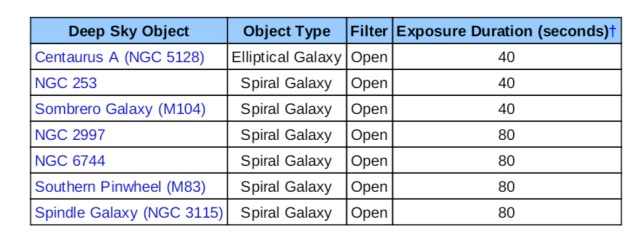
You will find the below table, which will list Saturn, its recommended filter, and exposure duration, as found in the above PDF.
Here is a copy of that table:
It isn’t too intuitive to find the “V” filter on Skynet. You are probably selecting telescopes, then filters which are supported by those telescopes.
I might suggest you reverse your selection process. That is, choose the filter first, and select from the list of telescopes then presented that offer those filter options.
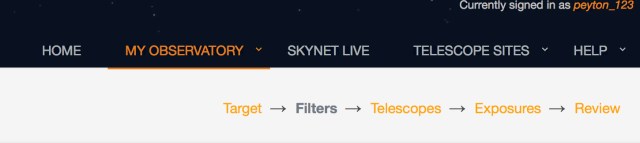
Look for this graphic on Skynet:
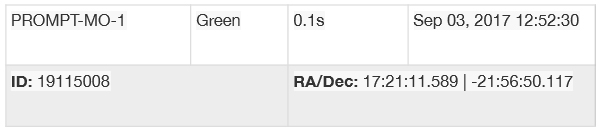
As you can see, I have selected “Filters” after assigning my target. On the filters page, you will find the recommended “V” filter for Saturn. The selection looks just like this:
Where GenG (generic G’reen” is listed as “V”, greenish filter. Or you might try the Astrophotography Green filter.
Moving onto the second part, of your first question… Do you have a recommendation on your own experience for a filter for galaxies (M101 magnitude 7.86) ?
In the same referenced Skynet Lab, there is a table for recommended exposures and filters. The “open filter” setting is recommended for Spiral Galaxies.
Here is a shot of the Whirlpool galaxy at 30 seconds exposure, with Open filter setting:
We arrive at your second question. I see in the video that there is a recommended maximum exposure time…When you have taken your images, do you just choose the max time or will it be overexposed?
The maximum time is presumed to keep the camera from overexposing. Having said that, go ahead and experiment. I haven’t tried past the maximum exposure time. You might find Skynet software presenting you with a warning, and a limitation on scope selection. See below:
I really enjoy your third and final question. It’s the best! How do I select what time I want to request the telescope to take the image? And when you set the time, is it our DST time or GMT or local time at the telescope?
In the Skynet user interface, where you select your filters, and telescopes, you will find an advanced options. It will appear just below your AAAP time account information.
Select the check box titled “Delay the start of this observation until …UTC.” And fill in a time.
At first blush, and for a few entries, you may enter incorrect information. It happened to me.
If you are permitting Skynet to automatically choose the next available telescope, then it will, of course, make any adjustments to ephemeris data and time parameters for you.
Rich, the 800 lb gorilla in the room is that when you are selecting a target, and it is in the “horizon” window then all is well.
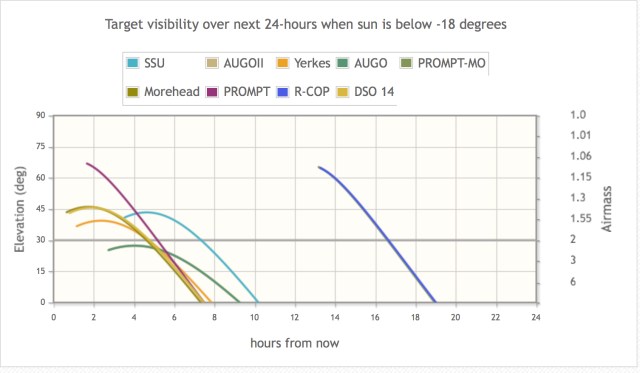
A horizon graph, like the one below, may provide you with a good chance of getting an image:
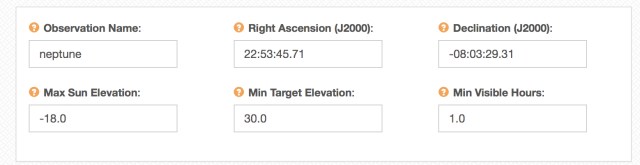
However, if there is no target visibility (nothing above the 30 deg elevation marker – or a complete lack of “colored” lines – then cancel your request, and choose another target. This will most likely happen with planets. Alternatively, you could change the minimum visible hours from “1.0” to, say, 0.5 and try to squeak in an observation.
I hope that this has been of some help for you, and our readers, and enriches the experience with the Skynet Robotic Telescope Network.
Rex had a really good solid reply. It appears below:
Thanks Ted, those comments are really helpful in answer to Rich’s questions. I’ll add a couple of other thoughts here.
The CCD cameras in Skynet have anti-blooming sensors (e.g., KAF-16803), beneficial for imaging dim objects such as galaxies. If a pixel registering a brighter area (e.g., galaxy core) becomes saturated (exceeds well depth capacity) it will not bloom vertical streaks the way non-anti-blooming CCD sensors do. At longer exposures pixels corresponding to fainter regions of the object continue to increase in value as brighter pixels max-out (at the well depth value for the sensor), improving the overall image character by showing fainter regions with greater intensity.
120 sec is a good starting point for galaxies. Try “bracketing” a few exposures to see how this affects the image. My SSRO group using PROMPT2 at Cerro Tololo uses 30 minute sub-frames for all deep sky work, and here at home in NJ I use 15 minute sub-frames. However, as mentioned at the meeting, exposures of this length need active autoguiding to correct small tracking errors (otherwise even very small errors lead to trailing, out-of-round stars). Skynet generally does not make auto-guiding available to the user due to complicating features, although it’s possible that at deeper levels in the user priority chain guiding may be possible.
Luminance (L) filters are really IR cutoffs and are used mainly to attain parfocality with the other R,G, B filters. Any filter in the light path causes a small but significant change in focal length, so not having a filter would cause problems. Having to adjust focus for filter changes is inefficient. Color imaging of deep sky objects is done by taking a series of L, R, G, and B filter frames and combining in software to make the color composite. The luminance (L) filter has the greatest sensitivity (highest quantum efficiency) since the others filter out broader wavelengths. It’s interesting to compare pixel brightness data for the same object at constant exposure times with L compared to R, G, and B filters.
— Rex
Epilogue:
I had inquired to Rich if we could use his follow-up, and publish results. Below, is our Amateur Astronomer’s first image taken from Skynet. It is M51 with its histogram adjusted in Afterglow software, ranging: min 40 max 99.2. The histogram feature, is a constraint on how much “white” and how much “black” will show thru in the final image.








 The December AAAP meeting will be held on the 12th at 7:30PM in Peyton Hall on the Princeton University campus. The talk is by AAAP member William Murray on “The Life and Legacy of Charles Messier”.






 Amateur Astronomers Association of Princeton