by Prasad Ganti
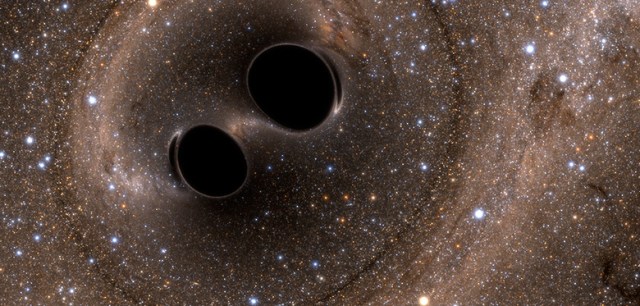
A couple of weeks back came the news that gravitational waves have been detected proving one of Einstein’s predictions. Rex wanted to see if we can arrange for a talk on this topic. The same sentiment was expressed by the program co-ordinator of “Science on Saturday” at the Princeton Plasma Physics Laboratory. Since our lectures are booked until June, we will try to find a speaker for September or later this year.
Einstein came up with the General Theory of Relativity about a hundred years ago in which gravity was a main player in the sculpting of our Universe. Most of his predictions regarding the bending of light due to space-time curvature and slowing of time in presence of gravitational fields have been proved. One thing left over was the prediction of gravitational waves. These ripples in the fabric of space are supposed to be created when violent cosmic events happen like the collision of two black holes. We have witnessed other extreme events like cosmic collision of galaxies and supernova explosions, but they are too mild to produce gravitational waves. No one has witnessed collision of black holes so far.
Black holes are a gravitational extremity predicted by Einstein. Since it is is a very compact gravitational well, absorbing all the radiation and giving nothing out, they have been observed indirectly through their effect on other visible bodies around them. Most of the galaxies are supposed to have a black hole at their centers, including our own Milky Way and our neighbor Andromeda. Finding two black holes in the vicinity of each other leading to a collision is rare events Finding such scenarios in our neighborhood or even within a few million light years is nearly impossible. If such a thing does exist, the human race may cease to exist!
Looking further into space also means looking back into the past. Because of the vast distances involved, even light takes millions or billions of years to reach us. As a result, the gravitational waves tend to be very feeble by the time they reach us. Detection of such waves is as much engineering as science. Like telescopes are detectors for light and radiation like infrared, ultraviolet etc., a precise interferometer was constructed in an L-shape with two2.5-mile arms. A laser beam fired along both the arms is reflected by end mirrors. Any discrepancy in arrival of the beams to the starting point could indicate the presence of gravitational waves.

LIGO Facilities in Washington and Louisiana (Credit: Caltech)
The mirrors are highly polished and guarded against any other terrestrial vibrations. The tubes themselves have a high vacuum and are very cold. To verify that a signal is not due to another source of vibrations, two such devices were built. Called LIGO (Laser Interferometer Gravitational-Wave Observatory), one is located in Louisiana and other in Washington state. Both of them detected the gravitational waves in a recent collision of two compact black holes. There is very high degree of confidence in the scientific community that these were indeed gravitational waves. More such observations are required to be totally certain. Since the equipment is becoming more sensitive and sophisticated, we can expect similar observations in the future.
LISA (Laser Interferometer Space Antenna), a set of 3 satellites with lasers and mirrors, will be positioned a million miles from the Earth, where the gravity from Sun and Earth cancel each other out. This Lagrangian points is a good spots for observing gravitational waves. Let us see if LISA can detect other gravitational waves including the ones from the Big Bang itself.
Coming on the heels of the discovery of Higgs Boson a few years back, this has been a phenomenal discovery. What is next ? Unification of gravity and quantum mechanics via the string theory? Discovery of multi verses? Just when we thought that we learnt a lot about cosmology, it seems like nature threw a wrench into the works and we stumbled upon dark matter and dark energy. Making us realize that we still have a long way to go. Learning is a quest, not a destination.
 China Telescope to Displace 9,000 Villagers in Hunt for Extraterrestrials
 New Animation Takes a Colorful Flight Over Ceres