Well-known author and personality Neil deGrasse Tyson authored (or co-authored) his 14th book this year, titled Cosmic Queries. The book is published by National Geographic, so the images and page layouts are slick, and the writing is clear and concise. It is one of those books that touches on everything—from the cosmic microwave background to black holes, from dark matter to quarks, and from how our star/solar system/universe started to how it will end. The topics addressed in Cosmic Queries were extracted from questions and conversations from the author’s StarTalk multi-cast (podcast, etc.).
So here is what I liked about the book:
Concise and clear explanations. I especially like concise writing.
Lots of good analogies and deGrasse Tyson has a knack for helping the reader understand the scale of astronomical topics. For example: “Earth’s moon is five times more massive than Pluto,” and “If a football field were a timeline of cosmic history, cavemen to now spans the thickness of a blade of grass in the end zone.”
There are lots of good facts, figures and historical information in the “callout” boxes.
The book’s structure is logical. It doesn’t start with the Big Bang and end with the Big Rip, but instead the chapters build on the knowledge and science of the preceding chapter(s).
It is a heavy, well-built book with thick pages, and lots of high-quality images—and it costs less than $20.
Here are a few things I didn’t like:
The author shares a lot of his tweets in other boxes on the page. There are probably too many of them and most add little to the chapter’s topic.
There were a couple topics that I expected him to address in a comprehensive astronomy book, but deGrasse Tyson skipped several of them. For example, he discusses evolution of intelligent life and the conditions likely needed to achieve it (as well as a dive into the Drake Equation), yet he does not address the critical role our moon has played in helping to sustain such conditions.
In summary, Cosmic Queriesis a beautiful book well-suited for the beginner to intermediate hobbyist, but probably not the right book for an advanced amateur astronomer who has assuredly read several other books like this.
NASA Releases First Detailed Map of the Insides of Mars NASA’s InSight mission revealed Mars’s inner workings down to its core, highlighting great differences of the red planet from our blue world. A trio of papers reveal the red planet to be something like a colossal candy treat, its crust split into layers of volcanic chocolate, the mantle rigid and toffee-like and the planet’s core light and syrupy….more
-BBC
Hubble Returns to Full Science Observations and Releases New Images NASA’s Hubble Space Telescope is back in business, exploring the universe near and far. The science instruments have returned to full operation, following recovery from a computer anomaly that suspended the telescope’s observations for more than a month…more
-BBC
Nasa’s Perseverance prepares to drill first rock sample The US space agency’s Perseverance rover is getting ready to take its first sample of Mars rock. The core, about the size of a finger, will be packaged in a sealed tube for eventual return to Earth. Scientists say their best chance of determining whether Mars ever hosted life is to study its surface materials in sophisticated home laboratories…more
-NYT
Moon wobble to bring surge in coastal flooding in 2030s, NASA study predicts Nearly all US mainland coastal areas will see a surge in high-tide floods in the mid-2030s, when a lunar cycle will amplify rising sea levels, a NASA study found. The rapid increase will start in the mid-2030s, when a lunar cycle will amplify rising sea levels caused by the climate crisis…more
-CC0 Public Domain
Glauconitic-like clay found on Mars suggests the planet once had habitable conditions A team of researchers from Spain, France and the U.S. has found evidence of a glauconitic-like clay on Mars that suggests the planet once had habitable conditions. In their paper published in the journal Nature Astronomy, the group describes their study of clay minerals extracted from Gale Crater by Curiosity rover back in 2016 and what they found….more
-space,com
Winchcombe meteorite gets official classification The Winchcombe meteorite is now official. The rocky material that fell to Earth in a blazing fireball over the Cotswold town of Winchcombe in February has had its classification formally accepted. Details have just been published by the international Meteoritical Society in its bulletin database…more
-NASA/ESA
Subsurface Ocean of Enceladus Has Currents, New Theory Suggests A novel theory proposed by planetary scientists from Caltech and NASA’s Jet Propulsion Laboratory challenges the current thinking that the saltwater global ocean of Enceladus, the sixth largest moon of Saturn, is homogenous. In 2014, NASA’s Cassini spacecraft discovered evidence of a large subsurface ocean on Enceladus and sampled water from geyser-like eruptions…more
-space,com
Scientists Accidentally Find a ‘Very Exciting’ Unique Exoplanet Has More Water Than Earth Scientists have accidentally discovered details about a “very exciting” planet orbiting a nearby star system, which is thought to contain more water than Earth. The scientific interest in the planet, known as Nu2 Lupi d, was sparked after researchers spotted it using the European Space Agency’s Cheops satellite…more
-BBC
Meteor wows Norway after blazing through night sky Norwegians have been left awestruck by a bright meteor that illuminated the night sky in the country’s south-east. Footage shows powerful flashes of light over Norway, followed by what witnesses described as loud bangs on Sunday…more
First Detection of Light from Behind a Black Hole Watching X-rays flung out into the universe by the supermassive black hole at the center of a galaxy 800 million light-years away, Stanford University astrophysicist Dan Wilkins noticed an intriguing pattern. He observed a series of bright flares of X-rays – exciting, but not unprecedented – and then, the telescopes recorded something unexpected: additional flashes of X-rays that were smaller, later and of different “colors” than the bright flares…more
by Rex Parker, Phd director@princetonastronomy.org
June 8 Meeting via Zoom. We hope to see you on June 8 for the presentation by Dr. Anna Schauer, NASA Hubble Fellow from the University of Texas, who will join us from Austin. See Program Chair Victor Davis’s section below for information on the talk.
Anticipation is strong that the June meeting will be AAAP’s last totally remote regular session, but let’s not tempt fate. It will be the final meeting of the academic year, as we used to consider it when regular semesters on campus guided our schedule. While there are positive signs that normal on-campus operations will resume at the university this fall, one sticking point for a possible return to Peyton Hall auditorium is whether the university will require proof of vaccination status (and how that would be executed) in order to be on campus. This has not been formally decided yet, and so our best advice for AAAP members is the obvious one – get the vaccination.
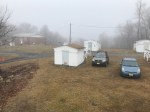
Renewal at the Observatory. With the state relaxing COVID guidelines, the situation at AAAP’s Observatory in Washington Crossing Park is swiftly changing too. We’ll discuss observatory attendance guidelines at the June 8 meeting and will continue to provide updates on opening status on the website. At this time we anticipate being fully open with normal operations for members who have been vaccinated.
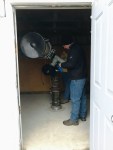
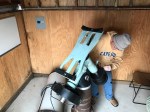
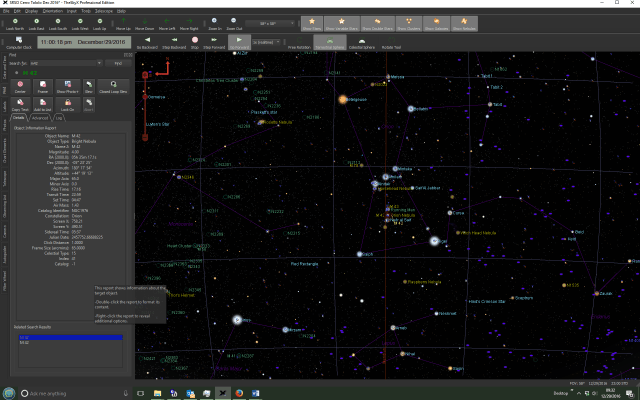
If you haven’t been to the observatory in the last year or two you may be amazed to see the equipment in action. Much credit goes to our current (and past) Observatory Chair and several AAAP observer members who have assembled, upgraded, and fine-tuned the equipment and systems to their current state. All of the telescopes are guided using a state-of-the-art program “TheSkyX” which directly controls two robotic equatorial mounts, the “Paramounts”. A ZWO ASI294 color CMOS camera is at the focus of the Celestron-14 Schmidt-Cassegrain telescope atop one Paramount. This camera has been a ground-breaking success story as one of the first of the new generation of high speed video-capable color cameras using the back-illuminated Sony sensors which provide remarkable sensitivity, with QE ~75% for the ASI294. The image is displayed on one or two large LCD monitors set up inside and sometimes outside the building to provide good viewing angles of the telescope target. The 5” apochromatic refractor (Explore Scientific) with glass eyepiece sits astride the C14 to give a visual wide field comparison of the higher-magnification astrovideo target. On a second Paramount sits the venerable and very long Hastings 6.25” refractor, one of the best planetary telescopes in central NJ. Co-mounted with it is the 10” Takahashi Mewlon Dall-Kirkham-Cassegrain reflector scope, which comes close to the Hastings in planetary capability but is better for deep sky objects, particularly globular clusters with its greater light grasp. Both of these scopes are set up for visual eyepiece observing and are aligned for complementary views of the same target by two people at the same time. I urge you to re-acquaint yourself with these fine instruments as we head towards prime observing season and clear skies at the Observatory this summer.
The Problem with Starlink. I had intended to review the Starlink issue at the May meeting but time ran out, so this will be on the agenda for the June 8 meeting.No doubt you’ve heard about Starlink, an ambitious project being constructed by SpaceX. The satellite internet constellation is intended to give fast, low-latency internet access to broad stretches of the earth. It consists of thousands of small satellites in low Earth orbit which communicate with ground transceivers. The problem with all this is that the low orbit results in bright visible trails from reflected sunlight as the trains of satellites cross the night sky.
The American Astronomical Society (AAS) and Noir Lab released a summary of the last summer’s workshop SATCON1, “Impact of Satellite Constellations on Optical Astronomy and Recommendations toward Mitigations” – see the link here, https://aas.org/satellite-constellations-1-workshop-report. A second workshop, SATCON2, is planned for July 12-16 this summer to discuss how to implement mitigation strategies from SATCON1, aiming to reduce the impact of satellite constellations on astronomy. SATCON2 has 3 objectives:
Define and quantify resources, metrics, and collaborations to implement SATCON1 recommendations, many of which will require substantial effort and funds to address.
Engage astronomers and satellite operators collaboratively in exploring policy frameworks and developing policy points for operations in low Earth orbit (LEO).
Increase the diversity of stakeholders and perspectives working to address both the challenges and the opportunities for astronomers, satellite operators, and all of humanity created by the industrialization of space.
There is clearly an opportunity for amateur astronomers to be one of those voices among the diversity of stakeholders. I urge you to read up on the issues and consider becoming an amateur member of AAS in order to participate in the expanding conversation on this major topic. You can become an amateur affiliate member of AAS through this link (on the application state your affiliation with AAAP). https://aas.org/join/classes-membership-and-affiliation
The June 2021 meeting of the AAAP will take place (virtually) on Tuesday, June 8th at 7:30 PM. (See How to Join the June Meeting below for details). This meeting is open to AAAP members and the general public. Due to the number of possible attendees, we will use the Waiting Room. This means when you login into Zoom you will not be taken directly to the meeting. The waiting room will be opened at 7:00 PM. Prior to the meeting start time (7:30 PM) you may socialize with others in the waiting room. The meeting room has a capacity of 100 people.
For the Q&A session, you may ask your question using chat or may unmute yourself and ask your question directly to the speaker. To address background noise issues, we are going to follow the rules in the table below regarding audio. If you are not speaking, please remember to mute yourself. You are encouraged, but not required to turn your video on.
Meeting Event
Participant Can Speak?
Participant Can Self-Unmute?
Director Rex’s General Remarks
Yes
Yes
Program Chair Victor’s Speaker Introduction
Yes
Yes
Speaker Presentation
No
No
Q&A Session
Start All on Mute
Yes
5-minute bio break
Yes
Yes
Journal Club presentation
Start All on Mute
No
Business Meeting
Start All on Mute
Yes
Director’s closing remarks
No
No
Only the Business part of the meeting will be locked.
PLEASE NOTE: June is traditionally the month when AAAP members travel to the New Jersey State Museum Planetarium in Trenton for a custom show presented by AAAP member and Planetarium staffer/educator Bill Murray. Due to Covid restrictions, the museum remains closed. The club will continue virtual meetings via Zoom until further notice.
Featured Speaker: Dr. Anna T.P. Schauer is a NASA Hubble Fellow at the University of Texas at Austin. She will talk about her research investigating “First Star Formation and the Lunar Ultimately Large Telescope.”
Dr. Schauer’s research focuses on the high-redshift Universe, running hydrodynamic, cosmological simulations to study the first stars and black holes. She studies large-scale effects that influence “minihalos,” the early building blocks of galaxies. By investigating these first objects, she aims to understand how the Universe through successive generations of stars and supernovae underwent the transition from metal-free to metal-enriched. Capturing the light from objects so long ago and far away will take extraordinary instrumentation, and to that end Dr. Schauer is looking forward to observations using what she and her colleagues are calling the “Ultimately Large Telescope.” They hope to revive a design proposed by Roger Angel and collaborators that described a 20-meter telescope (shown below) with a mirror of rotating liquid operating on the Moon. Dr. Schauer and colleagues believe that a 100-meter instrument is feasible, with which they could study the first stars that formed in the Universe, the so-called Population III stars.
Credit: The University of Texas McDonald Observatory
Anna T.P. Schauer grew up in Munich, Germany, where she earned her BS in Physics and two Masters Degrees in Physics and Astrophysics at Ludwig-Maximillians-Universität. For her PhD, she moved to the star formation group at Heidelberg University. After defending her PhD thesis, she remained in Heidelberg as a transitional postdoc before starting at UT Austin as a NASA Hubble Fellow in October 2018. Dr. Schauer has been a reviewer of HST proposals, chaired a conference on “The First Stars,” and is a member of UT Austin’s Astronomy Outreach Group. This past year, Dr. Schauer focused on a new area of long-term research by becoming a new mother.
AAAP webcast: This month’s AAAP meeting, beginning with Rex’s opening remarks and ending at the break before the business meeting, will be webcast live on YouTube and recorded for subsequent public access on AAAP’s YouTube channel. Be aware that your interactions during this segment, including questions to our guest speaker, may be recorded for posterity.
AAAP webcast: This month’s AAAP meeting, beginning with Rex’s opening remarks and ending at the break before the business meeting, will be webcast live on YouTube and recorded for subsequent public access on AAAP’s YouTube channel. Be aware that your interactions during this segment, including questions to our guest speaker, may be recorded for posterity. Here is YouTube live link: https://youtu.be/TrXEKOM4VTs
This session will be recorded and saved on YouTube. Send me an email at program@princetonastronomy.org if you have any concerns. Due to technical difficulties, the May meeting was not recorded on YouTube, and so is unavailable for public (or private) viewing.
Using Zoom: While we are, social distancing the AAAP Board has chosen to use Zoom for our meetings, based our belief that many members have already have used Zoom and its ease of learning. One of its great features is you can choose whether you want to install the software on your computer or use it within your browser.
How to Join the June Meeting: For the meeting, we are going to follow a simple two-step process:
Please make sure you have Zoom installed on your computer. You do not need a Zoom account or need to create one to join the meeting. Nor are you required to use a webcam.
Please visit our websitefor the link to the meeting
This session will be recorded and saved on YouTube. Send me an email at program@princetonastronomy.org if you have any concerns.
NOTE: We plan to open the meeting site 30 minutes to the 7:30 start time. This way you won’t have to rush to join the meeting. A maximum of 100 attendees can join the meeting.
More Information: The Zoom site has many training videos most are for people who are hosting a meeting. If you’re unsure how Zoom works you might want to view the videos on how to join a meeting or how to check your computer’s audio and video before the meeting.
We hope to make these short presentations a regular feature of our monthly meetings. If you are interested in presenting a topic of interest, please contact either director@princetonastronomy.org or program@princetonastronomy.org. We’d like to keep our momentum going!
WANTED: Members with interesting stories to tell. As of this writing, no member has volunteered to offer up a brief story or presentation for Journal Club this month. During the past months, we’ve enjoyed interesting and informative talks from AAAP members, and we’d like to keep the momentum going! We hope to make these short presentations a regular feature of our monthly meetings. We’d like to know what members are doing or what members are thinking about in the broad range of topics encompassed by astronomy. A brief ten-minute (or so) presentation is a good way to introduce yourself and the topics you care about to the club membership. If you are interested in presenting a topic of interest, please contact either director@princetonastronomy.org or program@princetonastronomy.org.
Looking forward to you joining us on-camera on Zoom or YouTube Live webcast at the June meeting!
● The meeting convened at 7:30 PM via Zoom and Yahoo (online). There were initially about 59 Zoom attendees.
● The Board of Trustees candidate slate, for 2021 – 2022, presented at last month’s meeting, was voted via an online survey app. The results, matching/exceeding the required quorum of 50% current AAAP membership:
*Rex Parker, Director
*Larry Kane, Assistant Director
*John Miller, Secretary
*Michael Mitrano, Treasurer
*Victor Davis, Program Chair
*David and Jennifer Skitt, Observatory Co-chairs
● Progress regarding the WCSP Observatory repairs and State permissions for same was discussed. The State Park officials are requiring the AAAP have a State-approved engineer certify our final repair plans/objectives.
● Victor Davis introduced the evening’s guest speaker: Alexander Hayes, Associate Professor, Department of Astronomy at Cornell University. Professor Hayes talk was titled: “Ocean Worlds of the Outer Solar System.” The topic included studying the possibility of Europa, Enceladus or Titan having environmental conditions biochemically favorable to forms of life.
● Member Sam Sherman introduced a current project on which he is working, using Calculus to prove Kepler’s 3rd Law and determine the mass of Jupiter using calculations derived from thr four Galilean moons. The law states that the ratio of the square of an object’s orbital period with the cube of the semi-major axis of its orbit is the same for all objects orbiting the same primary. This captures the relationship between the distance of planets from the Sun, and their orbital periods. Sam is 17 years old.
● AAAP member Ira Polans gave a short presentation describing his visit to the George C. Marshall Space Flight Center. Ira highlighted the history of the Apollo missions with additional information and images relating to the Shuttle and ISS missions.
● Observatory Chair David Skitt reviewed ongoing plans to train observatory key-holders on operational procedures. This included added management of visitor management to adhere to Covid 19 restrictions. Currently, only AAAP members are allowed on-site. We have entered observatory visitation rules “Phase 2” (temporarily modified for Covid precautions). <20 people on premise at one time.
● Observatory Chair David Skitt reviewed ongoing plans to train observatory key-holders on operational procedures. This included added management of visitor management to adhere to Covid 19 restrictions. Currently, only AAAP members are allowed on-site. We have entered observatory visitation rules “Phase 2” (temporarily modified for Covid precautions).
<20 people on premise at one time.
<6 people inside the observatory at any given time.