by Theodore R Frimet
the dragons breath
A few months ago I gave a partial reference to the oft-used phrase, “water, water, everywhere, and not a drop to drink”. (1) This Saturday morn, instead of watering at the mouth, and squabbling for scraps at Longshanks’ table, we focus on something more relevant. A topic that I am now comfortable writing about. I reach for the touchstone that is dew point and the glass oculus.
Little did I know that I built up a rune of a title (2), from the strong support and foundation of the “The Rime of the Ancient Mariner” – text of 1834, by Samuel Taylor Coleridge (1772–1834) ?
I was at Washington Crossing Park, Jersey side, if you like, a few months ago. With another club Amateur, we spied the night sky. He turned to me, after dark, and became cautious as to when the aperture would cloud up with water. The ever, unpopular, “dewing up”.
I stood up to the task. Quickly. I quickly reviewed the projected humidity levels, forecasted the temperatures, and dew-points. Like my sentient Pennsylvania cousin, Punxsutawney Phil, I prognosticated. Absent a tolerance for more visceral scientific data on millibars, I turned to my fellow Amateur and naysayed, “no dew, tonight”.
Of course. Later on, it clouded in. It always clouds in. Puffy white, or streaking across the heavens, leaving no star in sight – the clouds are always both judge and jury.
Not tonight, though. The Amateur Astronomers Association of Princeton (AAAP), club and editors maintain on their website, a link to A. Danko’s Clear Sky Chart Home page.
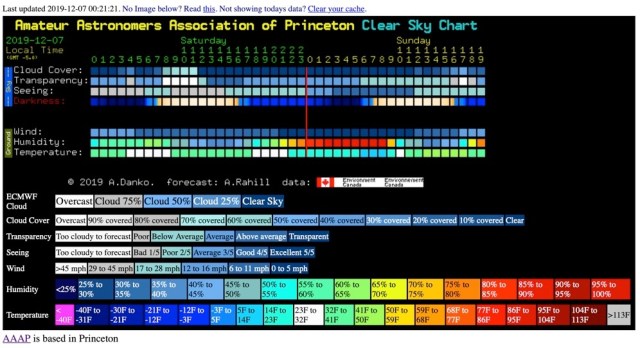
Make more than a cursory check of the above Clear Sky Chart for AAAP. No clouds. We are clear of the white puffy lactation of nearby weather systems. Ahhh, clear skies indeed! However, as any burgeoning amateur might ask, “will it dew up my scope, tonight? Let’s find out, shall we?
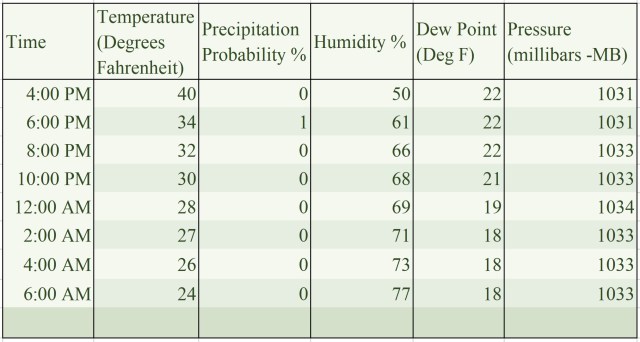
The above data was extracted, this Saturday morning, at 10:26 AM (EST) for my home location in Croydon, Pennsylvania, from the iPhone application, Dark Sky. My close proximity to the observatory (28.2 miles), relatively speaking, makes the chart worth consideration. Your mileage may vary, of course, with time, distance, and how much you want to geek out, on meteorological data.
Our AAAP Observatory Chair, deserves the credit, in their recommendation of many applications to help us acquiesce to the night sky. One of those is Dark Sky. It is very popular with me. It is my daily helper on the road. It warns me of impending next hour precipitation, summaries, and Severe and Extreme alerts that are Government issued. The UV index is monitored, and assists in the health and welfare of pursuing my passion for solar observation. You can set notification for limits. Acquire Dark Sky, for a few shekels, here:
https://darksky.net/app
So, making the mad dash to the app, armed with my Saturday morning Joe, we peruse the data. Scan the dew points with me. It ranges from 22 F to 18 F. Now, scan the temperature. Note it starts at a toasty 40 F, and plummets to 24 F. All is well. The projected temperature never is lower than the dew point. Ah, then there’s that barometric reading and all that humidity!
In my own, humble opinion, since the barometer is holding steady, and the temperature never achieves dew point, lower pressures will not precipitate more liquid out of the sky. Our relationship to the dark will not be unbalanced. Our assessment is a, “no dew tonight” forecast.
What should really bake your noodle is all that RED on the Clear Sky Chart. From midnight till ‘morn, the humidity is listed as a mind boggling 85% to 90%. So, where your open aperture behemoth may not cloud in, the seeing, this evening, may not agree with all. “Twinkle, twinkle, little star”, indeed! With the extra moisture, lurking in the atmosphere, a light scattering affect will be the comeuppance of all amateurs that venture into the night.
Capped with the rise and fall of the Waxing Gibbous Moon, this will make it for an interesting experiment. We could wait for the New Moon of December 25th, however the fix is in. I am gathering up the courage, now, for the taming of the night sky. Tarps for telescope? Check. Cold weather jump-suit with hat? Check. Pocketed, convertible mittens. Check. Cold weather boots. Check. Priss, the cold weather cat. Missing.
Priss, it turns out, is not a feral cat. She was my rescue from over a year ago. After having a discourse with our local Veterinarian, I have decided to bring Priss in. She is our forever cat. Priss has joined the ranks of Big Pussycat (aka Maybelle) and Fritz the Cat (aka the killer of dobsonians). No doubt, Astro-Dog, our neighbors’ night time pundit pooch, will be yelping to keep the local wildlife at bay. Due to the shadow-tigress absence, the rustling of meandering mice, and somewhat larger orphanages will continue to be unabated.
What experiment? Jenny Jump has just recovered from tree clearing and snow plowing. Our Washington Crossing Park access is experiencing similar parks and recreation clearing. We then have no recourse than to venture into the backyard, this evening. Because, after all, seeing is believing.
Among the untrimmed verge, and disaster that is the light from my mother-in-laws window, we shall peek at the star show. Until the night sky shows us her glistening underbelly of dawn, all of us should be out, at the eyepiece. Let’s challenge the laws of nature, versus the scientific data that I have presented. Venture forth, and be not afraid to “do the dew”.
Permit me to make a courteous ending note. For the early stage learners of the craft that is Amateur Astronomy, breathe not onto the eyepiece. Without regard to cold temperatures, and barometric pressures, the dragons breath will cloud up your view. Blow onto it gently, and let it weep away the mist. Or you could invest in a $32 Balaclava. My son-in-law was quick to say that the vented holes always ice-up. Still, it sucks to be cold. So, please dress accordingly.
https://www.refrigiwear.com/product/ultra-clava-0098rblklxl
Tonight, tonight
The world is full of light
With suns and moons
all over the place
– Maria and Tony, West Side Story (1961 film)
References, last accessed Saturday, 10:30 AM EST, December 7, 2019
(1) https://princetonastronomy.wordpress.com/2019/06/02/water-water-everywhere/
(2) https://www.poetryfoundation.org/poems/43997/the-rime-of-the-ancient-mariner-text-of-1834
Epilogue
6:30 PM, eat dinner. 7-7:30 PM, watch some recorded Avengers movie. 7:30 – 8:00 PM – suit and greet the scope; already set up previously during daylight. Moon, moon…moon. Ok. Moon! Lovely. Learned a few things about the moon, this evening. I’ll tell you an observation story in just a few minutes.
With my new cold weather gear, and balaclava, I was all toasty warm. I was snug as a bug in a rug! I looked forward to passing many an hour with the lunar surface, before me. What I didn’t plan on was the moisture from each exhale turned into a vaporub cloud. I clouded up my eyepieces!
While waiting for the moisture to evaporate, I rotated between magnifications, and 2” and 1.25” barrels. All in an effort to keep a clear view. I had fun. I also learned how to breathe tonight. “Very important”, I thought to myself, “to try to minimize clouding up my lens”. Try to breathe, “down” was the lesson, and not “up” into the lens. Sigh. Lesson learned.
After mastering the breathing exercise, I noticed something unusual. There appeared in my line of sight, in the eyepiece to be precise, a be a bit of meteorological mystery forming up. Yes. Right before my eyes was a little cloud, circling about. I checked my balaclava. No, I was the master of the mist.
I looked up directly at the moon. I saw a distant veiled ring, hung around her lunar majesty. It was something I expected, considering the excess of humidity predicted at 85 – 90%. Maybe the cloud was forming within my dew shield? I got off my seat, stood up, and took a look into the aperture. A little dusty, perhaps, yet no clouding in. Then I looked up into the night sky.
Yes. Every experimental data set deserves an actual, dyed in the wool, eyes on physical experience. Here I was. Looking up into the night sky. Clouds had formed. Somewhere, between my coffee break and 9:10 PM (there-a-bouts), there was a gravity wave that snuck into my visual horizon. With it, came a barometric depression which changed the forecast. I was clouded in.
Disassemble, and put in the shipping plug for the diagonal mirror. Cap the aperture end. Put away the Telrad finder. Out with the Telegizmos aluminized cover, and sack the telescope for the evening.
Dark Sky app reads, NOW: Clear, and 29 degrees. My visual observations tells me something different.
Ok. You all were good this evening. Here is our evening observation:
On the moons largest lava field, or mare, there is a prominent impact crater. Yet the star lines – the lines of bright lunar dust sprayed upon its surface, is not at all straight. In some areas, it appears to have been curved, as if dragged by a current of water. And then it hits you. The mare was turned to a semi-solid upon an impact, and the brighter moon-rock, turned outward onto the surface, engaged waves of liquid mare. Which soon solidified and left its mark upon the lunar surface. Good bedtime story. Pleasant dreams.

 Featured Speaker The January meeting of the AAAP will be held on the 14th at 7:30 PM in the auditorium of Peyton Hall on the Princeton University campus. The talk is Eying the Sun: Our Nearest Star by Bin Chen Associate Professor of Physics at the New Jersey Institute of Technology.



 The December meeting of the AAAP will be held on the 10th at 7:30 PM in the auditorium of Peyton Hall on the Princeton University campus. The talk is on Gamma-ray Bursts: Unraveling the mystery of the universe’s brightest explosions by Patrick Crumley Postdoctoral Research Associate at Princeton University.