Snippets

compiled by Arlene & David Kaplan

-NYT

Pluto May Have Captured Its Biggest Moon After an Ancient Dance and Kiss Some 4.5 billion years ago, the dwarf planet Pluto was suddenly joined by a companion. For a very brief period — perhaps only hours — they danced as if arm in arm before gently separating, a grand do-si-do that resulted in Pluto and its quintet of moons orbiting the sun together today….more

-NYT
-scitechdaily.com

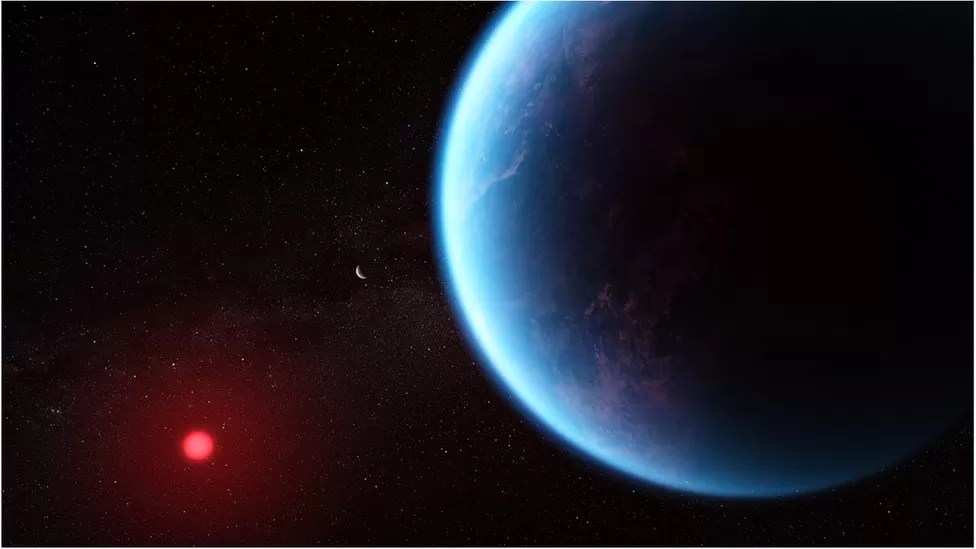
James Webb Unveils a Mysterious Planet Unlike Anything in Our Solar System The James Webb Space Telescope has provided groundbreaking insights into a new type of exoplanet, fundamentally different from those in our Solar System, by piercing through thick cloud layers to analyze atmospheric compositions. This discovery challenges existing classifications and expands our understanding of planetary formation and characteristics….more

-space.com

Earth’s recent asteroid visitor might’ve been a piece of the moon Earth’s distant rocky companion was likely a fragment of the moon blasted into space thousands of years ago, according to a new study that deepens our understanding of the types of space rocks that drift near our planet and occasionally impact it. Last year, the space rock named 2024 PT5more

-scitechdaily.com

Universe’s Expansion Defies Explanation: New Data Shatters Cosmological Models The Universe appears to be expanding faster than expected — faster than theoretical models predict and beyond what our current understanding of physics can explain.New measurements have confirmed earlier, highly debated results showing this unexpected rate of expansion. The gap between these findings and established models is known as the Hubble tensionmore

-livescience.com

Supermassive black hole spotted 12.9 billion light-years from Earth — and it’s shooting a beam of energy right at us Astronomers have discovered a supermassive black hole that’s shooting a giant energy beam directly at Earth. The cosmic juggernaut, which is about as massive as 700 million suns, is taking aim at us from a galaxy in the early universe, up to 800 million years after the Big Bang — making this the most distant “blazar” ever found…more

-petapixel.com

Sound of Meteorite Striking Earth Captured for First Time by Ring Camera Prince Edward Island, Canada resident Joe Velaidum and his wife Laura had just left his home to take his dog for a walk when the incident took place. While firsthand accounts of impacts have been heard before, they haven’t been captured—until now. …more

-scitechdaily.com

Astronomers Pinpoint Origins of Mysterious Signal That Traveled 200 Million Years To Reach Us Fast radio bursts are brief and brilliant explosions of radio waves emitted by extremely compact objects such as neutron stars and possibly black holes. These fleeting fireworks last for just a thousandth of a second and can carry an enormous amount of energy — enough to briefly outshine entire galaxies. Since the first fast radio burst (FRB) was discovered in 2007…more

-livescience.com

Giant ‘kidney beans’ spotted in Mars satellite images could point to signs of water and life These Martian “kidney beans” aren’t safe to eat: they’re actually frozen sand dunes in Mars’ northern hemisphere. A recently released photo by NASA‘s Mars Reconnaissance Orbiter (MRO) shows a top-down view of the frosty legume lookalikes, taken to help scientists determine if conditions on the Red Planet could have sustained life a long time ago…more

-smithsonianmag.com

Astronomers Found Strange, Accelerating X-Ray Pulses Coming From a Black Hole. They Might Be a Sign of an Orbiting White Dwarf A supermassive black hole in a distant galaxy is once again surprising scientists. In 2018, a black hole called 1ES 1927+654, located about 270 million light-years away from Earth, showed its first signs of mysterious behavior. Its corona—the billion-degree cloud of plasma that envelopes it—suddenly disappeared and reappearedmore

Posted in February 2025, Sidereal Times | Tagged , | Leave a comment

From The Director

by Rex Parker, PhD
director@princetonastronomy.org

Meeting January 14, 2025, at Peyton Hall and Zoom.  We hope you’ll join us in person at Peyton Hall on campus for the first meeting of the new year on Jan 14 (7:30pm).  This month our guest speaker will present remotely from outside of New Jersey, so the live meeting will be Zoomed and You Tubed to members as always.  Yet despite the excellence of Zoom, we encourage the mind-to-mind connection of the face-to-face variety, an important part of AAAP culture which we don’t want diminished for the sake of electronic convenience.

You may, like me, have sometimes thought of the moon as an unwelcome intruder obscuring views of the glories of the deep sky. Our speaker this month will dispel you of that illusion.  Acclaimed science writer and Scientific American Contributing Editor Rebecca Boyle will discuss her recent book, the national bestseller Our Moon: How Earth’s Celestial Companion Transformed the Planet, Guided Evolution, and Made Us Who We Are.  By chance I happened to read the book in April, borrowed from the Mercer County Library System (also available at Amazon).  It’s a captivating read with a unique perspective on Selene, the Greek Goddess, driving her chariot across the sky.  See Victor’s article below for more information about the presentation on Jan 14, including where to park your vehicle for the walk to Peyton Hall as well as Zoom information. 

If you’d like an opportunity to speak with fellow members about your interests in astronomy, please read on. At each month’s meeting we reserve a slot after the intermission for the Unjournal Club, in which a member has the floor (and screen) for 10-15 min to discuss recent astro-related magazine articles, books, or other personal astronomy experiences and projects to share with the membership. In November, for example, we had a very cool presentation by member David Ackerman about his progress programming and using a spectroheliograph to image the sun in astonishing detail. In order to get on the schedule for an unjournal club presentation, please send an email to me or the Program Chair. Remember that if you want to share astro images or other slides live in the auditorium, experience has shown that it’s better for connecting with the Peyton Hall projector and Zoom input to bring the file on a USB drive to insert into the laptop already connected up front during the meeting. Your brief presentation can also be done via Zoom if you aren’t in Peyton Hall. 

An Unusual Line-Up of the Planets in January. It’s a rarity for all seven of the planets to be visible in our sky during a single night.  This arrangement happens a few times a decade at most, with all except Neptune and Uranus being naked eye visible.  I generated a sky chart for our location for the early evening in late January using TheSkyX program that runs the AAAP Observatory equipment at Washington Crossing State Park (see below).  Saturn and Venus will drop below the horizon shortly after sunset so don’t wait too long if you plan to observe them.  Mercury will be visible during the same night, technically, but will require an alarm just before sunrise.  Mercury rises at around 6:50am in late January so will be quite difficult to see in the glare of the rising sun (sunrise at around 7:15am).

Sky chart for Princeton area in late January 2025 looking south.  Six of the planets can be seen at this time, a rare arrangement. The curved blue line is the ecliptic; the vertical blue line is the prime meridian.  Chart prepared using TheSkyX program from Software Bisque.

Posted in January 2025, November 2024, Sidereal Times | Tagged , | Leave a comment

From The Program Chair

by Victor Davis, Program Chair

Welcome to 2025

The January, 2025 meeting of the AAAP will take place in Peyton Hall on the campus of Princeton University on Tuesday, January 14th at 7:30 PM. As usual, the meeting is open to AAAP members and the public. Participants can join the meeting in-person at Peyton Hall or log in to the Zoom session as early as 7:00 pm to chat informally before the meeting begins. The evening’s guest speaker is science journalist Rebecca Boyle whose talk is entitled, “Our Moon, Ourselves.”

Options for Attending the Meeting

You may choose to attend the meeting in person or participate via Zoom or YouTube as we’ve been doing for the past few years. (See How to Participate below for details). Due to security concerns, if you log in before the host has set up internet connectivity in Peyton Hall, you may need to wait in the Waiting Room for a few minutes until the host is prepared to admit you into the meeting. You’ll need to unmute yourself to make comments or ask questions. It’s polite, though not required, for you to enable your camera so other participants can see you. A week or so after the meeting, the video of the lecture and Q&A will be posted on AAAP’s public YouTube channel.

Speaking Virtually

Rebecca, who resides in Colorado Springs, Colorado, will participate via Zoom. There will be no “meet the speaker” dinner this month.

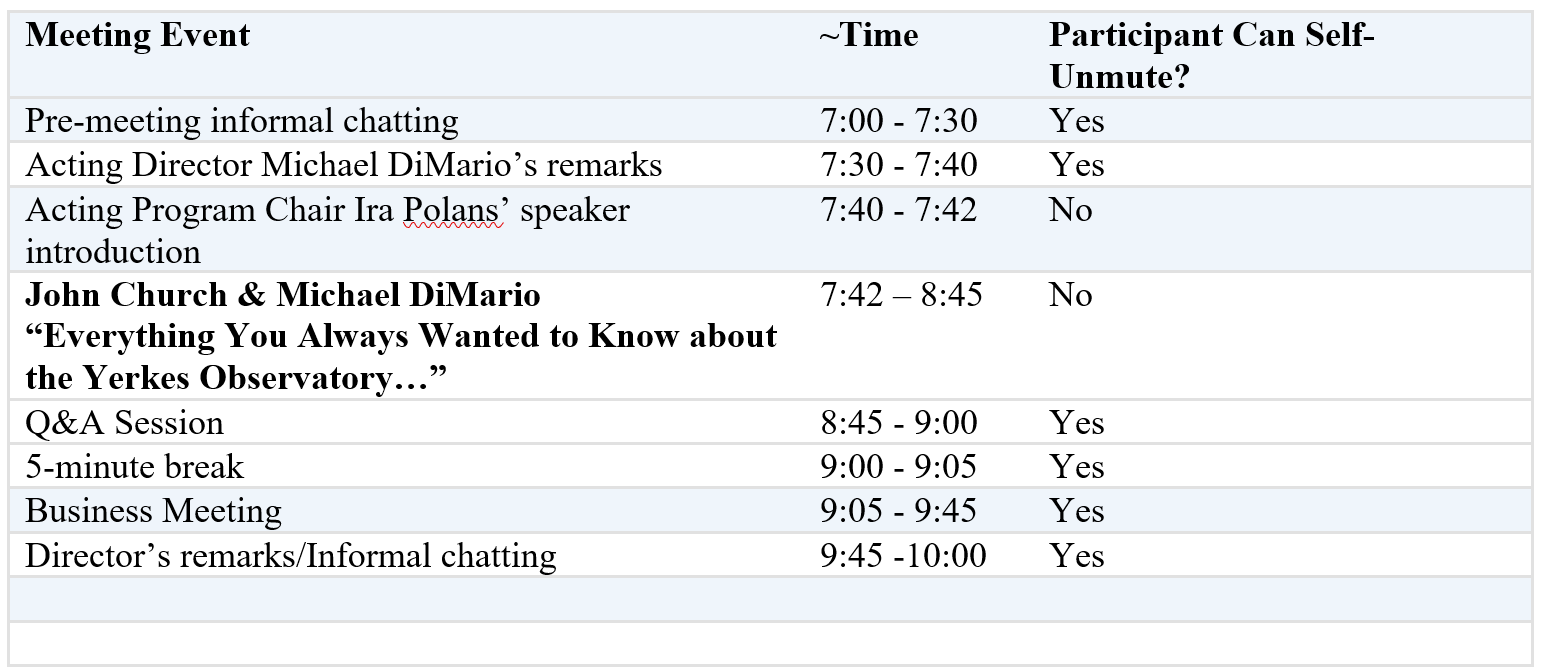
Here’s the anticipated agenda for January, 2025’s monthly meeting of the AAAP:

(Times are approximate)

Getting to Peyton Hall
The parking lots across the street (Ivy Lane) from Peyton Hall are now construction sites, unavailable for parking. We’ve been advised by the administration of the astrophysics department that we should park in the new enclosed parking garage off Fitzrandolph street and walk around the stadium and athletic fields. Here’s a map of the campus and walking routes from the parking garage to Peyton Hall. The map shows the recently completed East Garage. Not shown is an access road Sweet Gum that connects from Faculty Road to an entrance at the lower left corner of the garage. Stadium Road connects from Fitzrandolph Road to another entrance at the opposite corner (and higher level) of the garage. It’s about a 10-15 minute walk from the parking garage to Peyton Hall.

“Our Moon, Ourselves”

Our Moon, Ourselves
The Moon is one of Earth’s most unique features, and the two comprise what has often been termed a “double planet.” This unique pairing shapes all of the other things that make our planet special, from its geology to its multitudes of life, including us. Life might not have evolved on Earth at all without the Moon’s stabilizing gravitational influence and powerful tides. After we humans showed up, the Moon quickly became our primary way of telling time and organizing our lives. It shaped our understanding of our place in the universe, and helped us to invent forms of religious devotion and the process of science. The Moon plays a central role in our most famous wars, our greatest adventures, and our shared futures. And now, humans are trying to go back to the Moon’s surface — soon, and with plans to stay. We owe ourselves a thoughtful consideration of the Moon’s role in our history and our future. And what do we owe to our spectral satellite?

Author of Our Moon: How Earth’s Celestial Companion Transformed the Planet, Guided Evolution, and Made Us Who We Are  

USA Today and ABA Indiebound Bestseller

NYT Book Review Editor’s Choice

*Longlisted for the 2024 National Book Award in Nonfiction*

Rebecca Boyle

As a journalist, Rebecca Boyle has reported from particle accelerators, genetic sequencing labs, bat caves, the middle of a lake, the tops of mountains, and the retractable domes of some of Earth’s largest telescopes. Her first book, OUR MOON: How Earth’s Celestial Companion Transformed the Planet, Guided Evolution, and Made Us Who We Are (Random House, 2024) is a new history of humanity’s relationship with the Moon, which Rebecca has not yet visited on assignment. OUR MOON is a national bestseller and was longlisted for the National Book Award; is a New York Times Book Review Editor’s Choice; and is one of the New Yorker’s Best Books of 2024.

Based in Colorado Springs, Colo., Rebecca is a contributing editor at Scientific American, a contributing writer at Quanta Magazine, and a columnist at Atlas Obscura. She is a frequent contributor to the New York Times, The Atlantic, and many other publications. Rebecca’s work has been anthologized multiple times in the Best American Science and Nature Writing series, and she is the recipient of multiple writing awards.

How to Participate (Links)
Zoom
Topic: January 2025 AAAP Club Meeting – Rebecca Boyle
Time: Jan 14, 2025 07:00 PM Eastern Time (US and Canada)

Meeting ID: 860 8322 4764
Passcode: 005910

Meeting link Meeting link
Click the above icons for Zoom and YouTube


Date Featured SpeakerTopic
February 11, 2025Kimberly Burtnyk
kburtnyk@caltech.edu
AAAP member Aram Friedman and his family recently received a tour of the LIGO (Laser Interferometer Gravitational-wave Observatory) facility in Hanford, Washington. His guide was Kimberly Burtnyk, LIGO Laboratory Technical Editor and Web Content Developer. She’s agreed to (most likely virtually) give us a virtual tour of LIGO and explain what they do there and how and why they do it.
 
Thanks to Aram for facilitating this presentation.

As always, members’ comments and suggestions are gratefully accepted and much appreciated. Thanks to Ira Polans and Dave Skitt for setting up the online links and connecting the meeting to the world outside Peyton Hall.

Gene Ramsey Memorial
Here’s a mock-up of the memorial to former Observatory Chair Gene Ramsey, who, I am embarrassed to say, died 8 years ago. We’re finally getting around to paying tribute to his contributions to our club with an engraved metal plaque, approximately 8 X 10 inches in size, which we’re planning to mount on an inside wall at the observatory. A brief ceremony with family and friends will kick off the 2025 public observing season this spring. Please let me know if you have comments or concerns

victor.davis@verizon.net
program@princetonastronomers.org
(908) 581-1780 cell

Posted in January 2025, November 2024, Sidereal Times | Tagged , , , , , , , | Leave a comment

Minutes of the December 10, 2024 Meeting

by Gene Allen, Secretary

Assistant Director Bob Vanderbei opened the meeting in Peyton Hall and on Zoom at 1934. There were 33 attending in person and 41 online.

Bob discussed the Crab Nebula, a supernova remnant also known as M1, Messier object #1. He showed two astrophotos he took of the nebula in 2006 and 2019 using the same equipment. He blinked between them to point out that the nebula had expanded in the intervening years. He carefully measured the expansion and used that rate to estimate the date that it had gone supernova. He calculated 1045, and the actual date was recorded by multiple cultures as 1054. Pretty impressive that he was able to come within 9 years, less than a 1% error.

Program Chair Victor Davis introduced Dr Jesse Christiansen, the Chief Scientist at NASA’s Exoplanet Science Institute at Caltech. Her lecture was “The Search for Earth 2.0: Why We Think It Exists and How We’re Going to Find It.” She was a highly animated, fun speaker whose enthusiasm for her research was readily conveyed.

Questions and a break followed her talk.

The meeting reconvened at 2122 with an Unjournal Presentation by Director Rex Parker describing the multiple sources of evidence for the existence of dark matter.

The business meeting proceeded at 2140 with Outreach Chair Bill Murray reporting a Girl Scout troop request for a star gazing evening at Montgomery Township High School on January 6, with a cloud date of February 3.

It was noted that speakers for January and February are remote, which brings up the question of whether or not to gather in Peyton Hall for those meetings. The June meeting is expected to continue the tradition of gathering in the NJ State Museum Planetarium.

Bob Vanderbei will be giving a talk about his astrophotography at the Planetarium on December 14 at 1615.

Victor Davis reported that the Gene Ramsey Memorial Plaque should be ready for a ceremony in the spring.

Bob Vanderbei also mentioned that he, along with Secretary Gene Allen and Member Seraphine Allen met with Eve Mendel, Director of Programs and Outreach for the Historical Society of Princeton at their museum site at 354 Quaker Road. She is planning a star party in the spring and considering making it an annual event. The site looks excellent. The intended observing field has a low southern horizon and is shielded from the parking lot lighting by a large barn that can also house displays and activities.

The meeting was adjourned at 2152.

As of December 16, we have 217 active members. So far in CY2024, renewals number 127 and expirations number 52, giving us a 71% retention rate. We have added 67 new members.

Submitted by Secretary Gene Allen
December 16, 2024

Posted in January 2025, Sidereal Times | Tagged , | Leave a comment

Note From The Editor

by Surabhi Agarwal

Dear Members,

Wishing you all a very Happy New Year filled with clear skies and celestial wonders! As we embark on another year of exploration and discovery, I’m thrilled to welcome Abhinav Sukla as our new student editor. He brings fresh energy and enthusiasm to Sidereal Times, and we look forward to his contributions.

At the same time, I would like to extend my heartfelt gratitude to our outgoing student editor, Yugandhara Luthra, for her dedication and hard work. Her contributions have enriched our magazine and inspired our members. We wish her every success in her further studies in astrophysics and look forward to seeing her achievements in the field. Perhaps, in a couple of years, we should invite her back to the club to share her journey and insights with us in a talk!

As we look to the skies, it’s vital to remember the challenges here on Earth, particularly the imminent threat of climate change. Each of us can take small yet impactful steps to mitigate its effects, starting in our own homes and backyards. Planting native flowers, trees, and bushes not only enhances biodiversity but also provides crucial support for local fauna, including pollinators, birds, and other wildlife. Together, let’s do our part to preserve and protect our planet while we continue to explore the wonders beyond it.

I would also like to share details I received in an email to the editors about a fantastic getaway cabin in Livingston Manor, NY. The destination features Bortle Class 3 skies, with minimal light pollution. It promises to offer an exceptional stargazing experience with spacious grounds for setting up telescopes and other equipment. The name of the place is Amber Lake Chalet.

Here’s to a year of growth, collaboration, and unforgettable nights under the stars.

Posted in January 2025, Sidereal Times | Tagged , | Leave a comment

Neutron Stars: The Mysterious Engines of Cosmic Creation

by Abhinav Sukla, co-editor

Neutron stars are the dense remnants of massive stars that underwent supernova explosions. When a star goes supernova, it collapses in on itself as it no longer has any materials inside of it to fuse. Normally, the nuclear fusion occurring inside of a star releases energy. As the star fuses heavier and heavier elements, however, it comes to a point where fusion no longer produces any energy.

Iron is the heaviest element that can be produced via fusion in a star’s core, as its fusion does not release energy but instead consumes it. This leads to the creation of an iron core. Due to this lack of fusion, the star has no interior force to push back against the powerful inward force of its own gravity and collapses. A neutron star is formed when the iron core collapses under gravity, and the protons and electrons combine to form neutrons. This phenomenon is what gives neutron stars their names. The rest of the star’s matter bounces off of this ball after collapsing, leading to a massive outward shockwave that gives supernovae their explosive reputation.

The remaining compressed iron ball becomes a neutron star, which can have masses over thrice that of our sun, while only being about 20 kilometers across. Neutron stars are some of the most extreme objects in the universe. The compression of the original star’s magnetic field decreases the area through which the magnetic field lines have to pass drastically, proportionally increasing the magnetic field of neutron stars to about 10^8 Tesla, which is 2 trillion times that of Earth’s. Due to the massively shrunk radii of neutron stars, the conservation of angular momentum results in their spinning extremely fast, sometimes hundreds of times every second, as the rotational speed increases as the radius decreases.

All of this matter packed into a miniscule, superheated, and highly magnetized space results in completely unique conditions. I will be discussing the different layers of matter in a neutron star and what each of them look like.

Outer Crust
Despite being the most “tame” out of all of the layers, the outer crust is still extremely hot and densely packed. Magnetars, which are neutron stars with even more powerful magnetic fields than normal, can have surface temperatures of over 10 billion degrees celsius when newly formed. In this layer iron nuclei are still intact, but the electrons have been stripped away in a process known as electron degeneracy and float between the nuclei.

Inner Crust
As the force of gravity gets stronger, more and more electrons and protons merge to neutrons, and the iron nuclei are even more densely packed. The nuclei are pushed so close together in the deeper parts of the crust that they begin to deform against each other and merge, creating large, misshapen shapes with thousands or millions of neutrons. Just one cubic centimeter of this highly dense matter weighs around 100 million tons, which is equivalent to around 25000 Empire State buildings!

Core
The true make up of the core of a neutron star is an elusive question that is one of astrophysics’ greatest mysteries. One of the most prominent theories is the existence of a quark-gluon plasma. Quarks are the elementary particles that make up protons and neutrons. They are essentially the tiniest building blocks in the universe. Gluons are elementary particles that carry the strong force, a force that holds quarks together. The astounding strength of gravity deep in the core of a neutron star is believed to overcome the strong force, creating a sea of quarks and gluons that are tightly packed together. Strange quarks are a flavor of quark that could make up an exotic matter called strange matter. Normally, these quarks are unstable, but in the high pressure cores of neutron stars, where up, down, and strange quarks might freely interconvert, it’s possible that strange quarks are dominant.

Why Is This Important?
When neutron stars collide, the masses of neutrons re-arrange themselves into different structures, some of which are only possible to create in the unique conditions inside neutron stars. It is possible that these collisions are the reason behind most heavy metals today. The universe as we know it would not be the same without these stars and the extraordinary environments they create.

Posted in January 2025, Sidereal Times | Tagged , , , , | Leave a comment