
by Victor Davis, Program Chair
Welcome to 2025
The January, 2025 meeting of the AAAP will take place in Peyton Hall on the campus of Princeton University on Tuesday, January 14th at 7:30 PM. As usual, the meeting is open to AAAP members and the public. Participants can join the meeting in-person at Peyton Hall or log in to the Zoom session as early as 7:00 pm to chat informally before the meeting begins. The evening’s guest speaker is science journalist Rebecca Boyle whose talk is entitled, “Our Moon, Ourselves.”
Options for Attending the Meeting
You may choose to attend the meeting in person or participate via Zoom or YouTube as we’ve been doing for the past few years. (See How to Participate below for details). Due to security concerns, if you log in before the host has set up internet connectivity in Peyton Hall, you may need to wait in the Waiting Room for a few minutes until the host is prepared to admit you into the meeting. You’ll need to unmute yourself to make comments or ask questions. It’s polite, though not required, for you to enable your camera so other participants can see you. A week or so after the meeting, the video of the lecture and Q&A will be posted on AAAP’s public YouTube channel.
Speaking Virtually
Rebecca, who resides in Colorado Springs, Colorado, will participate via Zoom. There will be no “meet the speaker” dinner this month.
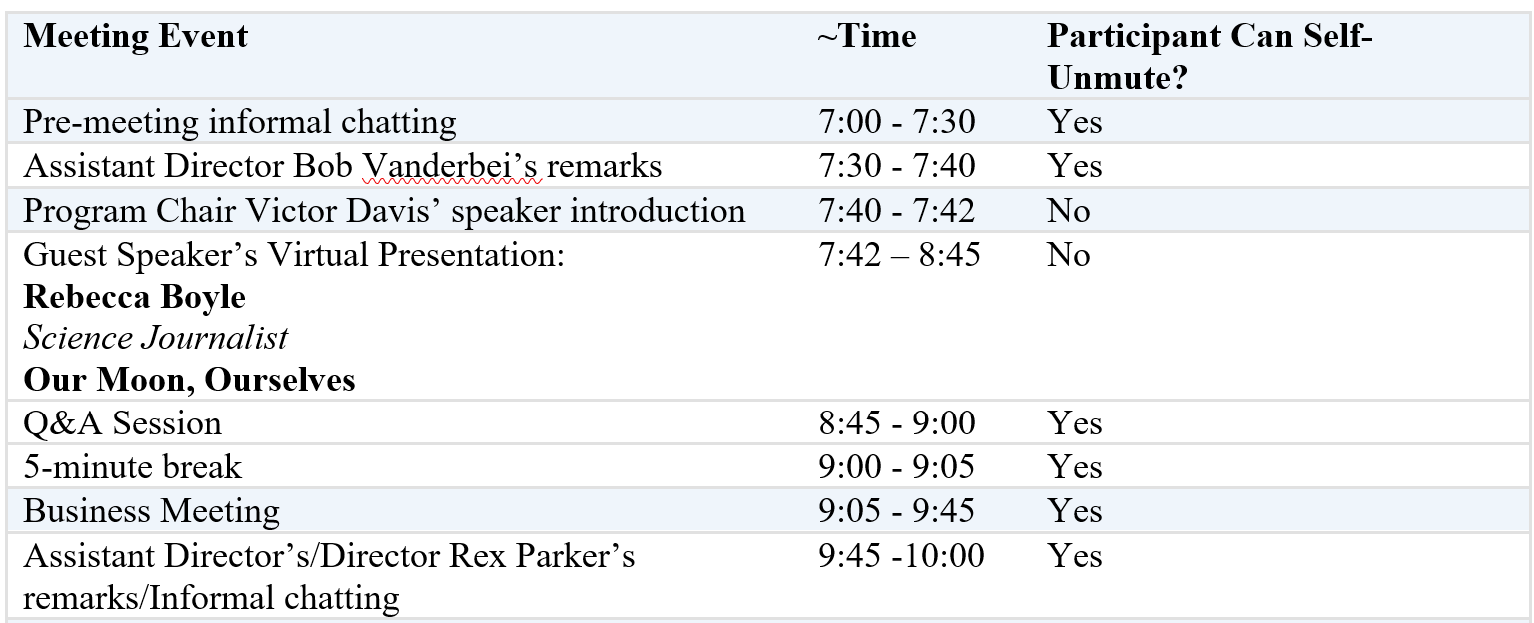
Here’s the anticipated agenda for January, 2025’s monthly meeting of the AAAP:
Getting to Peyton Hall
The parking lots across the street (Ivy Lane) from Peyton Hall are now construction sites, unavailable for parking. We’ve been advised by the administration of the astrophysics department that we should park in the new enclosed parking garage off Fitzrandolph street and walk around the stadium and athletic fields. Here’s a map of the campus and walking routes from the parking garage to Peyton Hall. The map shows the recently completed East Garage. Not shown is an access road Sweet Gum that connects from Faculty Road to an entrance at the lower left corner of the garage. Stadium Road connects from Fitzrandolph Road to another entrance at the opposite corner (and higher level) of the garage. It’s about a 10-15 minute walk from the parking garage to Peyton Hall.

Featured Speaker:
Rebecca B. Boyle
rebecca.b.boyle@gmail.com
Science Journalist
“Our Moon, Ourselves”
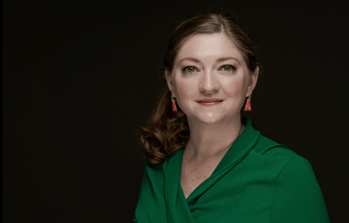
Our Moon, Ourselves
The Moon is one of Earth’s most unique features, and the two comprise what has often been termed a “double planet.” This unique pairing shapes all of the other things that make our planet special, from its geology to its multitudes of life, including us. Life might not have evolved on Earth at all without the Moon’s stabilizing gravitational influence and powerful tides. After we humans showed up, the Moon quickly became our primary way of telling time and organizing our lives. It shaped our understanding of our place in the universe, and helped us to invent forms of religious devotion and the process of science. The Moon plays a central role in our most famous wars, our greatest adventures, and our shared futures. And now, humans are trying to go back to the Moon’s surface — soon, and with plans to stay. We owe ourselves a thoughtful consideration of the Moon’s role in our history and our future. And what do we owe to our spectral satellite?
USA Today and ABA Indiebound Bestseller
NYT Book Review Editor’s Choice
*Longlisted for the 2024 National Book Award in Nonfiction*
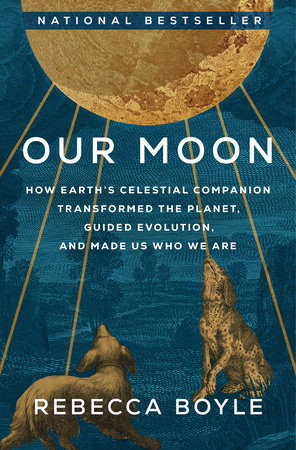
Rebecca Boyle
As a journalist, Rebecca Boyle has reported from particle accelerators, genetic sequencing labs, bat caves, the middle of a lake, the tops of mountains, and the retractable domes of some of Earth’s largest telescopes. Her first book, OUR MOON: How Earth’s Celestial Companion Transformed the Planet, Guided Evolution, and Made Us Who We Are (Random House, 2024) is a new history of humanity’s relationship with the Moon, which Rebecca has not yet visited on assignment. OUR MOON is a national bestseller and was longlisted for the National Book Award; is a New York Times Book Review Editor’s Choice; and is one of the New Yorker’s Best Books of 2024.
Based in Colorado Springs, Colo., Rebecca is a contributing editor at Scientific American, a contributing writer at Quanta Magazine, and a columnist at Atlas Obscura. She is a frequent contributor to the New York Times, The Atlantic, and many other publications. Rebecca’s work has been anthologized multiple times in the Best American Science and Nature Writing series, and she is the recipient of multiple writing awards.
How to Participate (Links)
Zoom
Topic: January 2025 AAAP Club Meeting – Rebecca Boyle
Time: Jan 14, 2025 07:00 PM Eastern Time (US and Canada)
Meeting ID: 860 8322 4764
Passcode: 005910


Click the above icons for Zoom and YouTube
| Date | Featured Speaker | Topic | |
| February 11, 2025 | Kimberly Burtnyk kburtnyk@caltech.edu  | AAAP member Aram Friedman and his family recently received a tour of the LIGO (Laser Interferometer Gravitational-wave Observatory) facility in Hanford, Washington. His guide was Kimberly Burtnyk, LIGO Laboratory Technical Editor and Web Content Developer. She’s agreed to (most likely virtually) give us a virtual tour of LIGO and explain what they do there and how and why they do it. Thanks to Aram for facilitating this presentation. |
As always, members’ comments and suggestions are gratefully accepted and much appreciated. Thanks to Ira Polans and Dave Skitt for setting up the online links and connecting the meeting to the world outside Peyton Hall.
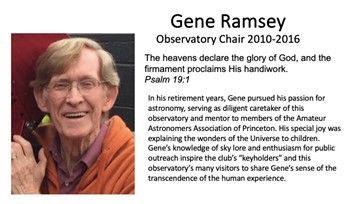
Gene Ramsey Memorial
Here’s a mock-up of the memorial to former Observatory Chair Gene Ramsey, who, I am embarrassed to say, died 8 years ago. We’re finally getting around to paying tribute to his contributions to our club with an engraved metal plaque, approximately 8 X 10 inches in size, which we’re planning to mount on an inside wall at the observatory. A brief ceremony with family and friends will kick off the 2025 public observing season this spring. Please let me know if you have comments or concerns
victor.davis@verizon.net
program@princetonastronomers.org
(908) 581-1780 cell


