SpaceX Falcon 9 Blasts Off to Geostationary Orbit

by Dr. Ken Kremer, Universe Today & AAAP

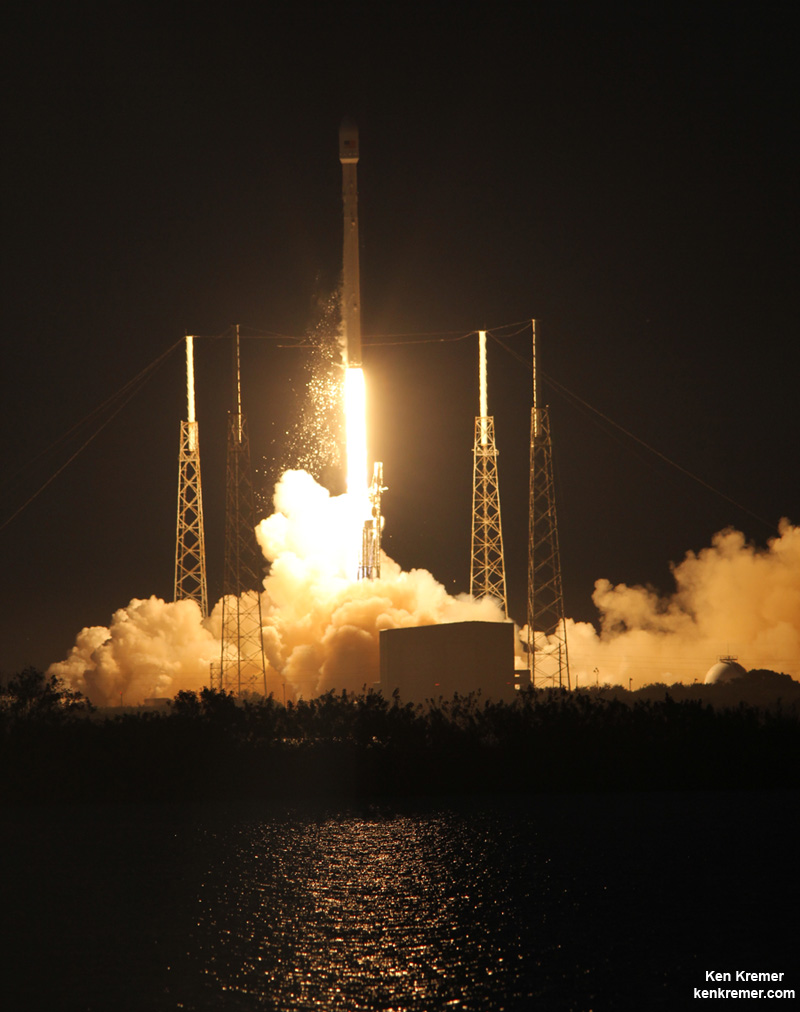
IMG_3792a_SpaceX SES-8 launch_Ken Kremer

SpaceX Falcon 9 Blasts Off with SES-8 Comsat. Credit: Ken Kremer

CAPE CANAVERAL AIR FORCE STATION, FL – Commercial space is taking off magnificently in 2013, and I’ve been fortunate to be an up close eyewitness to the hardware and launches in the new commercial space era, reporting for Universe Today.

SpaceX scored a spectacular launch success on Dec. 3 when the history making maiden flight of their upgraded Falcon 9 rocket scorched the evening sky of the Florida Space Coast and successfully delivered a commercial space satellite to geostationary orbit for the first time – thereby revolutionizing the commercial space industry from this day forward.

The Falcon 9 thundered off the pad at 5:41 p.m. EST from Launch Complex 40 at Cape Canaveral soon after sunset as the blistering roar rumbled deafeningly all across the coastal viewing area as I watched in awe.

IMG_5948_1a_SpaceX SES-8 launch_Ken Kremer

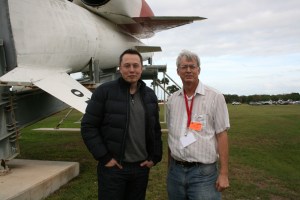
SpaceX CEO Elon Musk and Ken Kremer. Credit: Ken Kremer

The 6,918 lbs SES-8 satellite payload is a hybrid Ku- and Ka-band spacecraft that will give TV and communications coverage for Asia.  This new version of the Falcon 9 rocket has nearly 50% more thrust compared to the original Falcon 9. The firms future launch manifest of more than 50 flights worth billions of dollars were riding on a liftoff success.  Read more about the launch and my interview with SpaceX CEO Elon Musk at Universe here and here.

Orbital Sciences Next Launch: Jan. 8 from Wallops

Meanwhile the next Antares/Cygnus rocket built by Orbital Sciences and bound for the ISS blasts off from NASA Wallops (4.5 hours south of Princeton) in Virginia on Jan. 8 at 1:32 PM, having been delayed from December by ISS troubles. Open to the public! See viewing maps in my earlier story here and here .

Astronomy Outreach      by Dr. Ken Kremer

Rodeway Inn: Chincoteague Island, VA: Jan 6-8, Cygnus/Antares ISS Rocket Launch from Virginia.”

Please contact Ken for more info, science outreach presentations and his space photos. Email: kremerken@yahoo.com   website:  www.kenkremer.com, http://www.universetoday.com/author/ken-kremer/


Posted in January 2014 | Tagged , , , , | Leave a comment

From the Director

By Jeff Bernardis, Director

Looking back on the 2013 public observing season at the Simpson Observatory, one cannot help but notice that we had remarkably good luck with respect to the weather this year. The numbers of the public attending these sessions were higher than I have ever witnessed.  The success that we had this year would not be possible without the efforts of our keyholders.  I want to publicly thank all the keyholders for all that they did – let’s do it again next year.  I would also urge members who are not keyholders to volunteer and receive the training; it’s a good way to give back to the club. We can never have too many keyholders.

 At the last meeting, I asked for people to send me suggestions for what to do with the recently received donation.  This request was repeated in a membership-wide email for those who weren’t at the meeting.

I received several suggestions, and although I’m sure there will be additional discussion at the next meeting, there was a common theme among the suggestions so I think I see the direction this is headed.  The major points are as follows:

1.  Everybody suggested either selling or even giving away the dome and all of its parts.

Obviously we’d like to get some value for it, so perhaps a posting on Astromart would be in order here, or does somebody else have an alternate marketplace where we could list.  As I mentioned at the last meeting, the dome would have to be sold “as is”.  We cannot represent that we have everything needed to reassemble it.  This may diminish the value.

2.  Everyone also suggested that we chose the better of the two C14s and mount it on our existing Paramount.

We intend to have the new scope bench tested and can make this decision based on that result.

3.  All were in favor of having a camera at the observatory for use by members interested in astro-imaging.  Most suggested using the SBIG camera from the donation.  Rex suggested selling that camera and getting something more in tune with the C14 Fastar optics.

We would have to evaluate the economics here.  The donated camera might not be ideal, but it may suffice for what our members will want to do.

4.  There were several options for the new Paramount.

a.  Michael Wright suggested we keep it in reserve as a backup

b. Bill Murray suggested to simply mount the refractor on it in place of either the current Losmandy GM11 or the Gemini mount we have tried (unsuccessfully) to install.

c.  Of course there is the idea brought up by Rex at the last meeting about mounting both the C14 and the refractor on the new mount.  He has given us references to products that allow this to be done.  However, he also refined his suggestion.  Instead of tandeming the C14 with the refractor, he suggested selling whatever C14 we don’t use and buy something that is better paired with the refractor, and then mounting both on the new Paramount.

One thing to consider with two Paramounts in operation is that it might not be optimal to operate two scopes from the same PC.  I don’t think The Sky supports this, so we would have to run two copies simultaneously.  This might not even be possible.  The bottom line is that there may be additional computing needs.

5.  All other equipment should be sold.

All of these are good suggestions and we ought to be able to come to a resolution on some of them at the next meeting.   If anybody has any other suggestions, please let me know.

Posted in December 2013 | Tagged , | Leave a comment

From the Program Chair

by Kate Otto, Program Chair

A happy 2013 holiday season to all!  Thanks again to Rex Parker who gave the club a virtual tour of the University of Arizona’s Mt. Lemmon Sky Center at last month’s meeting.  The Mt. Lemmon Sky Center is an exceptional facility located at Steward Observatory’s “sky island” site just north of Tucson, Arizona.  The Sky Center builds on the extensive knowledge base at the University of Arizona’s Astronomy Department to deliver educational adventures to the public.  Since a number of our members expressed an interest, we are investigating a trip to Mt. Lemmon for a small group, more on this topic in the near future.

15b8

Thanks to those of you who volunteered to serve on the 2014 Program Committee.  A meeting invitation will be sent out once we have a convenient date for our first meeting.  I sincerely appreciate your input, ideas and involvement.

On December 10th, we will finish 2013 with a lecture by Derrick Pitts, Chief Astronomer of the Joel N. Bloom Observatory at the Franklin Institute.

Speaking of the Franklin Institute, you can see “Space Junk”, a short film highlighting the reality of satellite space debris and provoking thoughts on how to deal with it, currently showing there at their IMAX Theater.

Posted in December 2013 | Tagged , , , | Leave a comment

StarQuest 2014 – Volunteers Needed

by Michael Wright

Welcome astronomers

Welcome Astronomers. Credit: M. Wright

Save the date! We have reserved the Hope Conference Center for the weekend of September 26 to 28 for StarQuest 2014. This weekend is in the sweet spot between the hot, short nights of summer and the chilly, frosty nights of fall. We had to settle for the first weekend after new moon because the previous weekend was already taken. Even with the new moon up in the early evening, darkness will be longer than in the summertime.

To make StarQuest 2014 a full-blown celebration of astronomy, we need members to join in the planning. Ludy D’Angelo, Kate Otto, Jim Poinsett and I have already stepped up. How about you? If we have enough volunteers, we can have a swap meet, a raffle, a Saturday afternoon lecture and other interesting activities. If not, StarQuest 2014 will only be an observing event. If you are interested in helping, please send me an email or talk to me at the next meeting. Let’s make StarQuest 2014 one to remember.

Posted in December 2013 | Tagged | Leave a comment

Treasurer’s Report

by Michael Mitrano, Treasurer

As of November 29, 2013, paid membership for the current fiscal year is now at 53, which is very close to the membership level of a year ago. If you have not yet paid your dues, this giving season is the time to do so.

After the payment of our annual insurance premium that will be due in December, our year-to-date surplus will be about $700.

On a cumulative basis, the surplus is about $23 thousand.

Posted in December 2013 | Tagged , | Leave a comment

Minutes of the November 12, 2013 Meeting

by Michael Wright, Secretary

Director Jeff Bernardis opened the meeting and announced that the club has 2014 Astronomy calendars for sale at $10 each.

Program Chair Kate Otto introduced the speaker for the evening, member Rex Parker who presented “Galaxies, Comets, and Pixels from the High Desert” in which he talked about his recent astrophotography workshop with Adam Block at the University of Arizona’s Mt. Lemmon Sky Center. He showed images that he took with the 32-inch R-C Schulman Telescope and SBIG STX16803 CCD Camera and discussed the astrophotographic possibilities when using this equipment under dark skies. Members asked many questions about creating the images and the facility. Jeff suggested that the club should consider organizing a trip to Tucson.

After a brief break, Jeff convened the business portion of the meeting.

StarQuest – Michael Wright announced that the Hope Conference Center has been booked for September 26-28, 2014 for StarQuest. Ludy D’Angelo has agreed to cater the event if the club decides to self-cater again. Volunteers are needed to help organize the event if the club wants to have a speaker, raffles and other activities; otherwise, it will be only an observing event. Jeff suggested that a request for volunteers be published in Sidereal Times.

Sidereal Times – Mike W. announced that the deadline for Sidereal Times is Nov. 28. Also he needs the speaker’s information so he can send out the press release on Nov. 26.

Treasurer’s Report – Michael Mitrano said that there has been no substantial change in finances since the report in the November Sidereal Times. Dues are now past due. In January, he will send a reminder letter to any delinquent members, which usually brings in the remaining dues.

Program Chair’s Report – Kate Otto announced that the December speaker will be Derek Pitts, Director of the Franklin Institute’s Fells Planetarium. A Princeton graduate student will probably speak in January. John Grunsfeld, veteran of five Space Shuttle flights and former NASA Chief Scientist, has been invited to speak next year.

Simpson Observatory – Observatory Chair Gene Ramsey reported that he would be hosting 15 students from the Lawrenceville School at Washington-Crossing. He is training two new keyholders, who he expects to finish their training soon. This still leaves us about five short of the goal of having five or six keyholders on each team.

Gene requested permission to install a window in the computer room door, which sparked a debate about the need for a window in the door and a discussion about alternatives such as a camera. Jeff put the question to a vote and an overwhelming majority approved it.

Jeff said that the installation of the Gemini mount was cancelled. It was suggested that the work should be postponed until the spring due to the weather. Ludy reminded that the work was postponed last fall until the spring, and it still has not been completed. He urged that it be done now. The work was scheduled for November 26. Mike W. agreed to email a reminder.

Rex commented that public nights this year were very well attended. Jeff said that he would thank keyholders for their work in the next Sidereal Times.

Jen Skitt asked for help repairing the stereo system because it doe not produce any sound. Ludy volunteered to look at it. Gene confirmed that the microwave and cart were removed from the observatory.

New Observatory Donation – The dome, OTA, mount, camera, computer and other equipment was picked up from the donor. The dome is divided between Jeff’s garage and John Giles’ storage. John Miller has the computer. Ludy has the mount and OTA. Jeff said that the club should decide what to do with the donation so we are not imposing on these members to store the equipment. Gene asked if the scope has been tested. The answer was “No”. Ludy said the OTA is a Fastar version of the C14 that allows a camera to be mounted in place of the secondary mirror. It is very clean and appears to be well stored. The Paramount is almost brand new. Jeff said the dome is in pieces, and we do not know whether we have all the required hardware to reassemble it. If the club was to sell it, we would have to offer it as-is, which would command a lower price.

Rex questioned whether there is a committed group within the club that will see the project to completion. Jeff said that he was confident that the planning committee would have completed construction of the observatory, but he could not say whether they were still willing to do so after their plan was rejected. Rex said he thought the plan was fine but the concern of the membership was the commitment to complete the project.

Rex suggested the club look at alternative plans such as swapping out the existing C14 for the new one or mounting a C14 and the Hastings-Byrne on the new Paramount on the Hastings-Byrne’s pier. John Church and Rex debated whether it was feasible. Mike W. suggested that rather than try to engineer a scheme at this meeting, someone should prepare a list of alternatives for the next meeting. The best three or four alternatives could be select from that list and then their feasibility studied in detail. Jeff requested that members email potential alternatives to him.

Michael M. asked if the camera could be brought to the observatory so it could be tried on the existing C14. Rex suggested that it be tested on his scope. Ludy agreed to coordinate.

Outreach Report – David Letcher reported that the next outreach event on the calendar is Science Night at the Newell Elementary School in Allentown, NJ on Friday, November 15, 2013. The school is on High Street (CR 539).

Website – John Miller requested permission to increase the storage on the server from 1GB to 10GB, which will increase the annual cost from $39 to $77. The officers present agree to his request. John is also setting up a Flickr site to host the club’s photograph collection.

Jenny Jump Observatory – Bill Murray reported that the rotten wood was replaced and painted, and the electrical enclosure was repaired. He is going to put the equipment back on the scope. Chris Calli of UACNJ has agreed to monitor the observatory. Bill suggested that the club consider refurbishing the scope. One task that should be done is recoating the mirror, which would cost $100 to $200.

Jeff adjourned the meeting.

Posted in December 2013 | Tagged , | Leave a comment

Mangalyaan – India’s Passage to Mars

by Prasad Ganti

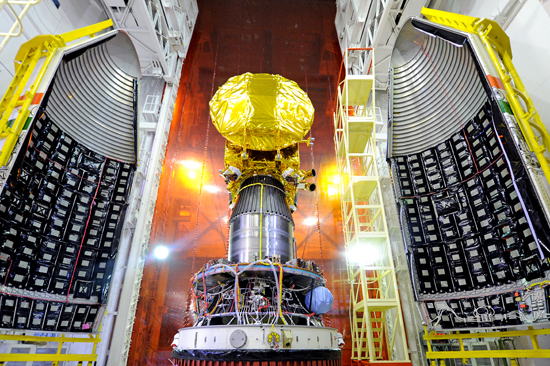
pslv-c25-25In the wake of the recent launch of MAVEN, the latest NASA mission to Mars, India’s space program is largely unknown to rest of the world, at least in the popular media.  At the beginning of November, India launched a spacecraft atop its Polar Space Launch Vehicle (PSLV). The destination is Mars, which is very challenging even for developed countries like US and Japan and a rapidly developing country like China. By the virtue of the sheer challenge, this launch is another milestone in India’s space history.

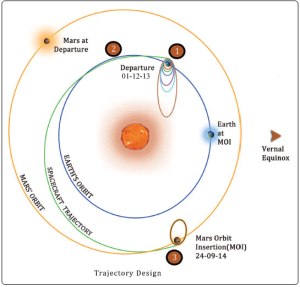
Mangalyaan or Mars craft was launched flawlessly and is now orbiting the Earth in a highly elliptical orbit.  The first critical maneuver will be the final boost to fling it towards Mars on December 1, 2013.  The second one will put it in Mars orbit on September 24, 2014. We could lose the spacecraft in either of these times. Until it reaches Mars, India will be waiting with bated breath, watching every day for news that the spacecraft is still alive and on course.  In addition to the bragging rights, the mission will help India get more sophisticated space launch business from other countries. Also, nationalities apart (I am proud of my motherland India and my adopted land US), overall it is good for humanity.

Ever since India launched the Aryabhata satellite in 1975, it has come a long way by building and launching more sophisticated satellites, and developing its own launch rockets with increasing payloads and higher orbits.  There has been no dearth of critics.  Some belittled the achievements by comparing the Indian Space Research Organization (ISRO) with NASA; some questioned India’s economic priorities; and some called India’s competition with China an Asian space race.  Clearly, ISRO cannot be compared with NASA, which has lot more resources and technology at its disposal even in times of dwindling space budgets.  Past space missions have helped India with communications, weather forecasting, and remote sensing and have created a business launching satellites for other countries.  Rather than being a pure science mission, Mangalyaan will add to India’s core technical capabilities.  I do not think Indian’s rivalry with China is a space race.  China is better in some spheres like putting a man in space, but lost the mission to Mars.

trajectory-design1

Like my physics professor used to say, we all are “prisoners of gravity”, meaning that Earth keeps us chained to its surface.  Escaping from Earth needs lots of fuel and powerful engines to generate the thrust.  Fuel is most of a rocket’s mass at launch time. By the time the rocket leaves the Earth’s atmosphere, which is about 60 miles above the Earth’s surface, most of its fuel is exhausted.

Most of car-sized Mangalyaan’s mass is its own fuel.  It has its own motors and fuel, separate from that of the launch rocket, PSLV.   The rest of the mass is scientific instruments, antennas, solar panels, etc.  Once in orbit around Earth, the satellite needs very little fuel to maintain its orbit, but the orbit must be adjusted to higher orbits of different shape before slinging it towards Mars. Consider this like an Olympic hammer thrower spinning faster and faster before flinging the hammer.  The spacecraft needs fuel for this purpose.  Once thrown towards Mars, the engines are shut down on the long journey.  Remember that Mars is not stationary during the trip. It is moving around the Sun like the Earth does.  The path which the spacecraft takes is carefully calculated to intercept Mars.

pslv-c25-20Mangalyaan is spending more time in Earth orbit before going to Mars. It gets incremental boosts during this time because the launch rocket was not very powerful. A PSLV rocket was used, which is meant for low orbit and low payload launches. The Geostationary Space Launch Vehicle (GSLV) is more powerful and can launch heavier payloads to higher altitudes, but there were a string of recent GSLV failures. The next GSLV test is sometime in December.

Once Mangalyaan approaches Mars, in September 2014, the engines are switched on by remote commands from Earth because it must slow down. There are no brakes on its wheels and no wheels either! Fuel is burned to generate reverse thrust to slow it down.  Slowing will enable Mars’ gravity to capture it.  If this capture fails, the spacecraft will fly beyond Mars and end up as space debris.  Mangalyaan does not have enough fuel to try a second capture like an airplane circling an airport and coming back for landing.  Once captured, some minor adjustments are required by burning more fuel.    Scientific observations using the onboard instruments can start after this stabilization exercise.

Mangalyaan will only orbit and will not land on Mars.  Landing is a very complex exercise needing a whole new level of sophisticated technology. Maybe Mangalyaan 2 will do it!

The spacecraft has its own intelligence in the form of computers and software because everything cannot be commanded from Earth.  Radio waves take 20 minutes to reach Mars from Earth, which means that each command would take 20 minutes to reach the spacecraft, and each response would take another 20 minutes to return. Direct control is not possible.

mars14In 2008-09, India successfully launched a lunar orbiter, Chandrayaan-1 or Moon Craft 1, which discovered evidence of water on the moon.  Mangalyaan was developed from technology tested during the Chandrayaan mission.  Five solar-powered instruments aboard Mangalyaan will gather data to help determine how Martian weather systems work and what happened to the water that is believed to have once existed on Mars in large quantities. Mangalyaan will also search for methane, a key chemical which can give clues about existence of life.

Only the European Space Agency, USA and USSR have succeeded so far. Good luck to Mangalyaan!

Photo Credits: ISRO
Posted in December 2013 | Tagged | Leave a comment

How to Buy Your First Telescope

by Michael Wright

Around the holidays, astronomers get asked by friends and family members about how to buy a first telescope.  In fact, the club received just such a questions last week from someone whose interest was sparked by a visit to our observatory.  I’ve put together this brief guide to help answer that question based on my research and experience.

Every experienced astronomer has an opinion about how to pick your first telescope. Here’s a sampling of some prominent ones:

Sky and Telescope Magazine
Astronomy Magazine
Ed Ting
Astronomical Society of Las Cruses
Royal Astronomical Society of Canada
Universe Today – Fraser Cain
Joe Roberts: here and here
Weber State University
Jay Reynolds Freeman

In addition to the above opinions, here are my own:

  • Before shelling out for a telescope, explore the night sky with your naked eyes and binoculars. Get outside and enjoy. Learn the constellations. This will test your enthusiasm for the hobby and give you a good introduction.  If you still want a telescope after a couple of months, then go ahead.
  • Find out what you will be able to see in a telescope.  The color photographs in astronomy books and magazine and found all over the Internet are produced using long exposures and large observatory telescopes or the Hubble Space Telescope. Views through an amateur telescope are very different.  Check out the sketches at Astronomy Sketch of the Day or the book Turn Left at Orion.  The pictures are more representative of what you will actually see.
  • Buy a reputable brand.  Meade, Celestron and Orion are the big three companies for beginner scopes.  This does not mean that other brands are bad.  Some companies like Tele-Vue and Takahashi specialize in high-end scopes more suitable for experienced observers.
  • Don’t buy a department store telescope. They are junk.  If you’ve received one as a gift and cannot return it, Joe Roberts explains how to correct their problems. Save your money until you can afford a quality scope.
  • Size counts. Buy the biggest aperture that you can afford.
  • Make sure that the mount is sturdy and stable.  A shaky mount will ruin the best optics.
  • Consider portability.  If you have to transport your scope, a smaller, lighter scope may be more appropriate because it will get used more. Also, available storage space may be a constraint.  Dobsonian mounted reflectors are often recommended as first scopes; however, they are bulky and heavy. I elected to buy a Meade ETX-90 for my first scope because I did not have the storage space for a Dob.
  • Include accessories in your budget because you are going to want eyepieces, filters, a finder, a cover, a dew shield, carrying cases, etc.  that usually do not come with the scope.
  • Consider buying used equipment.  Often good used equipment can be bought economically from someone who has upgraded to a better scope and no longer needs their first scope.  Astromart and Cloudy Nights run classified ads for amateur astronomers selling scopes.  I bough both my scopes and many accessories from Astromart ads.  Be sure to read their advice.
  • Go to a star party and try out some scopes. Most astronomers will let you look through their scope and tell you all about it.

GOTO mounts (a.k.a computer controllers) deserve a special mention because they are controversial. Some feel that reliance on GOTO mounts prevents users from truly learning the night sky. They prefer that observers star hop to objects and thereby learn the layout of the sky. Others feel that the convenience of GOTO mounts allows users to enjoy the night sky faster and avoid frustration finding faint objects. Should you pay extra for the convenience of the GOTO, or should you spend the money on more aperture?  The answer depends on your goals and needs.

So you decide to go slow and try using binoculars first.  How do you choose a suitable pair?  Binoculars are specified by magnification and objective size.  For example, 7×50 binos have a 50mm objective lens (the big ones in front) and magnify seven times. Weight is the most important feature because you have to be able hold them steady. Also, the size of the objective lenses is important because bigger ones will gather more light and let you see fainter objects; however, bigger ones are heavier.  You have to balance weight vs objective size.  Magnification is secondary.  7×42, 7×50, 8×40, 8×45, 8×50 or something similar would be a good choice for astronomy.  One other thing: make sure they have a focusing wheel.  I once had a pair that had a lever for quick focusing.  The lever made it difficult to get a good focus on stars and planets.

Highpoint Scientific, a NJ vendor, has pages for roof-prism and porro-prism binos.  These pages will give you an idea of reputable brands, weights and prices.  Also, you can hold some binos to see what would be a comfortable weight if you visit local sporting goods stores.

I hope this guide helps someone make the right choice this holiday season.  If I missed something or you have other opinions, I invite you to improve this article by posting a comment.

Clear skies and warm evenings to enjoy them.

Posted in December 2013 | Tagged , , | Leave a comment

The Best of Sidereal Times

by Michael Wright, Co-editor

When we scanned back issues of Sidereal Times for the 50th Anniversary Dinner, Surabhi and I found many lost gems buried in the archive. Occasionally, we will republish some. This is the first installment.

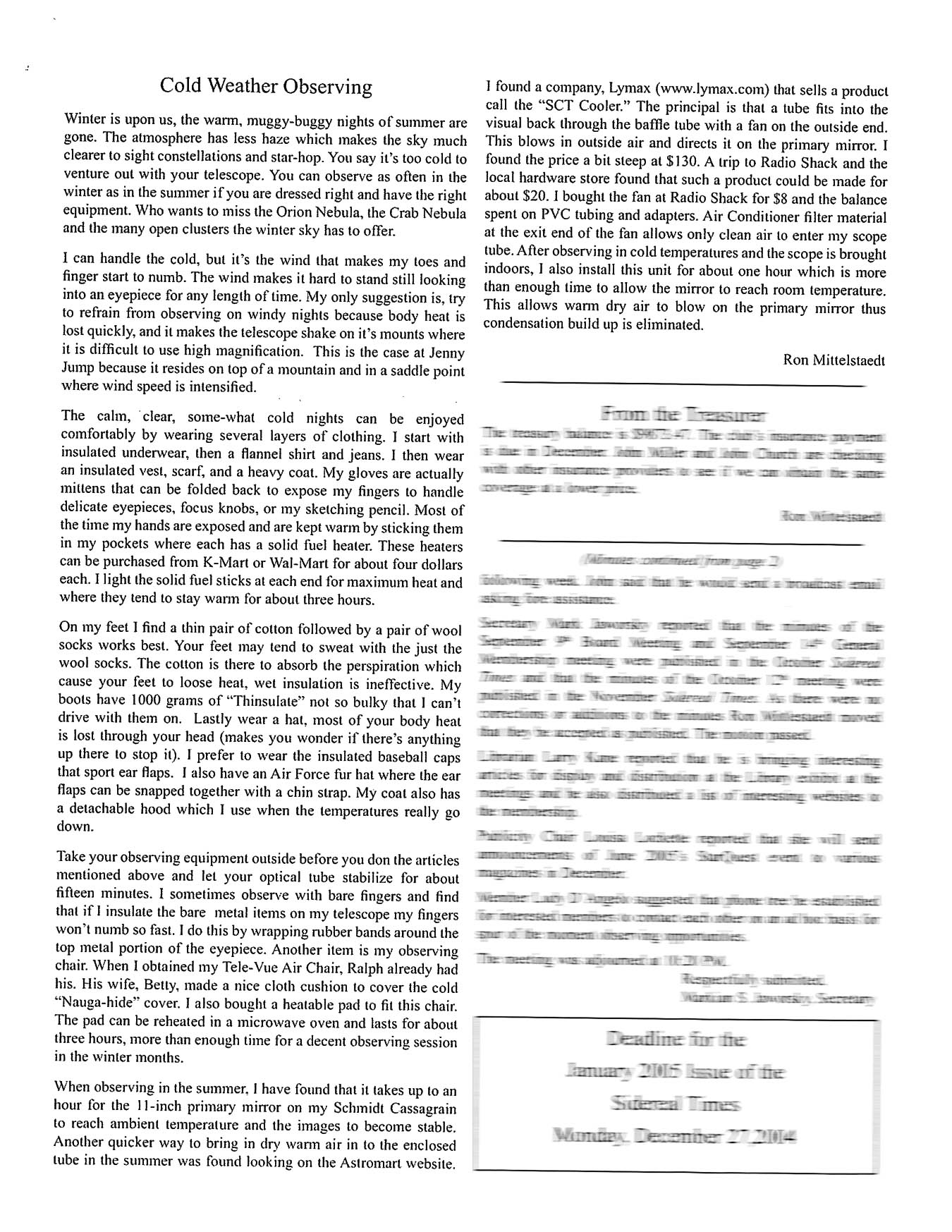
In December 2004, Ron Mittelstaedt wrote an article called Cold Weather Observing. With the recent cold snap presaging cold nights of winter, readers will probably find his advice useful.

Cold Weather Observing

Please click the image to read the article.

If anyone remembers any noteworthy articles that we should republish, please leave a comment.

Posted in Best of, December 2013 | Tagged , , | Leave a comment