NASA’s MAVEN Orbiter Soars to Space to Study History of Mars Water

by Dr. Ken Kremer:  Universe Today & AAAP

KENNEDY SPACE CENTER, FL – NASA’s Mars Atmosphere and Volatile Evolution (MAVEN) space probe thundered to space on Nov. 18, 2013 following a flawless blast off from Cape Canaveral Air Force Station’s Space Launch Complex 41 at 1:28 p.m. EST atop a powerful Atlas V rocket.
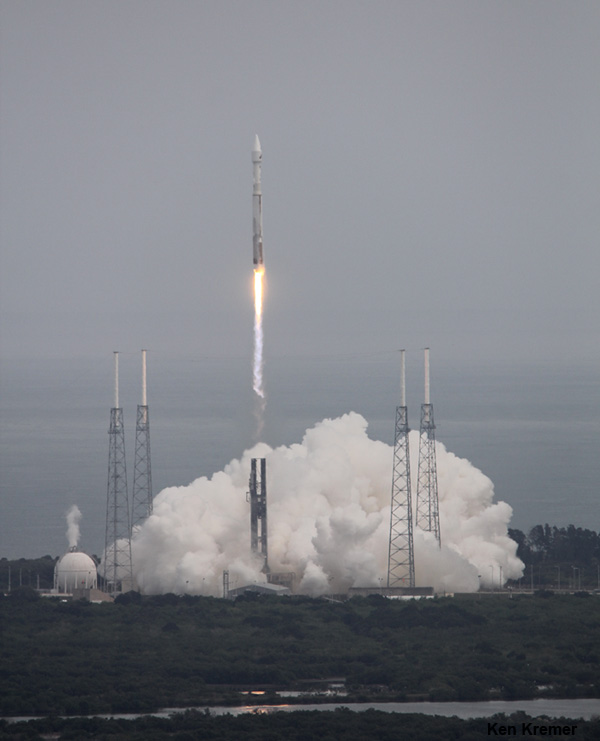
IMG_1870_2b_MAVEN launch_Ken Kremer

MAVEN launches atop Atlas V booster Credit: Ken Kremer

“Hey guys, we’re going to Mars!” gushed Bruce Jakosky, MAVEN’s Principal Investigator at a post launch briefing for reporters.

The countdown went off absolutely perfectly culminating in a spectacular and on time lift off that rumbled across the Florida Space Coast to the delight of cheering crowds assembled for the launch.

The $671 Million MAVEN spacecraft separated from the Atlas Centaur upper stage 52 minutes after liftoff, unfurled its wing like solar panels and thus began a 10-month interplanetary voyage to the Red Planet.  The spacecraft will reach the Red Planet on Sept. 22, 2014.

“We’re heading out to the Red Planet right now,” said MAVEN Project Manager David Mitchell of NASA’s Goddard Space Flight Center at the briefing, after the 5,400-pound spacecraft was safely soaring through space.

MAVEN’s purpose is to discover the history of water and habitability stretching back over billions of years on Mars and answer key questions about the evolution of Mars, its geology and the potential for the evolution of life.  Mars was once wet billions of years ago, but no longer.  Now it’s a cold arid world, not exactly hospitable to life.  MAVEN will measure current rates of atmospheric loss to understand how the Red Planet may have lost its atmosphere and water over billions of years.  Over the course of its one-Earth-year primary mission, MAVEN will observe all latitudes at altitudes ranging from 93 miles to more than 3,800 miles.

“We want to determine what were the drivers of that change?” said Jakosky.  “What is the history of Martian habitability, climate change and the potential for life?”

Read my Universe Today story for more about MAVEN:

Astronomy Outreach      by Dr. Ken Kremer

AAAP: Princeton University, Princeton, NJ: Dec 10, 8 PM,  “Upcoming Cygnus/Antares ISS Rocket Launch from Virginia.”

Rittenhouse Astronomical Society: Franklin Institute, Philadelphia, PA: Dec 11, 8 PM, “Curiosity, MAVEN and the Search for Life on Mars” and  “Antares ISS Rocket Launch from Virginia.” 

Rodeway Inn: Chincoteague Island, VA: Dec 17/18, Cygnus/Antares ISS Rocket Launch from Virginia.”

Dr. Ken Kremer:  Universe Today & AAAP

Please contact Ken for more info, science outreach presentations and his space photos. Email: kremerken@yahoo.com   website:  www.kenkremer.com, http://www.universetoday.com/author/ken-kremer/

Posted in December 2013 | Tagged , , | Leave a comment

From the Director

by Jeff Bernardis, Director

Based on the teaser that Rex showed at the last meeting, I am full of anticipation – both at Rex’s upcoming talk, and on the actual events to come in the sky over the next few months.

For those who were not there last month, Rex showed a video clip – perhaps 20 seconds in length – that showed comet ISON on its inward trajectory towards the sun. Although only a few seconds in length, it represented about 30 minutes of real time, and in that brief time, the movement of the comet against the background stars was readily observable. It was a fantastic video, and I look forward to the remainder of the story that Rex will provide us at the next meeting.

I also look forward to the comet itself. I wrote about this earlier, but in summary, the comet is currently inward bound. It is observable, but it won’t be at its closest to earth until after perihelion sometime around Christmas. Although there is some question about what will survive perihelion, this comet has the potential to be brighter that Hale-Bopp.

Changing subjects to the continuing saga of the observatory donation, we have acquired all of the items from the donation and will move forward with the testing the OTA to decide whether or not we want to swap it with the current C14 at Washington Crossing. The camera equipment, although somewhat dated, is also high quality and something that members of the club can readily use.

The real area of concern for me is the dome itself. When we picked it up, it was disassembled. The pieces are scattered to John Giles’ storage locker and to Ludy’s and my homes. Even not considering my own personal situation here, I do not want the club imposing itself on John and Ludy for an extended period of time. We need a resolution as to what to do with the dome – and selling it is an option – in the near term, hopefully before the end of our club year. We have never seen it in its assembled form, so we cannot represent that we have every nut and bolt needed to reassemble it. It would have to be sold “as is” which, to some extent, will compromise the price we can command.

Posted in November 2013, Sidereal Times | Tagged , | Leave a comment

From the Program Chair

Kate Otto, Program Chair

AAAP’s next meeting will be on Tuesday, November 12, 2013 at 8:00 p.m. in Peyton Hall. Member Rex Parker , PhD. (Indiana University, 1985, Biochemistry) will present “Galaxies, Comets, and Pixels from the High Desert” in which he will talk about his recent astrophotography visit to Arizona.

Rex Parker

Rex Parker

Rex is an avid amateur astronomer, astrophotographer and former director of AAAP, which he joined in 1993.

As member of the Hopewell Township Environmental Commission he helped write the township’s Outdoor Lighting Ordinance to help prevent light pollution near the AAAP observatory.

Professionally, Rex has been engaged in pharmaceutical research and cell & molecular biology for over 25 years at Bristol-Myers Squibb, currently as Senior Research Fellow in Cardiovascular Biology at the BMS Hopewell site. He has over 40 journal publications and led the discovery of the diabetes drug Saxaglitpin/Onglyza at BMS. His work includes biotechnology applications of optoelectronics and image processing, which fits perfectly with his long-standing interests in astronomy, astrophotography, and astrobiology. The observatory that he built in his backyard is equipped with a Paramount-MX, Celestron C11 and Takahashi-FS-128 telescopes and an SBIG-ST10XME camera. He enjoys CCD imaging deep sky objects & planets.

Posted in November 2013, Sidereal Times | Tagged , , | Leave a comment

From the Outreach Chair

by David Letcher, Outreach Chair

Well, star party season has started with our usual visits. Monday evening, October 28 saw us at the Linwood Middle School in North Brunswick showing Ms. McCarthy’s astronomy class a few sky objects. Unfortunately, there was a thin layer of clouds that prevented us from seeing a lot of objects but we were able to see Venus, the double double in Lyra, and a couple of globular clusters. Thanks to members Jeff Bernardis, Mary and Pat Hayes, David Zahler, Victor Davis and yours truly for volunteering!

Saturday evening, November 2 will see Gene Ramsey and some others visit South Hunterdon High School and do some stargazing with the school’s astronomy class.

Friday evening, November 15th will see a number of volunteers visiting Newell Elementary School in Allentown, NJ. This evening is part of their “Science-Live” night. The visit is one of our regular star parties and is very well attended! Let’s hope for clear skies and lots of volunteers!

Posted in November 2013, Sidereal Times | Tagged , | Leave a comment

Treasurer’s Report

by Michael Mitrano, Treasurer

StarQuest is behind us and member dues continue to come in. At this point, 41 members have paid – one person less than at the same date a year ago. If you’ve not yet paid, please send your check to the PO box.

Expenses have been modest so far this fiscal year, and year-to-date surplus is about $1,600.

On a cumulative basis, our surplus is nearly $24 thousand.

Posted in November 2013, Sidereal Times | Tagged , | Leave a comment

Minutes of the October 8, 2013 AAAP Meeting

by Michael Wright, Secretary

Director Jeff Bernardis opened the meeting by welcoming and recognizing new members.

Jeff announced that former Director Kirk Alexander recently passed away in his home in California after a battle with cancer. John Church remembered Kirk as one of the best AAAP Directors and noted that Kirk organized the 40th Anniversary Dinner. Rex Parker remembered Kirk had a 7-inch Questar on a Losmandy G11 mount that he brought to StarQuest.

Program Chair Kate Otto introduced the speaker for the evening, member Ken Kremer who gave an informative presentation entitled, “NASA’s LADEE and Cygnus Blast Off from Virginia” Ken presented eyewitness accounts of the recent historic rocket launches to the moon and the International Space Station from America’s newest spaceport at NASA’s Wallops Flight Facility in Virginia. He updated us on the latest NASA missions including MAVEN and the government shutdown’s impact on NASA’s operations.

After a brief break, Rex Parker gave a preview of talk that he will give at next month’s Member’s Night about imaging Comet ISON at recent astroimaging workshop that he attended given by Adam Block of the University of Arizona.

Jeff convened the business portion of the meeting.

New Observatory Donation – Plans are in the works to pick up the equipment from the donor’s storage facility on Saturday, October 12, 2013. Dome pieces will be stored in John Giles’ shed. Jeff had hoped to coordinate the pickup at this meeting, but will email or call the volunteers who were not in attendance.

StarQuest – Jeff observed that StarQuest was a success this year and asked for volunteers to organize next year’s event. Mike Wright said that he is willing to organize the event if Ludy will cater it again. Rex Parker suggested that the club hold it in the summer time. Gene Ramsey said that StarQuest was held in the summertime for few years. It was moved to the fall in the hope that weather would be better. The results have been mixed. Michael pointed out that it does not get dark until late in the summer. He will check with the conference center about availability on new moon weekends.

Assistant Director’s Report – Larry Kane reported that there is a “Friends of Washington-Crossing Park” group forming to support the park. The park administration asked AAAP to participate so Larry will be representing the club.

Secretary’s Report – Mike reported that he is setting up email boxes for the officers and committee chairs so they do not have to publicize their private email addresses. Also, he is creating a mailing list that can be used to broadcast emails to the membership. This will avoid the need to download the roster or maintain address books. Mike will maintain the mail list. Jeff said he liked the idea of a mail list for keyholders also.

Program Chair’s Report – Kate reported that the November will be a member’s night. Derek Pitts of Franklin Institute’s Fells Planetarium has agreed to speak in December.

Simpson Observatory – Observatory Chair Gene Ramsey confirmed that the Gemini mount will be installed on Saturday October 26, 2013 by himself, Rex and John Church.

Gene reported that recently 50-80 students and parents from the Chapin School visited the observatory. He requested that members bring their scopes to the observatory on nights when large groups are expected. Large school and scout groups are expected on October 11 and October 19, 2013. Gene said that new member Dan Vorgity, a teacher at South Hunterdon HS, brought his students to the observatory on August 30, 2013. He thanked Bill Murray for helping collimate their telescope that night. Dan said the administration, parents and students are excited about the new astronomy course that he is teaching. He thanked Gene and the club for their help.

Gene said he would like to get rid of the microwave and cart in the observatory. No one objected so he will dispose of it. He suggested that the club sell or donate the 8-inch Dobsonian and solar scope stored in the observatory. Jeff said that it’s important to have scopes available for member’s use so we should keep them.

Outreach Report – Jeff reported that the only outreach event on the calendar so far is Science Night at the Newell Elementary School in Allentown, NJ on Friday, November 15, 2013.

Jenny Jump Observatory – Bill Murray reported that 200-300 people completed the repairs to the observatories at Jenny Jump, including AAAP’s observatory. The rotten wood was replaced and painted, and the electrical enclosure was repaired.

Jeff adjourned the meeting.

Posted in November 2013, Sidereal Times | Tagged , | Leave a comment

The Higgs Boson, Relativity and Gravity Waves

by Prasad Ganti

The 2013 Nobel Prize in Physics was given to Peter Higgs of the UK and Francois Englert of Belgium for postulating a theory that predicted the Higgs boson. Nicknamed the “God Particle”, the Higgs boson is associated with the Higgs field that imparts mass to matter. The Higgs field exists everywhere, even in the vacuum of space. All matter weighs something due to the Higgs field, and the Higgs Boson acts as an intermediary. In 2012, evidence of the Higgs boson was found at the sophisticated Large Hadron Collider (LHC) at CERN, which accelerates protons to very high speeds using large amounts of energy.

The confirmation of this prediction follows the trend of past proposals and proofs. Let us consider Einstein’s General Theory of Relativity. Space becomes curved in the presence of gravity. Hence light, instead of travelling in a straight line, follows a curved path in the presence of gravity. The more intense the gravitational field, the more the bending. This leads to a black hole where gravity is so intense that light keeps bending and bending until it cannot escape out of the “hole”.

Arthur Eddington made a famous observation in 1919, which proved that the light does indeed bend in the presence of gravity. During a total solar eclipse, Eddington and his team measured the shift in position of a known star as it’s light passed nearby the Sun. The shift showed that the light from the star did bend in the presence of the massive Sun. The observation matched the theory perfectly, and Einstein became very famous for his “out of the world” theories. Einstein did get a Nobel Prize for Physics in 1921, but that was not for either the General or the Special Theory of Relativity. It was for the photoelectric effect, which is the basis for all the solar panels today.

Einstein’s General Theory of Relativity also predicts the existence of gravity waves. Massive and fast moving objects in the universe wrench the fabric of space-time and create these waves. Gravity waves should also exist from the time of creation of our Universe. None have been found so far. Will gravity waves to be discovered next?

There are two instruments built in the USA called LIGO (Laser Interferometer Gravity wave Observatory). One is in Louisiana, and another is in Washington State. Each observatory consists of two one-mile long arms constructed perpendicular to each other with laser beams running through them. When a gravity wave hits, it will change the length of one arm and cause an interference pattern. It has not happened so far. Probably the instruments are not sensitive enough to detect the waves or the Earth is obstructing the waves.

Two very sensitive instruments may be built in space using the same interferometry principle. One is called LISA (Laser Interferometer Space Antenna). Three satellites with very sensitive instruments will be positioned at the vertices of a large equilateral triangle. Each side of the triangle will be about a million miles long and positioned between the Earth and the Sun. The project is very expensive and funding is not committed yet. A competing cheaper version based on an atomic interferometer is being considered but is not funded either.

In these days of shrinking space budgets, neither of these projects may take off, but let us hope for the best that some day gravity waves will be discovered! Someday before I die, I would like to pen an article on the discovery of gravity waves!

Posted in November 2013, Sidereal Times | Tagged , , , | Leave a comment

NASA’s MAVEN Mars Orbiter Set to Launch on November 18

by Dr. Ken Kremer

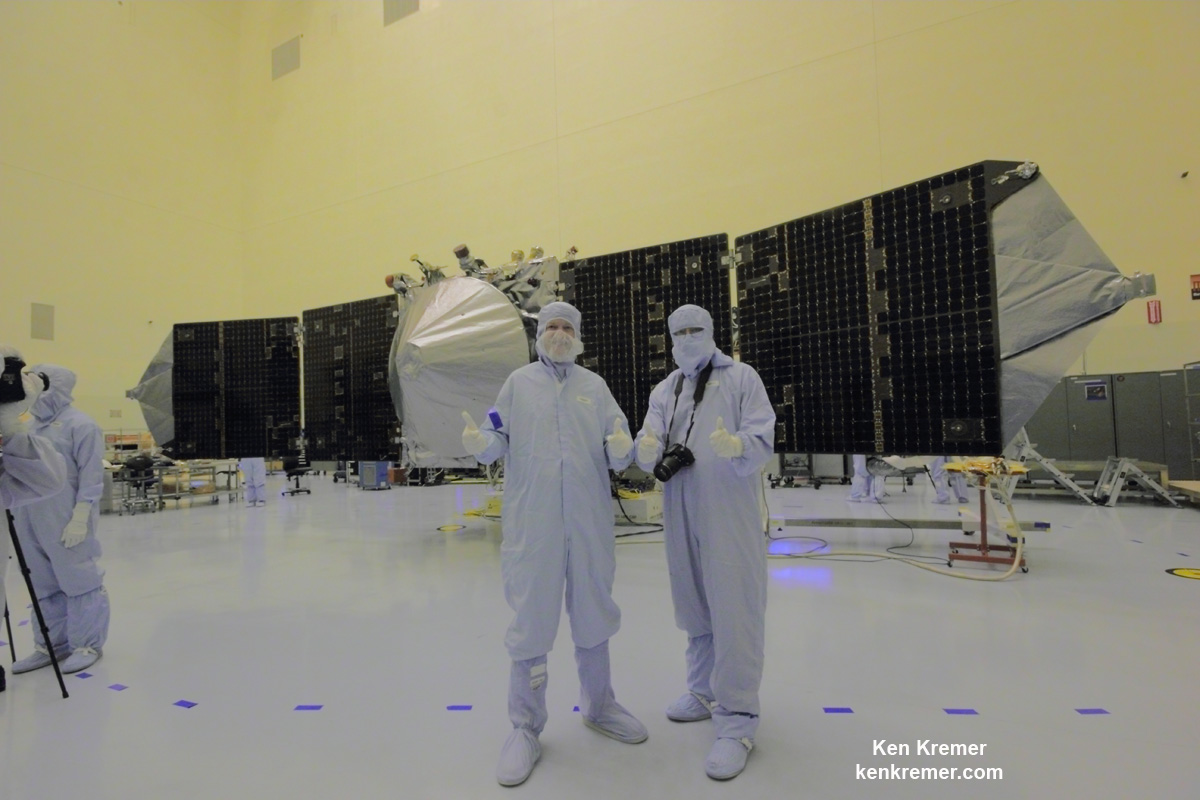
Bruce Jakosky and Ken Kremer stand before MAVEN Credit: Ken Kremer

Bruce Jakosky and Ken Kremer stand before MAVEN. Credit: Ken Kremer

KENNEDY SPACE CENTER, FL, – MAVEN (Mars Atmosphere and Volatile EvolutioN Mission), NASA’s next mission to Mars is scheduled to lift off on Nov. 18, 2013 from Cape Canaveral, Florida on an Atlas V 401 rocket. The 903-kilogram (2000-pound) probe will arrive at the Red Planet in September 2014 after a ten-month interplanetary voyage.

Maven is the first spacecraft from Earth devoted to investigating and understanding the upper atmosphere of Mars. “MAVENS’s goal is determining the composition of the ancient Martian atmosphere and when it was lost, where did all the water go and how and when was it lost,” said CU-Boulder’s Bruce Jakosky, MAVEN’s Principal Investigator in an interview at the Kennedy Space Center.

Scientists hope measurements from MAVEN’s suite of nine science instruments will help answer critical questions like whether the Martian atmosphere was once substantial enough to sustain liquid water on its surface and support life.

I personally inspected MAVEN inside the clean room at the Kennedy Space Center with Bruce Jakosky just prior to the partial shutdown of the US government on October 1. During the ultra-rare viewing opportunity, the solar panels were fully unfurled.

“MAVEN is on schedule and under budget.” said Jakosky as we stood a meter away from the nearly fully assembled spacecraft. “The solar panels look exactly as they will be when MAVEN is flying in space and around Mars.” “To be here with MAVEN is breathtaking,” Jakosky told me. “It’s laid out in a way that was spectacular to see!”

The government shutdown temporarily stopped all work but the mission was granted an emergency exemption after three days of no work. “We are working toward being ready to launch on November 18.” Jakosky told me. “We think it’s very feasible.”

Read more about MAVEN in my Universe Today story.

Posted in November 2013, Sidereal Times | Tagged , | Leave a comment

Juno Portrait of Planet Earth

by Dr. Ken Kremer

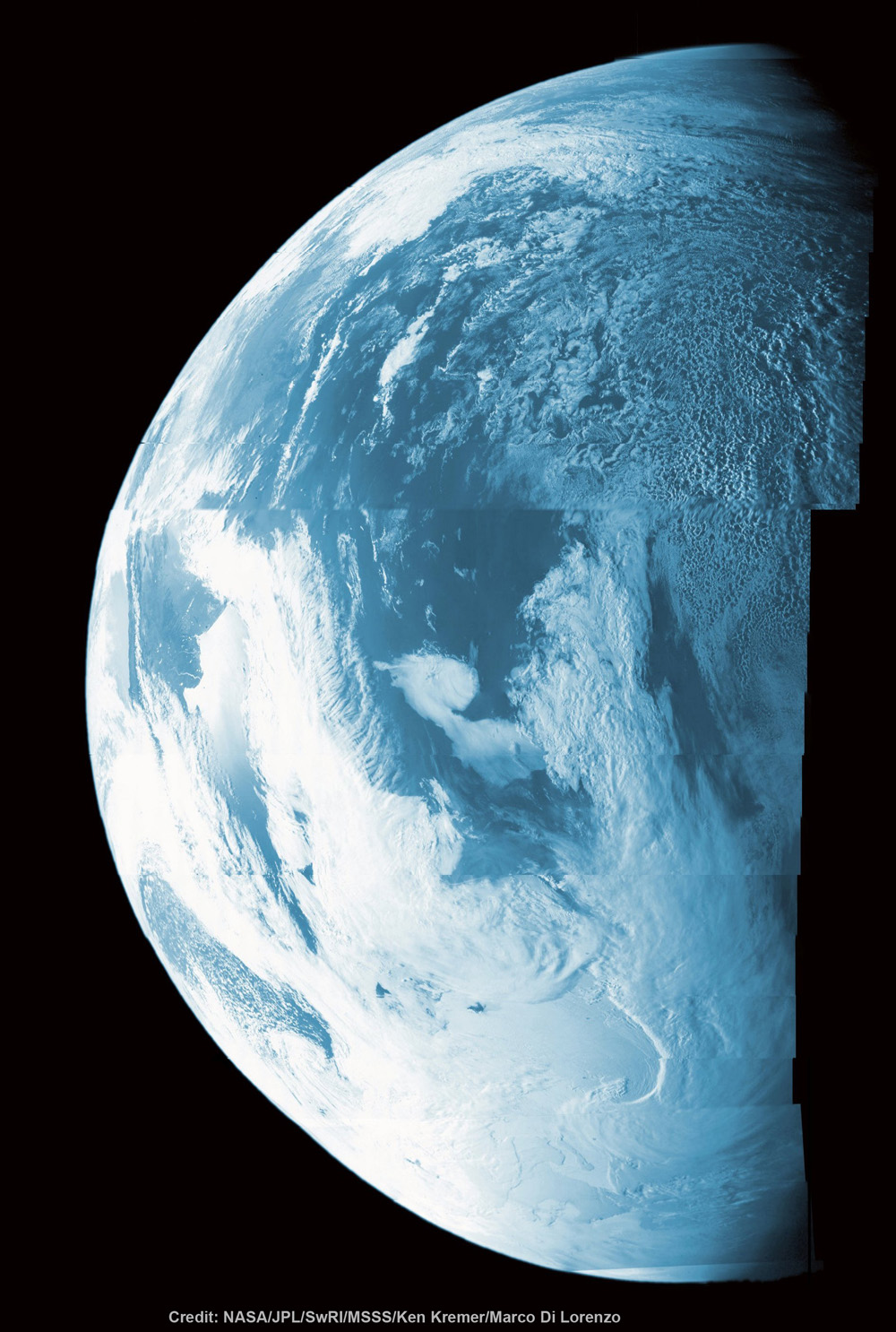
Junocam Earth Mosaic

Junocam Earth Mosaic

This false color mosaic assembled from raw images taken by the Junocam imager shows more than half of Earth’s disk over the coast of Argentina, South America and the South Atlantic Ocean as NASA’s Juno probe slingshotted by on Oct. 9, 2013 for gravity-assisted acceleration to Jupiter. Juno will arrive at Jupiter on July 4, 2016.

Astronomy Outreach by Dr. Ken Kremer
Rittenhouse Astronomical Society: Franklin Institute, Philadelphia, PA: Dec 11, 8 PM, “Curiosity, MAVEN and the Search for Life on Mars” and “Antares ISS Rocket Launch from Virginia.”

Rodeway Inn: Chincoteague Island, VA: Dec 14/15, “Cygnus/Antares ISS Rocket Launch from Virginia.”

Dr. Ken Kremer: Universe Today & AAAP
Please contact Ken for more info, science outreach presentations and his space photos.
Email: kremerken@yahoo.com website: www.kenkremer.com
http://www.universetoday.com/author/ken-kremer/
Posted in November 2013, Sidereal Times | Tagged , | Leave a comment