The Moon is a Harsh Mistress

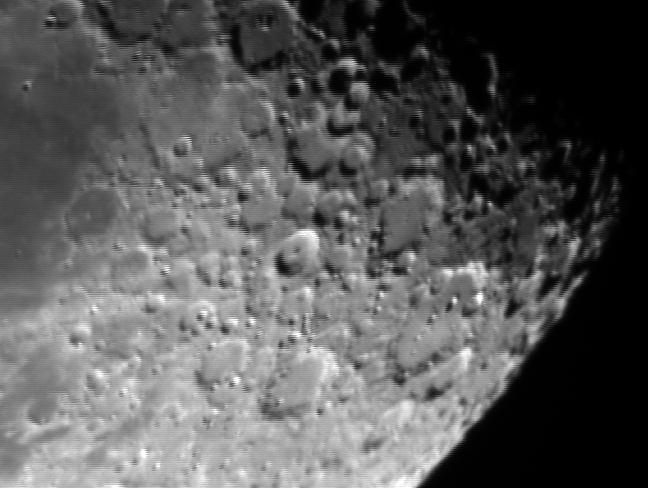
Moon0044Moon0014Member Jim Poinsett took these two shots of the moon this October as part of his first attempt at astrophotography from his backyard using his 8-inch LX-200 and Meade Deep Sky Imager. Well done, Jim!

Posted in November 2013, Sidereal Times | Tagged , | Leave a comment

From the Director

by Jeff Bernardis, Director

As most of you know by now, the Board has decided to withdraw its motion from last month seeking member approval of funding to build a new observatory to house a major donation that was being offered to us. A major part of the donation is a three meter aluminum dome, but it also includes a C14 SCT, a Paramount mount, and imaging equipment.

Before accepting the donation, we decided to make a plan for how we would utilize it, so for the past year or so, five or six dedicated members sought out quotes and approvals for a new observatory. That was the basis for the motion that we were to vote on last month, but the concerns raised at the last meeting brought me to the decision that we should convene a special Board meeting to discuss this matter and possibly amend our motion.

At that meeting, many non-board members voiced their concerns over the proposal. Some of the things we heard were:

  • The C14 SCT is not the best OTA for imaging
  • The planned observatory location would interfere with members bringing their own scopes, plus it would not have ideal horizons.
  • The imaging equipment is possibly outdated; it is approximately 10 years old.
  • Nobody really knows the state of the equipment. It’s been boxed up and sitting a storage facility for several years.
  • Sinking so much money into a facility that would serve a minimal number of members and yet would only be usable on a handful of nights each year is not prudent. We shouldn’t be spending half of our treasury on a single project like this.

I am sure there are many more objections that I’m overlooking. The bottom line is that this is a difficult decision to make. It is, in fact, a decision to be made by the general membership, but it has to be presented to the members as a board recommendation, and I couldn’t, in good faith, recommend that we proceed with so many unknowns and concerns.

I think it was John Miller who suggested that we should simply accept the donation and take stock of what we have. We had been focusing so much on the idea of building the observatory that we lost sight of the fact that the donation came without conditions, and we were not obligated by our acceptance to proceed with construction.

So what we have before us is the following. I have contacted the donor and told him we will accept his donation. He was pleased to hear it. In the next few weeks, we will be traveling down to Medford to pick it up. John Giles has kindly offered to store the dome. John Miller has offered to have the OTA bench tested. We still need to figure out how we will test the mount, and somebody needs to evaluate the imaging equipment.

The decision was NOT made to kill the observatory. That decision has been deferred, and we will face it again, probably in the next few months. We need to keep talking about this in the meetings. As Director, I feel the weight of being a fiduciary for your money. How you feel about expenditures, particularly of this magnitude, is very important to me. Let me know how you feel, both pro and con, so that when the time comes to evaluate this again, we won’t have as many surprises as we had at the last meeting.

Posted in October 2013, Sidereal Times | Tagged , | Leave a comment

Historic LADEE Lunar Orbiter and Antares/Space Station Rocket Launches

Our next monthly lecture will be “Historic LADEE Lunar Orbiter and Antares/Space Station Rocket Launches” by member and science ambassador Dr. Ken Kremer on Tuesday, October 8, 2013. The lecture will begin at 8:00 p.m. in Peyton Hall, 4 Ivy Lane on the Princeton University Campus.

Ken will present eyewitness accounts of the recent historic rocket launches to the moon and the International Space Station from America’s newest spaceport at NASA’s Wallops Flight Facility in Virginia. He will explain how the Fall 2013 launches of the Minotaur V/LADEE lunar orbiter and the Antares/Cygnus rockets were visible to tens of millions along the Mid-Atlantic coast for the first time. Ken will talk about how easy it is for New Jerseyans to witness rockets blasting off just a few hours south of Princeton. Also he will update us on the Curiosity rover and the future of NASA’s robotic and human spaceflight. Ken will have a selection of his space photos for sale.

kenkremerKen Kremer is a journalist, Ph.D. research scientist, speaker and photographer based in New Jersey. His space and Mars imagery and writings have been widely published on TV, magazines, books and websites including National Geographic, NBC, ABC, BBC and Fox News, PBS NOVA TV, Scientific American, APOD, NASA, Aviation Week, Astronomy, Astronomy Now, Space.com, Spaceflight Now, Spaceflight, New Scientist, The Planetary Society, Popular Mechanics, NASA Watch, Universe Today, Wired, Science News, All About Space, Space Quarterly, NPR, Mars Society, International Year of Astronomy, 2010 Year in Space Calendar and the covers of Aviation Week, Spaceflight and the Explorers Club magazines. His Curiosity Mars mosaic is on permanent display at the Smithsonian National Air & Space Museum in Washington, DC.

Dr. Kremer’s website: www.kenkremer.com.

Posted in October 2013, Sidereal Times | Tagged , | Leave a comment

From the Outreach Coordinator

David Letcher, Outreach Coordinator

Ms. Stephanie Williams of the Newell Elementary School in Allentown, NJ has invited us to participate in their science night on Friday, November 15, 2013. This is one of our regular star parties. We have been going there for years. Let me know if you can volunteer. Bring your telescope so we can show the children and their parents the night sky.

My annual fall lectures on backyard astronomy resumed last Friday evening, September 20th. This is the third year for me. These lectures are held at the Nature Center at Washington’s Crossing State Park. We had 18 people in this first session! After the lecture ended at 8:30 p.m., we all walked over to the observatory for an evening of viewing in a very clear, but moonlit sky. Everyone had a great time. We observed M57, the moon, and the Mizar-Alcor system in the handle of the Big Dipper. Some of the volunteers showed people how to identify some constellations, but the brightness of the moon made that a bit difficult.

Many thanks to Larry Kane for assisting me during the lecture and to Gene Ramsey and the team during the observing session. I will present two more successive Friday evening lectures this fall.


Posted in October 2013, Sidereal Times | Tagged | Leave a comment

Treasurer’s Report

by Michael Mitrano, Treasurer

It is early in our fiscal year, but StarQuest has taken place and had a $427 surplus, based on expenses so far received. Total revenue for the event was $1,680, close to that of 2010 and 2008.

Otherwise, expenses since July 1 have been modest. As of September 21, 23 members have paid dues for the current fiscal year. If you are not among them, please send yours along.

On a cumulative basis, our surplus remains about $23 thousand.

Posted in October 2013, Sidereal Times | Tagged , | Leave a comment

Minutes of the September 10, 2013 AAAP Meeting

by Michael Wright, Secretary

Director Jeff Bernardis opened the meeting by welcoming and recognizing new members.

Jeff announced that PPL will be holding a series of colloquia. Interested members can email him for details. Also, he announced that 2013-14 dues are now due. Checks can be given to Mike Wright or Michael Mitrano.

Program Chair Kate Otto thanked the 50th anniversary volunteers for organizing the event. She mentioned that those who attended enjoyed StarQuest held the past weekend. Kate then introduced the speaker for the evening, Clayton Meyers of PPPL, who gave an informative presentation entitled, “The Quest to Understand the Sun and the Space Weather It Produces” in which he discussed the composition of the sun, the constellation of solar-observing satellites, and the importance of space weather research.

After a brief break, Jeff reconvened the business portion of the meeting.

Treasurer’s Report – Michael Mitrano said that he is receiving dues and waiting for receipts from StarQuest so he had no report this month.

Jenny Jump Observatory – Delegate Bill Murray reported that a scout troop will make repairs to the observatories at Jenny Jump, including AAAP’s observatory, at no cost to the clubs. Bill will remove small objects from the observatory and protect the equipment with a tarp. Bill would like to rehabilitate the scope. Jeff asked him to prepare an estimate of the scope rehabilitation costs for the Board’s consideration.

Simpson Observatory – Observatory Chair Gene Ramsey said that he is training two new keyholders, but five new keyholders are needed to fill the current vacancies. Jeff suggested contacting new members to see if they are interested in volunteering.

Gene reported that Officer Jackson of the Park Police told him that there was a break-in at Jenny Jump and suggested that a motion activated camera be installed. Officer Jackson said that video is sometimes helpful in recovering the stolen equipment. John Giles will investigate.

Gene gave an update on the traffic on Friday nights as follows:

  • If there are only a few campers, he invites them to the observatory and allows vehicle access from the soccer fields. Jeff said that he had been doing the same on his duty nights.
  • On Nov. 1, the park will move AAAP’s lock to the 1st soccer field gate so access will be from the soccer fields after that date until next spring.
  • Brick Yard Road access is not viable because the road is too narrow for two-way traffic particularly at the bridge. AAAP had no problems with campers until last year so the park administration should considered our record when considering future access plans. Jennifer Skitt started a visitor log, which would be useful for showing the park administration level of public participation at the observatory.

Gene thanked Jen and David Skitt for their help at the observatory this season. He thanked Ludy D’Angelo and Michael Wright for organizing StarQuest.

Outreach Report – Coordinator David Letcher reported that no schools have contacted him yet because the school year is just starting. David will be running his four part Backyard Astronomy seminar at the Nature Center on September 20 & 27 and October 4 & 11. Gene Ramsey and Larry Kane will assist. Each class will be followed by observing at the observatory, weather permitting.

Gene Ramsey reported that he is working with a teacher from South Hunterdon Regional High School who is starting an astronomy club for students. The high school has a 10-inch LX-200 SCT. Gene will be training the teacher and 10 students on their scope at the observatory on Saturday, Sept. 14, weather permitting. Bill Murray volunteered to help.

Secretary’s Report – Michael Wright said that the Wikipedia article about the club that he submitted was rejected and asked for help finding published independent references to the club that could be added to the article to verify information and demonstrate notability. Also, he did not set up a Mail Chimp account because the Wikipedia article was taking more effort than expected. The submission deadline for the next issue of Sidereal Times is Sept. 26, 2013.

New Observatory at W-C – Jeff announced that at the July 9, 2013 Board meeting, the Board approved a recommendation to appropriate funds for the construction of a second observatory structure at Washington-Crossing State Park. Michael Wright said that the club has 103 paid members. An affirmative vote of 30% of the membership (31 votes) is required to pass the proposal. A count revealed only 27 members present.

Michael Mitrano, New Observatory Committee Chair, began a summary of the status of the observatory plan. After receiving conflicting information from the NJDEP and the Hopewell Twp. Code Enforcement Officials, the committee determined that building permit approval is required from the Department of Community Affairs. According to a DCA official, this is a minor project. If the proposal is approved, the next step is to apply for the permits.

Ludy D’Angelo and John Miller objected that not enough information was provided for the membership to vote on the proposal. Michael Wright said the proposal was published in Sidereal Times and information was provided in the Board Business meeting minutes. Jeff stated that the usual channels were used to disseminate information to the membership.

Michael Mitrano explained that the project has been under consideration and was discussed at several business meetings since the donor approached the club over a year ago. Michael summarized the history of the project. The donor once owned the Bridgewater Hill Observatory in Vermont, which he tried to operate remotely. He would like to donate the dome, a C14, a Paramount, a camera and other electronics from the observatory to a non-profit. It is currently in storage in Medford. The donor is running out of funds to pay for storage and is anxious to dispose of the equipment. Jeff and Ludy visited the storage facility to see the equipment last year but were unable to do a thorough inspection because the equipment was crated. The feasibility of installing the donated equipment at Jenny Jump was initially considered, but rejected because it was too far away.

The Board formed a committee of five volunteers to investigate constructing an automated observatory at Washington-Crossing for astrophotography. A round wood-framed structure on a concrete pad was seen as less desirable because of the maintenance required. Plans for a nine-foot diameter, five-foot high, octagonal block structure on which the dome could be mounted, as well as for the frame alternative, were developed. Three quotes were obtained for the masonry portion of the work, and NJDEP’s approval was sought. The working group determined that the observatory was feasible and affordable so they recommend funding construction to the Board. At the July 9, 2013 Board meeting, the Board voted to recommend that the membership approve $12,000 to fund construction, which would also cover permit fees and the cost of extending the electrical service from the existing observatory.

The members present held a lengthy discussion about the project. Objections and endorsements are summarized as follows:

Objections:

  • The proposed location is too close to the existing tree line that blocks views of the western horizon. Several years ago, the east side of the observatory was cleared in anticipation of constructing an observatory there. Members set up their scopes on the west side on public nights because the eastside get too much light from visitors’ headlights.
  • A camera on the existing C14 or fee-based online remote imaging should be tried before committing to another observatory.
  • The condition of the donated equipment is unknown so it may need repairs. Before committing to taking it, the equipment should be inspected. If repairs are needed, the cost should be included in the proposal.
  • A full implementation plan has not been prepared that considers all potential costs such as equipment repairs and equipment storage until the structure is ready (estimated at $100 per month).
  • Astrophotography, particularly at an auto-mated facility is difficult and time consuming. Do the interested members have the dedication to construct the observatory and negotiate the steep learning curve required to make the equipment operational?
  • If one can buy a shed for $1000, why is the cost so high?
  • Not enough members are interested in astrophotography.

Endorsements:

  • Members who are familiar with the site because they participated in the original observatory construction recommended the proposed location. The existing water line, existing observatory sight lines and proximity to the trees were considered. The proposed location conceals the observatory from the road. The building orientation puts the door conveniently near the existing observatory. The structure could easily be put on the other (east) side of the Simpson observatory
  • Members working on the project are committed to completing it.
  • The club needs to look to the future, not rest on its laurels. This project will inspire younger people to join.
  • The donor will not wait forever. The club has had the offer for over one year; we owe him a decision.

Jeff acknowledged that the club was divided on the proposal and could not reach a decision anyway because there was no quorum. He suggested that the Board hold another meeting to give the membership another opportunity to review and discuss the details of the plan. The proposal could be amended if necessary, and brought before the membership for approval at the October 8, 2013 meeting. The consensus was that this was a good suggestion. Jeff will try to obtain a conference room in Peyton Hall next week, and notices will be emailed to the membership.

Gemini Mount for Refractor: John Church, John Giles, Rex Parker & Gene Ramsey volunteered to install the mount on October 26, 2013, weather permitting.

Jeff adjourned the meeting.

Posted in October 2013, Sidereal Times | Tagged , | Leave a comment

Minutes of the September 18, 2013 Board Meeting

Submitted by Michael Wright, Secretary

Attendees:
Jeff Bernardis, Director                        Gene Ramsey
Larry Kane, Assistant Director            Brian Van Liew
Michael Mitrano, Treasurer                 Bill Murray
Michael Wright, Secretary                   John Giles
Saul Moroz                                              Ludy D’Angelo
Ira Polans                                                John Miller
Prasad Ganti                                           John Church
Jennifer Skitt           

Director Jeff Bernardis opened the meeting.

Jenny Jump Observatory – Bill Murray reported that he made preparations for the scouts to make repairs to AAAP’s observatory at Jenny Jump. He gave his key to UACNJ, removed equipment from the observatory, and wrapped the scope in a tarp. He suggested that a member be present when the repairs are made.

Bill reported that UACNJ dues for member clubs will increase to $35 plus $1 per member, but capped at 100 members or $135. Individual memberships will increase to $40.

Security Camera at Simpson Observatory
Gene Ramsey reported that Officer Jackson of the park police told him that there was a break-in at Jenny Jump and suggested that a motion activated camera be installed in the observatory. John Giles reported that he research suitable cameras. They range from $100 to $1000. He felt that a suitable one could be purchase for about $350. The group discussed the features that the camera should have. Jeff asked John to bring his recommendation to the next club meeting. Michael Wright asked for the specifications to be emailed so that interested members could review them before the meeting.

New Observatory at W-C – Jeff said that the purpose of this special Board meeting was to increase member’s knowledge about the proposal to build a second observatory at Washington-Crossing Park because the general membership must vote whether to move ahead with the project. The five member planning committee has done an excellent job of researching the project’s feasibility, obtaining quotes, shepherding it through the approval process and keeping the club informed. Michael Mitrano clarified that according to the by-laws, the Board has to recommend funding of this magnitude. Approval of 30% of paid members is required to spend the funds.

Holding a straw vote at the October meeting to test member’s opinions was briefly discussed, but discounted because it would delay making a decision. Jeff felt that the club owed the donor an answer soon because we have been considering the donation for more than one year. Michael M. pointed out that permits still must be obtained before construction can start, so delaying a decision would push construction to the spring.

Ludy D’Angelo said that the club is building the observatory around the donated equipment. Is it worth spending this much additional money to use the donated equipment? The scope and mount are about ten years old, and they are same as the C14 and Paramount in the existing observatory. He suggested that the club should decline the donation, or accept the donation and sell the equipment.

Brian Van Liew and John Church asked whether the scope and mount are in workable condition. Jeff and Ludy visited the storage facility with the donor last year, but could not inspect the equipment because it was boxed. Michael M. said that the owner represented that the equipment was in working order when he shipped it from Vermont to NJ.

Jeff suggested that the club take possession of the equipment before proceeding with the observatory construction.

Saul Moroz asked for the cost. Michael M. explained what the $12,000 would fund: construction of the masonry structure, ring to support the dome, installation of a door and electrical service, and permit fees.

Saul proposed an alternative. He has an acquaint-ance who could make a 33-inch, f/3.3 mirror for the club. A Dobsonian scope could be made with this mirror for about $2000. It could be housed in an inexpensive shed at Washington-Crossing.

Ludy questioned why the club needs an expensive structure. Michael M. explained the need to mount the dome on a sturdy structure. An octagonal block structure the same diameter as the dome is the most economical solution because other materials, shapes and sizes would be difficult to construct and maintain.

John Miller endorsed the idea of accepting the donation and picking up the equipment before proceeding with construction.

Jeff reiterated that the club owes that donor an answer. He said we would need a place to store the equipment until the structure was ready.

John C. asked whether the club has to take the whole donation. Michael M. replied that we have not asked the donor; however, the answer would probably be “Yes.”

John G. volunteered to store the dome pieces in his 10’x10’ shed.

Ludy reiterated that the donated C14 and Paramount are the same age as the ones at Washington-Crossing.

Brian said a C14 is not an imaging scope. He suggested selling the C14 and buying another scope if imaging is the goal.

Michael M. said that the donor is anxious to unload the equipment and is not in a position to impose conditions on its use by the club. He questioned whether members will have this same discussion in a few months if we only accept the donation now and not make a decision to fund the project.

Ludy questioned the need for a permit for a structure this size. Michael M. replied that the lease requires park administration approval of any structures. The committee had many conversations with the NJDEP who administers park, Hopewell Township and the Department of Community Affairs. The conclusion was that a DCA construction permit is required.

John M. questioned the value of the observatory to the members and whether it will serve the intended purpose.

Ludy reiterated that the equipment is 2003-2006 vintage. Technology has advanced a lot since then.

Brian asked whether anyone has seen any photos taken with the equipment. Jeff said that the donor showed them some black-and-white pictures. Bill M. pulled up the photos on the donor’s website and showed them to Brian.

The group had a lengthy discussion about the location of the structure at the observatory. Michael M. said the site was selected in consultation with club members who are familiar with the original observatory construction and the site. He presented his estimates of sky visibility from the proposed location, the existing observatory and the east side of the property. Other factors considered were the use of the west side for by members on Friday nights, light from visitor’s headlights, the existing water line location, the ease of running electrical service and the visibility to thieves. The group did not reach a consensus about the best location.

John C. questioned whether it is feasible to have Internet service at the observatory. Michael M. said that one of the planning committee members proposes a cell-based system that he has installed in other locations. The service cost is about $30 to $40 per month, which is cheaper than the current phone service. VOIP could replace the existing phone.

Ludy said that remote astroimaging is very difficult to do. Brian agreed and added that sky conditions are only suitable for imaging about 10 nights per year. Michael Wright suggested that the new observatory would have other uses. Michael M. described how a video feed could be provided for visitors on public nights.

Bill reiterated that running a remote observatory is not “push button” easy. Saul reminded that remote observatories like New Mexico skies have on-site staff who fix mechanical problems for the users. Also, he said that many users on the Observadome forums report that they have not perfected remote operations after owning domes for four or five years.

Jeff polled the Board members present whether the motion to fund the project should be withdrawn. All agreed that it should be withdrawn.

Jeff suggested that the club accept the donation. The consensus was this was the best course of action because the equipment could be checked before committing to spending money on the observatory.

John M. suggested that Michael Carr would bench test the C14.

Ludy asked whether the donor still had the funds that were supposed to accompany the equipment. Michael M. said that he has probably used the funds to pay for storage.

John Giles, Saul Moroz, Ludy D’Angelo, John Mil-ler, and Larry Kane volunteered to pick up the equipment and transport it to John Giles’ shed. The group discussed the logistics of transporting the equipment, which was followed by a brief discussion about field-testing the Paramount. Jeff authorized the volunteers to rent a truck to move the equipment if necessary.

John C. said this reminded him about how the club acquired the refractor 40 years ago. It had been exposed to the elements and was in poor condition. No one wanted it, but he collected it and stored it in his garage. The scope was restored and is now a treasured instrument.

Michael W. will prepare an email to the membership about the results of the meeting.

Jeff adjourned the meeting.

Posted in October 2013, Sidereal Times | Tagged , , | Leave a comment

Observing Barnard’s Star

by Robert J. Vanderbei

Barnard’s Star is one of the closest stars to us. It is also the star that has the fastest apparent motion across the sky moving about 11 arcseconds per year. With a right ascension of 17h 53m 26s, it reaches opposition on the night of the summer solstice: June 21st.

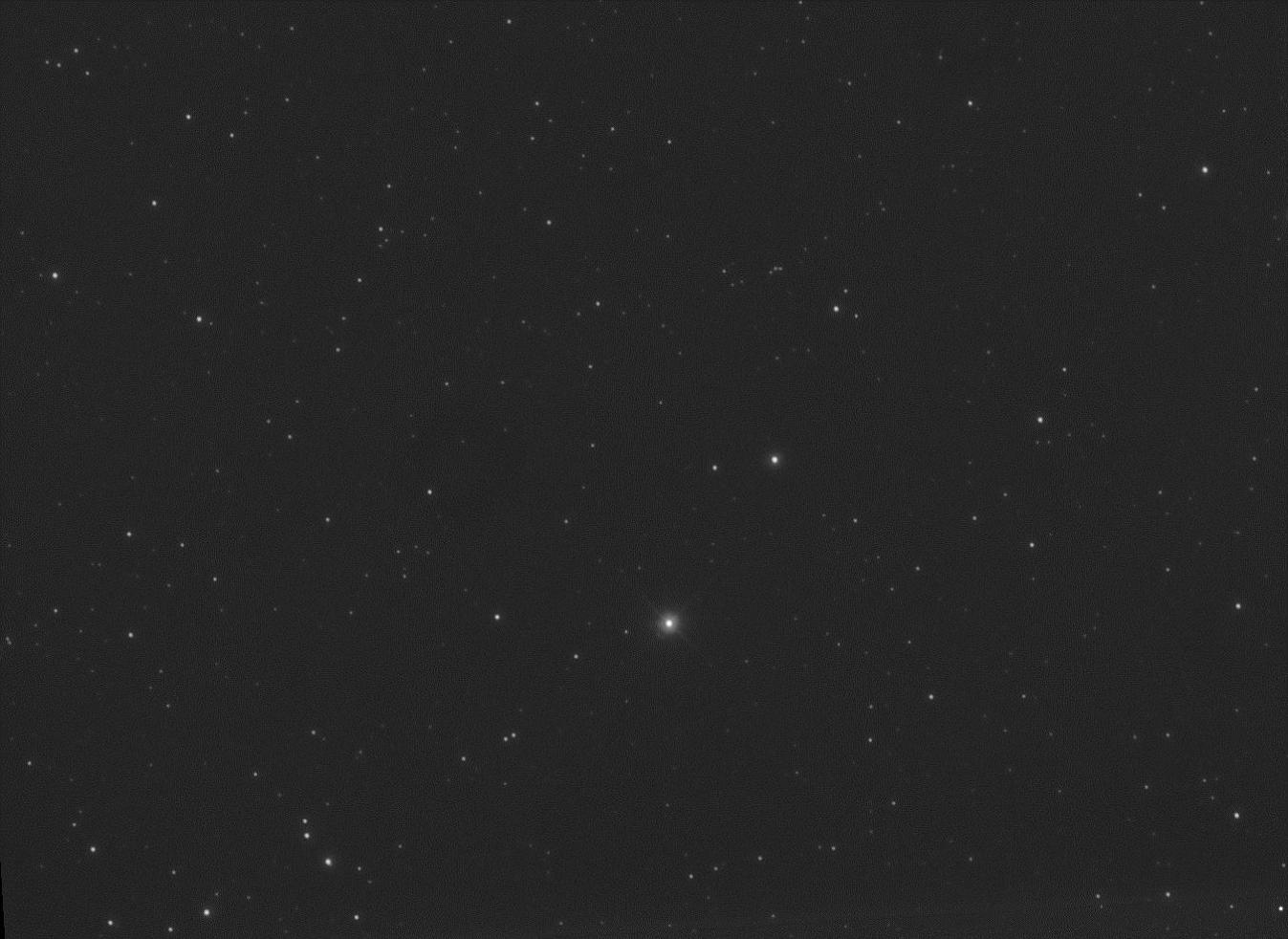
Over the course of 15 months, I took three pictures of Barnard’s star: (i) on 2012-06-21, (ii) on 2013-06-06, (iii) and on 2013-09-05. The September image is shown in Figure 1.

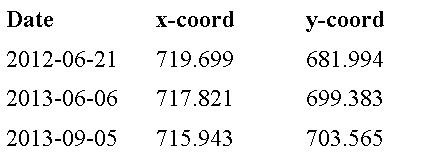
On each of the three nights, roughly 150 images were taken. Each image was an unguided 8-second exposure. For each night, the best of the images were selected and stacked to make a master image for the night. To maintain astrometric precision, the stacked images were saved in IEEE-float-format fits files. Then, using MaximDL, the three images were aligned to each other using the background stars for the alignment. In the aligned images, the centroid of Barnard’s Star was measured to subpixel level. The centroids so measured turned out to be:
BarnardStar
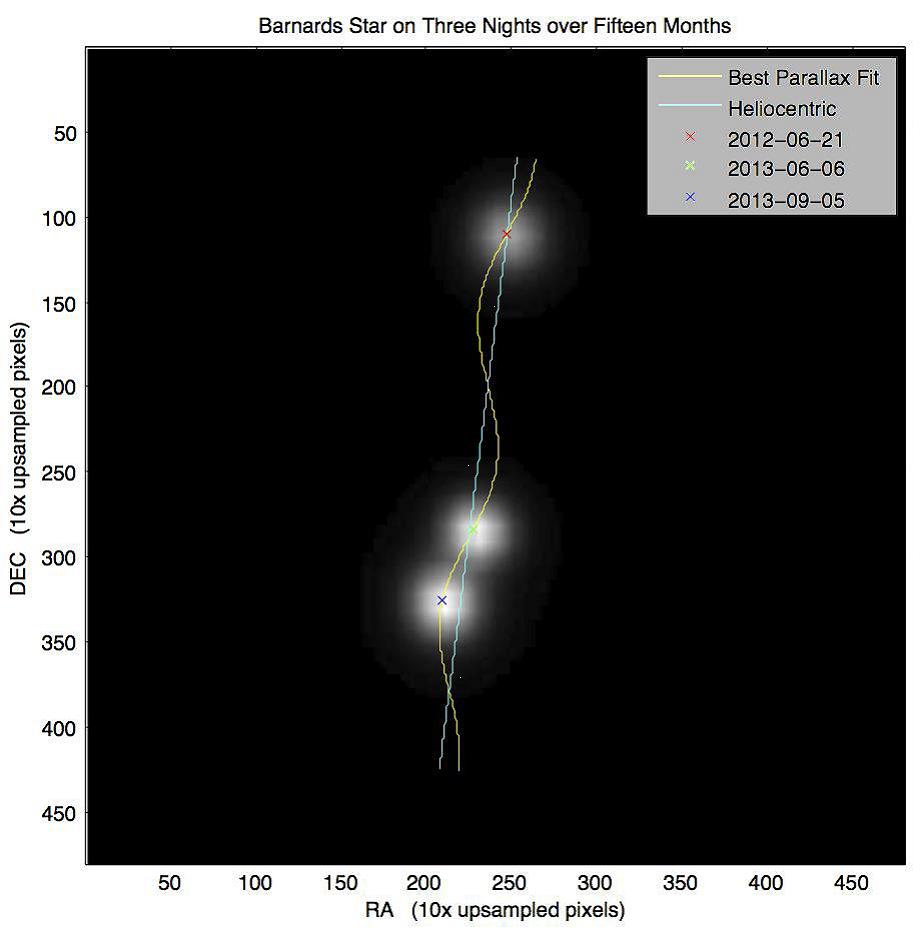
The three stacked and aligned images were then combined with each other to show in one image the relative motion of Barnard’s Star. A closely cropped version of this final stack is shown in Figure 2. Clearly, the proper motion is mainly a north-to-south motion. But, the third image is noticeably off the line that passes through the first two images. Its leftward displacement is due to the oscillatory east-west motion caused by the fact that our Earth is orbiting the Sun. In other words, any east-west displacement is due to parallax. I’ve overlayed on the figure the best-fit proper-motion/parallax path. To find this best sinusoidal path, I started by writing down the general equation for such a path. It turns out to have six free parameters. Matching the x and y coordinates at the three time epochs to the general equation produced six equations. Solving the six equations in six unknowns I was able to determine both the parallax and the proper motion (as well the other four free parameters).

Initially, these quantities were determined in pixel units but I already knew that my telescope/camera combination produces images in which each pixel is 0.575 arcseconds on a side. Converting from pixels to arcseconds, I arrived at my final answer:

                               Parallax of Barnard’s Star =0.635 arcseconds.

Fig. 1.— A stack of the best 120 out of 150 8-second exposures taken on September 5, 2013, starting at 21:25 EST. Barnard’s Star is the brightest star in the image. The telescope is a 10” RC from Ritchey-Chretien Optical Systems. The camera used is a Starlight Express SXV-H9.

Fig. 1.— A stack of the best 120 out of 150 8-second exposures taken on September 5, 2013, starting at 21:25 EST. Barnard’s Star is the brightest star in the image. The telescope is a 10” RC from Ritchey-Chretien Optical Systems. The camera used is a Starlight Express SXV-H9.


Fig. 2. — After aligning the three images based on the background stars, the three images were stacked and then closely cropped around Barnard’s Star. The cropped image was upsampled by a factor of 10 to produce the image shown here. Also shown is the best fit regression line showing the effect of parallax on the proper motion.

Fig. 2. — After aligning the three images based on the background stars, the three images were stacked and then closely cropped around Barnard’s Star. The cropped image was upsampled by a factor of 10 to produce the image shown here. Also shown is the best fit regression line showing the effect of parallax on the proper motion.


By definition, the distance in parsecs is simply the reciprocal of the parallax and so my measured distance to Barnard’s star is 1.57 parsecs. This result is in the right ballpark of the accurately known distance, which is 1.83 parsecs.

The computed parameters were used to make the overlayed sinusoidal plot shown in Figure 2. Clearly, the computed sinusoid passes through the three data points.

The measured proper motion came out to be 18.24 pixels per year, which translates to 10.49 arcseconds per year. This value also matches quite well with the established rate of proper motion of 10.37 arcseonds per year. And, the velocity in arcseconds per year times the distance in parsecs gives the velocity in astronomical units (au) per year. Using our derived numbers we get that the projected velocity is 16.5 au/yr.

Finally, note that in a previous paper Vanderbei and Belikov (2007) made parallax measurements on the asteroid Prudentia and in so doing were able to measure the astronomical unit in terms of Earth radii. We discovered that 1 au = 23,222 Earth radii.

And, in another previous paper, Vanderbei (2008) measured the radius of the Earth by analyzing the compressed reflection of the Sun on the smooth surface of Lake Michigan during a sunset on a calm summer evening. The result so obtained was
                               1 Earth radius = 5200 miles = 8400 km.

Again, these numbers aren’t terribly accurate but they are in the right ballpark. Anyway, combining these measurements, we see that the distance to Barnard’s star is

                        1.57 parsec = 1.57 au/arcsec × 3600 arcsecs/degree × 180 degree/π radians
                                             = 3.24 × 10⁵ au
                                             = 3.24 × 105 au × 23,222 Earth radii/au
                                             = 7.52 × 10⁹ Earth radii
                                             = 7.52 × 10⁹ Earth radii × 8400 km/Earth radius
                                             = 63.2 × 10¹² km.

This final answer is pretty close to the known distance of 56.6 trillion kilometers.

Along the same lines, the proper motion translates to a projected velocity of
                    16.5 au/yr = 16.5 au/yr × 23,222 Earth radii/au × 8400 km/Earth radius
                                        = 3.30 × 10⁹ km/yr
                                        = 3.30 × 10⁹ km/yr × 1 yr/365.25 days × 1 day/24 hr × 1 hr/3600 sec
                                        = 102 km/sec.

It’s pretty awesome to be able to measure these things with this level of accuracy using modest equipment readily available to amateurs everywhere.

I would like to thank Bill Nagel for sparking my interest in imaging Barnard’s star. He has been taking pictures of it every summer since 2007. Maybe at some point we can use a larger collection of images acquired by a number of AAAP members to compute Barnard’s Star’s parallax and proper motion with significantly better precision than was obtained with the three images described here.

REFERENCES
Vanderbei. The Earth Is Not Flat: An Analysis of a Sunset Photo. Optics and Photonics News, November:34–39, 2008.
Vanderbei and R. Belikov. Measuring the astronomical unit from your backyard. Sky and Telescope, 113(1):91–94, 2007.

Posted in October 2013, Sidereal Times | Tagged , | 1 Comment

No More Peeping into a Telescope

by Prasad Ganti

The word “telescope” conjures an image of a long scope with lenses or mirrors and an eyepiece to peep in to see the light collected by the lenses and mirrors. Well, this is the traditional optical telescope, the kind of device in existence since the days of Galileo and Newton. We have used these telescopes to learn about planets and stars in the sky and to get a picture of what our universe looks like. More powerful and bigger lenses and mirrors took us almost to the “edge” of the universe. There are some drawbacks because everything in the universe is not visible through optical telescopes.

First, by looking further and further, we look backwards in time. The further an object is away, the older is the picture we are viewing because light takes time to travel towards us, sometimes years, sometimes centuries, sometimes millions and billions of years. Up to a few hundred thousand years after the universe was born in the Big Bang, light was trapped in a cosmic soup of particles that did not resemble anything we have today. This means that even if we have the most powerful telescope we can design and build, we cannot see beyond this wall because there is no light to see from that era.

Second, all objects in the universe do not emit light, some emit x-rays, some gamma rays, some radio waves. All these waves belong to the family called electromagnetic radiation. They just differ in wavelength and frequency. The spectrum in the order of increasing wavelengths is: gamma rays, x-rays, ultra-violet rays, violet light, blue light, red light, infrared rays, microwaves and radio waves. The first rays detected in the invisible region were infrared rays. William Herschel, the discoverer of the planet Uranus, put a prism in front of the sun light to breaks up the light into different colors. He took a thermometer and measured the temperature of the different colors and found that temperature varied from color to color. What he did next was serendipitous. He put the thermometer beyond the red color and it showed a different temperature! This meant that there was some radiation there. Then came James Clerk Maxwell who tied all the radiation into a common family through his set of mathematical equations.

We see only a small portion of the electromagnetic spectrum, which we call visible light, presumably because our sun emits most of its radiation in this range, and life on earth evolved to naturally detect only this range. Aliens in some other planetary system may have x-ray vision, but not optical vision, depending on what their sun emits! Those alien’s “eyes” tuned to x-rays may look different.

Third, the universe is not empty. There is cosmic dust, clouds of gases and massive objects all across it. These block or cloud our vision. Gases and dust absorb light and send us distortions. Massive objects bend light and give us a different picture of the objects behind them. This phenomenon is known as gravitational lensing.

Due to these and other advances, astronomy has grown beyond just peeping into an optical telescope. We now have telescopes which operate in other parts of the electromagnetic spectrum: infrared, ultraviolet, radio, x-ray and gamma ray telescopes. Some of these telescopes operate in space beyond the atmosphere of the earth which blocks the radiation coming in from outer space. These telescopes show us different aspects of the universe than the optical ones do.

Astronomers do not peep into a telescope anymore. Most observations involves capturing the incoming radiation on a sensor like the ones we have in our digital cameras and analyzing it through a spectrograph, which is a high tech version of a prism. It not only splits the radiation into different wavelengths by showing it as a series of lines, it also shows the absence of wavelengths by showing dark lines (technically known as Fraunhofer lines). The presence of lines indicates emission of radiation by different objects.

Conversely, the absence of lines indicates absorption of radiation. Cosmic dust was discovered via absorption lines. Cosmic dust consists of minute particles of different elements spewed by dying stars. This dust and gas clouds form the inputs for the birth of next set of stars. It is not just the living beings on earth, but even the stars take birth and die all the time in our wonderful universe!

The radio telescope was invented by Karl Jansky of AT&T, after he accidentally discovered the radiation when he was working on a radio antenna. He detected noise which he could not reduce and finally traced it to extraterrestrial sources. This sounds similar to the serendipitous discovery of the cosmic background radiation by Penzias and Wilson. Two great cosmological discoveries in the quest for perfecting electronic communications on earth!

Peeping Toms can only go so far!

Posted in October 2013, Sidereal Times | Tagged , | Leave a comment