NASA Successfully Launches Historic Pair of Missions to the Moon and Space Station from NASA Wallops in Virginia

by Dr. Ken Kremer

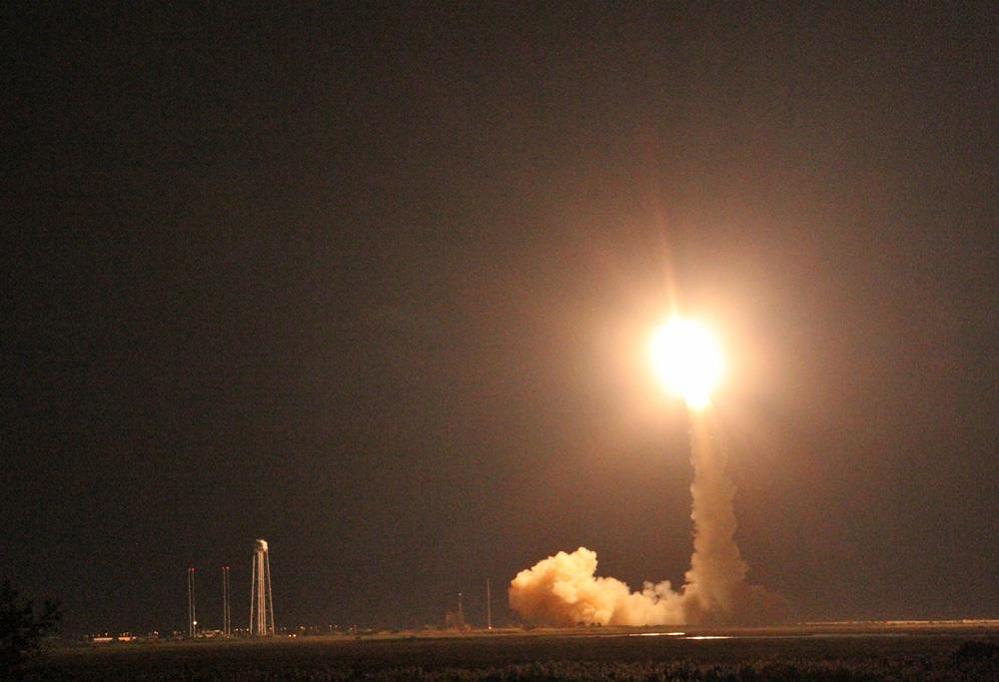
Launch of LADEE Lunar Orbiter on Maiden Flight of Mino-taur V from Wallops. Credit: Ken Kremer

Launch of LADEE Lunar Orbiter on Maiden Flight of Minotaur V from Wallops. Credit: Ken Kremer

In an unprecedented event in space history, NASA and Orbital Sciences Corporation successfully blasted a pair of historic and high stakes missions to the moon and the International Space Station from NASA’s Wallops Island center in Virginia on Sept. 6 & 19.

The flawless on-time liftoff’s of NASA’s Lunar Atmosphere and Dust Environment Explorer (LADEE) Observatory atop a Minotaur V rocket and the privately developed, Cygnus resupply capsule atop the commercial Antares rocket took place from America’s newest spaceport located just a few hours drive south of Princeton.

Antares Lifts Off with Cygnus to Resupply the ISS from Wallops. Credit: Ken Kremer

Antares Lifts Off with Cygnus to Resupply the ISS from Wallops. Credit: Ken Kremer

The duo of spectacular launches were visible to millions of spectators along the US Mid-Atlantic region who never before had the opportunity to witness powerful rockets blast off within sight of their homes.

LADEE launched at 11:27 p.m. in the evening of Sept. 6. Cygnus launched at 10:58 a.m. on Sept. 19. LADEE is due to arrive in lunar orbit on Oct. 6 and Cygnus should dock at the ISS in late September. I reported on both launches for Universe Today from NASA Wallops.

At the Oct. 8 AAAP monthly meeting, I will present an eyewitness account of both missions in my talk entitled; “NASA’s Historic LADEE Lunar Orbiter and Antares/Space Station Rocket Launches from Virginia”. I’ll also give an update on Curiosity, MAVEN and NASA’s future human spaceflight programs.

See a preview of my talk and my Universe Today articles here:
Antares Picture Perfect Blastoff
NASA’s Antares Rollout

Astronomy Outreach by Dr. Ken Kremer
AAAP at Princeton U: Princeton, NJ: Oct. 8, 8 PM. “LADEE Lunar orbiter and Antares ISS Rocket Launches from Virginia.”
STAR Astronomy Club: Monmouth Museum at Brookdale Community College, Lincroft, NJ, Oct. 3, 8 PM, “Curiosity, MAVEN and the Search for Life on Mars (3-D).”

Dr. Ken Kremer: Universe Today & AAAP
Please contact Ken for more info, science outreach presentations and his space photos.
Email: kremerken@yahoo.com website: www.kenkremer.com
http://www.universetoday.com/author/ken-kremer/

Posted in October 2013, Sidereal Times | Tagged , , , | Leave a comment

From the Director – Welcome to the 51st Year of the AAAP

by Jeff Bernardis, Director

In addition to the tremendous slate of speakers that we will have at our monthly meetings, there are several other exciting things going on. I’d like to get more people involved in these activities because there is so much more to the club than just coming to the lectures. You’re going to hear this repeatedly from me during my tenure.

Consider this. We are currently working on adding an observatory to our Washington Crossing location. This will utilize equipment we hope to obtain from a donation. There is already a team working on this, but they would welcome additional interested members. See Michael Mitrano if you’re interested.

One of the major aspects of our community outreach is the Friday sessions at the existing observatory. The observatory is staffed by one of six teams of keyholders – members who have undergone keyholder training. Gene Ramsey coordinates this training – see him if you are interested in becoming a keyholder.

Dave Letcher coordinates our outreach to local schools, scout troops, etc., and is always looking for volunteers. This is more of an adhoc activity – you can go to as many or as few as you wish. Listen for the meeting announcements for these efforts, or express your interest to Dave so he can add you to his email list.

Finally, there are occasional needs for volunteers – such as StarQuest the picnic, etc. So please help us out by getting involved with the club activities.

Posted in September 2013, Sidereal Times | Tagged , | Leave a comment

Appropriation for the New Observatory

by Michael Wright, Secretary

At the July 9, 2013 Board meeting, the Board unanimously approved the following motion:

The Board of Trustees recommends that $12,000 of AAAP’s reserves be appropriated for construction of the new observatory structure at Washington-Crossing State Park including electrical work and permit fees.

For more information on the plans for the new observatory, see the July 9, 2013 Board meeting minutes in the mid-summer Sidereal Times.

A vote on this motion will be taken at the September 10, 2013 business meeting following the monthly lecture. According to AAAP’s by-laws, this expenditure must be approved by a majority of the votes cast and not less than 30% of the paid membership. The Board urges all members to attend and vote affirmatively on the recommendation.

Posted in September 2013, Sidereal Times | Tagged , | Leave a comment

Jersey StarQuest 2013

by Michael Wright, Secretary

starquest1Again this year, Chef Ludy D’Angelo will be catering sumptuous breakfast and dinner on Saturday.

Already over twenty members and guests are registered. Don’t miss out on a great weekend of observing and camaraderie. More information and registration forms are available on the club website.

It’s not too late register for StarQuest 2013, which will be held the first weekend in September (Sept. 6 to 8) at the Hope Conference and Renewal Center, Hope, NJ.

starquest2Of all the star parties in the region, StarQuest has the best location. The conference center is located under dark skies in the bucolic hills of Warren County not far from Jenny Jump State Park. In addition to a nice lodge for socializing and meals, the facilities include clean comfortable cabins with indoor showers. Campsites are also available for those who prefer to rough it.

Posted in September 2013, Sidereal Times | Tagged , | Leave a comment

The Quest to Understand the Sun and the Space Weather It Produces

by Michael Wright, Secretary

Clayton E. Myers

Clayton E. Myers

Our monthly lectures will resume on September 10, 2013 with a lecture by Clayton E. Myers of Princeton Plasma Physics Laboratory entitled “The Quest to Understand the Sun and the Space Weather It Produces.” The lecture will begin at 8:00 p.m. in Peyton Hall, 4 Ivy Lane on the Princeton University Campus. Admission is free and the public is welcome. Ample free parking is available across the street from Peyton Hall.

The Sun is a consistent presence in our lives, rising and setting with complete predictability. Upon closer examination, however, there are many phenomena on the Sun that are anything but predictable. The most prevalent are the vast explosions that we call solar flares and coronal mass ejections (CMEs). These events, which are caused by a violent release of magnetic energy stored in the solar atmosphere, spew enormous amounts of particles and magnetic field out into the Solar System. When a solar eruption is directed at Earth, it can have terrestrial consequences that are both beautiful (e.g., the aurora) and hazardous (e.g., the destruction of satellites). Given the increasing dependence of our society on space-based technology, predicting and mitigating the effects of “space weather” is a top priority.

Inside MRX

Inside MRX

In this talk, he will discuss our current understanding of space weather and the multi-pronged approach that is being pursued to try to improve this understanding. In particular, he will describe the “Great Heliophysics Observatory,” which is the impressive constellation of satellites that are currently being used to study solar activity. He will also describe some of the extensive numerical modeling efforts that are underway with the goal of improving space weather prediction. Finally, he will show how laboratory experiments here in Princeton and elsewhere are beginning to contribute to this effort by providing in situ measurements of solar-relevant phenomena.

Clayton E. Myers is a senior graduate student in the Program in Plasma Physics of the Department of Astrophysical Sciences at Princeton University. For his doctoral thesis research, he is studying the physics of solar eruptions in the laboratory. Originally from rural Ohio, Clayton studied Engineering Physics at Cornell University and graduated Magna Cum Laude with Honors in 2007. He earned an M.A. from Princeton’s Department of Astrophysical Sciences in 2009 and will complete his Ph.D. in early 2014. Since first starting as an experimental plasma physicist as an undergraduate, Clayton has worked in several different laboratories and on a numerical simulation project. In that time, he has studied a variety of topics in plasma physics ranging from high energy density physics to magnetic confinement fusion to his present research in the emerging field of laboratory plasma astrophysics.

Posted in September 2013, Sidereal Times | Tagged , , , | Leave a comment

Construction of our Universe

by S. Prasad Ganti

The greatest achievement of Cosmology in the last hundred years has been the Big Bang theory. How it was formulated and how it was proved. For most of the time human beings spent on the Earth, our known universe was just our solar system, up to planet Saturn which could be seen with the naked eye. With the advent of telescopes and spectrographs, came the facts that stars are like our own Sun and that they reside outside of our solar system.

What revolutionized the cosmic knowledge was the observation by the great astronomer Edwin Hubble who not only found that Andromeda was a different galaxy than ours, but also the fact that our universe of galaxies and galaxy clusters is expanding. All the galaxies are moving away from each other. The rate of expansion being proportional to the distance between them. The farther a galaxy is, the faster it is moving away.

Extrapolating this observation backwards, if the movie of our universe is played backwards, it should go to a point in time when it was very small. Thus the theory emerged that our universe was formed in a big bang. It was resisted by a rival group of scientists who believed in the steady state theory. Which states that the universe has stayed the same all the time. A universe without any beginning. Religious considerations also played a part in support of the steady state theory.

The Big Bang theory postulated that there should be some radiation left over from the instant of the Big Bang. A prediction made by physicist George Gamow. This radiation should be found uniformly all over the universe and should be in the microwave frequency range. It was aptly titled as Cosmic Background Radiation. Evidence for this came from a totally unexpected source. From two AT&T Bell Labs scientists Robert Wilson and Arno Penzias. They were working on a microwave antenna and had received some noise. They tried to eliminate the noise by cleaning the antenna and turning it in different directions. Nothing worked. The noise seemed to be very consistent and seemed to be coming uniformly from all the directions. As if we were drowned in this ocean of background noise.

Wilson and Penzias mentioned it casually to the scientists at Princeton University who were working on the Big Bang theory. What was noise to Wilson and Penzias was music to the ears of the Princeton scientists ! Thus cosmic background radiation was found and the Big Bang theory got validated ! Wilson and Penzias won the Nobel prize for Physics in 1978 for their serendipitous discovery.

The next question which came up was how did the structures in the universe like the galaxies and stars form when the background radiation is so uniform. There might have been some variation, however tiny in some places in the universe. This tiny variation led to the formation of all the matter and all the structures, thus went the theory. Finding out such minute variations on Earth proved to be immensely challenging. An experiment was devised involving the design and building of very sensitive instruments to measure the temperature of the cosmic background radiation coming from different directions.

These variations known as anisotropy, forms the basis of the story of how the instruments were conceived, constructed and launched on the COBE satellite (Cosmic Background Explorer), is well narrated in 2 books written by 2 of principal investigators on the project. “The Very First Light” written by John Mather and “Wrinkles in Time” by George Smoot. The books contain details on the instruments working under cryogenically cooled conditions in space. And the results produced and the validation of the theory.

John Mather and George Smoot won the Nobel prize for Physics in 2006 for showing the minute variations in the cosmic background radiation which led to the construction of our universe as we see it today. Clearly, each succeeding generation stands on the shoulders of the giants who preceded them. And carry the story forward.

Posted in September 2013, Sidereal Times | Tagged , , | Leave a comment

Daystar

by John A. Church

Whenever I have trouble getting to sleep, which sometimes happens to people as they get older, I just think about the sun.

I first learned interesting things about the sun from The Beginner’s Star-Book. a delightful introduction to astronomy by Kelvin McKready that I read when I was about twelve. McKready’s excellent exposition was replete with astronomy-related selections from Victorian poets such as Matthew Arnold and Alfred Tennyson. A sample of the latter will surely be more than enough:

            My mood is changed, for it fell at a time of year
            When the face of the night is fair on the dewy downs,
            And the shining daffodil dies, and the Charioteer
            And starry Gemini hand like glorious crowns
            O’er Orion’s grave low down in the west . . .

This young lad was impressed by such imagery. For he had also seen Auriga and the Heavenly Twins keeping vigil above the place where the Giant Hunter rested on a delicious late April evening. And he had known the thrill of chill November twilights such as those watched by the narrator of “Locksley Hall”:

            Many a night I saw the Pleiads, rising through the mellow shade,
            Glitter like a swarm of fireflies tangled in a silver braid.

There was a chapter in McKready’s book describing the sun. Now the sun is something we take for granted: it rises early in the morning to send us off to school or work, then sets in the evening as we reflect on the day and prepare for dinner. It can get in our eyes during our commutes in the wintertime, might burn us in the summer, and doesn’t always shine when we most want it to. Reading McKready, however, gives us a little more respect for this monstrous object that heats the earth and keeps it safely in its orbit.

Anthropocentric conceit would have us imagine that the sun exists for our benefit alone, but some elementary facts disabuse us of this notion. As seen from the sun, the earth is nothing but a tiny speck. It catches only one part in 2,200,000,000 of the total energy that the sun pours out into space. To put it another way, the sun could light up and power well over two billion earths at once. Imagine the inconceivable amount of energy that the total daylit side of the earth is receiving at any one instant, multiply it by this factor, and you will have some remote idea of the sun’s power. And it has been doing this for billions of years and will continue to do so for billions more. (Peace, spirit of Carl Sagan, I didn’t mean to overuse your proprietary word.)

Well over a million earths could fit inside the sun’s globe. If the earth were at its center, the moon in its orbit would be only a little more than halfway out to the sun’s surface. What an impressive thing we have here, and we don’t even have to pay for it. (Imagine if we did.)

Scientists, strange people that we are, sometimes entertain ourselves by doing approximate calculations in our heads. Lying in bed one night, I was curious as to about how much of the sun’s surface would be required to take care of the earth’s entire solar energy budget. As we learned in elementary geometry, the surface area of a sphere is four times π times the square of the sphere’s radius. Astronomy buffs know, or ought to know, that the sun’s radius is 4.32 x 10⁵ miles. Square this in your head and you have roughly 20 x 1010 square miles. And four times pi is about 12.5. So the area of the sun’s surface must be about 2.5 x 10¹² square miles, or in other words, 2.5 trillion square miles of blazingly hot plasma. Now we already know that the sun could light up 2.2 billion earths, as McKready told us. Therefore, it would take only about 1,100 square miles of the sun’s surface to give full daylight and heat to the entire sunlit side of the earth. This is only about the size of two average New Jersey counties.

Deep inside the sun, millions of tons of matter are being converted into energy every second by the enormous gravitational pressure of the overlying material. The sun would really like to explode from all this released energy, but it can’t because of this same gravitational confinement, and everything stays almost perfectly in balance. As the sun slowly loses mass – the rate is about one earth equivalent every 40 million years – it continually expands at a very slow rate, partly because of decreased gravity, but mostly because its power output gradually increases due to complicated changes in its mode of energy generation. After many billions of years it will become a “red giant,” swelling to about the size of the earth’s orbit; talk about global warming! Long before things get to this stage, we shall have had to move; it’s not too early to begin thinking about it.

Now for some more illuminating facts. The total power generated by the sun is something like 5 x 10²³ horsepower. A number of this size is especially interesting to chemists, because it’s in the same ballpark as “Avogadro’s number,” which is about 6 x 10²³. This is the number of molecules in what’s called a “gram-molecule” (also known as a “mole”) of any chemical compound. Take water as an example, made of two hydrogen atoms and one oxygen. Hydrogen has an atomic mass of about 1 (convenient, since it’s the lightest element), and oxygen’s atomic mass is 16. So the molecular mass of water is about 18. Now a mole of any compound is defined as the number of grams of that compound numerically equal to its molecular mass, so a mole of water has a mass of about 18 grams. This is between three and four teaspoonfuls of water. This small swallow has more molecules in it than the horsepower of the sun! But, like Rodney Dangerfield, we chemists don’t get no respect for telling people how small a molecule is.

One more factoid for insomniacs and I’m done. How much of the sun’s surface do I personally need to keep me alive? An average person’s metabolic power consumption is about a hundred watts, or like one bright light bulb. This is the power output of a bit of the sun’s surface about the size of a pinhead. So now I finally know my place in the grand scheme of things.

Posted in September 2013, Sidereal Times | Tagged , | Leave a comment

Historic Lunar and Space Station Launches from NASA Wallops

by Dr. Ken Kremer

Just a few hours south of Princeton, NASA plans a pair of historic launches from the Wallops Island center in Virginia on Sept. 6 & 17. Both launches are open to the public.

Antares rocket will launch Cygnus spacecraft to the ISS from Launch Pad 0A at NASA Wallops Flight Facility, VA. Credit: Ken Kremer/kenkremer.com

Antares rocket will launch Cygnus spacecraft to the ISS from Launch Pad 0A at NASA Wallops Flight Facility, VA. Credit: Ken Kremer/kenkremer.com

A spectacular nighttime blastoff blazing a historic trail to the moon is set to soar first when NASA’s LADEE lunar spacecraft lifts off from the Eastern Shore of Virginia at NASA’s Wallops Flight Facility. The Lunar Atmosphere and Dust Environment Explorer (LADEE) Observatory will thunder to space at 11:27 p.m. on Friday, Sept. 6, from launch complex 0B atop the maiden flight of a Minotaur V rocket developed by Orbital Sciences Corp. LADEE’s late night launch will be absolutely spectacular and visible to tens of millions of spectators up and down the East coast and interior areas – weather permitting.

A Cygnus unmanned cargo carrier is slated to blast-off 11 days later on the historic first Demonstration Mission (CRS 1) to the International Space Station (ISS) on Sept. 17 atop Orbital’s privately developed Antares rocket from the adjacent launch pad 0A. Both the Minotaur V and Antares rockets are now in the midst of flight processing at Wallops.

The purpose of the Antares demo flight is to prove that the unmanned Cygnus can safely rendezvous and dock at the ISS. Cygnus will carry all types of essential equipment and science supplies to replace the cargo carrying ability of NASA’s retired space shuttles. The objectives are quite similar to the rival SpaceX Dragon.

My tour of 4th and 5th stages of 1st Minotaur V rocket propelling NASA’s LADEE spacecraft to the Moon on Sept. 6 from NASA Wallops in Virginia. Credit: Ken Kremer/kenkremer.com

My tour of 4th and 5th stages of 1st Minotaur V rocket propelling NASA’s LADEE spacecraft to the Moon on Sept. 6 from NASA Wallops in Virginia. Credit: Ken Kremer/kenkremer.com

Using four science instruments, LADEE will collect data to inform scientists in unprecedented detail about the ultra-thin lunar atmosphere, environmental influences on lunar dust and conditions near the surface that may lead to a better understanding of other planetary bodies in our solar system.

The LADEE lunar orbiter will be historic in many ways. It’s the first probe of any kind ever launched beyond Earth orbit from NASA Wallops, as well as being the first planetary science mission from Wallops and the first launch of the Minotaur V rocket. Recently, I had an exclusive tour and photoshoot of the upper stages of LADEE’s Minotaur V rocket at Wallops.

At the Oct. 8 monthly AAAP meeting, I will present a lecture about these launches and more from NASA Wallops. Learn more about LADEE & Antares in my Universe Today articles here:

Ladee Lunar Probe
1st Operational Cygnus Module

Astronomy Outreach by Dr. Ken Kremer
AAAP at Princeton U: Princeton, NJ: Oct. 8, 8 PM. “LADEE Lunar orbiter and Antares ISS Rocket Launches from Virginia.”
STAR Astronomy Club: Monmouth Museum at Brookdale Community College, Lincroft, NJ, Oct. 3, 8 PM, “Curiosity, MAVEN and the Search for Life on Mars (3-D).”
Rodeway Inn: Chincoteague Island, VA: Sep 5/6/16/17. “LADEE and Antares Launches from Virginia.”

Dr. Ken Kremer: Universe Today & AAAP
Please contact Ken for more info, science outreach presentations and his space photos.
Email: kremerken@yahoo.com website: www.kenkremer.com
http://www.universetoday.com/author/ken-kremer/

Posted in September 2013, Sidereal Times | Tagged , , , | Leave a comment

From the Director

Jeff Bernardis, Director

I remember sitting in science class in grade school learning about Halley’s Comet, thinking that it was cool – that it was something I’d be able to see in my lifetime. Its last appearance was in 1910, and its next appearance in 1986 was only a few years away. The way it was presented in the textbooks and in artwork, it looked like we were going to see something spectacular.

Halley’s Comet was the one comet that everybody knew by name. It is unique in the impact it has played in human history. Sightings have been chronicled back to more than 200 years before Christ. It is the only known comet that one can see twice in a lifetime.

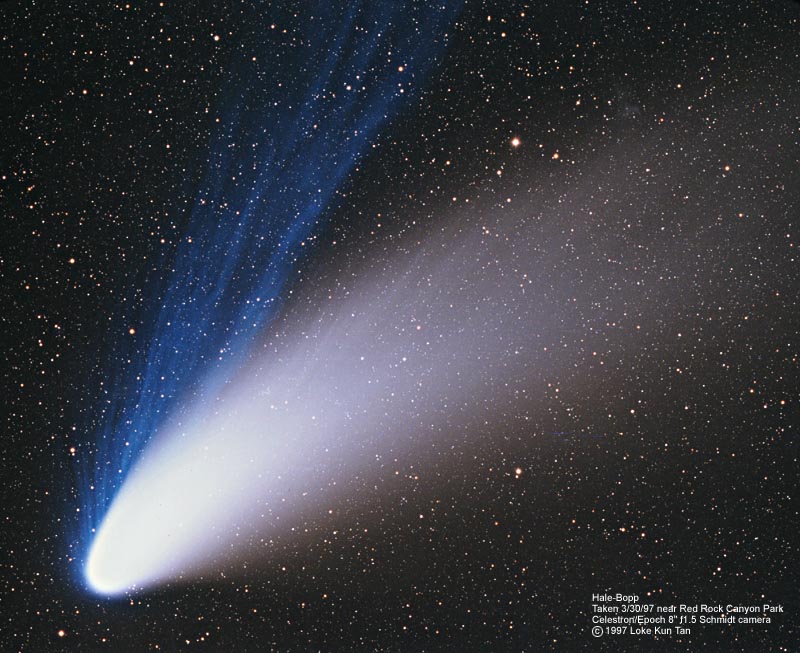
Comet Hale-Bopp. Photo credit: NASA

Comet Hale-Bopp. Photo credit: NASA

Of course, despite all of that buildup and anticipation in 1986, Halley’s Comet was a dud. I do remember seeing it. I even had the opportunity to observe it through a good telescope, but it was rather underwhelming (as was comet Kohoutek 13 years earlier).

Then in 1997, quite unexpectedly, two independent amateur astronomers – Alan Hale in New Mexico, and Thomas Bopp in Arizona -simultaneously noticed a fuzzy but moving object in view while they were looking at M20. They reported their findings and were both given credit for the discovery of comet Hale-Bopp.

This was going to be the big one. It was billed as being 1000 times as bright as Halley’s comet. And of course it did not disappoint. It was a fascinating display. It seemed to go on forever, night after night. It was the event that rekindled my interest in astronomy.

At the beginning of 2013, there was mention of two comets that were approaching the earth in this year. Some publications even labeled 2013 as “The Year of the Comet”. Comet Pan-STARRS would be in the March timeframe and Comet ISON would be visible later in the year in November and December.

In March we did see comet Pan-STARRS. From our vantage point, it was very low on the horizon and very underwhelming. We were warned though. It was not going to be all that spectacular.

However, if what everyone is saying turns out to be true, ISON will be a different story completely. In late November it will be at perihelion, zooming past the sun at greater that 400,000 mph at a distance of ~800,000 miles. After perihelion, on about December 26, it is expected to pass over the northern hemisphere at a distance of about 40,000,000 miles. The comet is estimated to be about three miles in diameter, and although there is some concern about what will survive such a close perihelion, expectations are that the comet will be brighter than the moon. It is also labeled “the brightest comet to grace the skies in memory”. This, of course, implies that it is expected to be brighter than Hale-Bopp, and based on my memory, that’s quite a statement.

Of course we’ve been disappointed before, and anything can happen between now and the comet’s appearance, but I am anticipating a great show. Let’s hope it lives up to the hype. Let’s also hope that, like me with Hale-Bopp, the comet will spark interest in astronomy, and perhaps even contribute to the growth of the club.

Posted in Mid-Summer 2013, Sidereal Times | Tagged , | Leave a comment