Curiosity Begins Mars Trek

by Dr. Ken Kremer

Mars Trek has begun for NASA’s Curiosity rover following the spectacular and pinpoint rocketguided touchdown beside a huge layered mountain inside Gale Crater on the night of August 5/6. Millions of people around the world were eagerly and excitedly following along with NASA’s live broadcast from Mission Control at the Jet Propulsion Laboratory in Pasadena, Calif. Pandemonium erupted when confirmation was received that the never before tried and highly complex “skycrane” landing was successfully completed.

The one-ton mega rover has now departed from her touchdown vicinity at “Bradbury Landing” and set off on a multi-week eastwards traverse to her first science target which the team has dubbed “Glenelg”. Glenelg lies about a quarter mile (400 meters) away. The car-sized rover has now driven about ¾ of the way as of late September, nearly two months into the mission, and should arrive at Glenelg sometime in October. The science team selected Glenelg as the first target for detailed investigation because it sits at the intersection of three types of geologic terrain, affording the researchers the chance to get a much more comprehensive look at the diverse geology inside the Gale Crater landing site.
Curiosity

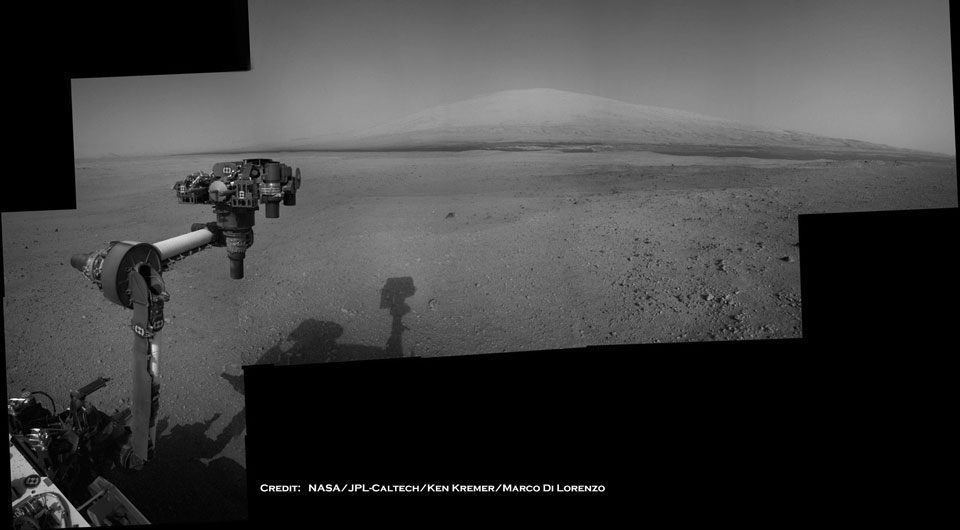
Curiosity points her robotic arm at Mount Sharp, her driving destination. Published on APOD Aug. 27, 2012 and at NBC News on Aug. 21, 2012.

Engineers have carefully checked out nearly all of the powerful science instruments, including the first of its kind rock zapping laser. Among other tasks, the Mastcam color camera is collecting high resolution images at points along the way so the scientists can create a 3D map of Mount Sharp, the rover’s ultimate driving destination.

Perhaps in about a year or so, Curiosity will reach the base of Mount Sharp and begin climbing up the side of the 3.6-mile (5.5-km) high mound in search of hydrated minerals that will shed light on the duration of Mars watery past.

The mission goal is to ascertain whether the Red Planet was ever capable of supporting microbial life, past or present and to search for the signs of life in the form of organic molecules during the two-year primary mission phase. Curiosity is equipped with a sophisticated array of 10 state of the art science instruments far beyond any prior rover.

The science team also deployed the 7-ft. (2.1-meter) long robotic arm and tested the science instruments in the turret positioned at the terminus of the arm. Curiosity flexed her mighty robotic arm for the first time on Aug. 20 and aimed the hand-like tool turret squarely at Mount Sharp.

If you want to see exactly where Curiosity is headed and why she was sent to Gale Crater, just take a look at the mosaic assembled by Ken Kremer and Marco Di Lorenzo which was selected to appear on Astronomy Picture of the Day on August 27, 2012. Curiosity is pointing with her robotic arm right at Mount Sharp, the huge 18,000-foot (5.5-kilometer) tall mysterious mound that covers the center of the 96-mile (154-km) wide Gale crater. Our Curiosity mosaic was also featured on the front page of NBC News in the link below. Several more of our original Curiosity mosaics showing the rovers traverse appeared at NBC, most recently on Sept. 26 at the link below.

NASA
Curiosity points to mars destination
See a crescent moon in martian sky

The layered sediments in Mount Sharp could unveil the geologic history of Mars stretching back billions of years and reveal why the planet transitioned from an ancient, wet period of flowing liquid water on the surface to the dry, desiccated era of today.

Astronomy Outreach by Dr. Ken Kremer

Amateur Astronomer’s Inc (AAI) at Union County College: Cranford, NJ, Nov 16, 8 PM, “Curiosity and the Search for Life on Mars (in 3-D)”.
AAI Website: http://www.asterism.org

STAR Astronomy Club at Monmouth Museum, Brookdale Community College, Lincroft, NJ. Dec 6, 8 PM. “Atlantis, the Premature End of NASA’s Shuttle Program and What’s Beyond for NASA.”
Ken Kremer: Spaceflight magazine & Universe Today

Please contact Ken for more info or science outreach presentations:
Email: kremerken@yahoo.com website: www.kenkremer.com
http://www.universetoday.com/author/ken-kremer/

Posted in October 2012, Sidereal Times | Tagged , | Leave a comment

AAAP Mourns the Passing of Member Bryan Hubbard.

AAAP mourns the passing of member Bryan Hubbard. Bryan was an active member of AAAP who helped with Starquest and public outreach on many occasions. He was also editor and contributor to Sidereal Times for several years. We send our condolences to his family.

His online obituary may be found here.

Posted in September 2012 | Tagged , | Leave a comment

From the Director

Ludovico D’Angelo, Director

I hope everyone is having a bearable summer with this heat. As a result, there hasn’t been much opportunity to get out and do some observing. The heat haze is a real downer, but I hope that some of you have gone on vacations to nice clear sky areas and enjoyed the nature and sky around you. Write an article for ST and share your experiences.

My summer finds myself on vacation in Minnesota one again. We go every year. This year I brought my large binoculars, but never had a chance to use them for astronomy. We did see the great bald eagle that inhabits the lake again.

At the last AAAP Board meeting, we discussed several things (see Board minutes in this issue.) We will have a picnic on September 15th for all members (time and venue to be announced). We will look into Starquest for October or November, and we will have a 50th anniversary dinner in November in lieu of our November meeting. Stay tuned for more on these upcoming activities. Kate Otto has been working diligently to secure guest speakers for our up coming year. We are planning some work parties for both Washington Crossing and Jenny Jump. Plus we are looking into a major donation for the observatories.

As always, all these activities cannot be done by a certain few. We encourage all of you to speak up or volunteer to help plan and implement all these activities. And add more too!

I understand that Gene Ramsey, long time member and Observatory Chair, had undergone major heart surgery. As of this writing, he is recuperating slowly and will be out of commission for several months. I have appointed Jeff Bernardis as temporary Observatory Chair. Any issues with the observatory should be addressed to him. Lets all keep Gene in our thoughts for a speedy recovery.

Posted in August 2012, Sidereal Times | Tagged , | Leave a comment

From the Program Chair

Kate Otto, Program Chair

Prof. David Spergel

Prof. David Spergel

Our monthly lectures will resume on September 11, 2012 at 8:00 pm in Peyton Hall with a lecture from AAAP’s friend, Prof. David Spergel, Chair of the Princeton’s Department of Astrophysical Sciences. Prof. Spergel’s talk is entitled “Illuminating the Evolution of the Universe with the Cosmic Microwave Background”.

Prof. Spergel is well known for his theoretical astrophysics work with Wilkinson Microwave Anisotropy Probe (WMAP) observations of the microwave background radiation to determine cosmological parameters. In fact, two papers that he co-authored are the two most cited papers in science over the past decade according to the website Incites. This lecture by one of the superstars of theoretical astrophysics should be fascinating so do not miss it.

The November monthly program will be held on Sunday, November 4th, between 4:00 and 8:00 p.m., instead of Tuesday, November 13th.   AAAP is holding a special dinner meeting celebrating the start of our 50th Anniversary of successful Amateur Astronomy in Princeton.   I hope that you will mark your calendar for this event.  We are looking for volunteers to help us plan all of the 50th Anniversary year activities.  More information will follow.  In the interim, please let one of the officers know if you are interested in getting involved.

Posted in August 2012, Sidereal Times | Tagged , , | Leave a comment

From the Outreach Chair

David Letcher, Outreach Chair

On Sunday August 12, the D & R Greenway Organization and AAAP are hosting a ‘Perseid Meteor Shower party’ at a recently acquired preserve known as the Cider Mill Grasslands Preserve in E. Amwell Township, Hunterdon County. The event is from 10:00 PM to Midnight and is one of the programs that introduces the general public to the Greenway’s lands and encourages them to get outdoors.

I sent out a map to the AAAP membership recently. So far we have about 8 – 10 AAAP volunteers who will be there to provide some background on meteor showers and some telescopes for viewing the sky.

Posted in August 2012, Sidereal Times | Tagged , , | Leave a comment

Treasurer’s Report

Michael Mitrano, Treasurer

The AAAP’s fiscal year ends on June 30, and this represents my fifth year-end report to members. Again this year showed a surplus and our financial position remains very strong.

A fiscal year 2012 income statement and balance sheet was sent to all members with Sidereal Times.

Membership Chart

Membership Chart

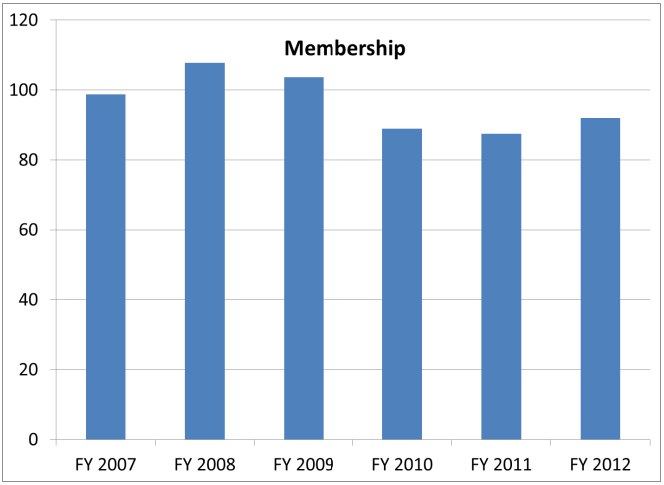
The year ended with 92 paid members. As the chart shows, this is an improvement over the past two years but is down from our recent high in FY 2008.

As noted earlier, StarQuest revenues almost exactly covered the event’s cost. Observatory expenses were not very high this year, with no major repairs or improvements needed. The largest non-routine expense for the year was our new graphic table cover, which is the $378 expense shown in “miscellaneous.”

For these reasons and because of our membership and outreach income, the AAAP had a surplus of $1,220 for the year. Combined with previous years, results, the association’s cumulative surplus was $21,994 on June 30. FY 2012 was our 6th year of surplus and leaves us very well positioned to continue our programs of education and outreach. Please let me know if you have any questions about the AAAP’s finances.

Posted in August 2012, Sidereal Times | Tagged , | Leave a comment

July 17, 2012 AAAP Board Meeting Minutes

by Michael Wright, Secretary

Board meeting was attended by:

  • Ludy D’Angelo, Director
  • Jeff Bernardis, Assistant Director
  • Michael Mitrano, Treasurer
  • Michael Wright, Secretary
  • William Murray
  • Ira Polans
  • John Church
  • Surabhi Agarwal
  • Saul Moroz
  • Program Chair, Kate Otto

Director Ludy D’Angelo called the meeting to order.

  1. Director’s Report: Ludy said that Friday night open houses at the observatory have been well attended considering the poor weather recently.
  2. Assistant Director: nothing to report.
  3. Treasurer’s Report: The Treasurer’s report appears in another section of the Sidereal Times.
  4. Secretary’s Report: A membership application and dues were received today from Dr. Jerry Rosenberg on behalf of Dr. Robert Griggs. Dr. Rosenberg also made a $100 donation in appreciation of Ludy’s help selecting and setting up a telescope for Dr. Griggs. Michael confirmed that he is maintaining the roster; however, he is seeking a better way to update the email server’s address book. Surabhi offered to help.
  5. Outreach Report: David Letcher was not present because he was on vacation. Ludy reported on a successful Sidewalk Astronomy event on July 2 conducted in conjunction with the Princeton Public Library’s showing of The City Dark. Ludy, John Miller, John Giles and Michael Wright showed the Moon, Saturn and Mars to passersby in front of the library.
  6. Observatory Report:
    1. John Church, reporting for Gene Ramsey, said that the park administration had installed a lock on the new gate near the parking lot without notifying AAAP. Ludy said that when he was informed by Gene, he called the park superintendent and the lock was removed.
    2. The new Losmandy mount is ready for installing under the Hastings-Byrne when the pow-er supply is replaced. John Giles is contacting Losmandy for a replacement. Jeff and Michael M. volunteered to help John C. install the mount.
    3. John said that the observatory needs to be professionally painted. Ludy and John debated whether power washing is required, which would require trucking water to the building, and whether members could perform the work. They agreed that John C. would obtain a quote from a professional painter for consideration by the Board.
    4. Ludy said that the park had installed a gate at the parking lot. It is not locked. On public nights one keyholder still needs to direct visitors in the parking lot. If keyholders plan to visit the observatory any other night, they should notify the park by leaving a message on the park superintendent’s phone. Police will ticket visitors if they think they are not authorized to be at the observatory. Leaving the message will be proof that an attempt was made to contact the superintendent. The superintendent is still figuring out a workable system. The park has indicated that AAAP can use Brick Yard Road when reconstruction is complete. So far, they have paved it with gravel. We do not know whether the bridge approaches have been repaired. Michael M. stated emphatically that the current arrangement, particularly members policing the parking lot and access road, is unacceptable over the long-term. The lease agreement gives AAAP unrestricted access to the observatory. Bill suggested that AAAP have a lock on the parking lot gate. Ludy said that he requested the park to replace the latch so both the park and AAAP can have locks on the gate.
    5. Ludy asked for a volunteer to fill in as Observatory Chair for Gene while he is convalescing. Jeff agreed to fill in.
  7. Observatory Donation: Jeff explained that he spoke to Michael Niessner, who approached the club about donating an observatory that he has in storage. Mr. Niessner has a C14, a Paramount, digital cameras and the electronics to run them remotely, a 10’ diameter metal dome and about $6000 in cash that belongs to a non-profit organization. He would like to donate it to another non-profit that will use it. Ludy emphasized that AAAP would only accept the donation without conditions. The group discussed uses for the equipment including swapping out our C14 and installing the Paramount and remote equipment at Jenny Jump, which would require building a larger structure at Jenny Jump. Surabhi proposed donating the equipment to the South Brunswick School District. Ludy pointed out that many schools in the area have observatories, but do not use them anymore. Michael M. pointed out that a domed observatory would have to be well secured unless it is at Jenny Jump. A remotely accessible installation at Jenny Jump was favored. Ludy asked Jeff to tell Mr. Niessner that AAAP is interested and would like to see the equipment.
  8. Program Chair Report: Kate reported that she has arranged with David Spergel of Princeton Astrophysics for the September meeting and Renee Hlozek, a Princeton Astrophysics post-doc. for December. She has leads on some other speakers but is always looking for more suggestions. Meetings for the next season will be Sept. 11, Oct. 9, Nov. 13, Dec. 11, Jan. 8, Feb. 12, Mar. 12, Apr. 9, May 14, and Jun. 11.
  9. 50th Anniversary Ideas:Potential celebrations were discussed. The consensus was that the club will hold a dinner on November 4. The dinner would take the place of the usual monthly meeting in November. Prospect House was the first choice to hold it. Kate will contact Prospect House to find out if it is available. A local restaurant to be determined later was the second choice. John confirmed the first meeting of AAAP was on Nov. 5, 1962 and read the minutes of the meeting.
  10. Jenny Jump: The work party is on hold until a decision is made about the observatory donation.
  11. AAAP Picnic: Ludy asked whether the club should hold a picnic. The consensus was to hold a picnic after Labor Day so we have use of the canopy at Washington-Crossing Park. Saturday, September 15 was selected because it is the Saturday closest to the new moon. The observatory will be open for observing after the picnic.
  12. StarQuest: Ludy said that so far there are no plans yet for StarQuest this fall. The Hope Conference Center is not available over the summer; however, they like AAAP to hold our star party there. Possible dates are Oct. 13 or 20, or Nov. 10. The questions whether we should hire a caterer was briefly discussed. No clear consensus emerged whether to hold StarQuest.
  13. Board Meetings: The frequency of Board meetings was discussed, and it was decided to hold the next two Board meetings on October 10, 2012 and January 15, 2013.
  14. Calendar Sale: Mike M. will submit the order for 2013 Astronomy calendars.
  15. Other Business: Mike W. received a request from Member Dee Bosch for help getting her school’s telescope repaired. Bill Murray volunteered to help.

The meeting was adjourned by the Director.

Posted in August 2012, Sidereal Times | Tagged , | Leave a comment

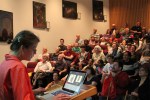
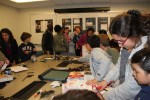
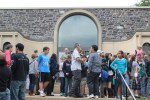
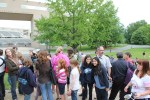
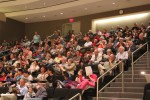
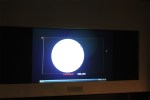
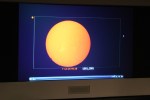
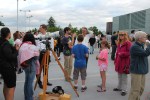
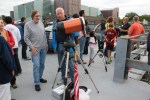
Transit of Venus Open House Draws Crowd

Pictures by Surabhi Agarwal

Posted in August 2012, Sidereal Times | Tagged , , | Leave a comment

Snippets

compiled by Bryan Hubbard

NASA X-ray concept inspired from a roll of Scotch® tape
Published: Thursday, July 26, 2012 – 18:03 in Astronomy & Space

The inspiration behind NASA scientist Maxim Markevitch’s quest to build a highly specialized X-ray mirror using a never-before-tried technique comes from an unusual source: a roll of Scotch® tape. Markevitch and a team of X-ray optics experts at NASA’s Goddard Space Flight Center in Greenbelt, Md., have begun investigating the feasibility of fashioning a low-cost mirror from plastic tape and tightly rolling it like the sticky adhesive commonly found in most homes and offices.

“I remember looking at a roll of Scotch tape and thinking, ‘was it possible to use the same design for capturing hard X-rays,'” Markevitch recalled. “I talked with a few people, and to my surprise, they didn’t see any principal reasons why it couldn’t be done.”

The complete article may be found at: X-ray concept from Scotch® tape

Astronomers report the earliest spiral galaxy ever seen, a shocking discovery
Published: Wednesday, July 18, 2012 – 13:03 in Astronomy & Space

Astronomers have witnessed for the first time a spiral galaxy in the early universe, billions of years before many other spiral galaxies formed. In findings reported July 19 in the journal Nature, the astronomers said they discovered it while using the Hubble Space Telescope to take pictures of about 300 very distant galaxies in the early universe and to study their properties. This distant spiral galaxy is being observed as it existed roughly three billion years after the Big Bang, and light from this part of the universe has been traveling to Earth for about 10.7 billion years. “As you go back in time to the early universe, galaxies look really strange, clumpy and irregular, not symmetric,” said Alice Shapley, a UCLA associate professor of physics and astronomy, and co-author of the study. “The vast majority of old galaxies look like train wrecks. Our first thought was, why is this one so different, and so beautiful?”

For the full story go to – Earliest spiral galaxy

The electric atmosphere: Plasma is next NASA science target
Published: Published: Tuesday, July 17, 2012 – 18:03 in Astronomy & Space

Our day-to-day lives exist in what physicists would call an electrically neutral environment. Desks, books, chairs and bodies don’t generally carry electricity and they don’t stick to magnets. But life on Earth is substantially different from, well, almost everywhere else. Beyond Earth’s protective atmosphere and extending all the way through interplanetary space, electrified particles dominate the scene. Indeed, 99% of the universe is made of this electrified gas, known as plasma. Two giant donuts of this plasma surround Earth, trapped within a region known as the Van Allen Radiation Belts. The belts lie close to Earth, sandwiched between satellites in geostationary orbit above and satellites in low Earth orbit (LEO) are generally below the belts. A new NASA mission called the Radiation Belt Storm Probes (RBSP), due to launch in August 2012, will improve our understanding of what makes plasma move in and out of these electrified belts wrapped around our planet.

The complete article may be found at: The electric atmosphere

Astronomers discover Houdini-like vanishing act in space
Published: Thursday, July 5, 2012 – 16:05 in Astronomy & Space

Astronomers report a baffling discovery never seen before: An extraordinary amount of dust around a nearby star has mysteriously disappeared. “It’s like the classic magician’s trick — now you see it, now you don’t,” said Carl Melis, a postdoctoral scholar at UC San Diego and lead author of the research. “Only in this case, we’re talking about enough dust to fill an inner solar system, and it really is gone!”

“It’s as if the rings around Saturn had disappeared,” said co-author Benjamin Zuckerman, a UCLA professor of physics and astronomy. “This is even more shocking because the dusty disc of rocky debris was bigger and much more massive than Saturn’s rings. The disc around this star, if it were in our solar system, would have extended from the sun halfway out to Earth, near the orbit of Mercury.”

For the full story go to – Vanishing act in space

New instrument sifts through starlight to reveal new worlds
Published: Thursday, July 5, 2012 – 17:03 in Astronomy & Space

An advanced telescope imaging system that started taking data last month is the first of its kind capable of spotting planets orbiting suns outside of our solar system. The collaborative set of high-tech instrumentation and software, called Project 1640, is now operating on the Hale telescope at the Palomar Observatory in California after more than six years of development by researchers and engineers at the American Museum of Natural History, the California Institute of Technology, and the Jet Propulsion Laboratory (JPL). The project’s first images demonstrating a new technique that creates extremely precise “dark holes” around stars of interest were presented July 5 at the International Society for Optics and Photonics (SPIE) Astronomical Telescopes and Instrumentation meeting in Amsterdam by Ben R. Oppenheimer, a curator in the Museum’s Department of Astrophysics and principal investigator for Project 1640.

For the full story go to – New instrument reveals new worlds

Posted in August 2012, Sidereal Times | Tagged , , , | Leave a comment

From the Director

Ludovico D’Angelo, Director

Thank you for your support throughout the AAAP season this year. At our last meeting, you voted on the new Board of Directors for the coming season starting in September. I hope to have at least one Board meeting between now and September. Your new Board is Ludy D’Angelo (Director), Jeff Bernardis (Assistant Director), Kate Otto (Program Chair), Michael Mitrano (Treasurer), and Michael Wright (Secretary). If you have ideas for guest speakers for our next season, please direct them to Kate (kathleen.otto@verizon.net), I’m sure she will appreciate it.

The last Transit of Venus in our lifetimes will occur on June 5, 2012. The AAAP Board has decided to participate with the Princeton University Astrophysics department in providing telescopes to view the transit. There will be events starting at 4:00 p.m. at Peyton Hall. We will move to the E-Quad parking garage for the start of the transit, and then back to Peyton Hall to view a live feed for the rest of the transit. If it is raining or cloudy, we will just see the live feed in Peyton Hall. You can also see the live feed on your computers at NASA’s Transit of Venus webcast.

Did the public observatory nights set a record? Since we opened the Simpson Observatory on April 6th, 7 out of 8 Friday nights, have been clear enough for public viewing. Is this a new record? Given this is New Jersey, you bet! The crowd size has varied because of new access procedures, but observing has been very successful. I asked the WC superintendent for an update on Brickyard Road, and he indicated that those plans are going forward with new stone being put down. The road will be repaved soon. The condition of the bridge still needs to be reviewed.

Recently, we received generous donations of equipment to the club. Former director and past member Richard Peery donated all his telescopes. They include an 8-inch Orion Dobsonian, a Coronado PST (Personal Solar Telescope), and an old Celestron 8” SCT with wedge and stand. He also added several astronomy books to our library. We also received a donation of a Meade Series 5000, 40 mm, 68 degree FOV eyepiece from AAAP member Wilber Stewart.

Please visit our new Facebook page.

Our next and last meeting for the season will be at the State Planetarium in Trenton, hosted by our own member Bill Murray. That will start at 8:00 p.m. on June 12th. Hope all of you can come see the show!

Posted in June 2012, Sidereal Times | Tagged , | Leave a comment